
Dialing in the perfect grow environment in a 2×2 tent means every inch of canopy space matters. A light that hits the wrong footprint leaves dark corners or burns the center, wasting the precious real estate you carefully curated.
I’m Min — the co-founder and writer behind Gadgets Feed. I’ve spent countless hours cross-referencing PPFD maps, actual wattage draws, and real customer performance data to separate the spec-sheet fiction from the genuine canopy coverage for this specific form factor.
After comparing seven of the most competitive panel-and-bar configurations on the market, I’ve found the models that genuinely deliver uniform, full-cycle light in that space. This guide covers everything you need to confidently pick the best 2×2 grow light for your specific setup and budget.
How To Choose The Best 2×2 Grow Light
Choosing a light for a 2×2 canopy is about precision, not brute force. A fixture that throws 400W into that space will cook plants and waste electricity, while a weak 60W panel leaves you with stretched, lanky growth. You need the right wattage, spectrum, and physical footprint to maximize that 4-square-foot area.
Actual Wattage vs. Claimed Wattage
Many budget lights advertise a “1500W equivalent” that is meaningless. What matters is the power draw from the wall in watts. For a 2×2 tent, the sweet spot for dense full-cycle growth (seedling to flower) is between 100W and 150W of actual draw from high-efficiency LEDs. Anything below 60W is suitable only for seedlings or low-light plants like pothos.
PPFD Uniformity & Footprint
PPFD (Photosynthetic Photon Flux Density) tells you how many usable photons hit each square inch. A light with a high center reading but steep drop-off at the edges creates a hotspot. Look for models that publish a 2×2 PPFD map showing less than 20% deviation from center to edge. Diode layout—whether concentrated in the middle or spread across the board—directly controls this.
Spectrum & Controllability
A full spectrum (white 3000K-5000K plus red 660nm and IR 730nm) supports the entire growth cycle without switching bulbs. Being able to dim the intensity from 0-100% lets you dial in the perfect level for each stage without raising or lowering the fixture. Smart-app control adds convenience but isn’t strictly necessary—a simple knob works fine for a single tent.
Quick Comparison
On smaller screens, swipe sideways to see the full table.
| Model | Category | Best For | Key Spec | Amazon |
|---|---|---|---|---|
| VIPARSPECTRA XS1500 Pro | Premium | Optical lens uniformity | 150W draw, 120° beam angle | Amazon |
| Spider Farmer G1500 | Premium | Smart app control | 150W draw, 2.85 µmol/J PPE | Amazon |
| AC Infinity IONBEAM S16 | Mid-Range | Supplemental inter-canopy lighting | Samsung LM301H EVO diodes | Amazon |
| MARS HYDRO TS1000 | Mid-Range | Patented reflector efficiency | 150W draw, 120° reflector | Amazon |
| Spider Farmer SF1000 | Mid-Range | Fanless silent operation | 100W draw, 2.5 µmol/J PPE | Amazon |
| RDJ Bouns 120W | Value | Highest bare-minimum wattage | 120W draw, SANAN 3030 chips | Amazon |
| MetryGrow 60W | Budget | App-controlled freestanding setup | 60W draw, 2×2 ft coverage | Amazon |
In‑Depth Reviews
1. VIPARSPECTRA XS1500 Pro

The XS1500 Pro uses optical lenses over its Samsung-style diodes to focus light into a tight, uniformly distributed cone, reducing the light loss that plagues flat-panel boards. Real-world reviews report PAR readings of 747 µmol/m²/s at 13 inches and 50% power, putting this light comfortably into the high-intensity territory needed for dense flowering in a 2×2 space.
Its 150W draw matches the top contenders on this list, but the lens design delivers a more even PPFD map from corner to corner, which prevents the “hot center, dim edges” problem common with cheaper boards. The dimmer knob and daisy-chain capability (up to 20 units) make scaling to a larger room seamless, though the fixture itself weighs a substantial 5.6 lbs.
Reviewers growing hot peppers and succulents both report strong results after adjusting intensity, indicating the spectrum is genuinely full-cycle and the output is controllable enough to avoid light burn on sensitive starts. The lack of an on/off switch means you will need a timer to cut power fully, a minor trade-off for the performance.
Why it’s great
- Optical lenses produce the most uniform PPFD in this roundup
- Strong PAR output suitable for full-cycle flowering
- Daisy-chain supports up to 20 lights for expanding setups
Good to know
- No physical on/off switch requires an external timer
- Heavier than some competing 150W panels
2. Spider Farmer G1500
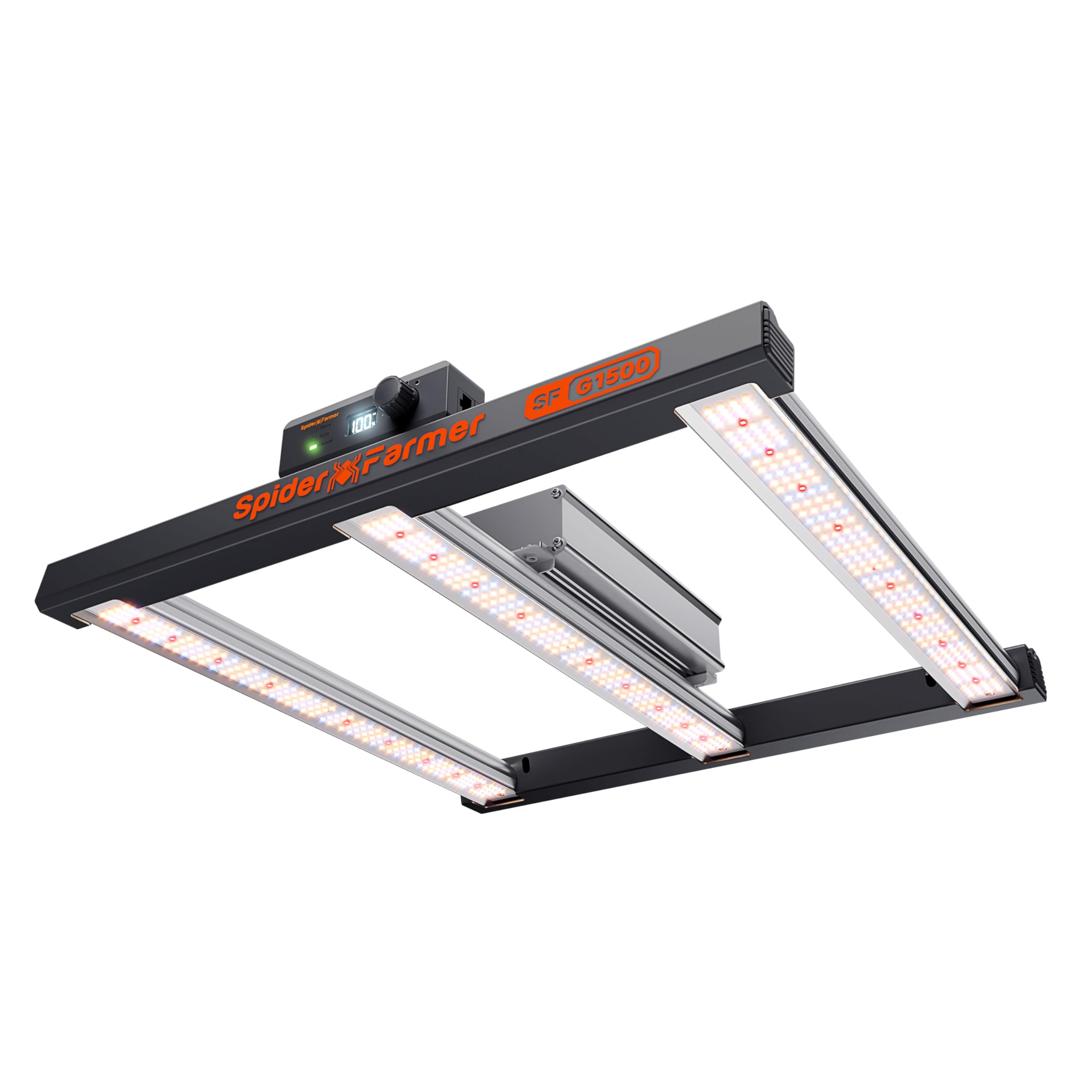
The G1500 shifts from the square-panel design of the SF1000 to an elongated bar-style layout that throws a more even footprint across a 2×2 space while drawing a full 150W. Its Bridgelux diodes achieve a solid 2.85 µmol/J PPE, which means less energy wasted as heat and more photons hitting the canopy.
The standout feature here is the Spider Farmer app (iOS/Android), which allows you to program sunrise/sunset simulations, set custom schedules, and dim from anywhere. That level of control is rare at this price point and eliminates the need to reach into the tent to twist a knob. The built-in digital display on the driver shows the exact dimming level, removing guesswork.
Customer feedback notes the included hanging hooks may not fit every tent pole diameter, so zip ties might be needed depending on your frame. The 5-year warranty with a US-based service center provides peace of mind that the app-connected hardware is backed up, and users consistently praise its cool-running operation and brightness at 20% power.
Why it’s great
- Full app control with sunrise/sunset scheduling
- Bar-style design delivers excellent edge uniformity
- 5-year warranty with local US service center
Good to know
- Included hanging hooks may not fit all tent poles
- Setup instructions could be more detailed
3. AC Infinity IONBEAM S16

The IONBEAM S16 is not a primary 2×2 light—it is a set of four 16-inch LED bars designed for inter-canopy or supplemental use to fill shadow zones that overhead panels miss. The Samsung LM301H EVO diodes rate at 3.14 µmol/J PPE, which is the highest efficiency in this entire selection, though the total output is only 3000 lumens across all four bars.
Magnetic mounting onto a tent frame or included steel bars makes attachment tool-free, and the digital Controller 77 (included) offers ten intensity levels plus a daily timer with sunrise/sunset ramp. This is the ideal companion to a primary overhead panel if you want to push lower bud sites or widen coverage in a 2×4 tent.
Users confirm the build quality is excellent, with solid aluminum housings and strong magnets. The main complaint is that the interconnecting cables are short, requiring purchased extensions to separate the bars across a wider canopy, and the unit price sits higher than many full-panel options.
Why it’s great
- Highest PPE (3.14 µmol/J) using Samsung LM301H EVO chips
- Magnetic mounting for quick, tool-free setup
- Separate digital controller with programmable timer
Good to know
- Supplemental only—not a standalone 2×2 light
- Short interconnect cables may need extensions
4. MARS HYDRO TS1000

The TS1000 differentiates itself with a patented white reflector hood that increases light utilization by 25% compared to a bare-board design, bouncing stray photons back onto the canopy instead of letting them escape. The diode layout is intentionally denser in the center to compensate for the natural fall-off, and the 120° beam angle covers the full 2×2 tent without wasting light on the walls.
At 150W draw and 0.63 amps, this is one of the more power-efficient options that still delivers the punch needed for flowering. The fanless design keeps noise at zero, and the external dimmer knob allows adjustment from 0-100% without introducing electrical noise into the tent. The daisy-chain feature supports up to 50 lights, which is overkill for a single 2×2 but useful for scaling.
Reviews consistently report dense, frosty buds from this unit, with users noting that it runs warmer to the touch than some competitors because the reflector traps a small portion of heat. The thin metal reflector can feel flimsy during assembly, but once mounted, the overall build holds up well through multiple grow cycles.
Why it’s great
- Patented reflector boosts light utilization by 25%
- Fanless and silent operation
- Daisy-chain capable up to 50 units
Good to know
- Runs slightly warmer than board-style lights
- Thin metal reflector feels fragile during setup
5. Spider Farmer SF1000
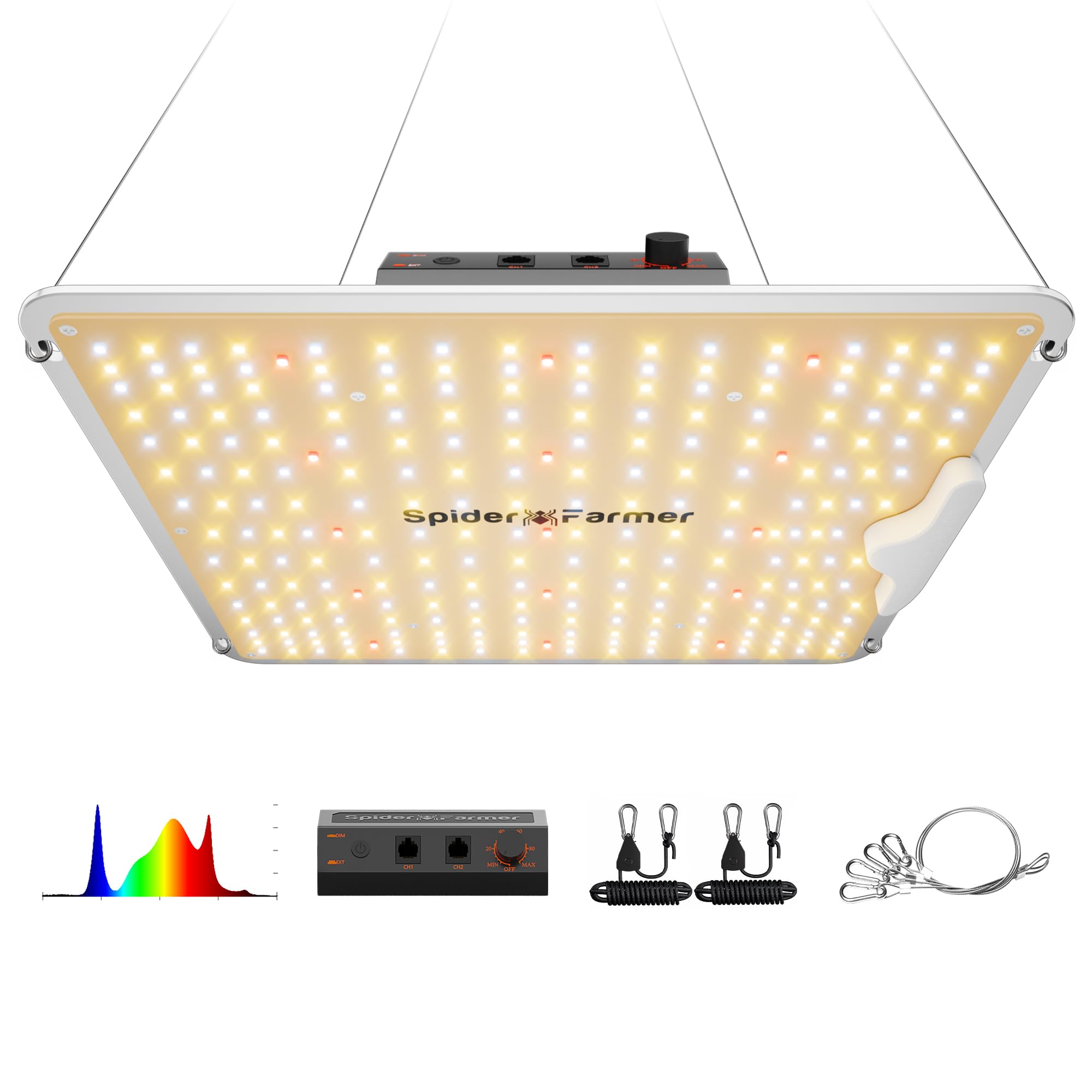
The SF1000 is the original quantum-board-style light that built Spider Farmer’s reputation, and it remains a solid choice for low-profile 2×2 tents where 100W is sufficient for veg and moderate flowering. The 2026 revision gathers the diodes toward the edge, which improves PPFD uniformity significantly compared to older center-heavy layouts, and the 2.5 µmol/J PPE is respectable for this wattage class.
The fanless, silent design means zero mechanical noise, and the thick aluminum heatsink dissipates heat effectively enough that the light stays cool to the touch even after 18-hour photoperiods. It includes 660nm red and 730nm IR diodes specifically to boost bloom response, making it a true full-cycle unit despite the lower total wattage.
Users note that the SF1000 feels almost too strong for a 2×4 tent when used alone, which is actually a compliment to its focused coverage. The 5-year warranty and responsive US-based customer service (frequently name-checked in reviews for hassle-free RMA) add long-term value, though the dimming knob lacks a digital readout, making precise repeatable settings harder.
Why it’s great
- Fanless, silent operation with excellent heat management
- Edge-gathered diode layout improves PPFD uniformity
- 5-year warranty with strong customer service reputation
Good to know
- 100W max—limited for heavy flowering in a packed 2×2
- Dimming knob lacks digital percentage readout
6. RDJ Bouns 120W

The RDJ Bouns 120W cuts straight to the chase: it provides 120W of actual power using SANAN 3030 chips at a price point that undercuts many 100W competitors. The three adjustable panel segments allow you to angle the wings inward or outward to shape the footprint, which is a rare mechanical feature at this level and helps fit the light inside differently sized tents.
Including UV and IR diodes in the spectrum stack means the light covers the full photosynthetic range without needing supplemental bars. The 0-100% dimmer supports both PWM and 0-10V control, and the RJ45 daisy-chain port lets you gang multiple units without a separate master controller. The 5-year warranty is also present at this price tier, though service is handled by RDJ directly rather than a local center.
The build quality is solid for the cost, and the foldable body makes storage easy. For the grower on a tight budget who needs maximum watts per dollar, this is the most straightforward value play in the 2×2 category.
Why it’s great
- 120W actual draw at a budget-friendly price point
- Adjustable panel wings for customizing light shape
- Includes UV and IR diodes for full spectrum
Good to know
- Center hotspot is pronounced; edge uniformity is weaker
- Bar spacing is tight, limiting lateral coverage
7. MetryGrow 60W Smart Grow Light
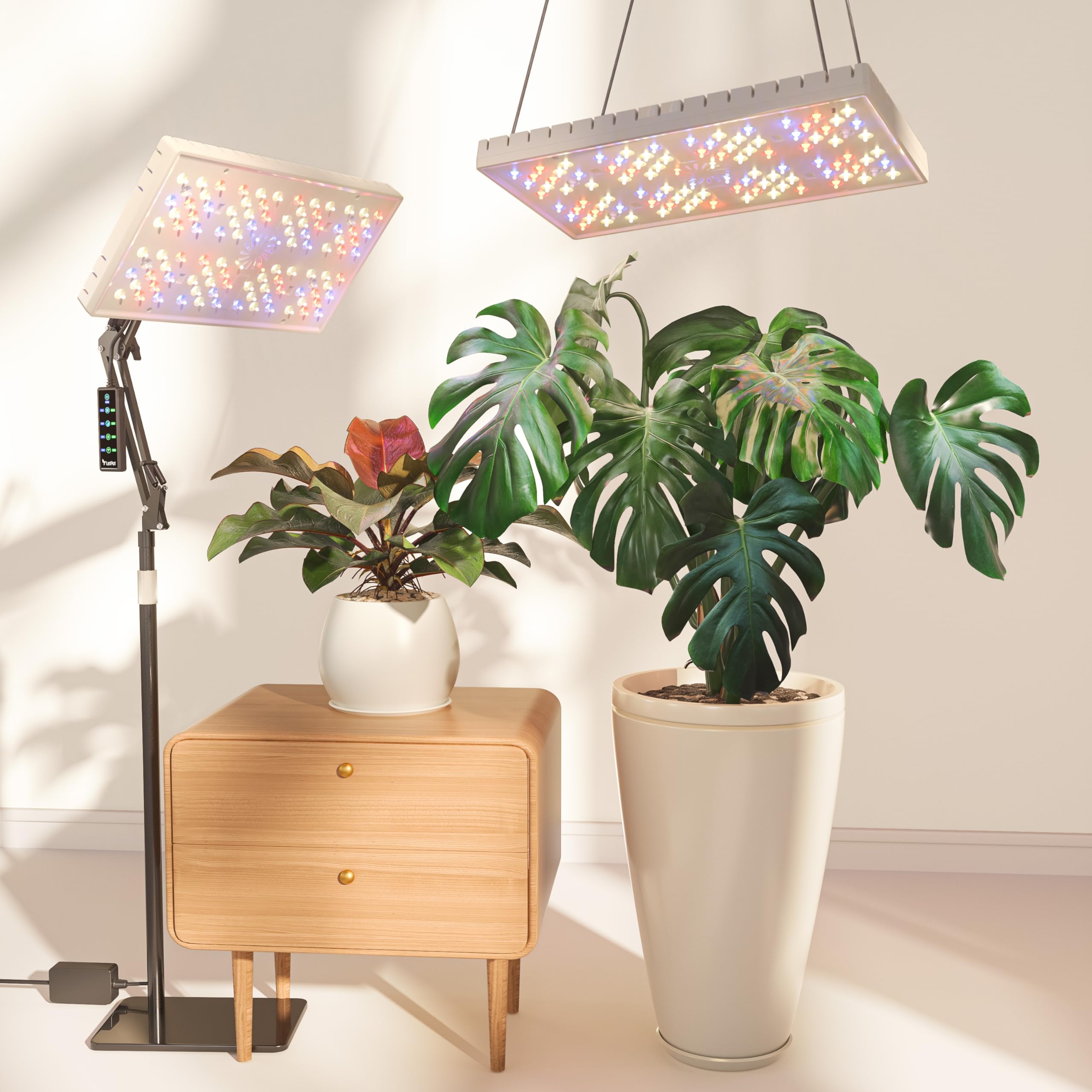
The MetryGrow 60W is designed for the non-tent grower—someone placing the light on a desk, shelf, or open plant stand. The freestanding base with adjustable steel poles (4 to 72 inches) and a 270° folding, 360° rotatable head gives it placement versatility that no overhead hanging panel can match.
Its 60W actual draw and 8 brightness levels produce a genuine 2×2 ft coverage area, making it sufficient for seedlings, herbs, leafy greens, and low-to-moderate light ornamental plants. The aluminum honeycomb heatsink keeps the unit whisper-quiet and notably cooler than similarly priced clip-on lights. The MetryGrow app offers timer scheduling and sunrise/sunset simulation, though some users report the app interface is less intuitive than the hardware itself.
The main limitation is wattage—60W is not enough to flower dense, heavy-yielding plants in a 2×2 space. Reviews confirm the stand can tip if the arm is fully extended with a heavy plant pot, but for seed starting and vegetative maintenance, this is one of the most thoughtfully designed standalone fixtures available.
Why it’s great
- Freestanding with adjustable height and rotation
- Excellent heat dissipation via aluminum honeycomb design
- Wi-Fi control with sunrise/sunset scheduling
Good to know
- 60W is only suitable for seedlings, veg, and low-light plants
- Stand can tip if the arm is overextended
FAQ
How many watts do I really need for a 2×2 tent?
Can I use a 100W light in a 2×2 for flowering?
What hanging height works best for a 2×2 grow light?
Final Thoughts: The Verdict
For most users, the 2×2 grow light winner is the VIPARSPECTRA XS1500 Pro because its optical lenses deliver the best PPFD uniformity in the class, ensuring every plant in the tent receives equal light intensity without rotating. If you want smart control, grab the Spider Farmer G1500 and take advantage of the app-based sunrise/sunset scheduling. And for the strictest budget, nothing beats the raw watts-per-dollar of the RDJ Bouns 120W for a focused 2×2.