
Our readers keep the lights on and my morning glass full of iced black tea. As an Amazon Associate, I earn from qualifying purchases.
Specs are compiled from manufacturer listings and verified buyer reviews and can change over time — please confirm the key details on the product page before buying.
If you weld for a living, the wrong lens means two things: a puddle you can’t read, and a face that burns at the end of the day. A good 2X4 welding lens fixes both. It darkens fast enough to block the arc before your eyes register the strike, then stays clear enough to read the toes, tie-ins, and bevel without lifting your hood. This guide covers eight lenses that actually fit standard 2-by-4¼-inch hoods, from budget stick-and-MIG glass to premium adjustable filters, so you can match the lens to the work you do every day.
I’m Min — the founder and writer behind Gadgets Feed. This guide is built by comparing the manufacturers’ published specifications and the patterns across verified customer reviews, so you get each pick’s real strengths and trade-offs instead of marketing spin.
Some lenses darken in half a millisecond and others in a hundredth of that, and the shade number stamped on the box doesn’t always match what your eye sees through the glass. What follows sorts the eight strongest 2×4 welding lens options by what actually matters at the bench.
Our Picks at a Glance


How To Choose The Best 2X4 Welding Lens
Three specs decide whether a lens feels like an upgrade or a regret: switching speed, shade, and whether it physically drops into your hood. The tint, coating, and solar panel matter, but they’re supporting cast. Here’s what to check before you order.
Switching speed and the flash you don’t feel until later
Switching speed is how long the glass takes to go dark after the arc strikes, measured in milliseconds (thousandths of a second). The fastest lenses here react in 0.01 ms, essentially instant. A slower lens leaves a sliver of bright arc visible on every strike, and that sliver is what tires your eyes across a shift. If you weld pipe, do a lot of starts and restarts, or work in tight spots where you can’t always see the arc coming, this is the spec to check first.
Fixed shade versus adjustable shade
A fixed-shade lens holds one darkness level — often shade 10 — and you pick a different lens for different jobs. An adjustable lens lets you dial anywhere across a range, so the same filter handles thin sheet and heavy plate. Fixed is simpler and has fewer parts to fail. Adjustable is the better long-term buy if you switch processes or materials through the week, though it adds settings you’ll need to dial in by feel.
Fitting a pancake or sugar scoop hood
Standard 2-by-4¼-inch hoods take a lens roughly 2 inches tall and 4¼ inches wide, and that’s the footprint every pick in this guide uses. Pancake and sugar scoop hoods have less internal room, so a slim profile — some lenses here trim down to 0.19 inches thick — slides in where a bulky filter won’t. Measure the slot in your hood before ordering if it’s an older or off-brand shell.
Quick Comparison
| Model | Best For | Shade | Switching Speed | Weight | Amazon |
|---|---|---|---|---|---|
| ArcOne S240-11★ Best Overall | Stick, TIG and MIG at the bench | Shade 11 | 0.5 ms | 2.88 oz | Amazon |
| Tefuawe Low Amps 5A TIGTop TIG Pick | Low-amp TIG on thin stock | Shade 10 | — | 32 g | Amazon |
| ArcOne S240-10Precision Pick | General shop welding | Shade 10 | 0.5 ms | 0.09 kg | Amazon |
| Ridge Products King Single | Clarity-first stick and MIG | Shade 10 | — | 2.2 oz | Amazon |
| Tefuawe True Color Blue | All-day TIG and MIG | Shade 10 | — | 35 g | Amazon |
| Preruner Flex Series Gold | Switching processes mid-day | Shade 5-13 | 0.01 ms | 3.84 oz | Amazon |
| Ridge Products King 1.0 | Adjustable shade, high-amp work | Shade 5-13 | — | 2.2 oz | Amazon |
| Preruner Core Series Red | Budget pancake-hood builds | Shade 10 | 0.01 ms | 3.2 oz | Amazon |
In‑Depth Reviews
1. ArcOne S240-11 Horizontal Single Auto-Darkening Filter
Our pick — over 4.5★ from 400+ verified ratings; the strongest balance of quality and price.
The pipe welder’s filter — a shade 11 that holds its color through stick, TIG, and MIG without throwing a flash.
Five and a quarter square inches of active viewing area (the actual window you look through, not the outer frame size) is a lot of glass for a 2-by-4¼-inch hood. Two independent sensors watch for the arc from separate angles, so if one is blocked by a piece of plate, the other still catches the strike. The 0.5-millisecond switching speed is slower on paper than the 0.01 ms adjustable lenses further down this list, but ArcOne compensates with sensor redundancy, and owners consistently report no flashes when trailing off the end of a weld. The dark-to-light delay is 0.2 seconds, which keeps the glass dark just long enough that the yellow afterglow doesn’t sting when you pull away.
This lens runs stick, TIG, and MIG between 50 and 300 amps, which covers most shop work short of heavy submerged arc. It’s also water and dust resistant, so a dusty fab shop or a damp job site won’t kill it. The weight is 2.88 ounces — lighter than the Preruner Flex Series Gold’s 3.84 ounces, which matters if you’re wearing a pancake hood that already sits tight on your face.
The trade-off is that the shade 11 marking doesn’t read as dark as a true 11 in practice. Owners compare it to the dark end of a shade 9, and the flip side is the view stays brighter and sharper than a genuine 11 would. Users who need deep darkness for heavy high-amp work may want to step up to a fixed higher shade.
What owners rave about
- Two independent sensors so the arc gets caught even when one eye-line is blocked
- 5.25 square inches of active viewing area — genuinely wide for a 2×4 hood
- Water and dust resistant, which holds up in real shop conditions
- 0.2-second dark-to-light delay kills the afterglow sting
- Quality and clarity are the two most-discussed strengths by a wide margin
Where it asks something of you
- Shade 11 reads closer to a dark 9 in practice, so heavy high-amp work may want more darkness
- 0.5 ms switching is slower than the 0.01 ms adjustable lenses in this guide
- Owners doing a lot of trailing-off welds do occasionally report flashes at the end of a pass
Reach for it if: you run stick, TIG, and MIG through the week and want one lens that handles all three without blinking.
Look past it if: you spend most of your day in high-amp heavy plate and need a true dark shade.
2. Tefuawe 2×4 1/4 Auto Darkening Welding Lens, Low Amps 5A TIG
Low-amp TIG is where most lenses start strobing — this one holds steady down to 5 amps.
At 0.19 inches thick, this lens is the thinnest pick in the guide, and on a pancake or sugar scoop hood that slimness is the difference between a lens that slots in clean and one that fights the frame. The headline spec is the 5-amp minimum, which means the glass still reacts on delicate TIG work that a fixed shade 10 would leave you waiting on. Standard fixed lenses are designed for higher current, and on thin stainless or small bracelets they can flicker or stay stubbornly light. Owners weld Schedule 10 pipe up to 55 amps with no flicker and report the glass catching reliably at bevel angles.
The build uses a high-temperature-resistant housing that resists the heat deformation that shortens the life of cheaper filters. Tefuawe pairs that with an exclusive optics system that tracks the arc across different processes and workplaces, plus a true color view with a light state of 2.5 (a brighter resting tint than the 3.0 most fixed lenses race), so you can see your work before the arc fires and flip the hood less often. Buyers who compared it side-by-side with Blue Demon, Pipeliners, and an Apex 8K admitted better lenses exist at the high end, but called this one unbeatable for what it costs.
The realistic catch: the fixed shade 10 capsule can’t be dialed back if you’re welding thick material at high amps and want more darkness, and one owner noted that on 7018 with strong backlight they had to stay ahead of the puddle to avoid glare. That’s a working-style complaint, not a defect. Overall, this is the lens for a welder who spends most of their day in TIG and wants it to just work — 4.6 stars across 280+ ratings, with lens quality leading the praise.
The 5A trick: Most fixed-shade lenses stub their toe below 20 amps. This one documents a 5-amp minimum and owners back it — TIG work on thin stainless and small-diameter parts comes out steady where budget glass flickers.
Who it’s really for: TIG-first welders running pipe, sanitary work, or fine fabrication. If you also do heavy 7018 at 200 amps, the fixed shade 10 is the ceiling — that’s your reason to look at an adjustable lens instead.
Locked in for: the TIG welder who runs low-amp work daily and needs the glass to catch every start.
Not the one for: welders who switch from thin TIG to thick high-amp plate several times a shift.
3. ArcOne S240-10 Horizontal Single Auto-Darkening Filter
A shade 10 with the same wide viewing window and sensor redundancy as its shade 11 sibling, tuned for general shop work.
If the shade 11 S240 above felt darker than you need, this is the same lens at shade 10 — 5.25 square inches of active area, two independent sensors, 0.5-millisecond switching, 0.2-second dark-to-light delay, and water-and-dust resistance, all confirmed in the spec sheet. The difference is purely the resting shade. Experienced welders who own a Speedglas 9100xx, an ArcOne Tradesman, and Jackson TrueSight glass put these optics second only to the Speedglas and said the shade 10 is brighter than a Tradesman 10.5, while still giving a perfectly readable puddle.
The view is described as High Definition, and that’s the practical reason this lens keeps coming up. The amber tint makes the puddle easy to read without the yellow-green cast that traditional lenses leave. Darkening is instant on arc strike, and the glass clears in roughly a second when you pull away — a touch slower than the fastest adjustable lens in this guide, but not enough to slow you down. Grinding sparks do trigger a flicker between dark and light, so if you grind a lot with the hood down, that’s worth knowing.
Durability is where the honest picture sits. Weigh that against the lens quality being overwhelmingly the most-praised aspect, with clarity not far behind, and this is a solid long-haul filter rather than a lifetime piece. 4.5 stars across 600+ ratings — a proven track record for daily stick and MIG use.
Second-opinion endorsement: A career welder who’s run Speedglas, ArcOne, and Jackson glass rates these optics second only to the Speedglas flagship and calls this shade 10 brighter than a 10.5 Tradesman. That’s a strong signal for a filter in this price band.
Rebuy consideration: Most buyers report the lens still working sharp and clear a year in. A subset reports darker-than-expected degradation after heavy use — you’re buying a great lens, not a permanent one.
Great fit for: the welder who wants proven manufacturer optics and a bright, readable shade 10.
Consider skipping if: you grind extensively with the hood down and don’t want the dark-light flicker from sparks.
4. Ridge Products Gold Shade 10 Auto Darkening Welding Lens, Cool Blue View

A shade 10 with tightly-controlled alignment so you never see a double image through the glass.
Weighing in at 2.2 ounces, this is one of the lightest lenses in this round-up — the same weight as its adjustable sibling below and lighter than every filter in the budget tier. On a pancake hood that sits close to the face, low weight is the difference between a hood you forget you’re wearing and one you’re readjusting every five minutes. The Ridge pitch is precision: extremely tight tolerances and quality control, which the maker claims keeps the glass aligned so the view stays single, not doubled, across the whole weld path.
Ridge warns that these lenses aren’t recommended for TIG below 90 amps — at low amperage, the lens slowly loses battery charge and starts flashing. If your work is mostly low-amp TIG, you’d want Ridge’s King Single 2.0 lens instead. But if your day is stick and MIG, the shade 10 handles it comfortably. Owners describe the visibility as exceptionally crisp, with the puddle and wall breakdown easy to see at a glance — the phrase that keeps coming back is that this is one of the clearest lenses they’ve used.
The blue tint is polarizing. Some welders describe the view as spot-on for reading the puddle, while others find it too bright and prefer to run sunglasses underneath — and their practical advice is simply to step up a shade if you’re flash-sensitive. A handful of owners have run into auto-darkening issues where the glass needs a tap to trigger, and that’s the sort of thing worth buying from a source where you can pursue the warranty. The clear consensus, though, is a lens that improve your stick and MIG work — 4.4 stars across 150+ ratings.
What wins: That tightly-controlled alignment means the view doesn’t ghost or shift as you move the puddle — a real advantage on long beads and tight root passes.
Honest warning: TIG below 90 amps with this lens is a no. Ridge says so directly on the sold page — buy the King Single 2.0 instead if low-amp TIG is your trade.
Pick this one if: your work is stick and MIG and you want the lightest, sharpest shade 10 on your hood.
Step elsewhere if: you weld low-amp TIG under 90 amps regularly — Ridge itself points that buyer to a different model.
5. Tefuawe Auto Darkening Welding Lens, True Color Blue, Shade 10

The clarity-first blue-tint filter that TIG welders keep buying again — two included replacement cover lenses sweeten the deal.
Tefuawe ships this kit with two replacement outside cover lenses (the clear protective sheet that takes the spatter so your filter doesn’t have to), which is a real money-saver over time on any hood that runs hot. At 35 grams, the lens itself is one of the lightest in the guide. The engineering team behind it has worked in welding lenses and helmets since 1985, and the filter is produced to CE EN379 and ANSI Z87.1 standards. It’s also polarized, which the maker says helps correct for the light distortion that plain glass can introduce.
The shade is fixed at 10, and the true-color blue technology is the marquee feature. Welders describe the view as clean and true to the advertised blue — the puddle reads clearly without the greenish cast that older filter styles leave on the work. Owners who’ve been welding on this size hood for a long time call it the clearest they’ve seen through a shield, and one owner who dropped their hood from a high spot and broke the housing had been running the original lens for four years before that.
The two honest notes: shade 10 is fixed, so if you want to dial down for light sheet or up for heavy plate you’d need a different lens. And a subset of TIG welders report occasional flicker at low amperage — for those owners the flash tendency is a real ongoing annoyance. If your TIG is mid-to-high amp and your stick and MIG runs are long, this is among the most trusted fixed-shade 10s on the market — 4.3 stars across 500+ ratings.
Clarity champion: True-color blue view is what welders notice first — the puddle reads clean, without a greenish cast. The most-praised aspects here are clarity and quality, tied at the top.
Two lenses in the box: Replacement outside cover lenses are included, so the front of the filter stays protected without a separate purchase.
Straight to checkout for: welders who run mid-to-high amp TIG, stick, and MIG and want the clearest fixed shade 10 in their hood.
Pause before buying if: the flickering some TIG users report at low amps would get in your way — an adjustable lens sidesteps that entirely.
6. Preruner Flex Series Gold Shade 5-13 Auto Darkening Welding Lens
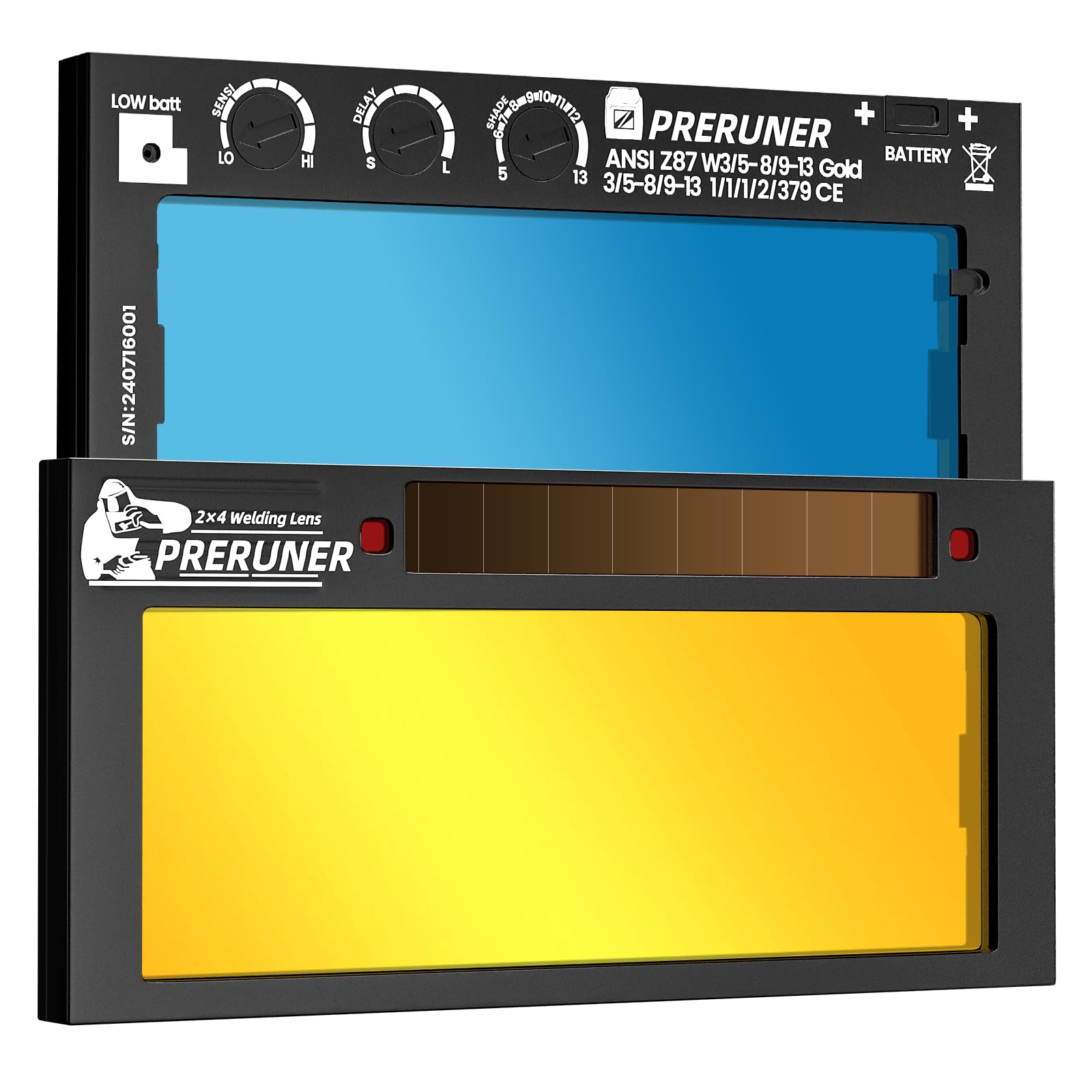
A shade 5-to-13 dial that follows you from thin sheet to heavy plate in the same shift, without swapping glass.
At 3.84 ounces this is the heaviest lens in the guide — noticeably weightier than the Ridge king lenses at 2.2 ounces and the ArcOne S240-11 at 2.88 ounces — which is the honest cost of the adjustable mechanism. What you trade for that weight: a full shade 5-13 range, sensitivity control that decides how bright the arc must be before the glass darkens, and delay control that sets how long the glass stays dark after the arc stops. One owner said their first attempt at the settings was trial and error, then found their dialed-in balance and stopped touching it.
Switching speed is the star attraction — the dual arc sensors react in 0.01 milliseconds, the fastest spec in this guide. On jobs where you strike the arc dozens of times an hour, that speed means you don’t see the arc at all before the shield goes dark. The gold coating produces a cool blue puddle view that owners describe as dramatically easier to read in fine detail than traditional green glass. Power comes from replaceable batteries with solar assist, so the cell isn’t the only source of darkening current.
The concern here is long-term reliability. Most owners mention quick, dependable switching for months or years, but a minority describe intermittent failures — one owner had the lens shut off mid-weld after two weeks, another had lenses that picked up scratches over time. Weigh those rare cases against the fact that the most-mentioned aspect is quality, followed by clarity and value. If you switch processes through the week, this is worth the heft. 4.2 stars across 290+ ratings.
The shade dial: Shade 5 for light sheet and crisp TIG, up to shade 13 for heavy high-amp plate — one lens, no swap, no counting on having the right shade in the truck.
Fastest in class: 0.01 ms switching is faster than the ArcOne S240’s 0.5 ms — the difference shows on high-rep tacking where you strike hundreds of arcs a shift.
Built for: the fabricator who runs thin sheet in the morning and heavy plate in the afternoon and doesn’t want to swap glass.
Think twice if: you want the lightest possible hood setup — at 3.84 oz, this is the heaviest lens here.
7. Ridge Products King 1.0 Shade 5-13 Adjustable Gold Auto Darkening Welding Lens
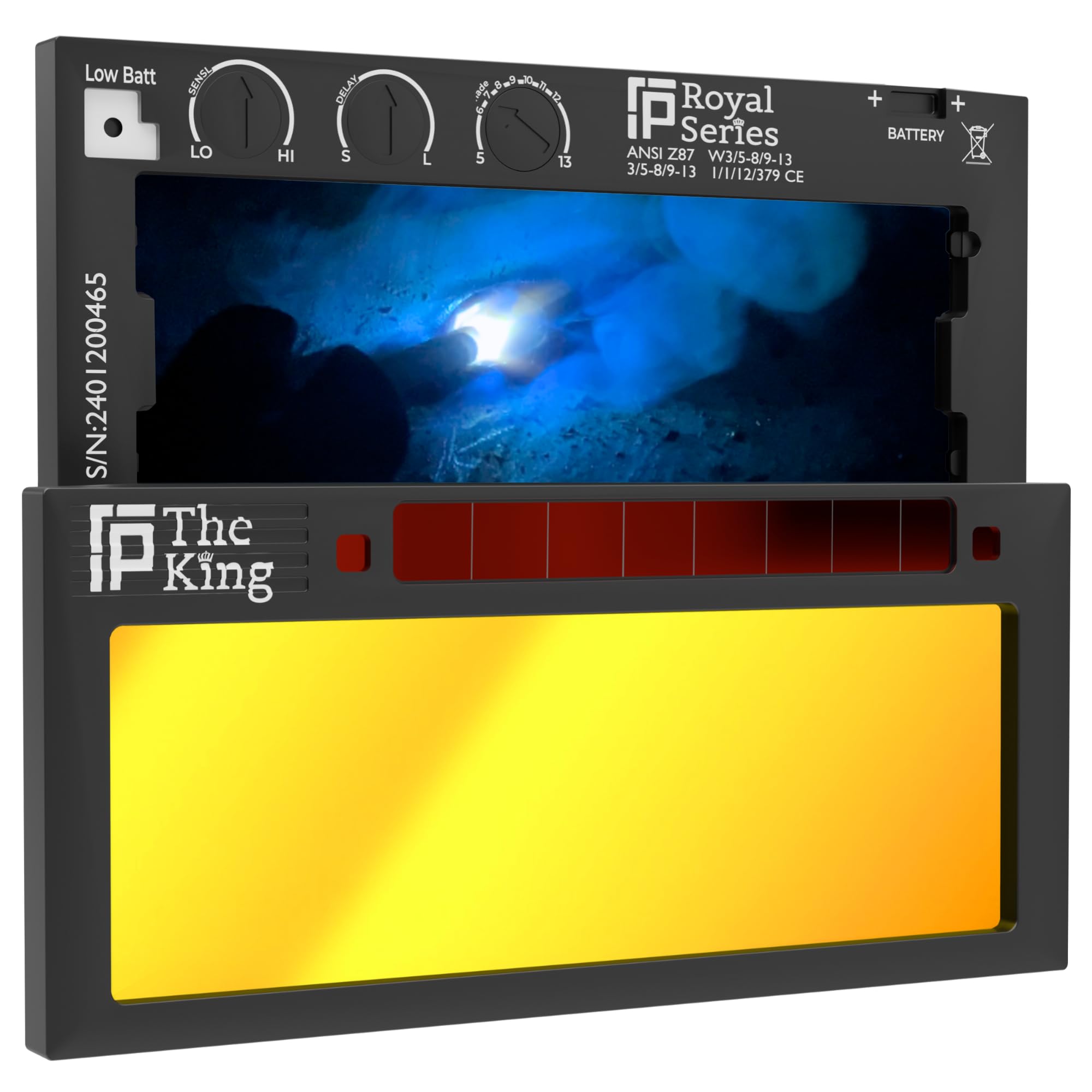
A shade 5-13 adjustable filter with tight-tolerance alignment, backed by a free replacement for up to a year.
At 2.2 ounces, this is a rare adjustable — most adjustable lenses add weight for the dial mechanism, yet this King 1.0 matches the fixed-shade King Single at the same 2.2 ounces. Ridge achieves that with an upgraded build using extremely tight tolerances and quality control, so the glass is aligned precisely, and the maker claims you’ll never see double through it. That alignment promise is backed by a free replacement for up to a year if anything goes wrong, which is meaningful on a lens whose movable parts could, in theory, work loose.
The adjustable range runs shade 5 to 13 in one filter, which is the widest coverage in this guide and lets you move from light sheet to heavy plate without buying additional glass. Ridge’s alignment claim holds up in the reviews — experienced welders report crisp, zero-distortion optics and see their puddle, toes, and tie-ins clearly across the range. Two product-specific CR1025 batteries are included. The solar panel charges the lens while you weld (Ridge notes the panel doesn’t charge from ambient sun alone), so the batteries are the fallback rather than the primary source.
Ridge is upfront about the TIG limitation: not recommended below 90 amps, because the lens will slowly lose battery and start flashing. The other practical concern is the sensor count — a minority of customers note arc flashes in tight positions where the arc is at the edge of the sensor’s field of view, and those owners are the ones most vocally asking Ridge for more sensors in future versions. If your work runs mid-amp and above, this is a top-shelf adjustable. 4.1 stars across 670+ ratings, with quality as the runaway most-mentioned aspect.
Where it earns its keep
- Shade 5-13 range in one lens — the widest coverage in this guide
- 2.2 oz — matches the fixed-shade King Single despite the adjustable mechanism
- Tight-tolerance build with a free replacement warranty for up to a year
- Two CR1025 batteries included, solar-assisted while welding
- Owner-described as one of the best lenses they’ve used, with clarity the second-most praised aspect
What to plan around
- Not recommended for TIG below 90 amps — the battery drains and the lens starts flashing
- No self-test button; the glass needs to be checked in sunlight, which several owners find inconvenient
- A minority of reviewers point out arc flashes in tight positions where the sensor can’t see the arc
Best paired with: mid-amp and heavy shop work where an adjustable shade and precise alignment are worth the mid-range outlay.
Ruled out for: dedicated low-amp TIG work under 90 amps — Ridge’s own warning puts that buyer on a different model.
8. Preruner Core Series Red Shade 10 Auto Darkening Welding Lens
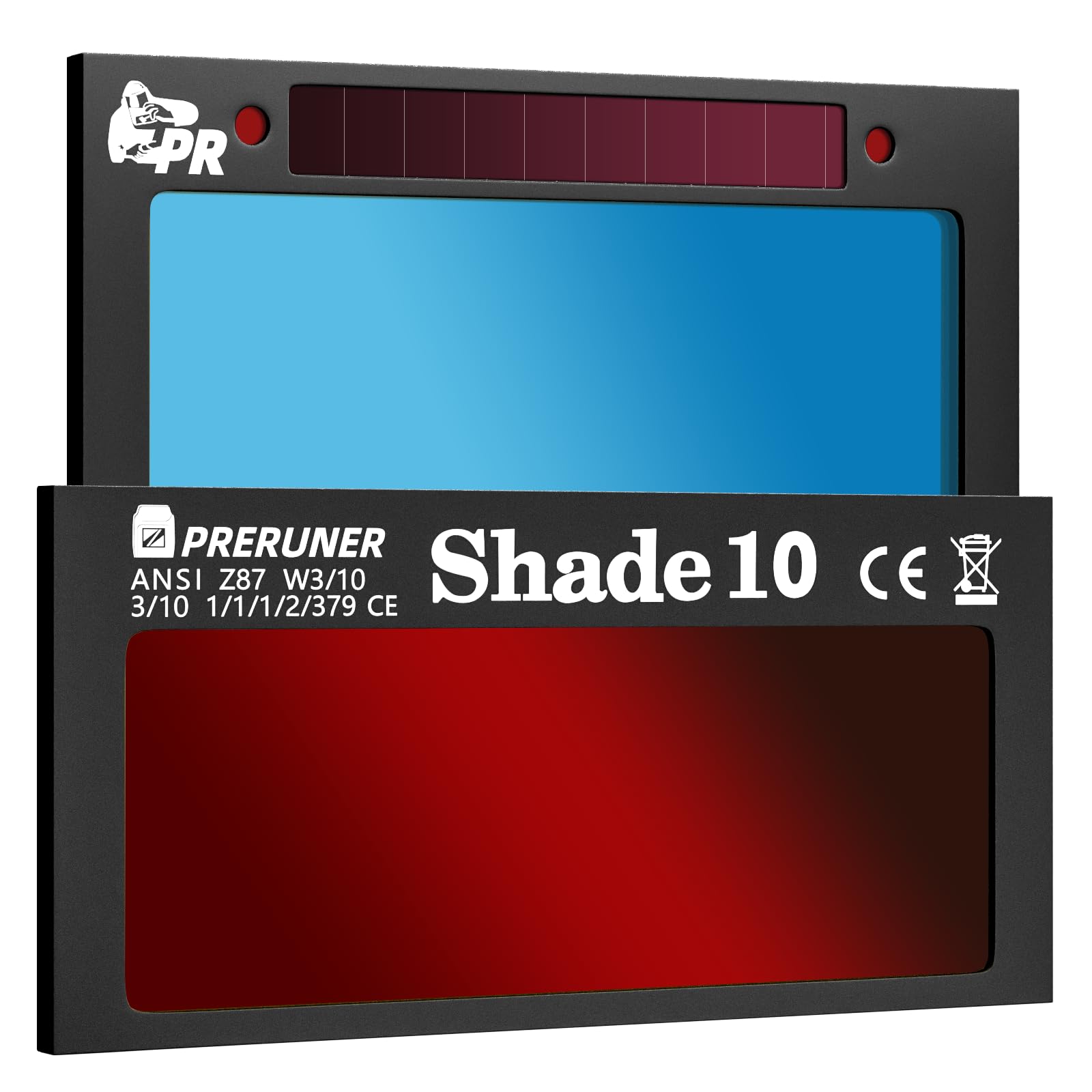
The slimmest lens here, made specifically for pancake and sugar scoop hoods that won’t take a fat filter.
At 0.2 inches thick and 3.2 ounces, this is the thinnest and second-lightest pick in the guide — designed to slide into the tight confines of a pancake or sugar scoop hood where bulkier retrofits won’t fit. If your hood is one of those shells, the Core Series is one of the few lenses built with that constraint in mind. The dual arc sensors react in 0.01 milliseconds (the same fast spec as the Preruner Flex Series above, and faster than the ArcOne S240’s 0.5 ms), and the solar-powered cell means no battery to swap.
The look is the standout personality feature. A red coating applied over the filter creates a teal-tinted view of the arc, and most owners say the color and visibility read clean and comfortable — the puddle stands out against the teal without the green cast that traditional glass throws. Frame is plastic but owners describe it as solid rather than flimsy, and the fit into standard 2-by-4¼-inch hoods is described as tight and precise. The shade is fixed at 10, so this is a stick-and-MIG filter rather than a switch-process unit.
The honest note is reliability. Most shoppers say dependable darkening for months of daily use, and the most-mentioned aspects are quality followed by reliability — both strongly positive — but a minority report the lens eventually fails to darken and throws arcs. Those owners’ feedback is specific and rare rather than a pattern, but if you’re buying for hard professional duty, the ArcOne and Ridge models above are the safer long-haul bets. For a pancake-hood build, a garage setup, or a backup lens in the truck, this is the best value in the guide — 4.0 stars across 180+ ratings.
Where it wins: The 0.2″ slim profile and 0.01 ms switching are a rare combination at the budget tier. For a tight pancake or sugar scoop hood, most lenses this thin don’t darken this fast.
Where it asks something of you: A minority of buyers report darkening failures after a month of daily use. If your welding is a rent check, buy from the more proven filters; if it’s a hobby or spare, this is excellent value.
Best for: pancake and sugar scoop hood builders, weekend welders, or anyone who wants a slimmest-fit lens as a truck backup.
Consider the alternatives above if: your welding is full-time, professional, or relies on the lens not failing mid-run.
Understanding the Specs
Switching Speed (Milliseconds)
Switching speed is how long the glass takes to darken after the arc strikes, measured in milliseconds — thousandths of a second. A lens rated at 0.5 ms needs half a thousandth of a second to react. A lens rated at 0.01 ms reacts fifty times faster than one rated at 0.5 ms. In practice, the fastest lenses leave you no visible sliver of arc on any strike, while a slower lens can show a sliver on every restrike. If you strike hundreds of arcs a shift, that sliver accumulates as eye strain.
Shade Number
Shade is the darkness rating of the filter while the arc is live. Higher numbers mean darker glass. A fixed shade 10 is the most common workhorse; a fixed shade 11 is darker; an adjustable range gives you both, typically from shade 5 (light, for low-amp TIG and light sheet) up to shade 13 (dark, for heavy high-amp plate). No shade number is universally right — an adjustable lens lets you match shade to the process and thickness you’re running, while a fixed lens locks you into one.
Active Viewing Area
Active viewing area is the actual window of glass you look through, measured in square inches. It is not the outer frame size — the same 2-by-4¼-inch housing can hold a wide active area or a much narrower one. A larger active area (like the 5.25 square inches on the ArcOne S240 series) gives you more surrounding view while you weld, so you can watch the wall, the toe, and the tie-in without repositioning your head.
Sensor Count and Arc Detection
Arc sensors are the eyes that watch for the strike. A lens with dual independent sensors has two viewing angles on the weld zone, so if one is blocked — by a piece of plate, a pipe, or your own forearm — the other still catches the arc. More sensors isn’t automatically better, but in tight positions where the arc blooms at the edge of your field of view, sensor placement matters more than the count on the box.
FAQ
Will a 2×4 welding lens fit my hood?
What shade should I use for MIG welding?
Is a fixed shade or adjustable shade lens better for TIG?
How long does an auto-darkening welding lens last?
Do I need a battery in an auto-darkening welding lens?
Why do I keep getting flashed at the end of my weld?
What does true color or blue-tint mean on these lenses?
Can I use one lens for stick, MIG, and TIG?
Does a 0.01 ms lens really make a difference over a 0.5 ms lens?
How much does a good 2×4 welding lens weigh, and does weight matter?
Final Thoughts: The Verdict
For most welders, the 2×4 welding lens winner is the ArcOne S240-11 because it handles stick, TIG, and MIG across 50 to 300 amps on one filter, with two independent sensors and 5.25 square inches of active viewing area. It’s the well-established name in this round-up and the safest bet for a welder who wants to buy once. If low-amp TIG is your trade, grab the Tefuawe Low Amps 5A TIG — its 5-amp minimum and 0.19″ sl
How We Picked
We do not accept paid placement. Every pick is matched to a real buyer and a real use-case; we do not hands-on test units.
Sources & Methodology
Specifications: manufacturer listings and product documentation. Review insights: verified customer reviews, as of September 2026. Pricing: not shown on this page (it changes often); check the current price via the retailer link.
As an Amazon Associate, Gadgets Feed earns from qualifying purchases. This does not affect which products we feature.