
Our readers keep the lights on and my morning glass full of iced black tea. As an Amazon Associate, I earn from qualifying purchases.
Specs are compiled from manufacturer listings and verified buyer reviews and can change over time — please confirm the key details on the product page before buying.
If you grind knives, clean up welds, or shape metal, the one thing that decides whether a 2×42 belt grinder earns its bench space is whether the belt keeps tracking straight and the motor holds speed under pressure. Every pick here runs the exact same 2-inch-wide, 42-inch-long belt, so belt fitment is never the question — the real differences come down to motor power, disc size, and how long the machine stays steady when you lean into it.
I’m Min — the founder and writer behind Gadgets Feed. This guide is built by comparing the manufacturers’ published specifications and the patterns across verified customer reviews, so you get each pick’s real strengths and trade-offs instead of marketing spin.
This guide sorts out which machine suits a knife maker, a woodworker, or a garage hobbyist, and it explains what separates a steady grinder from one that stalls the moment you push. If you want the short answer before the specs, here it is: buy for motor power and disc size first, and treat the 2×42 belt grinder choice as a fit decision, not a brand one.
Our Picks at a Glance
How To Choose The Best 2X42 Belt Grinder
A 2×42 belt grinder is a bench machine that runs a belt 2 inches wide and 42 inches long, and that fixed size is the whole reason you are shopping this shelf. Every machine below takes the same belt, so the belt itself is not your decision. What you decide is how much motor you want, how big a disc sits beside it, and whether the belt can swing from horizontal to vertical.
Start with motor power, because that is what stalls first
Amperage and horsepower together tell you how hard you can press before the belt slows down. A 6.2 A machine and a 6.67 A machine both bring serious current to the job, while a 3.5 A unit is built for lighter passes. If you shape thick steel or hog off material fast, more power means fewer burned belts and less waiting for the machine to recover.
Then match the disc and orientation to your work
Disc diameter sets how much flat surface you get for squaring and flattening. Grit number matters too — a coarse 80-grit belt removes stock quickly, while a 100-grit medium belt is the better choice when you want to remove material and start finishing in the same pass. A belt that tilts vertical or horizontal lets you work the platen flat or hit curves and openings, which is why knife makers prize that flexibility.
Quick Comparison
| Model | Best For | Amperage | Disc Diameter | Weight | Amazon |
|---|---|---|---|---|---|
| JET 2″ x 42″ Belt and 8″ Disc Sander★ Best Overall | Heavy shop use and knife making | 6.2 A | 8 inches | 60 pounds | Amazon |
| VEVOR 6″ Disc Sander & 2″ x 42″ Belt Sander | Beginners and light DIY | 6.67 A | 6 inches | 32 pounds | Amazon |
| KFMK 2×42 in. Belt Sander & 6″ Disc Sander Combo | Sharpening blades and chisels | 3.5 A | 6 inches | 15.54 kg | Amazon |
| Eastwood 2 inch x 42 inch Belt and 6 inch Disc Sander | Portable benchtop grinding | — | 6 inches | 31.4 pounds | Amazon |
In‑Depth Reviews
1. JET 2″ x 42″ Belt and 8″ Disc Sander
Our pick — over 4★ from 250+ verified ratings; the strongest balance of quality and price.
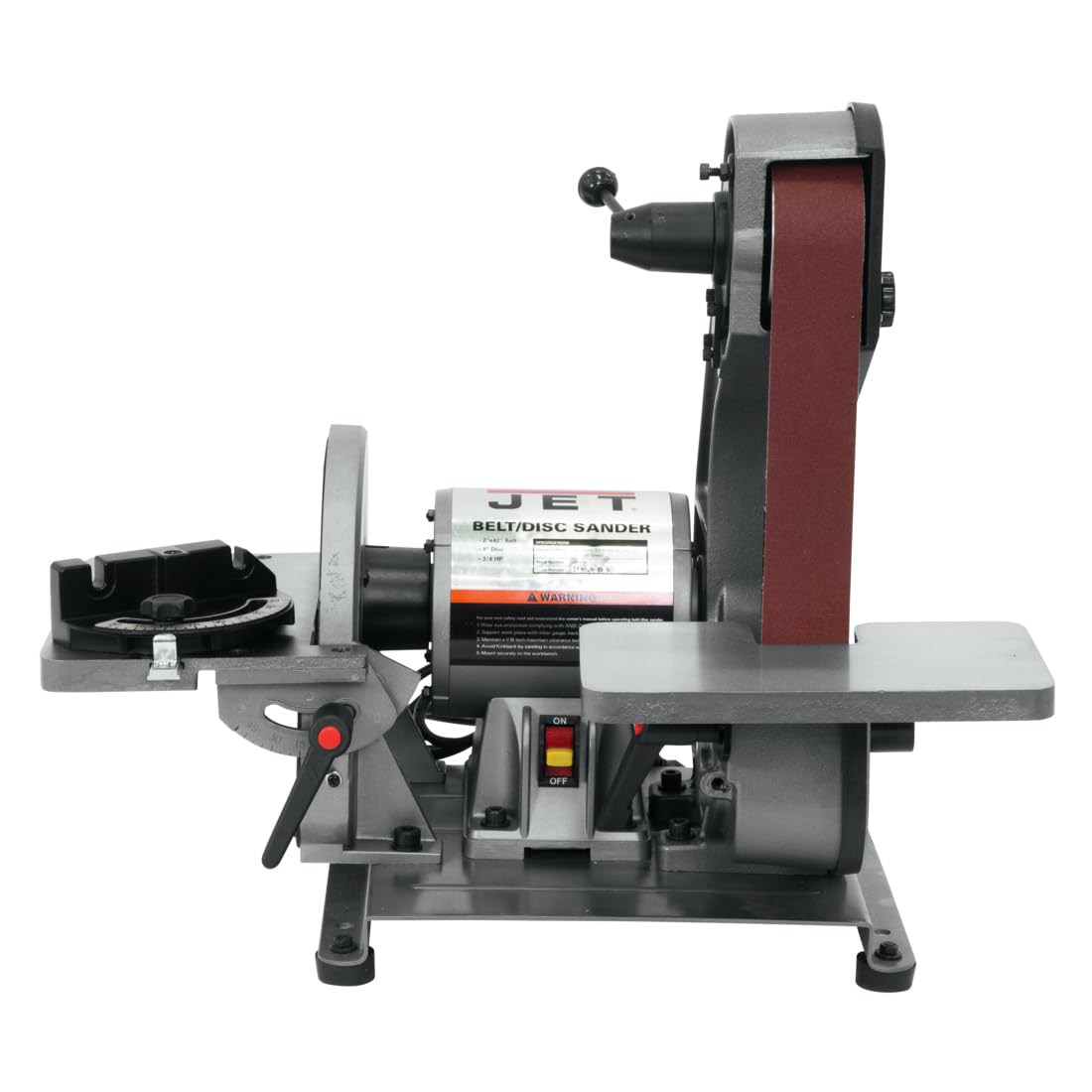
A 60-pound cast-iron sander with a 6.2 A motor and 8-inch disc that holds speed through long grinding sessions.
For anyone running a knife-making or metalworking bench, the JET earns its spot by simply being the heaviest and most planted machine of the group. At 60 pounds against the VEVOR’s 32, its cast iron and steel base puts the vibration in the floor, not in your finish.
What wins people over is how it works, and how hard it works: it is the machine praised most for functionality across owner feedback, followed closely by sturdiness and raw motor power. The 6.2 A, 115V corded motor holds speed rather than slowing when you press, and the belt both removes material and finishes in the same pass. Six inches smaller disc? No — this runs a full 8-inch disc compared with the 6-inch disc on the VEVOR, KFMK and Eastwood, giving you more flat surface for squaring work. Its 100-grit medium belt is a step finer than the 80-grit coarse belt the VEVOR and KFMK ship, so you start closer to a finish.
The honest trade-off is belt speed — the machine is single-speed and heavy-handed pressure can bog it down. There is a spring-loaded tracking wheel, and the recurring warning is not to force it into the lock, because that can smoke the motor. Belt tracking itself takes a little dialing in, and the disc side is the one area where a few buyers report a wobble.
Where the JET pulls ahead
- 60 pounds of cast iron and steel base kills vibration for cleaner cuts
- 6.2 A, 115V motor keeps the belt moving without stalling on steady pressure
- 8-inch disc beats the 6-inch disc on every other pick here for squaring and flattening
- Removable platen lets you sand and grind curves or odd-shaped pieces on the belt
- Deluxe miter gauge locks at 45 degrees both left and right
What to expect going in
- Single speed, so heavy-handed pressure can bog the belt down
- The spring-loaded tracking wheel can smoke the motor if you force it into lock
- Belt tracking and the disc side take some fiddling to get true
Worth it for: the metalworker or knife maker who wants a heavy, stable bench machine with a big 8-inch disc and doesn’t mind a single speed.
Weigh the trade-off: because it’s single-speed with a spring-loaded tracking wheel, it rewards a patient setup — not a hurried one.
2. VEVOR 6″ Disc Sander & 2″ x 42″ Belt Sander
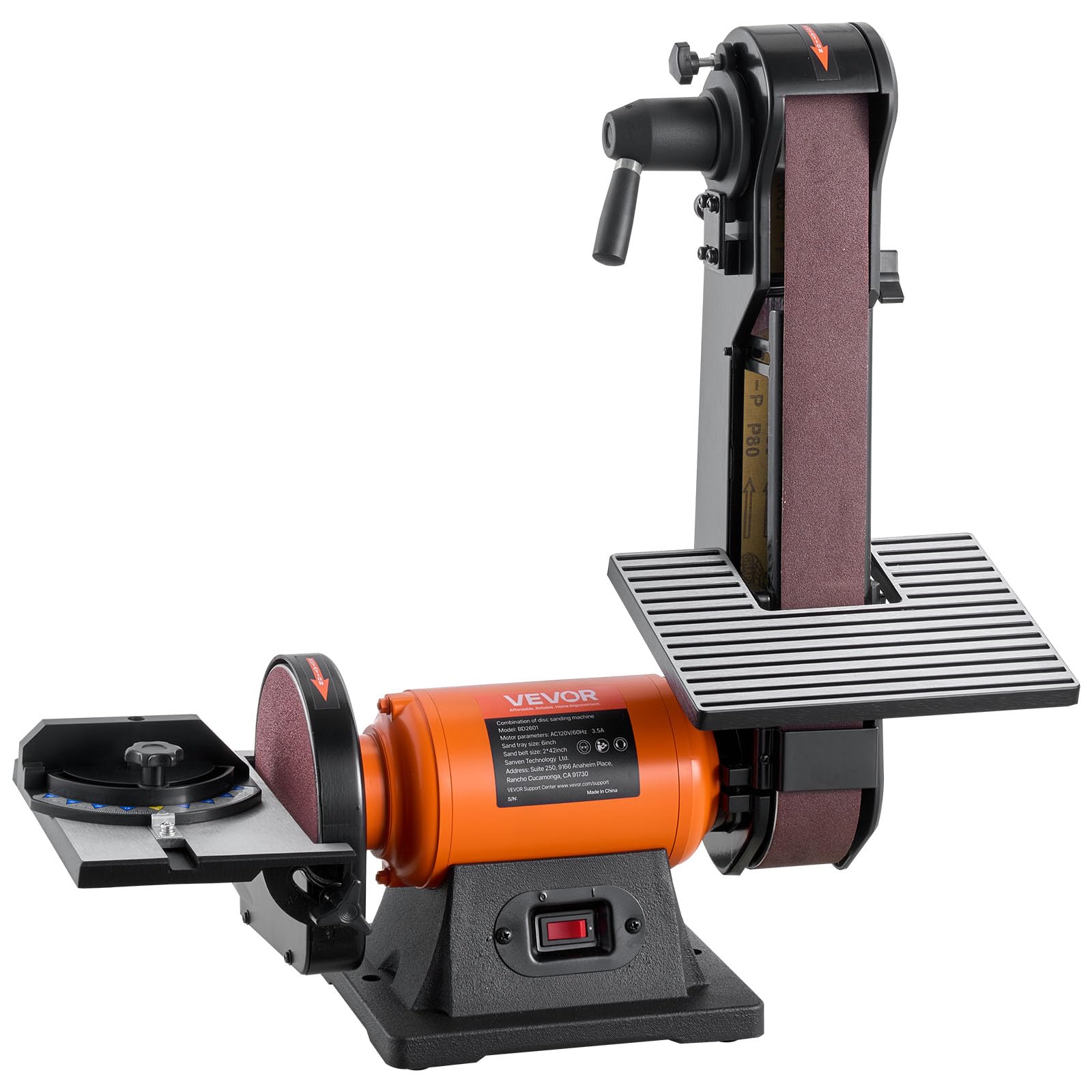
A 6.67 A, 420W sander whose belt arm swings 0–90° and whose disc and belt tables tilt 0–45°.
The VEVOR packs 6.67 A of current, plenty for light-to-medium work, but realistically this is a beginner and hobby machine that carries no illusions about being a production grinder. It runs a 420W motor with the disc spinning at 3590 rpm and the belt at 1250 rpm. Owner feedback is lopsided in a good way: what comes through most is quality, with value for money a close second, so buyers clearly feel the money went to the right place.
Where the VEVOR separates itself from the JET is adjustability. The sanding belt arm swings 0 to 90°, so you can grind horizontal or vertical, and both the disc worktable and belt worktable tilt 0 to 45°. A miter gauge comes in the box to keep angles honest. There’s a dust collection port, and the heavy metal base with rubber feet cuts vibration and the racket that comes with it. For the fullest angle control, this and the KFMK are the two to look at; the JET offers only a fixed platen and a miter gauge.
The honest catch is that the belt is the weak link, not the machine — the stock 80-grit belt gums up and a few buyers strip it early, while some find the workplate smaller than the job calls for. It also starts up slowly rather than snapping to speed. Neither hurts the wood and light metal work this was built for, but don’t expect production-level throughput.
Setup that fits the buyer: From belting from the start to first cut in 20 minutes, this is a weekend DIY machine that lets you tilt and swing to the angle the piece wants — the box even includes the miter gauge, hex wrenches and worktables.
Right pick if: you’re a woodworker or hobbyist who values an adjustable belt arm and a tilting table more than sheer horsepower.
Look elsewhere for: production-volume grinding or heavy metal hogging — the belt is the bottleneck, not the motor.
3. KFMK 2×42 in. Belt Sander & 6″ Disc Sander Combo

A 3.5 A, 1/2 HP combo with a 6-inch disc and a belt that runs vertical or horizontal for repeatable chisel and blade edges.
If your bench is mainly about getting an edge back on tools and knives, this is the machine tuned for it. A 1/2 HP induction motor with direct drive spins the 6-inch disc at 3580 rpm, and the belt sander will stand vertical or lie horizontal depending on how you want to present the workpiece. That versatility is exactly why it has earned a following among sharpeners — it’s cited most for functionality, with quality close behind, and owners talk openly about pulling a perfect edge on everything from chisels to blades.
Compared with the VEVOR above, sharpening performance is the clear strength here — 80-grit coarse belt, a 6-3/4 x 9 in. belt worktable, and a 6-1/8 x 9 in. disc table that tilts to 45°. That disc table is genuinely larger than the VEVOR’s, giving you more surface for flat work. Accessories include a tool rest for the belt, a miter gauge for the disc, and a set of hex keys and flat wrench, so you can be working in minutes.
Two honest notes from owners: the belt rest table grooves are uneven on some units, so fine work benefits from an upgraded platen or rest. And a few sharp-eyed buyers measured the motor and found it closer to 1/3 HP than the advertised 1/2 HP. Neither is a deal-breaker for sharpening work, but the stated rating deserves a raised eyebrow.
Go for it if: sharpening chisels, plane irons, and blades is your primary job and you want the adjustable table and dual orientation without paying premium money.
Consider a step up if: you need the motor to hold full speed through thick steel — a 3.5 A draw is lighter than the JET’s 6.2 A, and owners note it slows under heavy load.
4. Eastwood 2 inch x 42 inch Belt and 6 inch Disc Sander

A 31.4-pound benchtop grinder with a 1/2 HP motor, 4130 FPM belt speed, and a belt drive assembly that swings horizontal or vertical.
The Eastwood sits in a useful middle ground — more capable than the tiny hobby machines, less of a bench hog than the JET. Its 1/2 HP motor drives the belt at 4130 FPM while the disc turns at 3590 rpm, and the positionable belt drive assembly swings between horizontal and vertical so you can present the workpiece however the grind calls for it.
The tuning leans toward knife making, and its fans tend to arrive as upgrades from smaller belt sanders like the 1×30 class, drawn in by the wider 2-inch belt. There’s a Secure Stop fence and tool rest, an angle-adjustable work surface, and a 6-inch adhesive-backed sanding disc. Belt changes are designed to be quick, and a 6-foot cord gives you some reach from the outlet. Weigh it against the KFMK: similar 6-inch disc and 1/2 HP motor class, but the Eastwood adds the positionable belt drive and a higher belt speed in FPM where the KFMK lists rpm only, and it’s the trimmer package to move around.
The caution here is power reserve. Owners who push a 2-inch belt hard report it stalling under more than minimal pressure, and a common suggestion is that a larger motor would suit aggressive stock removal better. If you’re a finesse grinder — sharpening and light shaping — it holds up fine; if you want to bury the belt in steel all day, look at the JET’s heavier setup.
Best matched to: the sharpener or light knife maker who wants a repositionable belt drive, a portable 31.4-pound footprint, and a quick belt swap.
skip it if: you plan to lean into thick stock all day — this motor is a starter’s motor, and heavy pressure will stall the belt.
Understanding the Specs
Amperage and Horsepower
Amperage tells you how much electrical current the motor draws, and horsepower tells you how much of that turns into cutting force. Higher numbers mean the belt keeps its speed when you press harder. A 6.67 A machine and a 6.2 A machine both have real reserve; a 3.5 A unit is a lighter-duty build that tends to slow when you lean in. Match the number to your material — thicker steel wants more current.
Disc Diameter and Grit
The disc gives you a flat rotating surface for squaring and flattening. An 8-inch disc covers more ground per pass than a 6-inch one, which saves time on big faces. Grit number is how coarse the abrasive is — lower numbers cut faster and leave a rougher surface, so an 80-grit coarse belt removes stock quickly while a 100-grit medium belt removes material and starts the finish in the same pass. Choose grit by how much material you need to take off.
FAQ
Will any 2×42 belt fit all of these machines?
What’s the difference between the 8-inch disc and the 6-inch disc?
Is a 3.5 A motor enough for knife making?
Why does the belt keep drifting off center and how do I fix it?
How long do the belts and discs last before I replace them?
Can I connect a shop vacuum to these sanders?
Should I mount the grinder to a bench or can it sit loose?
Is a belt sander or a disc sander better for sharpening?
Final Thoughts: The Verdict
For most buyers the 2×42 belt grinder winner is the JET 2″ x 42″ Belt and 8″ Disc Sander because it brings the heaviest cast-iron base, the largest 8-inch disc, and a 6.2 A motor that holds speed under pressure. If you want maximum adjustability with a 0–90° belt arm and a tilting table, the VEVOR 6″ Disc Sander & 2″ x 42″ Belt Sander is the one to reach for. And for sharpening blades and chisels with a dual-orientation belt and a 45° tilting disc table, the KFMK 2×42 in. Belt Sander & 6″ Disc Sander Combo is the natural pick.
How We Picked
We do not accept paid placement. Every pick is matched to a real buyer and a real use-case; we do not hands-on test units.
Sources & Methodology
Specifications: manufacturer listings and product documentation. Review insights: verified customer reviews, as of September 2026. Pricing: not shown on this page (it changes often); check the current price via the retailer link.
As an Amazon Associate, Gadgets Feed earns from qualifying purchases. This does not affect which products we feature.