
Our readers keep the lights on and my morning glass full of iced black tea. As an Amazon Associate, I earn from qualifying purchases.
Specs are compiled from manufacturer listings and verified buyer reviews and can change over time — please confirm the key details on the product page before buying.
If your child keeps quitting guitar because a full-size instrument feels like wrestling a fence post, the problem is usually the size of the guitar, not their talent. A 3/4 acoustic guitar shrinks the body and neck to roughly 36 inches overall, so the strings sit closer together and closer to your hand — small fingers can actually reach the chords they are being taught. Look for a 23-inch scale length (the distance from the nut to the bridge), because that measurement is what makes a smaller guitar feel playable instead of punishing. Below are nine real junior-size acoustics, from beginner nylon-string models to solid-wood spruce picks that sound far bigger than they look.
I’m Min — the founder and writer behind Gadgets Feed. This guide is built by comparing the manufacturers’ published specifications and the patterns across verified customer reviews, so you get each pick’s real strengths and trade-offs instead of marketing spin.
Some of these guitars are light enough to bounce along in a gig bag, while others deliver a warm fingerstyle voice that surprises adults. If you need a tough nylon-string starter for a beginner, or a spruce-topped pick that a serious small-handed player won’t outgrow, this breakdown of the 3/4 acoustic guitar makes the choice clear.
Our Picks at a Glance

How To Choose The Best 3/4 Acoustic Guitar
For a beginner, the guitar that fits your hands is the one you’ll actually practice. That is why scale length — not brand or price tag — is the first filter. Once the scale fits, tone, finish, and accessories become a matter of taste.
Scale length and body size first
A “3/4” label is loose shorthand, not a fixed measurement. What matters is the scale length (the vibrating length of the string from nut to bridge); these 3/4 instruments run from roughly 22.75 inches up to about 23.5 inches. The shorter the scale, the smaller the stretch between frets — easier for young or small hands, though it costs a little in string tension and low-end rumble. A scale that’s too long will feel like work; a good fit lets a child reach a first-position chord without hand strain.
Nylon strings or steel strings
Nylon strings feel softer on the fingertips and are standard on classical guitars, so they suit a beginner building up calluses. Steel strings project louder and cut through better for strumming, but they press into your fingers harder. If the player is under about 8 or is struggling with hand pain, nylon is usually the friendlier starting point.
What’s in the box
Most 3/4 guitars ship as kits, and the bundle contents vary widely. A padded gig bag, a set of spare strings, a tuner, and a strap cover the basics. Weigh the bundle against what you’d buy separately — a decent padded bag and a working clip-on tuner can justify a slightly higher price on their own.
Quick Comparison
| Model | Best For | Top Material | String Type | Scale / String Source | Amazon |
|---|---|---|---|---|---|
| Hola! Music 36″ 3/4 Solid Spruce Top (Purple)★ Best Overall | Steel-string beginners wanting big tone | Solid Spruce top, mahogany back/sides | Steel (D’Addario EXP16) | 3/4 size 36-inch | Amazon |
| Orangewood Dana Mini / TravelTop Performer | Travel and casual recording | Layered spruce top, layered mahogany back/sides | Steel | 23.5-inch scale | Amazon |
| Fender Redondo Mini 3/4 BundleBest Bundle | All-in-one kids’ starter bundle | Laminated Sapele | Steel | 22.75-inch scale | Amazon |
| Yamaha JR2TBS | Preteens who’ll stick with it | Spruce top, mahogany back/sides | Steel | 3/4 scale, 36.34″ long | Amazon |
| Vangoa 36″ Classical Cedar Top | Classical players on a value budget | Cedar top with X-bracing | Nylon | 3/4 (36 inch) | Amazon |
| Fender FA-25N 3/4 Nylon | Kids starting with Fender Play lessons | Sapele top, back and sides | Nylon | 3/4 size | Amazon |
| Pyle Steel String Cutaway Kit | Budget kit with the most extras | Linden plywood top, back and side | Steel alloy | 23.2-inch scale | Amazon |
| Hola! Music 36″ 3/4 Classical | Fingerstyle and smaller adults | Spruce top, mahogany back/sides | Nylon | 23-inch scale | Amazon |
| Winzz 3/4 Beginner Classical | Cheapest classical starter | Basswood top, back and sides | Nylon | 3/4 size 36-inch | Amazon |
In‑Depth Reviews
1. Hola! Music 36″ 3/4 Acoustic Guitar, Solid Spruce Top, Purple
Our pick — over 4.5★ from 500+ verified ratings; the strongest balance of quality and price.
A 36-inch steel-string junior with a solid spruce top and a bright, projecting voice.
Here’s the pick that should top most shortlists. It sits in the mid-range group, runs 36 inches overall at just 16 ounces, and pairs a smooth solid spruce top with mahogany back, sides, and neck. For a smaller body that translates to a bright, loud, projecting voice — buyers report it holds its own in volume against full-size dreadnoughts. The 3/4 size makes it ideal for a young musician or anyone traveling light, and it arrives pre-strung with D’Addario EXP16 coated Phosphor Bronze steel strings so it’s ready the day it lands.
What wins people over is the quality of the build itself — finish, hardware, and strings all feel considered rather than budget. Buyers describe the tone as comparable to instruments costing several times more, and the smaller body gives a warmer, tighter character that some players actually prefer for fingerpicking and everyday practice. The included kit is generous: a padded gig bag with backpack straps and a front compartment, three picks in different sizes, a pickguard, a hex key, and a strap. The neck runs slightly fatter than some juniors, which most find comfortable rather than cramped, and the action comes good enough that a beginner can play within minutes of tuning.
Here is the honest catch with budget steel-strings: some units arrive with fret buzz that needs a truss-rod adjustment (a small tweak to the metal rod inside the neck) or a trip to a pro, and the thin pickguard is flimsy enough that several owners just leave it off. Treat the guitar itself as the star and the extras as a bonus. As one owner put it, it “exceeded my expectations.”
What earns it top spot
- Solid spruce top over mahogany back, sides and neck for genuine acoustic projection
- Just 16 ounces — a true travel-friendly 3/4 that a child can carry unaided
- Full starter bundle: padded gig bag, 3 picks, pickguard, hex key and strap
- Pre-strung with D’Addario EXP16 coated strings — playable right from the start
Worth knowing before you buy
- A few units arrive with fret buzz that needs a truss-rod adjustment
- The included pickguard is thin and easy to skip
- Fat-ish neck profile may feel wide to the smallest hands
Dialed in for: a young steel-string beginner or a traveling adult who wants real tone from a small body.
Think twice if: you want a near-perfect factory setup — budget a little for a professional truss-rod tune.
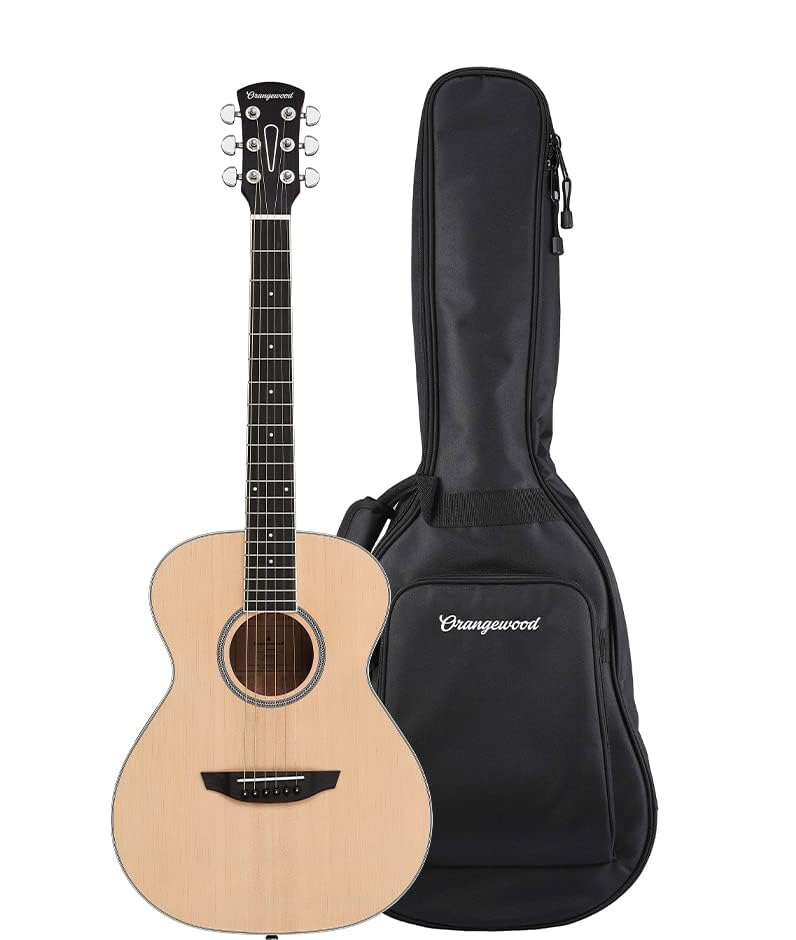
2. Orangewood Dana Mini/Travel Acoustic Guitar with Spruce Top, Junior 3/4 Size
A setup-ready travel guitar with a longer scale that keeps real bass and harmonics alive.
The Dana Mini takes a different approach than the Hola above. It uses a 23.5-inch scale, and that extra string length matters — it lets the harmonics and low-end come through where shorter juniors can sound thin. A layered spruce top over layered mahogany back and sides keeps it light and stable, and every Orangewood gets a professional setup before it ships, so it tends to arrive playable rather than rough. The natural satin finish reads clean and understated, and it comes with a premium gig bag plus adjustment tools.
What people rave about is how it carries — reports describe it as super light and easy to stow, which is exactly the point for a guitar meant for travel and casual use. The laminate body shrugs off humidity and temperature swings that would trouble a solid-wood instrument, so it holds its tuning across trips. Sound quality punches above its modest frame, with owners comparing it favorably to pricier models. It’s also forgiving of new players: the string height and enclosed tuners make it an easy first instrument.
The trade-off is honest — a laminate top won’t match the depth of a solid spruce, and a few units turn up with rough fret edges or light scratches on the face. If you’re chasing pro-level recording tone, this isn’t it; for travel, practice, and beginners, it’s a strong fit.
Longer scale, fuller voice: the 23.5-inch scale (the distance from nut to bridge) separates it from most juniors here, giving you real harmonic presence instead of a boxy plink.
Room to move: purple-heart fretboard, bone nut/bridge, and enclosed tuners point to a build that holds tune and handles gigging.
Pick this one for: a frequent traveler or casual recorder who needs a tough, stable little guitar.
Not your match if: you want the full resonance of solid tonewoods for serious recording.
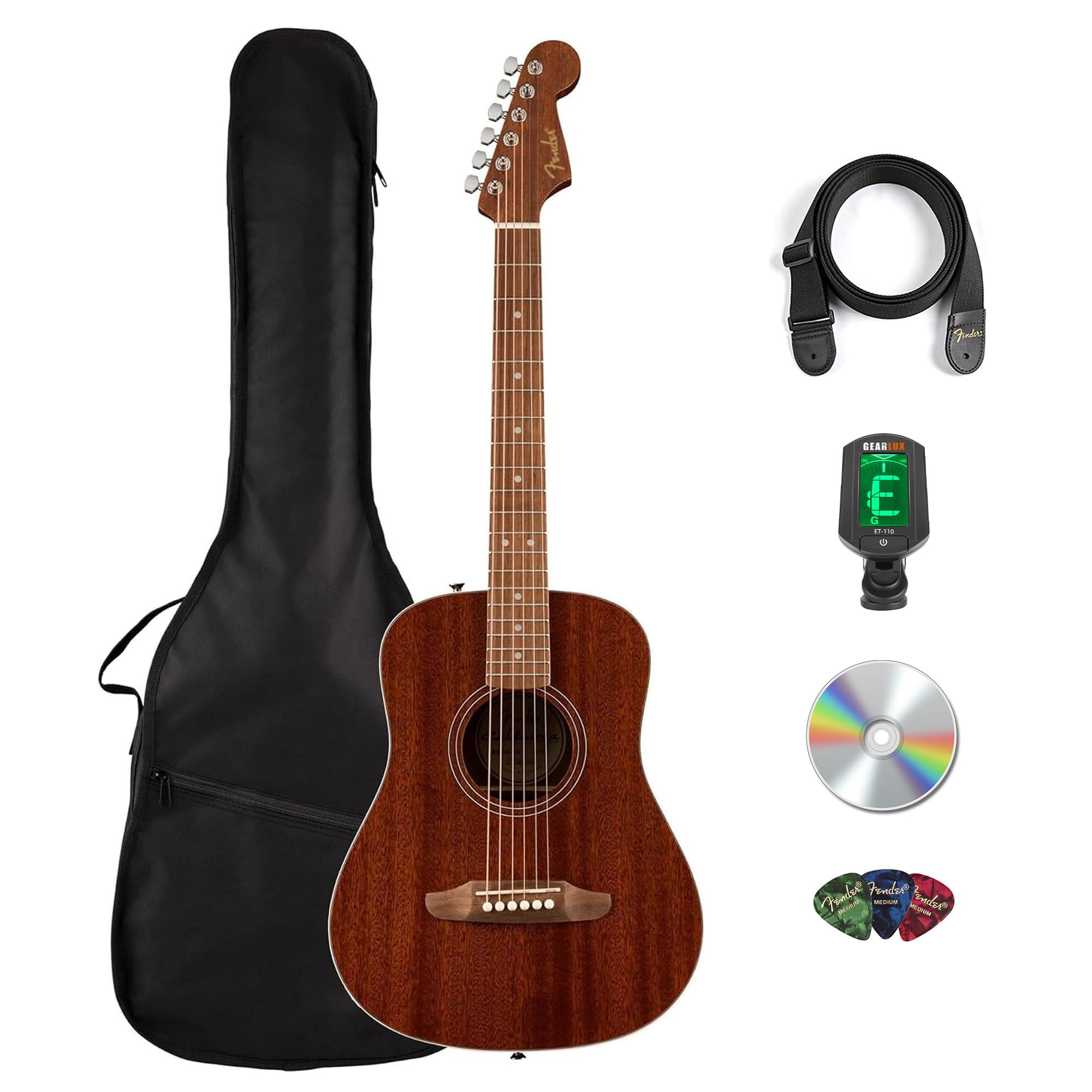
3. Fender California Standard Redondo Mini 3/4-Size Kids Acoustic Guitar
The everything-in-one bundle that puts a Fender name in a kid’s hands with zero extra shopping.
If you want one order to cover everything, this premium pick makes the case: it arrives as an Austin Bazaar bundle with a gig bag, tuner, strap, picks, and an instructional DVD, plus Fender’s own Play online lessons. The guitar is a miniature dreadnought (a smaller version of the classic big-bodied shape) with a 22.75-inch scale — the shortest here — which gives the smallest players the friendliest reach. Its laminated sapele top, back, and sides (layered wood that resists cracking) keep it durable for everyday handling, and a slim “C”-shaped okoume neck with a walnut fingerboard makes chord changes easy. Reliable hardware rounds it out: a Modern Viking bridge, die-cast sealed tuning machines (covered gears that keep dust out and hold tune), and a Micarta nut (the slotted piece the strings pass over at the top of the neck).
The size is the headline. Players with small hands — and even adults managing hand issues — find the 3/4 scale genuinely comfortable, and it holds its tune well over repeated sessions. The laminated sapele body gives a balanced, even acoustic tone that suits strumming, and children take to it quickly. As the full-size Redondo’s junior sibling, it borrows the same playability DNA in a package a younger student can manage — noticeably lighter and more compact than the Fender FA-25N below.
The recurring gripe is the accessories, not the guitar: it ships with a single strap button, so an easy upgrade is adding a second, and the travel bag is thinner than the guitar deserves. Neither affects how it plays. As a ready-to-go starter, it earns its spot.
Why it makes the shortlist
- Complete bundle: gig bag, tuner, strap, picks and instructional DVD all included
- 22.75-inch scale is the shortest reach here — ideal for very small hands
- Die-cast sealed tuning machines and Micarta nut for dependable tuning
- Light at 6.6 pounds, easy for a child to handle
Where it could be better
- Ships with only one strap button; adding a second is a small extra step
- The travel bag feels thin next to the guitar’s build quality
Made for: a parent who wants a name-brand junior and every accessory in one box.
Look elsewhere if: you already own a good gig bag and tuner and would rather put that value into the guitar alone.
4. Yamaha JR2TBS 3/4 Scale Guitar Tobacco Sunburst

A spruce-topped junior that preteens can grow into instead of outgrow.
For a player who’ll stick with guitar for years, this is the premium-tier pick to beat. A solid spruce top over mahogany back and sides is a genuinely serious tonewood pairing for a 3/4 body, and a rosewood fingerboard and bridge add a level of feel usually reserved for bigger instruments. It arrives ready to play with no neck adjustment needed, and it includes a deluxe padded bag that buyers rate as quality rather than an afterthought. This is the step up worth taking over Yamaha’s own JR1 — the JR2 brings better hardware and a better gig bag in the same shell.
There’s a reason this one carries a reputation for being a real instrument rather than a toy. Owners describe the build as solid and pro-grade, with no fret buzz and smooth frets, and the tone holds up well for daily practice. It fits small hands comfortably, making it a natural fit for a preteen beginner, and the size still travels easily. The scale and spruce top mean the sound is warm and clear rather than boxy, so it earns its keep across practice, lessons, and the occasional trip.
The honest note: the finish is plain compared to fancier juniors, and intonation runs slightly sharp high up the neck on some units — a minor quirk most beginners never notice. Neither is a reason to pass it by.
Tonewoods that punch up: spruce over mahogany in a 3/4 frame delivers far more depth than the all-laminate budget options below.
Choose it when: you want one junior guitar that a 9-to-13-year-old can grow with for years.
Reconsider if: you need an eye-catching finish or a fingerstyle nylon voice.
5. Vangoa Classical Guitar 3/4, 36 Inch Junior Nylon String Bundle, Cedar Top

A cedar-topped classical with a stable X-braced build and a generous accessory kit.
Classical players get a real alternative here. Vangoa builds this in the Spanish tradition with a cedar top and sapele back and sides, using an X-shaped bracing structure for structural stability and a responsive voice. Cedar tends to deliver a mellower, softer tone than spruce, so it suits classical repertoire, fingerstyle, and latin tunes. The 3/4, 36-inch body has soft nylon strings and a comfortable C-shaped neck with open high-precision tuners, all sized for a beginner. Comes with strap, capo, cleaning cloth, manual, pick set, spare strings, accessory pouch, and more.
The bundle is part of the appeal — reports note the included padded gig bag and clip-on tuner are genuinely useful rather than throwaway, and a few owners rate the tuner as accurate across multiple instruments. The cedar top gives it a warm, balanced character that new players find encouraging, and the build quality holds up for daily practice. The vintage-engraved headstock and inlaid pattern give it an old-world look that punches above its cost.
Where it’s mixed — and this is the honest part — some units ship with strings that go dead quickly or tuning pegs that feel loose, and a few players find the action (the height of the strings above the fretboard) a touch high up the neck or catch a sharp fret end. None of these are dealbreakers, and a fresh set of strings and a light setup fix most of them. As a value starter, it’s a fair trade.
What stands out
- Cedar top with X-bracing for a warm, mellow classical voice
- Generous kit: gig bag, clip-on tuner, capo, picks, strap, spare strings
- Soft nylon strings — gentle on beginner fingertips
- Adjustable truss rod and precise open tuners
Fine print to expect
- Some units arrive with lackluster strings or a loose tuning peg
- Action can sit high up the neck on certain examples
Right for: a classical-curious beginner who wants a warm nylon tone and a full accessory kit.
Skip if: you want a beginner guitar that arrives perfectly set up with pro-grade strings already fitted.
6. Fender FA-25N 3/4 Size Nylon String Acoustic Guitar

A sapele-bodied nylon-string junior that pairs a soft touch with real lessons in the box.
Beginners who learn best with guidance should look here. This is a right-handed 3/4 nylon-string acoustic with a sapele top, back, and sides, a walnut bridge and fingerboard, and an easy-to-play “C”-shaped neck. The soft nylon strings and comfortable bridge height are the whole point — they’re gentle on a beginner’s fingertips, so practice doesn’t hurt too much to keep going. It also comes with a subscription to Fender Play, which includes lessons with thousands of instructional videos, and it’s backed by a 2-year warranty. At 3/4 size it’s built for small hands and travel.
The value here is really the full beginner package: an instrument, a warranty, and a structured lesson path in one purchase. Owners find it easy to play with nice action, and many report it holds tune well for practice, home get-togethers, and lessons. The nylon strings and low bridge height keep finger pain down, which matters most in the first weeks when a new player either builds momentum or quits. For a 13-year-old with smaller hands, or any adult re-learning on a softer string, it’s a sensible starting point.
Two honest caveats surface in owner feedback: some find the 3/4 body smaller than they pictured, and the factory strings are the weakest link, with a handful of players swapping them early. Neither spoils the experience, but if you want a fuller sound from the start, plan on a fresh string set.
Built for soft starts: nylon strings plus a low, comfortable bridge height give a beginner the pain-free feel that keeps them practicing.
The lesson bonus: Fender Play access and a 2-year warranty make this among the most complete starter packages for a kid taking up guitar.
Suits: a first-time player who wants lessons and a warranty bundled with a gentle nylon-string feel.
Look further if: you want a steel-string strummer or a larger body for more volume.
7. Pyle Steel String Acoustic Guitar Kit, 3/4 Junior Size Cutaway, 36″ Orange

The budget kit that throws in a cutaway body and more accessories than anyone else at the price.
If you want the most stuff in the box for the least outlay, this is the value play. It’s a 3/4, 36-inch steel-string with a 23.2-inch scale, a cutaway body for easier access to the upper frets, and 20 frets across a wood fingerboard. The body is all linden plywood with an okoume headstock, white ABS binding, and a hand-rubbed matte finish. The kit is stuffed: a gig bag, 6 spare strings, picks, a cleaning cloth, and a detachable shoulder strap. Against the Vangoa above, you trade the cedar top and classical warmth for a cutaway steel-string and a bigger pile of accessories.
Two things tend to satisfy owners most: the sound and the fact that it’s genuinely ready to play. Reports describe it as resonant and surprisingly loud for a 3/4 size, with a 43mm nut and smooth tuners, and it arrives as a solid, complete starter set that works for a beginner, a gift, or travel. The cutaway adds a practical touch for anyone who wants to reach higher up the neck, and the matte desert-orange finish stands out from the usual natural spruce crowd.
Be realistic about the extras: the included gig bag is the weak point, with reports of it failing under normal use within weeks, so budget for a replacement. The factory strings are also basic, and some units come with action that needs lowering at the saddle. The guitar itself holds up; the bundled bag and strings are where the savings show.
Why budget buyers like it
- Cutaway body for easier reach to the upper frets
- Loaded kit: gig bag, 6 spare strings, picks, cloth and strap
- 23.2-inch scale and 43mm nut for a manageable small-hand feel
- Matte desert-orange finish with ABS binding and celluloid inlay
Set expectations here
- The included gig bag is flimsy and often replaced early
- Factory strings are basic; upgrading them lifts the tone
- Action may need a saddle adjustment on some units
Best when: you want maximum accessories and a cutaway design without spending much.
Pass if: a durable gig bag and out-of-the-box string quality matter more than kit volume.
8. Hola! Music 36″ 3/4 Classical Guitar, Nylon Strings, Natural Gloss

A nylon-string classical with the scale and nut width fingerstylists actually want.
Fingerstyle players should pay attention to this one. It uses a 23-inch scale with a 45mm nut (the width where the strings sit at the top of the neck) and 18 frets on a walnut fingerboard, and that combination — short scale but a wide nut — is exactly what makes classical and fingerstyle playing comfortable for small hands. A spruce top over mahogany back, sides, and neck gives it genuine classical warmth, and the glossy finish with decoration around the soundhole makes it look far more refined than its mid-range price suggests. A padded gig bag comes included to protect it in transit.
The size and reach are the draw. A 5’1″ player with small hands finds the 23-inch scale spot on for reaching chords and projecting clearly, and calls the wide string spacing a plus for fingerpicking. Experienced players rate its tone and craftsmanship alongside larger 41-inch models, and it stays in tune well for daily practice. For a smaller adult or a child moving past the very smallest instruments, it’s a natural fit — and a full step up in playing character from a starter classical.
Its size sits right between the two Fender picks above: longer and more spacious than the 22.75-inch Redondo Mini, yet far more fingerstyle-friendly than the soft-string FA-25N. The honest trade-off is tuning stability from the start — some units need a few days to settle and hold pitch — plus one report of a minor lacquer crack in shipping. Both are minor and rare.
Ideal for: a fingerstyle beginner or a smaller adult who wants wide string spacing and a warm nylon voice.
Not the one for: a steel-string strummer chasing maximum volume.
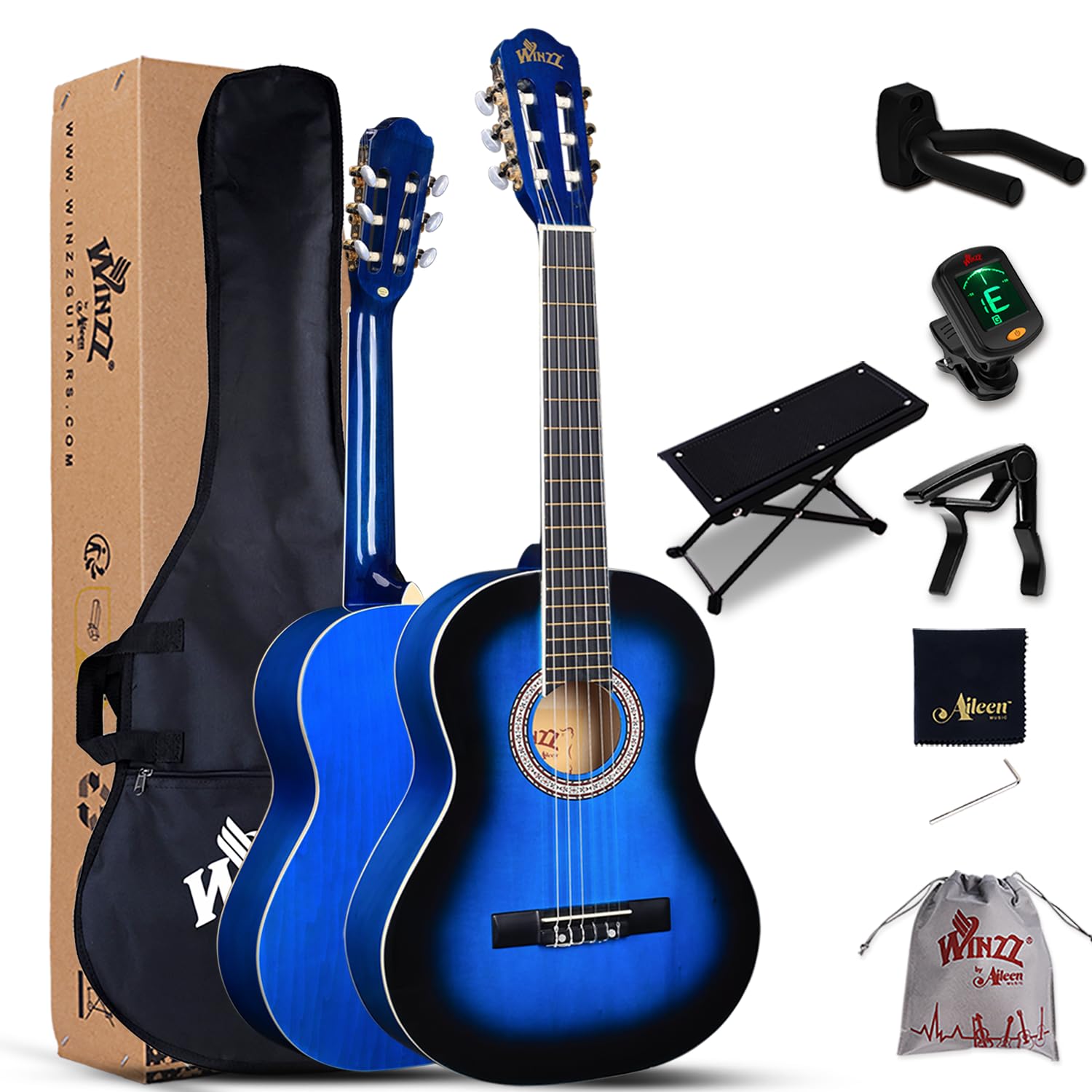
9. Winzz 3/4 Size Beginner Classical Guitar, 36 inch, Blueburst
The entry-level classical that gets a nine-year-old started with soft strings and a wide fretboard.
When the goal is simply to get a first guitar into young hands for the least outlay, this one delivers. It’s a 36-inch 3/4 classical guitar built for older children, teenagers, and beginners with small hands. It uses a traditional wide fretboard and six soft nylon strings, which ease finger soreness for daily practice and suit classical, fingerstyle, and latin tunes. The basswood body has a neat high-gloss finish, and it’s light enough to carry to lessons or gatherings. A dual-action truss rod — a metal rod inside the neck you can adjust from both ends — helps balance tension and keep the neck from warping, which is a nice detail at this level.
What it does well is the starter job. The smooth, burr-free frets and proper string height keep fret buzz down so a beginner can practice for longer without fighting the instrument, and the soft nylon strings build calluses gently rather than painfully. It arrives as a complete starter kit with the essential accessories, so there’s nothing extra to buy before the first lesson. The blueburst finish is bright and eye-catching — a nice motivator for a kid who’s just starting out.
What it won’t do is grow with an advancing player. As a lightweight basswood build, it’s a practice and learning instrument rather than something to keep for years of serious playing, and its voice is the softest and most modest of the nine here. As a first guitar that won’t sit unplayed after a week, though, it’s tough to argue with.
What you get for the money
- Complete starter kit with the essential accessories included
- Dual-action truss rod helps the neck stay true and in tune
- Soft nylon strings and a wide fretboard ease small hands
- Lightweight with a bright blueburst gloss finish
The limitations to note
- Basswood build and tone are entry-level, not a long-term keep
- Won’t satisfy an advancing player for more than a season or two
Pick this if: you want the lowest-cost way to put a real nylon-string guitar in a beginner’s lap.
Step up if: you’d rather buy once for a player who’s serious about sticking with lessons.
Understanding the Specs
Scale Length
This is the vibrating length of the string, measured from the nut at the top of the neck down to the bridge. On these 3/4 guitars it runs from about 22.75 up to 23.5 inches. A shorter scale means the frets sit closer together, so small hands can reach chords without stretching — the single most important spec for a young or small-handed player. The trade-off is slightly softer string tension and less low-end. Match the scale to the player’s reach, not their age.
Top Wood and Bracing
The top is the soundboard, and its material shapes the guitar’s voice. Spruce gives a bright, projecting tone; cedar runs mellower and warmer; laminate options like basswood or linden plywood are durable and budget-friendly but less resonant. Bracing — the internal struts — supports the top; an X-shaped bracing structure adds stability. Solid wood tops generally open up and gain character over time, while laminates stay consistent and shrug off humidity swings. For a first guitar, both work.
FAQ
What age is a 3/4 acoustic guitar right for?
Is a 3/4 guitar easier to learn on than a full-size one?
Nylon strings or steel strings for a child beginner?
How long does a 3/4 acoustic guitar stay in tune?
Do kids’ guitars come with a truss rod, and do I need one?
What accessories should come with a 3/4 acoustic guitar starter kit?
Can an adult play a 3/4 acoustic guitar, or is it just for kids?
Should I buy a solid-top or laminate-top 3/4 guitar?
What is scale length, and why does it matter on a 3/4 guitar?
Do I need to set up a new 3/4 acoustic guitar from the start?
Final Thoughts: The Verdict
For most buyers, the 3/4 acoustic guitar to start with is the Hola! Music 36″ Solid Spruce Top, because its solid spruce top over mahogany and its bright, projecting tone deliver far more than its small body and price suggest — It holds 4.7 stars across 500-plus ratings. If you want a proven name-brand junior a preteen can grow into, the Yamaha JR2TBS is the reliable step-up with its spruce-over-mahogany build and deluxe padded bag. And for a child starting on soft, gentle nylon strings, the Winzz 3/4 Beginner Classical is the budget-friendly way to begin. Whichever you pick, the rule stays the same: match the scale to the player’s hands, and the guitar gets played instead of gathering dust.
How We Picked
We do not accept paid placement. Every pick is matched to a real buyer and a real use-case; we do not hands-on test units.
Sources & Methodology
Specifications: manufacturer listings and product documentation. Review insights: verified customer reviews, as of September 2026. Pricing: not shown on this page (it changes often); check the current price via the retailer link.
As an Amazon Associate, Gadgets Feed earns from qualifying purchases. This does not affect which products we feature.