
Our readers keep the lights on and my morning glass full of iced black tea. As an Amazon Associate, I earn from qualifying purchases.
Specs are compiled from manufacturer listings and verified buyer reviews and can change over time — please confirm the key details on the product page before buying.
You need a 3/4-inch PEX line that won’t burst in a sub-zero snap, won’t kink as you snake it through tight joists, and costs less per foot than the big-box hardware aisle. The problem is choosing between letters — PEX-A versus PEX-B — and figuring out whether a 100-foot roll is enough or you should go bigger. This guide cuts through the labels to tell you exactly which coil delivers on the connection method you prefer, the temperature range your climate demands, and the balance of flexibility versus burst strength your project needs.
I’m Min — the founder and writer behind Gadgets Feed. This guide is built by comparing the manufacturers’ published specifications and the patterns across verified customer reviews, so you get each pick’s real strengths and trade-offs instead of marketing spin.
Every pick here passes the real-world test of running hot and cold potable water without leaks. Here is my definitive lineup of the 3/4 pex pipe options actually worth your time right now.
Our Picks at a Glance

How To Choose The Best 3/4 PEX Pipe
PEX pipe comes in three manufacturing methods — PEX-A, PEX-B, and PEX-C — and the difference matters the moment you try to make a connection. PEX-A (often called Engel or annealed tubing) can be expanded with a special tool so a fitting slides in, then the pipe shrinks tight. PEX-B is stiffer and uses crimp rings or stainless-steel clamps. Your choice depends on which tool you already own or whether you prefer the cold-expansion method, which typically leaves the inner diameter wider for marginally better flow.
Temperature and Pressure Matching
A single 3/4-inch pipe might be rated 160 psi at 73°F but only 80 psi at 200°F. If you are running it for a radiant floor system where the water stays under 180°F, the lower pressure figure is fine. If you are using it as a main water line in a warm climate, the higher 160 psi rating matters more. Always check the specific rating at your operating temperature — the raw numbers are printed on the pipe every few feet for a reason.
Length and Roll Size
PEX comes in coils from 100 feet up to 500 feet. A 100-foot roll is manageable for a single room re-pipe or a short run to a new sink. A 300-foot or 500-foot coil covers an entire house or a multi-zone radiant floor system, and the cost per foot drops significantly — but you need space to unroll and straighten it. Straightening tip: pin one end on the lawn and let the sun warm it; the natural memory of the coil relaxes over an afternoon.
Quick Comparison
| Model | Best For | Length | Max Temp | Pipe Type | Amazon |
|---|---|---|---|---|---|
| PEX Pipe 3/4 Inch 300ft (non-barrier)★ Best Overall | Massive value for whole-home jobs | 300 ft | 203°F | PEX-B | Amazon |
| SharkBite PEX-A 100 ft (Blue)Top Performer | Premium brand trust + push-fit ease | 100 ft | 200°F | PEX-A | Amazon |
| VEVOR PEX Pipe 3/4 Inch 100 ft | Budget-friendly starter roll | 100 ft | 203°F | PEX-B | Amazon |
| EFIELD Pex A 100 ft (Blue) | Expansion-connection users | 100 ft | Not listed | PEX-A | Amazon |
| Happybuy PEX Tubing 300 ft | Radiant floor heating on a budget | 300 ft | 230°F | PEX-B | Amazon |
| EFIELD Pex-A 200 ft (Blue & Red) | Color-coded hot/cold runs | 200 ft | Not listed | PEX-A | Amazon |
| SupplyGiant PEX-A 500 ft (White) | Massive continuous runs for pros | 500 ft | 200°F | PEX-A | Amazon |
In‑Depth Reviews
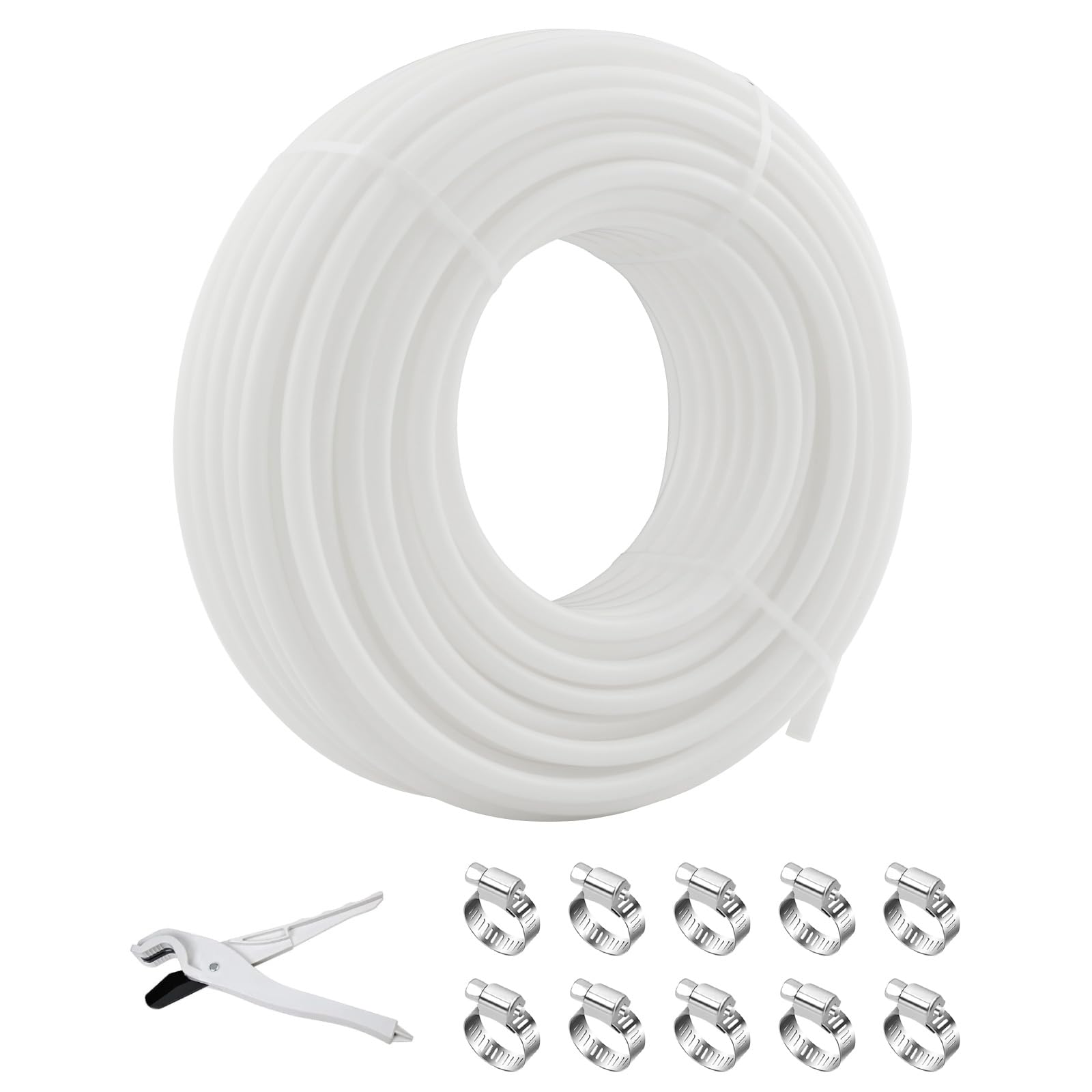
1. PEX Pipe 3/4 Inch 300ft 1 Rolls Oxygen Non-Barrier PEX Tubing EVOH Pex-B
Our pick — over 4.5★ from 500+ verified ratings; the strongest balance of quality and price.
The 300-foot monster coil that undercuts the big-box stores by a country mile.
You get 300 feet of PEX-B pipe in one roll, so you avoid three separate 100-foot trips to the hardware store — and buyers report the price is “over half off box stores.” It handles the full range of residential temperatures, rated from -40°F to 203°F, with pressure tolerances of 160 psi at 70°F and 100 psi at 180°F (so it works for both cold supply lines and hot water recirculation). A 5-inch bending radius lets you loop it around tight floor joists without forcing a kink, and the smooth inner wall keeps water moving freely even on long runs.
The non-barrier (EVOH) construction means this is not designed to keep oxygen out of a closed radiant loop — it is intended for open-loop radiant heating, potable water, and general plumbing where oxygen ingress is not a concern. A pipe cutter and 10 tube clamp rings arrive inside the box, so you can start your first connection without a separate trip to the tool drawer.
The data sheet does not list an outside diameter or wall thickness, so you will want to confirm fitment with push-to-connect fittings if that is your preferred method. The saying goes: “Saved vs hiring.”
Why This Roll Wins
- 300 feet at a per-foot cost that beats nearly every competitor — verified by owners comparing to local stores
- -40°F freeze tolerance makes it viable for unheated crawlspaces and seasonal cabins
- Bundled pipe cutter and clamps let you start the job immediately
One Honest Caveat
- Non-barrier pipe is not suitable for closed-loop radiant systems that require oxygen-blocking layers
- Without an OD or wall-thickness spec on the listing, you should test a push-fit fitting before committing to a full installation
Reach for it if: you are plumbing an entire house or a large radiant floor system and want the lowest cost per foot from a single roll, with PEX-B crimp connections you already know.
Look elsewhere if: you need an oxygen-barrier pipe for a closed-loop boiler system or you prefer the cold-expansion connection method of PEX-A.
2. SharkBite 3/4 Inch x 100 Feet Blue PEX-A, Made in the USA
The brand every hardware aisle knows, now in a 100-foot expansion-ready PEX-A coil.
SharkBite built its reputation on push-to-connect fittings, and this pipe works perfectly with that system — but it also works with cold expansion (F1960, a method where you stretch the pipe to fit over a fitting), plastic crimp, and brass crimp methods. The pipe is PEX-A, meaning you can stretch it with an expansion tool to accept a fitting, then it shrinks back for a continuous-bore connection that improves water flow. It weighs 10.3 pounds for the 100-foot coil, but carries a noticeably thicker nominal wall at 0.097 inches versus 0.075 inches — that translates to long-term burst resistance.
The pipe handles up to 200°F at 80 psi, or 160 psi at cooler temperatures between 33°F and 70°F. It is certified under ASTM F2023 for oxidative resistance in recirculating hot water loops, and has a six-month UV tolerance — enough to survive a partially exposed supply run while you finish the wall. The flexibility is the most-discussed trade-off: some owners find PEX-A easier to bend than standard PEX-B, while others note it feels stiffer than expected. That stiffness is actually a sign of the thicker wall doing its job.
What you are paying for here is the engineering pedigree. SharkBite pipe is USA-manufactured and the company stands behind its system compatibility — if you are already using SharkBite fittings or plan to use their expansion tool, sticking with the same brand eliminates any fitment guesswork.
Why Pros Stick With It
- Thicker 0.097-inch wall compared to 0.075-inch budget PEX-B means better resistance to pinhole leaks over decades
- Six-month UV rating means accidental sun exposure during a renovation won’t ruin the run
- Compatible with expansion, push-to-connect, and every crimp style — you are not locked into one system
The Flexibility Catch
- Some owners find it stiffer than other PEX-A brands, which makes tight-radius bends more forceful
- Premium price compared to generic PEX-B rolls — you pay for the brand guarantee and thicker wall
Best for: homeowners and plumbers who want the thickest wall available in a 100-foot coil and plan to use expansion or push-fit connections for a future-proof, leak-resistant system.
Think twice if: your project is a simple exposed run where budget PEX-B and a crimp tool do the same job for half the cost.
3. VEVOR PEX Pipe 3/4 Inch, 100 Feet Non-Oxygen Barrier PEX-B

The entry-point roll that costs less than two bags of concrete and does the same job as premium coils.
At for 100 feet of 3/4-inch PEX-B, this VEVOR roll is the price anchor of the lineup. The pipe is made from polyethylene (PE) and rated from -40°F to 203°F, handling 80 psi at 200°F and 160 psi at 73°F. The outside diameter is 0.88 inches and the nominal wall is 0.075 inches — so it is the slightly thinner, more flexible cousin to the SharkBike PEX-A on the thicker wall. A dedicated pipe cutter and ten stainless-steel clamps come in the box, so you can start crimping immediately.
What the numbers do not capture is the owner feedback: quality and value for money are the two most-praised aspects, with 15 owners singling out the build quality and 13 calling out the price. One owner wrote that they “saved us at least ” by buying two rolls instead of sourcing locally. The pipe is marked with its type, diameter, and production date along the length, which is a small touch that helps identify the run years later if you do a modification.
The trade-off is that PEX-B does not expand; you need a crimp ring or clamp tool to make connections. Compared to the thicker 0.097-inch wall on the SharkBite, this 0.075-inch wall still meets the ASTM standards for potable water, but it is not the choice for a high-pressure recirculating loop where every thousandth of an inch of wall thickness adds longevity. For a straightforward water line to a new bathroom or an RV hookup, this is the most sensible economic play.
The Value Verdict
- Lowest price per 100-foot roll in the roundup — owners consistently say it undercuts local suppliers
- Full temperature range (-40°F to 203°F) matches premium brands at a fraction of the cost
- Includes cutter and clamps so the bundled cost is even better than it looks
The Practical Limit
- Thinner wall (0.075 inches) means less safety margin in high-temperature, high-pressure recirculating systems
- PEX-B requires a separate crimp tool — not compatible with the expansion method some DIYers prefer
Reach for it if: you are on a strict budget, already own a PEX-B crimp tool, and need a reliable 100-foot roll for standard hot/cold potable water or an outdoor project.
Look elsewhere if: you need the thicker wall of PEX-A for a high-stress recirculating loop, or you plan to use expansion fittings.
4. EFIELD Pex-A Pipe/Tubing Blue & Red 3/4 inch 2 x100 ft (200 ft)

Two 100-foot coils in the colors that instantly tell you hot from cold.
EFIELD sells pipe directly from one of the bigger PEX manufacturers, and this bundle gives you a 100-foot blue coil for cold water and a 100-foot red coil for hot water, plus a pipe cutter. The outside diameter comes in at 0.75 inches — a 17% smaller OD than the VEVOR’s 0.88 inches, meaning these EFIELD coils are dimensionally tighter and may seat differently in push-fit connectors that expect the larger 0.875-inch standard. The pipe is PEX-A, so it is compatible with expansion connections (F1960) as well as barb crimp, clamp, or sleeve methods.
The color coding is the standout feature here. Blue pipe for cold, red pipe for hot — no need to mark runs with tape or remember which line goes where years later. The owner feedback is overwhelmingly positive, with 17 reviews highlighting quality and 5 pointing to functionality. One buyer re-piped an entire old house with these coils and called them excellent value. Another noted that the pipe “expands just like the name brand stuff” at a much better price — a direct comparison that suggests EFIELD is trading on manufacturing capability rather than marketing spend.
The listing does not publish a maximum temperature or pressure rating, which is a meaningful omission for anyone planning a high-temp radiant floor system. If you are running standard domestic hot water (typically 120°F to 140°F), the lack of a published spec is less concerning. The included cutter is a basic tool that works fine for a few cuts but will dull fast on a full 200-foot install.
Why Two Colors Matter
- Instant visual identification of hot vs cold — eliminates labelling errors during install and future servicing
- True PEX-A material that expands for full-bore connections with no flow restriction
- Manufacturer-direct pricing that undercuts name-brand PEX-A coils
The Missing Spec
- No published temperature or pressure range, so you are trusting the material standard compliance (ASTM F876) rather than a verified max
- Smaller 0.75-inch OD may not be compatible with all push-fit fittings designed for the standard 0.875-inch OD
Best for: a whole-house repipe where color coding saves time and you plan to use expansion fittings for full water flow — especially if you want PEX-A without paying the SharkBite premium.
Think twice if: you rely on push-fit connections that expect a 0.875-inch OD, or you need a published temperature rating for a high-temp radiant system.
5. EFIELD 3/4 Inch 100 ft Pex A Pipe/Tubing BLUE Color

The single 100-foot PEX-A coil for a focused project that does not need two colors.
If you only need a cold-water run — say, a new supply line to an outdoor spigot or a basement utility sink — this EFIELD 100-foot blue coil is the same PEX-A material as the two-color bundle above, but in a single roll. The pipe is 3/4-inch with an OD (outer diameter) of 0.75 inches and is rated to 160 psi (pounds per square inch, a measure of pressure it can handle). It meets a long list of ASTM standards (F876, F877, F1807, F1960, F2023, F2080, F2169), which covers everything from dimensional specs to chlorine resistance and oxidative stability.
Owners note that the PEX-A stretcher (expansion tool) works well with this pipe, and a few mention that the included pipe cutter performs adequately but is nothing special. The pipe is blue throughout, so there is no confusion about which line is cold when you run it alongside a separate hot line. One buyer picked it specifically “because of the length and color” and confirmed the quality was good.
What is missing: like its bigger sibling, this listing does not publish a maximum operating temperature. That omission is tolerable for a cold-water line but note if you intend to use it for a mixed hot-and-cold application. At 100 feet, this coil hits the balance for a single-room addition or a short radiant loop where you do not want to wrestle with a massive 300-foot spool.
Best reachable target: the DIYer who needs exactly 100 feet of blue PEX-A for a cold-water expansion project and wants the simplest, most straightforward coil available — no extra colors, no unnecessary length to store.
The one shortcoming: no published temperature rating means you should reserve this for cold potable water or verify with the seller before mixing it into a hot loop.
6. Happybuy 3/4″ PEX Tubing 300Ft Non-Barrier PEX Pipe Blue

The 300-foot non-barrier coil with the highest temperature rating on the list — 230°F.
Happybuy claims a maximum operating temperature of 230°F and a pressure range of 188-217 psi at 20°C (68°F) — figures that outpace every other pipe in this comparison by 27°F on the high end. That extra headroom matters for radiant floor systems where the boiler output can spike, or for solar thermal loops that run hotter than standard domestic water. The pipe is PEX-B with a nominal wall of 0.2 inches, a 0.83-inch OD, and a 7-inch minimum bend radius; it is stiffer than PEX-A but capable of handling structural concrete slabs and staple-up between joists.
Owner feedback centers on value for money (10 mentions) and quality (9 mentions). One buyer called it a “bargain price” and another said the quality is “really good” for the cost. The included pipe cutter works fine, but the clamps that come in the box are basic and one owner noted they are essentially useless without separate connectors — plan to buy your own crimp rings or stainless clamps. The coil is 33 pounds, so unrolling it takes two people or a solid anchoring point to prevent the pipe from springing back.
This is a non-barrier pipe, meaning it does not have an oxygen-diffusion layer. For closed-loop radiant systems where oxygen ingress can corrode the boiler, you need an EVOH-barrier pipe — the regular PEX-B here is best for open-loop systems or potable water applications where oxygen is not a concern.
The Heat Advantage
- Rated to 230°F and 188-217 psi at 68°F — the highest published temperature tolerance in the lineup
- 300-foot length covers multiple radiant zones from a single coil, reducing joint count
- 7-inch bend radius is acceptable for most staple-up and slab installations
Non-Barrier Limitation
- Not suitable for closed-loop radiant systems that require oxygen barrier (EVOH) to protect the boiler
- Basic clamps included are inadequate — you will need to buy separate crimp rings or stainless clamps
Reach for it if: you are installing an open-loop radiant floor system or a solar hot water circuit where the water temperature will regularly exceed 200°F.
Look elsewhere if: you need an oxygen-barrier pipe for a closed boiler loop, or if you prefer the flexibility of PEX-A for tight-radius bends.
7. Pex-A Tubing – 3/4″ x 500 Ft Coil; Non-Barrier Water Tube for Plumbing, White (SupplyGiant)
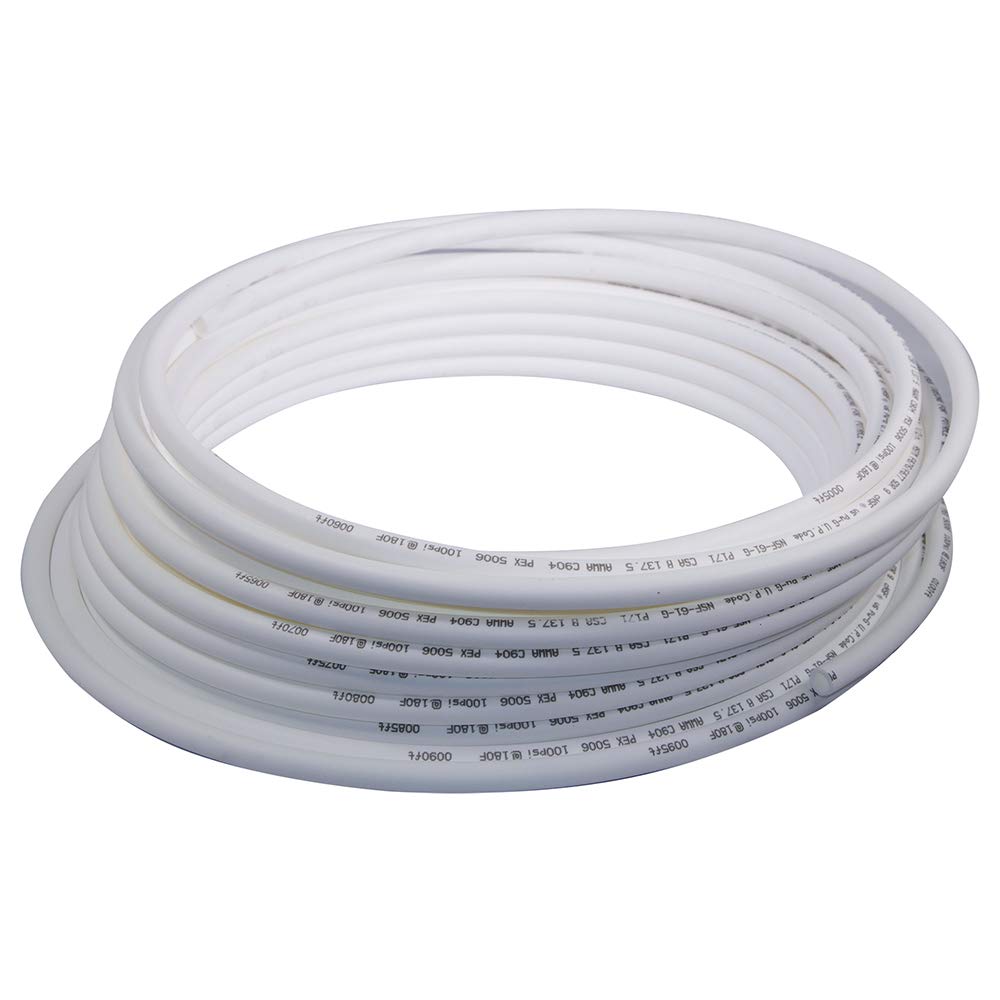
The half-thousand-foot PEX-A coil for plumbers who hate making unnecessary joints.
When you need to run a single continuous line across a large building — a warehouse, a large house with a slab foundation, or a multi-zone radiant system — a 500-foot coil means fewer fittings, fewer potential leak points, and faster installation. This SupplyGiant PEX-A coil is 3/4-inch with a 0.671-inch inner diameter and a 0.875-inch outer diameter, which matches the standard OD for push-fit connectors. The pipe is rated at 160 psi at 73°F and 80 psi at 200°F, meeting ANSI, ASTM, and CSA standards — the certifications are marked every 5 feet along the tube.
PEX-A is the most flexible type of PEX, and this coil can bend to a radius as tight as 3-1/2 inches for 1/2-inch tubing (the spec for 3/4-inch is larger but still generous). That flexibility means fewer support brackets and easier snaking through tight chases. Because it is PEX-A, it can be expanded with a cold-expansion tool for full-bore connections. It also carries a freeze-resistant property — the material can expand slightly and recover, reducing the chance of a burst in a cold snap.
The honest downside: this is the most expensive single coil in the roundup, and at 500 feet it is physically large and heavy. You need a dedicated un-spooler or a second pair of hands to prevent the pipe from tangling. A few owners note that the white color is less intuitive than the industry-standard blue-for-cold, red-for-hot convention, so you will want to label your runs. That said, one owner called it “the best for freezing temps too” and said it is the “smartest way to plumb your buildings” — a sentiment that captures why a pro would choose a single massive PEX-A roll over multiple smaller ones.
The Continuous-Run Edge
- 500 feet of PEX-A eliminates up to 5 separate joints vs using 100-foot rolls, reducing leak risk
- Expansion-ready PEX-A material recovers from freezing better than stiffer PEX-B
- Codes and standards printed every 5 feet for easy inspection compliance
The Scale Challenge
- Significant upfront cost and requires careful un-spooling to avoid kinking the massive coil
- White color lacks intuitive hot/cold identification — you must label or mark it yourself
Best for: professional plumbers or serious DIYers tackling a whole-house or commercial project where continuous runs of PEX-A improve water flow and reduce joint count.
Think twice if: your project is under 200 feet — a smaller spool is more manageable and costs less upfront.
Understanding the Specs
PEX-A vs PEX-B: The Connection Difference
PEX-A (Engel method) is made by crosslinking polyethylene during the extrusion process, which creates a more flexible pipe that can be expanded with a hand tool. You insert a fitting, the pipe shrinks back, and you get a full-bore connection that does not restrict water flow. PEX-B (silane method) is stiffer and uses a chemical crosslinking process after extrusion. It requires crimp rings or stainless-steel clamps. PEX-A is generally considered more forgiving in cold weather and more resistant to kinking, but PEX-B is cheaper and works perfectly well when installed correctly.
Oxygen Barrier (EVOH) vs Non-Barrier
An oxygen-barrier PEX pipe has a thin EVOH (ethylene vinyl alcohol) coating that prevents oxygen from diffusing through the pipe wall and into the water. This is critical for closed-loop radiant heating systems because oxygen in the water can corrode the metal components of the boiler and circulator pump. Non-barrier pipe (most standard PEX) is fine for potable water and open-loop systems where oxygen does not accumulate. If you are buying pipe for a radiant floor system with a metal boiler, check the listing for “EVOH” or “oxygen barrier” — otherwise you risk premature boiler failure.
FAQ
What is the difference between PEX-A and PEX-B for 3/4-inch pipe?
Can I use 3/4 PEX pipe for both hot and cold water?
Is a 500-foot coil too big for a beginner?
What fittings are compatible with 3/4 PEX pipe?
How do I straighten PEX pipe that comes in a tight coil?
Can 3/4 PEX pipe be buried underground or under concrete?
What is the maximum pressure for 3/4 PEX pipe at high temperature?
Should I get an oxygen-barrier PEX pipe for a radiant floor system?
Final Thoughts: The Verdict
For most people, the 3/4 pex pipe winner is the PEX Pipe 3/4 Inch 300ft (non-barrier) because it delivers the lowest per-foot cost in the comparison while maintaining the full -40°F to 203°F temperature range, and it includes a cutter and clamps so you can start the job without a second trip. If you prefer PEX-A for expansion connections and want the thickest possible wall, grab the SharkBite PEX-A 100 ft. And for a two-color bundle that simplifies hot and cold identification at a glance, the EFIELD Pex-A 200 ft (Blue & Red) is the one to reach for.
How We Picked
We do not accept paid placement. Every pick is matched to a real buyer and a real use-case; we do not hands-on test units.
Sources & Methodology
Specifications: manufacturer listings and product documentation. Review insights: verified customer reviews, as of July 2026. Pricing: not shown on this page (it changes often); check the current price via the retailer link.
As an Amazon Associate, Gadgets Feed earns from qualifying purchases. This does not affect which products we feature.