
Our readers keep the lights on and my morning glass full of iced black tea. As an Amazon Associate, I earn from qualifying purchases.
Specs are compiled from manufacturer listings and verified buyer reviews and can change over time — please confirm the key details on the product page before buying.
If your pipes rattle, your water heater relief valve drips, or your washing machine hammers when it fills, your house is telling you the incoming pressure is too high. A 3/4 pressure reducing valve (a device that sits on your main water line and trims high city pressure down to a safe, steady level) fixes that, and you do not need a plumber to install one. This guide compares the top regulators by build quality, adjustability, and how easily they service, so you can buy the right one the first time.
I’m Min — the founder and writer behind Gadgets Feed. This guide is built by comparing the manufacturers’ published specifications and the patterns across verified customer reviews, so you get each pick’s real strengths and trade-offs instead of marketing spin.
Find the right fit for your home’s plumbing with honest breakdowns of the best 3/4 pressure reducing valve options on the market.
Our Picks at a Glance

How To Choose The Best 3/4 Pressure Reducing Valve
Before you click buy, know that not every regulator on this list connects the same way. Some use standard threaded NPT fittings, some use push-to-connect for PEX, and some are built specifically for PEX-B barb connections. You need to match the connection type to your existing pipes, or you will be buying adapters before you finish the job.
Check the Pressure Range First
Every valve has a setpoint range, and yours should cover your home’s needs. Most are factory-set at 50 psi, but the range matters: a valve adjustable from 25 to 75 psi gives you room to dial in the exact pressure your appliances want. If your street pressure sits near 120 psi, make sure the valve’s maximum rating handles it before the water even hits the regulator.
Look for a Serviceable Design
You are not buying this valve for a single season — you want one you can rebuild a decade from now. Cartridge-style valves let you swap the internal working parts without removing the whole body from the pipe. Traditional spring designs may need a full replacement kit or an entirely new valve when the diaphragm wears out.
Quick Comparison
| Model | Best For | Pressure Range | Connection Type | Weight | Amazon |
|---|---|---|---|---|---|
| Watts LF25AUB-Z3★ Best Overall | Whole-home durability | 25 to 75 psi | 3/4″ NPT Female Union | 3.3 pounds | Amazon |
| CMI Push ConnectEasiest Install | Fast DIY install | — | 3/4″ Push Connect / PEX | — | Amazon |
| Cash Acme EB45 | Compact replacements | 10 to 70 psi | 3/4″ FNPT Single Union | 1.3 pounds | Amazon |
| Apollo APXPRV34WG | Tool-less adjustments | 15 to 75 psi | 3/4″ PEX-B Double Union | — | Amazon |
| Watts 0009589 | Backflow + reduction | 25 to 75 psi | 3/4″ NPT Union x NPT Female | 2 pounds | Amazon |
| Zurn Wilkins 34-70XL | Contractor-grade build | 25 to 75 psi | 3/4″ Union | 1.8 pounds | Amazon |
| Zurn Wilkins 34-600XL | Precise pressure holding | — | 3/4″ FNPT Union | 2 pounds | Amazon |
In‑Depth Reviews
1. Watts LF25AUB-Z3 Lead-Free Water Pressure Reducing Valve 3/4″ NPT
Our pick — over 4.5★ from 950+ verified ratings; the strongest balance of quality and price.
The heavy-duty replacement that owners say outlives the original regulators it swaps out.
This Watts valve is the pick for anyone who wants a regulator that feels built for the long haul, not just the install day. Buyers report swapping out failed 1966 Watts valves with this one and eliminating water hammer on the first try.
The standard setting of 50 psi (345 kPa) covers most homes, and you can adjust anywhere from 25 to 75 psi. What sets this apart is the bypass feature: when thermal expansion on the outlet side pushes pressure above the main supply, the valve lets water flow backward into the main instead of stressing your water heater. The lead-free copper silicon alloy body, stainless steel strainer, and replaceable seat module mean the internals you might one day need to swap are actually available.
Installation gets consistent praise as a do-it-yourself job, with owners completing the swap in under 30 minutes using two wrenches. The one honest caveat from buyers is durability — reviews are split between “made to last” and “doesn’t last very long,” with a few reporting roughly six years before needing a second unit. If your old valve survived decades, this should feel like an upgrade; if you want absolute confidence, the Zurn below may serve you better.
What wins people over
- Bypass feature protects water heater from thermal expansion pressure
- Replaceable seat module means rebuilds, not full replacements
- Owners find it easy to adjust and leak-free after install
What to weigh
- Durability reports are mixed — some owners replace it around the six-year mark
- Heavier and bulkier than compact rivals at 3.3 pounds
Reach for this if: you want a full-featured regulator with thermal expansion protection and an easy path to future repairs.
Look elsewhere if: you need a valve that fits into a cramped space — the 6 x 3 x 6 inch body takes up room.
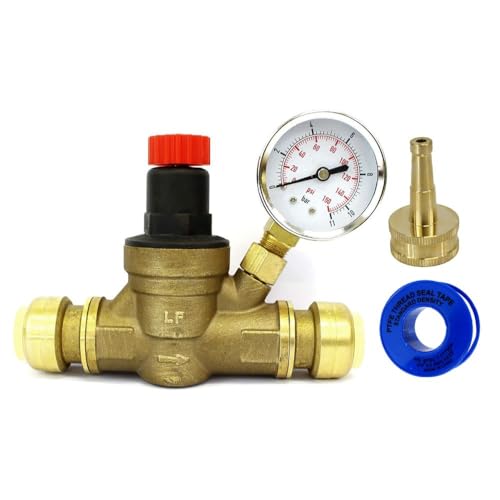
2. CMI Inc 3/4 in Push Connect Water Pressure Regulator Valve with Test Gauge
A push-to-connect regulator with a live pressure gauge, built for weekend DIYers.
If the words “pipe thread” and “Teflon tape” make you nervous, this is the regulator for you. Instead of wrestling with wrenches, you push it onto your 3/4″ PEX or CPVC pipe and it locks in place. It is marketed for RVs and campers, but owners mention installing it in full-size homes — “Says it’s for camper or rv but I installed in my 2800 sq ft house and it works flawlessly,” as one buyer puts it.
The integrated pressure gauge is the real standout here, displaying live pressure so you can watch the needle settle as you adjust. It displays the pressure constantly, so you can watch the needle settle as you turn the adjustment. Owners note it holds steady at 60 PSI static and 50 PSI working pressure, and the adjustment stays put after a week of use. The brass body carries a maximum pressure rating of 160 psi, which covers most municipal and well systems.
The catch is connection compatibility — this unit works on CPVC and PEX at 3/4″, but not on white PVC, which has a slightly different diameter. This unit works on CPVC and PEX at 3/4″, but not on white PVC, which has a slightly different diameter. Push-to-connect fittings also demand a clean, square pipe cut, so prepare the end properly before you push. If you have threaded copper pipes, this is not the valve for you — you would need adapters that defeat the simplicity.
The easy-win features
- Built-in gauge shows live pressure with no extra tools
- Push-to-connect install works on 3/4″ PEX and CPVC
- Handles up to 160 psi maximum pressure
The fit notes
- Not compatible with white PVC pipe
- Push-connect requires a clean, square cut on the pipe
Grab it if: you want the fastest possible install with a gauge you can read at a glance.
Pass if: you have threaded copper or white PVC — this valve needs PEX or CPVC to work.
3. Cash Acme 3/4 Inch EB45 Single Union Pressure Regulating Valve, 45 PSI
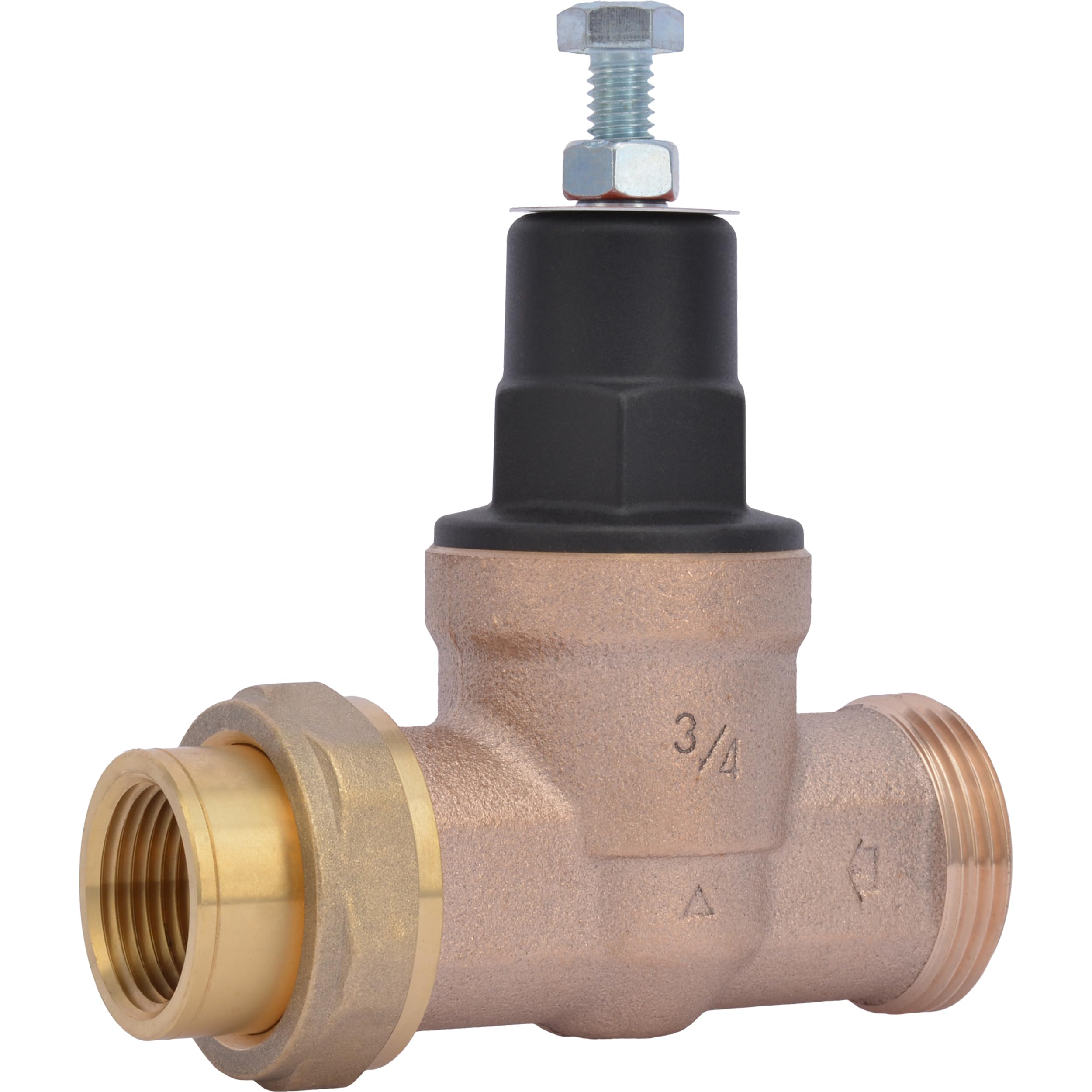
A pint-sized bronze regulator that fixes high pressure without taking over your pipe run.
At 1.3 pounds and about 2.25 x 5 x 5.5 inches, this Cash Acme is the featherweight of the group — roughly 2 pounds lighter than the Watts LF25AUB-Z3 above. That small footprint makes it the go-to when your main line is buried in a tight crawlspace or tucked against a wall. Despite the size, it is built from durable lead-free bronze and uses a patented half-cartridge design, meaning you get cartridge-style servicing benefits without the bulk.
It ships set to 45 PSI and adjusts anywhere from 10 to 70 PSI, which is a wider low end than most rivals — handy if you want to drop pressure hard for a boiler or irrigation system. Owners have used it as a boiler regulator replacement and to tame incoming pressure. In one dramatic case, a buyer’s pressure test showed 105 psi coming into the house, flooding an ice machine; this valve installed perfectly and solved it at a fraction of the cost of the premium valve at the hardware store.
The trade-off is simplicity. This is a basic unit with no debris screen, and the union comes on only one end — a few owners wish both ends had unions so the valve could spin out more easily for service. It is rated for hot water up to 180 degrees F, so it works on both cold and hot lines. If you want the smallest possible footprint with a wide adjustment range, this is the one.
Why it earns its spot
- Compact body fits tight spaces other valves cannot
- Wide 10 to 70 psi adjustment range
- Lead-free bronze construction rated to 180 degrees F
The honest limits
- No debris screen included
- Single union design means one end is harder to service
Choose it if: space is tight and you want a wide, low-end adjustment range in a lightweight bronze body.
Think twice if: you want a debris screen for well water or dual unions for easy future service.
4. Apollo Valves ApolloPEX 3/4″ Bronze Double Union PEX Regulator with Gauge

A PEX-B regulator with a color-coded gauge and no-tool adjustment for quick dialing.
This Apollo is built specifically for PEX-B piping systems, using a double union PEX-B barb design that makes installation fast and straightforward if your home is plumbed in PEX. The integrated internal bypass mechanism handles thermal expansion, and the color-coded gauge is designed to reduce adjustment errors — you can see at a glance where the pressure sits. It is factory-set at 50 psi and adjustable from 15 to 75 psi, and certified to ASSE 1003 and CSA B356.
The tool-less adjustment is the feature that gets the most compliments — you turn the dial by hand instead of hunting for a wrench, and clockwise raises pressure while counter lowers it.
The downside here is the reliability record is not spotless. While many owners love it, a notable share report the valve stops regulating pressure after a couple of months or develops leaks, and the value-for-money sentiment is mixed. One dramatic failure review describes the housing blowing apart after six months, though the buyer also noted the seller’s legitimacy was questionable. If you want the convenience of tool-free tuning in a PEX system, this delivers — just buy from a reputable seller and check the warranty.
The convenience wins
- No tools needed to adjust pressure
- Color-coded gauge reduces tuning errors
- Double union PEX-B design installs fast
Where it gets mixed
- Some units reportedly fail to regulate pressure after two months
- Leakage reports appear in a minority of reviews
Best for: PEX-B homes where hand-turning a dial beats digging out a wrench.
Be cautious if: you need absolute long-term reliability — some customers note early failures, so check your seller.
5. Watts Backflow Preventer 3/4 In Water Pressure Reducing Valve, NPT Thread Union
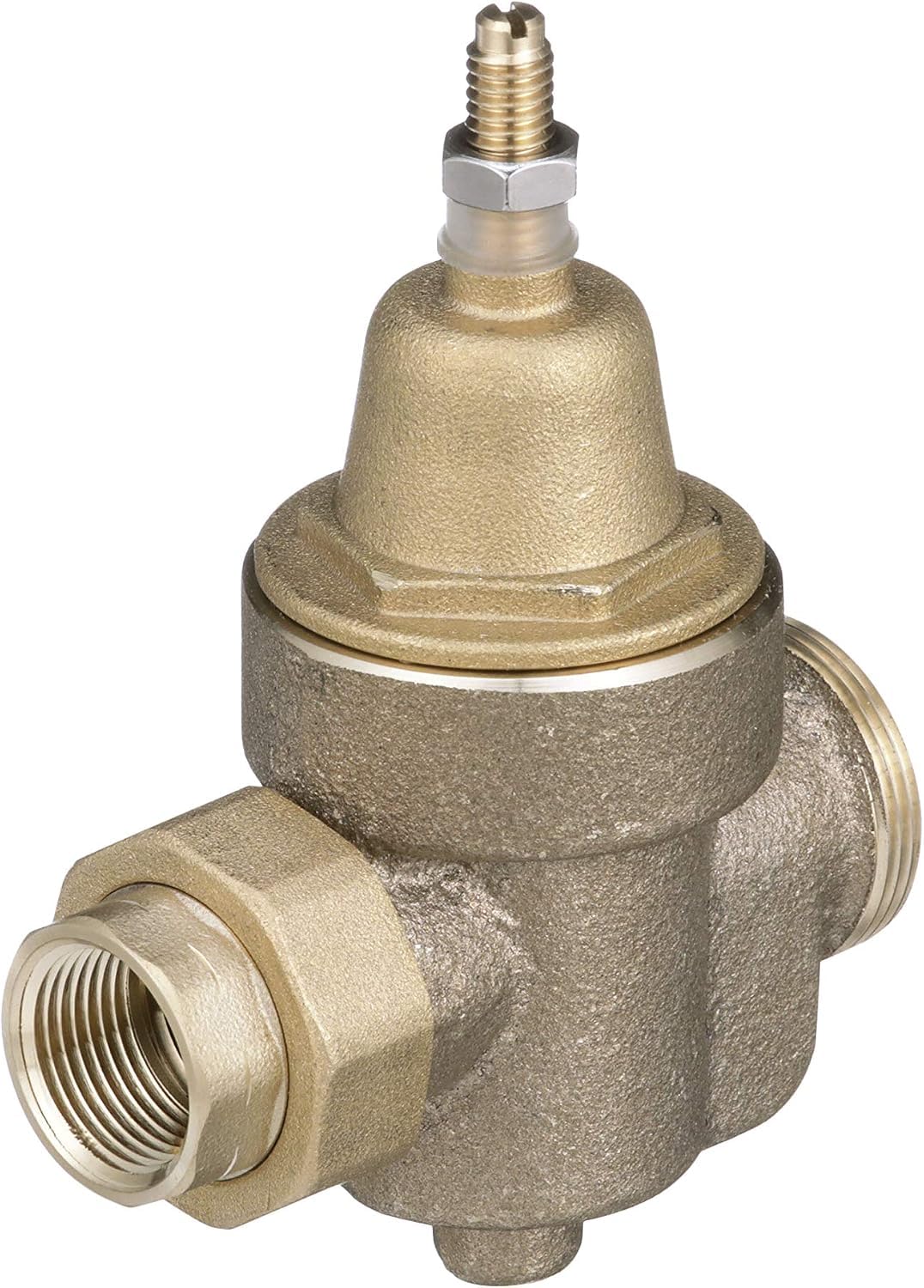
A dual-duty valve that stops backflow and trims pressure in one heavy brass package.
This Watts unit is the workhorse for outdoor waterworks and pit installations, combining pressure reduction with backflow prevention in a single assembly. It is built from lead-free copper silicon alloy with a removable integral stainless steel strainer and a bronze-sealed spring cage, and it handles a maximum working pressure of 400 psi. The operating range spans 33 degrees F to 180 degrees F, so it shrugs off freezing outdoor temps and hot water alike.
Adjustment runs from 25 to 75 psi with a standard setting at 50 psi. Owners describe it as an exact match to original regulators, with one noting a factory-verified 50 psi setpoint and a three-minute install. It is rated for pressures up to 400 psi — a higher ceiling than most home regulators — making it a solid pick if you are on a steep hill or have aggressive municipal pressure spikes.
The honest caveat is that the backflow prevention feature gets mixed feedback, with several owners noting it does not fully prevent backflow on its own. If your municipality requires a dedicated backflow preventer, this may not be a substitute for a true double-check assembly. Also, one owner found the included fastening hardware mismatched and reused their existing nuts. For a straightforward pressure reduction with a high-pressure ceiling, it is excellent.
What stands out
- 400 psi maximum working pressure handles aggressive systems
- Removable stainless steel strainer protects the valve internals
- 33 to 180 degrees F operating range for outdoor use
What to double-check
- Backflow prevention is mixed — not a true substitute for a dedicated backflow device
- Included fastening hardware may not match your setup
Pick this if: you need pressure reduction with a high pressure ceiling for outdoor or pit installations.
Skip if: your goal is true backflow prevention — this is primarily a pressure regulator.
6. Zurn Wilkins 34-70XL 3/4″ 70XL Pressure Reducing Valve
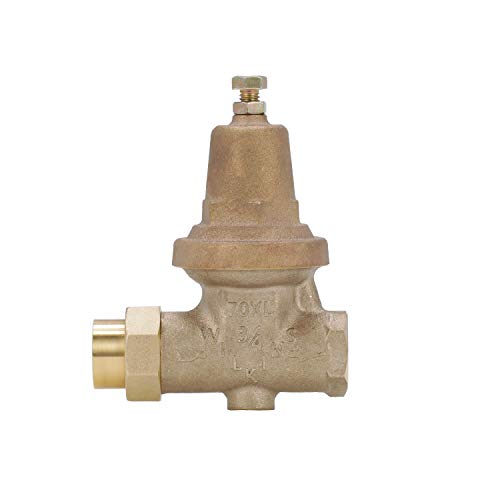
A contractor-grade cartridge valve trusted for decades, with rebuild kits that stay available.
The Zurn Wilkins 34-70XL is what plumbers reach for when they want a regulator that will not come back to haunt them. It is a trusted contractor favorite with over 40 years of field use, listed by ASSE 1003 and IAPMO, and CSA certified. The cartridge design means the working parts slide out for service without removing the valve body — a huge time-saver if you ever need to rebuild it, and owners specifically note that rebuild kits remain available for the long term.
The lead-free bronze and composite construction resists corrosion, which matters if your water is aggressive or you live in a coastal area. Reviewers point out it as an exact replacement for failed regulators, with one swapping out a 12-year-old Cash Acme on a Hawaii property where county pressure runs around 110 PSI. Adjustment runs from 25 to 75 psi and users find it easy to set, with several completing the swap in five to twenty minutes.
It weighs 1.8 pounds and spans about 4.63 x 2.75 x 6 inches, a middle ground between the compact Cash Acme and the beefier Watts. The one thing to know: this is a pressure reducer, not a backflow preventer, so do not expect contamination protection. For a plain, dependable, serviceable regulator that plumbers trust, this is about as safe a bet as exists.
The professional edge
- Cartridge design with widely available rebuild kits
- Corrosion-resistant lead-free bronze and composite build
- ASSE 1003 and IAPMO listed, CSA certified
The fit note
- Not a backflow preventer — reduction only
- Stainless steel finish shows the metal more than brass rivals
Reach for it if: you want a serviceable, contractor-grade regulator that you can rebuild in place for decades.
Look past it if: you specifically need backflow prevention built into the same valve.
7. Zurn Wilkins 34-600XL 3/4″ 600XL Pressure Reducing Valve
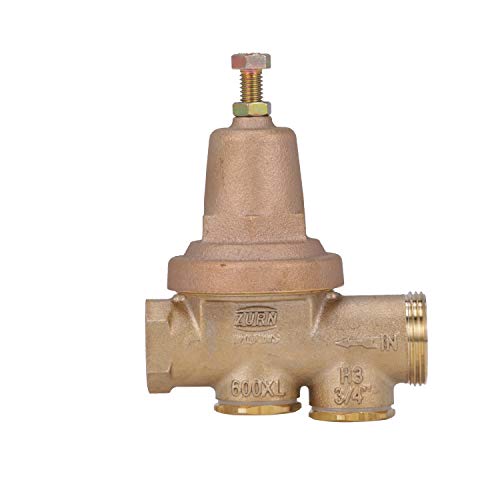
The precision regulator that holds steady pressure where lesser valves let it sag.
This is the valve you buy when you are tired of watching pressure drop every time someone opens a faucet. The 34-600XL is the upgraded step up from the 70XL, with a balanced design that keeps outlet pressure stable even when inlet pressure or flow changes. The stainless steel strainer screen removes with a single cap for easy cleaning, and the fiber union gasket speeds up installation. It is built from solid bronze and carries a 1-year limited warranty.
Shoppers say a dramatic difference in pressure stability, with one noting the valve loses only a couple of PSI even with three faucets running. One buyer replaced a Cash Acme EB45 that dropped 20 PSI whenever a bathroom faucet opened — this Zurn loses only a couple of PSI even with three faucets running. That is the defining strength here: consistent pressure that protects appliances and gives you a satisfying shower no matter what else is running in the house. It is described by owners as “the gold standard used by my water utility,” with one noting it still worked flawlessly after five years with zero attention.
The catch is cost and complexity. This is the premium-tier pick, priced accordingly, and it connects via FNPT union and FNPT female threaded, so it is not a push-to-connect or PEX-B affair. If precision pressure holding matters more than saving a few dollars, and your pipes are threaded, this is the most reliable choice on the list. Owners consistently say the install is easy and requires no custom work.
Why it earns the premium
- Balanced design holds pressure steady under multiple faucet loads
- Stainless steel strainer screen with single-cap removal
- Solid bronze construction owners trust for years
The honest trade-offs
- Premium price tag for the precision performance
- Threaded FNPT connection only — no PEX push-fit option
Buy it if: you want flawless pressure stability and are willing to pay for the precision.
Save elsewhere if: you need push-to-connect convenience or a lower entry price.
Understanding the Specs
Pressure Range and Bypass
The adjustment range — typically 25 to 75 psi, with some going as low as 10 psi — is the heart of the valve. A factory setting of 50 psi works for most homes, but the range lets you fine-tune. The bypass feature is the quieter hero: it lets water flow backward through the valve when thermal expansion on the outlet side exceeds the main supply pressure, protecting your water heater from excess pressure buildup.
Connection Type and Materials
Match the connection to your pipes: NPT threaded for copper, push-to-connect or PEX-B barb for plastic tubing. Materials matter for longevity — lead-free bronze resists corrosion in aggressive water, brass offers durability in standard conditions, and stainless steel strainers protect the internals from debris. A cartridge design means you can rebuild the valve body without removing it from the line.
FAQ
What does the bypass feature on a pressure reducing valve do?
Will a 3/4 pressure reducing valve fit my existing copper pipes?
How long does a pressure reducing valve typically last?
What is the difference between a cartridge valve and a traditional spring valve?
Can I install a pressure reducing valve myself or do I need a plumber?
What pressure should I set my regulator to?
Is a pressure reducing valve the same as a backflow preventer?
Will a pressure reducing valve help with water hammer noise?
Can a pressure reducing valve be used on hot water lines?
What does ASSE 1003 certification mean for a pressure reducing valve?
Final Thoughts: The Verdict
For most buyers, the 3/4 pressure reducing valve winner is the Watts LF25AUB-Z3 because it pairs the bypass feature that protects your water heater with an easy path to future repairs. If you want tool-free tuning in a PEX-B system, grab the Apollo APXPRV34WG. And for flawless pressure stability that outshines the rest, the Zurn Wilkins 34-600XL is the one to reach for — buyers report it holds pressure even when three faucets run at once.
How We Picked
We do not accept paid placement. Every pick is matched to a real buyer and a real use-case; we do not hands-on test units.
Sources & Methodology
Specifications: manufacturer listings and product documentation. Review insights: verified customer reviews, as of August 2026. Pricing: not shown on this page (it changes often); check the current price via the retailer link.
As an Amazon Associate, Gadgets Feed earns from qualifying purchases. This does not affect which products we feature.