
Finding the right outboard for a small dinghy, inflatable, or kayak means balancing weight, fuel type, and the real-world thrust needed to get on plane without overpowering a lightweight transom. A 3.5 HP outboard motor sits in the sweet spot—enough grunt to push a tender or fishing skiff at cruising speed, yet light enough to lift and stow without a second thought.
I’m Min — the co-founder and writer behind Gadgets Feed. After comparing displacement, shaft lengths, gear ratios, and real customer break-in reports across the entry-level to premium electric spectrum, I’ve filtered down the options that actually deliver reliable starts and consistent performance on the water.
This guide examines the best contenders for your next purchase, breaking down which model truly earns the title of the best 3.5 hp outboard motor for your specific boating scenario.
How To Choose The Best 3.5 HP Outboard Motor
Selecting the right 3.5 HP outboard means understanding your boat’s transom height, preferred fuel type, and how often you’ll be hauling the motor on and off the boat. Overlooking any of these three factors can turn a promising weekend on the water into a frustrating battle with cavitation, hard starts, or a motor that’s simply too heavy to lift.
Shaft Length — Short vs. Long
The most common mistake is buying a shaft that’s too long for the transom. A short shaft (15 inches) is designed for small inflatables, dinghies, and jon boats. A long shaft (20 inches) fits deeper transoms common on sailboats or taller fishing skiffs. If the anti-cavitation plate sits more than an inch above the bottom of the hull, you’ll suck air and lose thrust. Measure your transom height before you click purchase.
Fuel Type — Gas vs. Electric
Gas-powered 3.5 HP outboards give you range and the ability to carry extra fuel, but they come with noise and maintenance routines like gear oil changes and carburetor cleaning. Electric equivalents, like the Newport NT300, are whisper-quiet, instant-start, and emissions-free, but they require a dedicated 36V battery bank and limit your range to the battery’s amp-hour capacity. If you fish or explore for long days, gas wins; if you troll quietly near shore, electric is the smarter choice.
Quick Comparison
On smaller screens, swipe sideways to see the full table.
| Model | Category | Best For | Key Spec | Amazon |
|---|---|---|---|---|
| Newport NT300 Electric | Electric | Quiet trolling & tender use | 1300W / 110 lb thrust / 23.8 lb weight | Amazon |
| BJTDLLX 6.5 HP 4-Stroke | 4-Stroke Gas | Fuel-efficient weekend cruising | 123cc / 4-stroke / weight 57.3 lb | Amazon |
| BJTDLLX 12 HP 2-Stroke | 2-Stroke Gas | Heavy-duty fishing boats | 169cc / 2-stroke / integral 6.34 gal tank | Amazon |
| awolsrgiop 18 HP 2-Stroke | 2-Stroke Gas | High-speed inflatable planing | 246cc / 18 HP / 6.34 gal internal tank | Amazon |
| DNYSYSJ Hangkai 18 HP 2-Stroke | 2-Stroke Gas | Budget-friendly high-power option | 246cc / 2-stroke / 360° steering rotation | Amazon |
| Newport 10ft 6in Inflatable | Boat Bundle | Complete package with boat | 0.9mm PVC / 15 HP max / 5 person capacity | Amazon |
| Lowrance Ghost 97/120 lb | Electric Trolling | Ultra-quiet spot-lock fishing | Brushless / Digital pedal / HDI sonar ready | Amazon |
In‑Depth Reviews
1. Newport NT300 Electric Outboard Motor

The Newport NT300 is a 1300W electric outboard that delivers the equivalent thrust of a 3 HP gas motor with zero emissions and near-silent operation. Weighing only 23.8 pounds, it’s the lightest option in this lineup — a critical advantage when you’re lifting it onto a dinghy transom after a long day. The included digital throttle with LCD display gives real-time voltage and speed feedback, while the 9.8-inch two-blade composite propeller pushes most small tenders to a top speed around 6.5 MPH.
Battery requirements are an important consideration: you’ll need a 36V external battery (not included), minimum 30 Ah. With a recommended 100 Ah lithium pack, real-world runtime at full throttle is approximately two hours, while trolling speeds can stretch that to over 30 hours. The field-oriented control technology makes throttle response smooth, and the four trim positions (0°, 7°, 14°, 21°) help dial in the right planing angle.
Compared to a gas equivalent, the NT300 eliminates carburetor maintenance, fuel mixing, and pull-start frustration. It’s also short-shaft designed (24.6 inches), best suited for inflatables and small skiffs. Keep in mind that the tiller is not offset, and the propeller picks up weeds in shallower water. Still, for anyone prioritizing clean, quiet power without the fuss of gasoline, this electric outboard makes the strongest case.
Why it’s great
- Instant start, silent operation, no fumes and no maintenance beyond battery care.
- At 23.8 lb, easily portable and stowable — ideal for lightweight tenders.
- Digital LCD display provides speed, battery level, and diagnostic data.
Good to know
- Requires a separate 36V battery with minimum 30 Ah capacity.
- Short shaft length may be too long for shallow water and can pick up weeds.
- Throttle delay reported by some users — feels slightly less responsive than gas.
2. BJTDLLX 6.5 HP 4-Stroke Outboard Motor
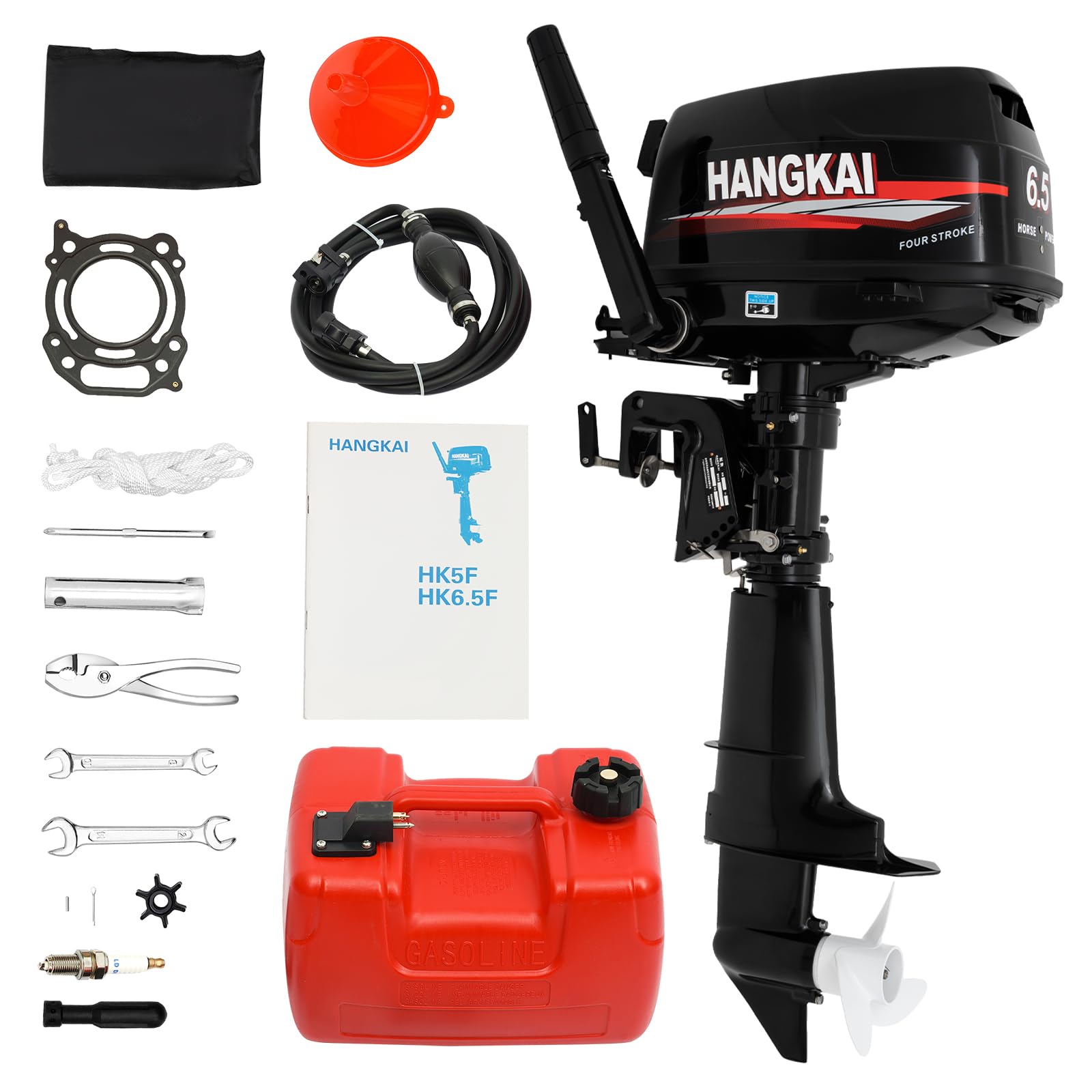
This 4-stroke 6.5 HP outboard from BJTDLLX brings genuine value to the sub-7 HP segment with a 123cc engine that sips fuel at roughly one tank per ten hours of use. Multiple verified reviews confirm it pushes a 14-foot flat-bottom boat with two passengers at 7-8 MPH, which is entirely sufficient for lazy river runs or pond fishing. Owners report starting it on the second or third pull after proper priming and gear oil attention.
The four-stroke design means you run straight gasoline without mixing oil, which cuts down on prep time and long-term sludge. Water cooling technology improves reliability, and the three forward/neutral/reverse gears give you full speed control through the twist-grip throttle. One recurring point of caution: the hood may crack after repeated use, and laying the motor on its side in the rain can allow carburetor water intake. These are manageable if you treat the cowling with care and store it upright.
At 26 kilograms (57.3 pounds), this is heavier than the electric options but lighter than the 18 HP models. The 90-day warranty is short, so performing the initial break-in gear oil change at ten hours is critical. If you want a reliable gas outboard that won’t break the budget and you don’t mind a little extra weight for the convenience of 4-stroke fueling, this is the best value pick.
Why it’s great
- Delivers 6.5 HP from a fuel-efficient 123cc 4-stroke engine that runs on straight gasoline.
- Water cooling system helps maintain consistent operating temperature during long runs.
- Multiple real owners report excellent reliability over many hours of weekend use.
Good to know
- Hood can crack after hard use; needs careful handling and storage upright.
- 90-day warranty is shorter than industry average for mid-range outboards.
- Some units have required carburetor adjustment out of the box.
3. BJTDLLX 12 HP 2-Stroke Outboard Motor

Stepping up to the 12 HP range, this 169cc 2-stroke from BJTDLLX is rated for 5500 RPM and claims 661 to 1763 pounds of thrust. That translates to pushing a 19-foot fiberglass or inflatable boat at 8-30 kilometers per hour (roughly 5-18 MPH) depending on load. Owners on a 14-foot flat bottom report it holds up well even in river situations with stumps and weeds, and the CDI ignition system allows cold starts on the third or fourth pull.
The 6.34-gallon external fuel tank saves you from hauling extra jerry cans — enough for a full day of cruising. The three forward/neutral/reverse positions are continuous variable via the twist grip, so you can set a constant speed for trolling. One unique point in the user reports: after a year of extreme abuse (sudden stops, hitting objects, minimal maintenance), this motor still started reliably, which speaks to the durability of the aluminum construction and the simple 2-stroke design.
Keep in mind this is a short-shaft model (15 inches), and the weight is 27 kilograms (59.5 pounds). It requires mixed fuel (2-stroke oil with 87 octane gasoline), which some boaters find inconvenient. Also, a few users mention a longer-than-expected break-in period. But for the raw power-to-weight ratio at this price point, this motor punches well above its displacement class.
Why it’s great
- 169cc 2-stroke delivers 12 HP with thrust exceeding 1700 pounds on lighter hulls.
- 6.34-gallon integral fuel tank enables long days on the water without refueling.
- Proven durability in real-world abuse scenarios — logs, weeds, and hard use.
Good to know
- Requires mixing 2-stroke oil at 25:1 during break-in, then 50:1.
- Shipping times can be longer than domestic alternatives; some users waited over a month.
- No manufacturer warranty listed — purchase is at your own risk.
4. awolsrgiop 18 HP 2-Stroke Outboard Motor
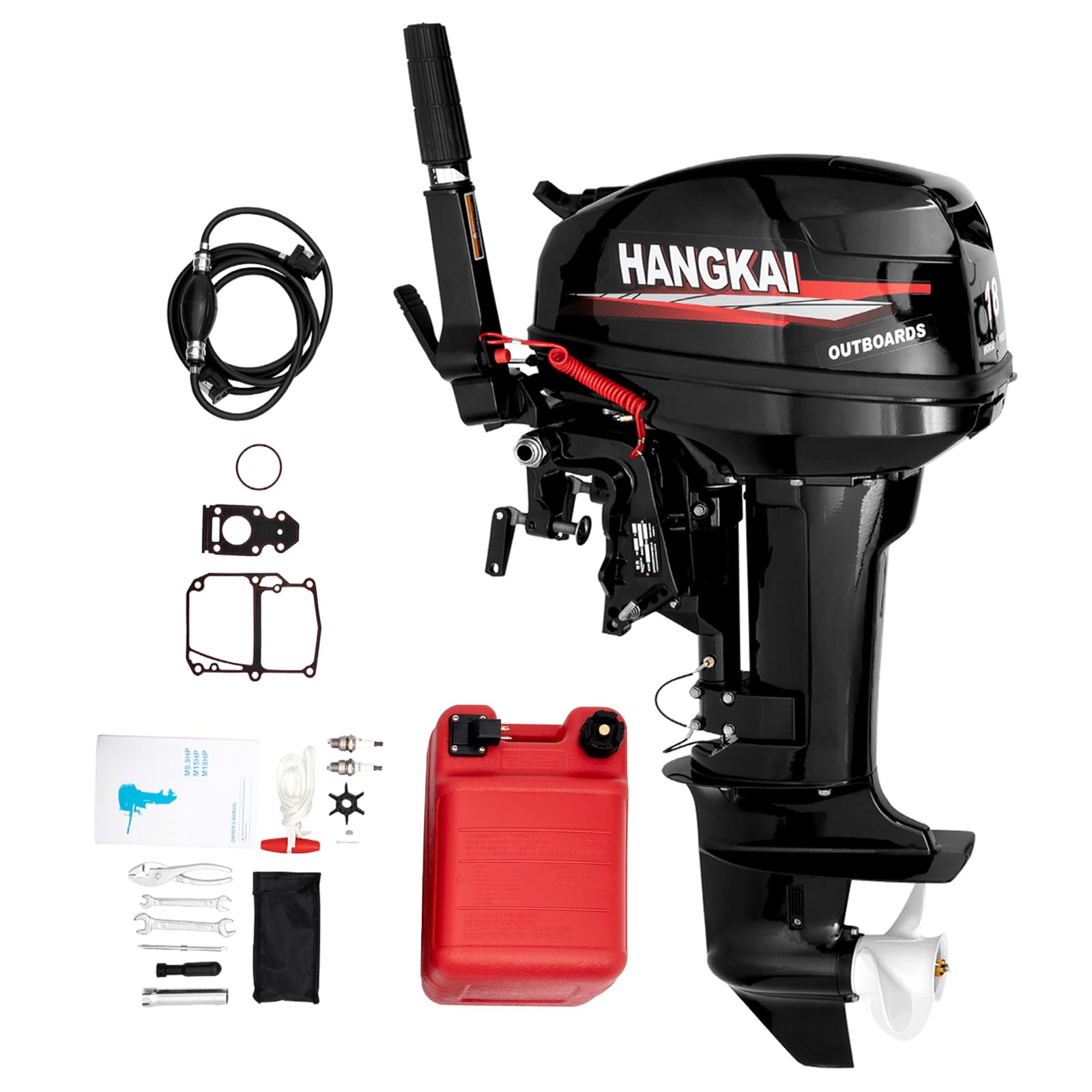
If raw horsepower is your priority, this 18 HP 246cc 2-stroke is the strongest engine in the lineup. It pushes an 11.5-foot inflatable to 19 MPH during break-in (with oil-heavy mix) and an owner on a Bris 15.4 inflatable reports 25 MPH after full break-in. That’s planing speeds for a tender, making it competitive with premium 15 HP models from established brands.
The CDI ignition system ensures reliable starts, and the streamline individual fin design protects the propeller if you hit a submerged object. Fuel tank capacity is 6.34 gallons, again integral to the motor housing. The ergonomic rubber-covered handle provides a solid grip, and the anti-vortex plate keeps water flow stable at speed. One note from the user community: it is very close in design to a Yamaha 15 HP 2-stroke, and many parts may be interchangeable.
The weight — not listed on the official spec but estimated around 75 pounds — is substantial, so plan on a transom that can handle it. Shipping took about a month for some customers, but FedEx delivery was quick once it left the warehouse. For boaters who want near-20 MPH performance on a small inflatable without spending four figures on a branded outboard, this is a compelling dark horse.
Why it’s great
- 246cc 2-stroke produces 18 HP, capable of planing a 15-foot inflatable at 25 MPH.
- Clone design compatible with Yamaha 15 HP parts, making repair sourcing easier.
- 1-year manufacturer warranty — longer than most budget outboards in this tier.
Good to know
- Heavy — likely 75+ pounds — demands a sturdy transom and is not portable for everyone.
- Shipping can take 2+ months from some vendors, so plan ahead.
- Requires strict break-in procedure: 25:1 fuel mix for first 50 hours, then 50:1.
5. DNYSYSJ Hangkai 18 HP 2-Stroke Outboard Motor
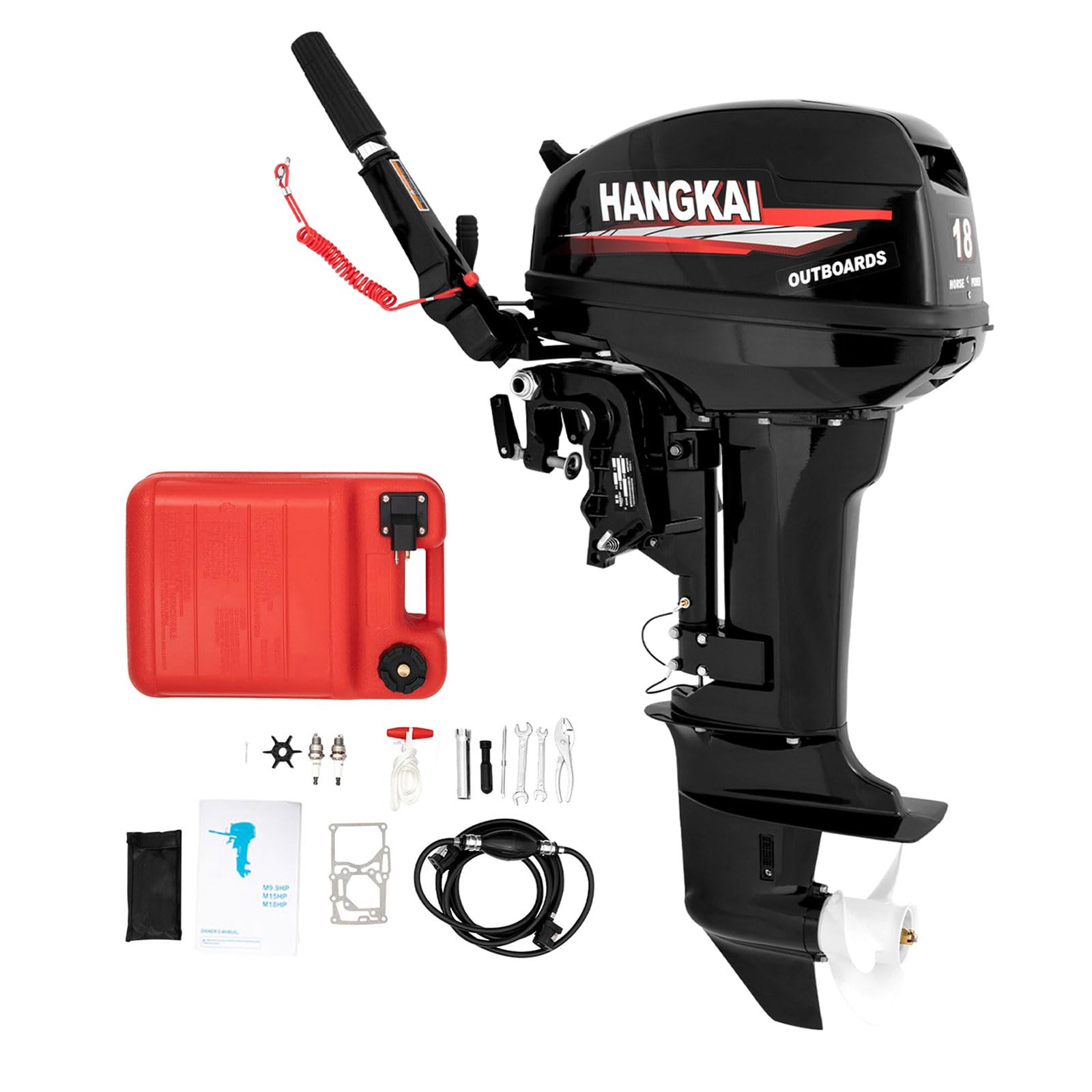
The DNYSYSJ Hangkai 18 HP is another 246cc 2-stroke, but with a two-cylinder layout that improves smoothness over the single-cylinder competitors. Verified owners report that it is a near-exact clone of the Tohatsu M9.8B, which means parts sourcing is straightforward. With a 12-foot aluminum V-hull, one user recorded 18-20 MPH carrying a passenger after break-in. The 360-degree steering rotation allows full reverse without shifting gears — a clever design feature for tight docking.
Water cooling and CDI ignition are standard, and the integrated 24-liter (6.34-gallon) fuel tank provides extended range. The gear ratio is 2.08:1 (27:13), and the short shaft measures 40 cm (15.75 inches). Several owners highlight the ease of setup — 20 minutes out of the box to first start — and the seller provides MSO and invoice paperwork for state registration. The two-year warranty is among the best in the budget tier.
The trade-off is reliability over time. One two-year review reports the pull-start housing broke and the engine eventually wouldn’t start, stranding the owner. Another notes the throttle sticker was reversed from the factory. At 38.6 kg (85 pounds), this is a heavy motor, so confirm your transom is rated for the weight. It’s the best option if you want a documented Tohatsu clone with good spare part availability, but proceed with eyes open on long-term durability.
Why it’s great
- Identical design to Tohatsu M9.8B 2-stroke, making replacement parts widely available.
- Two-cylinder configuration for smoother power delivery than single-cylinder alternatives.
- Two-year warranty and MSO paperwork for hassle-free state registration.
Good to know
- Some units have throttle sticker reversed, and the pull-start housing may fail over time.
- Heaviest motor in this group at roughly 85 pounds — not a portable option for most.
- Break-in period requires careful attention to gear oil changes and spark plug checks.
6. Newport 10ft 6in Inflatable Dinghy Boat (Boat Only)

While this is not a motor itself, the Newport 10.5-foot inflatable is a perfect companion for a 3.5 HP outboard motor. Rated for up to 15 HP and built from triple-layered 0.9mm/1,100-denier PVC, this USCG-certified boat is significantly more rugged than budget inflatables. Users report it inflates to firm pressure in about 90 seconds with the included foot pump, and full setup — including the aluminum-framed marine plywood floor — takes about 20 to 30 minutes the first time.
The three-chamber plus keel design gives a V-hull shape that tracks well with a 3.5 HP motor. Owners with a 3.5 HP Mercury say it planes easily, and a family of six aboard with an 18 HP motor cruises at 17 MPH. The boat includes two aluminum oars, a carrying bag, oar locks, towing D-rings, and topside D-rings for a Bimini top. At 123 pounds, it is not backpack-friendly, but it fits in a large suitcase for car-top transport.
The main catch is that the Newport is a boat only — you still need an outboard motor. If you pair it with the NT300 electric or the 6.5 HP 4-stroke above, you get a turnkey tender setup that’s quality all the way through. The white material is harder to keep clean than gray options, and the seat mounts are not adjustable. Still, for anyone who needs both a dinghy and a motor, this is the foundation of an excellent combination.
Why it’s great
- High-denier PVC construction (0.9mm/1,100 denier) is more durable than entry-level inflatables.
- Planes easily with a 3.5 HP motor and handles up to 15 HP for speed when needed.
- Complete kit includes floorboards, oars, pump, bag, and D-rings — ready for registration.
Good to know
- Heavy at 123 pounds; requires two people or wheels to move over land.
- White material stains easily and is harder to clean than darker PVC.
- No front carrying handles and seat mounts are not adjustable.
7. Lowrance Ghost Freshwater Trolling Motor
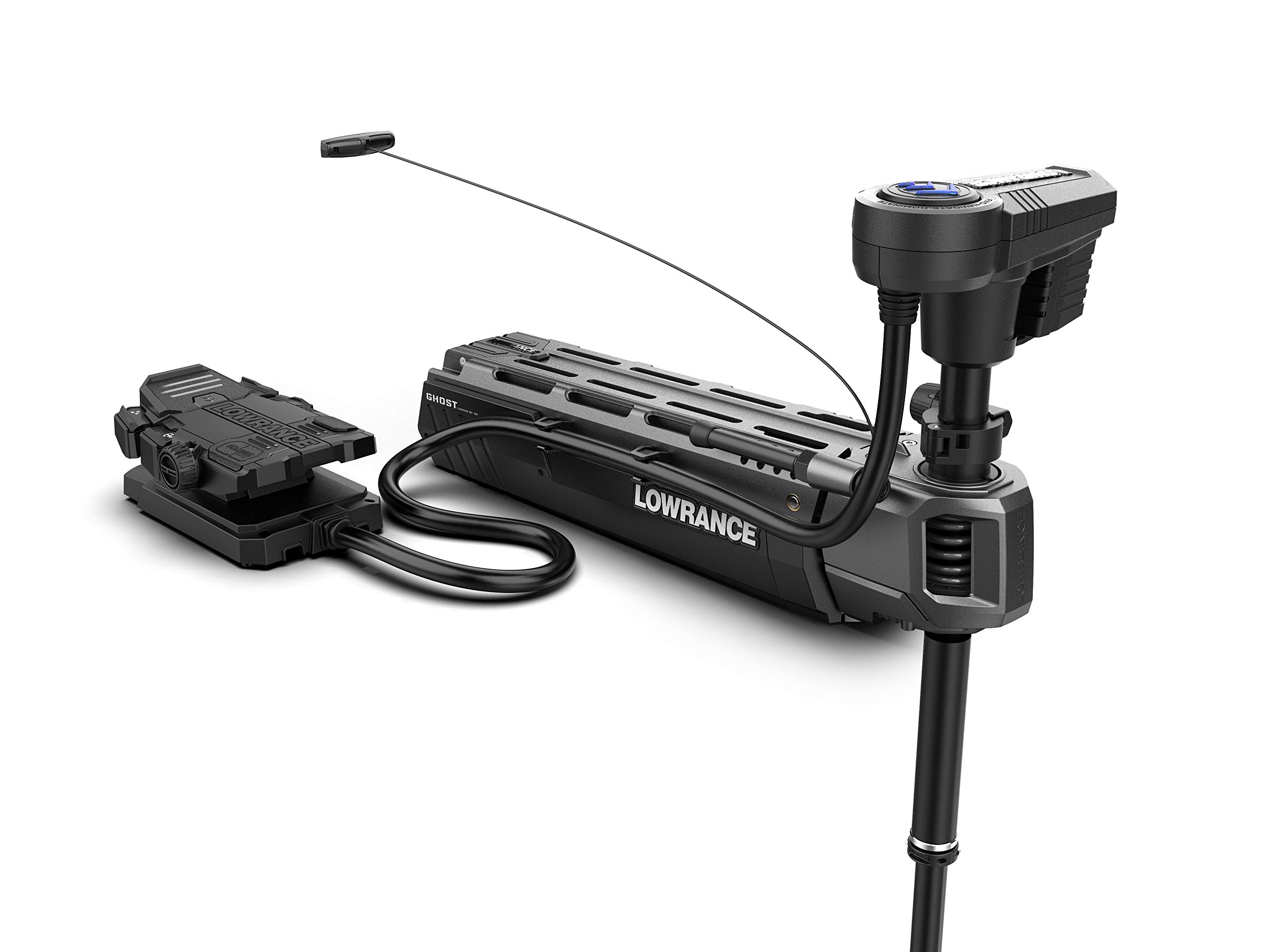
The Lowrance Ghost is a different beast entirely — a premium bow-mount electric trolling motor designed for serious anglers who demand silent operation and precise navigation. Its brushless motor emits zero electromagnetic interference, keeping sonar views crystal clear even at full thrust. The included HDI nosecone transducer gives you CHIRP sonar and DownScan Imaging right out of the box, with an upgrade path to Active Imaging 3-in-1 for SideScan.
The configurable foot pedal offers shortcut keys for dropping waypoints or activating your Power-Pole shallow-water anchor. Spot lock holds position in 20+ MPH winds, and the Autopilot route tracing function integrates seamlessly with Lowrance HDS Live units. On a 24V system, owners report over 16 hours of runtime with two 100 Ah lithium batteries — enough for a full day of serious fishing without recharge anxiety.
At roughly 85 pounds (38.56 kg) and a premium price point, the Ghost is the polar opposite of the budget motors above. It’s also strictly freshwater, has a scissor-style mount that requires a compatible bow platform, and customer service has been criticized for slow response times. That said, if you fish from a bass boat or deep-V and value pinpoint accuracy and stealth, this is the most capable electric option available today.
Why it’s great
- Ultra-quiet brushless motor with zero electromagnetic interference for clear sonar.
- Spot lock and Autopilot hold position accurately even in strong wind and current.
- Configurable foot pedal with shortcut keys for waypoints and shallow-water anchors.
Good to know
- Freshwater only — not designed for saltwater use.
- Direction indicator may not stay calibrated, and customer service response is reportedly slow.
- Premium price point significantly higher than other electric trolling options.
FAQ
Can a 3.5 HP outboard plane a small boat?
Is a 4-stroke or 2-stroke better for a 3.5 HP motor?
What shaft length do I need for my inflatable boat?
Final Thoughts: The Verdict
For most users, the best 3.5 hp outboard motor winner is the Newport NT300 Electric because it combines instant-start electric convenience with a featherlight 23.8-pound weight that practically disappears on a dinghy transom. If you want extended range without battery anxiety and don’t mind carrying a few extra pounds, grab the BJTDLLX 6.5 HP 4-Stroke. And for pure budget-friendly power on a small inflatable, nothing beats the awolsrgiop 18 HP 2-Stroke.