
Our readers keep the lights on and my morning glass full of iced black tea. As an Amazon Associate, I earn from qualifying purchases.
Specs are compiled from manufacturer listings and verified buyer reviews and can change over time — please confirm the key details on the product page before buying.
If your phone’s headphone jack has gotten noticeably weaker, or your high-impedance cans sound thin and quiet, a dedicated 3.5mm headphone amp is the fix. It sits between your music source and your headphones, giving your audio the extra power and clarity it needs to sound its best. This guide breaks down the best options for every use case, from pocket-sized dongles for commuting to desktop units for serious listening sessions.
I’m Min — the founder and writer behind Gadgets Feed. This guide is built by comparing the manufacturers’ published specifications and the patterns across verified customer reviews, so you get each pick’s real strengths and trade-offs instead of marketing spin.
Before you buy, know that not every unit here has the exact same 3.5mm jack setup, so check the input and output types on your gear first. My goal is to help you find the 3.5mm headphone amp that matches your headphones and your listening habits.
Our Picks at a Glance

How To Choose The Best 3.5mm Headphone Amp
Finding the right amp starts with knowing what problem you’re solving. Are your headphones too quiet, or do they sound muffled? The answer points you toward one of two main types: a simple analog amplifier or a digital-to-analog converter (DAC) dongle.
Match the Amp to Your Headphones’ Impedance
Impedance, measured in ohms, is how much resistance your headphones offer. High-impedance headphones (like the 150Ω Sennheiser HD660s) need more voltage to play loudly. A powerful amp with high output, like 1300mW, is your best bet here. Low-impedance in-ear monitors (IEMs) are easier to drive and will work fine with a more modest portable unit.
Decide Between Analog and DAC
An analog amp merely takes the signal it receives and boosts it, which helps if your source is weak. A DAC dongle, on the other hand, actually converts digital audio data into an analog signal. If you’re plugging into a phone that has no headphone jack, you absolutely need a DAC dongle. If you’re connecting to a device that already has a 3.5mm output, an analog amp will do the job.
Quick Comparison
| Model | Best For | Output Power | Input Type | Battery | Amazon |
|---|---|---|---|---|---|
| Donner EM1★ Best Overall | Musicians & IEMs | High | XLR / TRS | 12 hours | Amazon |
| BZINK BA36Best Value | Hi-Res portable audio | 227mW @ 32Ω | USB-C | Powered by source | Amazon |
| Fosi Audio DS2Top Performer | Balanced output on the go | 170mW @ 32Ω | USB-C | Powered by source | Amazon |
| Neoteck Amp | Simple volume boost | — | 3.5mm AUX | 8 hours | Amazon |
| YGiTK BT Amp | Wireless + bass control | — | 3.5mm AUX / Bluetooth | 8-10 hours | Amazon |
| TNP Portable Amp | Home stereo to headphones | 100 Milliwatts | RCA / 3.5mm | Powered by USB | Amazon |
| Douk Audio U3 | Desktop high-impedance cans | 1300 milliwatts | RCA | Powered by USB | Amazon |
| FiiO KA1 | Ultra-portable hi-res dongle | — | USB-C | Powered by source | Amazon |
| Fosi Audio SK01 | Analog tone control | 2400mW | 3.5mm / 6.35mm | 6 hours | Amazon |
In‑Depth Reviews
1. Donner EM1 Portable Analog Headphone Amplifier
Our pick — over 4★ from 850+ verified ratings; the strongest balance of quality and price.
The stage-ready powerhouse for in-ear monitoring that refuses to quit mid-set.
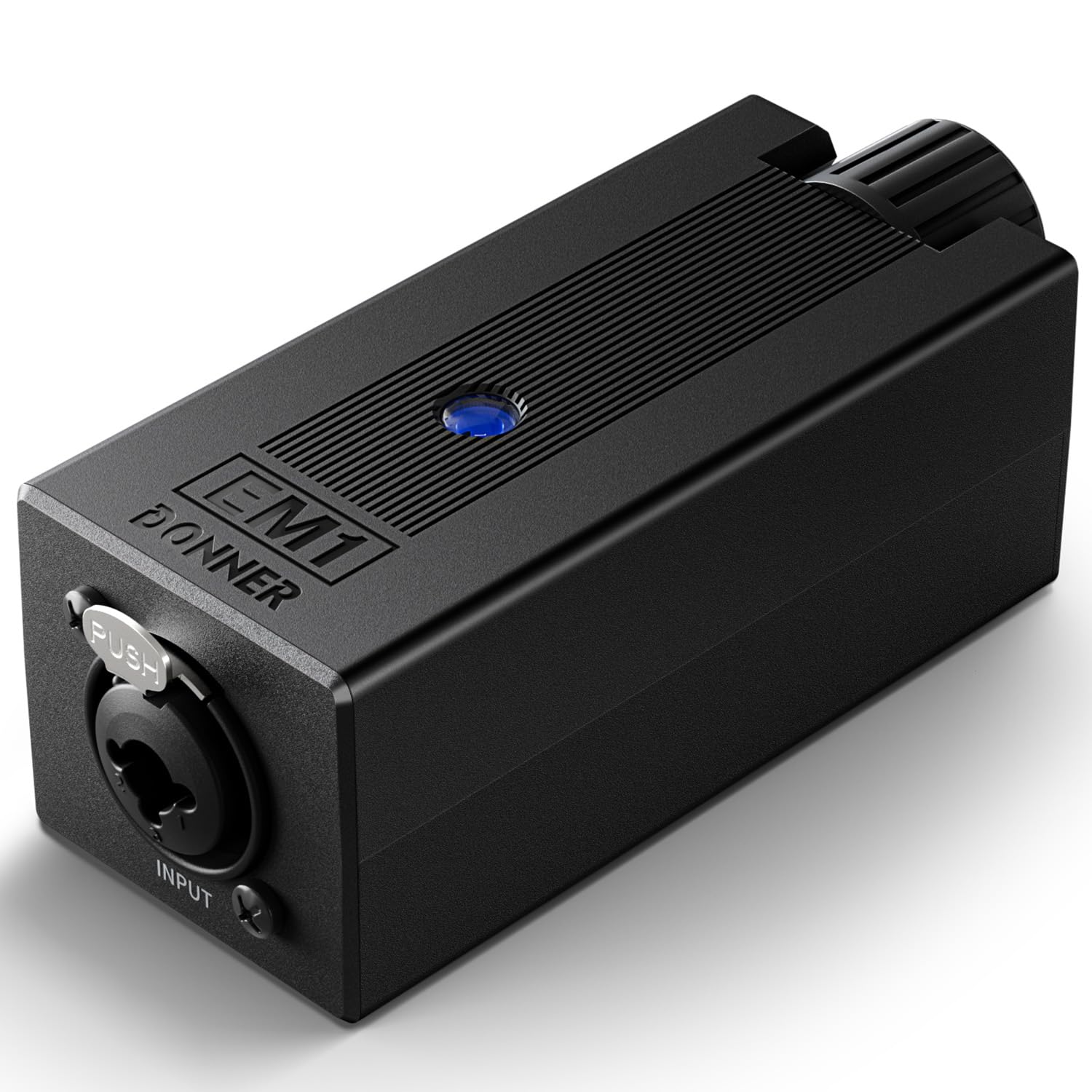
Built for musicians, the Donner EM1 is your backstage ally. Its high-power design handles high-impedance professional headphones, ensuring you hear every note clearly even on a noisy stage. The durable metal belt-pack clip lets you secure it to your gear while you move, and the XLR and TRS inputs feature a locking mechanism so your cable won’t accidentally unplug during a performance.
Its endurance is a headline feature. A single charge of its Li-ion battery keeps it running for up to 12 hours, which the manufacturer states, and owners confirm it lasts through long gigs. For drummers using in-ear monitors, it amplifies the monitor signal directly to your 3.5mm earbuds, with plenty of volume for Shure 315s at just 30% output. Buyers report that the battery delivers 3+ hours easily, and that sound quality is clearer than a Behringer unit when paired with MEE M6 Pro IEMs.
Owners call it a reliable, solid unit that delivers excellent value for the price. Reliability dominates owner feedback, with build quality and battery life close behind. Owners mention a minor, tolerable white noise floor, and one notes that the volume knob is easy to bump accidentally. For the price, it’s a recommend-again product for practice sessions and 30-minute sets.
Stage-Ready Strengths
- Runs up to 12 hours on a single charge for long rehearsals.
- XLR and TRS inputs with a locking mechanism for secure connections.
- Compact design with a solid metallic belt-pack clip.
Before You Buy
- The volume knob is easy to bump and change accidentally.
- You must use the proprietary USB-A to C cable; USB-C to C fails to charge it.
- A 1/4″ input treats mono sources as stereo (only one ear works); use XLR for mono.
Best for musicians: If you’re a drummer or guitarist needing dependable in-ear monitoring on stage, this is your pick.
A fair warning: Treat the volume knob gently mid-performance, and guard your original charging cable.
2. BZINK BA36 USB C DAC with Dual Chip
A pocket-size dongle that turns your phone into a high-resolution audio player.
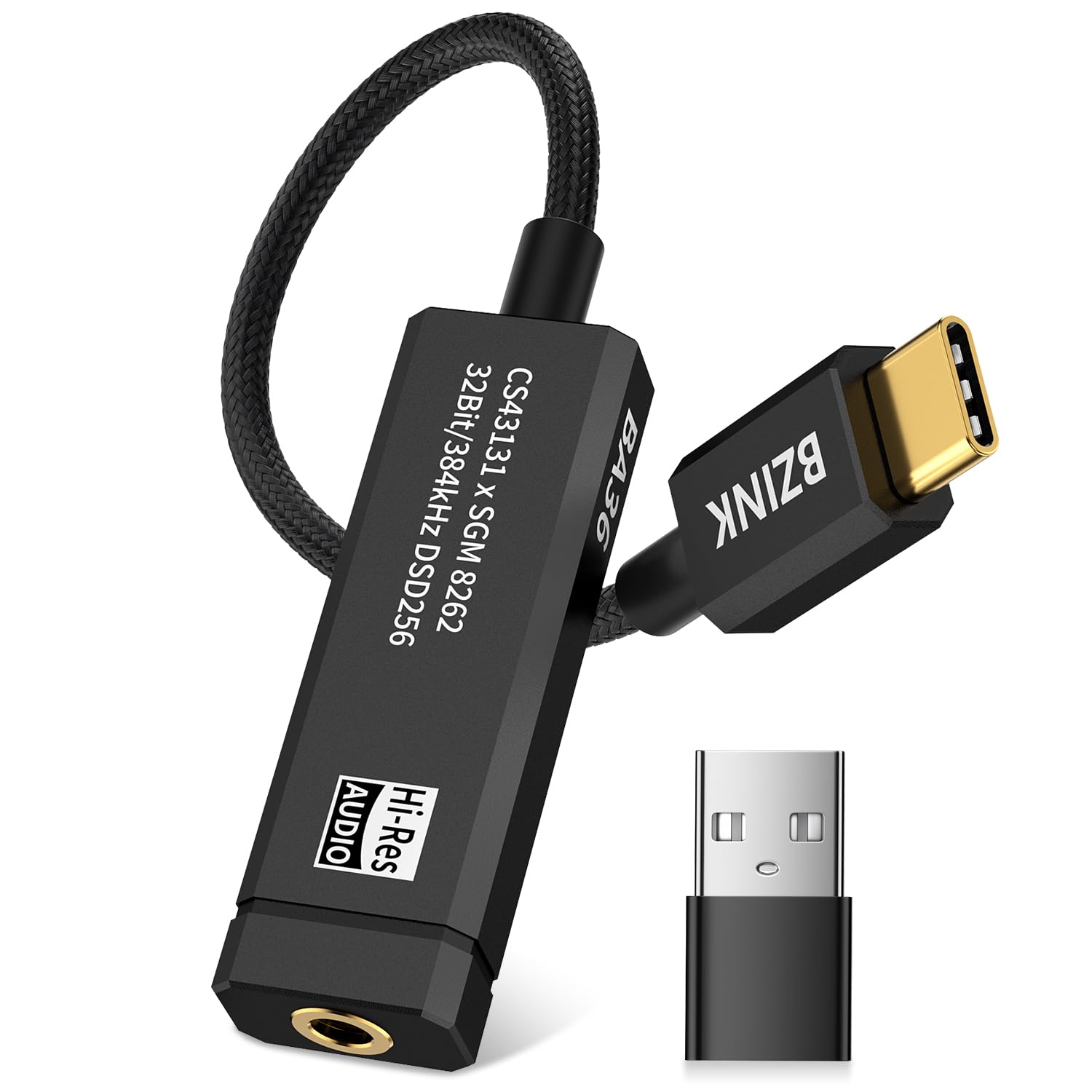
The BA36 is for audiophiles who want studio-grade sound from a USB-C device without a big investment. Its dual CS43131 + SGM8262 chipset delivers ultra-clear Hi-Res audio with 32bit/384kHz decoding. This means you hear the full detail in your music files, from subtle background instruments to the air around a vocalist, without the muddiness of a phone’s built-in circuitry.
Raw power is its calling card. With up to 227mW@32Ω output and support for a 16Ω–600Ω impedance range, it drives everything from small in-ear monitors to high-impedance headphones with ease. Customers note it gets plenty loud on a Galaxy S24+, draining battery from 90% to 15% over 6-7 hours, and that the metal shell runs warm but not hot. It’s a true plug-and-play adapter for iPhone 15 series, Android phones, iPads, and laptops—no drivers required.
Over 100 buyers highlight its build quality and sound as the top aspects. The aluminum alloy shell and silver-plated oxygen-free copper cable feel premium. An occasional note mentions thin exposed wires near the connector, so treat the cable with care for a long life.
Hi-Res Highlights
- 227mW@32Ω output drives high-impedance headphones cleanly.
- Plug-and-play with no driver needed on Windows, Android, and iOS.
- Includes a USB-A adapter for added compatibility.
What to Watch
- Pulls power from your phone, so battery life takes a hit.
- Thin exposed wires at the connector are a durability risk with heavy flexing.
Reach for this if: you want a serious sound upgrade from your phone or laptop for less than you’d expect.
Look elsewhere if: you plan to use it hooked to a desk setup with constant cable movement.
3. Fosi Audio DS2 USB C to AUX Headphone Amp DAC
The Swiss Army knife of portable DACs, ready for your phone, console, and desktop.
The DS2 is the most versatile dongle here because it offers both a 3.5mm single-ended and a 4.4mm balanced output. If your headphones support a balanced connection, reviewers point out it massively improves the sound of high-impedance sets like the Sennheiser HD 660S2 (300Ω), adding deep bass and detail that a standard 3.5mm jack can’t deliver. It supports up to DSD256 and PCM 32bit/384kHz decoding.
Inside, two Cirrus Logic CS43131 DAC chips deliver pure sound with an ultra-low 1μV noise floor and minimal 0.0001% THD. This translates to a dead-silent background between tracks, letting you hear only the music. Independent 60-step volume buttons give you precise control, and the solid metal CNC-machined body feels premium in hand. Buyers confirm it works flawlessly with a PS5 Pro, iPhone, and Android phones.
What wins people over is the sound quality—it’s flat, balanced, and clear, driving a wide range of IEMs and full-size headphones. There’s a real trade-off to know: it draws significant power from your source. In a two-hour gym session, an iPhone can drop from 100% to 84% battery, which is a heavy drain. The included USB-C cable is also on the cheap side.
Versatile Strengths
- 4.4mm balanced output open up better sound from compatible headphones.
- Independent 60-step volume buttons with volume memory.
- Shares the flagship CS43131 chip found in premium DACs.
The Catch
- Heavy power draw drains phone batteries noticeably fast.
- No second USB port, so you’ll need a hub to charge and listen simultaneously.
Pick this for: a single device that follows you from the gym to the living room console to your desk.
Consider this: if you plan long listening sessions from a phone, budget for a USB hub with external power.
4. FiiO JadeAudio KA1 Tiny USB DAC

Featherlight hi-res magic that disappears into your pocket until you need it.
If size is your priority, the KA1 is the ultimate travel companion. Its body measures just 43x15x8mm and weighs about 10g, making it barely noticeable on a keychain. Despite the tiny footprint, it supports high-resolution audio up to 32bit/384kHz PCM and DSD512, plus MQA 8x rendering, so you get lossless sound from Tidal or other MQA sources.
Shoppers say it delivers roughly twice the volume of Apple’s dongle and noticeably opens up the soundstage on mid-range headphones like the Audio-Technica ATH-M50x and Sennheiser 560s. The aluminum build and braided cable feel solid for the size. Reviews consistently mention that the sound quality is a massive step up from any budget dongle, even with standard Spotify streams.
Sound quality and performance are the most-praised traits, giving it a premium feel. However, there’s a durability concern that’s hard to ignore. The twisted wired connection lacks proper stress relief, and the cable has been described as fragile and not pocket-friendly. It also runs warm during use, especially at higher sample rates like 96kHz.
Pocket-Sized Pros
- Weighs just 10g for ultimate portability.
- Supports MQA 8x rendering and DSD512 decoding.
- Solid metal build with a sturdy braided cable.
Durability Downsides
- Cable stress relief is poor; the connection is the weak point.
- Gets warm during use, especially at 96kHz.
- Can’t charge your phone while listening.
Grab this for: commuters and travelers who want the best sound in the smallest possible package.
Think twice if: you’re hard on your cables—this one needs gentle handling.
5. Fosi Audio SK01 Amplifier Equalizer Preamp

Analog tone-shaping knobs that put you in the producer’s chair.
The SK01 stands out because it’s a full analog equalizer, not just an amplifier. Three knobs—for treble, midrange, and bass—let you sculpt the sound to your liking with central detents for a flat, neutral starting point. This is perfect for musicians or listeners who find their headphones too bright or lacking low-end punch and want a hardware fix rather than a software EQ.
You get up to 2400mW of power in high-impedance mode (a mode for high-resistance headphones), so even demanding headphones get loud and clear. The built-in 2500mAh battery lasts up to 6 hours, enough for a long listening session. It has both 3.5mm and 6.35mm headphone jacks (32-300 ohms), so you can plug in most headphones, or use it as a preamp for an electric guitar or as a desktop headphone amp.
It drives demanding planars like the Hifiman Sundara and Audeze LCD2 with rumbling bass. The loudness compensation button is a crowd favorite, boosting lower and upper frequencies for late-night listening. The main trade-off reported is that the battery life claims feel exaggerated for high-impedance planars, and the unit is bulkier than your average dongle.
Creative Control
- Tri-band EQ with bass, midrange, and treble knobs.
- One-click tone-defeat button restores original sound instantly.
- 2400mW power drives high-impedance planars.
Limitations
- The 6-hour battery life may be overstated for power-hungry planars.
- It’s a bulky box, not a pocket-friendly dongle.
- No DAC; USB-C port is for power only.
Reach for this if: you want hardware tone control for your headphones or guitar without opening a software app.
Look elsewhere if: you need a tiny, pocketable device for daily commutes.
6. Douk Audio U3 Mini Hi-Fi Amplifier

A tank-like desktop amp that punches way above its price class.
The U3 is the budget audiophile’s secret weapon for a desktop setup. It uses a classic TI-NE5532 op-amp and a transistor current expansion circuit with a 1300mA large current output transistor working in Class A status. This gives it ultra-low distortion and a warm, delicate, full, and mellow sound that’s ideal for vocals, string music, and rock.
Its a neat extra is the pluggable op-amp socket design. You can swap out the stock op-amp for a different one, like the Burson V5, to change the sound signature—a fun DIY project for tinkerers. With 1300 milliwatts of maximum output power, it easily drives high-impedance headphones like the Sennheiser HD600/HD650 or Beyerdynamic DT880/DT990. Buyers report it powers 150Ω Sennheiser HD660s with volume to spare, even at the 9 o’clock position.
Over 120 owners praise its build quality, describing a solid, tank-like feel. It’s a high-value pick for sim racing rigs and desks. The main catch is that it requires an external USB-A power supply, which isn’t included, and the power supply quality matters—cheap generic adapters can introduce a buzz. It also has an RCA-only input, so you may need a 3.5mm to RCA adapter cable.
Desktop Strengths
- 1300mW output drives demanding high-impedance headphones.
- Socketed op-amp allows for DIY sound customization.
- Stepped volume knob prevents accidental changes.
Setup Notes
- External USB-A power supply is required but not included.
- RCA-only input; you may need an adapter for 3.5mm sources.
- A bright front-facing blue LED can be distracting in dark rooms.
Best for: desk-bound listeners who want a powerful, upgradeable amp without spending big.
Keep in mind: budget for a quality power supply to avoid hum.
7. Neoteck 3.5mm Headphone Amp with Bass Boost
The simple analog boost that makes your phone’s music sound like a home stereo.
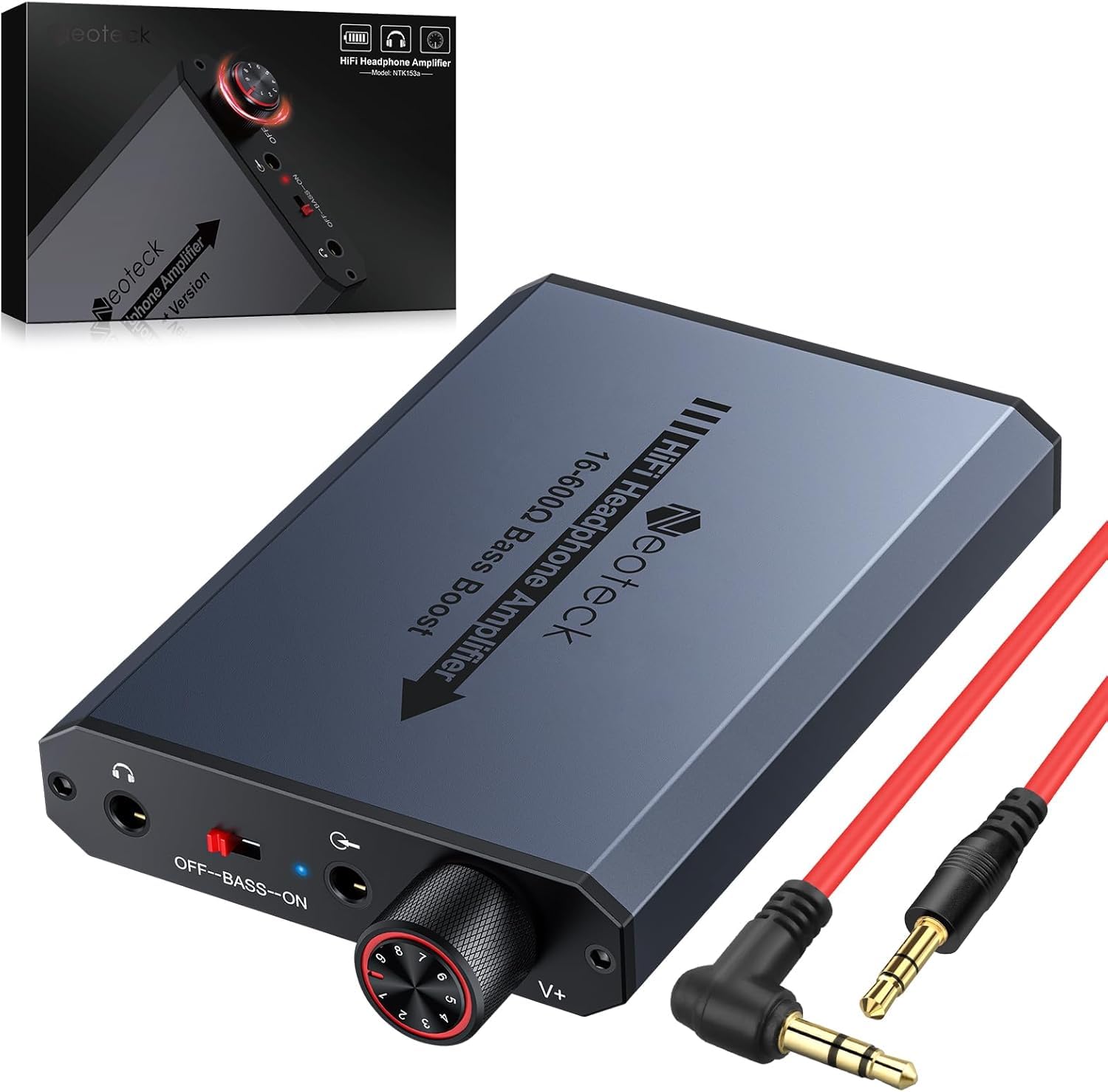
If your phone or laptop’s headphone jack sounds weak, the Neoteck fixes that simply. It has a 3.5mm AUX input and output with an SNR>100dB (signal-to-noise ratio, meaning less background hiss) and THD+N of just 0.0005% (total harmonic distortion plus noise, so sound stays clean). You get louder, sharper, more realistic stereo without distortion. The bass boost switch adds a softer, warmer low-end, making music feel more rich.
Compatibility is wide open. It works with MP3 players, iPods, phones, laptops, and portable CD players. A built-in rechargeable battery keeps it going for more than 8 hours, which buyers confirm lasts all day while watching videos. The aluminum matte surface feels durable and comfortable in hand, and it’s light enough to carry anywhere.
Owners agree the quality far outweighs the low cost. Owners love that it prevents hum interference by running on its own battery, isolating it from your device’s noisy power. One buyer’s experience sums it up: using it on a phone with Spotify made the music sound like a high-end home stereo. The only honest note is that the bass boost is subtle—don’t expect a nightclub thump, as owners mention the bass is not dramatically pronounced.
easy Upgrade: If your only problem is quiet audio, this plug-and-play amp gives you clean, distortion-free volume in seconds.
Keep Expectations Real: The bass boost is gentle, not a dramatic EQ, so bass-heads should look elsewhere.
8. YGiTK Bluetooth Headphone Amplifier
Adds wireless freedom and a bass dial to your wired headphones.
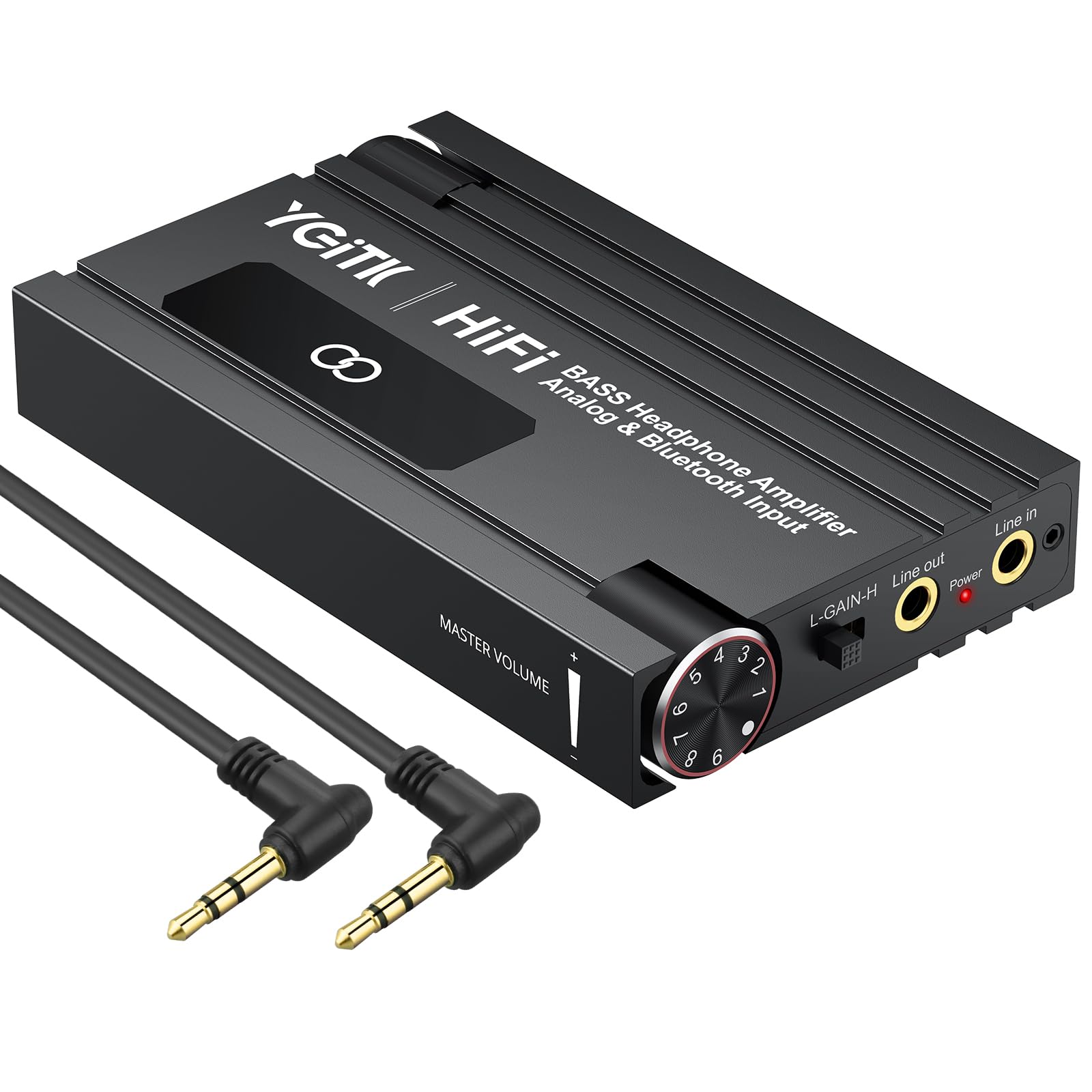
This amp is unique because it adds Bluetooth wireless connectivity to the mix, so you can connect to your phone, iPad, or MP3 player without any cables while still using your favorite wired headphones. It supports headphones in the 16-600Ω impedance range, delivering clear, detailed, and powerful sound. The dedicated bass knob lets you dial in exactly the low-end intensity you want.
It also doubles as a call-taking device. Plug in a headset with a microphone and use the call function to make and receive calls through the amp (though you’ll need to supply two TRRS cables). The sturdy aluminum case shields against signal interference, and the rechargeable 1350mAh lithium-ion battery provides 8 to 10 hours of extended runtime.
The bass control is the thing everyone raves about. Owners note they can dial in the desired level to suit their music, with one motorcycle rider saying it adds strong bass to helmet audio, making it louder than a Harley at freeway speeds. The honest trade-off is that Bluetooth range is a point of contention. While the advertised range is 8m, some customers note the connection cuts out around 3m, so it’s best used with your phone nearby.
Freedom of Choice: This is the pick for anyone who wants the convenience of Bluetooth but refuses to give up their wired headphone sound.
Wireless Range Reality: Keep your source device close—the Bluetooth range is shorter than expected for some.
9. TNP Portable 3.5mm Headphone Amplifier

A versatile bridge that breathes life into headphones and speakers alike.
The TNP amp is a flexible tool for home systems. Its defining feature is the flexible input options: it supports Stereo 3.5mm or RCA input, letting you connect it to a TV, CD player, or mixer. This makes it a great solution for boosting audio from an older TV or home component system to a pair of headphones or spare powered speakers. It delivers up to 100mW of output power.
The smooth rotating analog knob gives you precise volume control with a wide range. It can turn headphones off completely or quieter than the incoming signal, which is rare for a basic amp. Adding it between your player and audiophile headphones provides a significant, audible improvement in clarity, detail, and dynamics. It’s powered via Micro-USB or the included DC adapter, so you don’t need to worry about charging batteries.
Owners find the sound crisp with plenty of volume range, making it worth the price for boosting TV audio through a 3.5mm jack to spare speakers. Sound quality and precise volume control are the most-praised features. However, it lacks a rechargeable battery, has a cheaper hollow build, and the included power supply isn’t a USB cord, so you’ll need to supply one. Durability is its weakest point per owner feedback.
System Integrator: Ideal for connecting a TV or stereo’s RCA output to your headphones or powered speakers without wireless lag.
A Note on Power: It must stay plugged in, and it’s not built for the road.
Understanding the Specs
Output Power (mW)
Measured in milliwatts, this tells you how much raw power the amp can push. More power generally means louder volume and better control over high-impedance headphones. A spec like 1300mW is very powerful, while 100mW is more modest and suited for sensitive IEMs or low-impedance cans.
DAC Chip & Decoding
A DAC (digital-to-analog converter) chip translates digital audio files into analog sound. Better chips support higher-resolution formats like 32bit/384kHz PCM or DSD256, which means they can handle studio-grade files without losing detail. If you only stream from Spotify, a good DAC still improves the sound by cleaning up the conversion process.
FAQ
Will a headphone amp make my music louder?
What is impedance and why does it matter?
What is the difference between a DAC and an amp?
How long does a headphone amp battery last?
Will a 3.5mm amp work with my phone?
Can I use a headphone amp for my electric guitar?
What does a bass boost switch do?
Is an expensive headphone amp always better?
Final Thoughts: The Verdict
For the majority of shoppers, the 3.5mm headphone amp winner is the Donner EM1 because it offers the best blend of power, battery life, and musician-friendly features. If you want a pocket-sized DAC to upgrade your phone’s sound, grab the BZINK BA36. And for for headphone listeners who want hardware tone control, the Fosi Audio SK01 is the one to reach for.
How We Picked
We do not accept paid placement. Every pick is matched to a real buyer and a real use-case; we do not hands-on test units.
Sources & Methodology
Specifications: manufacturer listings and product documentation. Review insights: verified customer reviews, as of August 2026. Pricing: not shown on this page (it changes often); check the current price via the retailer link.
As an Amazon Associate, Gadgets Feed earns from qualifying purchases. This does not affect which products we feature.