
Our readers keep the lights on and my morning glass full of iced black tea. As an Amazon Associate, I earn from qualifying purchases.
Specs are compiled from manufacturer listings and verified buyer reviews and can change over time — please confirm the key details on the product page before buying.
The hard part of buying a 3.7 volt battery is not finding one — it is finding one whose connector, size and polarity match the device you already own. Get those three things right and almost any cell on this list will work; get one wrong and you are staring at a battery that will never leave your drawer. Everything below is organized around that reality, so you can match a pack to your project in a couple of minutes instead of a couple of evenings.
I’m Min — the founder and writer behind Gadgets Feed. This guide is built by comparing the manufacturers’ published specifications and the patterns across verified customer reviews, so you get each pick’s real strengths and trade-offs instead of marketing spin.
You will see the difference between a JST 1.25 board pack and an SM-2P toy pack, why milliamp hours are not the same as runtime, and how much of a device’s play time a swap really buys. Here is how to sort through every 3.7 Volt Battery option without guessing at the connector.
Our Picks at a Glance


How To Choose The Best 3.7 Volt Battery
Start with the old battery in your hand, not with a spec sheet. Nearly every return in this category traces back to one of four mismatches: the plug does not fit the socket, the cell is too thick for the compartment, the wires are reversed, or the capacity is far lower than the device wants.
Match the connector first, the capacity second
A JST 1.25 plug will not seat in a PH2.0 socket, and an SM-2P two-pin plug is a different shape entirely from a JST-PHR. Those connectors are physically incompatible, so a perfect cell with the wrong plug is still useless. Read the socket on your board or toy and buy the plug that matches it. Capacity only matters once the plug fits.
Read milliamp hours as stored charge, not runtime
A milliamp hour (mAh) is the amount of charge a cell holds — think of it as the size of the fuel tank, not the speed of the car. How long that tank lasts depends entirely on what your device draws. A 2000mAh cell feeding a low-power sensor board can run for days, while the same cell feeding a motor or a heating element empties in hours. That is why two devices with identical batteries can report completely different runtimes.
Physical size is the silent dealbreaker
Lithium cells are sold by a numeric code that describes their own dimensions — the 103454, 103665 and 103395 model numbers are size codes, not quality grades. Before you buy, measure the compartment your old cell came out of. A cell a few millimetres thicker than the original is the single most common reason a replacement physically will not fit back in.
Quick Comparison
| Model | Best For | Capacity | Connector | Cell Type | Amazon |
|---|---|---|---|---|---|
| MakerFocus 3.7V 3000mAh for ESP32 (4-Pack)★ Best Overall | ESP32 and Meshtastic board projects | 3000mAh each | JST 1.25 | Lithium Polymer | Amazon |
| Blomiky 3.7V 1000mAh (2-Pack, SM-2P)Best Value | Small RC trucks and cars | 1000mAh each | SM-2P | Lithium Ion | Amazon |
| Blomiky 3.7V 1200mAh (2-Pack, SM2P)Best for Toys | Construction toys, diggers and bubble guns | 1200mAh each | SM-2P | Lithium Ion | Amazon |
| DGBOSEN 3DS XL Battery 1750mAh | Reviving a Nintendo 3DS XL handheld | 1750mAh | Device-internal | Lithium Polymer | Amazon |
| EEMB 3.7V 103454 2000mAh | Compact electronics and soldered projects | 2000mAh | JST 2.0mm | Lithium Polymer | Amazon |
| Meshnology 3.7V 3000mAh 103665 | Meshtastic devices and RAK boards | 3000mAh | PH2.0 | Lithium Polymer | Amazon |
| HXJNLDC 3.7V 1100mAh 102050 | Small DIY builds under 4.07Wh | 1100mAh | JST 1.0mm | Lithium Polymer | Amazon |
| EEMB 3.7V 103395 3700mAh | Long-run projects needing maximum charge | 3700mAh | JST 2.0mm | Lithium Polymer | Amazon |
| BEBAT BL-5C 1400mAh (2-Pack) | Pocket radios, speakers and keyboards | 1400mAh each | BL-5C style | Polymer | Amazon |
In‑Depth Reviews
1. MakerFocus 3.7V 3000mAh Lithium Polymer Battery for ESP32 (4-Pack)
Our pick — over 4.5★ from 350+ verified ratings; the strongest balance of quality and price.
Four 3000mAh cells with the plug already on — the pack tinkerers reach for first
If you are building an ESP32 LoRa node, a wireless tracker, a Mesh Node T114 or a Mesh Node T096, this is the pack to start with. Each cell holds 3000mAh at 3.7 volts, which is three times the stored charge of the Blomiky 1000mAh toy pack further down this list — a real difference when your board is logging data around the clock. The plug is JST 1.25, matching the SH1.25-2 socket those boards ship with, so there is no adapter to hunt down and no soldering iron to warm up.
There are four cells in the box, and the maker’s own guidance on current is unusually clear: charge at 0.6A normally and never exceed 1.5A, and keep discharge in the same band. Those numbers matter because the protection board is doing real work here. It cuts the cell off at 4.2 volts when full, at 3.0 volts when nearly empty, and within milliseconds on a short circuit. For a device you leave powered on unattended, that trio of cutoffs is the most valuable thing in the package.
You get four 3000mAh cells in one pack, so you can power several boards without reordering. Board builders back that up with results — one project log ran a Bluetooth speaker on a single cell for over 5 days on standby and more than 12 hours of playback. The honest catch is current headroom. The maker warns that the protection board fails if you keep pushing past its limits, and buyers report the tiny JST 1.25 connector (a small snap-fit plug) is fiddly to unclip by hand. If your project pulls big amps, look at the Meshnology 103665 instead, which carries the same 3000mAh capacity over a chunkier PH2.0 plug.
What earns it the top slot
- 3000mAh per cell across a four-pack — three times the capacity of the small RC packs
- JST 1.25 plug seats straight into ESP32 LoRa V3, LoRa V4 and Mesh Node sockets
- Protection board handles overcharge, over-discharge and short circuit automatically
- Insulating tape pre-applied, and the maker publishes a clear 0.6A charging figure
Where it asks for care
- Current is capped in a real band — exceed 1.5A and the protection board can be damaged
- That 1.25mm plug is small and awkward to unclip with fingers alone
- At 185 g for the pack it is the heaviest option here, which tells you the cells are substantial
Made for board builders: anyone wiring an ESP32, LoRa or Meshtastic node who wants four ready-to-plug cells with protection already on board.
Look past it if: your device runs on an SM-2P or PH2.0 plug, or draws more than the 1.5A ceiling this cell is rated for.
2. Blomiky 3.7V 1000mAh 2-Pack Li-ion Battery with SM-2P Plug and USB Cable
Two packs and two charging cables — the cheapest way to double a small toy’s run time
Blomiky’s selling point here is simple arithmetic. You get two 1000mAh cells and two USB charging cables in the box, and the pack weighs just 38 g in total — 147 g lighter than the four-cell MakerFocus set above. The connector is the black two-pin SM-2P, the standard plug on small RC trucks, some RC boats and certain Kendilong robots, and it comes with an 8.5A over-current protection circuit built onto the battery itself.
What buyers notice most is how much longer these run than the cells that came with the toy. In a lightweight RC car, stepping up to double the cells translates into noticeably more play before the pack quits — one owner got roughly 30 minutes of combined run time from the two 1000mAh packs in a lightweight RC car. The USB cables have a red light while charging that flips to green when full, so you always know whether a cell is ready without a separate charger.
Set expectations on size before ordering, because fit is the one thing people flag as hit-or-miss. At 2.07 by 1.12 by 0.57 inches, the cell is small, but toy compartments are sized exactly to their original battery and a few millimetres of extra thickness can stop the lid closing. Measure the bay first. Everything else about this pair — the genuine 1000mAh capacity, the over-current protection, the included cables — is what makes it the value pick for anyone replacing a tired toy cell.
Runs about twice as long: the two-pack exists so one cell charges while the other plays, which is why the runtime jump feels larger than the capacity number suggests.
Where it can fall short: the SM-2P plug only suits devices wired for it, and if your toy’s bay is tighter than the original cell’s footprint you will notice the difference.
The value call: buyers replacing a worn 3.7V cell in a small RC truck, boat or robot and wanting spare capacity plus cables in one order.
Think twice if: you need to solder a JST-style connection into a project board — this plug is for toys, not dev boards.
3. Blomiky 3.7V 1200mAh 2-Pack Li-ion Battery with SM2P Plug and USB Cable
The bubble-gun saviour — two 1200mAh cells that keep the party running without a break
This is the battery you buy when a grandchild’s bubble machine, digger or stunt car keeps eating batteries. The extra 200mAh over the 1000mAh pack is what keeps a bubble gun or digger running instead of quitting mid-session.
This cell fits RC construction diggers, bulldozers and certain excavators, where a longer, slimmer pack slides into the bay. At 2.7 inches long it is notably longer and slimmer than the 1000mAh pack, which suits compact trucks instead. It carries the same 8.5A over-current protection circuit (it cuts the flow if the draw gets too high) and a built-in over-discharge board, and the charging cable’s own IC (a small control chip) handles over-charge and overheating protection — the red light goes solid while charging and turns green when the pack is full.
The real-world results are exactly what a parent wants to hear. Bought as backup cells for a bubble bazooka, they fit and function on the first try, and one owner described being able to keep the bubbles going without stopping to recharge. Two honest notes: the charging cords are short, which means the device sits right beside the plug during a top-up, and one person found a single dud cell in their pair. Those are occasional gripes against a four-star-plus track record, and the second cell in the pack covers most people either way.
Bigger cell, longer play: the 1200mAh capacity is the whole point — more stored charge than the 1000mAh pack for toys with a longer battery bay.
Measure before you commit: the cell is deliberately long, so a toy designed around a short battery will not close over it.
Reach for this if: a construction digger, bulldozer or bubble machine is the thing draining batteries and its bay is long enough for a 2.7-inch cell.
Look elsewhere if: you need a compact short cell, or you want a JST connector for a project board.
4. DGBOSEN 3DS XL Battery, 3.7V 1750mAh Replacement with Tool Kit
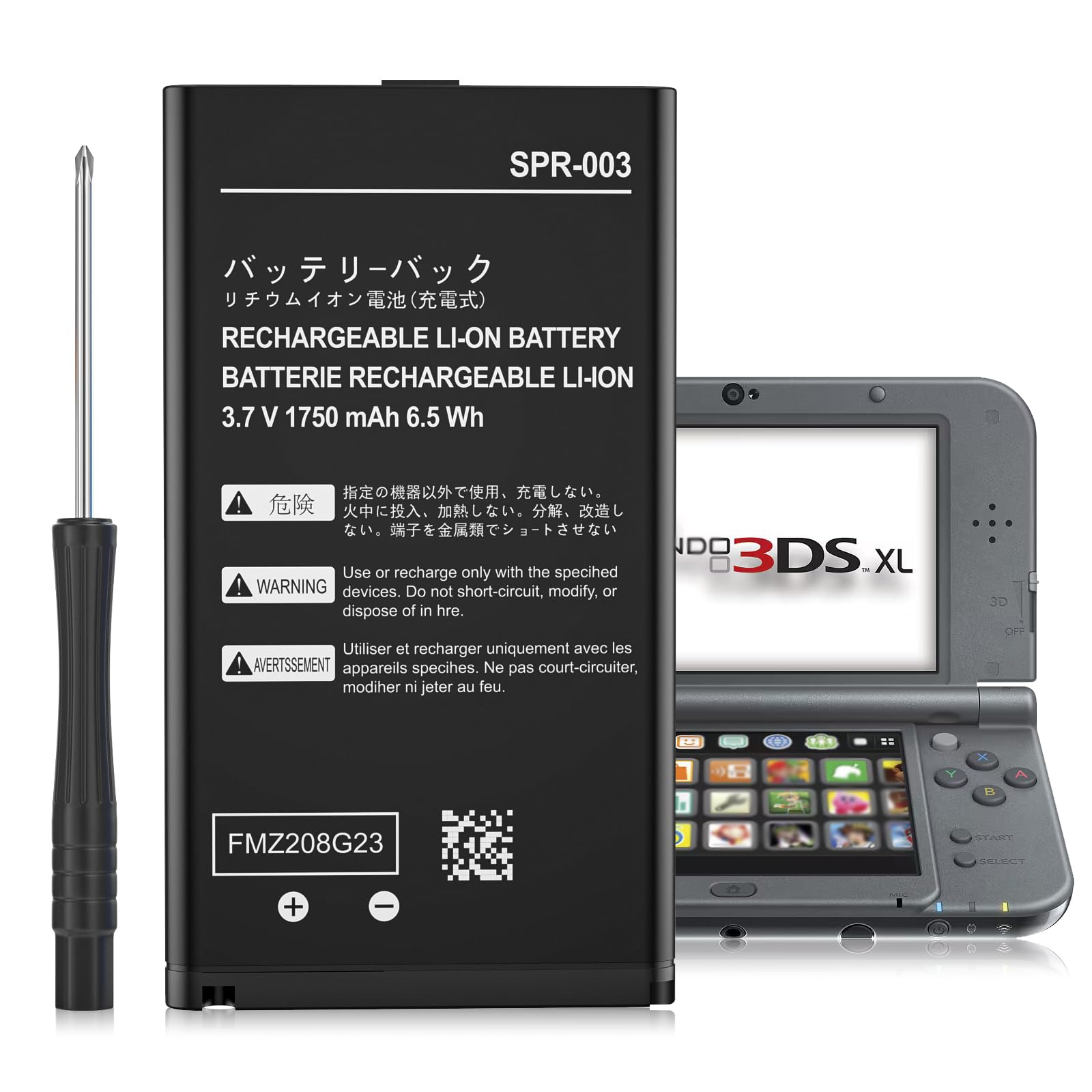
One cell, one screwdriver, one dead handheld brought back to life
A worn-out 3DS XL is a shelf ornament, and this 1750mAh cell is the fix. It is made specifically for the 3DS XL, New 3DS XL, 3DS LL and New 3DS LL — and importantly, it does not fit the 2DS, 2DS XL, New 2DS or New 2DS XL, so check your model before ordering. The battery is lithium polymer (a flat, pouch-style cell) and rated 3.7 volts, and it ships with the small screwdriver and tool kit you need to open the console’s battery bay.
Installation is genuinely the easy part. The cell slots into the tray like the original, and because it comes with an intelligent protection IC against over-current, over-voltage, over-charging, over-heating and short circuit, you can simply charge it in the console as normal. The 1750mAh figure is close to the stock cell’s rating, so there is no surgery required and no odd charging behaviour to get used to.
What owners value most is how reliably the handheld comes back — a revived device plays for hours without the mid-session shutdown the old cell caused, and it slots in without a fight. The catch is the included screwdriver. It is the wrong size for the 3DS’s tiny recessed screws, and pressing on with it will strip the heads, so use your own precision screwdriver for the swap and keep this one in the drawer. The cell itself is covered by a one-year warranty, which takes the risk out of the repair.
Restores the original feel: at 1750mAh the runtime lands close to what the console shipped with, so nothing about charging or play sessions changes.
Use your own driver: the bundled screwdriver does not match the 3DS screw heads and can strip them — a small caveat on an otherwise clean repair.
The repair kit for: 3DS XL and New 3DS XL owners whose console now dies mid-game, with a one-year warranty behind the cell.
Wrong purchase if: you own a 2DS or New 2DS XL — this cell is not made for that shell.
5. EEMB 3.7V 103454 2000mAh Lipo Battery, JST 2.0mm, 1-Pack

A certified 2000mAh cell at 40 g — the tidy replacement for a swollen battery
When a small device’s original cell has puffed up or gone flat, this EEMB pack is the one that lets you put the device back in service. It holds a typical 2000mAh (minimum 1900mAh) at 3.7 volts in a single cell that weighs just 40 g — 18 g lighter than the Meshnology 3000mAh cell further down, and small enough at 34.5 by 56 by 10.3mm to drop into compact electronics, dash cams, keyboards, GPS units and e-readers.
This is also the most heavily certified cell on the list. It carries UL and IEC62133-2 certification and UN38.3 compliance for air and sea shipping, which is why manufacturers trust it in retail products. The built-in PCM protection board guards against overcharge, over-discharge, over-current and short circuit, and the 500-plus cycle life means you are not buying another one next year. EEMB even publishes a storage routine — keep it at 40% to 60% charge when shelved, top it up every three months, and store it below 25°C.
The one thing you must check is polarity. Owners mention the red and black wires arriving the opposite way round on some units, and connecting a reversed cell to a device is a genuine short-circuit risk — the maker’s own instructions lead with this warning. Depinning the two sockets and swapping them is a two-minute job if you catch it first. If you are prepared to look before you plug, this is a well-built, well-documented cell that fixes a huge range of small electronics.
Verified, not just claimed: UL and IEC62133-2 certification plus UN38.3 compliance put it a step above unlabelled cells for anything you leave running unattended.
Check the wires before connecting: reversed polarity is the recurring report here, and the fix is quick only if you spot it in advance.
Suits the careful builder: anyone replacing a swollen or dead cell in a compact electronic device who wants certified protection and a documented storage routine.
Not for you if: your device needs a PH2.0 or SM-2P plug, or you would rather not check polarity before first use.
6. Meshnology 3.7V 3000mAh 103665 LiPo Battery with PH2.0 Connector and USB Charger
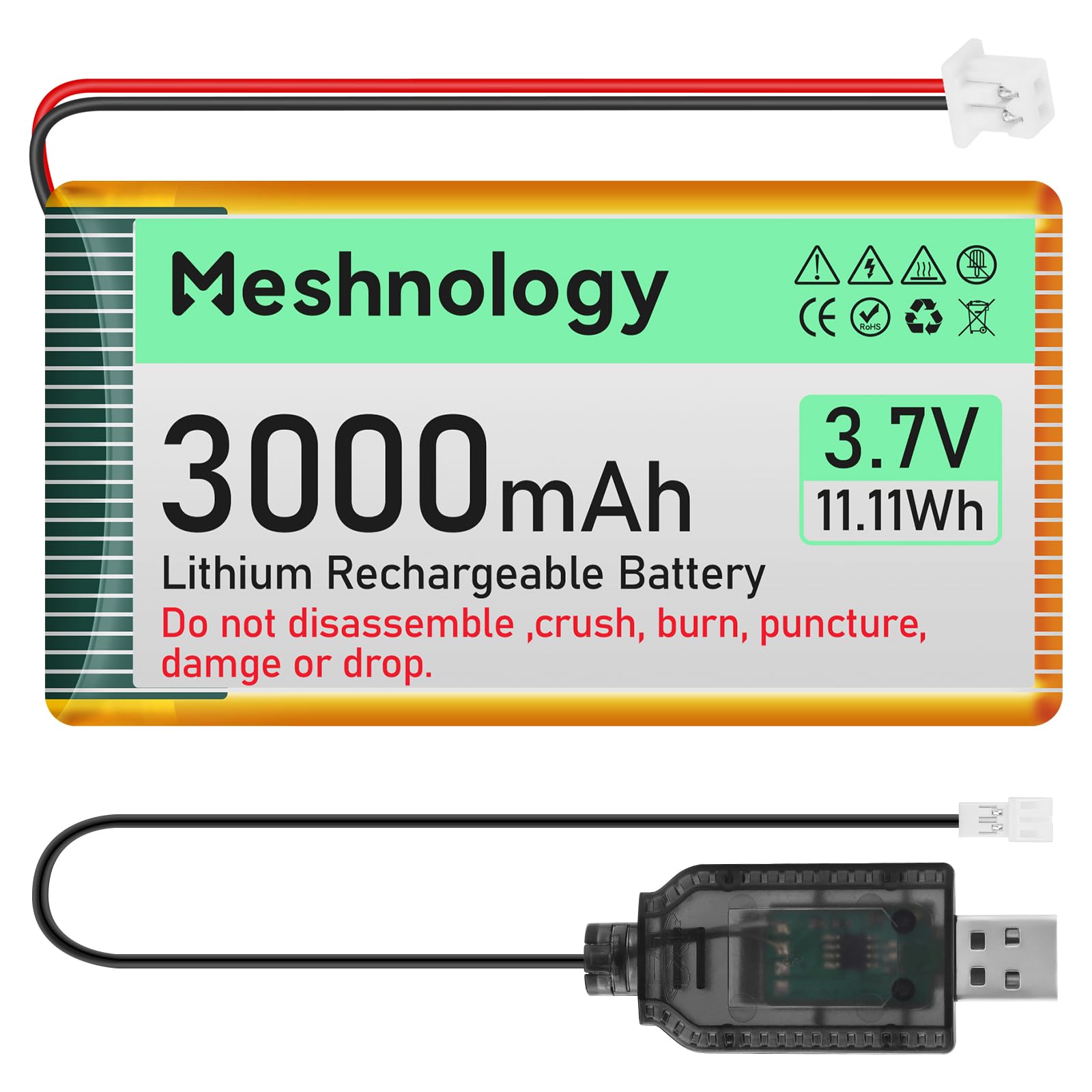
The same 3000mAh as the top pick, but on a sturdier PH2.0 plug with a charger in the box
If the MakerFocus pack’s JST 1.25 connector is the one thing stopping you, this is the answer. It carries the same 3000mAh capacity at 3.7 volts in a 103665-format cell, but terminates in a PH2.0 plug — a chunkier, easier-to-seat connector — and comes with a USB charging cable built around anti-short-circuit and reverse-polarity protection. The cell itself is certified to UN 38.3 and CE standards, and a built-in protection board guards against over-charge, over-discharge, over-current, over-heating and short circuit.
Under a steady 450mA load it holds over 4 hours of runtime.
For Meshtastic users this is a straightforward buy — it is sold specifically with RAK19007 and RAK4631 boards in mind, and owners running Meshtastic devices report no problems. It weighs 58 g in the 103665 footprint, so it is a chunkier cell than the compact EEMB 103454, and the warranty is a short 7 days. Budget for the confidence yourself: the protection board does the day-to-day defensive work, so a defective unit tends to show up quickly.
Why it earns its place
- 3000mAh capacity on a PH2.0 plug — no adapter needed for boards wired for that connector
- USB charging cable included, with reverse-polarity and short-circuit protection built in
- UN 38.3 and CE certified with full protection board coverage
- Delivered over 4 hours of runtime under a measured 450mA load
Worth knowing up front
- Short 7-day warranty — if something is wrong, you need to catch it fast
- At 58 g it is heavier in the hand than the compact cell it is often compared with
- The 103665 format suits specific board builds, not general-purpose replacement
Pick this over the top choice when: your board takes a PH2.0 plug and you want a charger in the box rather than the four JST cells of the MakerFocus pack.
One caveat to weigh: that short warranty window means testing the cell on arrival is not optional.
7. HXJNLDC 3.7V 1100mAh 102050 LiPo Battery with JST 1.0mm Connector
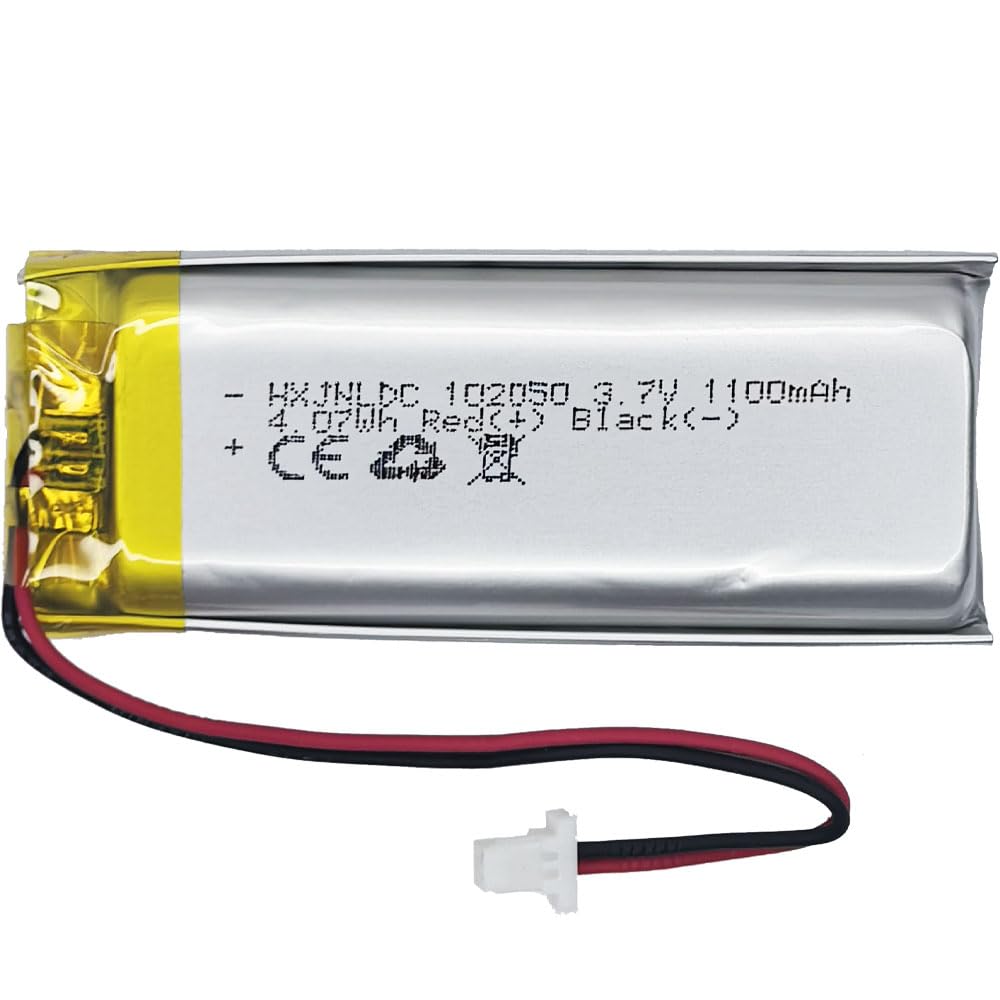
An 18 g cell for tight builds — the lightest battery here with a heat-resistant silicone lead
Where the top two picks pack four and three thousand milliamp hours respectively, this one is built for the other end of the spectrum: small DIY electronics under 4.07Wh. It holds 1100mAh at 3.7 volts in an 18 g cell (0.635 oz) that measures just 51 by 20 by 10 millimetres, so it slips into devices with no room to spare. Maximum current is 1.1A, and the maker states clearly that it is not meant for high-power electric tools or model aircraft.
The build quality is the part that stands out at this capacity. Inside you get a large-capacity A+ lithium cell, a Seiko IC protection board for overcharge, over-current and short-circuit, high-temperature-resistant silicone cable, and a genuine JST pitch 1.0mm connector.
In practice it handles small loads comfortably. One owner connected it to a 30mm by 40mm heater film drawing 160mA and ran it for 3 hours of continuous use without a problem. The honest note is self-discharge: a small cell like this loses its charge faster than a big one sitting idle, and some buyers find the connector doesn’t match their device first time. Compare your plug and polarity against the wiring diagram before ordering and you will sidestep that entirely.
Runs warm loads without complaint: the silicone lead and protection board make it a sensible pick for builds that generate a bit of heat.
The trade-off to accept: at 1100mAh and 18 g you are buying compactness, not endurance — and a small cell sitting unused will lose charge faster than a large one.
Perfect for micro-projects: soldering a replacement into a helmet unit, an MP3 player, a tiny LED build or any device under the 4.07Wh rating.
Skip if you need endurance: this is a space-conscious cell, and a 1100mAh budget empties fast in anything drawing real current.
8. EEMB 3.7V 103395 3700mAh Lipo Battery, JST 2.0mm, 1-Pack
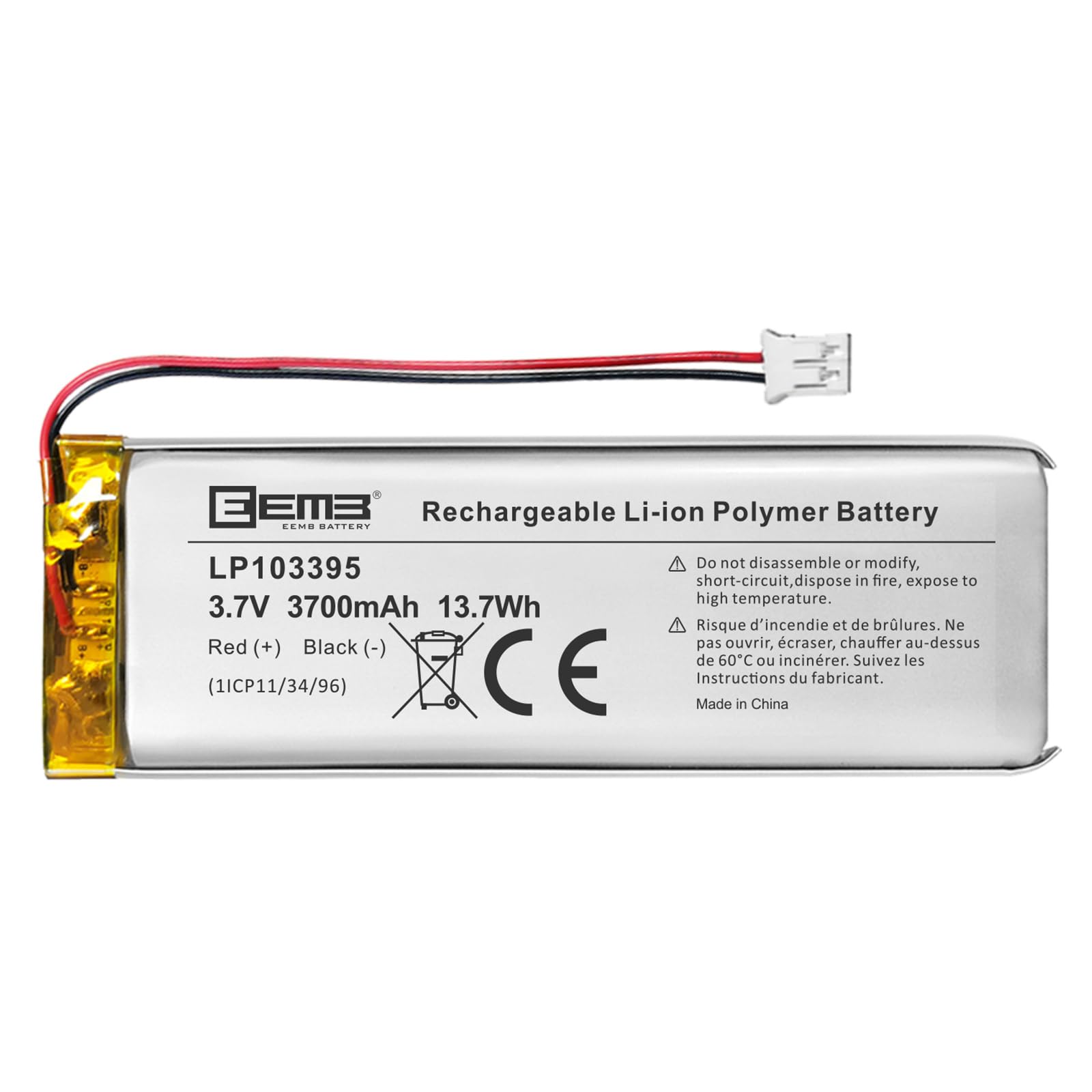
The biggest tank on the list — 3700mAh for projects that must not stop
At 74 g with a 33.5 by 96 by 10.3mm footprint it is a long, flat pack — the shape that slots into dash cams, speakers, radios and LED lights where a wide, slim cell fits better than a chunky one. The connector is a JST-PHR with 2mm pitch (the pins sit 2mm apart).
Like its smaller sibling, this cell is properly certified. It carries UL and IEC62133-2 certification and UN38.3 compliance for shipping, and the built-in PCM board handles overcharge, over-discharge, over-current and short circuit. A 500-plus cycle life and low internal resistance round out the picture, and EEMB publishes the same storage guidance: 40% to 60% charge in long-term storage, topped up every three months, kept below 25°C.
Two things buyers discover on arrival. First, the polarity: the wires come reversed on some units, and the fix involves depinning the sockets with a mini screwdriver before re-seating them — straightforward for anyone comfortable with JST latch tabs, fiddly for a first-timer. Second, the fit is not universal; the same cell is reported as both roomy and larger than expected depending on the build. Both are manageable with a quick look at your device before you buy, and neither stops this being the go-to cell for LED and long-run 3D-printing projects.
Maximum stored charge: 3700mAh is the largest capacity on this list, which is the entire reason to choose it over every other cell here.
Verify the wiring diagram: check polarity and connector pitch before connecting, because both are the recurring setup step for this cell.
Best for endurance projects: Bluetooth speakers, dash cams, radios and LED arrays where you want the biggest single-cell charge available.
Not the one to grab if: your compartment is short and wide — this is a long, flat cell and needs the room to match.
9. BEBAT BL-5C 3.7V 1400mAh Rechargeable Battery (2-Pack)
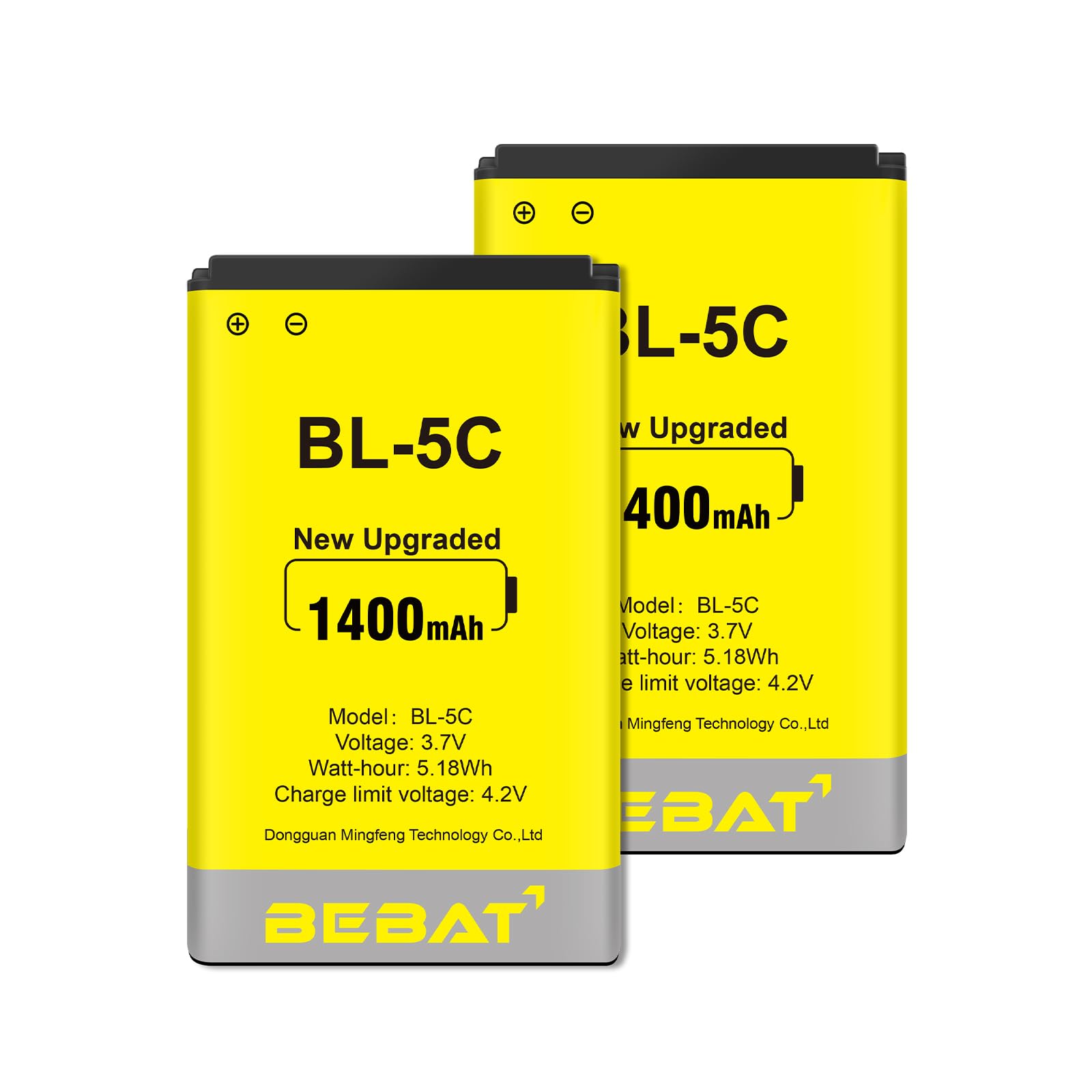
Two BL-5C cells for pocket radios and speakers — more charge than the originals they replace
The BL-5C is among the most widely used small battery formats in consumer gadgets — it turns up in portable radios, Bluetooth speakers, cameras and wireless keyboards. This is a two-pack of 1400mAh replacements at 3.7 volts, each weighing 30 g, with a current-protection circuit against over-charge, over-discharge, over-current and short circuit. If you have a device that takes a BL-5C and the original cell has given up, this is the drop-in replacement.
The extra capacity is the practical benefit. Older BL-5C cells typically held around 1000mAh, so stepping up to 1400mAh means more hours between charges — one owner running small radios three to four hours a day got several extra days per charge from the 1400mAh cells. In a Bluetooth speaker the higher-capacity cells simply outlast the originals, and the pair means one can live in the device while the other sits charged and ready.
Two things worth knowing from the field. The cells run a little thicker than some originals, which can stop a tight battery door from closing fully — one owner secured the compartment with a rubber band. And as with any small rechargeable, an occasional unit underperforms on runtime. Against that, most customers note the pair performing as expected, charges holding, and the format being the best BL-5C option they have tried. For radios and keyboards, the two-pack makes far more sense than buying singles.
More charge than the stock cell: at 1400mAh each, both cells in the pair outlast the roughly 1000mAh originals they replace.
Check your battery door: some devices have a compartment moulded so precisely that a slightly thicker cell will not let it shut cleanly.
The sensible two-pack for: pocket radios, Bluetooth speakers, cameras and keyboards that use the BL-5C format and want longer runtime than the originals offered.
Worth checking first: whether your device’s battery door has spare depth, since these cells run slightly thicker than some stock equivalents.
Understanding the Specs
Milliamp hours (mAh) and what they actually buy you
A milliamp hour is the amount of charge a battery holds — treat it like the size of a fuel tank. A 3000mAh cell holds roughly three times the charge of a 1000mAh cell, but that does not mean three times the runtime. Runtime depends on the current your device draws. A low-power sensor board might run for days on 2000mAh, while the same cell feeding a motor will empty in hours. That is why two owners of the same battery can report completely different results without either being wrong.
Protection boards, polarity and safe handling
A protection board is a tiny circuit that sits between the cell and your device and cuts the connection if something goes wrong — overcharge above the full-charge voltage, over-discharge near empty, over-current, or a short circuit. Every cell on this list has one, and it is what lets you charge and use these batteries without a specialist charger. Polarity matters just as much: the red wire is positive and the black wire is negative, and connecting a reversed cell is a short-circuit risk. Check the wires before the first connection, and never store a lithium cell fully flat or fully charged for long periods.
FAQ
Will a 3.7V battery work in a device that originally took AA batteries?
How do I know which connector my device needs?
What happens if I connect a battery the wrong way round?
How long can I leave a 3.7V battery in storage?
Does more milliamp hours always mean longer runtime?
Is it safe to leave a 3.7V battery charging overnight?
Can I use a 3.7V battery for a dash cam or Bluetooth speaker project?
Can I replace a swollen battery with any of these cells?
What is the difference between a JST 1.25 and a JST 2.0 connector?
Is the BL-5C format the same as a standard 3.7V hobby battery?
Final Thoughts: The Verdict
For most builders, the 3.7 volt battery winner is the MakerFocus 3000mAh four-pack, because it combines the highest capacity in a plug-and-play pack with JST 1.25, a protection board and four cells for the price of a single premium battery — and its 4.6-star rating across a large pool of board builders backs that up. If you want the same 3000mAh on a sturdier PH2.0 plug with a USB charger in the box, the Meshnology 103665 is the natural step up. For maximum single-cell endurance, reach for the EEMB 103395 and its 3700mAh; for a handheld revival, the DGBOSEN 3DS XL cell; and for small toy and radio swaps, the Blomiky two-packs and the BEBAT BL-5C pair have you covered. Whichever you choose, check the plug, the size and the polarity before you connect — those three checks decide whether the battery works, and every pick here is capable once they match.
How We Picked
We do not accept paid placement. Every pick is matched to a real buyer and a real use-case; we do not hands-on test units.
Sources & Methodology
Specifications: manufacturer listings and product documentation. Review insights: verified customer reviews, as of September 2026. Pricing: not shown on this page (it changes often); check the current price via the retailer link.
As an Amazon Associate, Gadgets Feed earns from qualifying purchases. This does not affect which products we feature.