
Our readers keep the lights on and my morning glass full of iced black tea. As an Amazon Associate, I earn from qualifying purchases.
Specs are compiled from manufacturer listings and verified buyer reviews and can change over time — please confirm the key details on the product page before buying.
Charging a 3.7V lithium-ion cell (the kind inside flashlights, vapes, camera gear, and solar lights) is easy to get wrong. A cheap charger might overcharge it, undercharge it, or just stop working after a month. This guide breaks down the nine chargers that actually earn their spot, with a focus on real-world speed, safety, and the honest trade-offs each one carries.
I’m Min — the founder and writer behind Gadgets Feed. This guide is built by comparing the manufacturers’ published specifications and the patterns across verified customer reviews, so you get each pick’s real strengths and trade-offs instead of marketing spin.
Choosing a 3.7V battery charger is easier once you know how many batteries you need to charge at once, how fast you want them ready, and which battery types you own—so we compared the top models side-by-side to help you pick the right one.
Our Picks at a Glance
How To Choose The Best 3.7V Battery Charger
Before you buy, think about the batteries you already own. Chargers handle different chemistries and sizes, so matching the device to your cells is the single most important step.
1. Check the Battery Sizes You Own
Most modern chargers handle a wide range of lithium-ion sizes like 18650, 26650, and 21700, plus older Ni-MH AA and AAA cells. If you only have one type of battery, a simple two-bay charger is plenty. If you have a mix, look for a model that supports everything you use.
2. Look at Charging Current (Amps)
The charging current, measured in amps (A), controls how fast your battery fills. A charger that pushes 1A will fill a typical 18650 in a few hours, while a 2A or 3A setting is noticeably faster. Just remember that higher current creates more heat, so a charger with thermal protection matters.
3. Safety Features Are Non-Negotiable
Lithium-ion batteries fail if overcharged or reversed. Look for built-in protections like overcharge cut-off, reverse polarity protection, and short-circuit prevention. Some premium models also show the battery’s internal resistance, so you can spot a deteriorating cell before it becomes a problem.
Quick Comparison
| Model | Best For | Bay Count | Max Current | Battery Types | Amazon |
|---|---|---|---|---|---|
| MC-ELIN 2-Slot★ Best Overall | Everyday household mix | 2 | 1 A | Li-ion & Ni-MH | Amazon |
| Guard Dog SecurityCompact Pick | Single-cell simplicity | 1 | 0.6 A | Li-ion & Ni-MH | Amazon |
| IMREN 2-BayBest Value | Fast 26650 charging | 2 | 2 A | Li-ion & Ni-MH | Amazon |
| XTAR MX4 | Multi-chemistry flexibility | 4 | 2 A | Li-ion, LiFePO4, Ni-MH | Amazon |
| WANGDAJIEDIAN 4-Bay | LCD monitoring on a budget | 4 | 2 A | Li-ion & Ni-MH | Amazon |
| NITECORE UMS2 | Dual-slot high-speed | 2 | 3 A | Li-ion, LiFePO4, Ni-MH | Amazon |
| NITECORE UMS4 | Four-slot power users | 4 | 3 A | Li-ion, LiFePO4, Ni-MH | Amazon |
| XTAR VC8 Plus | Capacity testing & bulk charging | 8 | 3 A | Li-ion & Ni-MH | Amazon |
| Opus BT-C3100 | Lab-grade testing tools | 4 | 1 A | Li-ion, Ni-MH, Ni-Cd | Amazon |
In-Depth Reviews
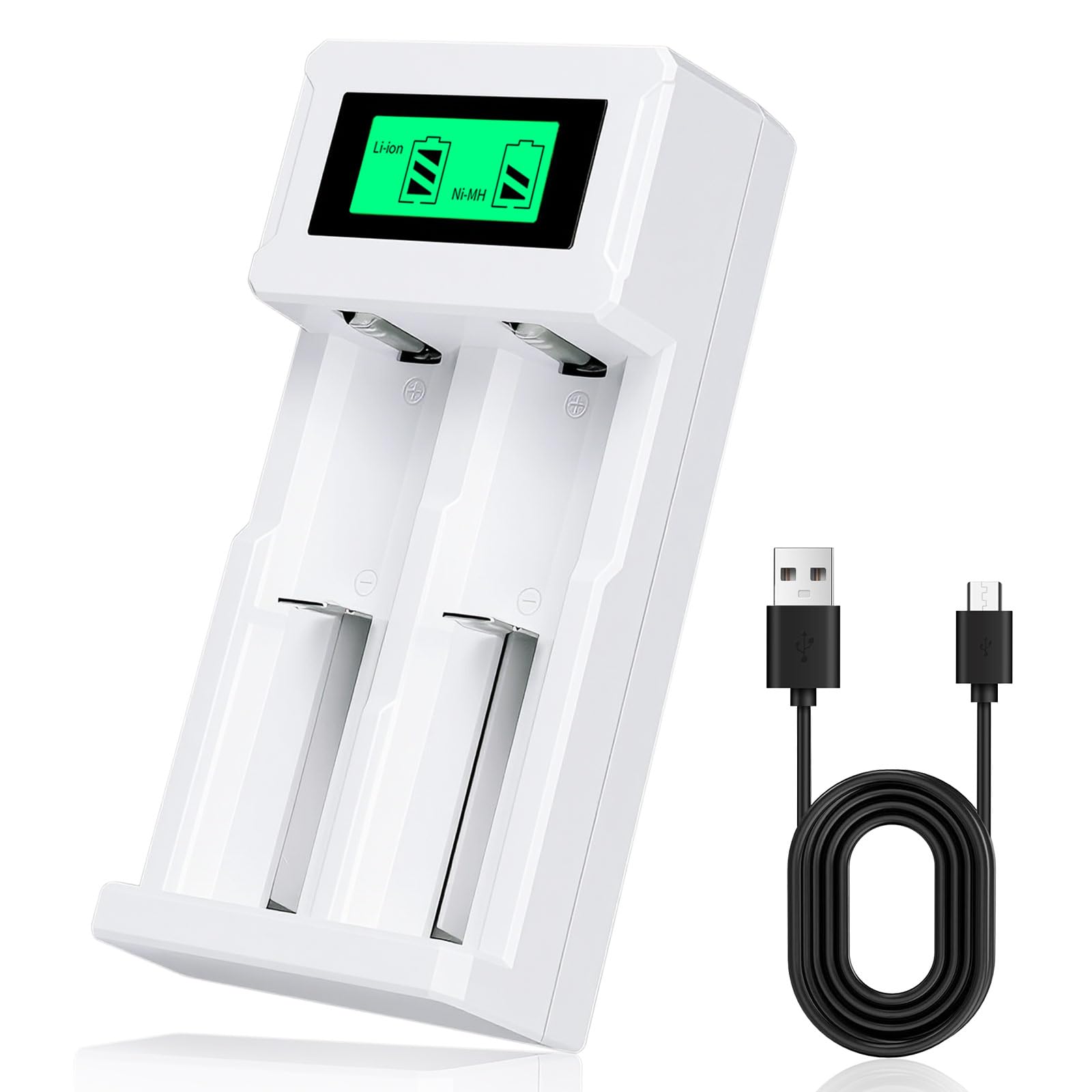
1. MC-ELIN Smart Universal Charger (2-Slot)
Our pick — over 4.5★ from 300+ verified ratings; the strongest balance of quality and price.
The everyday workhorse that handles your whole battery drawer without fuss.
This charger earns the top spot because it simply does everything well. It charges two 18650 batteries in under 30 minutes, making it fast enough for daily use. The LED bar meters on the front show your charging progress at a glance, so you always know what’s happening.
Its real strength is versatility. It handles a huge range of lithium-ion cells like 10440, 14500, 16340, 18650, 21700, and even the big 26650, plus 1.2V Ni-MH AA and AAA batteries. That means one device covers your flashlight cells, vape batteries, and TV remote batteries. It draws power from any USB-C port, and it stops automatically when a battery is full to prevent overcharging.
The trade-off is that it needs a separate 5V/2A USB power block, which is not included. Some owners note the 26650 bays are a bit narrow, so you can squeeze in three at a time but not a full row of four. Buyers report it survives drops and kicks and keeps working, which speaks to its build quality.
Why it wins
- Fast 1A charging per slot gets cells full quickly
- Accepts nearly every lithium and Ni-MH size you own
- Clear LED charge-level indicators on each bay
The catch
- USB power adapter not included
- Wide 26650 cells fit only three at a time
Reach for it if: you want one dependable charger for a mixed household of lithium and Ni-MH batteries.
Look elsewhere if: you need a wall plug in the box or regularly charge four large 26650 cells at once.
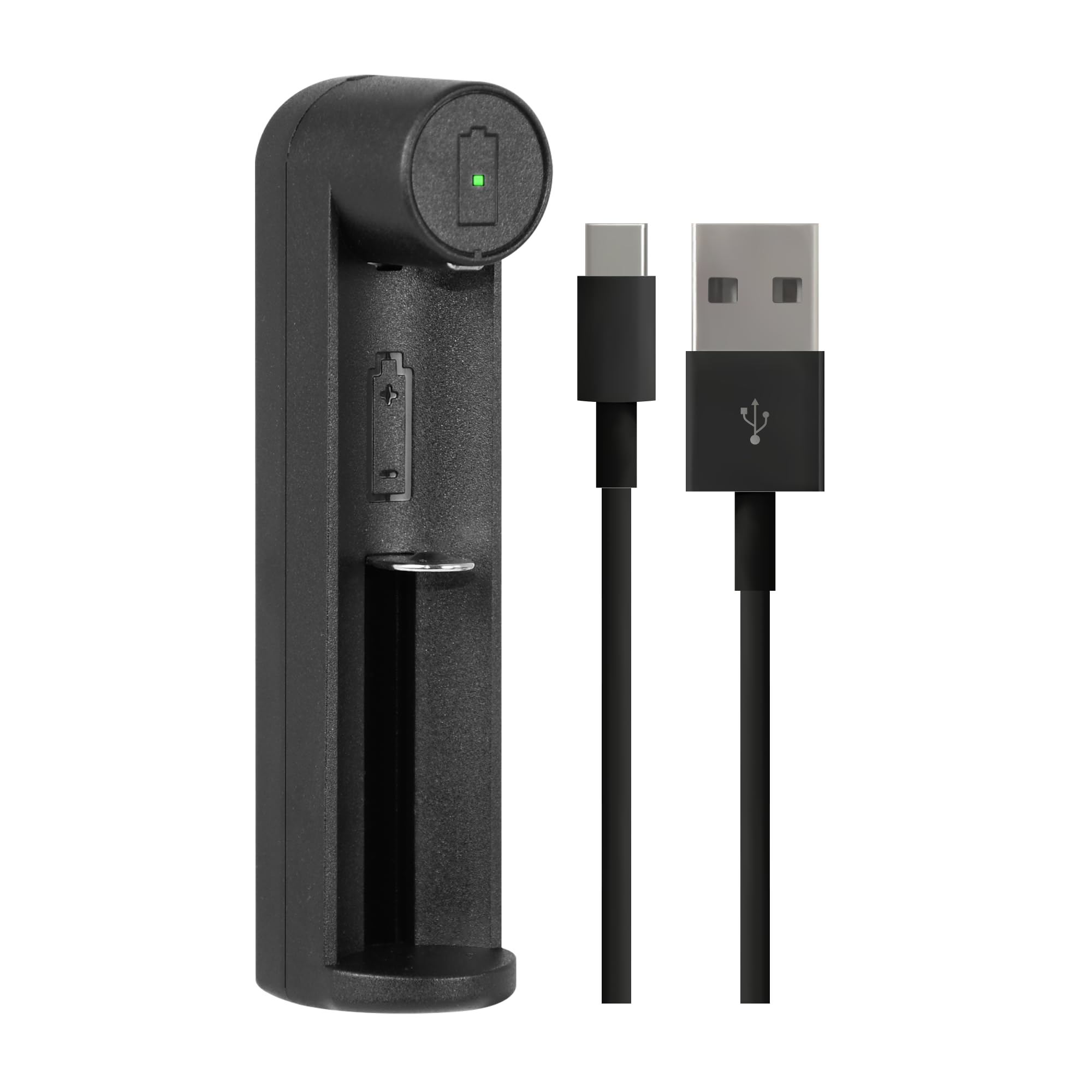
2. Guard Dog Security Single Slot Charger
A tiny single-bay charger that fits in a glovebox and tops up one cell at a time.
This one-slot charger is for the person who just needs to top up a single 18650 for a flashlight or a stun gun. It pumps out a modest 0.6A with a 4.2V output, which is gentler on the battery but slower than most rivals. The LED indicator glows red while charging and flips to green when full.
It accepts a long list of cells, from 14500 and 16340 up to 21700 and 26650, so it’s not limited to just one size. It’s smaller than its competitor here — 4″D x 1″W x 0.9″H versus 4.84″D x 2.44″W x 1.22″H — so it slips into tight drawers easily.
The honest caveat is the spring-loaded battery tray. Some owners mention the battery can pop out during charging if it’s not seated perfectly, and the build feels a bit cheap. The charging speed also trails the 1A output of the MC-ELIN above by a noticeable margin.
Single-purpose tool: works exactly as advertised for one cell, but its spring tray and 0.6A output make it a backup, not a daily driver.
Best for: emergency preparedness kits or anyone topping up a single flashlight battery overnight.
skip it if: you want fast charging or plan to charge more than one cell at a time.
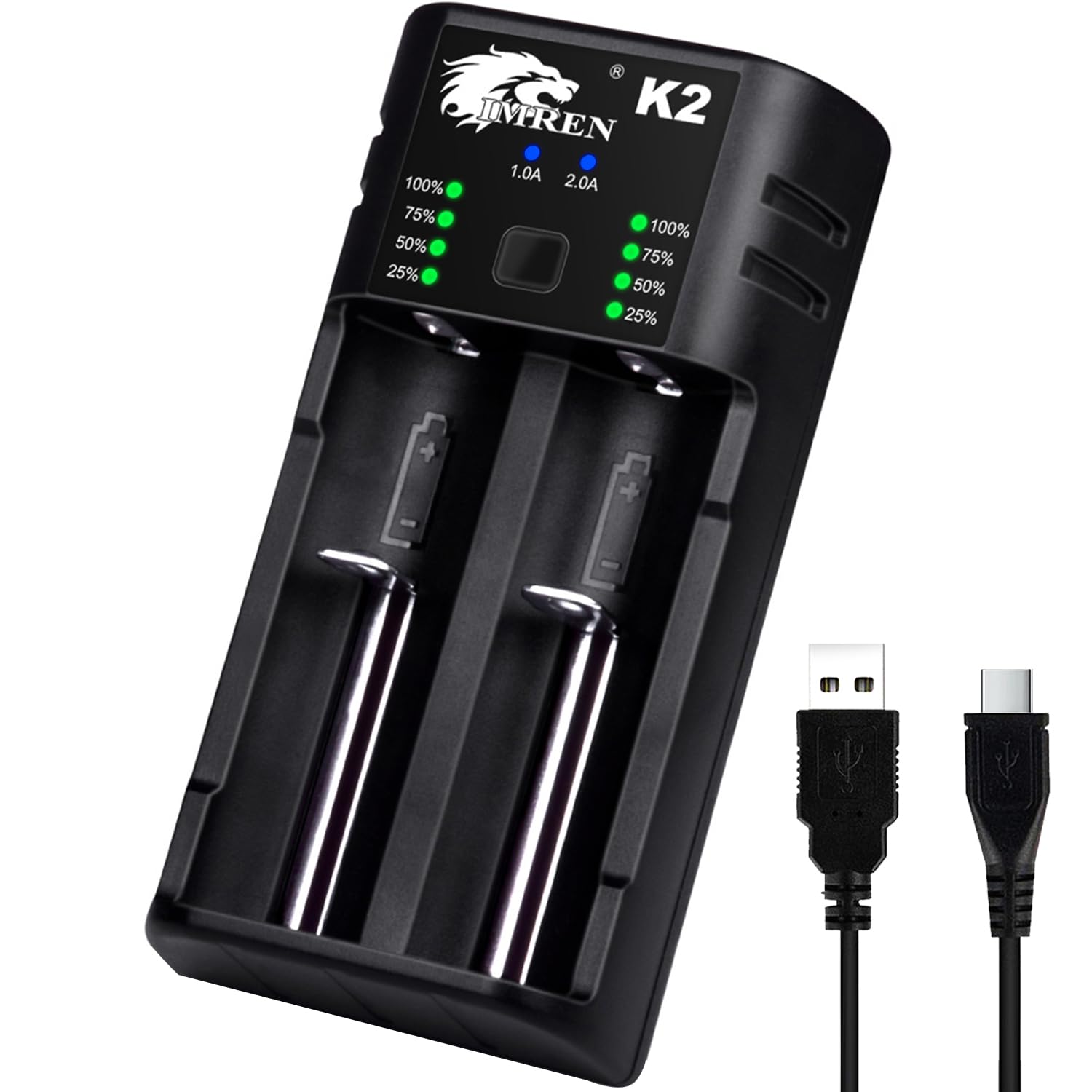
3. IMREN 2-Bay 26650 Charger
The speed demon for big 26650 cells, with a button to switch between 1A and 2A.
If you own large 26650 batteries, this charger is built around you. Its two middle slots are 25mm wide, so it comfortably fits two of the chunky 26650 cells at the same time. It also handles the usual spread of 10440, 14500, 18350, 18650, 21700, and more.
The headline feature is the charging current. Press the middle button to switch from a gentle 1A (1000mA) slow charge to a rapid 2A (2000mA) fast charge. Customers note a full charge overnight and good speed on a bike light battery. It pulls power from any USB-C source, so you can run it from a car charger, power bank, or computer.
The trade-off is that the amp setting resets to 1A every time you use it, so you have to manually switch to 2A for high-capacity cells. Build quality is a bit plasticky, and a few units stopped working after about a month. It’s cheap enough that the speed makes up for it.
Speed for the price: the 2A mode charges faster than most chargers in this price range, and the wide bays are a rare fit for 26650 cells.
Grab it if: you charge large 26650 batteries daily and want the speed without a premium price tag.
Think twice if: you want a rugged build that you can drop carelessly.
4. XTAR MX4 Intelligent Charger

The first charger that truly handles 1.5V lithium, 3.6V/3.7V, LiFePO4, and Ni-MH all in one box.
The MX4 is the all-in-one answer for households with mixed battery chemistries. It charges 1.5V lithium-ion cells, 3.6V/3.7V lithium, 3.2V LiFePO4, and 1.2V Ni-MH batteries. That’s a rare combination — most chargers claim to handle all types but only output 4.3V for 1.5V cells, which isn’t enough.
Each of its four slots works independently, so you can charge a 18650 next to an AAA next to a LiFePO4 cell without issue. It’s also rated with CE and FCC safety certifications, with reverse polarity protection, overcharge safeguards, and automatic cut-off.
The practical downside is that smaller AAA batteries can slip out of contact if not placed just right — you have to seat them slightly raised. It needs a separate 5V 2A adapter or USB power supply, which is not included.
Versatility win
- Genuinely charges 1.5V, 3.6V/3.7V, 3.2V, and 1.2V cells
- Four independent slots for mixed batteries
- CE and FCC certified safety
Fit note
- AAA cells need precise placement to make contact
- USB power adapter not included
Perfect for: anyone juggling 1.5V lithium AAAs for thermostats alongside standard 18650 and Ni-MH cells.
Not for: people who want a charger that comes with its own wall plug.
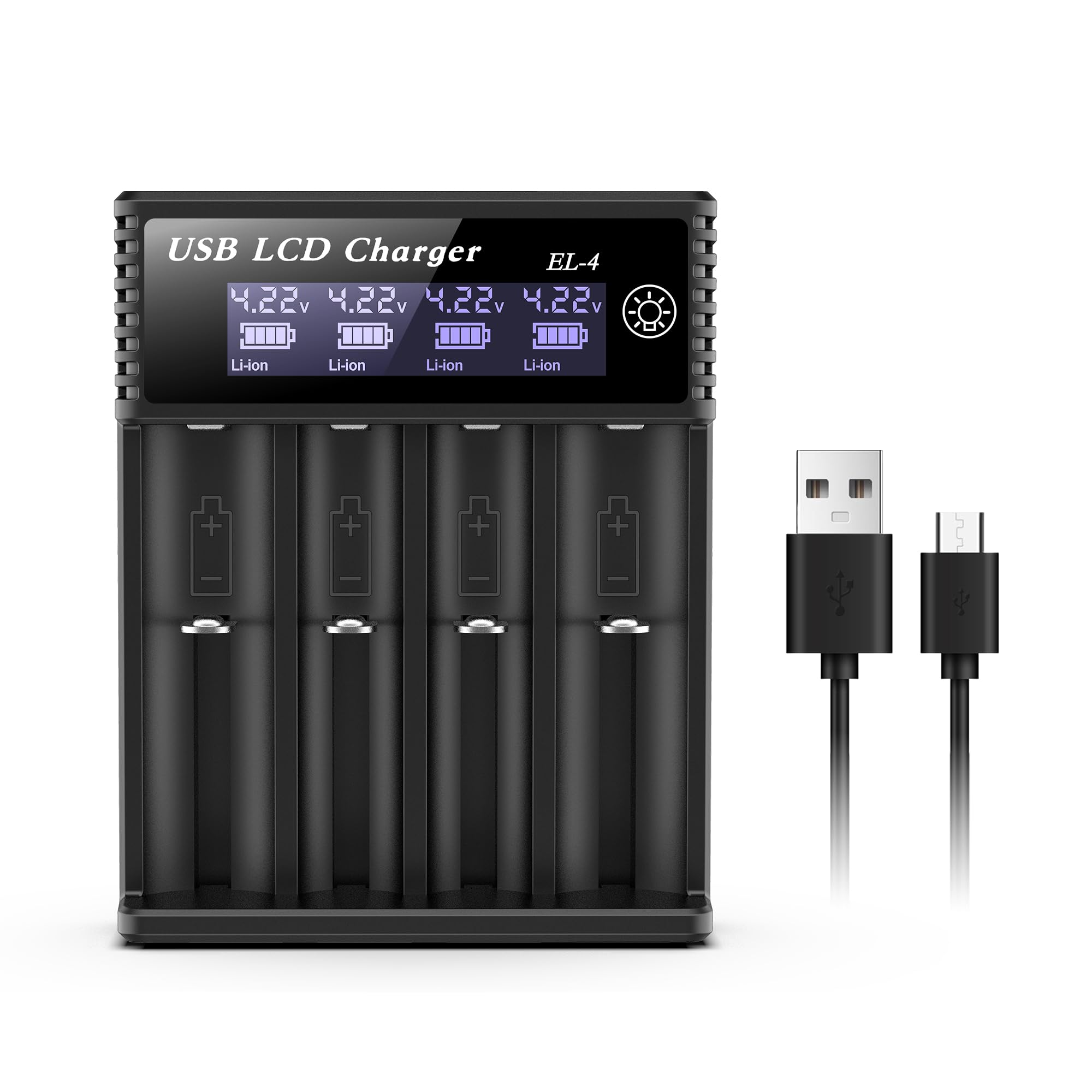
5. WANGDAJIEDIAN 4-Bay LCD Charger
A four-bay charger with a per-slot LCD that shows voltage, current, and battery type.
This is the budget-friendly way to see exactly what’s happening inside each battery. The LCD screen independently displays voltage, current, charge level, and battery type for all four slots. The screen auto-dims after 30 seconds of inactivity, so it won’t glow in your room at night.
It delivers up to 2A of charging current for lithium-ion cells, with a slower 300mA for AA/AAA Ni-MH batteries. The build uses flame-retardant PC material to handle the heat from fast charging. It accepts cells from 10440 up to 26650, plus AA, AAA, and C batteries.
Charging performance gets mixed feedback from owners though — some say it’s slow and others report units that failed early. One buyer found it doesn’t actually fit 21700 batteries despite the claim.
Data-rich budget option: the per-bay LCD is a rare feature at this price, but quality control is hit-or-miss.
Choose it if: you want per-battery voltage readings without spending premium money.
Pass if: you need reliable 21700 support or flawless charging every single time.
6. NITECORE UMS2 Dual-Slot Charger

Serious charging intelligence with a 55-minute 80% charge and battery-health readout.
The UMS2 is for people who treat their batteries as an investment. Its LCD screen shows real-time battery health as “Good” or “Poor,” internal resistance, charging current, voltage, charged volume, and charging time. That data lets you spot a dying cell before it fails in your device.
It’s fast — a single slot can output up to 3,000mA, and it takes just 55 minutes to reach 80% of a 3,500mAh battery. The charger automatically detects battery power level and picks the right voltage and mode, so there’s no guesswork.
It also has advanced safeguards: reverse polarity protection, anti-short circuiting, over-discharge activation, and a temperature regulation system. One caveat is the USB-C input on this model is actually micro-USB, which some owners found disappointing. A few buyers also had durability complaints, so it’s worth handling with care.
Intelligent charging: the health monitoring and 3A speed justify the premium for anyone charging expensive Eneloop Pro or high-end flashlight cells.
Worth it for: battery enthusiasts who want to monitor cell health and charge fast.
Maybe not if: you’re after a basic charger and don’t need the LCD data.
7. NITECORE UMS4 Four-Slot Charger

Four slots of fast, independent charging with the same smart health readout as the UMS2.
Everything that makes the UMS2 great is here, just with double the capacity. The UMS4 charges four batteries simultaneously, with a total max output of 4,000mA and a single-slot max of 3,000mA. It handles 18650, 20700, 21700, and AA/AAA cells with ease.
Each slot runs independently, which means you can charge a big 21700 at full speed while a smaller AAA trickles along. The LCD screen shows battery health, internal resistance, voltage, and charge status for each slot. Owners who upgraded from older Nitecore units report a clearer screen and smoother springs.
It’s a favorite for keeping thermal optics and high-performance flashlight batteries topped up. The one honest gripe is that the internal resistance reading can be inconsistent — the same battery sometimes shows “Good” and sometimes “Poor” depending on how it’s seated.
Four-bay workhorse: the combination of 3A per slot and independent control makes it ideal for charging a full set of flashlight cells quickly.
Best for: owners with multiple devices who charge four cells at once and want to check battery health.
Not for: anyone who needs precise internal-resistance measurements as a diagnostic tool.
8. XTAR VC8 Plus 8-Bay Charger

An eight-bay powerhouse that also tests real battery capacity — a lab tool for the enthusiast.
If you have a drawer full of loose cells, this is the charger that tames them all at once. It handles eight batteries simultaneously, including protected 20700 and 21700 cells, which is rare. It comes with a DC 12V 3A adapter, so no hunting for a USB block.
The killer feature is the built-in capacity analyzer. The first four bays (CH1-CH4) can run a charge-store-grade test cycle that measures the true mAh capacity of your cell. Owners have used it to expose new 3500mAh batteries that were actually only ~2400mAh and to identify worn-out cells that had dropped to 700mAh.
You can pick from five charge currents — 3A, 2A, 1A, 0.5A, or 0.25A — depending on how fast you want to go. The high-definition LCD shows voltage, current, internal resistance, and charged capacity. It’s made of flame-retardant PC material and stops charging automatically when full.
The downside is that some reviewers point out AA batteries from Amazon don’t fit the bays well, and one unit failed within a month.
What you get
- Eight bays charge a whole battery fleet at once
- Capacity test mode reveals true mAh of your cells
- DC 12V 3A adapter included
Keep in mind
- Only first four bays run capacity tests
- Some AA batteries fit the slots poorly
Reach for it if: you manage a large battery collection and want to verify which cells are still worth keeping.
Look elsewhere if: you just need two or four bays to top up daily-use cells.
9. Opus BT-C3100 V2.2 Charger

The classic four-slot analyzer that can charge, discharge, test, and refresh your batteries.
This is the charger that serious DIYers and powerwall builders swear by. Its four independent slots each offer five working modes: Charge, Discharge, Test, Quick Test, and Refresh. That means you can check the real capacity of a battery, not just fill it up.
Charging current is selectable from 200mA up to 1000mA on all four slots, and you can push to 1500mA or 2000mA when using just slot 1 or 4. It also has a fan to keep batteries cool during testing, plus overheat detection that shuts the unit down at high temperatures. It comes with its own US wall adapter.
Owners use it to revive “defective” Ni-MH batteries that other chargers had undercharged, and to compare the real capacity of cells from different brands. The recurring complaints are a noisy, high-pitched fan and a user interface that takes time to learn.
Test bench in a box: no other charger here offers discharge, refresh, and capacity testing in four independent slots for this price.
Choose it if: you want to measure, revive, and maintain batteries like a professional.
pass on it if: you can’t tolerate a loud fan or don’t need the testing modes.
Understanding the Specs
Charging Current (A)
The charging current in amps controls how fast a battery fills. A 1A charger fills a typical 18650 in a few hours, while 2A or 3A is noticeably quicker. Higher current generates more heat, so look for a charger with temperature regulation if you plan to push the speed.
Bay Count and Independence
The number of slots matters less than whether they work independently. Independent bays charge different battery types and sizes at their own pace, so a 21700 can charge at full speed next to a small AAA. Shared bays often slow down when multiple cells are inserted.
Chemistry Support
Not all “3.7V” chargers handle every lithium variant. Standard chargers support 3.6V/3.7V Li-ion, but you need a specific model for 3.2V LiFePO4 or 1.5V lithium-ion AAAs. Check the compatibility list before buying to ensure your exact cells are supported.
Safety Protections
Lithium-ion batteries are sensitive to overcharging and reverse insertion. Essential protections include automatic cut-off when full, reverse polarity detection, and short-circuit prevention. Premium models add internal resistance detection to flag deteriorating cells before they fail.
FAQ
What does the 3.7V rating on a battery actually mean?
Will a 3.7V charger work with 1.2V Ni-MH AA batteries?
Why does my 26650 battery not fit in some 18650 chargers?
Is a 1A charger too slow for daily use?
Can I charge a 3.7V battery with a phone wall adapter?
What is the difference between a smart charger and a dumb one?
Is the Opus BT-C3100 better than the XTAR and NITECORE chargers?
How do I know when my battery is fully charged?
Final Thoughts: The Verdict
Across the board, the clear winner for a 3.7v battery charger is the MC-ELIN 2-Slot because it balances speed, compatibility, and rock-solid reliability at an accessible price. If you want to charge large 26650 cells fast on a budget, grab the IMREN 2-Bay. And for anyone who wants a lab-grade tester that reveals true battery capacity, the Opus BT-C3100 is the one to reach for.
How We Picked
We do not accept paid placement. Every pick is matched to a real buyer and a real use-case; we do not hands-on test units.
Sources & Methodology
Specifications: manufacturer listings and product documentation. Review insights: verified customer reviews, as of August 2026. Pricing: not shown on this page (it changes often); check the current price via the retailer link.
As an Amazon Associate, Gadgets Feed earns from qualifying purchases. This does not affect which products we feature.