
Under-hood and under-car work often throws you into impossibly cramped corners where a standard ratchet simply can’t swing. A 3/8 air ratchet delivers rotation without clearance, letting you spin fasteners out in seconds instead of fighting for every fraction of a turn by hand. The right model transforms a frustrating job into a clean, efficient process.
I’m Min — the co-founder and writer behind Gadgets Feed. I’ve spent countless hours analyzing technical specifications, torque curves, and real-world user experiences across dozens of pneumatic tools to separate genuine performance from marketing claims in this tightly competitive segment.
Whether you’re removing stubborn exhaust bolts, assembling suspension components, or working on a production line, finding the best 3/8 air ratchet means balancing torque output, head size, ergonomics, and air consumption for your specific shop conditions.
How To Choose The Best 3/8 Air Ratchet
Picking the right pneumatic ratchet for your 3/8-inch drive system goes beyond grabbing the highest number. Torque delivery, physical dimensions, and air management all determine whether the tool saves you time or becomes a frustration. The three factors below directly affect how well a ratchet performs in real garage conditions.
Torque vs. Head Profile – The Real Trade-off
Maximum torque ratings in this category range from roughly 25 ft-lbs to over 130 ft-lbs. Higher torque lets you break free rusted or overtightened fasteners that a lower-rated unit would stall on. But high-torque mechanisms often require a larger head housing or a longer body, which reduces access in tight spaces like alternator brackets, bell housing bolts, or behind intake manifolds. A mid-range 50 ft-lbs ratchet with a slim head frequently outperforms a bulky 130 ft-lbs model in everyday confined work because it actually fits where the fastener lives.
SCFM and Compressor Compatibility
Every pneumatic ratchet lists its air consumption in SCFM at a given PSI, typically around 90 PSI. A tool demanding 4.5 SCFM needs a compressor that delivers at least that volume continuously — otherwise the ratchet loses power mid-run. Smaller pancake compressors (2-3 SCFM) struggle with high-consumption ratchets. Matching the tool’s SCFM requirement to your compressor’s output at 90 PSI prevents frustrating power drops during long fastening sequences. High-torque models often consume more air, so if you work from a portable compressor, a lower-SCFM ratchet is the practical choice.
Ergonomics, Noise, and Direction Control
An air ratchet that vibrates excessively or runs above 90 dBA becomes exhausting over a full workday. Look for models with insulated grips, contoured triggers, and tuned exhaust systems that route air away from your hands and reduce noise. The direction switch placement matters: switches near the head are easy to reach with your thumb but may be blocked by a socket in tight spaces. Tools with extended necks or angled heads improve access but can shift the balance point. Test the trigger feel — a variable-speed trigger gives you finesse for final tightening, while a single-speed trigger works fine for production spin-off.
Quick Comparison
On smaller screens, swipe sideways to see the full table.
| Model | Category | Best For | Key Spec | Amazon |
|---|---|---|---|---|
| ACROPOW Cordless Ratchet | Cordless Conversion | DIYers with DeWalt battery ecosystem | 74 ft-lbs, 200 RPM | Amazon |
| CRAFTSMAN Air Ratchet | Entry Pneumatic | Budget-conscious home mechanics | 50 ft-lbs, 4.4 SCFM | Amazon |
| ACDelco ARW1218-3T Extended | Extended Reach | Deep engine bay and tight firewall access | 40 ft-lbs, 6″ neck | Amazon |
| Astro Pneumatic 1838 ONYX | Mini Impact | Breaking stubborn fasteners in tight spots | 415 ft-lbs, nano head | Amazon |
| Ingersoll Rand 105-D3 | Compact Pneumatic | Pro mechanics needing a tiny head | 25 ft-lbs, 250 RPM | Amazon |
| AIRCAT 805-HT | High Torque | Heavy-duty loosening of seized fasteners | 130 ft-lbs, 84 dBA | Amazon |
| Ingersoll Rand 2317G Combo | Kit with Impact | Buying both impact and ratchet at once | 55 ft-lbs ratchet + 500 ft-lbs impact | Amazon |
In‑Depth Reviews
1. ACROPOW 3/8″ Cordless Ratchet (Bare Tool)

The ACROPOW delivers 74 ft-lbs of torque from a brushless motor that runs silently and efficiently on any DeWalt 20V Max battery you already own. Its slim head profile and aluminum alloy housing make it durable enough for daily abuse while staying light enough for one-handed operation in tight suspension cavities.
The variable-speed trigger gives you feather control for delicate assembly work, yet the motor has enough grunt to break loose rusted nuts that stall lesser cordless ratchets. The onboard LED light genuinely helps in dark engine bays — not a gimmick. Real users report handling full weekend jobs on a single 3Ah battery, which speaks to the motor’s efficiency.
This is a bare tool, meaning no battery or charger is included, but that keeps the entry cost low if you’re already in the DeWalt ecosystem. The included adapters (1/2″ and 1/4″) and 3-inch extension bar add immediate versatility. For home mechanics who want cordless freedom without the premium price tag, this is the most balanced offering in the entire segment.
Why it’s great
- Brushless motor runs cooler and quieter than brushed alternatives
- 74 ft-lbs torque rivals many corded pneumatic models
- Compact head design fits into tight transmission bell housing areas
Good to know
- No manual ratchet override mechanism included
- Direction switch located at the head, not the handle
2. CRAFTSMAN 3/8-in Air Ratchet (50 ft-lbs)

The CRAFTSMAN 3/8 air ratchet punches above its 50 ft-lbs rating thanks to a well-tuned single pawl mechanism and a contoured trigger that fits naturally under your index finger. At just 2.5 lbs and with a head profile that stays narrow, it slips into tight spots behind dashboard brackets and under intake manifolds where bulkier ratchets simply can’t go.
The insulated handle is a thoughtful touch for winter shop work — cold air exhausting through the tool won’t chill your palm during extended use. The forward/reverse switch on the head is easy to toggle without looking, though gloved users note it requires a bit of finger dexterity. Air consumption sits at 4.4 SCFM at 90 PSI, which works well with a standard 20-gallon compressor without overtaxing the tank.
Real-world feedback from owners confirms it spin-off bolts quickly after break-loose, but you’ll need to crack stubborn fasteners with a breaker bar first — that’s expected at this torque level. The built-in muffler keeps noise reasonable for a pneumatic tool. For the home mechanic who values predictable reliability and brand support, this Craftsman delivers exactly what it promises.
Why it’s great
- Insulated handle prevents cold air discomfort during long use
- Contoured trigger reduces hand fatigue on repetitive fastening
- Compact 9.88-inch length for tight workspace access
Good to know
- 50 ft-lbs insufficient for breaking fully seized fasteners
- Quick-connect plug not included in the package
3. ACDelco ARW1218-3T G12 Extended Ratchet

The ACDelco ARW1218-3T stands out immediately for its 6-inch extended neck, a feature that transforms access to fasteners buried deep in engine bays or behind transmission housings. While most 3/8 ratchets top out around 3 inches of reach, this extended design lets you reach water pump bolts, motor mount fasteners, and bell housing bolts without needing wobble extensions.
Torque is rated at 40 ft-lbs with a fixed 250 RPM speed, which places it in the light-to-medium duty category. That’s perfectly appropriate for spinning off fasteners after manual break-loose — and the extended length gives you enough leverage to apply manual torque up to 100 ft-lbs if the power stalls. The included battery and charger make this a complete cordless solution out of the box.
Users report the electronic brake stops the head quickly when you release the trigger, a safety feature that prevents the socket from spinning loose. The LED light positioned near the head illuminates deep cavities clearly. One caveat: the larger head housing due to the extended mechanism means it won’t fit the absolute tightest crevices, but for 90% of deep-reach scenarios, this is the tool to grab.
Why it’s great
- 6-inch extended neck reaches deep engine bay fasteners
- Electronic brake stops the head immediately for safety
- Complete kit includes battery and charger
Good to know
- 40 ft-lbs torque limits it to light-to-medium duty
- Extended head profile slightly larger than standard models
4. Astro Pneumatic 1838 ONYX Nano Impact

The Astro Pneumatic 1838 ONYX is technically an impact wrench in a 3/8-inch drive, but its nano-sized head (just 3.46 inches long) makes it function like a hyper-powered ratchet in spaces where conventional impact guns can’t squeeze in. With a staggering 415 ft-lbs of torque, it demolishes rusted exhaust bolts, seized caliper bracket fasteners, and stubborn suspension hardware that leaves standard pneumatic ratchets helpless.
The progressive trigger offers three distinct power settings with audible detents, so you’re not always blasting at full force. The rotating exhaust directs air away from your face, and the aluminum housing keeps weight manageable at 3.2 lbs. However, this tool demands real air supply — the recommended 45 CFM at 120 PSI means most portable compressors won’t cut it.
Professionals who reviewed this tool praise its ability to remove fasteners in locations where a standard ratchet head wouldn’t fit, such as inside brake caliper brackets or behind the harmonic balancer. The trade-off is that it’s an impact mechanism, not a true ratchet — you won’t get the smooth rotation for running nuts down threads quickly. It’s a specialized tool for specialized problems, and it excels at that narrow mission.
Why it’s great
- 415 ft-lbs torque destroys seized fasteners in tight spots
- Nano head design fits where standard impacts won’t go
- Three power settings with positive detents for control
Good to know
- Requires high CFM compressor (45 CFM at 120 PSI recommended)
- Trigger feel is less refined than true ratchet triggers
5. Ingersoll Rand 105-D3 Mini Air Ratchet
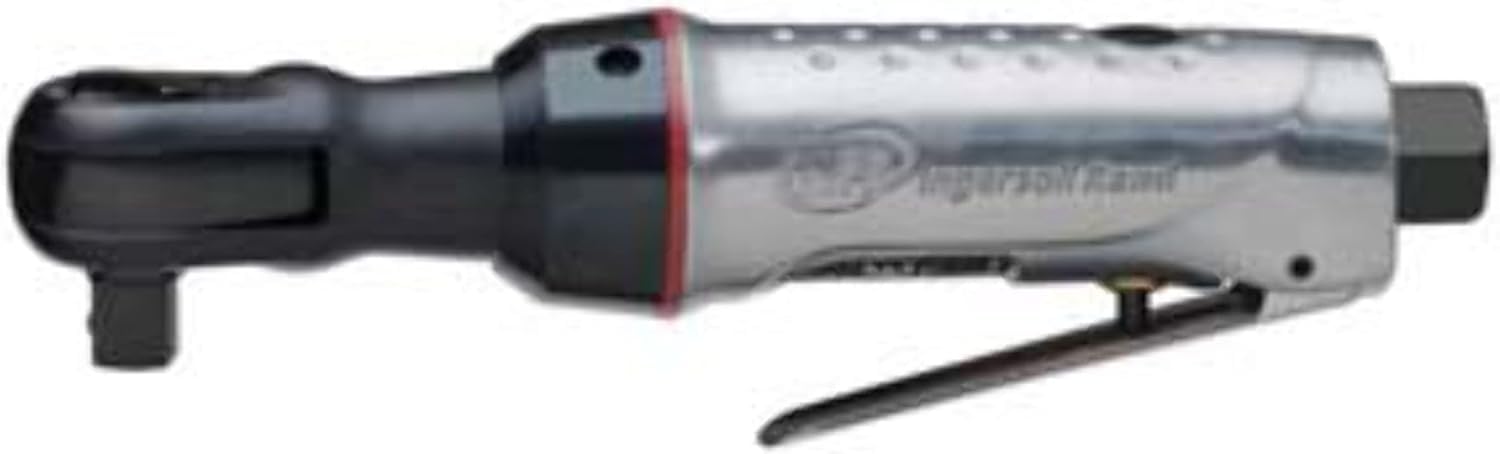
The Ingersoll Rand 105-D3 is the definition of a compact workhorse — its tiny head and lightweight 0.64 kg construction make it the go-to tool for confined spaces like inside door panels, under dashes, and around transmission coolers. With 25 ft-lbs of torque and a free speed of 250 RPM, it prioritizes access and speed over brute force, which is exactly what you need for production fastening and disassembly work.
The ball dent anvil securely locks sockets in place, preventing them from falling off mid-operation — a small detail that saves significant frustration. The aluminum housing with a steel head construction provides durability without adding bulk. Mechanics who work on motorcycles, ATVs, and tight engine compartments consistently choose this model for its ability to fit where nothing else does.
The trade-off is torque: 25 ft-lbs won’t break loose corroded fasteners, so you’ll need to crack them manually first. But for what it lacks in raw power, it makes up in speed and maneuverability. The direction selector is clear and positive, though some users note it’s a bit stiff to operate with greasy gloves. For professional technicians who spend all day behind a workbench, this mini ratchet earns its place through sheer utility.
Why it’s great
- Extremely compact head fits the tightest workspaces
- Ball dent anvil provides secure socket retention
- Lightweight design reduces hand fatigue during repetitive use
Good to know
- 25 ft-lbs torque requires manual break-loose for stuck bolts
- Direction switch can be tricky to operate with heavy gloves
6. AIRCAT 805-HT High Torque Ratchet

The AIRCAT 805-HT is a torque monster in the 3/8 air ratchet category, delivering 130 ft-lbs of maximum torque from a single pawl mechanism that snaps fasteners loose with authority. This is a tool for professional technicians who encounter seized exhaust manifold bolts, frozen caliper brackets, and rusted suspension hardware daily — it breaks things that other ratchets stall on.
Its patented tuned exhaust system keeps noise at 84 dBA, significantly quieter than competing high-torque models that push past 95 dBA. The ergonomic handle is well-contoured for gloved hands, though the body is noticeably longer and thicker than standard ratchets — at 12.45 inches, it requires more clearance to operate. The variable-speed trigger gives you modulation for final tightening, though the single pawl design means over-tightening is a real risk if you’re not careful.
Real-world feedback from heavy-duty users confirms this ratchet outperforms Snap-on and Matco equivalents at a fraction of the price. The trade-off is physical size — it won’t fit into the ultra-tight areas that a mini ratchet handles easily. You need high-flow fittings and a quality air system to feed its appetite. For the pro who needs maximum torque without the impact hammer mechanism, this is the definitive choice.
Why it’s great
- 130 ft-lbs torque breaks seized fasteners reliably
- Tuned exhaust keeps noise at a comfortable 84 dBA
- Beats truck-brand performance at a lower investment
Good to know
- Longer 12.45-inch body limits ultra-tight access
- No torque adjustment mechanism for final tightening control
7. Ingersoll Rand 2317G Impact Wrench & Ratchet Combo

The Ingersoll Rand 2317G combo kit bundles the 170G 3/8 air ratchet (55 ft-lbs, 170 RPM) with the 231G 1/2-inch impact wrench (500 ft-lbs), giving you both a fastening and a breaking tool in a single padded carry case. The 170G ratchet features a Twin Pawl Plus mechanism that’s heat-treated for extended life, delivering smooth operation and enough torque to spin off most automotive fasteners after initial break-loose.
The 231G impact uses a twin hammer mechanism with a 6-vane motor that provides balanced blows for consistent torque delivery. Professionals report it removes heavily corroded bolts from vintage vehicles and snapped suspension components without hesitation. The contoured grips on both tools reduce hand fatigue during all-day use, and the included 5-piece socket set gets you started immediately.
The case keeps everything organized in a shop environment, and both tools run efficiently on a 5.1 SCFM air system. The main consideration is that both tools are built to a mid-range durability standard — they’re excellent for home and semi-professional use, but hardcore daily abuse may reveal their limitations over years of service. For the mechanic who needs both a reliable ratchet and a powerful impact in one purchase, this kit represents smart value.
Why it’s great
- Combines ratchet and impact in a single organized kit
- Twin Pawl ratchet mechanism is heat-treated for longevity
- 500 ft-lbs impact handles seized and rusted fasteners
Good to know
- Both tools built for mid-range, not heavy daily professional use
- Socket set included is limited to 5 pieces
FAQ
Will a 3/8 air ratchet break loose rusted lug nuts?
Can I use a 3/8 air ratchet on a 6-gallon pancake compressor?
What is the difference between a 3/8 air ratchet and a 3/8 impact wrench?
How important is variable-speed trigger on an air ratchet?
Should I lubricate my air ratchet and how often?
What does a 1/4 NPT air inlet mean for connecting my air ratchet?
How does noise level (dBA) affect my choice of air ratchet?
Final Thoughts: The Verdict
For most users, the best 3/8 air ratchet winner is the ACROPOW Cordless Ratchet because it delivers 74 ft-lbs of brushless torque in a compact, battery-powered package that eliminates air hose hassles while matching pneumatic performance. If you need maximum brute force for seized fasteners, grab the AIRCAT 805-HT with its class-leading 130 ft-lbs. And for access in the tightest engine bay crevices, nothing beats the Ingersoll Rand 105-D3 mini ratchet’s tiny head profile.