
Our readers keep the lights on and my morning glass full of iced black tea. As an Amazon Associate, I earn from qualifying purchases.
Specs are compiled from manufacturer listings and verified buyer reviews and can change over time — please confirm the key details on the product page before buying.
A shaky video can ruin a perfect moment, whether it’s your kid’s first steps or a scenic travel vlog. A 3-axis gimbal fixes that by using three motors to counteract your hand movements, keeping your phone or camera smooth and steady in any direction. If you’re wondering which one is worth your money, the short answer is the DJI Osmo Mobile 6 — it’s the crowd favorite for its balance of performance and ease of use.
I’m Min — the founder and writer behind Gadgets Feed. This guide is built by comparing the manufacturers’ published specifications and the patterns across verified customer reviews, so you get each pick’s real strengths and trade-offs instead of marketing spin.
Choosing a 3 axis gimbal means deciding between phone and camera models, so we break down the best stabilizers for every use case.
Our Picks at a Glance


How To Choose The Best 3 Axis Gimbal
The first big decision is what you’re mounting. A phone gimbal is lightweight and folds down, while a camera gimbal carries heavier gear and uses stronger motors. Knowing your gear’s weight is the starting point — a gimbal with a low payload limit will struggle or shut off if you push it.
Payload Capacity is the Hard Limit
Every gimbal has a maximum weight it can handle, called payload. For phones, this is usually around 300g to 400g, which covers most modern handsets but not heavy cases or add-on lenses. For mirrorless cameras, look for a payload of at least 2kg to 3kg to comfortably support a body and a standard zoom lens.
Battery Life Defines Your Day
Gimbals use motors that drain batteries quickly, so runtime is a real-world concern. Budget models offer around 10 hours, while premium camera gimbals can hit 12 to 16 hours on a single charge. Most use USB-C for charging, and some even let you reverse-charge your phone in a pinch.
AI Tracking vs Manual Control
AI tracking uses a vision sensor to lock onto a face or object and rotate the gimbal automatically, which is great for solo creators. Some models do this without an app, while others need a separate module. If you prefer full control, a joystick and a physical side wheel for focus and zoom might serve you better.
Quick Comparison
| Model | Best For | Payload | Battery | Weight | Amazon |
|---|---|---|---|---|---|
| DJI Osmo Mobile 6★ Best Overall | Best Overall Phone | — | 3-4 hrs | 1.3 lbs | Amazon |
| AOCHUAN XE AIBest Value | No-App Tracking | 250g | 10 hrs | 350 g | Amazon |
| Hohem iSteady M6High Payload | High Payload Phone | 400g | 18 hrs | 551 g | Amazon |
| hohem iSteady V3 Ultra | Touchscreen Remote | 14.11 oz | 9 hrs | 15.1 oz | Amazon |
| ZHIYUN Weebill 3E | Camera Value | 3 kg | 16 hrs | 990 g | Amazon |
| ZHIYUN Smooth 5S AI Pro | Fill Light Phones | 300 g | — | 644 g | Amazon |
| FeiyuTech SCORP Mini-3-Pro | 4-in-1 Versatility | 2 kg | All-day | 1 kg | Amazon |
| GoPro Fluid Pro AI | GoPro & Phone | — | — | 551 g | Amazon |
| DJI RS 4 | Professional Cameras | 3 kg | 12 hrs | 1.55 kg | Amazon |
In‑Depth Reviews
1. DJI Osmo Mobile 6
Our pick — 4.5★ from 20,000+ verified ratings; the strongest balance of quality and price.
The DJI Osmo Mobile 6 pairs ActiveTrack 6.0 with a foldable 305g build for smooth, cinematic phone footage.
The Osmo Mobile 6 is the most complete phone gimbal you can buy, and the reason starts with ActiveTrack 6.0. This upgraded tracking tech locks onto energetic kids or playful pets and holds them in frame, and it can track you too for solo filmmaking. You unfold it, it powers on, you attach your phone via the magnetic quick-mount, and you’re ready to shoot.
Buyers report the battery lasts 3-4 hours, which covers a good day of casual shooting but means you’ll want a power bank for long sessions. The initial learning curve comes from opening/closing the gimbal and getting used to the joystick direction and speed — several owners mention YouTube tutorials are essential for getting the hang of it.
The side wheel gives you control over focus and zoom for cinematic effects like a Hitchcock zoom, and ShotGuides suggests shot sequences for beginners. At 305g and foldable, it’s made to travel, and the built-in extension rod lifts your phone for selfies or high angles. This is also the crowd favorite — a 4.5-star average across 20,000+ owners.
What wins people over
- Magnetic quick-mount makes setup genuinely fast
- Gesture control: peace sign starts recording, stop sign stops it
- Works with standard tripods for static shots
- Compact foldable design at 305g
The honest trade-offs
- Battery is 3-4 hours, so long days need a power bank
- Motors struggle with added weight like external lenses
- No ProRes video support for advanced mobile filmmakers
The right pick when: you want a dependable, beginner-friendly phone gimbal backed by a huge base of happy owners.
Think twice if: you shoot all day on location — the runtime falls short of the 10-hour models below.
2. AOCHUAN XE AI Gimbal Stabilizer
The AOCHUAN XE AI offers 10-hour battery life and app-free AI tracking for under.
The AOCHUAN XE AI stands out because its smart AI tracking module uses an integrated vision sensor, so face tracking works without you ever opening an app. For solo creators, that removes a real barrier — no pairing, no app crashes, just point and track. The 2600mAh battery gives you 10 hours of use after a 3-hour full charge, which is lengthy by any standard.
The build quality is the thing buyers praise most, described as solid and well-made. The four practical stabilizer modes — “F”, “POV”, “DM”, and “GO” — cover push-pull moves, tilt-angle shooting, Inception-style rotation, and quick sports transitions. It weighs 350g and folds to a storage size roughly that of a 15 Pro Max.
Functionality gets mixed feedback in the reviews, so it helps to know your fit. The clamp can fail to securely hold a large phone (like an S26 Ultra) with a thick protective case, so check your phone width against the 2.2–3.4 inch spec. One owner was thrilled to capture a Blue Angels performance better than a friend’s k camera setup — the motors clearly deliver when your phone is within spec.
Real-world trade-off: you get remarkable battery life and app-free tracking, but the clamp width is the catch — measure your phone with its case before you buy.
Reach for this if: you want long runtime and AI tracking without fighting with an app.
Look elsewhere if: you use a heavily-cased plus-size phone that exceeds the clamp’s 3.4 inch width.
3. Hohem iSteady M6
The Hohem iSteady M6 delivers 18 hours of runtime and reverse-charges your phone mid-shoot.
The iSteady M6 is built around two specs that content creators care about most: a 400g payload and 18 hours of continuous usage. The higher payload means it handles bigger phones and heavier lens attachments without the motors straining, and the reverse-charge technology lets you top up your smartphone through the power-out port while you record — no low-battery anxiety.
The 0.91 inch OLED display on the handle shows your gimbal parameters, Bluetooth status, battery level, and mode at a glance, so you’re never guessing what it’s doing. The iSteady 7.0 stabilization algorithms keep footage smooth whether you’re walking or running, and the versatile control wheel handles roll axis rotation, focus, and even cold/warm light adjustment.
Sturdiness is what wins people over here — buyers consistently describe it as solidly built, and it gets through a whole day of shooting on a single charge. The four 1/4″-20 UNC ports let you mount accessories to expand your setup. An A-B motion button enables motion timelapse without needing the app or Bluetooth at all.
The catch: the vertical pitch is limited and the separate AI tracker can cut off faces in close-up, so this rewards stabilizing fundamentals over auto-tracking.
Pick this for: long shooting days and a phone packing extra gear, where the 400g payload and 18-hour runtime shine.
skip it if: you want reliable built-in AI tracking — that module is a known weak point here.
4. hohem iSteady V3 Ultra
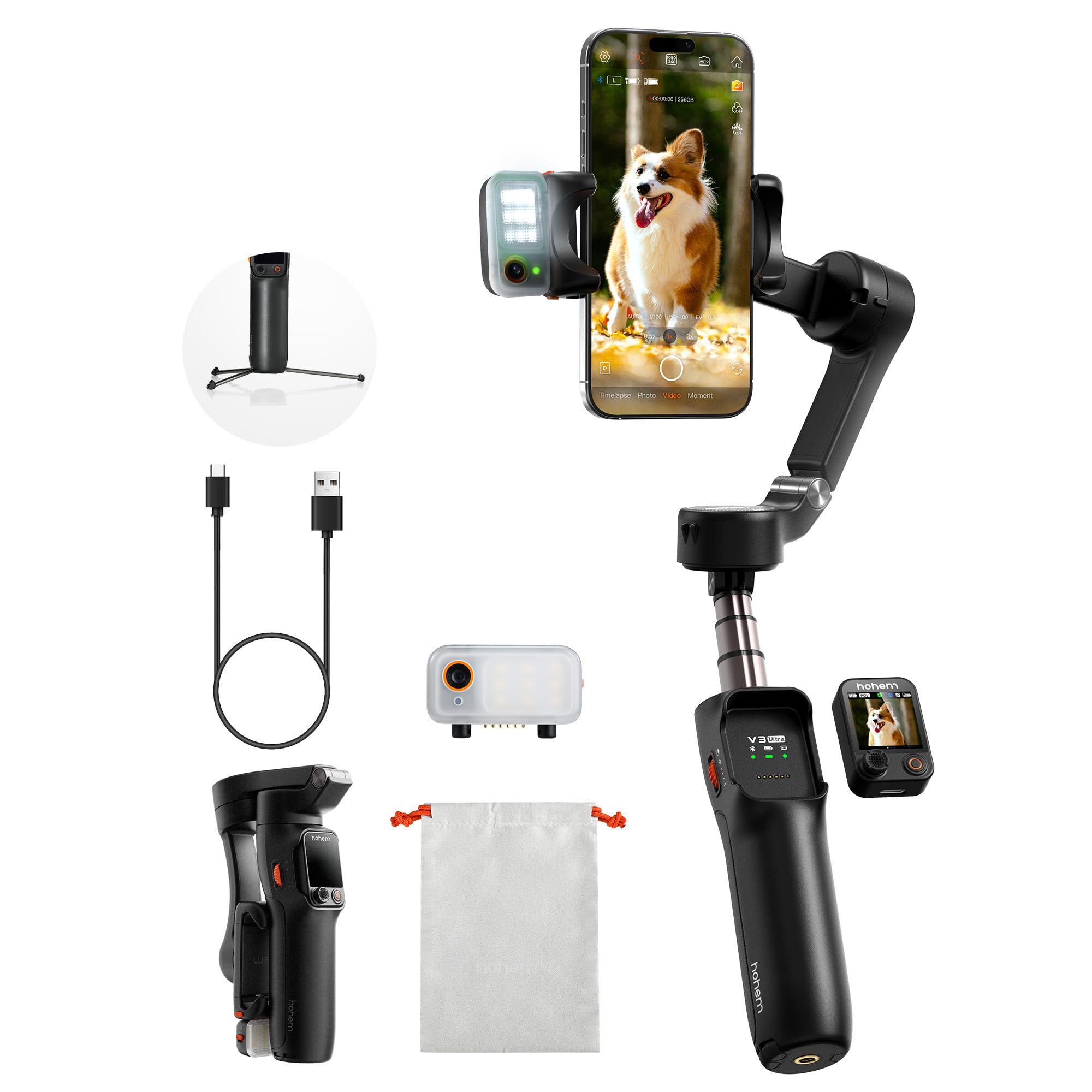
The hohem iSteady V3 Ultra packs a detachable 1.22″ touchscreen remote and fill light into a 6.3-inch foldable body.
The iSteady V3 Ultra’s defining feature is its detachable 1.22″ touchscreen remote, which gives you full control from up to 33 ft away. You can adjust tracking, preview shots, and fine-tune settings without touching the gimbal itself — a huge win for solo vloggers, fitness coaches, and parents filming action from a distance. It uses a magnetic AI tracker with a built-in fill light for studio-quality lighting on the go.
This is the smallest pick of the premium bunch, folding to just 6.3 inches and weighing 15.1 oz, so it genuinely slips into a pocket. The iSteady 9.0 stabilization algorithm keeps shots buttery whether you’re walking or running, and the built-in 8-inch extension rod plus tripod covers low and high angles. It supports phones up to 14.11 oz and runs up to 9 hours.
Buyers praise the removable remote control most, and they call the AI tracking “magic.” Stability gets mixed feedback, though: you may need to correct leveling by 0.5-1.5 degrees at each startup. The handle fits smaller hands well, but large-handed users find it awkward to grip.
Best in class for: remote-controlled solo shooting, where nothing else at this size gives you a viewfinder and preview 33 feet away.
Choose it for: travel and solo content where a pocket-sized gimbal and a wireless remote beat a bigger rig.
Be aware: you’ll re-level at startup, and the compact handle isn’t built for large hands.
5. ZHIYUN CINEPEER Weebill 3E

The ZHIYUN Weebill 3E carries a 3kg mirrorless rig for 16 hours at a budget-friendly price.
If you’ve moved up to a mirrorless or DSLR camera, the Weebill 3E is the budget-friendly way into professional stabilization. It carries a 3 kg (6.6 lbs) payload while weighing only 1.05 kg itself — an A4 paper-sized, portable design that handles a body plus a 24-70mm F2.8 lens. Native vertical shooting is a standout: you mount the quick-release plate to the vertical arm and shoot social media content without extra accessories or dismantling anything.
The 16-hour max battery life with 14W PD fast charging (about 2 hours 46 minutes to full) means this is an all-day tool. Bluetooth shutter control pairs automatically on first connect, letting you start and stop recording or trigger photos wirelessly. Buyers call it the best bang-for-buck gimbal on the market, with one owner leaving a DJI RS 3 Mini for it.
Quality is the thing buyers praise most, but balancing takes time and patience — that’s the recurring note. One owner found balancing tricky, then got smooth footage after. It can’t go a full 360 on the y-axis, and the package only includes a Panasonic control cable, so Canon and Sony shooters need to buy additional cables for full connectivity.
The honest read: you get class-leading payload-to-price for camera users, but you pay for it with a steeper balancing learning curve.
Who it beats: any “mini” camera gimbal that can’t handle a full-frame zoom lens.
Who it doesn’t: shooters who need a 360° y-axis or plug-and-play camera control from the start.
6. ZHIYUN Smooth 5S AI Pro
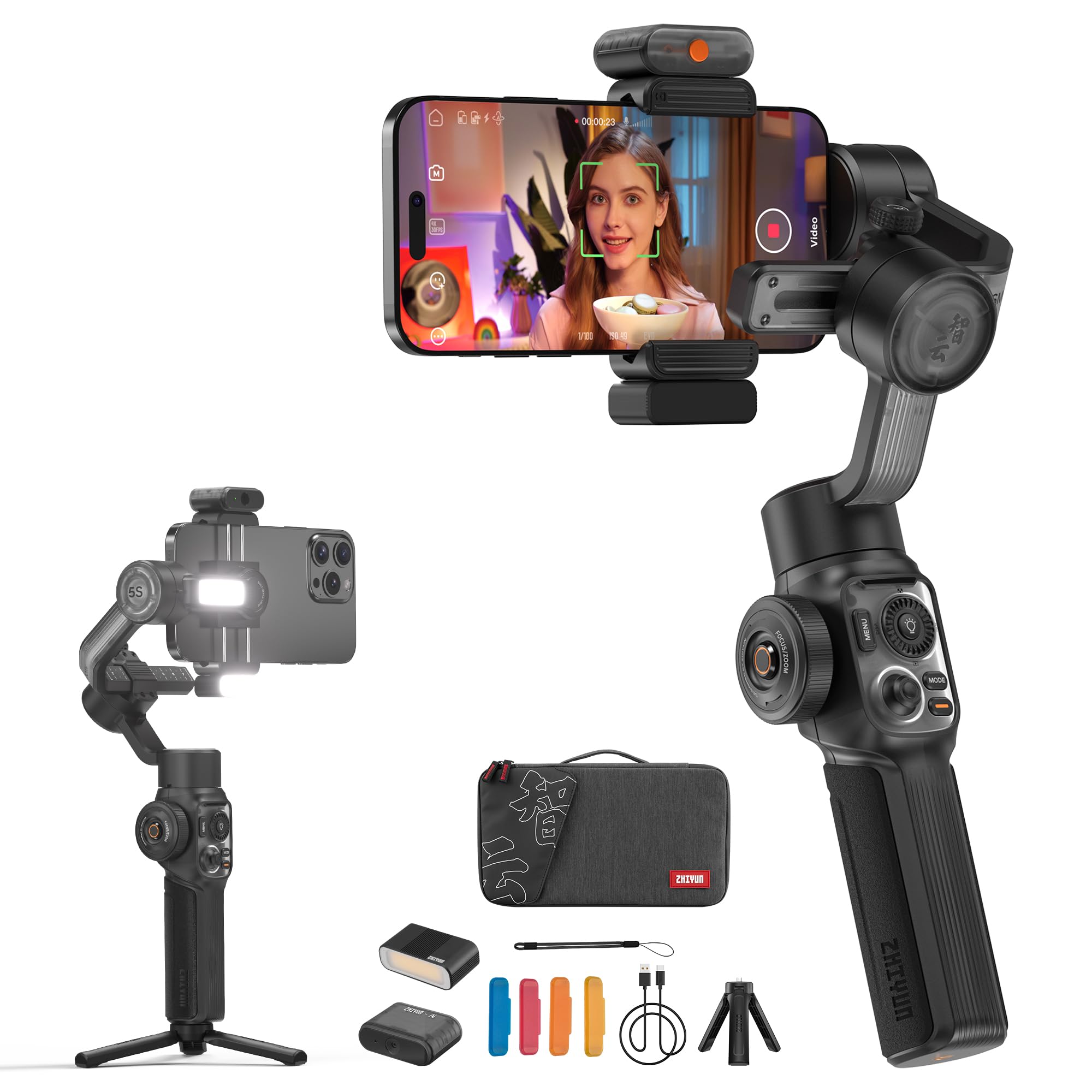
The ZHIYUN Smooth 5S AI Pro adds built-in fill lights and unlimited 360° rotation for phone creators.
The Smooth 5S AI Pro suits creators who obsess over lighting as much as stability. It pairs a built-in high-power fill light with additional magnetic fill lights in the Pro package — plus four fill light filters — so you can balance light on a face or product without carrying a separate light rig. It also enables true 360° unlimited rotation without app limitations for dramatic panning and wide landscape shots.
The AI tracking module delivers rapid, responsive target tracking without needing an app, using intuitive gestures to start and stop. The full keyboard control panel puts menus and settings on physical keys, so you adjust on the fly without digging through on-screen menus. It weighs 644 g and folds to 311mm (l) x 168mm (w) x 52mm (h).
Buyers praise functionality most here, with owners reporting great results on a Samsung S25 Ultra and calling the fill lights a standout. Ease of use is the mixed note — setup takes time, and there’s a known limitation: the USB-C port on top doesn’t charge iPhones with USB-C ports, despite iPhone 15 being listed as compatible. An occasional unit arrives with the counterbalance beeping and shutting off.
The standout feature: no other phone gimbal in this list gives you this level of built-in lighting control plus true 360° rotation.
Reach for the Smooth 5S if: you’re a beauty or livestream creator who needs controllable light built into the stabilizer.
Watch out: if you shoot with a USB-C iPhone, the top charging port won’t work for your phone.
7. FeiyuTech SCORP Mini-3-Pro

The FeiyuTech SCORP Mini-3-Pro supports mirrorless, phone, and action cameras with a 2kg payload and detachable remote.
The SCORP Mini-3-Pro is the four-in-one answer for creators with mixed gear. It supports mainstream mirrorless cameras, compact cameras, smartphones, and action cameras — so you can swap from your camera to your phone without buying a second stabilizer. The 2kg (4.4lbs) payload with an extended quick release plate gives you larger installation space for varied setups.
AI Tracking 4.0 is the headline feature: up to 18 meters of tracking distance with a 0.003s response time, a 40% expanded tracking view, and 360° infinite tracking follow. The detachable handle works as a remote control, which is perfect for solo creators needing long-distance operation. It comes with 16 accessories including a GoPro adapter, smartphone holder, and lens holder.
Stability is the thing buyers praise most here, with one owner calling it a standout for iPhone filming and noting all-day battery life. The tracking is sensitive to movement, so it takes practice to master. Weight is a limiting factor — attaching an external light to a Canon R50 can exceed what the motor comfortably moves, so respect the 2kg limit.
The flexibility play: if your kit mixes a camera and a phone, this is the single gimbal that carries both well.
Great for: hybrid shooters who switch between camera, phone, and action cam without wanting separate rigs.
Keep in mind: the sensitive AI tracking rewards practice, and the motor fights back if you overload it with lights.
8. GoPro Fluid Pro AI
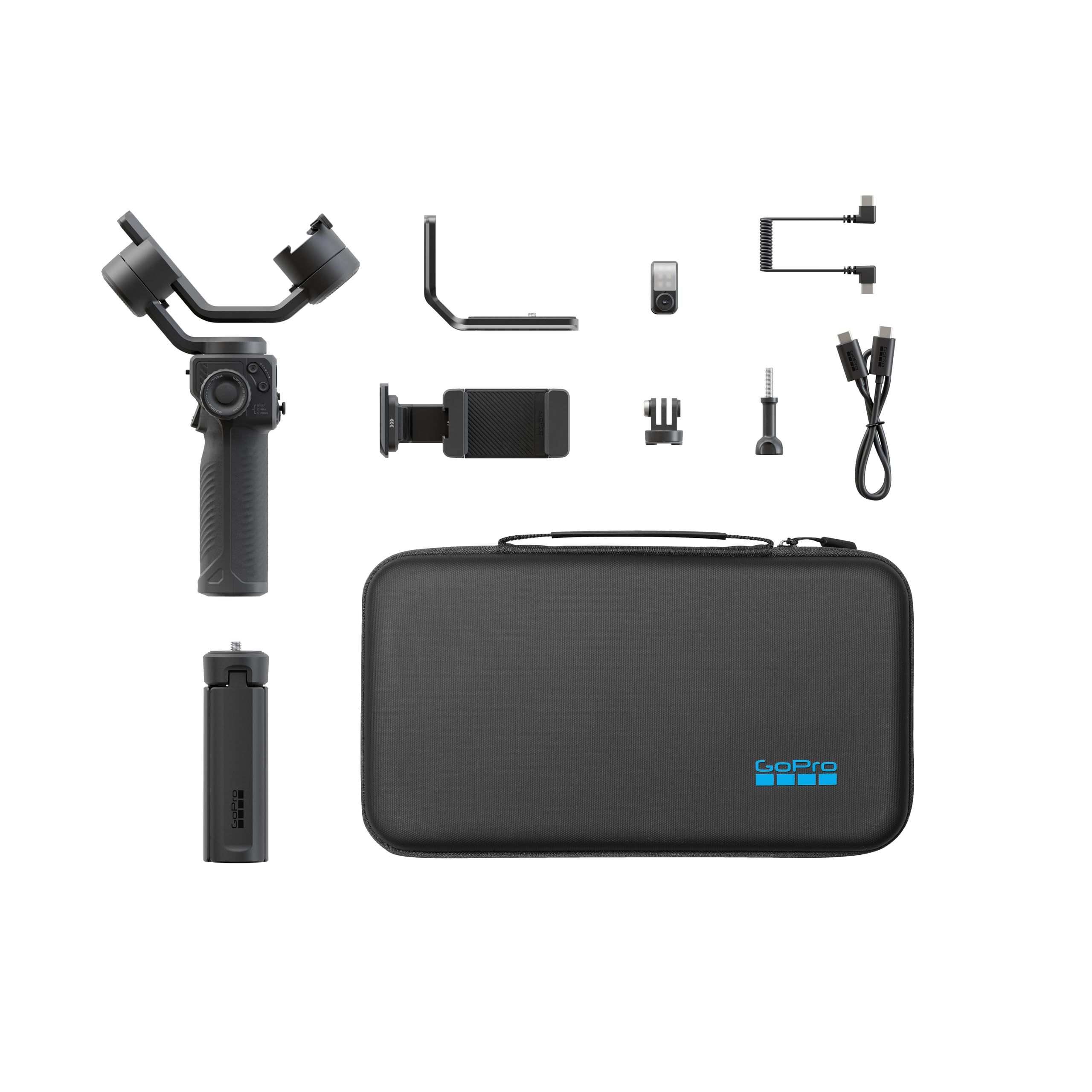
The GoPro Fluid Pro AI is the brand’s own gimbal with interchangeable mounts for GoPros and phones.
This is the rare gimbal built by the action camera brand itself, with interchangeable mounts that work with mobile phones, GoPro cameras, and select compact point-and-shoot cameras. The forward- or rear-facing AI subject tracker module locks onto a person’s face or body and keeps them framed automatically. An integrated fill light balances your shot for more professional results.
The package is generous: gimbal, AI tracking module, phone mounting bracket, GoPro camera bracket, GoPro finger adapter, tripod base, two USB-C cables, and a zippered case. Bluetooth functionality works with HERO9 through HERO13 Black. Customers note it works great with a GoPro 9 and a Samsung Ultra 24 Plus, with smooth movement and phone charging on the fly.
AI tracking is the thing buyers praise most here, called “unsurpassed” — a powerful selling point for solo action vloggers. Compatibility is the mixed note: it doesn’t handle camera zoom lenses, which are too heavy for the motors to compensate. Some features need the app, which limits functionality and drains battery, and you must rebalance when switching devices.
The real use case: a GoPro owner who also wants phone stabilization in one travel-friendly kit.
Best for: GoPro users who want official-mount integration plus the option to stabilize a phone.
Not for: heavy zoom-lens setups — the motors can’t compensate for that weight.
9. DJI RS 4

The professional’s choice that balances a 6.6 lb rig in seconds and shoots vertically natively.
At the top of the range sits the DJI RS 4, a camera gimbal that pros reach for because balancing is genuinely fast. The Teflon-coated axis arms reduce friction on all three axes for ultra-precise balancing, and the 3kg (6.6lbs) payload with an extended tilt axis (8.5mm longer than the previous generation) mounts mainstream mirrorless and lens combos with room to spare.
The 2nd-gen native vertical shooting is a time-saver: release the new horizontal plate, secure it into the vertical position, and you’ve switched formats without extra accessories. The joystick mode switch toggles between PF, PTF, and FPV modes, and FPV can be set to 3D Roll 360 or custom mode. The included BG21 battery grip runs 12 hours, extendable to 29.5 with the separate BG70 grip.
Balance is the thing buyers praise most — owners call it a rock-solid stabilizer with responsive motors and fast setup. The RSA communication port connects to a wider accessory ecosystem. Battery life gets mixed feedback, and the optional high-capacity grip is pricey; the setup process also has a learning curve. But owners consistently call it the best gimbal they’ve owned, essential for professional shoots.
The pro verdict: nothing in this list balances a heavy camera setup as quickly or holds it as rock-steady.
Built for: working photographers and videographers who need fast balancing on paid shoots.
Know this: the 12-hour battery is the weak spot, and the bigger grip that fixes it costs extra.
Understanding the Specs
Payload Capacity
This is the maximum weight the motors can hold steady, measured in grams (g) or kilograms (kg). For phones, look for at least 250g to 400g so your handset plus a case fits comfortably. For cameras, you need 2kg to 3kg to support a body and lens together. Going over the limit makes the motors strain and fail.
Battery Life & Charging
Runtime tells you how long the gimbal steadies before needing a charge, ranging from 3-4 hours on basic models to 16-18 hours on premium ones. Longer is better for all-day shoots. Some gimbals support fast charging via USB-C, and a few can reverse-charge your phone — a handy backup when your phone is dying mid-filming.
FAQ
What is the difference between a 2-axis and 3-axis gimbal?
Will a phone gimbal work with my iPhone or Samsung?
How long does a gimbal battery last on a single charge?
Can a camera gimbal also hold my smartphone?
What is AI tracking on a gimbal and do I need it?
Is a heavier gimbal better for stability?
How do I know if my camera and lens combo is too heavy for a gimbal?
What is the best gimbal for vertical TikTok and Reels videos?
Final Thoughts: The Verdict
Across the board, the 3 axis gimbal winner is the DJI Osmo Mobile 6 because it pairs reliable ActiveTrack 6.0 tracking with a foldable, beginner-friendly build that a massive base of owners already trusts. If you want the longest runtime and reverse charging for your phone, grab the Hohem iSteady M6. And for camera owners who need a 3kg payload without the premium price, the ZHIYUN Weebill 3E is the one to reach for.
How We Picked
We do not accept paid placement. Every pick is matched to a real buyer and a real use-case; we do not hands-on test units.
Sources & Methodology
Specifications: manufacturer listings and product documentation. Review insights: verified customer reviews, as of August 2026. Pricing: not shown on this page (it changes often); check the current price via the retailer link.
As an Amazon Associate, Gadgets Feed earns from qualifying purchases. This does not affect which products we feature.