
Shaky handheld footage instantly signals amateur production, no matter how good your smartphone camera is. A 3-axis phone stabilizer uses three independent motors to counter every micro-movement of your hand, delivering the buttery-smooth, cinematic pans and tracking shots that separate casual clips from professional content. Whether you are filming a family walk, a product demonstration, or a travel vlog, the right gimbal is the single upgrade that transforms your phone into a serious video rig.
I’m Min — the co-founder and writer behind Gadgets Feed. I’ve spent hundreds of hours analyzing motor torque specs, battery cycle tests, and load capacity limits to find the stabilizers that truly hold a lock on your subject, even during fast motion.
After comparing payload ratings, battery longevity, tracking algorithms, and build quality across seven top contenders, this guide delivers a clear verdict on the best 3-axis phone stabilizer for every type of shooter.
How To Choose The Best 3-Axis Phone Stabilizer
Three-axis gimbals are not all the same. The motor strength, battery endurance, tracking intelligence, and physical build define your experience as much as the brand name. Focus on these three decision points before clicking add to cart.
Motor Torque and Payload Capacity
Every 3-axis stabilizer has a maximum payload measured in grams. A standard iPhone Pro Max with a case often weighs 250–280 grams. If your gimbal is rated for 280 grams, you are already at the limit — and any wind or fast movement will cause the motors to overheat and drop the horizon. Look for at least 350–500 grams of rated payload so the motors have headroom to maintain a steady lock. A 500g rating lets you attach a small microphone or fill light without destabilizing the gimbal.
Tracking: App-Based vs. On-Device AI
Lower-cost stabilizers rely entirely on a companion app to handle face and object tracking. This approach drains your phone’s battery faster and often forces you to use the app’s inferior camera instead of the native camera app. Mid-range and premium models now integrate an on-device AI tracker module that works with any app — including the native camera, FaceTime, or third-party streaming apps. On-device tracking is faster, more reliable, and preserves your phone’s native image processing.
Battery Life and Charging Speed
Manufacturer battery claims often assume the motors are idle. In real shooting with active stabilization and tracking, expect 60–70% of the stated runtime. A gimbal that advertises 10 hours will realistically deliver 6–7 hours of mixed use. Quick-charge capability (full charge under 2.5 hours) and the ability to charge while operating are two features that prevent downtime on long shoots. Always check the capacity in mAh — 2600 mAh is a common baseline, but some premium models offer larger cells.
Quick Comparison
On smaller screens, swipe sideways to see the full table.
| Model | Category | Best For | Key Spec | Amazon |
|---|---|---|---|---|
| DJI Osmo Mobile 6 | Premium | All-round reliable performance | 305g weight, 6-hour battery | Amazon |
| Insta360 Flow 2 Pro | Premium | Multi-app tracking | Apple DockKit, 10h battery | Amazon |
| Hohem iSteady M7 | Premium | Heavy phones & accessories | 500g payload, detachable remote | Amazon |
| AOCHUAN XE AI | Mid-Range | No-app AI tracking | Built-in AI tracker module | Amazon |
| Hohem iSteady X3 SE Plus | Mid-Range | Solo creators | Detachable remote, 11h battery | Amazon |
| AOCHUAN Smart XE | Mid-Range | Low-light shooting | RGB magnetic fill light | Amazon |
| JCROBOT iSleeky L7C Pro | Budget | First-time buyers | 0.78 lbs, foldable design | Amazon |
In‑Depth Reviews
1. DJI Osmo Mobile 6
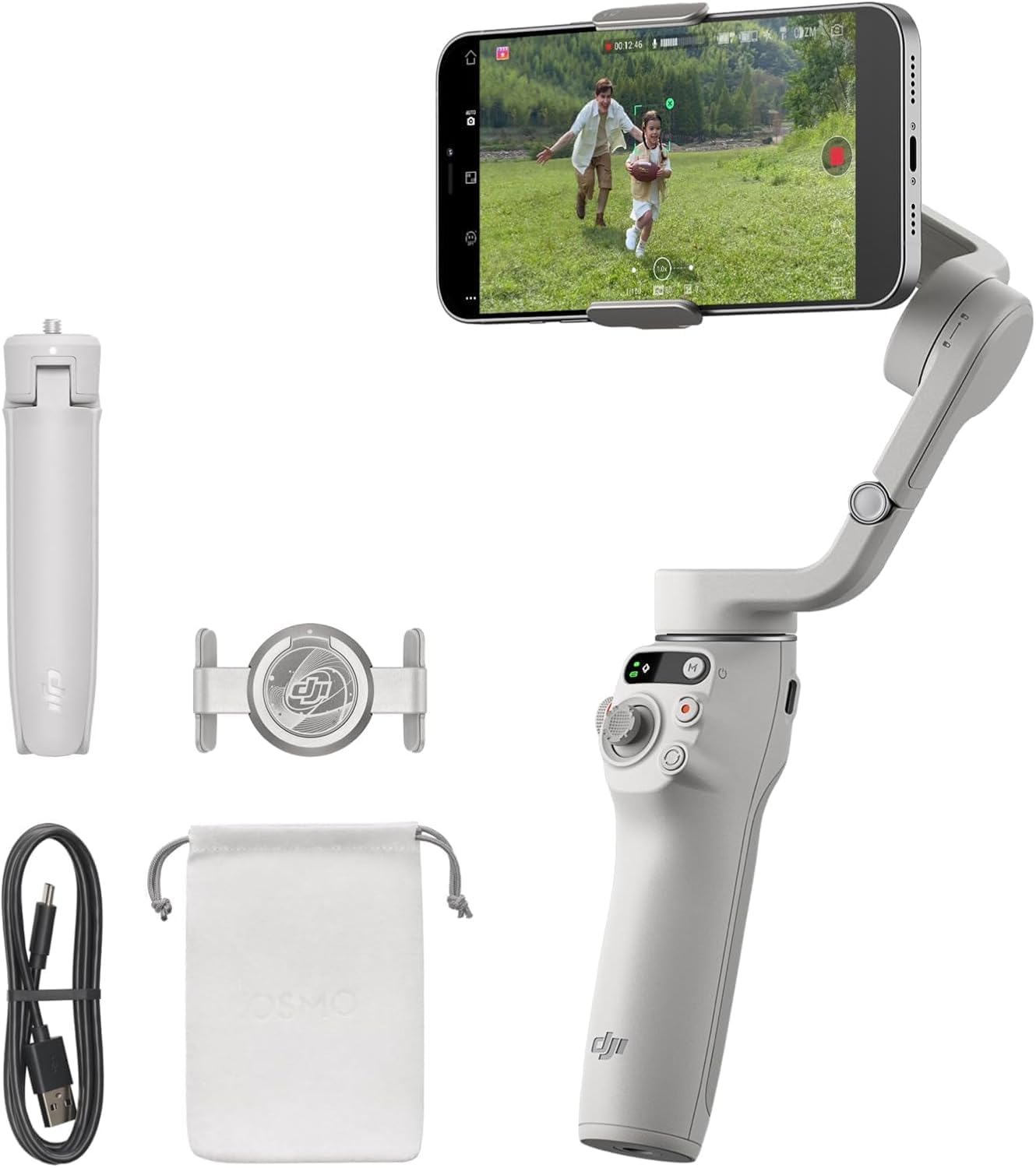
The DJI Osmo Mobile 6 is the benchmark that other phone stabilizers measure themselves against. Its 3-axis stabilization system delivers buttery-smooth footage even with larger phones like the iPhone 16 Pro Max, and the ActiveTrack 6.0 algorithm locks onto children, pets, or yourself with industry-leading reliability. The built-in 8-inch extension rod lets you pull off low-angle pet shots and high-angle selfies without switching gear.
Weighing only 305 grams, the Osmo Mobile 6 folds into a footprint smaller than a soda can, making it genuinely pocketable for daily carry. The magnetic phone clamp snaps on in under two seconds, and the gimbal powers on automatically when you unfold it — eliminating any hesitation to start shooting. The side wheel gives you smooth focus and zoom control, and ShotGuides recognizes your scene and suggests a shot sequence for beginners.
Battery life lands around 6 hours under active stabilization, and charging to full takes about 2 hours. The supplied grip tripod is sturdy enough for tabletop use, and the storage pouch protects the gimbal in a bag. The only real downsides are the premium price and the fact that advanced features like ActiveTrack and gesture control require the DJI Mimo app rather than working with the native camera app.
Why it’s great
- Industry-leading ActiveTrack 6.0 subject tracking
- Ultra-compact 305g foldable design for daily carry
- Magnetic phone clamp enables near-instant setup
Good to know
- Advanced features require DJI Mimo app, not native camera
- Battery life of 6 hours is average for this class
2. Insta360 Flow 2 Pro

The Insta360 Flow 2 Pro sets a new standard for gimbal compatibility by being the first stabilizer series with Apple DockKit support. This means it tracks subjects inside over 200 iOS apps including FaceTime, Zoom, Teams, and any third-party camera app — not just its own companion software. The 360° infinite pan rotation keeps you centered during presentations, live streams, and video calls without ever hitting a rotation limit.
Active Zoom Tracking is a unique trick: even at up to 15x digital zoom, the gimbal stays locked onto fast-moving subjects, making it ideal for sports games or stage performances. Multi-person tracking frames your entire group during camping trips or family gatherings, and the built-in selfie stick extends to pull wide-angle shots without losing stability. The foldable design weighs 385 grams — slightly heavier than the DJI — but the integrated tripod, selfie mirror, and teleprompter in the app make it a complete content creation tool.
Battery life reaches a claimed 10 hours, and real-world shooting with active tracking and stabilization yields around 7 hours. The magnetic phone clamp snaps on quickly, and the included protective pouch keeps the unit safe during transport. The only catch is that the app-based editing tools are less complete than competitors, so you will likely use an external video editor for heavy post-production work.
Why it’s great
- Apple DockKit enables tracking in 200+ iOS apps including FaceTime and Zoom
- 360° infinite pan never hits rotation limit
- Multi-person tracking and 15x zoom tracking
Good to know
- Heavier than DJI at 385 grams
- In-app editing is limited; requires external video editor
3. Hohem iSteady M7

The Hohem iSteady M7 is built for creators who run heavy phones or rig accessories. With a 500-gram payload capacity — the highest in this roundup — it handles a Samsung Galaxy S24 Ultra with a case plus a shotgun microphone without bogging down the motors. The detachable 1.4-inch full-color touchscreen remote detaches from the handle and lets you monitor footage and control the gimbal from up to 32 feet away, solving the solo-filmmaker problem of walking back to check framing.
The enhanced magnetic AI tracker uses a dedicated camera module to lock onto subjects through the native phone camera — no app required. Pixels are boosted 100% over previous generations for precise recognition, and the tracker stays locked even when you temporarily leave the frame. The built-in aluminum extension rod extends to 7.6 inches, giving you selfie-length reach and low-angle pet perspectives. A CCT/RGB fill light attaches magnetically to the gimbal, with adjustable color temperature and brightness for low-light environments.
Battery life hits around 12 hours of mixed use, and the gimbal can double as a power bank to keep your phone charged during long shoots. The 629-gram weight is heavier than any other stabilizer here, but the payload capacity and accessory ports justify the bulk. The detachable remote has a 1.5-inch touchscreen with a live AI feed — a feature no competitor in this price tier offers.
Why it’s great
- 500g payload handles heavy phones and accessories
- Detachable touchscreen remote with 32-foot range
- No-app AI tracking via dedicated camera module
Good to know
- Heaviest option at 629 grams
- Premium price reflects the advanced features
4. AOCHUAN XE AI Version

The AOCHUAN XE AI Version brings on-device AI tracking to a mid-range price point, freeing you from the need to use a companion app. The integrated AI vision sensor enables face tracking, body tracking, and object tracking that works with the native phone camera, FaceTime, or any third-party app. The AI algorithm is robust enough to keep your subject centered even during dynamic movement — a feature typically reserved for gimbals costing twice as much.
The four practical stabilizer modes (F, POV, DM, GO) cover push-pull shots, tilt-angle shooting, classic Inception 360° spins, and quick sports transitions. The 2600 mAh battery delivers a claimed 10 hours of runtime, and real-world use with active stabilization yields around 6–7 hours. At 350 grams, the XE AI is lighter than the Insta360 Flow 2 Pro and folds down to about the size of an iPhone 15 Pro Max, making it genuinely portable for travel.
The package includes the AI vision tracker module, a mini tripod, and two separate user manuals (one for the gimbal, one for the AI tracker). Build quality feels solid, and the joystick provides responsive control. The main downside is that the companion AOCHUAN app, while functional, lacks the polished interface and creative templates of DJI Mimo or Hohem Joy. Some users report a slight learning curve when calibrating the AI sensor for the first time.
Why it’s great
- On-device AI tracking works with any app
- Lightweight at 350 grams with compact fold
- Four gimbal modes cover all common shooting scenarios
Good to know
- AI sensor calibration has a slight learning curve
- Companion app is less polished than premium options
5. Hohem iSteady X3 SE Plus

The Hohem iSteady X3 SE Plus solves a specific solo-creator pain: framing yourself without a second person. The detachable remote controller lets you start and stop recording, switch modes, and trigger tracking from up to 32 feet away, meaning you can set the gimbal on a tripod, walk into the frame, and control the shot entirely by remote. The remote automatically reconnects via Bluetooth when brought near the gimbal, removing pairing hassle.
Hohem’s iSteady 8.0 anti-shake technology delivers smooth footage even during fast walking or light jogging, and the built-in 8-inch extension rod lets you switch between low-angle dog shots and high-angle group selfies without external accessories. The gimbal supports portrait and landscape mode switching with a single hand — a design decision that matters for creators who bounce between YouTube and TikTok formats throughout the day.
Battery life is a standout: 11 hours claimed, with real-world shooting delivering about 7–8 hours of active stabilization. At 0.85 pounds, the foldable design fits easily into a daypack, and the included storage pouch adds protection. The Hohem Joy app provides AI tracking and gesture control, but requires the app to be in use for advanced features — the native camera is fine for basic stabilization. A few users reported that the tripod legs feel fragile, so swapping to a sturdier third-party tripod for tabletop work is a worthwhile upgrade.
Why it’s great
- Detachable remote enables solo filming from a distance
- Excellent 11-hour battery life
- iSteady 8.0 delivers smooth footage during fast motion
Good to know
- Advanced tracking requires the Hohem Joy app
- Included tripod feet feel less durable than premium options
6. AOCHUAN Smart XE Kit

The AOCHUAN Smart XE Kit differentiates itself with a magnetic RGB fill light that attaches to the gimbal handle. With 7 color modes and 3 brightness levels, this light solves the low-light shooting problem without requiring a separate accessory. The fill light weighs only 0.05 pounds and has its own built-in battery, so it does not drain the gimbal’s main power source — a smart design choice for evening vlogs or indoor content creation.
Beyond the light, the Smart XE packs a 2600 mAh battery good for about 10 hours of filming (around 6–7 hours in real use). The intelligent 8.0 anti-shake system eliminates blur during walking shots, and the companion AOCHUAN app unlocks Hitchcock zoom, Inception mode, slow-motion, and panorama presets. The focus wheel and zoom slider on the handle give you precise real-time adjustments — a feature usually found on more expensive units.
The foldable design collapses to 6.4 x 4.3 x 2.1 inches, and the unit weighs only 0.77 pounds, making it easy to pack. The maximum phone width is 6.3 inches, so larger Android phablets with thick cases may not fit. Some users reported initial Bluetooth pairing frustration with iPhone Pro Max models, and the setup process requires downloading the app to unlock all features. For users who prioritize built-in lighting without a separate purchase, however, this kit delivers exceptional value.
Why it’s great
- Magnetic RGB fill light with 7 color modes
- Focus wheel and zoom slider for precise control
- Compact foldable design under 0.8 pounds
Good to know
- Bluetooth pairing can be finicky with iPhone Pro Max
- App required for advanced features and tracking
7. JCROBOT iSleeky L7C Pro

The JCROBOT iSleeky L7C Pro proves you do not need to spend premium money to eliminate shaky footage. The 3-axis stabilization system smooths out walking motion and pans, delivering results that are hard to distinguish from gimbals costing three times as much for basic walking shots. At 12.48 ounces, it is lightweight enough to throw into any bag, and the foldable design reduces its carry footprint to 5.98 inches — easily pocketable in a jacket or daypack.
The companion JCROBOT Gimbal Pro app unlocks face tracking, gesture control, and creative templates like Inception dolly zoom and motion timelapse. The status panel on the handle gives you live battery level and mode indicators, and the M button lets you cycle through four gimbal modes (half follow, full follow, first-person, and pan-only) to match your shooting style. Charging takes only 80 minutes via USB-C, and the gimbal can be used while charging — a convenience feature rarely seen at this price tier.
Maximum payload is listed at 0.66 pounds, which comfortably handles most standard phones including the iPhone 15 Pro and Samsung Galaxy S24. Larger phones with bulky cases may exceed this limit, causing the motors to struggle during fast movement. The included documentation is minimal, and several users noted that balancing the phone in the mount requires careful centering to avoid off-level horizon issues. For first-time buyers who want to test the waters of gimbal filming without a big investment, the L7C Pro delivers excellent value.
Why it’s great
- Exceptional value for basic 3-axis stabilization
- 80-minute fast charge with pass-through charging
- Compact 5.98-inch fold for easy portability
Good to know
- Documentation is sparse and can be confusing
- 0.66-pound payload limit struggles with large cases
FAQ
Does a 3-axis phone stabilizer work with any smartphone case?
Should I use the companion app or the native camera app?
How do I calibrate a new gimbal before first use?
Final Thoughts: The Verdict
For most users, the best 3-axis phone stabilizer is the DJI Osmo Mobile 6 because it balances professional-grade ActiveTrack 6.0, featherlight 305-gram build, and best-in-class app support into a single compact package. If you need app-agnostic tracking for streaming and video calls, grab the Insta360 Flow 2 Pro for its Apple DockKit compatibility and 360° pan rotation. And for heavy phone users who rig accessories, nothing beats the Hohem iSteady M7 with its 500-gram payload and detachable touchscreen remote.