
A 3-cup moka pot occupies a specific slot in the coffee gear lineup: it’s small enough for a personal morning ritual but large enough to serve a quick espresso-sized pick-me-up for two. The problem with this size is consistency. Too many entry-level models sputter, leak from a poor thread seal, or introduce a metallic twang into your brew. That’s the core tension—this small pot has to deliver concentrated flavor without the flaws that plague cheaper aluminum builds.
I’m Min — the co-founder and writer behind Gadgets Feed. Across dozens of hours comparing moka pot specifications, from gasket material to safety valve placement to induction-base construction, I’ve filtered the market down to the models that actually solve the size-specific challenges of the 3-cup format.
Whether you need induction compatibility or a visual brewing window to dial in your heat, this guide breaks down the technical choices that separate a smooth morning brew from a burnt, watery disappointment. This is your definitive resource for the best 3 cup moka pot.
How To Choose The Best 3 Cup Moka Pot
Selecting a 3-cup moka pot is about balancing material science with real-world heat control. The 160ml to 180ml water capacity of this size amplifies every variable—a poor gasket seal or a thin aluminum wall changes the brew temperature enough to ruin the shot. Focus on three core decisions.
Material: Aluminum vs. Stainless Steel vs. Glass
Aluminum is the traditional choice because it conducts heat rapidly and evenly at the low flame moka brewing requires. However, uncoated aluminum oxidizes over time and can impart a metallic taste if not properly seasoned. Stainless steel eliminates that flavor risk entirely and adds corrosion resistance, but it requires a thicker base for even heating, which makes it heavier and typically more expensive. A glass-top variant offers the unique advantage of brew visibility, allowing you to cut the heat the moment the coffee reaches the collector—critical for avoiding a burnt, bitter shot at this small volume.
Induction Base vs. Pure Stovetop
Standard aluminum moka pots do not work on induction cooktops because aluminum lacks magnetic properties. If your kitchen runs on induction, you need a model with a ferromagnetic stainless steel base bonded to the lower chamber. This design adds manufacturing complexity and often raises the price, but models like the London Sip or the Alessi 9090 solve this without compromising heat distribution. Check the product spec for explicit induction compatibility; vague claims about “all stovetops” often exclude induction.
Gasket Quality and Thread Design
The gasket is the most failure-prone component in any moka pot. Silicone gaskets outlast rubber by a significant margin and resist heat degradation better over daily use. The thread design—screw-on versus clamp-style closure—determines how easily you can achieve a consistent seal. Screw-on threads are standard but can cross-thread easily on inexpensive pots; clamp-style mechanisms, found on premium models like the Alessi 9090, eliminate thread stripping but cost substantially more. For a 3-cup pot, where even a small leak lowers the pressure required for proper extraction, gasket and thread integrity are non-negotiable.
Quick Comparison
On smaller screens, swipe sideways to see the full table.
| Model | Category | Best For | Key Spec | Amazon |
|---|---|---|---|---|
| Grosche Milano | Mid-Range | Burn-safe handling | Burn guard handle & silicone gasket | Amazon |
| Alessi 9090 | Premium | Induction & longevity | 18/10 steel, clamp closure | Amazon |
| London Sip Stainless | Mid-Range | Induction & no metallic taste | Stainless steel, 300ml output | Amazon |
| LAOION Glass-Top | Mid-Range | Brew visibility | Borosilicate glass + steel | Amazon |
| Alessi AAM33 | Premium | Design and daily ritual | Polished aluminum, Mendini design | Amazon |
| Zulay Moka Pot | Budget | Entry-level lightweight build | Cast aluminum, 295g weight | Amazon |
| Magefesa Kenia Noir | Budget | Extra-thick aluminum build | Thick aluminum, black finish | Amazon |
In‑Depth Reviews
1. GROSCHE Milano Stovetop Espresso Maker Moka Pot

The GROSCHE Milano stands out in the mid-range for its deliberate user-safety engineering. The large, soft-touch handle includes a burn guard that keeps your fingers away from the hot boiler wall—a real advantage given that the 3-cup size sits low on the burner. The body is food-grade anodized aluminum, which provides the fast heat conductivity moka brewing expects while adding a protective layer that resists the pitting and oxidation common on raw aluminum pots.
The silicone gasket included with this model shows better heat resilience than standard rubber gaskets found on budget options; users report it maintains a consistent seal even after a year of daily use. The Italian-made safety valve is positioned to vent pressure reliably, and the radial grooves on the base improve heat distribution across gas and electric burners. At 445 grams, the Milano feels solid without being heavy enough to dent if accidentally knocked over.
Some users note that the dark paint finish on certain colors develops a patina near the base over time, though this is cosmetic and does not affect brew quality. The threads are smooth but require careful alignment to avoid cross-threading initially. Overall, the Milano delivers the best functional balance of safety features, heat efficiency, and build quality in the 3-cup category.
Why it’s great
- Burn guard handle eliminates finger burns during pour
- Silicone gasket outlasts rubber alternatives
- Anodized aluminum resists oxidation and metallic taste
Good to know
- Not compatible with induction cooktops
- Dark finishes may show base wear over time
2. Alessi 9090/3 Stovetop Espresso Coffee Maker

The Alessi 9090 is the most technically distinct moka pot on this list, designed by Richard Sapper in 1979 and still the benchmark for engineering in the category. Instead of a threaded connection, it uses a stainless steel clamp mechanism that seals the upper and lower chambers without threads. This eliminates the cross-threading risk that plagues screw-on pots and allows you to pre-heat the lower chamber on the stove before adding coffee—a technique that improves extraction consistency by reducing thermal shock.
The body is constructed from 18/10 stainless steel, the same alloy used in high-end cookware, with a ferromagnetic base that makes it fully induction-compatible. The mirror-polished finish resists corrosion far better than aluminum, and users report decades of use without material degradation. The 160ml capacity produces minimal sediment compared to aluminum pots, likely due to the tighter machining tolerances of the filter plate.
The downsides are real: the clamp mechanism is expensive to manufacture, pushing this pot into a premium price bracket. Some units have shown a reducer filter bending after repeated use, and a small number of users reported internal surface peeling. However, the overall design philosophy—repairable gaskets, no stripped threads, induction-ready—makes the 9090 the longest-lasting 3-cup pot available, provided you use medium-low heat and avoid aggressive scrubbing.
Why it’s great
- Clamp design eliminates thread stripping permanently
- 18/10 stainless steel is fully induction-compatible
- Minimal sediment from precision filter plate
Good to know
- Premium price reflects the complex manufacturing
- Some units reported filter plate bending under pressure
3. London Sip Stainless Steel Stovetop Espresso Maker

The London Sip offers a practical solution for induction-stove users who want stainless steel without the investment demanded by the Alessi 9090. The entire lower chamber and boiler are 18/8 stainless steel, and the base is explicitly designed with a magnetic stainless layer that couples efficiently with induction coils. Customer reports confirm it heats faster on induction than a comparable Bialetti aluminum pot on gas, which is a meaningful time-saver for morning routines.
The stainless steel construction eliminates the need to season the pot—there is no oxidation layer to build up, and no metallic flavor transfer even on the first brew. The extra-large handle keeps your hand well away from the heat source, and the steam safety valve is positioned at the standard safe angle. The copper finish adds a warm aesthetic that distinguishes it from the silver-dominated moka market.
Several users noted that the initial brew can come out watery if the heat is too high—this is common to stainless steel moka pots, which have different thermal conductivity than aluminum. The solution is to keep the burner at medium-low and remove the pot the moment the flow turns from dark to light. A minority of users, particularly those experienced with traditional aluminum pots, reported that the brew lacked the body they expected, which may be a function of the different heat profile rather than a design flaw.
Why it’s great
- Induction-compatible at a mid-range price
- Stainless steel eliminates metallic taste risk
- Large handle provides good burn protection
Good to know
- Thinner steel requires lower heat to avoid watery brew
- Some experienced users find it less forgiving than aluminum
4. LAOION Stovetop Espresso Maker 3-Cup

The LAOION takes a unique approach by replacing the upper metal chamber with a borosilicate glass collector. This design choice directly solves the biggest variable in 3-cup moka brewing: heat timing. You can watch the coffee rise into the glass chamber and remove the pot the instant the flow changes from a steady stream to a sputter. For the 160ml volume, where a 10-second delay can turn a balanced brew into a bitter one, that visual feedback is a real advantage.
The lower boiler is stainless steel with an induction-compatible base, so this pot works on all stove types. The fit between the glass and the steel frame is tight, and the included filter is a standard reusable type. The overall weight is 0.67 kilograms, which feels substantial but not unwieldy. The modern aesthetic is a clear departure from traditional moka pot styling, which attracts some users and puts off purists.
The biggest trade-off is fragility: glass breaks. Users who preheat the base or use high heat risk thermal shock cracking. One reviewer reported the base expanded during brewing, causing the pot to wobble on a glass stovetop. Others noted that the glass chamber must be handled carefully during cleaning. This pot rewards attention to heat management—rushing the brew or using too high a flame will produce sputtering and potential leaks.
Why it’s great
- Borosilicate glass provides full brew visibility
- Induction-compatible stainless steel base
- Modern aesthetic stands out from traditional designs
Good to know
- Glass chamber is fragile and requires careful handling
- High heat can cause base expansion and wobbling
5. Alessi AAM33/3 Design Espresso Coffee Maker

The Alessi AAM33 is designed by Alessandro Mendini and is effectively a design-led interpretation of the classic Bialetti moka pot architecture. The rounded, polished aluminum body and thermoplastic resin handle create a piece that is as much a countertop object as a brewing tool. The 3-cup version holds 150ml, which brews roughly 100ml of finished coffee—enough for one large mug or three small espresso cups.
The machining on the threads and the base mating surface is noticeably tighter than on standard aluminum pots, which contributes to a leak-free seal. The handle stays cool during brewing due to the resin material, and the overall balance when pouring is excellent. The coffee produced is comparable to a high-quality traditional moka—smooth, with good body, and without the excessive bitterness that comes from cheap aluminum pots with poor heat distribution.
The premium here is paid primarily for the design and the Alessi brand. Some users were disappointed by the small output—it is genuinely a 3-cup pot in the traditional espresso cup size, not a 3-mug pot. There were isolated reports of leaks due to poor sealing on some units, suggesting quality control inconsistency given the price point. This is a pot for someone who values daily aesthetics as much as the coffee it produces.
Why it’s great
- Exceptional build finish and tight thread tolerances
- Handle stays cool throughout brewing
- Designer pedigree adds kitchen aesthetics
Good to know
- Not induction-compatible due to aluminum construction
- Some units reported inconsistent sealing
6. Zulay Moka Pot Espresso Stovetop Coffee Maker
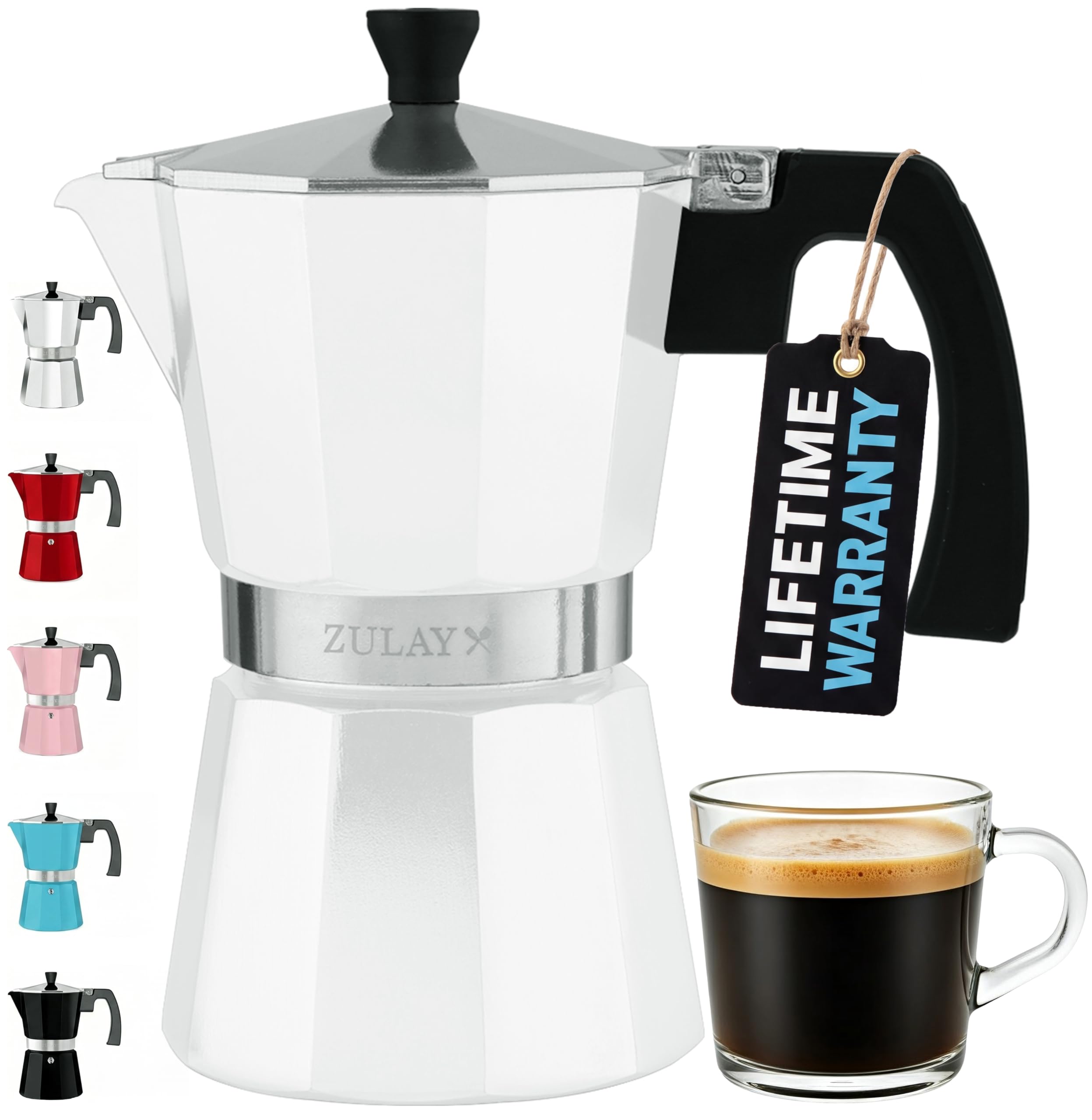
The Zulay Moka Pot is a cast-aluminum entry that competes directly with the classic Bialetti in form and function but undercuts it significantly on price. At 295 grams, it is noticeably lighter than many aluminum competitors—a mixed blessing, because while it is easy to carry for camping or travel, the thin metal walls lose heat faster and require more careful flame management.
The blizzard white enamel finish is the defining visual feature, but early user reports indicate the paint does not hold up well to regular stovetop use, with chipping visible after several months. The heat-resistant handle and lid knob stay cool, and the built-in silicone gasket has held up better than the rubber gaskets on similarly priced models. The safety valve is functional and well-positioned.
Brew quality is solid for the price bracket, but not exceptional. Users coming from a Bialetti noticed the thinner metal more than beginners did. The lifetime guarantee from Zulay is a meaningful safety net, covering gasket failure or stripped threads that would otherwise write off a budget pot.
Why it’s great
- Very lightweight for travel or camping use
- Silicone gasket outlasts rubber on comparably priced pots
- Lifetime guarantee provides peace of mind
Good to know
- Enamel paint may chip with regular stovetop use
- Thin aluminum requires careful heat control
7. Magefesa Kenia Noir Stovetop Espresso Moka Pot

The Magefesa Kenia Noir uses extra-thick aluminum walls, which gives it a distinct advantage over lighter aluminum pots in heat retention and stability. The radial grooves machined into the base improve heat transfer, allowing the pot to reach brewing temperature without the hot spots that cause uneven extraction. The bakelite handle is thermo-resistant and stays cool even after multiple brewing cycles.
The black Noir finish hides the patina that develops on raw aluminum bases, keeping the pot looking clean longer than silver or white alternatives. The standard reusable filter is fine enough to limit sediment, and the 3-cup capacity is accurate to traditional espresso cup sizes. Cuban coffee preparation—a common use for this pot—benefits from the thicker metal, which handles the slightly longer brew times required for sugar-infused methods.
The limitations are typical for an aluminum pot at this price point: it is not induction-compatible, and the bakelite handle, while functional, does not feel as refined as the resin handles on premium competitors. A few users reported that the initial brew had a faint metallic taste before seasoning was fully established. Overall, the Magefesa offers the best build substance among budget-tier options.
Why it’s great
- Extra-thick aluminum provides stable heat distribution
- Bakelite handle stays cool and comfortable
- Black finish hides base patina better than light colors
Good to know
- Not compatible with induction cooktops
- Requires seasoning to eliminate initial metallic notes
FAQ
Why does my 3-cup moka pot produce watery coffee?
Can I use a 3-cup moka pot on an induction stove?
How much coffee does a 3-cup moka pot actually make?
Final Thoughts: The Verdict
For most users, the best 3 cup moka pot winner is the GROSCHE Milano because it delivers the best combination of user safety engineering, heat-efficient anodized aluminum construction, and a silicone gasket that eliminates the most common failure point in the category. If you need induction compatibility and are willing to invest in a pot that will outlast all others, grab the Alessi 9090. And for budget-conscious buyers who prioritize substance over aesthetics, nothing beats the Magefesa Kenia Noir for its thick aluminum build and stable heat distribution.