
Our readers keep the lights on and my morning glass full of iced black tea. As an Amazon Associate, I earn from qualifying purchases.
Specs are compiled from manufacturer listings and verified buyer reviews and can change over time — please confirm the key details on the product page before buying.
A machine that handles MIG, TIG, and Stick welding should make your shop more versatile, not more complicated. The problem is that many machines labeled as multi-process welders manage to excel at only one mode or don’t deliver enough amperage to handle thicker materials. This guide breaks down the eight best multi-process welders on the market that actually deliver on the promise of real 3-in-1 capability, from compact budget units for the home garage to professional-grade machines built for continuous fabrication work.
I’m Min — the founder and writer behind Gadgets Feed. This guide is built by comparing the manufacturers’ published specifications and the patterns across verified customer reviews, so you get each pick’s real strengths and trade-offs instead of marketing spin.
After looking at the amperage output, duty cycle, portability, and the real-world user feedback for each machine, the best 3-in-1 welder for most home and light professional use balances a high 270-amp output with a lightweight chassis that lets you move it between work sites without a cart.
Quick Picks
- ESAB Rebel EMP 215ic — Professional Pick
- Everlast THUNDER 255 — Top Performer
- VEVOR MIG-270 — Best Overall
- Reboot RBM2500 PRO — Feature-Rich
- GZ GUOZHI MIG-210LED — Pulse MIG Expert
- YESWELDER 185DS PRO — Dual Voltage Champ
- Forney 271 Easy Weld 140 MP — Beginner Friendly
- Amico MIG-140GS — Compact Lightweight
How To Choose The Best 3-in-1 Welder
Buying your first multi-process welder is exciting, but the spec sheets can be overwhelming. Focusing on a few key factors will keep you from ending up with a machine that runs out of power halfway through your project. Here is what you need to know.
Amperage and Duty Cycle
The rated amperage tells you how thick a piece of metal the welder can fuse in a single pass. A 140-amp machine is fine for thin sheet metal and auto body panels up to about 1/8 of an inch, while a 270-amp machine like the VEVOR handles 3/8-inch and thicker material with ease. The duty cycle is just as important — it tells you how long you can weld continuously before the machine needs to cool down. A 60% duty cycle at 200 amps means you can weld for six minutes out of every ten without overheating.
Dual Voltage (110V vs. 220V)
A dual-voltage machine lets you plug into a standard household outlet (110V) for light work like thin-gauge repairs, then switch to a 220V outlet for heavy fabrication where you need full power. Some budget machines label themselves as dual-voltage but come with a simple plug adapter, which may trip a standard 15-amp breaker if you push it hard. Look for a unit with a true internal auto-switching power supply that adjusts to the voltage you feed it.
Multi-Process vs. Gimmick Modes
A legitimate 3-in-1 welder offers MIG (with or without gas), TIG (even if it is just lift-start TIG), and Stick welding. Some machines list eight or nine modes by counting sub-variants like “Pulse MIG” and “Spot Welding” as separate processes. These are still useful — pulse MIG makes aluminum welding much cleaner — but make sure the machine does the three core processes well before you pay extra for the fancy add-ons.
Quick Comparison
| Model | Best For | Max Output | Weight | Included Modes | Amazon |
|---|---|---|---|---|---|
| ESAB Rebel EMP 215ic | Pro & Serious Hobbyist | 240A | 79.2 lbs | MIG, Stick, Lift TIG | $2,590.42Amazon |
| Everlast THUNDER 255 | Heavy Fabrication | 275A | 79.8 lbs | MIG, Pulse MIG, TIG, Stick | $1,649.00Amazon |
| VEVOR MIG-270 | Best Overall Home Shop | 270A | 30 lbs | MIG, Lift TIG, Arc | $229.90Amazon |
| Reboot RBM2500 PRO | Versatility on a Budget | 250A | 28.8 lbs | 8-in-1 Modes | $209.99Amazon |
| GZ GUOZHI MIG-210LED | Aluminum & Pulse MIG | 210A | 33.7 lbs | 8-in-1 w/ Pulse | $242.89$284.99Amazon |
| YESWELDER 185DS PRO | Entry-Level Dual Voltage | 185A | 33.4 lbs | 5-in-1 | $249.99$319.99PrimeAmazon |
| Forney 271 | Beginner Simplicity | 140A | 25.8 lbs | MIG, DC TIG, Stick | Amazon |
| Amico MIG-140GS | Portability & Light Metal | 165A | 19 lbs | 5-in-1 w/ Spool Gun | $329.00Amazon |
In‑Depth Reviews
1. ESAB Rebel EMP 215ic
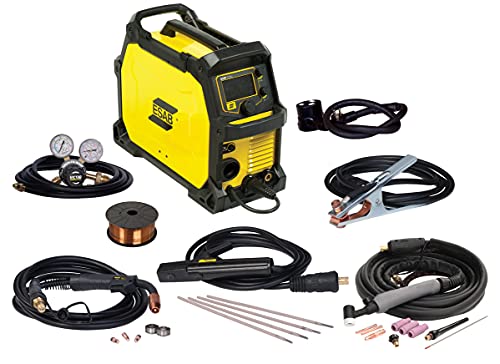
The industrial-grade machine that actually learns your welding style as you work.
The ESAB Rebel uses an exclusive feature called sMIG (smart MIG) that continuously learns and adapts to your welding technique to deliver a stable arc and consistent, repeatable welds. This is not a gimmick — experienced welders report that the MIG performance here beats dedicated MIG machines in its class, and beginners find the auto-parameter setting takes the guesswork out of dialing in a good bead.
It is a true multi-voltage machine with a 120/230V input and a 5-240A output range that handles everything from thin sheet metal to thicker structural work. The unit also runs 6010 Stick electrodes, which many lower-end multi-process welders simply cannot do. The build quality is top-tier with a unique five-handle roll cage in unibody steel construction, yet it remains reasonably portable at 79.2 pounds. It comes ready to weld right from the start with professional TWECO accessories and a Victor gas regulator.
The main limitation is that the TIG operation is lift-start only, not high-frequency start, and it lacks a foot pedal, so TIG purists will want to look elsewhere. One reviewer also noted that at the current price point, the machine feels overpriced compared to when it debuted at. On the plus side, the unit is backed by a 3-year handle-to-handle warranty.
What It Excels At
- sMIG auto-learning delivers perfect MIG welds every time
- Runs 6010 Stick electrodes, rare for a multi-process unit
- Roll-cage design with unibody steel construction is built to last
- Comes with professional-grade TWECO torch and Victor gas regulator
The Trade-Offs
- No high-frequency TIG start and no foot pedal included
- Price has increased significantly from its original launch cost
- Heavy at 79.2 pounds despite the roll cage for portability
- No spray transfer capability; the gun melts at 475 ipm feed speed
Reach for this if: You weld professionally and need a machine that delivers perfect MIG welds with zero setup time and runs 6010 rods without complaint.
Look elsewhere if: Your primary work is TIG welding, or you are on a tight budget — the ESAB’s price is premium, and TIG is a secondary feature here.
2. Everlast THUNDER 255
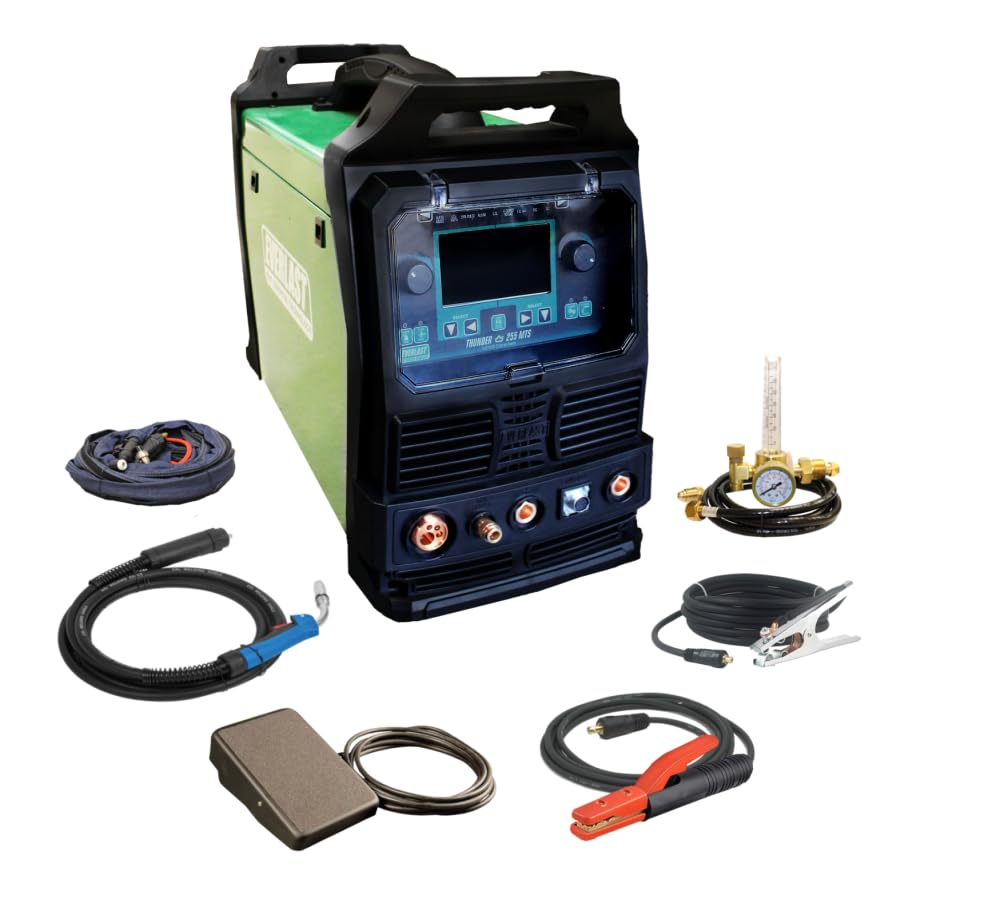
Professional pulse control and a massive 275-amp ceiling for continuous fabrication.
The Everlast THUNDER 255 is a true workhorse for the serious fabricator, offering a digital DC CC/CV multi-process inverter that handles Short Circuit, Spray Arc, Synergic Single Pulse MIG, Flux-Cored, Pulsed TIG, and even E6010 root pass welding. The 4.3 HD color LCD screen makes navigating these modes intuitive, and you can fine-tune every aspect of the arc with adjustable MIG Wave Form control, Arc Force control, and TIG Up/Downslope.
Buyers who have used the machine for six months on 230V report that MIG and flux-core welding with 75/25 gas and.035 wire is excellent. One user welded a fabrication table with 3/16-inch tube and a 3/8-inch top, and the machine handled 1/4-inch angle iron flawlessly. It also supports 8-inch and 12-inch wire spools for long-duration work without changing spools. The welder is backed by a full 5-year warranty, which is a strong vote of confidence for a machine in this price range.
The biggest complaint across multiple reviews is the terrible manual — it lacks a proper welding reference chart for settings, and dialing in decimal adjustments is difficult without experience. The unit is also heavy at 79.8 pounds, and some units arrive with shipping damage, so inspect the crate carefully. After six years of use, one long-term owner reported intermittent HF TIG start issues and mentioned that the MIG gun switch needed periodic cleaning.
Pure Power Verdict: The 275A output at this price point is class-leading, and the pulse MIG mode makes aluminum welding significantly easier than with a standard MIG setup. The 5-year warranty takes the sting out of the occasional build-quality quibble.
Your best buy if: You are a weekend fabricator or small shop owner who needs pulse MIG, runs long beads on thick steel, and wants a 5-year warranty on your investment.
skip it if: You are a beginner who needs a clear manual and step-by-step guidance, or if you only weld 110V — this machine really needs 220/240V to perform.
3. VEVOR MIG-270

A 270-amp beast that weighs only 30 pounds — the power-to-portability winner.
The VEVOR MIG-270 delivers a staggering 270 amps of welding power in a package that weighs just 30 pounds, making it the easiest high-output machine to move around a shop or load into a truck for off-site work. It uses advanced IGBT inverter technology for excellent arc stability and offers three modes: MIG, MMA (Stick), and Lift TIG. The LCD digital display is clear and easy to read, and you get separate knobs for current adjustment, wire-speed control, and voltage switching between 110V and 220V.
One buyer reports that the unit is “lightweight (21 lbs), easy to use, very hot even at low voltage (12.2V),” and another was impressed that it welded 3/8-inch material with.035 wire in continuous 8 to 10-inch beads “without skipping a beat.” It can handle 0.024-inch, 0.031-inch, and 0.039-inch flux-cored wire and solid wire, with both 2.2-pound and 11-pound spool capacity. Safety features include a built-in overheat/overload auto-shutdown and an IP21 splash-water protection rating.
The included accessories are generous for the price point: a MIG torch, TIG torch, argon tube, earth clamp, electrode holder, welding glasses, a slag hammer, and 1 KG of carbon steel gas-shielded welding wire. However, several buyers report that the gas regulator and welding nozzle that come in the box are low quality — one owner said the regulator was “junk” and he ended up swapping it for a better unit. Plan on upgrading those two items immediately.
Why It Earns the Top Spot
- 270-amp output at only 30 pounds is the best power-to-weight ratio here
- Overheat/overload protection and IP21 splash resistance for confidence
- Clear LCD display with separate voltage and wire-speed controls
- Excellent real-world reviews on 3/8-inch material with continuous beads
The Catch
- Included gas regulator and welding nozzle are low quality — plan to replace
- Top-end amperage is 270A versus the 250A RBM2500 PRO, and it weighs 30 lbs versus the GZ GUOZHI 210A at 33.7 lbs
- Lift TIG is basic and may not suit TIG purists
The power-to-portability king: If you need to weld thick steel in one pass and move the machine between job sites, the VEVOR MIG-270 is the one to buy. Just set aside a few extra dollars for a better gas regulator.
4. Reboot RBM2500 PRO
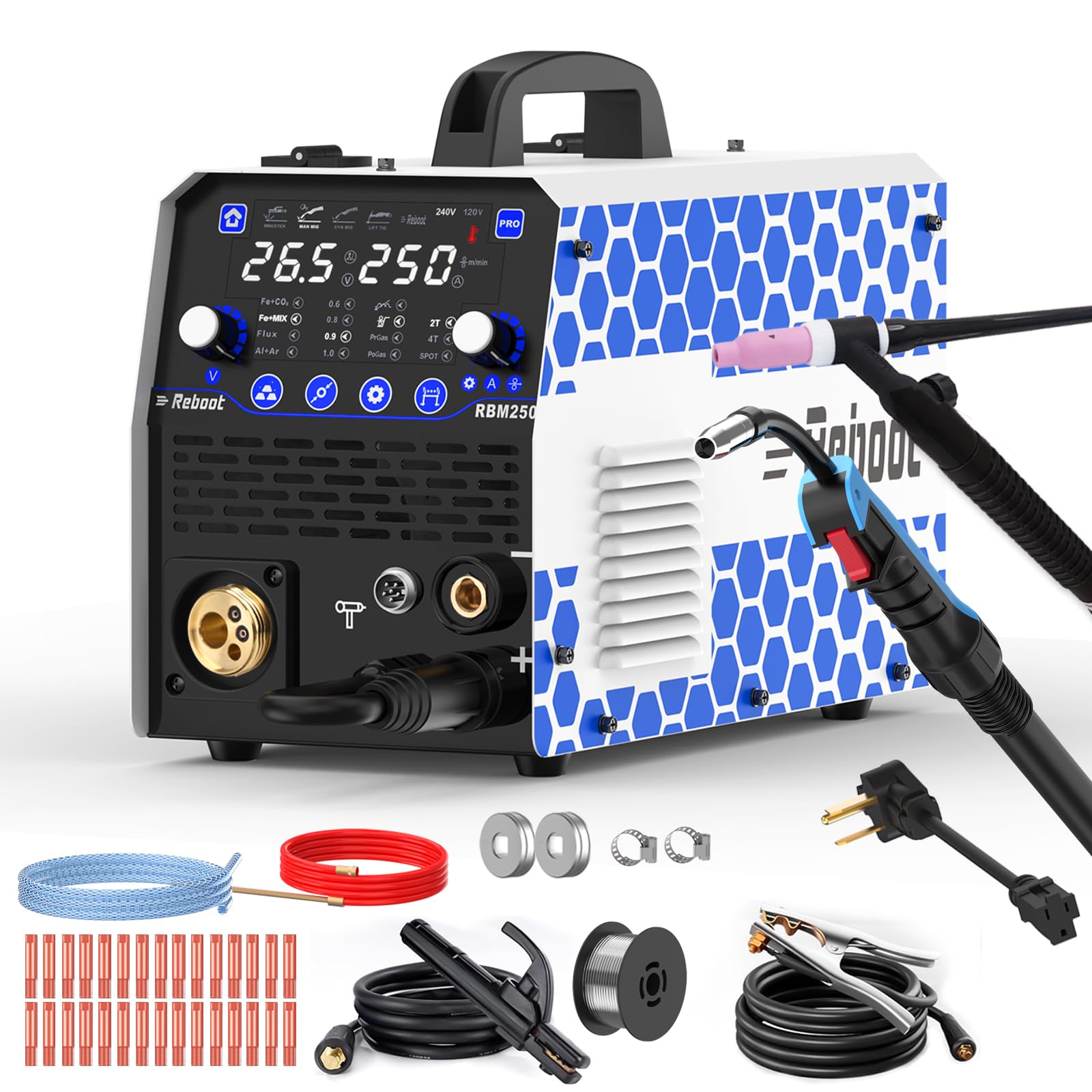
Eight process modes, a full TIG torch kit, and aluminum-capable welding for under.
The Reboot RBM2500 PRO packs an astonishing eight process modes into a single compact machine: Flux MIG, Gas MIG, MAG, Lift TIG, Stick, Spot Welding, Spool Gun, and Aluminum welding. The 250-amp industrial-grade output handles 1/4-inch steel and 3/16-inch aluminum, which is impressive for a unit that weighs only 28.8 pounds versus the GZ GUOZHI 210A at 33.7 pounds. Advanced soft-start technology with IGBT control slashes inrush current by 80% to protect internal components and double capacitor lifespan.
The included package is the most complete in this comparison: a 10-foot MIG torch, a 13-foot Lift TIG torch with full consumable kit (collet, tungsten needle, ceramic cup, back caps), ground clamp, electrode holder, and three different types of wire feed wheels (knurled, V-groove, and U-groove). It also offers both Synergic MIG (auto-sets voltage based on wire size) and Manual MIG for experienced welders who want full parameter control. The 2T/4T trigger modes let you switch between short spot welds and long continuous beads.
The one catch is that the Spool Gun is listed as “not included, can be purchased in store,” so if you plan to weld aluminum regularly with a spool gun, factor in that extra cost. Also, the.023-inch roller needs to be bought separately. Despite these small gaps, the sheer versatility and the inclusion of a real TIG torch with consumables at this price point is tough to beat.
The Swiss Army Knife: No other welder in this price range hands you this many modes, this many consumables, and a real TIG torch from the start. The soft-start IGBT technology is a genuine bonus that extends the machine’s lifespan.
Perfect for: The DIYer who wants one machine that can do everything — gas MIG, flux core, stick, and even occasional TIG — without spending extra on a separate TIG torch.
Not for: Anyone who needs serious aluminum welding immediately, since the spool gun is an extra purchase.
5. GZ GUOZHI MIG-210LED
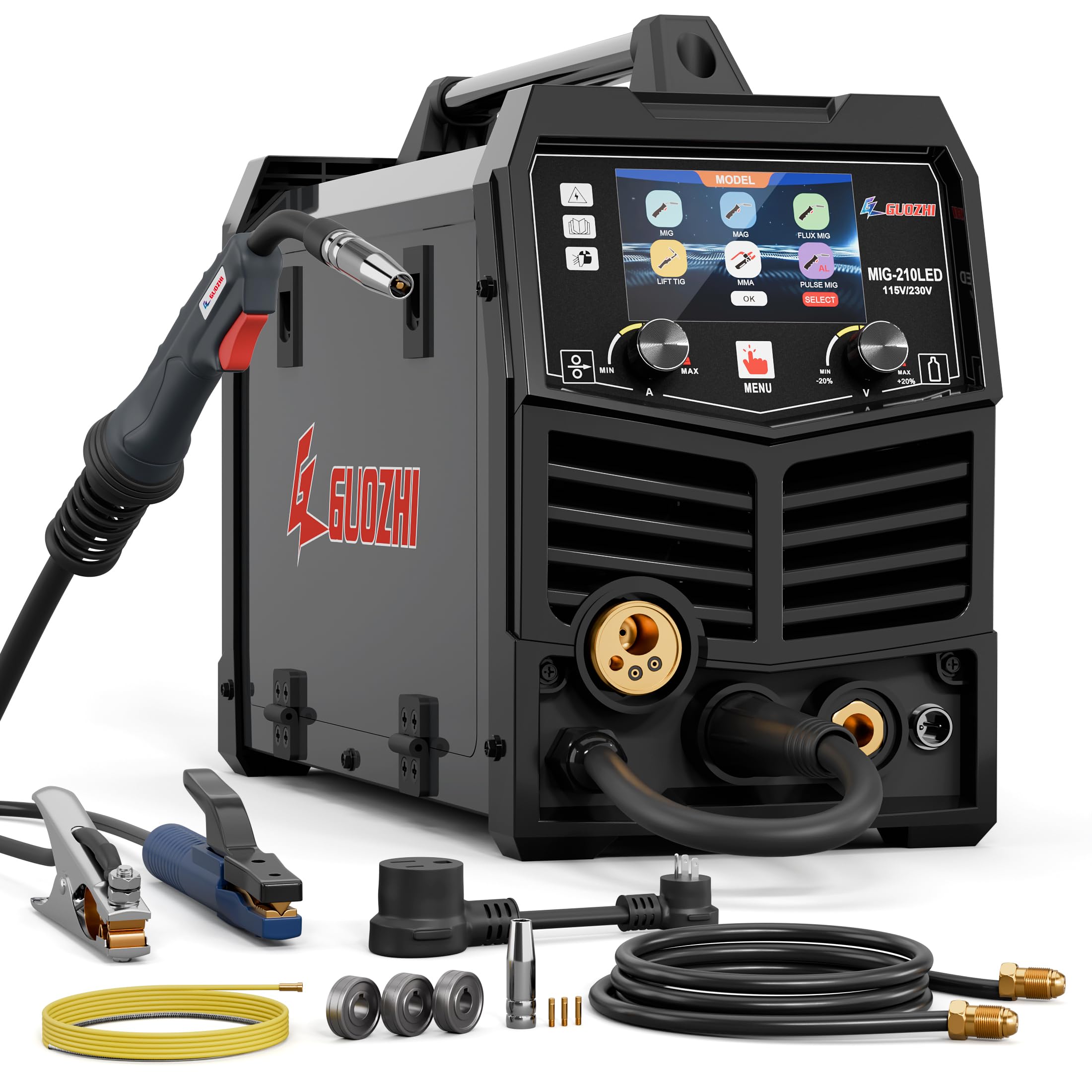
Pulse MIG for clean aluminum welds plus 40 custom parameter slots for repeat jobs.
The GZ GUOZHI MIG-210LED stands out in this list because of its Pulse MIG capability, which delivers fast, high-quality, low-spatter welds that look consistently great — especially on aluminum, where standard MIG often produces a messy bead. The machine can weld material up to 12mm thick, and the pulse mode makes aluminum welding far easier than with a standard MIG setup. It offers eight total processes: Gas MIG, MAG, Flux Core MIG, Pulse MIG, MMA/Stick, Lift TIG, Spot Welding, and it is Spool Gun compatible.
The preset parameter system is a standout feature for production work: you can store up to 40 groups of parameters (10 for each of four modes: MIG, Lift TIG, MMA, and Spool Gun), so you can instantly recall the perfect settings for a repeat job without dialing them in from scratch again. The machine also automatically saves the last welding parameters in case you shut it off mid-project.
The package dimensions of 20.7 x 15.2 x 12.6 inches make it a bit larger than the YESWELDER 185DS PRO at 18.3 x 15.5 x 13.7 inches, so check your cart space. Note that the TIG torch and Spool Gun are not included in the box, which is a notable omission for a machine at this price. You will need to buy those separately if you intend to use Lift TIG or aluminum spool gun welding.
What It Does Best
- Pulse MIG mode delivers clean, low-spatter aluminum welds
- 40 preset parameter slots for fast recall of repeat jobs
- Welds up to 12mm thickness, impressive for a 210A machine
- Auto-saves the last welding parameters on shutdown
Missing Pieces
- TIG torch and Spool Gun not included — separate purchases needed
- Heavier than the RBM2500 PRO (33.7 lbs vs 28.8 lbs)
- Package dimensions are larger, so verify cart space
Ideal for: The intermediate welder who is moving beyond basic stick welding and wants to experiment with clean pulse MIG on aluminum without paying pro-level prices.
Pass on it if: You need a complete ready-to-weld package from the start, because the missing TIG torch and spool gun add unexpected cost.
6. YESWELDER 185DS PRO
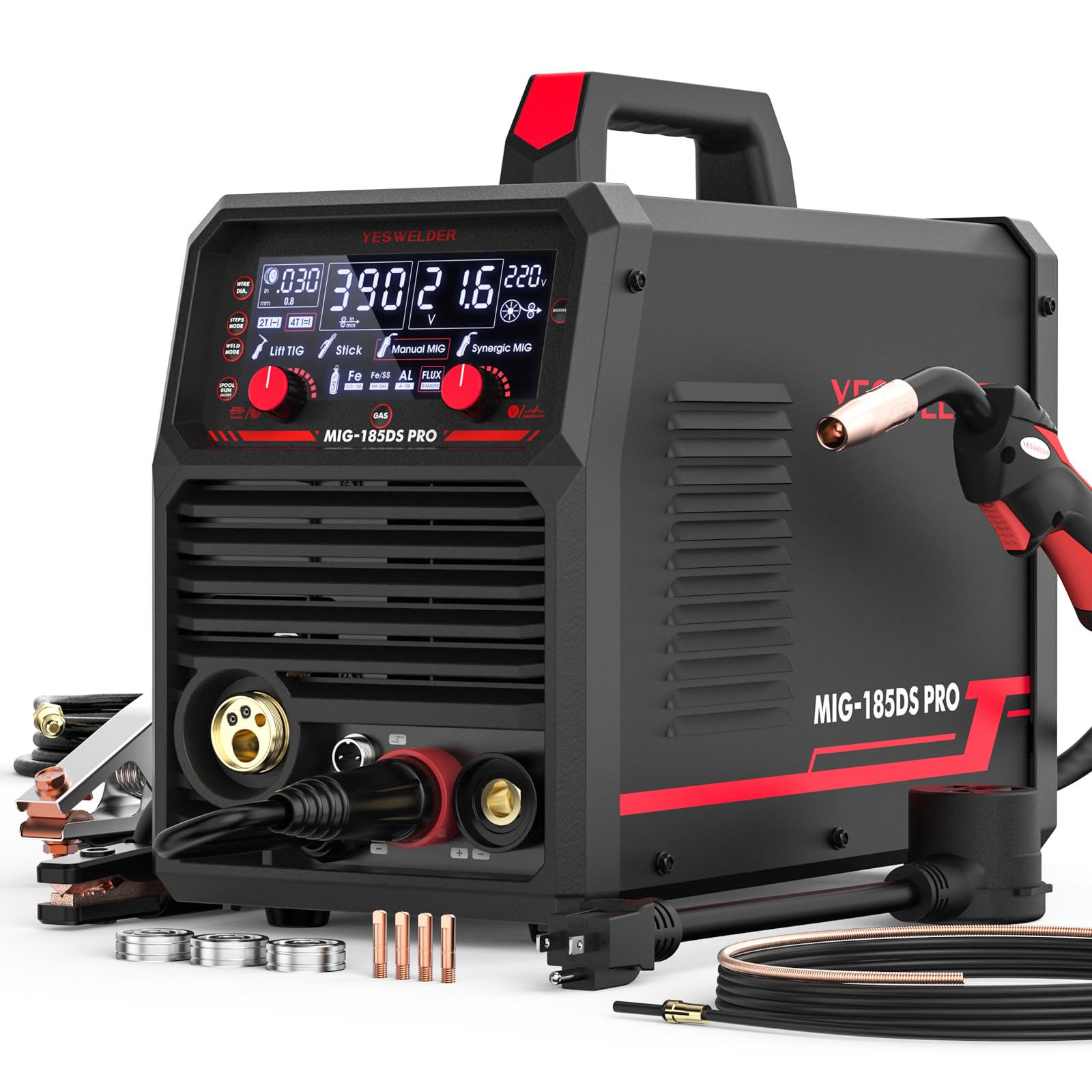
Synergic control takes the guesswork out of voltage matching for beginners on both 110V and 220V.
The YESWELDER 185DS PRO uses Synergic MIG control, which means when you adjust the wire feeding speed, the voltage automatically matches to a recommended value — a huge help for beginners who do not yet know the balance for every material and thickness. It is a true dual-voltage machine with an included 220V to 110V adapter, and it offers five processes: Gasless Flux Core MIG, Gas MIG, Spool Gun MIG, Stick, and Lift TIG (with an additional torch purchase).
The 185-amp output provides reliable performance for most home and light automotive work. One reviewer noted that he “successfully MIG-welded a truck rust repair” and found the machine had “plenty of power on 110V and 220V generator.” Another long-time welder bought it for his son and noted that “when you run it on 220 it really digs,” praising the penetration on thicker steel. The digital display is clear and easy to read, and the machine includes safety features like automatic voltage fluctuation compensation and over-current/over-load/over-heating protections.
The main complaint is that the welding lead is too short, forcing you to keep the unit close to your work. You may need to purchase an extension lead if you plan to weld on larger projects like trailers or automotive frames. The unit weighs 33.4 pounds, which is heavier than the VEVOR MIG-270 at 30 pounds, while the VEVOR is rated at 270A versus 185A.
The Beginner’s Helper: The synergic MIG control is a genuine teaching tool — you set the wire speed and the machine handles the voltage, so you can focus on technique rather than knob-turning. This is the simplest path to a good weld for a first-time buyer.
Reach for this if: You are new to welding and want a machine that helps you learn correctly rather than making you struggle with manual tuning. The dual voltage makes it flexible for home and generator use.
Look elsewhere if: You need to weld thick steel frequently — the 185A limit is noticeable once you move past 1/4-inch material, and the short welding lead is a genuine hassle.
7. Forney 271 Easy Weld 140 MP
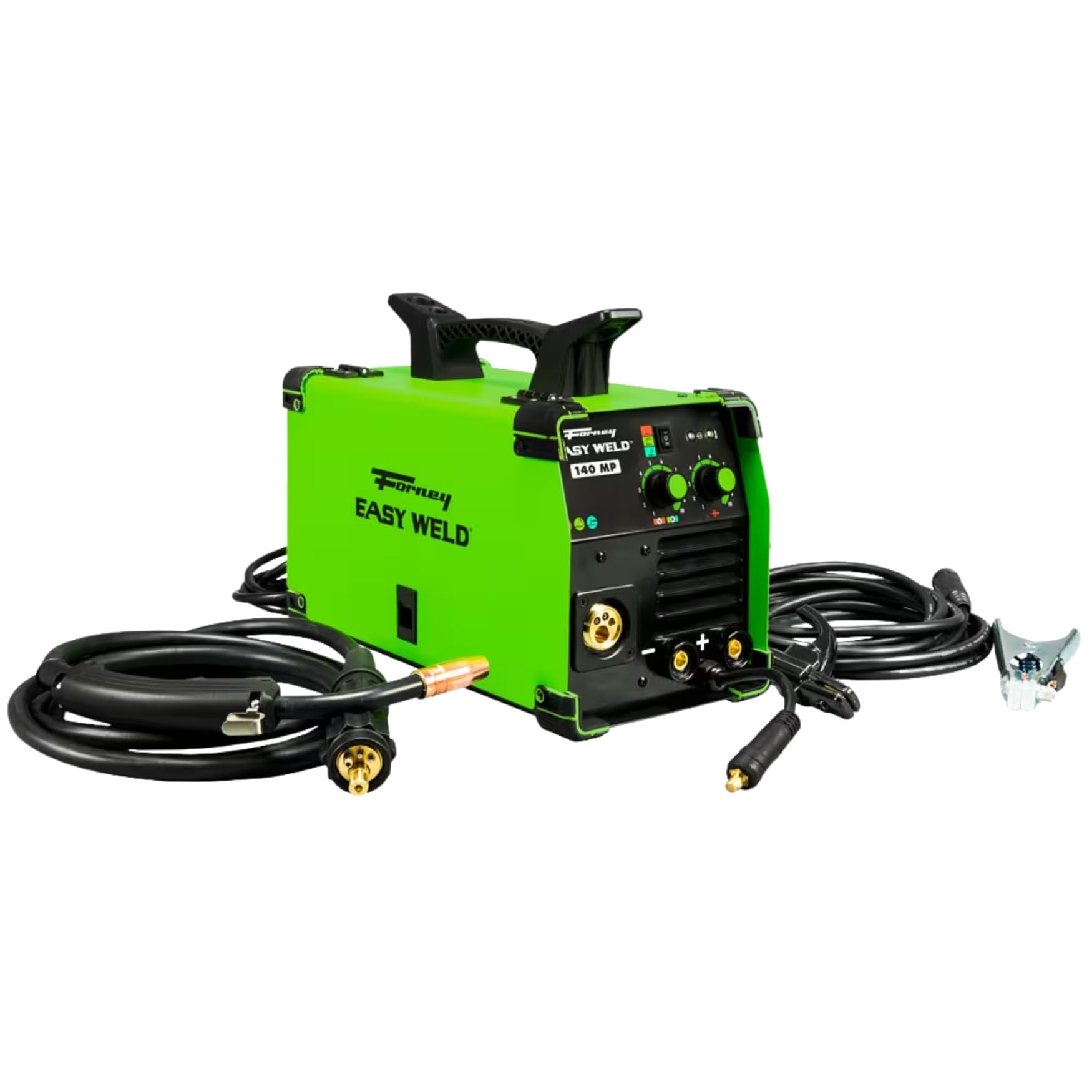
A simple, tactile 3-in-1 machine that runs on 120V and is built like a tank.
The Forney 271 Easy Weld 140 MP is the most straightforward multi-process welder on this list, built around ease of use with a simple three-position switch to change between MIG, DC TIG, and Stick. It offers infinite voltage and wire feed speed adjustments so you can dial in the perfect weld for your specific project, but it never feels overwhelming to a beginner. The all-metal case is built to take daily abuse, and it runs on a standard 120-volt power source — no 220V outlet required.
Reviewers consistently praise it as a “great entry-level welder,” with one buyer calling it his “favorite of 3 welders” and noting that it is a “better deal than Harbor Freight multi-process.” The smooth arc produces very low spatter, and one first-time welder reported laying “a respectable bead on 1/8-inch steel with 6013 rods in my first hour.” The Forney works with a 5500-watt generator, making it a solid choice for farm and ranch repairs where a 220V outlet is not available.
The 140-amp output means you are limited to materials roughly 1/8-inch thick or less in a single pass. For thicker steel, you will need multiple passes or a more powerful machine. It also seems to struggle with Lincoln 1/8-inch 6011 rods on a standard 20A circuit, so using a dedicated 25-30A 110V breaker is recommended for best performance. The included accessories are basic — a 10-foot MIG gun, 8-foot electrode holder, and 8-foot ground clamp — but the build quality is noticeably better than other units at this price tier.
Why It Works for Beginners
- Simple 3-position switch for process changes — no menus to navigate
- All-metal case is noticeably tougher than plastic budget welders
- Low spatter, smooth arc even with 6013 rods on thin steel
- Works on standard 120V and with a generator
The Limits
- 140A output restricts you to about 1/8-inch material in a single pass
- Needs a dedicated 25-30A breaker for best performance
- Struggles with 1/8-inch 6011 rods on a standard 20A circuit
The right start: If you are picking up a welder for the first time and need something that is not intimidating, the Forney 271 delivers a forgiving arc and a built-to-last frame. It is a class on a 120V cord.
8. Amico MIG-140GS

At 19 pounds, this is the easiest welder to carry up a ladder or into a crawlspace.
The Amico MIG-140GS packs MIG, MAG, Flux Core, Lift-TIG, Stick, and Spool Gun capability into a chassis that weighs just 19 pounds — the lightest machine in this comparison by a wide margin. The unit can weld all conductive metals up to around 1/8 inch, including aluminum, aluminum alloy, stainless steel, carbon steel, cast iron, and copper. When using MIG, MAG, or Flux Core modes, the current and wire feeding speed automatically coordinate and control each other, so adjusting the wire speed automatically matches the current output.
The included accessories are generous for the price: an 8-foot power cord, 10-foot MIG torch assembly, 10-foot Lift-TIG torch assembly, 10-foot 200-amp electrode holder, 10-foot 200-amp ground clamp, and a 230V to 115V power adapter. The auto-voltage sensing works smoothly — one buyer mentioned that the machine “automatically adapts to whichever volts you plug it into whether 110V or 220V and it also indicates it to you.” It is ETL Listed, so safety certifications are in order, and the dimensions at 15.35 x 10.25 x 12.6 inches make it easy to store on a shelf.
The real-world limitation is longevity under regular use. One reviewer who owned the machine for a year reported that the “MIG wire drive started surging after 1 year of occasional use” and had problems welding thin sheet metal. The trigger also started sticking over time. At 165 amps, it is on the lower end of power in this comparison, so it is best suited for light repairs, auto body, and home maintenance rather than daily professional fabrication. The Lift TIG torch works well for thin steel, but the auto-coordination feature can be finicky if you prefer full manual control.
Portability Advantage
- 19 pounds is the lightest of all 8 machines — genuinely portable
- Auto-voltage sensing switches smoothly between 110V and 220V
- Includes both MIG torch and Lift-TIG torch in the box
- ETL Listed for safety compliance
Durability Notes
- Reported wire feed surging after one year of occasional use
- 165-amp output limits it to thin materials (around 1/8 inch)
- Trigger has been known to stick over time
Grab it for: Occasional auto body work, metal art, or any situation where you need to carry your welder to the job. The 19-pound weight and auto-voltage make it uniquely low-maintenance.
pass on it if: You need a machine for daily shop use or thicker steel — the 165A limit and reported durability issues mean you will outgrow it fast.
Understanding the Specs
Amperage Output (A)
This is the welder’s peak welding current, measured in amps. It directly determines how thick a piece of metal you can weld in a single pass. For a rough guide: 140-165A machines handle up to 1/8-inch steel, 185-210A machines manage 1/4-inch comfortably, and 250-275A machines can weld 3/8-inch or thicker without multiple passes. More amps means more heat and deeper penetration into the base metal. A 270A machine like the VEVOR versus a 185A unit like the YESWELDER shows up immediately when you try to weld a tractor hitch vs. a thin car panel.
Duty Cycle (%)
The duty cycle tells you how long you can weld continuously within a 10-minute window before the machine needs to cool down to avoid overheating. A welder rated at 60% duty cycle at 200 amps means you can weld for six minutes straight, then must let it rest for four minutes. Lowering the amperage output usually increases the duty cycle. If you plan to weld long beads — like building a welding table with 8-10 inch continuous passes — you want a higher duty cycle. Machines that lack a published duty cycle are usually cheap inverter units that will trip thermal protection quickly.
FAQ
Can a 3-in-1 welder really replace a dedicated MIG, TIG, and stick machine?
Will a 110V welder work on a standard household outlet?
What thickness of steel can a 140-amp welder handle compared to a 270-amp welder?
Is Pulse MIG worth paying extra for in a 3-in-1 welder?
What is the difference between synergic MIG and manual MIG control?
How long should a 3-in-1 inverter welder last?
Do I need a spool gun to weld aluminum with a 3-in-1 welder?
What safety features should I look for in a multi-process welder?
Can I weld stainless steel with a 3-in-1 welder?
Is a heavier welder always better quality?
Final Thoughts: The Verdict
Across the board, the best3-in-1 welder winner is the VEVOR MIG-270 because it delivers the highest usable amperage (270A) in the lightest-weight package (30 lbs) among the affordable mid-range machines, and real-world users confirm it handles 3/8-inch material with.035 wire in single-pass beads without overheating. If you want the professional-grade sMIG auto-learning technology and a 3-year warranty, grab the ESAB Rebel EMP 215ic. And for the tightest budget that still gets you a true multi-process machine with dual voltage and synergic control, the standout is the YESWELDER 185DS PRO.
How We Picked
We do not accept paid placement. Every pick is matched to a real buyer and a real use-case; we do not hands-on test units.
Sources & Methodology
Specifications: manufacturer listings and product documentation. Review insights: verified customer reviews, as of July 2026. Pricing: not shown on this page (it changes often); check the current price via the retailer link.
As an Amazon Associate, Gadgets Feed earns from qualifying purchases. This does not affect which products we feature.
Product prices and availability are accurate as of the date/time indicated and are subject to change. Any price and availability information displayed on Amazon at the time of purchase will apply to the purchase of this product. As an Amazon Associate I earn from qualifying purchases.
CERTAIN CONTENT THAT APPEARS ON THIS SITE COMES FROM AMAZON. THIS CONTENT IS PROVIDED "AS IS" AND IS SUBJECT TO CHANGE OR REMOVAL AT ANY TIME.
Amazon and the Amazon logo are trademarks of Amazon.com, Inc. or its affiliates.