
Our readers keep the lights on and my morning glass full of iced black tea. As an Amazon Associate, I earn from qualifying purchases.
Specs are compiled from manufacturer listings and verified buyer reviews and can change over time — please confirm the key details on the product page before buying.
If you machine round stock, you already know the pain: you bolt on a chuck, spin it up, and the workpiece wobbles like a loose tooth because the jaws didn’t close on center. A 3-jaw chuck is supposed to solve that by pulling all three jaws inward together, so your part stays put and turns true. The real question is which one holds that center reliably without you having to machine, shim, or fight it every single time.
I’m Min — the founder and writer behind Gadgets Feed. This guide is built by comparing the manufacturers’ published specifications and the patterns across verified customer reviews, so you get each pick’s real strengths and trade-offs instead of marketing spin.
You need a chuck that grips tight, stays concentric, and matches your spindle, so here is the honest breakdown of the best 3 jaw chuck options for your lathe or mill.
Our Picks at a Glance


How To Choose The Best 3 Jaw Chuck
Before you buy, you need to match three things: the chuck’s mounting style to your spindle, the jaw range to your workpiece sizes, and the body size to your machine’s swing. Get one of these wrong and you’ll be machining adapters or returning the unit.
Mounting: Threaded vs. Plain Back
A threaded-back chuck screws directly onto a spindle with a matching thread size, like the common 1 1/2″-8 or the older 3/4-16. A plain-back chuck has a flat rear face and needs a separate backing plate to connect it to your lathe; this gives you flexibility but adds a step. A threaded-back unit with a finished plate is the easiest path if your spindle matches the spec.
Jaw type and clamping range
External jaws close inward to grip the outside of a rod or bar, while internal jaws expand outward to hold a bore or hollow part from the inside. Many chucks ship with both sets, which doubles the range of workpiece diameters you can handle. Check the listed clamping range — the gap between the smallest and largest part it can hold — against what you actually turn.
Runout and accuracy
Runout is how far the workpiece deviates from true center as it spins, usually measured in thousandths of an inch. A scroll mechanism with tight tolerances keeps that number low, but even good chucks benefit from a light facing pass to true them to your spindle. The crowd favorite here holds repeat positioning accuracy around 0.002 inches, which suits hobby and light production work.
Quick Comparison
| Model | Best For | Body Size | Clamping Range | Mounting | Amazon |
|---|---|---|---|---|---|
| VEVOR 6″ K11-160★ Best Overall | Hobby lathe all-rounder | 160 mm (6.3″) | 0.14–6.3 in (3.5–160 mm) | Closed/Open center | Amazon |
| HHIP 3900-3107 3″Vintage Fit | Vintage Atlas/Craftsman spindles | 3″ | — | 3/4-16 threaded backplate | Amazon |
| HAowosi 3″ Wood ChuckWoodworker’s Pick | Wood lathe with 1″x8 TPI spindle | 3″ (48 mm capacity) | — | MT-1 and MT-2 arbor shank | Amazon |
| findmall K11-160 6″ | CNC and manual lathe work | 160 mm (6.3″) | 3–160 mm | Plain back (bolted) | Amazon |
| WFLNHB K11-100 4″ | High-accuracy small parts | 4″ (100 mm) | 2–90 mm | Bolt circle 84 mm | Amazon |
| maXpeedingrods K11-200A 8″ | Large shafts and discs | 8″ (200 mm) | 0.16–7.87 in (4–200 mm) | 3-M10, BCD 180 mm | Amazon |
| HHIP 3900-0032 4″ Plain Back | Welding turntables and mills | 4″ | — | Plain back | Amazon |
| CME 8″ Plain Back | CNC mill pallet work holding | 7 7/8″ | 0.16–7.87 in OD | Plain back | Amazon |
| CME 8″ Threaded Back | Bringing old lathes back to life | 7 7/8″ | 0.16–7.87 in OD | 1 1/2″-8 threaded plate | Amazon |
In-Depth Reviews
1. VEVOR 6″ Self-Centering Lathe Chuck
Our pick — over 4★ from 250+ verified ratings; the strongest balance of quality and price.
The 6-inch all-rounder with hard steel jaws that keeps a 0.002-inch bearing tolerance.
VEVOR builds this 160 mm (6.3″) chuck from HT300 material, with 20Cr steel jaws hardened to 53HRC and a 40Cr scroll at 45HRC — which in plain terms means the gripping parts resist wear and rust far longer than soft castings. The self-centering design uses a bevel gear and three pinion gears inside, so you rotate the T-key and all three jaws close together with a bearing tolerance of 0.002 inches.
You get both an internal and an external jaw set, pushing the clamping range from 0.14 inches all the way to 6.3 inches (3.5–160 mm) so it can hold small rods or large industrial parts. The crowd favorite here is a strong 4.4-star average from roughly 300 owners, and buyers report it is the 4th VEVOR chuck they have owned with all performing as expected — good accuracy and a solid build.
What wins people over is the quality-to-price ratio, with quality the most-praised aspect. The recurring note is to disassemble and clean manufacturing grit before first use, and one buyer needed to drill larger holes with a step bit to mount it on a weld positioner — so plan a little setup time.
What earns the top spot
- Hardened 53HRC jaws resist wear on daily turning
- Internal and external jaws cover 0.14–6.3 in parts
- Repeatable concentricity near 0.002″ on a 1/2″ rod
Setup caveats
- Expect manufacturing grit — clean and re-oil first
- Mounting holes may need enlarging for some positioners
Grab it if: you want one dependable 6-inch chuck for a hobby lathe, mill, or 3D printer setup.
Think twice if: you demand zero prep — this one rewards a 20-minute clean before first spin.
2. HHIP 3900-3107 3″ Chuck with 3/4-16 Backplate
The small 3-inch chuck built for older 3/4-16 spindle threads like the Atlas 618.
This HHIP unit is a niche lifesaver for owners of vintage metal lathes, since its steel body comes with a 3/4-16 threaded backplate already attached. Owners mention it fit a 1946 Craftsman 101 and an Atlas 618 perfectly, calling it a 10-out-of-10 purchase, and one owner mounted an ER-32 collet chuck to a Craftsman Atlas 12″ lathe with a light skim pass to true it.
The hand-tightened, keyless operation keeps it simple, and the package includes the pre-drilled 3-hole backplate. Fit is the most-discussed point, and the honest read is split: some say it matches their spindle nicely, while others on desktop lathes found it too long and needed to face or machine the register for a snug fit.
The 4.3-star average across 170+ owners tells the real story: functionality gets strong praise, but expect to do minor fitting work because the material and threading quality draw mixed feedback. It is not high-grade casting steel, so treat it as a capable base part that may need a little attention.
A machinist’s part: this is for the person who enjoys a quick facing pass to make a chuck perfect, not the bolt-on-and-go crowd.
The trade-off: lower-grade steel and occasionally rough threads mean you earn the low price with a little elbow grease.
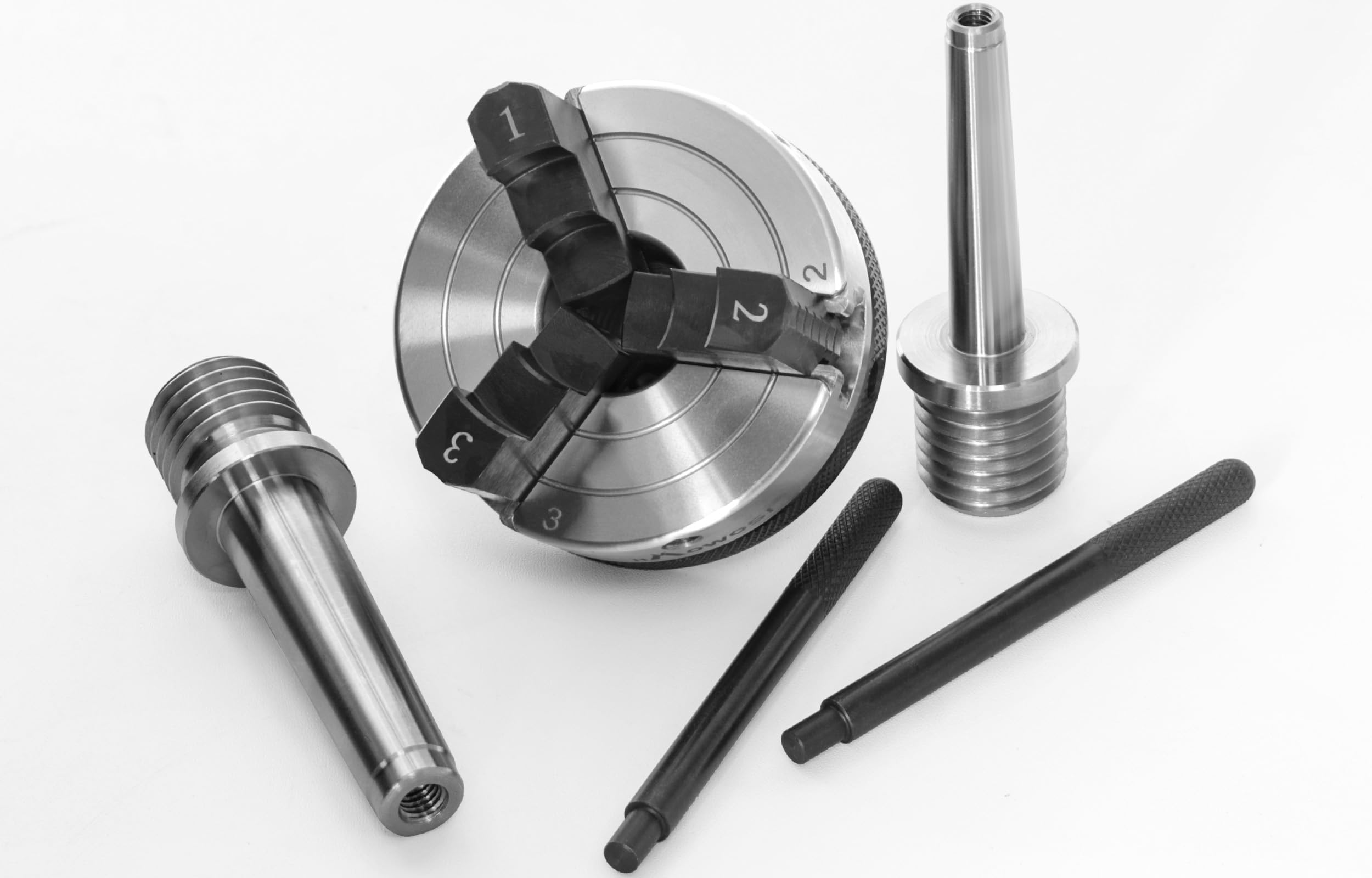
3. HAowosi 3″ Wood Lathe Chuck with MT-1 and MT-2 Shanks
A 3-inch wood-chuck package that screws straight onto 1″x8 TPI spindles with two Morse taper shanks included.
If you turn bowls or spindles on a wood lathe, this HAowosi chuck fits all wood lathes with a 1-Inch by 8 TPI spindle, and it ships with both an MT-1 and an MT-2 arbor shank so you can adapt to different headstocks. The reversible stepped jaws hold workpieces internally or externally, and the self-centering action means you install it in the right order and skip repeated calibration.
Owners on basic WEN and Jet lathes report it screwed right on, ran very concentric, and held great for polishing round metal objects. The 4.3-star score from 100+ buyers leans on functionality value — the thing everyone praises — but jaw tightness is the recurring weak spot, with one frustrated owner saying the jaws would not center no matter what was tried.
Weigh that against the price point and the included wrenches and shanks, and you have a solid budget entry for light woodturning. Just inspect jaw movement before you commit a critical piece to it.
Straightforward value: a complete chuck-plus-shank kit at a friendly price for hobby woodturners.
The catch: occasional units arrive with jaws that will not center, so test the scroll early and return fast if it misbehaves.
4. findmall K11-160 6″ Self-Centering Chuck
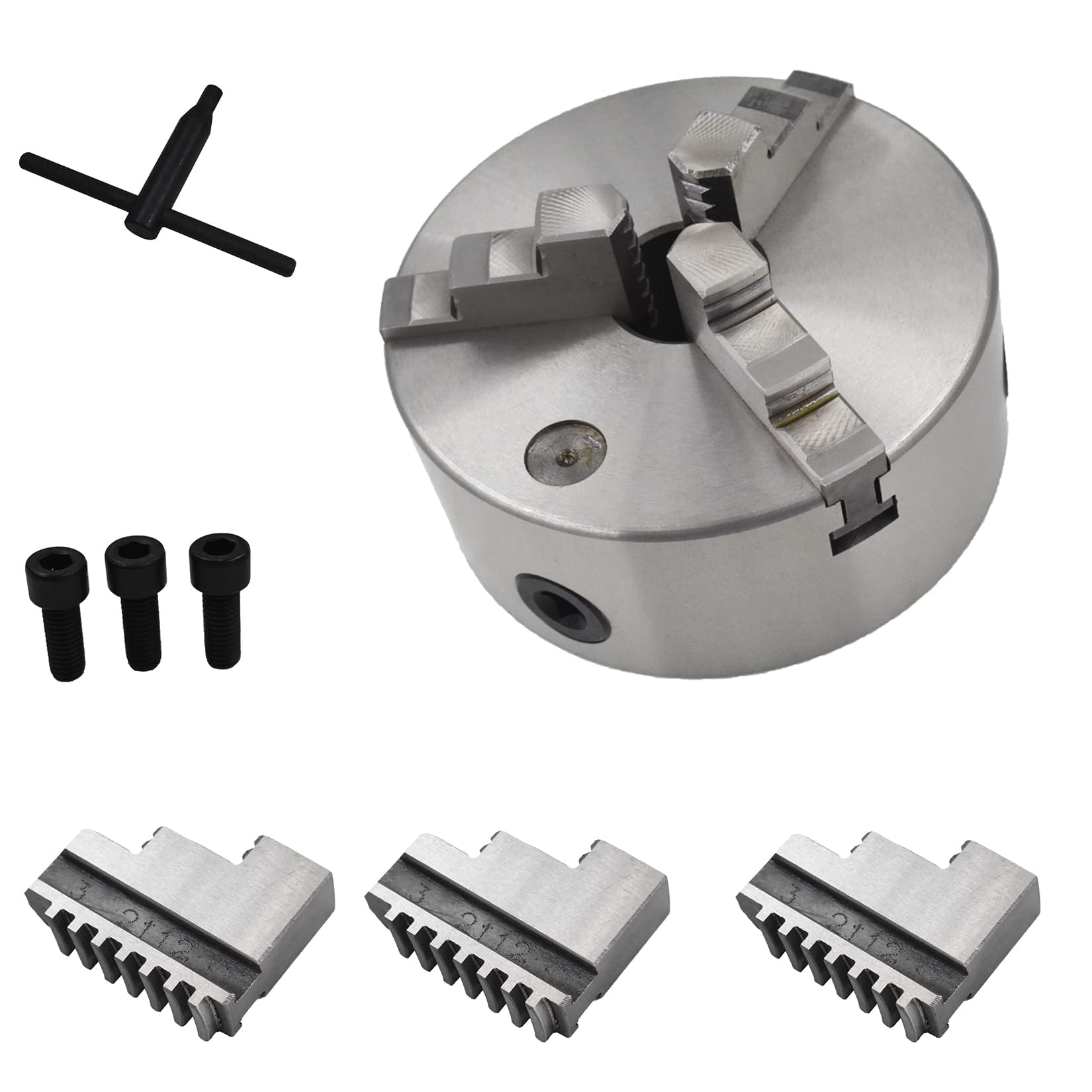
A 160 mm CNC-style chuck whose ground jaws are hardened to HRC 58-62 for long service.
findmall’s K11-160 brings the same 160 mm (6.3″) diameter as the VEVOR above, but it leans toward machine-tool use — general lathes, economical CNC lathes, grinding, milling, and drilling. Both sides of the jaw teeth and guides are ground and hardened to HRC 58-62, so the surfaces that touch your workpiece stay sharp through heavy cycles.
The two sets of jaws split the work: internal clamping from 3–55 mm and external from 55–145 mm, with a jamming range up to 160 mm. Owners on a 1906 lathe with a worn four-jaw report it is working great, and the quality earns praise for the price — though you must supply your own backplate, and one buyer did milling on a new plate for runout adjustment wiggle room.
At 4.1 stars from a smaller pool of 38 ratings, this is the pick for someone comfortable with machine setup who wants a hardened 6-inch workhorse for CNC or manual use. Plan for backplate fitting, since a plain-back chuck always demands one.
Shop-floor performer: hardened jaws and CNC-friendly range suit a machine that runs all day.
Budget accordingly: no backplate ships in the box, so factor machining time into your total cost.
5. WFLNHB K11-100 4″ Self-Centering Chuck
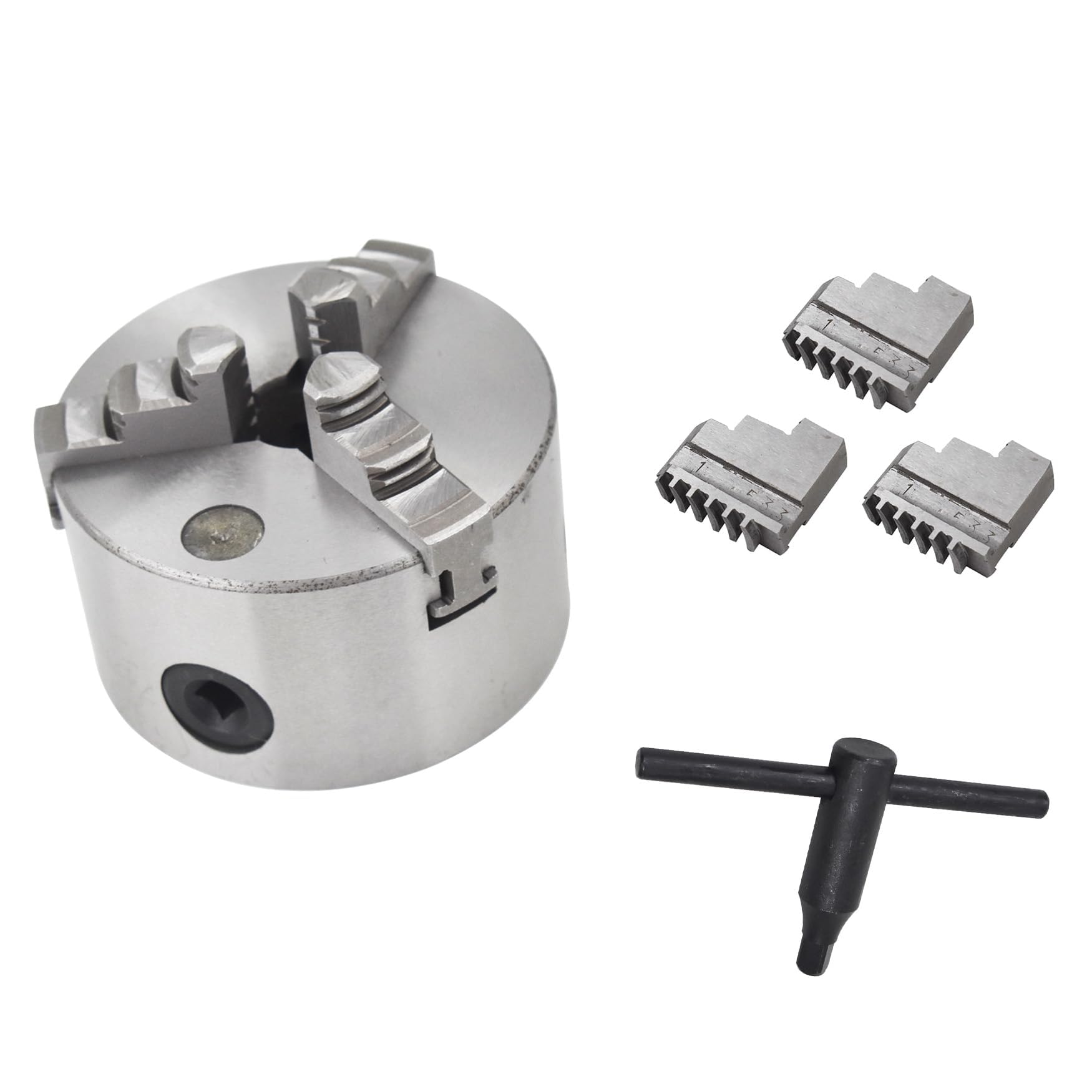
The 4-inch chuck with radial runout as low as 0.002 inches and repeat positioning under 0.03 mm.
WFLNHB’s K11-100 targets accuracy first, advertising radial runout as low as 0.002 inches and repeat positioning accuracy of ≤0.03 mm — numbers that matter when you are turning small precision parts. Built for 4-inch (100 mm) lathes, it has a 22 mm center bore for direct bar-stock machining and a bolt circle of 84 mm for mounting.
The dual-stage clamping uses inner jaws for 2–30 mm and 30–90 mm ranges, while outer jaws cover 30–80 mm, so a single chuck handles internal and external work across most small stock. Jaws are fully quenched 45 steel with a non-slip surface design, and owners replacing factory chucks on Grizzly lathes report it bolts right on with very little runout — a fix for units that came off the line almost an eighth of an inch off.
This is the highest-rated chuck in the roundup at 4.7 stars from 41 owners, with quality and price both getting consistent praise. It includes the chuck body, 3 inner jaws, 3 outer jaws, 3 mounting bolts, and a chuck wrench — a true one-stop kit.
Accuracy first
- 0.002-inch radial runout for true turning
- Six jaws total cover 2–90 mm stock
- Complete kit with bolts and wrench included
Know before you buy
- Make sure your machine matches the 84 mm bolt circle
- Some machines need an adapter to mount it
Best for: precision-minded hobbyists who want factory-grade runout without factory-grade pricing.
Not for: anyone with a non-standard spindle who is not ready to make an adapter plate.
6. maXpeedingrods K11-200A 8″ Self-Centering Chuck
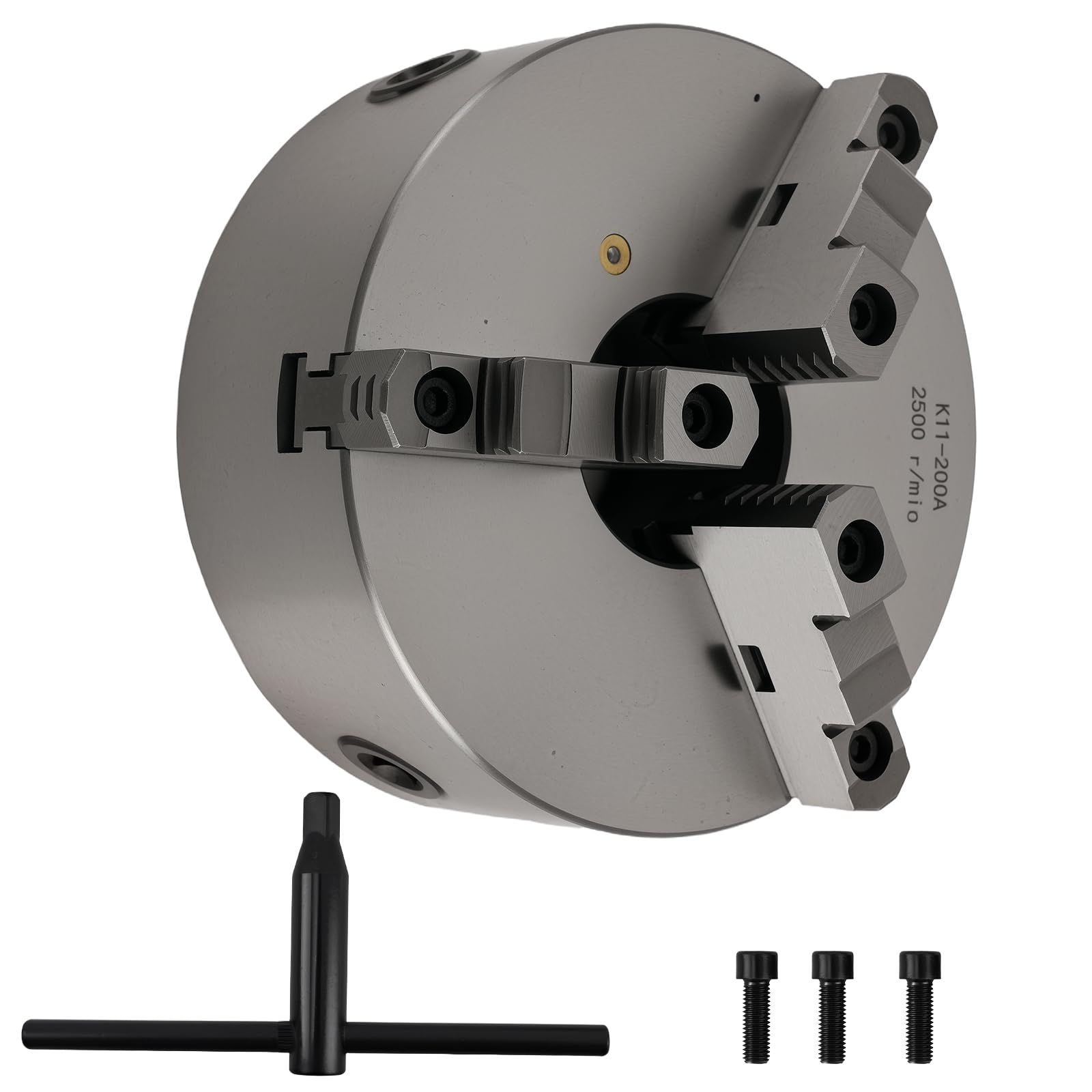
An 8-inch (200 mm) chuck that takes external jaws out to 7.87 inches for big shafts and discs.
When your workpieces outgrow a 6-inch chuck, maXpeedingrods steps up with the K11-200A. Internal jaws grip from 4 mm to 85 mm for precise small parts, while the external jaws handle diameters from 65 mm all the way to 200 mm (7.87″) — enough for sizeable shafts, discs, and hexagonal bar stock.
The scroll mechanism carries a 0.002-inch accuracy spec, and the L-shaped reversible jaws are heat-treated for a longer service life than standard cast-iron chucks. Critical mounting specs matter here: the bolt circle diameter is 180 mm with 3-M10 threads, and the center through-hole is 65 mm, so verify those against your spindle adapter before purchase.
At 4.5 stars from 100+ owners, the praise centers on smooth operation and solid function for occasional jobs. The honest gap: no D1-4 adapter plate is offered, so if your lathe uses that mount, you will be hunting for a plate on your own — check that before you commit.
Reach for it if: your lathe swings 8-inch work and you want hardened steel jaws at a value price.
Look elsewhere if: you run a D1-4 camlock spindle — no factory adapter exists for this one.
7. HHIP 3900-0032 4″ Plain Back Chuck
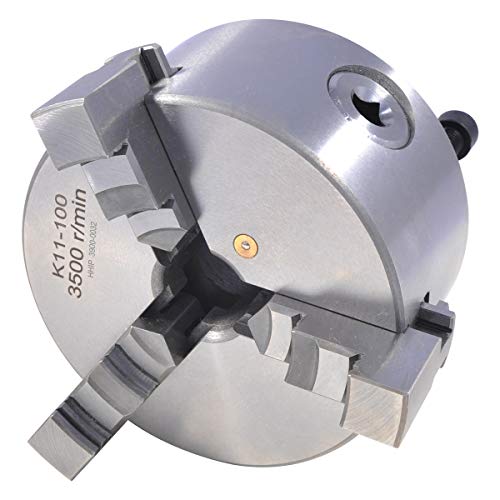
A 4-inch plain-back chuck that surprised owners with high-end fit and finish.
The HHIP 3900-0032 is a compact 4-inch chuck made of high-quality semi-steel, hardened and ground, with a center hole of 0.866 inches. Owners were genuinely surprised at the quality, saying the fit and finish are on par with far more expensive chucks of the same type and noting there is virtually no play on the scroll within the body.
It ships with two sets of hard jaws — internal and external — plus the chuck key, so small projects are covered right from the start. One owner bolted it to a welding turntable and reported it paid for itself in the first hour., while another uses it on a CNC mill just to hold round stock with good repeatability.
The 4.5-star score from 47 owners reflects a chuck that exceeds expectations at its price. The plain-back design means you need your own mounting solution, but for turntable and mill workholding that is often exactly what you want.
Quality surprise: scroll smoothness and finish that rival premium chucks at a friendly price.
Plan the mount: plain back needs your backing plate, so it suits users who already have one or work on turntables.
8. CME 8″ Plain Back 3-Jaw Scroll Chuck

A 45-pound, 7 7/8-inch plain-back chuck with two-piece reversible jaws on the ISO3442 standard.
CME’s 8-inch plain-back chuck is a heavy-duty workholding tool at 45 pounds, built with alloy steel and quench-hardened inner mechanisms. Each jaw is a two-piece design with a top and bottom “master” jaw, so you can reverse them easily for an extended clamping range — a genuine versatility win.
The body measures 7 7/8 inches with a 2 9/16-inch through-hole, handling workpieces from 0.16 to 7.87 inches OD. One owner mounted it to a pallet system for a CNC mill and called it a far better build than expected, while another measured runout under 0.001 inch at a 3/8-inch work diameter after disassembly and proper setup.
At 4.2 stars from 99 owners, the honest prep note pops up repeatedly: like many scroll chucks in this class, it ships full of manufacturing grit and needs a full disassemble, deburr, and re-oil before serious use. Plan that into your first hour and it runs true.
Heavy hitters
- Two-piece reversible jaws for wide range
- Sub-0.001-inch runout possible after setup
- ISO3442 American tongue-and-groove standard
Prep required
- Ships full of millings — disassemble and clean first
- Plain back needs a fitted backing plate
Choose it for: CNC mill workholding or a big lathe where you will true it once and run it for years.
skip it if: you are not ready to spend an hour cleaning grit and fitting a backplate.
9. CME 8″ 3-Jaw Chuck with 1 1/2″-8 Threaded Plate
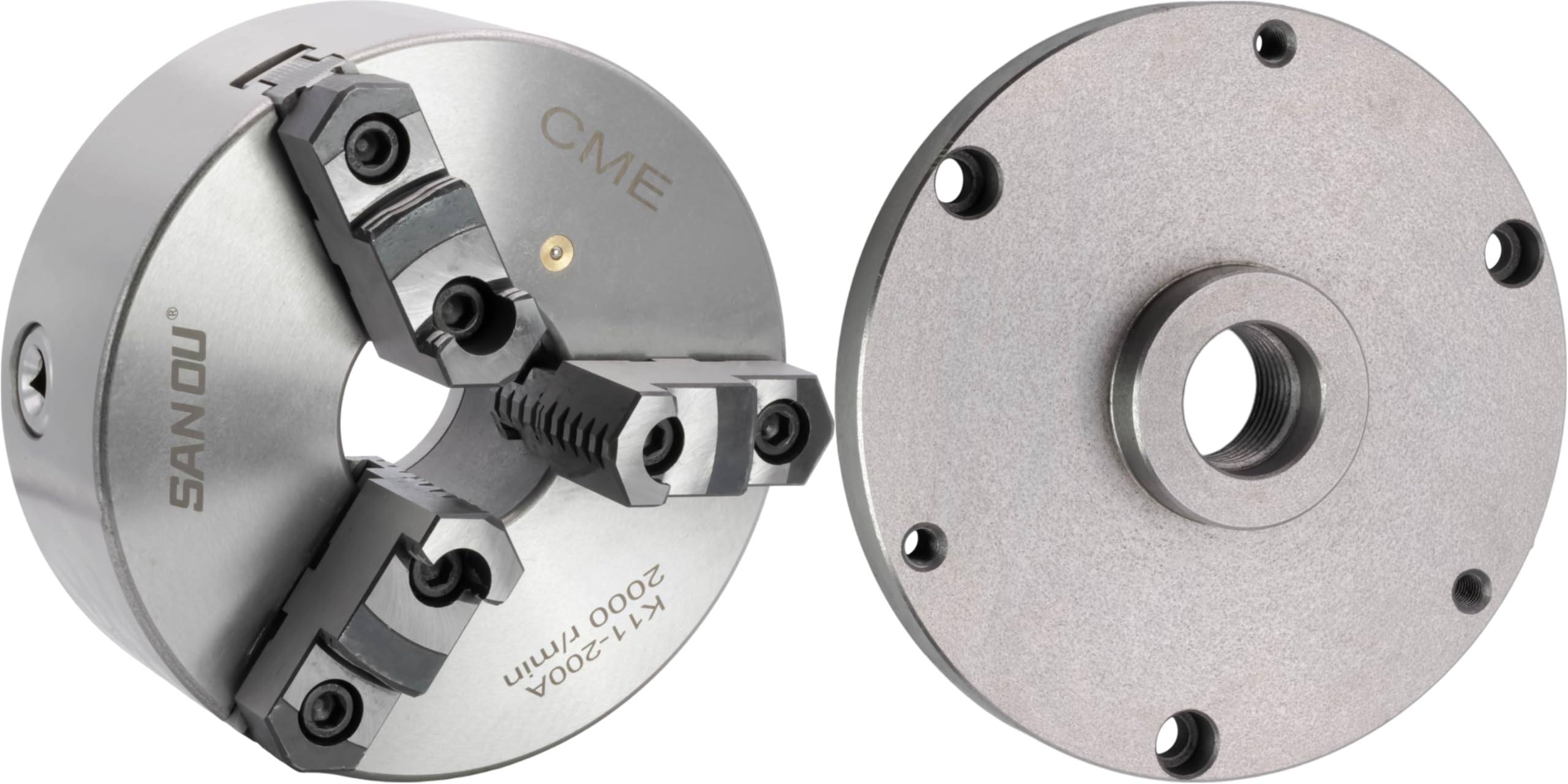
The 8-inch chuck with a finished 1 1/2″-8 threaded plate for a true screw-on install.
This is the ready-to-run version of the CME 8-inch chuck above: it comes with a finished 1 1/2″-8 threaded adapter plate already mounted, so it screws straight onto standard spindles with that thread. Customers note it threaded on perfectly to a Logan lathe, with a dial indicator that did not move on the face and less than 0.0005-inch movement on a clamped drill rod.
The quality story here is strong — 4.4 stars from 110 owners with quality as the most-praised aspect. Owners brought 50+ year old Atlas 10F and 10D lathes back to life, reporting body runout of 0.001 to 0.0015 inches with no backplate machining needed. The two-piece reversible jaws and quench-hardened steel internals match the plain-back sibling, but the threaded plate removes the hardest part of the install.
One owner notes it is thicker than the pictures suggest and you give up a little between centers, so check your swing clearance. It ships dripping in oil — a sign of proper protection, just have a rag ready.
The easy button: ready-out-of-box accuracy near 0.001 inches for anyone with a 1 1/2″-8 spindle.
The honest check: measure your between-centers clearance because this unit carries real thickness.
Understanding the Specs
Runout and self-centering
The whole point of a 3-jaw chuck is that all three jaws close on center at once, so you do not align each jaw by hand. Runout is the tiny error that remains — how far the part sits off true center as it spins. It is measured in thousandths of an inch, and the best budget chucks here hold around 0.002 inches, which is plenty for most hobby and light production work.
Internal vs. external jaws
External jaws have steps that face inward, so they close over the outside of a rod or bar to grip it. Internal jaws face outward and expand to grip the inside of a hollow bore or pipe. Many chucks ship with both sets, which is why you see ranges like “internal 3–55 mm, external 55–145 mm” — one chuck covers far more workpiece shapes.
Mounting: threaded, plain back, and bolt circle
Threaded-back chucks screw directly onto a spindle with a matching thread, like 3/4-16 or 1 1/2″-8. Plain-back chucks have a flat rear face and need a separate backing plate. For bolt-on chucks, the bolt circle diameter (BCD) is the circle that the mounting holes sit on — get this wrong and nothing lines up, so match it to your spindle adapter.
Jaw and scroll hardness
Hardness ratings like HRC 58-62 tell you how well the jaw teeth resist wear over time. A scroll is the spiral gear inside that moves all three jaws together when you turn the key. Hardened jaws and scrolls last longer under heavy clamping force, which is why you see specs like “53HRC jaws” and “quench-hardened steel” on better chucks.
FAQ
How do I know if a 3-jaw chuck will fit my lathe spindle?
What does self-centering actually mean on a 3-jaw chuck?
What is internal versus external clamping on a chuck?
Why does my new chuck have manufacturing grit inside?
Can I use a metal lathe chuck on a wood lathe?
What is runout and how much is acceptable?
Do I need a backing plate for a plain-back chuck?
Why would I want reversible jaws on a chuck?
What is the difference between a 3-jaw and a 4-jaw chuck?
Final Thoughts: The Verdict
The best 3 jaw chuck winner for most buyers is the VEVOR 6-inch because it pairs hardened 53HRC jaws with a 0.002-inch tolerance at a price that makes sense for hobby shops. If you want precision on small parts, the WFLNHB K11-100 leads the pack with 0.002-inch radial runout and a complete jaw set. And if you are reviving a vintage lathe with a 1 1/2″-8 spindle, the CME 8-inch threaded screws on ready and brings old iron back to life.
How We Picked
We do not accept paid placement. Every pick is matched to a real buyer and a real use-case; we do not hands-on test units.
Sources & Methodology
Specifications: manufacturer listings and product documentation. Review insights: verified customer reviews, as of September 2026. Pricing: not shown on this page (it changes often); check the current price via the retailer link.
As an Amazon Associate, Gadgets Feed earns from qualifying purchases. This does not affect which products we feature.