
Our readers keep the lights on and my morning glass full of iced black tea. As an Amazon Associate, I earn from qualifying purchases.
Specs are compiled from manufacturer listings and verified buyer reviews and can change over time — please confirm the key details on the product page before buying.
The real test of a 3 person backpacking tent is how it performs on the third night of a trip in sideways rain, when you’re exhausted and your partner needs a snack without soaking the interior. The best 3 person backpacking tent balances livable space with a weight that won’t punish your legs after eight miles.
I’m Min — the founder and writer behind Gadgets Feed. This guide is built by comparing the manufacturers’ published specifications and the patterns across verified customer reviews, so you get each pick’s real strengths and trade-offs instead of marketing spin.
After sorting through the specs and hundreds of real owner reports, I’ve narrowed the field to five tents that genuinely deliver on the promise of a 3 person backpacking tent — giving you honest trade-offs between weight, weather protection, interior space, and value.
Quick Picks
- Naturehike Cloud Up 3 Person Backpacking Tent with Footprint — Best Overall
- Kelty Tents Kelty Discovery Trail 3 — Budget Champion
- Naturehike Mongar Upgraded 3 Person Backpacking Tent — Best Value
- MSR Freelite 3-Person Ultralight Backpacking Tent — Top Performer
- NEMO Equipment Dragonfly OSMO 3 — Premium Pick
How To Choose The Best 3 Person Backpacking Tent
Buying a three-person backpacking tent means you’re carrying everyone’s home, so every ounce of weight and cubic inch of space needs to earn its spot in your pack. A tent that is comfortable for lounging but weighs eight pounds is a car-camping tent; a tent that shaves every gram but fits like a coffin will make your trail partners miserable.
Weight: Packed Weight vs. Trail Weight vs. Minimum Weight
Manufacturers often quote several different weights. The trail weight (sometimes called minimum weight) includes the tent body, rainfly, and poles — but leaves out the stakes, stuff sack, and footprint. The packed weight is everything. For a 3 person backpacking tent, a good packed weight is under 6.5 pounds. Once you go above 7 pounds, you and your partners are really paying the penalty on climbs.
Floor Area and Headroom: The Truth About 3-Person Capacity
A true 3 person backpacking tent should have a floor area around 42 to 46 square feet. That gives each person roughly a 20-inch by 72-inch sleeping pad space — snug but doable. Peak height matters, too: 45 to 49 inches lets you sit up to change clothes without scraping your head on the mesh. A tent with a floor that is too short (under 84 inches) means the tallest person sleeps diagonal.
Double Wall vs. Single Wall
Nearly every great three-season backpacking tent uses a double-wall design: an inner mesh body and a separate rainfly. The gap between the two layers manages condensation by letting moist breath air escape through the mesh while the fly keeps rain out. Single-wall tents are lighter but notorious for soaking the inside in humid weather when you touch the walls.
Quick Comparison
On smaller screens, swipe sideways to see the full table.
| Model | Best For | Floor Area | Packed Weight | Peak Height | Amazon |
|---|---|---|---|---|---|
| Naturehike Cloud Up 3 | Value + spacious interior | 42.6 sq ft | Under 6.3 lbs | 45.3 in | $159.00$169.00Amazon |
| Kelty Discovery Trail 3 | Budget-friendly durability | 46 sq ft | 5 lbs 7 oz | 49 in | $159.95Amazon |
| Naturehike Mongar Upgraded 3 | Ventilation + dual doors | 43.8 sq ft | 6 lbs | 43.3 in | $199.00Amazon |
| MSR Freelite 3 | Ultralight performance | 38.5 sq ft | 3.75 lbs | 43 in | $569.95Amazon |
| NEMO Dragonfly OSMO 3 | Premium materials & features | — | 3.75 lbs | — | from $429.00Amazon |
In‑Depth Reviews
1. Naturehike Cloud Up 3 Person Backpacking Tent with Footprint
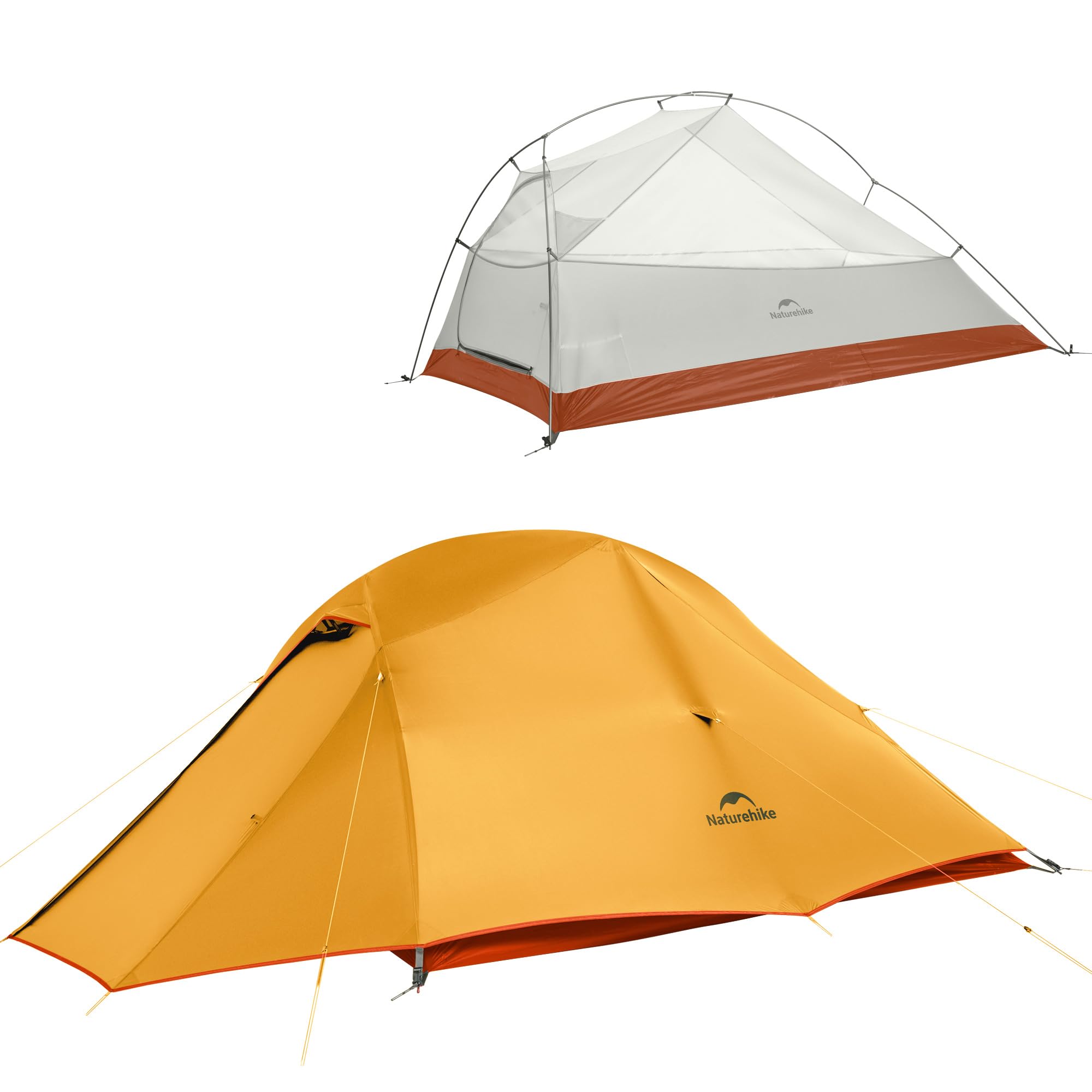
The freestanding dome that offers the most sprawling floor for the weight — a rare balance.
If you have ever tried to stuff three adults into a tent measured for three, you know the squeeze. The Naturehike Cloud Up gives you a floor that stretches 116.1 inches long and 82.7 inches wide, versus the Naturehike Mongar at 86.6 inches long, so the tallest person sleeps fully stretched out without angling. At under 6.3 pounds packed, the weight is still low enough for two people to split in their packs. The 210T ripstop polyester walls with a PU3000mm coating (a waterproof layer that withstands a 3000mm column of water pressure) and sealed seams have kept buyers dry in heavy rain — one reviewer noted “excellent breathability and waterproofness in heavy rain; no condensation at ~40°F”.
The double-wall design uses a high-density B3 mesh inner, so on humid nights the airflow continues even with the fly fully on. Setup is a dual-Y aluminum pole structure that one person can handle — a real asset after a long day. The included footprint (a groundsheet that protects the tent floor) is a 210T polyester piece with a stronger PU5000mm coating, keeping any gravel or sharp rocks from poking through the floor. Reviewers do note that the tent only has a single door, which can be a headache for the middle person trying to get out in the middle of the night.
At 42.6 square feet of floor area, it slips just behind the Mongar’s 43.8 square feet, but the Cloud Up’s rectangular shape — rather than a tapered profile — means the usable space is better for three sleeping pads side by side. The packed size of 16.9 by 6.7 inches slips into a 40-liter backpack easily, as one buyer described stashing it into a dry bag.
Sprawling shelter: The longest floor in this comparison (116.1 inches) plus a sub-6.3-pound weight makes it the go-to for groups with a tall hiker.
Single-door snag: One door is fine for a couple, but middle-of-the-night exits for three people become a chore.
Reach for this if: space and value are your top priorities — you want the biggest interior for the lightest pack weight under.
Look elsewhere if: you need two doors so two people can exit without crawling over each other.
2. Kelty Tents Kelty Discovery Trail 3

A beginner-friendly shelter that tested well in gusts that would push lesser tents flat.
The Kelty Discovery Trail 3 lands at a packed weight of 5 pounds 7 ounces, making it the lightest among the budget-friendly picks. That low weight comes with a 46-square-foot floor — the largest floor area of any tent here — but the tent’s 49-inch peak height means you can actually sit up to organize gear without hunching. Buyers report that the tent “withstood 50mph gusts without moving” — proof of the pressfit aluminum poles and pre-attached guy lines (the ropes that anchor the tent to the ground).
What makes the Kelty stand out at its price tier is the use of DWR/PFC-free fabrics — an environmentally friendlier coating that sheds water without the chemicals used in many other tents. The single-door, single-vestibule design keeps the weight down and the setup simple: the Quick Corner clips let one person pitch the whole thing in minutes. It fits a 79-inch pad comfortably, so tall sleepers are covered. Buyers do note that the included stakes are “flimsy”, and many recommend picking up a set of aftermarket aluminum stakes.
The trade-off is that the rainfly has a single vent that some reviewers found does not pull enough airflow on hot afternoons — the inside can heat up fast in direct sun. Still, for the price and the sub-6-pound weight, this is the tent to grab if you are equipping the whole friend group on a budget.
Why it wins for price
- Largest floor area in this roundup at 46 sq ft
- One of the lightest packed weights at 5 lb 7 oz
- Environmentally friendly PFC-free fabric coatings
- Proven wind resistance, with one buyer’s report of 50mph gusts
Small catches
- Single door/vestibule limits exit options for three people
- Included stakes are flimsy — upgrading makes a real difference
- Rainfly vent alone doesn’t keep the tent cool on hot mornings
Best value for beginners: If you are buying your first three-person backpacking tent and want the lowest weight alongside the biggest floor, this is the pick.
Not ideal if: you want dual doors or a vestibule on both sides for independent gear storage.
3. Naturehike Mongar Upgraded 3 Person Backpacking Tent
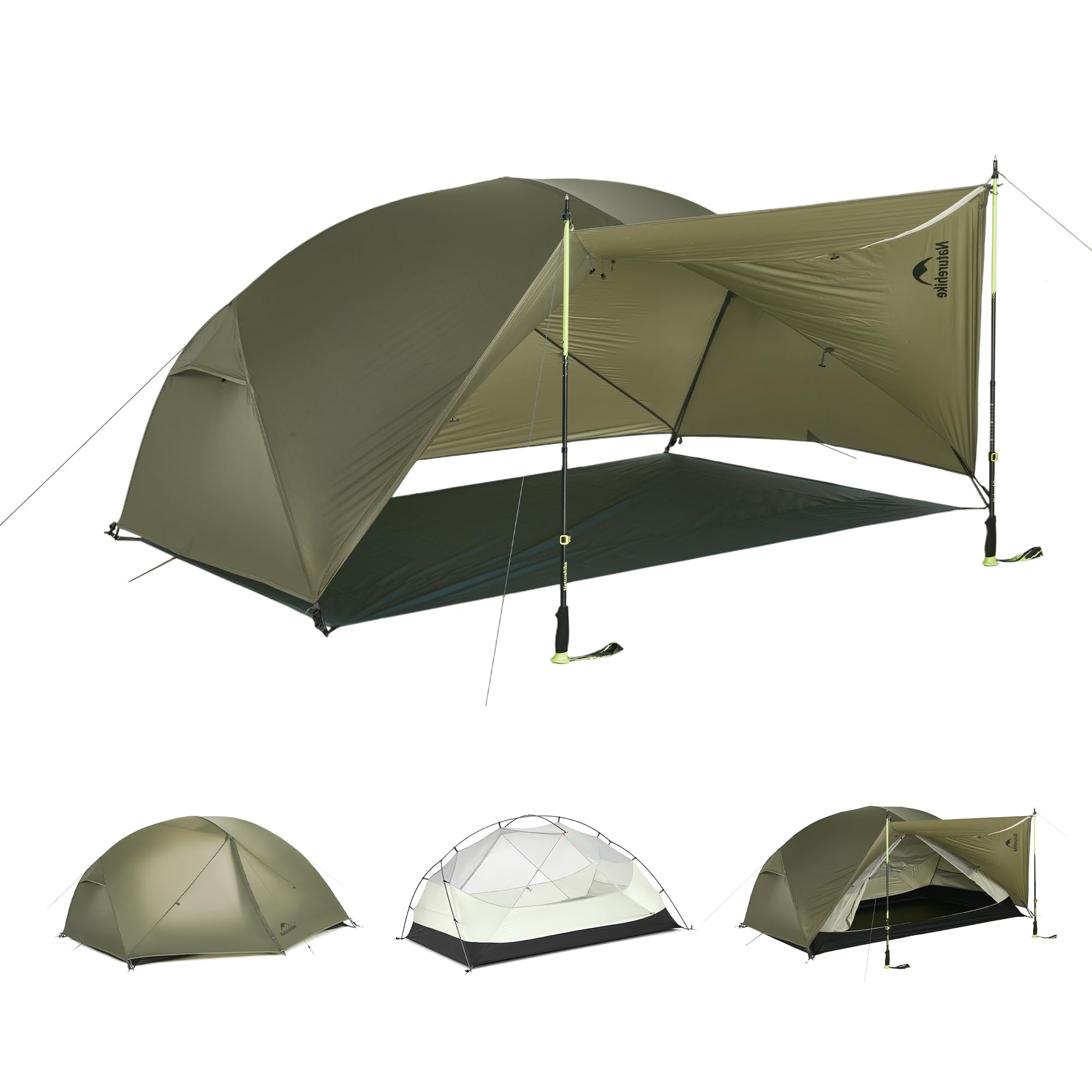
The dual-door, dual-vestibule layout that solves the biggest complaint of budget three-person tents.
The Naturehike Mongar Upgraded is the answer to the “one door is a nightmare” frustration. It gives you two doors and two vestibules (the covered storage area outside each door), so the person on the left can exit for a midnight bathroom break without crawling over the person on the right.
The standout feature here is the expandable awning, which extends beyond the vestibule to give you extra shade and rain protection when you are cooking or just sitting outside. Owners mention it “withstood 20-30mph winds and thunderstorms” — solid stability for a lightweight tent. The advanced ventilation system combines mesh panels with an adjustable vestibule height, so condensation is much less of a problem than in single-wall tents. At 6 pounds packed, it is slightly heavier than the Kelty, but the added livability of two doors and the awning makes that ounce trade-off worthwhile for three-season use.
The 20D nylon fabric with a PU3000mm coating keeps rain out, and the 9.5mm aluminum alloy poles are eco-friendly and strong. The packed size is 16.9 by 6.7 by 6.7 inches — about the size of a large water bottle — which fits well in a backpack side pocket. The only catch from owners: the stuff sack is snug, and the included stakes are basic.
Ventilation leader: Dual doors plus an expandable awning make this the most livable tent in the mid-range — perfect for anyone who camps in humid climates or wants to cook from the tent door.
Watch the length: At 86.6 inches long, a 6-foot-2 sleeper may touch the walls.
Grab it for: the dual-door convenience and the unique awning that turns your tent into a mini basecamp.
Pass if: your group has a member over 6 feet tall who needs the extra length of the Cloud Up.
4. MSR Freelite 3-Person Ultralight Backpacking Tent

The ultralight specialist at about 3.75 pounds versus the Naturehike Cloud Up at under 6.3 pounds and the Kelty Discovery Trail at 5 pounds 7 ounces — but with a smaller floor to match.
The MSR Freelite 3 weighs about 3.75 pounds, versus the Naturehike Cloud Up at under 6.3 pounds and the Kelty Discovery Trail at 5 pounds 7 ounces. That weight drop requires a trade: the floor area is just 38.5 square feet, with a floor width of 66 inches and length of 84 inches. One buyer summed it up as “cramped for two adults, fits three small people” — so if you are three average-sized men, you will be a very cozy group. The 43-inch peak height means headroom is adequate but not generous, and customers note you can’t sit up fully in all spots.
The build quality is premium 15D ripstop nylon for the floor and rainfly, with a DuraShield waterproof coating that is PFAS-free (no forever chemicals). The DAC NFL aluminum poles are the same supplier used by many high-end tent brands, and they fold into an ultra-compact hub-and-pole system that sets up and packs down quickly. Two large side-entry vestibules provide exterior storage for your packs and boots, and tech-friendly pockets with cable ports let you run a charging cable from a battery pack to your phone without opening the tent.
Owner reports on reliability are mixed: one reviewer described waking up in a puddle after five uses, but others praised its stormworthiness in tropical rains. This is a tent for the dedicated backpacker who measures every tenth of a pound and is willing to accept less interior space for a pack that feels empty on your back.
What the weight weenies love
- Incredibly light at ~3.75 lbs, versus the Naturehike Cloud Up at under 6.3 lbs and the Kelty Discovery Trail at 5 lb 7 oz
- Premium DAC NFL poles and PFAS-free DuraShield waterproof coating
- Two vestibules for gear storage on both sides
- Cable ports on interior pockets for charging devices
The space penalty
- Tight for three people — truly best for two plus gear
- Smallest floor area in the roundup at 38.5 sq ft
- Some buyers reported seam and seal failures after a few uses
Perfect for gram-counters: If your backpacking trips are long miles where every ounce matters, the Freelite is the lightest true three-person tent here.
Skip if: you need room for three full-size pads or you want the confidence of a lower price point.
5. NEMO Equipment Dragonfly OSMO 3
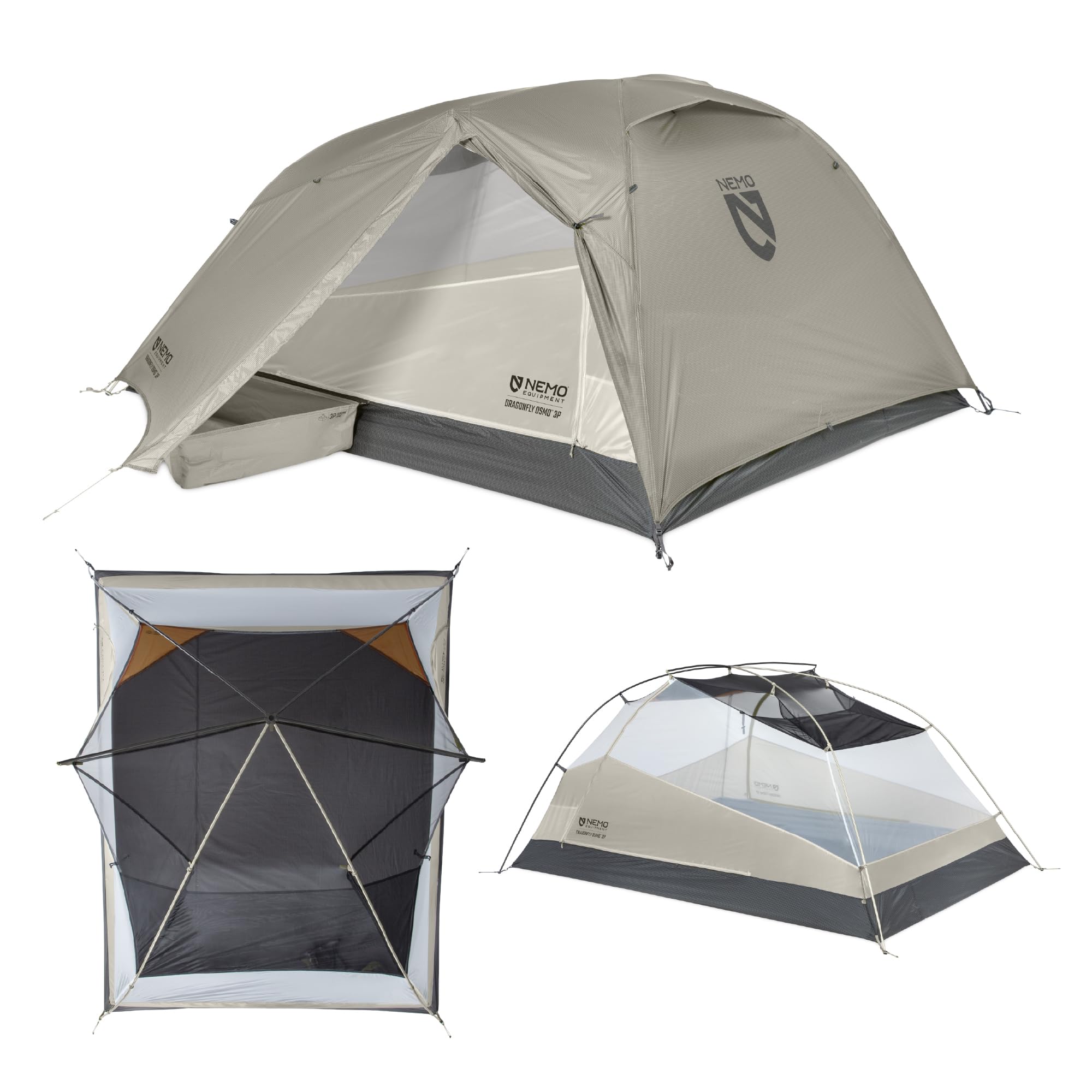
The high-performance fabric wizard that stays waterproof longer and stretches less in a downpour.
The NEMO Dragonfly OSMO 3 is built around OSMO poly-nylon ripstop fabric, which the company says has “5x longer-lasting water repellency and 3x less stretch when wet” compared to standard nylon. That means your rainfly stays taut in a soaking storm instead of sagging onto your face, and the fabric keeps beading water long after cheaper tents have soaked through. The fabric is made from 100% recycled yarns and is PFAS-free, meeting flame retardancy standards without added chemicals.
The geometry is where NEMO’s engineering stands out. The hubbed, pre-bent DIAPOLE recycled aluminum poles include a Precurve cross pole that boosts volume at the head area, so your shoulders and head have more breathing room while you sleep. The color-coded poles and matched webbing make setup completely intuitive even for first-timers. The tent includes a Divvy Cube stuff sack (a cube-shaped sack that packs evenly into your backpack), a Landing Zone storage tub for dirty boots, and a Nightlight Pocket that diffuses your headlamp for soft interior light.
Buyers call it “super nice lightweight tent — very easy to set up” and favor it as a roomy solo or duo shelter. At 3.75 pounds, it matches the MSR Freelite’s listed weight, with a more spacious-feeling interior thanks to the pre-bent pole design. The main concern from owners is durability of the ultralight materials at this price point, with one reviewer noting the tent is “very compact and light but sacrifices durability.” This is a premium investment for the gear obsessive who wants the latest fabric tech and the best livability-to-weight ratio.
Fabric innovator: The OSMO fabric is described by the brand as having longer-lasting water repellency, helping this tent shed rain reliably over time.
Price of progress: At a premium price, the ultralight materials may not survive as many seasons of heavy use as a thicker polyester tent.
Ideal for the gear enthusiast: who values the latest fabric technology, a spacious-feeling interior for its weight, and an eco-friendly build.
Not for the rough user: If your trips involve crawling over sharp rocks or you want a tent that can handle years of rental-level abuse, look at a more durably built option.
Understanding the Specs
Floor Area and Usable Shape
Floor area is the total square footage inside the tent body. But not all floor shapes are equal. A rectangular floor (like the Naturehike Cloud Up’s 116.1 x 82.7 inches) gives more usable sleeping space than a tapered or coffin-shaped floor. The actual sleeping width at shoulder level matters more than the widest point listed in specs.
Waterproof Rating (PU mm)
This number tells you how much water pressure the fabric can handle before leaking. A PU rating of 3000mm means the fabric can withstand a 3000mm column of water. For backpacking tents, 2000mm-3000mm is sufficient for moderate rain. For heavy, prolonged downpours, 5000mm on the footprint is a real safety margin. Sealed seams are just as important as the fabric coating — water always finds the stitch holes first.
FAQ
Can three adults really sleep in a 3 person backpacking tent?
What is the difference between trail weight and packed weight?
Why do some three-person tents only have one door?
How important is a footprint for a backpacking tent?
What does PU3000mm mean on a tent?
Is a double-wall tent better than a single-wall tent?
How many stakes come with a typical backpacking tent?
Can I use a 3 person backpacking tent for car camping?
What is a vestibule on a tent?
What is the best way to store a backpacking tent after a trip?
Final Thoughts: The Verdict
For the majority of shoppers, the 3 person backpacking tent winner is the Naturehike Cloud Up 3 because it delivers the longest floor in the roundup (116.1 inches) while keeping packed weight under 6.3 pounds and including a footprint — all without a premium price. If you want dual doors and a built-in awning for better livability, grab the Naturehike Mongar Upgraded 3. And for the ultralight purist who values the lowest possible pack weight over interior space, the MSR Freelite 3 is the featherweight champion at 3.75 pounds.
How We Picked
We do not accept paid placement, and we did not hands-on test every unit. Instead, we match each pick to a real buyer and use-case by comparing the manufacturers’ published specifications against the patterns in verified customer reviews — so you get each pick’s real strengths and trade-offs instead of marketing copy.
Sources & Methodology
Specifications: manufacturer listings and product documentation. Review insights: verified customer reviews, as of July 2026. Pricing: not shown on this page (it changes often); check the current price via the retailer link.
As an Amazon Associate, Gadgets Feed earns from qualifying purchases. This does not affect which products we feature.
Product prices and availability are accurate as of the date/time indicated and are subject to change. Any price and availability information displayed on Amazon at the time of purchase will apply to the purchase of this product. As an Amazon Associate I earn from qualifying purchases.
CERTAIN CONTENT THAT APPEARS ON THIS SITE COMES FROM AMAZON. THIS CONTENT IS PROVIDED "AS IS" AND IS SUBJECT TO CHANGE OR REMOVAL AT ANY TIME.
Amazon and the Amazon logo are trademarks of Amazon.com, Inc. or its affiliates.