
A 3-pound hammer sits in a curious middle ground — too light for full-swing sledge work, too heavy for a standard framing nailer. Yet for anyone who has ever tried to drive a cold chisel into concrete, seat a stubborn bearing race, or break apart a cinder block with a 16-ounce claw hammer, the 3-pound club hammer is the tool that actually finishes the job without wearing out your arm. The weight-to-control ratio is what makes this category addictive: enough mass to deliver real kinetic energy, but short enough to swing with one hand in a tight crawl space or against a vertical wall.
I’m Min — the co-founder and writer behind Gadgets Feed. For this guide I analyzed head geometries, handle materials, grip textures, and shock-dampening claims across seven distinct 3-pound hammer designs to separate genuine engineering from marketing weight.
Whether you need to demolish tile, set masonry stakes, or persuade a rusted suspension component without marring the surrounding steel, these seven models represent the current market for the best 3 pound hammer across striking, demolition, non-sparking, and dead-blow categories.
How To Choose The Best 3 Pound Hammer
Not all 3-pound hammers are interchangeable. The category includes club hammers, dead-blow hammers, brass sledge hammers, and drilling hammers — each built for a specific impact profile. Choosing the wrong one means either marring your workpiece, absorbing excess vibration in your elbow, or losing striking accuracy because the head geometry doesn’t match your task.
Head Material and Striking Face Geometry
Forged alloy steel heads deliver maximum destructive force for demolition and chisel work, but they will mark steel surfaces. Brass heads are softer than hardened steel, so they transfer force without leaving dents — essential for automotive assembly, mold work, and explosive environments where sparking is a hazard. Polyurethane dead-blow heads contain steel shot that redistributes kinetic energy for zero rebound, which is critical when striking near finished surfaces or when every missed swing could damage surrounding components.
Handle Length and Shock Isolation
A 3-pound hammer with a 9-inch handle (like the MAXPOWER) is a stubby one-handed tool for tight spaces, but requires more effort per swing because the lever arm is short. An 11-to-12-inch handle (Fiskars, Spec Ops) adds swing velocity without making the tool unwieldy. Patented vibration-control systems — Fiskars IsoCore transfers 2X less shock than wood — directly reduce fatigue over 50 strikes. For mechanics who swing repeatedly, a steel-core handle with rubber overmolding (Stanley Antivibe) transmits less vibration to the wrist and elbow.
Non-Sparking vs. General Purpose
If you work near flammable gases, fuels, or grain dust, brass hammers (C&T, Titan) are mandatory because alloy steel can generate sparks on impact. Brass is also non-magnetic, which matters when working near sensitive electronics or magnetic fixtures. For general masonry, concrete demolition, and driving stakes, forged steel heads offer higher impact energy per strike and longer edge retention.
Quick Comparison
On smaller screens, swipe sideways to see the full table.
| Model | Category | Best For | Key Spec | Amazon |
|---|---|---|---|---|
| Fiskars Pro IsoCore 3 lb Club Hammer | Club Hammer | Demolition & masonry chisel work | IsoCore shock isolation, 2X less vibration | Amazon |
| Spec Ops Tools Drilling/Crack Hammer | Drilling Hammer | Precision demolition & tethering | Refined Power Geometry head, overstrike armor | Amazon |
| Stanley Antivibe 1-56-001 | Engineer’s Hammer | Automotive & repeated striking | One-piece forged steel, ANTI-VIBE technology | Amazon |
| Capri Tools 10098 Dead Blow Hammer | Dead Blow | Non-marring striking on metal | PU head with steel shot, 10-year warranty | Amazon |
| Titan 63040 Solid Brass Hammer | Brass Hammer | Non-sparking & non-marring assembly | 15.5 inch overall, 12 inch handle | Amazon |
| MAXPOWER 3lb Club Hammer | Club Hammer | Light duty demolition & tight spaces | 9 inch fiberglass handle, 11 inch overall | Amazon |
| C&T 3lb Brass Sledge Hammer | Brass Sledge | Explosion-proof & surface protection | Drop-forged pure brass head, 15.4 inch length | Amazon |
In‑Depth Reviews
1. Fiskars Pro IsoCore 3 lb Club Hammer (11″)

The Fiskars Pro IsoCore is the most thoughtfully engineered 3-pound club hammer on the market because it solves the two problems that plague every other short-swing hammer: vibration fatigue and off-center striking. The wedged demolition head concentrates force into a narrower impact zone, delivering demolition power that feels disproportionate to the 3-pound mass — users report breaking cinder blocks and thick slate with controlled one-handed swings that would require a 6-pound sledge with a standard head.
The patented IsoCore Shock Control System is the defining feature here. Where a wood-handled club hammer transmits sharp vibrational spikes up through the wrist, the Fiskars handle absorbs 2X more shock, which translates to less pain after twenty strikes into concrete or stone. The extra-large diameter driving face also drastically improves accuracy when driving masonry nails or cold chisels — the wider target area reduces glancing blows that typically chip the striking face of a chisel head.
Blacksmiths have even adapted this hammer for light forging after minor surface modifications, which speaks to the steel quality and balanced weight distribution. The head is forged alloy steel with a straight head geometry that works equally well for demolition and driving. Fiskars backs it with a full lifetime warranty, which is rare at this price point and indicates confidence in the fiberglass-reinforced handle bonding.
Why it’s great
- Wedged demolition head concentrates force for 5X more destructive power per swing
- IsoCore system transfers 2X less shock than wood-handled hammers
- Extra-large driving face reduces miss-strikes when hammering chisels
Good to know
- Handle length is 11 inches — longer than a stubby club hammer, which may feel large for glove box storage
- Steel head will mar finished surfaces; not suited for non-marring work on exposed metal
2. Spec Ops Tools Drilling/Crack Hammer, 3 lbs

The Spec Ops Tools drilling hammer punches well above its price bracket by incorporating design elements usually reserved for premium demolition tools. The RPG (Refined Power Geometry) head uses a contoured striking profile that directs energy forward rather than dispersing it across a flat face — this results in cleaner breaks through tile, thin concrete, and brick without the head bouncing off target. The Flat Dark Earth and black aesthetic is tactical-inspired, but the real story is the bi-material shock-absorbing grip that deadens vibration effectively enough for all-day use on demolition sites.
Where this hammer differentiates itself is the integrated composite overstrike armor that wraps the handle base. Most club hammer failures happen when a missed swing hits the handle against a hard edge — the overstrike armor doubles handle durability in that scenario. The included soft mallet cap adds versatility by converting the steel striking face into a non-marring surface for automotive or furniture assembly, effectively giving you two hammers in one tool. The overall length is just 10.62 inches, making it one of the most compact 3-pound options for confined workspaces.
Spec Ops also donates 3% of proceeds to veteran and first responder causes, which adds a philanthropic angle. Users report the grip performs well even in wet conditions, and the hammer is compatible with SRS retention lanyards for tethering at height — a niche but important feature for roofing or scaffolding work where dropping a tool is dangerous.
Why it’s great
- RPG head geometry improves striking energy transfer over flat-faced designs
- Overstrike armor protects handle from impact damage on missed swings
- Soft mallet cap provides non-marring option without buying a second hammer
Good to know
- Some users find the 10.62 inch handle slightly short for maximum swing leverage
- Durability over heavy commercial use is still unproven — relatively new product
3. Stanley Antivibe 1-56-001 Hammer, 2.99 lbs

The Stanley Antivibe is a direct descendant of the Mac Tools truck hammer at nearly half the price — professional mechanics have been cross-shopping these for years. The one-piece forged construction means the head and handle are a single continuous piece of alloy steel, eliminating the single most common failure point of club hammers: the head-handle connection. This also means the hammer has zero flex, so every joule of energy from your swing transfers directly into the workpiece without loss to handle deflection.
Stanley uses a tuned rubber grip sleeve that decouples the steel handle from your hand, dampening high-frequency vibration that causes fatigue and joint stress during repetitive striking. For mechanics seating brake rotors, driving bearing races, or persuading seized suspension bolts, this makes a noticeable difference after 30 to 40 strikes — your hand doesn’t go numb. The 2.99-pound weight is technically under 3 pounds, but the forged steel head has a dense feel that strikes with authority despite the 0.01-pound difference.
This hammer is specifically designed for automotive and mechanical work, not masonry or demolition. The flat steel head will mar painted surfaces, but mechanics appreciate that the weight is concentrated in a compact head profile that fits between tight engine bay components. The black rubber grip is ergonomic and slip-resistant even when covered in oil or brake cleaner, though some users note it can feel slick without gloves.
Why it’s great
- One-piece forged steel construction — head cannot separate from handle
- ANTI-VIBE grip reduces vibration transfer to wrist and elbow significantly
- Identical design to Mac Tools branded hammer at half the cost
Good to know
- 2.99 lbs is technically under 3 lbs; some users expect a full 3 lb head
- Steel face will mark and dent softer metals; not for non-marring applications
4. Capri Tools 10098 Dead Blow Hammer, 3 lb

The Capri Tools dead blow hammer fills a specific gap that steel-faced hammers cannot touch: striking hardened surfaces without bouncing back at your face. The orange polyurethane head is filled with steel shot that shifts forward on impact, extending the contact duration and absorbing the rebound energy that makes standard hammers dangerous on hardened steel. For machinists seating workpieces in a vise, mechanics knocking brake rotors loose, or carpenters persuading tight joinery, the dead blow action means the hammer stays where it lands instead of kicking back.
The advanced polyurethane material is a significant upgrade over the rawhide and rubber dead blow heads of the past. PU does not absorb oil, water, or solvents, so the head weight remains consistent even after exposure to shop chemicals. The handle contains a reinforced steel core that prevents the hammer from snapping at the neck on high-force impacts — a critical safety feature because dead blow heads are often swung with maximum force to overcome the inherent energy absorption of the shot-filled design. Capri backs this with a 10-year warranty, which suggests confidence in the PU-to-steel bond.
Users note that the round grip feels ergonomic but can be slippery when hands are oily, with some adding tape or gloves for a more secure hold. The dead blow effect requires a committed swing — light taps produce less energy transfer than you’d get from a steel hammer of the same weight, so this tool rewards firm, deliberate strikes rather than tentative taps. For automotive use, the non-marring head is essential when hitting suspension components near painted surfaces or aluminum parts.
Why it’s great
- Steel shot filling eliminates rebound for safer striking on hardened surfaces
- Polyurethane head does not mar or dent workpiece surfaces
- Steel core in handle prevents catastrophic failure at the neck
Good to know
- Round grip can feel slippery without gloves or added tape
- Dead blow design absorbs some impact energy; requires harder swings than steel
5. Titan 63040 3lb Solid Brass Hammer

The Titan 63040 is the brass hammer that mechanics and machinists reach for when they need to hit something hard without damaging it or causing a spark. The solid brass head is softer than hardened steel, so when you strike a bearing race, a threaded shaft, or a mold insert, the brass deforms microscopically instead of the steel workpiece — this prevents galling, burring, and surface marring that would ruin precision components. The 15.5-inch overall length with a 12-inch handle gives this brass hammer a longer swing arc than typical club hammers, which helps compensate for the fact that brass is less dense than steel and delivers slightly less impact force per swing.
The fiberglass handle is protected by an impact-resistant poly jacket that prevents splintering if the handle strikes a hard edge. The textured grip is contoured to prevent hand slippage during overhead or angled swings, which is important because brass hammers are often used in awkward positions inside engine bays or machinery housings. The handle-to-head bond uses permanent epoxy that will not loosen over time, eliminating the rattle that develops on mechanically fastened hammers after extended use.
For automotive enthusiasts working on vintage vehicles, the non-sparking property is a serious safety advantage when striking near fuel lines, battery terminals, or in engine compartments where fuel vapors may be present. Users specifically cite using this hammer on Land Cruisers, 2A-related fabrication work, and general shop iron applications without marring threads or finishes. The brass face does show wear after repeated use — that is expected and indicates the brass is sacrificing itself to protect your workpiece.
Why it’s great
- Solid brass head prevents sparking in volatile environments
- Non-marring surface protects steel and iron workpieces from damage
- 12-inch handle provides better swing leverage than stubby club hammers
Good to know
- Brass is softer than steel; striking face will show wear over time
- Lower density than steel means less kinetic energy per swing at same weight
6. MAXPOWER 3lb Club Hammer, Small Sledge
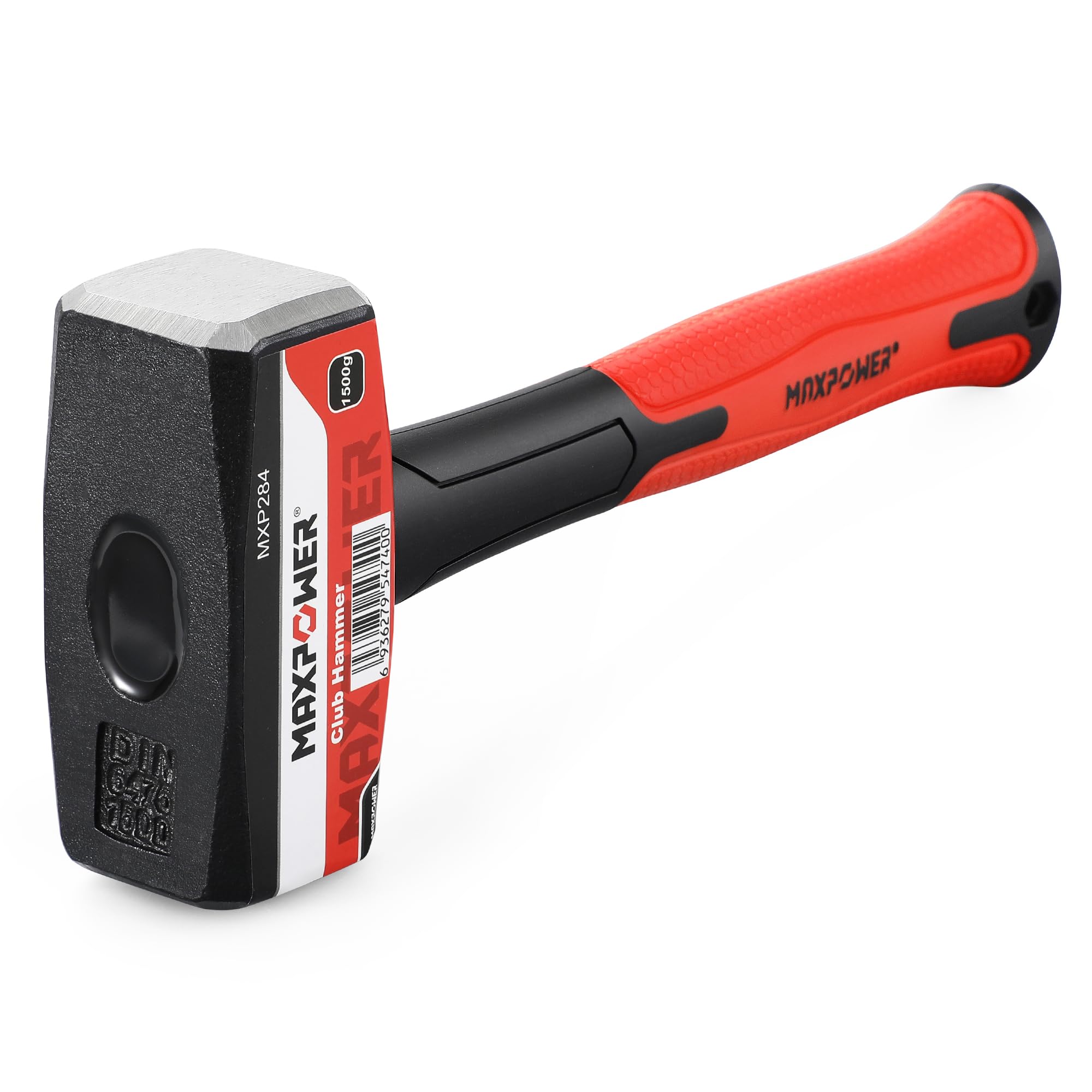
The MAXPOWER 3lb club hammer is the shortest option in this comparison at only 11 inches overall with a 9-inch handle, making it the clear choice for anyone working in crawl spaces, behind appliances, or inside wall cavities where a normal hammer swing is physically impossible. The drop-forged steel head has smooth-ground double striking faces and a corrosion-resistant surface finish, and the head dimensions (4.3 x 1.8 x 1.8 inches) pack the 3-pound weight into a compact profile that can reach into tight corners. The total tool weight comes to 3.5 pounds including the handle, so the head-to-total weight ratio is excellent — almost all the mass is in the striking end.
The fiberglass handle is wrapped with an anti-slip textured rubber grip that absorbs a reasonable amount of shock, though it lacks the sophisticated vibration damping of the Fiskars or Stanley. For light-duty demolition — driving masonry nails, setting tent stakes, light chisel work — the shorter handle actually improves control because there is less leverage to manage. Users report using it effectively for stone masonry, garden posts, and even driving 6-inch spikes through half-logs into framing, which speaks to the head’s durability under repeated heavy strikes.
A note on quality control: one user reported that one striking face caused their chisel to bounce to the right while the opposite face struck true. This suggests the head might not be perfectly symmetrical from face to face, which is disappointing at this price point. However, the majority of users rate it 5 stars for durability and value, and for occasional use or as a dedicated truck tool, the compact size and low weight make it worth considering.
Why it’s great
- 9-inch handle is the most compact option for confined workspace striking
- Drop forged steel head with double striking faces for extended service life
- Excellent head-to-total weight ratio — dense striking mass in small package
Good to know
- Some quality control variation in striking face symmetry reported
- Short handle reduces swing velocity compared to longer club hammers
7. C&T 3lb Brass Sledge Hammer

The C&T brass sledge hammer is the entry-level non-sparking option that makes brass-head striking accessible without the premium price of the Titan. The drop-forged pure brass head delivers the same fundamental advantage as the more expensive brass options — it reduces sparking risk in hazardous environments and prevents marring on hardened steel surfaces — but at a noticeably lower build cost. The 15.4-inch overall length with a fiberglass handle puts it in the same ergonomic class as the Titan, with a textured grip that provides adequate slip resistance for most shop tasks.
The handle construction uses a permanent epoxy bond between the brass head and the fiberglass core, which should prevent loosening over time. The high-strength fiberglass handle is protected by an impact-resistant poly jacket, though the jacket feels less substantial than the overstrike armor on the Spec Ops hammer. For light to medium striking tasks — seating mold components, automotive assembly, chasing tools — the C&T performs adequately. The brass material is corrosion-resistant and non-magnetic, which is important for work near sensitive electronics or magnetic holding fixtures.
Bargain hunters should be aware that the “3 lb” claim refers specifically to the head weight, and the overall tool weight will be approximately 3.5 to 4 pounds depending on handle density. Some users note that the brass face develops visible wear patterns faster than expected, but this is inherent to the material choice — brass is meant to sacrifice itself. For occasional use in non-sparking environments or as a dedicated soft-face hammer for home mechanics, the C&T delivers the essential function at a budget-friendly price point.
Why it’s great
- Drop-forged pure brass head prevents sparking and workpiece marring
- Non-magnetic construction safe for electronics and magnetic fixture work
- Epoxy-bonded handle head will not loosen with use
Good to know
- Brass striking face will show wear and deformation faster than steel
- Build quality feels less refined than the Titan brass equivalent
FAQ
Can a 3-pound hammer replace a standard 16-ounce claw hammer for framing?
Why would I choose a dead blow hammer over a steel hammer for automotive work?
Is a brass 3-pound hammer heavy enough for non-sparking demolition?
How do I maintain the striking face of a brass 3-pound hammer?
Final Thoughts: The Verdict
For most users, the best 3 pound hammer winner is the Fiskars Pro IsoCore 3 lb Club Hammer because its wedged demolition head and IsoCore shock control system deliver the highest destructive power-per-swing while minimizing arm fatigue across dozens of strikes. If you need a non-marring, zero-rebound hammer for automotive or machinist work, grab the Capri Tools 10098 Dead Blow Hammer. And for non-sparking environments where safety regulations demand brass striking surfaces, nothing beats the Titan 63040 Solid Brass Hammer.