
Our readers keep the lights on and my morning glass full of iced black tea. As an Amazon Associate, I earn from qualifying purchases.
Specs are compiled from manufacturer listings and verified buyer reviews and can change over time — please confirm the key details on the product page before buying.
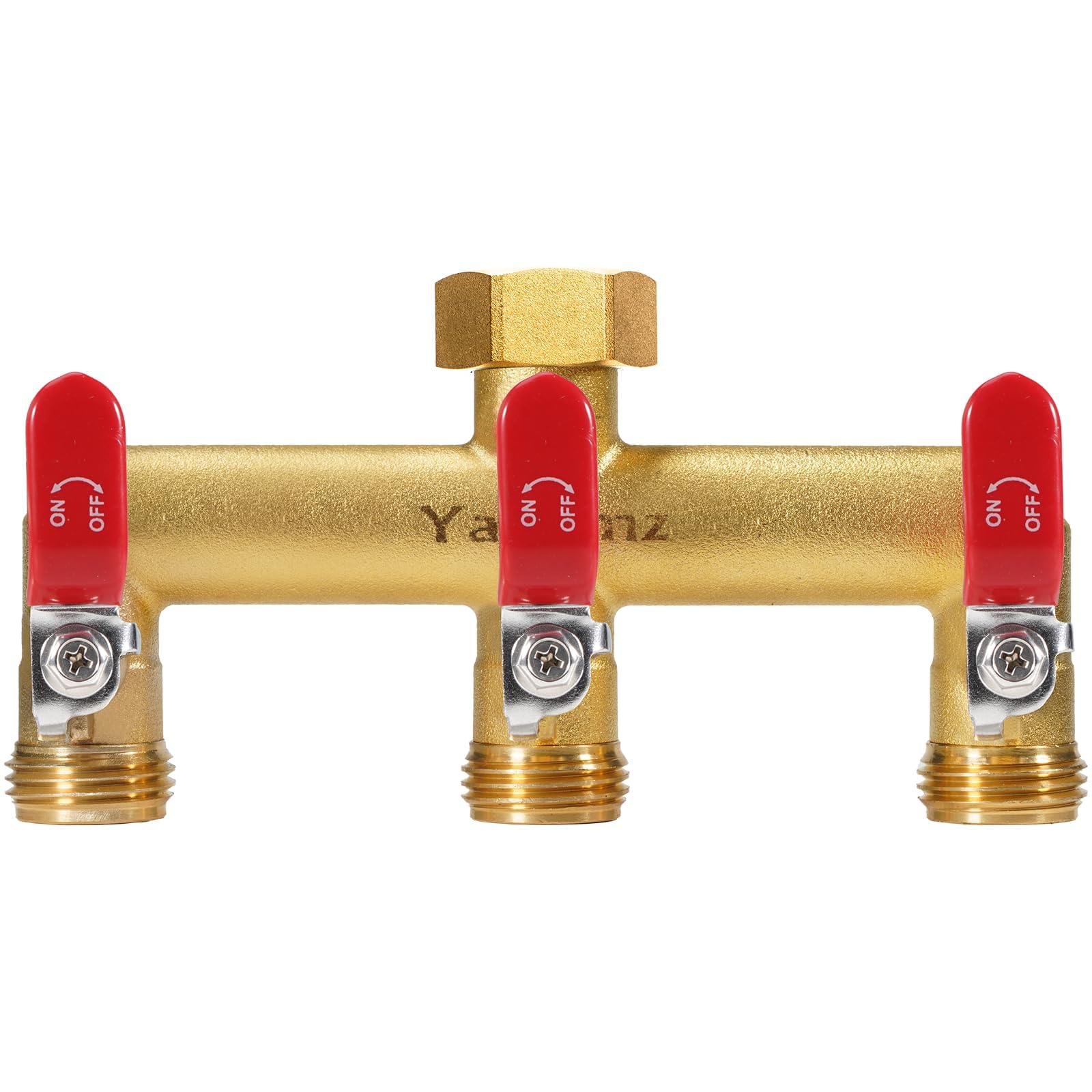
A three-way water valve is a splitter that turns one water outlet into three you can control separately. The point is simple: water where you want it, when you want it, without swapping hoses by hand. The Yayamz 3 Way Garden Hose Splitter is the one most buyers land on — a solid brass unit owners repeatedly praise for sealing tight and turning easily.
I’m Min — the founder and writer behind Gadgets Feed. This guide is built by comparing the manufacturers’ published specifications and the patterns across verified customer reviews, so you get each pick’s real strengths and trade-offs instead of marketing spin.
Below you’ll find the splitter that suits a backyard tap, the stainless T-port valve that suits a boat or a drain line, and the CPVC pool valves that glue straight into existing plumbing. There’s no single universal answer — the right pick depends on whether you’re threading onto a garden hose or solvent-welding into a pool line.
Our Picks at a Glance


How To Choose The Best 3 Way Water Valve
Not every three-way valve is built for the same job. A backyard splitter that threads onto a hose bib, a stainless T-port valve that plumbs into a saltwater suction line, and a CPVC pool diverter all share the “three-way” label but live in completely different worlds. The trick is knowing which one fits your setup before you buy.
Match the Thread to the Job, Not the Picture
The single most common mistake is buying the right valve with the wrong thread. A garden hose splitter uses GHT (Garden Hose Thread) — the standard coarse thread every US outdoor spigot and hose end uses. A plumbed-in valve uses NPT (National Pipe Tapered), a straight pipe thread that needs tape and a wrench to seal. Force an NPT valve onto a garden spigot and water escapes at the join, no matter how hard you tighten.
Look at What’s Inside the Valve
A valve with a wide, unobstructed internal bore (“full port”) passes water at a much higher rate than a narrow one. If you’re running a pressure washer, filling a stock trough, or pushing a sprinkler across a big lawn, internal port size determines whether your flow drops the moment you split the line. A restricted inside port visibly slows the flow your pressure washer or sprinkler was built to deliver.
Handles Are Not a Decoration
You’ll turn these valves standing in wet grass with stiff fingers, gloves, or both. A short plastic lever is hard to grab; a longer metal handle with a rubber grip is genuinely easier to rotate — especially as it ages and the seals start to stiffen. Look for a handle long enough to grab with three gloved fingers and still turn.
Spacing Between Outlets
If you plan to run a bulky hose timer, a nozzle, or a pressure washer fitting on one outlet, the gap between the outlet ports matters. Two outlets sitting close together leave no room for chunky fittings to sit side by side. Wider spacing lets two bulky hose timers sit side by side without clashing.
Quick Comparison
| Model | Best For | Body Material | Connection | Rated Pressure | Amazon |
|---|---|---|---|---|---|
| Yayamz 3 Way Garden Hose Splitter★ Best Overall | Everyday outdoor spigot splitting | Brass | 3/4 in male thread | 1.6 MPa working | Amazon |
| DERNORD 3-Way Ball Valve, T PortTop Performer | Plumbed lines needing a T-port valve | Stainless Steel 304 | 3/4 in female NPT | 1000 psi | Amazon |
| EBH Brass Garden Hose SplitterWidest Outlet Gap | Running bulky timers on wide outlets | Brass | 3/4 in threaded | — | Amazon |
| HammerHead Showers 3 Way Shower Diverter | Running two shower heads off one arm | Brass | 1/2 in threaded | — | Amazon |
| LNEZCDB 3 Way Hose Splitter | Max flow to sprinklers and pressure washers | Brass (C38500) | 3/4 in GHT | 2.4 MPa tested | Amazon |
| FibroPool 3-Way Pool Diverter Valve | Pool heater and salt-system plumbing | CPVC | 2 in slip | — | Amazon |
| Restmo 3 Way Garden Hose Splitter | High-pressure taps and RV hookups | Metal with brass fittings | 3/4 in GHT | 840 psi max | Amazon |
| RAINPOINT 3 Way Hose Splitter | Long-life outdoor use with frequent cycling | Zinc alloy with TPR | 3/4 in GHT | — | Amazon |
| Hayward PSV3S2 CPVC 3-Way Diverter | Pool heater bypass and flow balancing | CPVC | 1 in PVC | 50 psi | Amazon |
In‑Depth Reviews
1. Yayamz 3 Way Garden Hose Splitter
Our pick — over 4.5★ from 650+ verified ratings; the strongest balance of quality and price.
The brass hub that shrugs off hard water, UV, and cold snaps — and still turns freely after a winter outside.
If your outdoor spigot feeds more than one hose, this is the one most buyers land on. It’s a solid brass body rated for temperatures from -4°F to 176°F and a working pressure of 1.6 MPa, paired with a hexagonal inlet nut that adds 0.35 ounces of brass over the older version. That extra mass is why the thread seats firmly and why the whole unit keeps its shape after a hot summer.
What wins people over is durability, then leak-free sealing right behind it. The metal handle is 2 inches long and 0.5 inches wide — large enough to turn with a gloved hand — and the outlet ports sit 1.77 inches apart, which is where this model separates from the wider EBH. Owners describe paddle arms that allow precise flow control down to a trickle, and fittings that stay watertight season after season. Its UV resistance matters if your tap faces south all year.
The honest catch: the outlet gap is 1.77 inches, versus the EBH’s 2.95 inches. If you plan to run two chunky hose timers side by side, that narrower gap is the one thing to weigh — everything else about this unit punches above its tier.
What Holds Up
- Solid brass construction rated to 1.6 MPa working pressure and the -4°F to 176°F temperature range
- 2 in by 0.5 in metal handle turns easily even with gloves on
- 0.35 oz of extra brass on the hexagonal inlet nut for a secure thread seat
- Vertical outlet design keeps connections in line with the pipe for a longer service life
Where It Falls Short
- Outlet spacing is narrower at 1.77 in than the EBH’s 2.95 in
- The colorway (Red/Gold) isn’t for everyone
- Lacks a 360° swivel, so the whole body turns when you tighten the inlet
Top pick for: The standard outdoor spigot that needs one tap turned into three with faultless sealing.
Think twice if: You’re running two bulky hose timers side by side — the EBH’s wider 2.95 in spacing is the better call there.
2. DERNORD 3-Way Ball Valve, T Port, Stainless Steel 304
A stainless T-port valve for plumbed lines — the only style where you can truly choose your flow path.
This is a completely different animal from the garden splitters above. It’s a stainless steel 304 body with 3/4-inch female NPT ports, designed to thread into pipe rather than clip onto a hose. The T-port configuration means you can send water in more than one direction from a single inlet — the reason it’s the go-to for winterizing a boat, draining a water heater, or isolating a salt-water suction line.
What’s most-discussed here is quality, followed closely by functionality. Buyers install it at the water heater for drain-outs, up on a boat for salt-water winterizing, and inside resin tanks as a splitter — and it does those jobs without fuss. The fluid temp range is -20°F to 410°F and it holds up to 1000 psi, so it works in hot and high-pressure service where a soft-metal valve wouldn’t.
Here’s the caveat you need before you buy: the internal porting runs one size smaller than the fittings. On a 1-inch valve you’ll find 3/4-inch inside ports, and that internal restriction is why it isn’t the valve for high-volume flow. It’s a fit-for-purpose issue, not a defect — the valve itself is a good one.
Porting caveat: The internal port restriction is real — that’s the trade-off every buyer should know before ordering.
Versatility note: The T-port path is genuinely rare. Owners specifically flag it as the only T-port 3-way they could find.
Right for: Plumbed installations where you need a single valve to switch between two or three output lines — boats, water heaters, and industrial loops.
Not for: A garden spigot. This needs a threaded pipe connection, not a hose connection.
3. EBH Brass Garden Hose Splitter
The widest outlet gap on the list — built for the buyers running chunky hose timers side by side.
Where the Yayamz above packs neatly against the wall, this EBH spreads out. The distance between spouts is 2.95 inches — nearly an inch and a half wider than the Yayamz’s 1.77. That gap exists for a reason: large timers, sprinkler heads and pressure-washer fittings all need clearance, and this is the model that gives it to them.
The brass body here weighs 1.3 pounds, and both outlet male threads are enlarged to 0.43 inch to pass more water. Owners mostly praise the durability, then the practical daily functionality. The connection is a standard 3/4-inch thread that fits most US garden hoses and outdoor faucets — the size you’ll find on all but the odd metric outlier.
Worth knowing: the leak-proof score is mixed in owner feedback, so pay attention to thread tape and don’t overtighten. That’s the trade-off of an enlarged thread — it seats differently than a standard one. Nothing here is fragile, but treat the extra thread with the respect a fresh fitting deserves.
Spacing payoff: If you plan to run multiple timers or chunky outdoor fittings, the 2.95 in outlet gap is the whole reason to pick this over the smaller Yayamz.
Body heft: 1.3 pounds of brass — noticeably heavier than 1.1 lb models, which is weight you feel in the hand but never in the installation.
Choose this if: Your outdoor setup involves a hose timer or any bulky fitting that needs elbow room next to the outlet.
skip it if: You need the smallest possible body — this one takes up more room against the wall than a compact splitter.
4. HammerHead Showers Solid Metal 3 Way Shower Diverter Valve
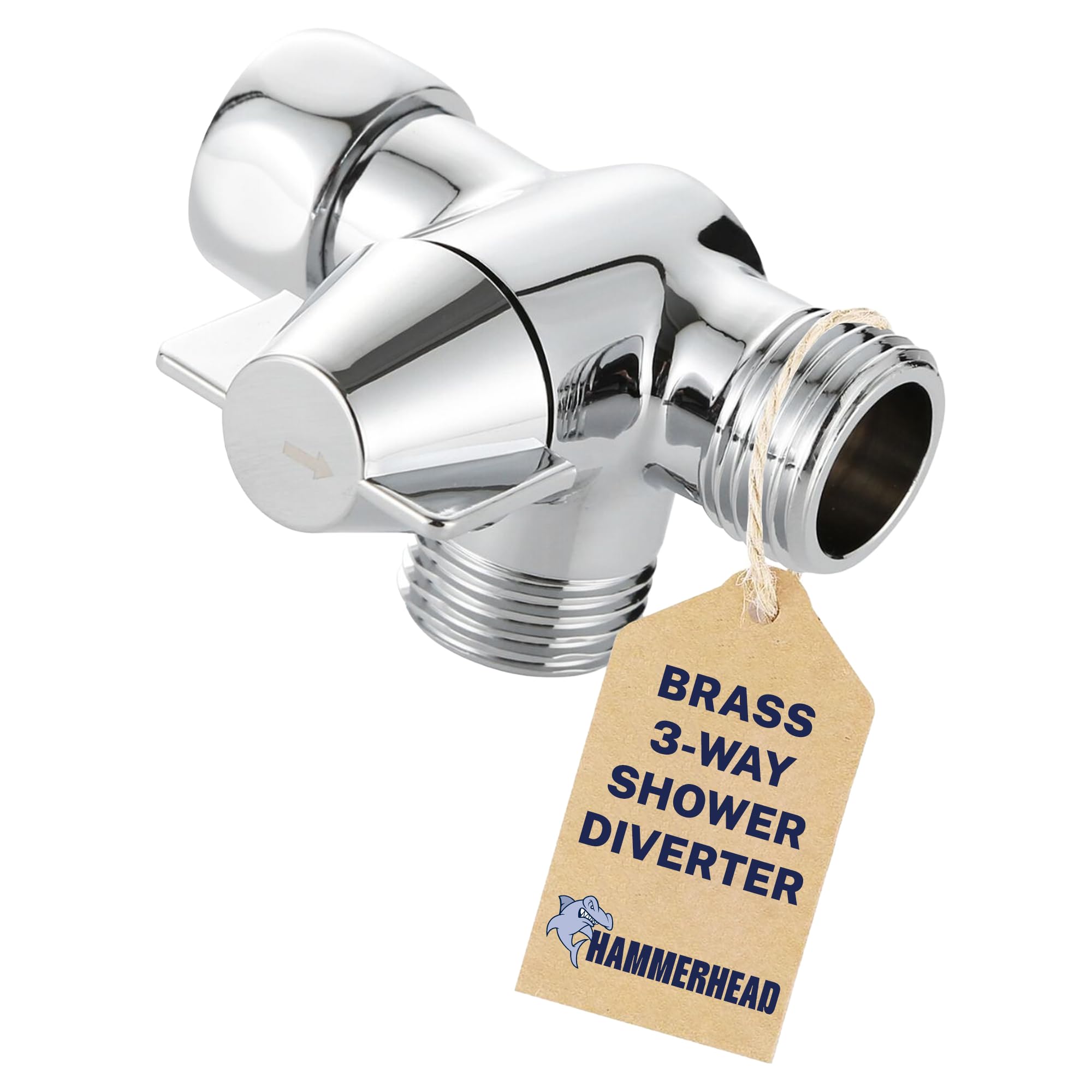
A solid brass shower diverter that lets you run a fixed head, a handheld head, or both at once — no plumbing experience needed.
This one lives on your shower arm, not on a garden spigot. It replaces the push-pull diverter you may already have (the one that starts sticking after a year) with a twist-knob that switches water between a fixed shower head, a handheld head, or both simultaneously. The 1/2-inch threaded connection fits a standard shower arm and both outlet ports are also 1/2 inch, so the two shower heads attach directly.
The reason buyers reach for this is dual flow — the shower head valve has no flow restrictor, and wide internal ports deliver up to 2.5 GPM through each attachment. That means running two heads at once doesn’t starve either one. The build is all brass, with a chrome or brushed nickel finish that suits a modern bathroom. The knob is genuinely comfortable to turn, and installation takes minutes with just the included tape and instructions.
The honest note here: water pressure feedback is mixed. Some buyers see a genuine improvement over their old diverter, while others find the flow feels more restricted than expected. The X-factor is usually the upstream pressure in the house — the valve itself is not the limiting component. Also, the direction arrows on the knob aren’t always intuitive, so match them to your setup before you seal the thread.
Ticks the Boxes
- Solid brass body — not a plastic diverter that ages badly
- 2.5 GPM unrestricted flow through each attachment
- Runs fixed head, handheld, or both at the same time
- Installs in minutes with tape and instructions included
Watch For
- Direction arrows on the knob are inconsistent — check before taping
- Mixed reports on water pressure — house pressure plays a big role
- Chrome finish shows water spots more than brushed nickel
Best for: Anyone replacing an old push-pull diverter who wants a brass unit that runs two shower heads from one arm.
Look elsewhere if: You have low household water pressure to begin with — this valve keeps flow open, but it can’t create pressure that isn’t there.
5. LNEZCDB 3 Way Hose Splitter Heavy Duty Full Flow
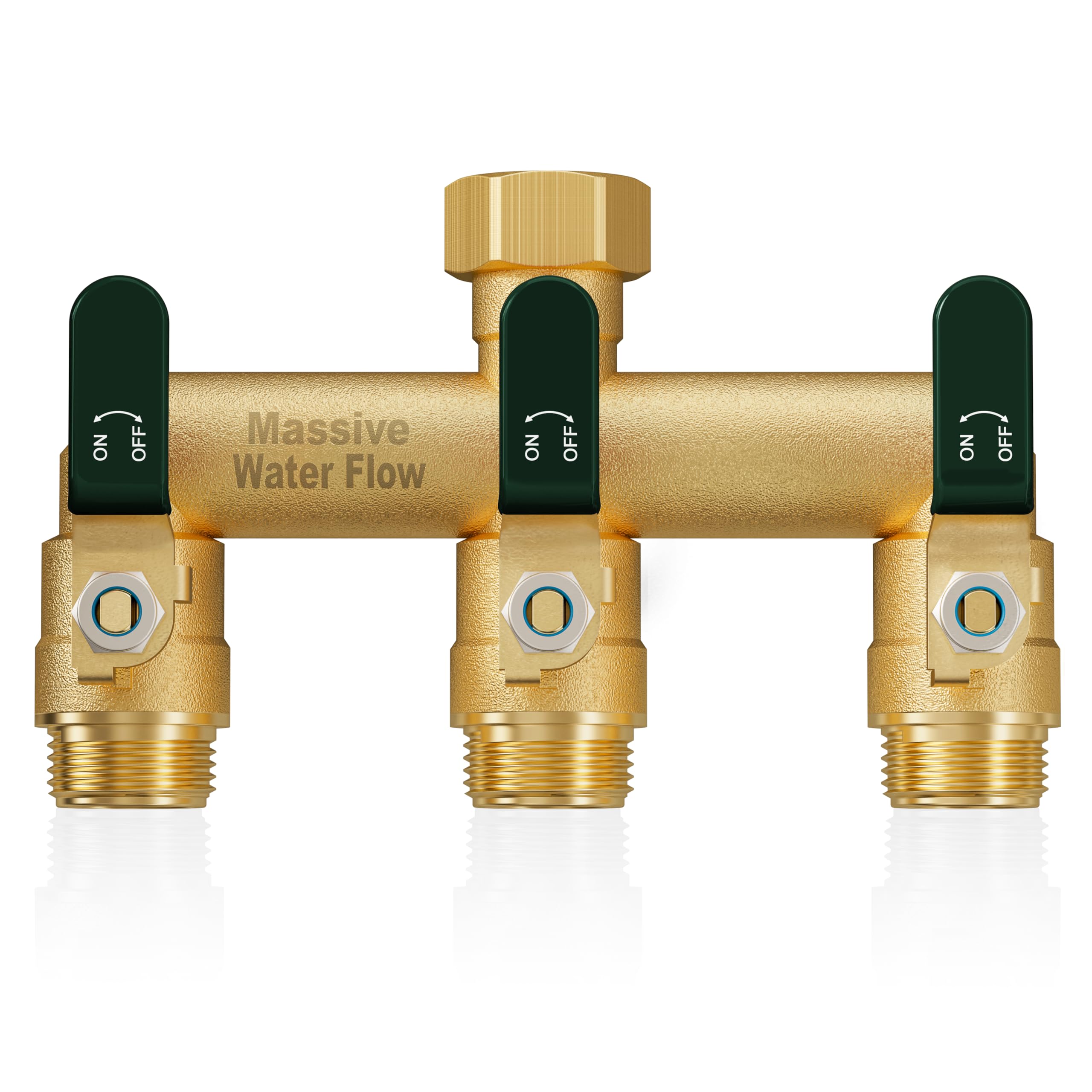
A 1.52-liter-per-second full-port splitter that keeps pressure washer lines fully fed.
If flow matters more than anything else to you, this is the splitter to look at first. It’s cast from C38500 brass with a 0.6-inch inner diameter and a 0.59-inch large ball valve to let water through unobstructed. The flow rating is 1.52 liters per second, and the body has been tested at 2.4 MPa — numbers designed to hold up under constant service on a working garden or small farm.
The long 2.1-inch metal handle with a curved grip is the standout ergonomic feature here. It’s meant for turning with gloved or stiff hands, and the 1.6-inch outlet spacing leaves room for large timers and sprinkler fittings. The vertical 90° male thread reduces the gravitational pull on the connector, which is a small design choice that quietly adds years to the life of the thread and washer.
The one thing to plan around: this valve is not built for a light indoor tap. It weighs 1.52 pounds and takes up real estate outdoors — it shines on a hose bib that sees hard use, but there’s a reason it’s heavier than the standard splitter. It’s also important to drain the unit in freezing weather; the temperature rating goes down to -40°F for the metal itself, but ice expansion will damage any valve.
Where it earns its keep: The 0.59 in ball valve and 0.6 in inner diameter are the reason it can feed a pressure washer or sprinkler at full flow without a pressure drop.
Handle design: At 2.1 in, the curved handle is one of the longer levers on any splitter here — useful when hands are cold or gloved.
Best fit: Pressure-washer setups, sprinkler lines, and any application where every drop of flow matters from the spigot to the tip.
Consider another if: You want a small, lightweight splitter for occasional watering — this unit prioritizes flow and durability over compactness.
6. FibroPool 3-Way Pool Diverter Valve
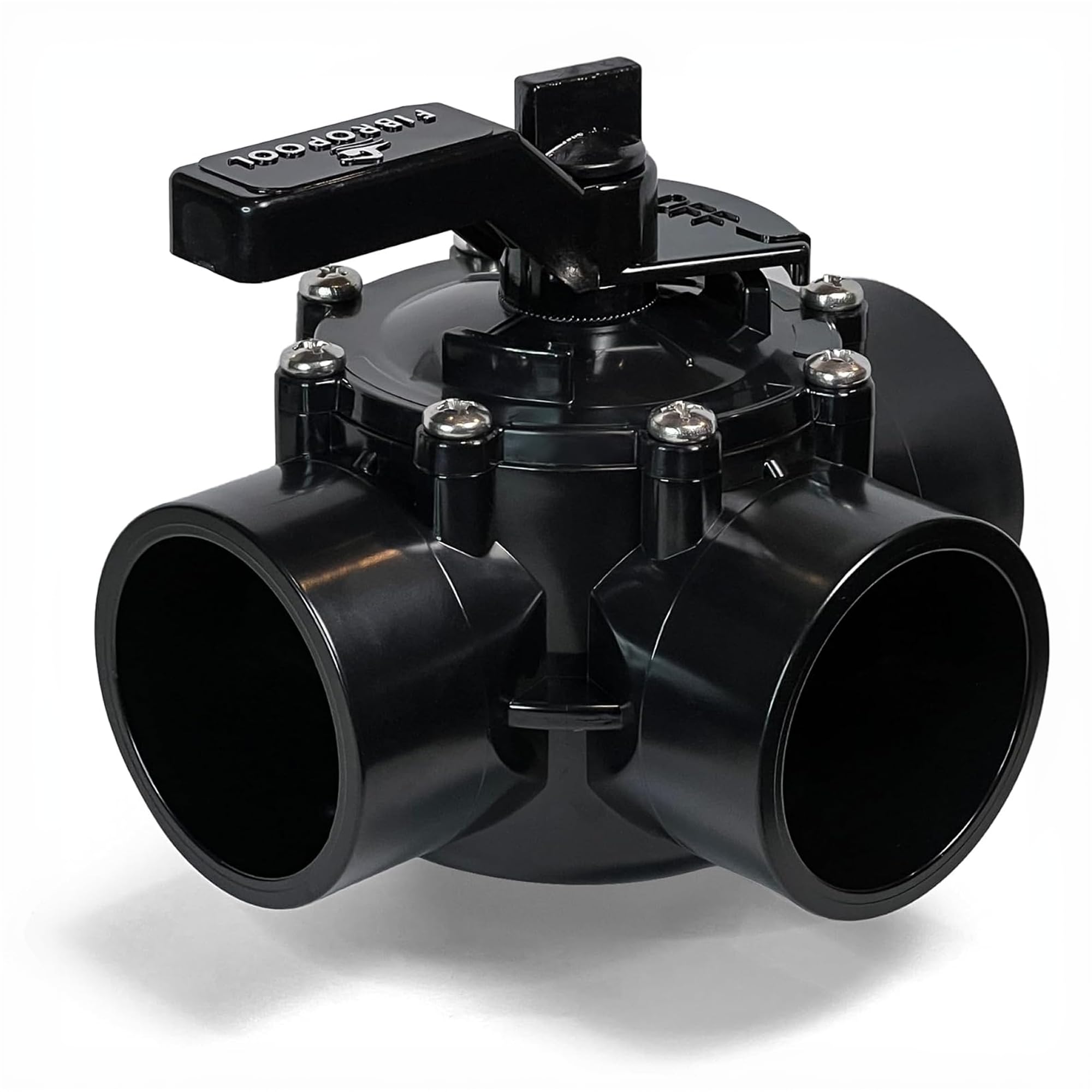
The pool plumber’s valve — 2-inch slip ports that glue straight into existing CPVC plumbing without a single adapter.
This one is not for a garden spigot. The FibroPool is a true pool diverter — it has 2-inch slip ports, meaning the pipe glues directly into the housing for a permanently sealed joint. The CPVC body resists pool chemicals and pool water temperatures, and the PTFE (self-lubricating) seats mean the handle turns smoothly without ever needing to be greased.
The functionality is what pool owners care about, and this valve gets it. Owners install it as heater bypasses, as waste valves on pump assemblies, and as replacements for the classic Jandy 3-ways — often with the note that it saves real space on a crowded equipment pad by replacing a T-junction plus two separate ball valves. The TEE configuration means your inlet is centered and flow divides left and right; the dial handle has a visible indicator of which way the ball is turned.
A couple of setup details worth knowing before you cut pipe. The handle ships with a tab that needs to be snipped if you want the dial to rotate around the full 180° — otherwise the third port may suck air, which is what one buyer dealt with. And installing the body with the closed position facing the rounded no-outlet side instead of the inlet is a mistake owners have corrected by pulling the 8 to 10 body bolts and re-seating. Both are setup problems, not valve failures.
Pool-Ready Features
- 2 in slip ports glue directly into standard pool plumbing
- CPVC body handles pool chemicals and swimming-pool temperatures
- PTFE self-lubricating seats need no grease and stay smooth
- TEE configuration replaces a T-junction plus two ball valves on a tight equipment pad
Installation Notes
- Handle may need the tab snipped to allow full rotation
- Body orientation must be checked before gluing — closed side faces the inlet, not the rounded side
- Some units have arrived with a cracked locking set screw; check before install
Right call for: Pool owners plumbing a heater bypass, a salt cell feed, or a waste line who want one diverter instead of three fittings.
Not for: Anyone working with a hose or faucet — this valve is solvent-welded into pipe, not threaded on.
7. Restmo 3 Way Garden Hose Splitter Heavy Duty 100% Metal Body
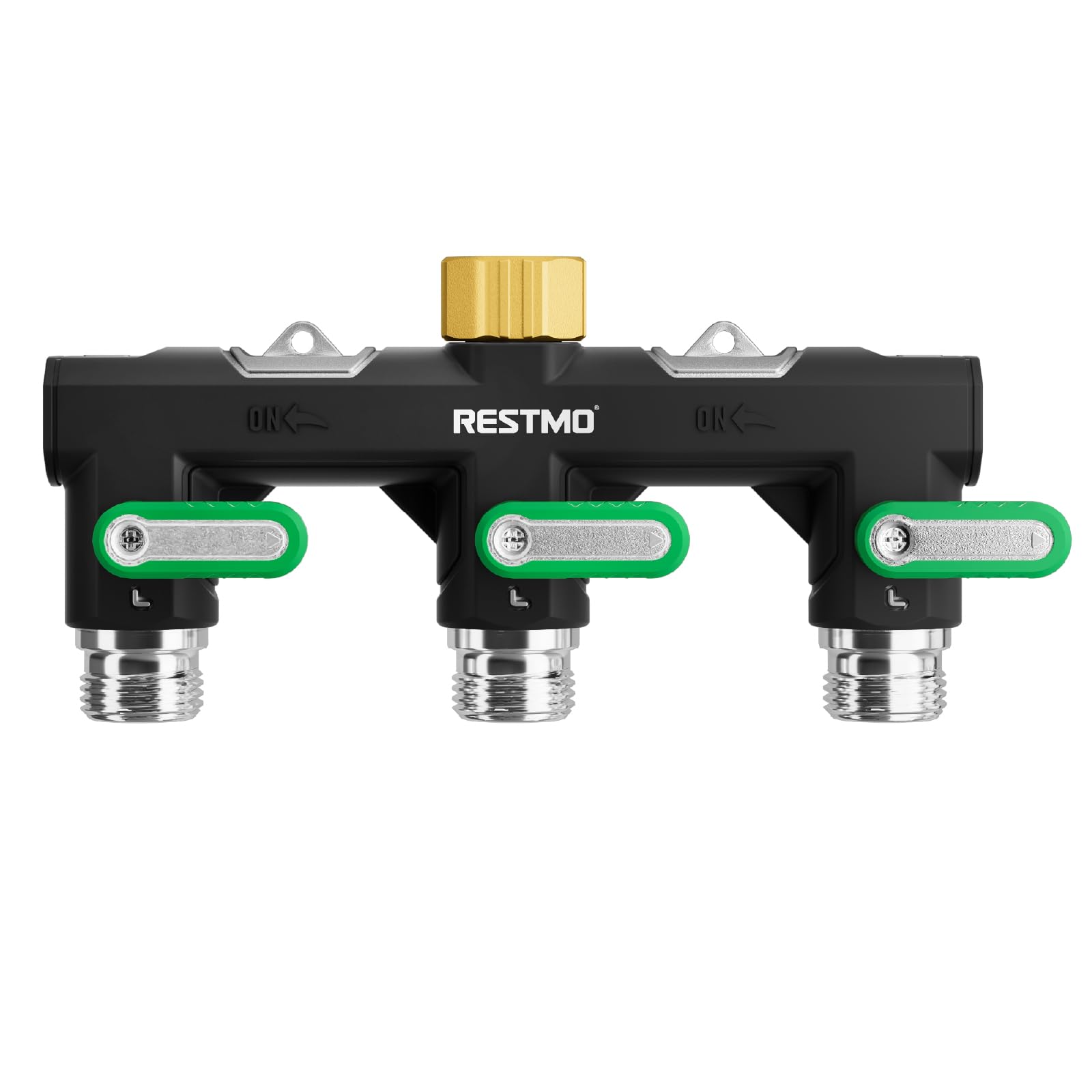
A one-piece metal body with a 360° swivel inlet — made for the strongest water pressures on the block.
The Restmo is the splitter you want if your tap runs at strong pressure. It’s built from a single-piece heavy-duty metal body with brass fittings and is rated for a maximum water pressure of 840 psi. The 0.52-inch stainless steel ball valves are wide full-port, tested to deliver up to 38 GPM at 200 PSI — enough to keep multiple sprinklers or a car-wash nozzle flowing without a pressure drop.
The 360° swivel inlet is a genuinely useful feature that the Yayamz and most competitors lack. It prevents the hose from kinking as you move around the yard and stops the “everything turns when I tighten the inlet” problem. The 1.77-inch extended handles are easy to grab with wet hands or gloves, and the body is wrapped in a thick TPR rubber coating that resists UV, weathering, and small impacts.
Two things to plan for. This is cold-water only — no hot water lines. And the body runs heavier (1.79 pounds) than the entry-level brass splitters, so if you’re mounting to thin hose bibs, use one hand for support. Otherwise the quality of the build is well in step with the price point.
Swivel payoff: The 360° rotating brass inlet genuinely prevents kinks — a real upgrade over the fixed-inlet splitters above.
Cold water only: The 840 psi rating and TPR coating suit outdoor garden use; don’t run this on a hot-water line.
Reach for this if: You have strong household water pressure or an RV hookup that needs a durable, kink-resistant splitter.
Pass if: You need to run hot water through it — the Restmo is rated for cold water use only.
8. RAINPOINT 3 Way Hose Splitter, 100% Metal
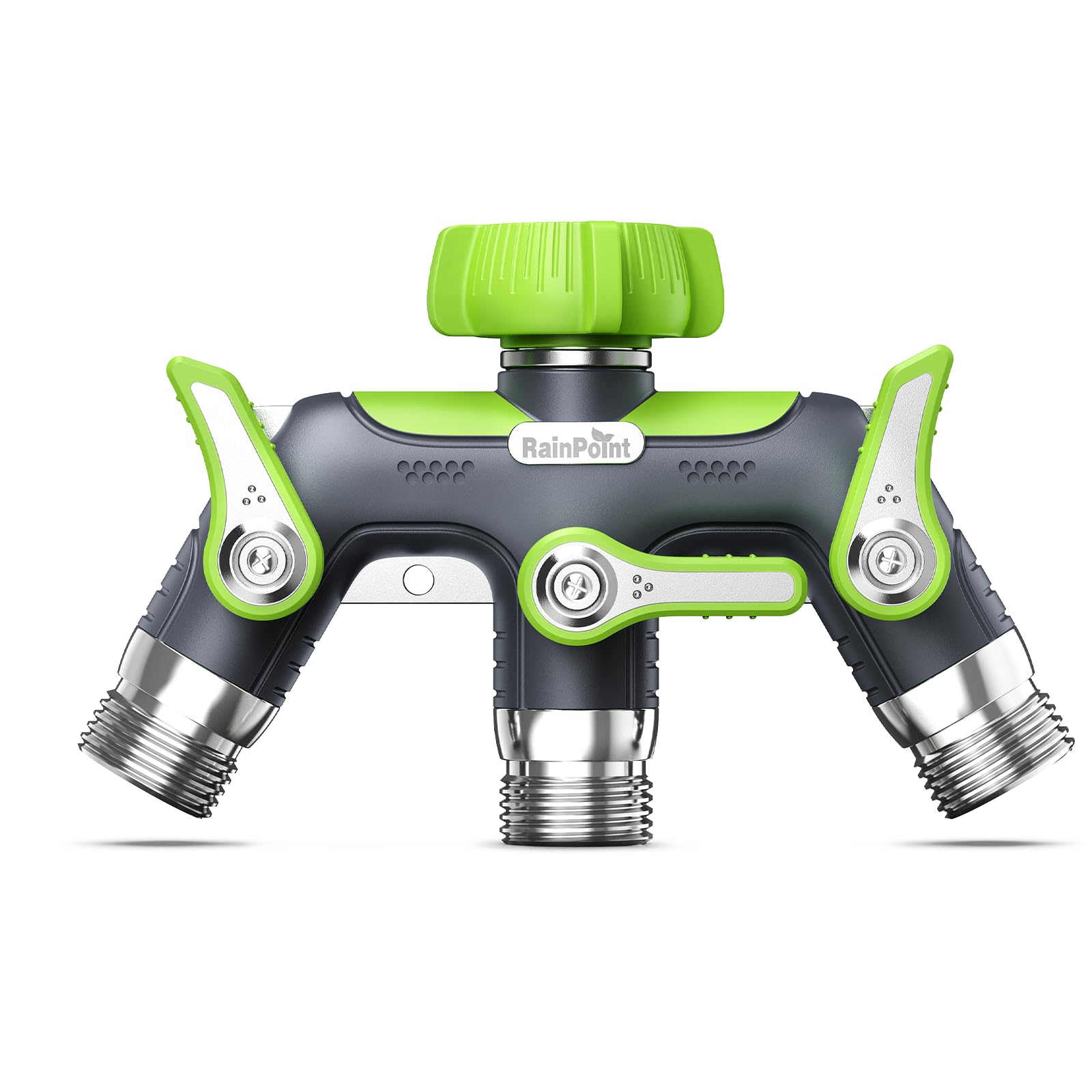
The valve that’s been tested to cycle 60,000 times — for buyers who hate replacing splitters.
If you’ve thrown away three plastic splitters in five years, this is the model to lock in. The valve body is 100% zinc alloy with a TPR rubber coating and brass connection, and the internal stainless steel ball valves are rated for 60,000+ smooth on/off cycles. That’s a lifecycle figure most plastic and cheaper-metal splitters can’t match, and it’s exactly why repeat buyers here tend to describe this as the splitter they’ll own for a long time.
Ergonomics are dialed in: the 1.9-inch ergonomic handle reduces the effort needed to turn the valve, which matters when fingers are stiff or winter gloves are on. The 2.94-inch outlet spacing and 30-degree configuration give ample room for large sprinkler timers and hoses to sit side by side without tangling. Flow rate is tested to 10.0 GPM per outlet across standard pressure ranges — enough for lawn sprinklers, garden beds, or two car-wash nozzles at once.
The one buyer note to know: the valve position indicators on the handles aren’t always intuitive, so a fresh glance at the handle position before turning is worth adopting. It doesn’t affect function — it’s just a habit worth forming on day one.
Longevity spec: The 60,000+ cycle rating is the spec that justifies this pick over cheaper splitters — tests mimic years of daily on/off use.
Outlet spacing: The 2.94 in gap and 30-degree configuration clear chunky timers and dual-hose setups without hassle.
Pick this if: You’re tired of replacing plastic splitters every couple of seasons and want valves rated for the long haul.
Don’t pick this if: You need an intuitive on/off indicator at a glance — the handle positions take a moment to learn.
9. Hayward PSV3S2 CPVC 3-Way Diverter Valve

A dial-handle CPVC diverter with Teflon seats — the pool-valve equivalent of a proper plumbing fixture.
Like the FibroPool above, this is a pool-grade valve, not a garden splitter. It’s a CPVC body with a PVC connection type, rated to a maximum pressure of 50 psi and built with a union end connector that holds the ball in precise alignment and allows the piping to be disassembled without cutting anything. The Teflon seats deliver dependable sealing and the non-corrosive materials stand up to pool treatment chemicals.
Owners pick this for its quality and its adjustability. It can be indexed — the top screw comes off and the inner mechanism is shifted so the handle covers different ports, which lets you change the inlet/outlet relationship without buying a different valve. In a heater bypass or a pool-heater isolation line, that flexibility avoids a mid-project repipe. It bonds solidly to PVC and CPVC with standard glue, and it fits 2-inch and 2-1/2-inch plumbing as well as larger scheduled pipe.
Two things to know. First, the default port layout has the inlet at the bottom of the “T” with flow diverting left or right — if you need the inlet on the side, plan for a repipe or a re-index. Second, leakage reports exist in older reviews, but the more recent feedback notes tight sealing when the valve is properly glued and the union is hand-tightened correctly. It’s a fit-and-installation issue rather than a chronic valve problem.
Adjustability worth having: The re-indexable handle lets you change which ports are covered without buying a new valve — real value for tricky equipment pads.
Pressure ceiling: 50 psi max means this belongs on pool circulation lines, not on household supply pressure.
Best suited to: Pool equipment pads where the valve will live inline with PVC plumbing and needs to be re-indexed for the specific loop layout.
Not the right pick if: You’re plumbing a garden hose or a domestic faucet — this needs solvent-welded PVC joints.
Understanding the Specs
GHT vs NPT Threads
GHT (Garden Hose Thread) is the coarse thread on every standard US outdoor spigot and hose end — it seals with a rubber washer and hand-tightening. NPT (National Pipe Tapered) is a straight pipe thread used inside plumbing systems; it seals with thread tape and a wrench, not a washer. Buyers who mix the two usually find a leak at the joint, because the threads physically won’t mate correctly.
Working Pressure Rating
Every valve carries a number describing how much water pressure it can take. MPa (megapascals) and psi (pounds per square inch) both express this — a valve rated to 1.6 MPa is built for typical residential supply pressure, while one rated to 1000 psi is designed for industrial piping and hot-oil or gas service. Match this figure to your system before buying.
Ball Valve Bore Size
A ball valve (the on/off mechanism inside the valve, shaped like a rotating sphere) comes in “full port” or restricted versions. A full-port ball valve has an internal bore about the size of the pipe itself and passes water barely impeded; a restricted one has a smaller opening inside and slows flow. If you’re feeding a pressure washer or a big sprinkler, full port matters.
Body Material
Brass resists rust and UV and handles wide temperature swings — the go-to for outdoor garden use. Stainless steel 304 is stronger and handles higher pressure and temperature, but requires threaded pipe to install. CPVC is a plastic with excellent chemical resistance used in pool systems. Zinc alloy with a TPR rubber coating is another outdoor-friendly option that’s lighter and often carries a longer cycle rating for on/off movement.
FAQ
Will a 3-way garden splitter fit my standard outdoor faucet?
How many hoses can I run at once without losing pressure?
Can I use a 3-way water valve indoors on a washing machine line?
Why is my 3-way water valve leaking from one of the outlets?
What is the difference between a T-port and an L-port valve?
Do I need to drain a garden hose splitter in winter?
Can a 3-way water valve handle hot water?
How long do 3-way water valves typically last?
What is the difference between MPa and PSI water pressure ratings?
Can I glue a 3-way pool valve into existing PVC plumbing?
Final Thoughts: The Verdict
The overall winner for a standard outdoor spigot is the Yayamz 3 Way Garden Hose Splitter — solid brass, UV-resistant, rated for -4°F to 176°F, and reported by owners as sealing tight with handles that stay easy to turn. It’s the balance of durability, daily usability, and value. If you need a wider outlet gap for hose timers, the EBH Brass Garden Hose Splitter delivers 2.95 inches of spacing to match. For maximum flow to sprinklers or a pressure washer, the LNEZCDB 3 Way HoseSplitter with its 1.52 L/s flow rating is the one to reach for. If you’re plumbing into a permanent line, the DERNORD 3-Way Ball Valve brings a 1000 psi stainless T-port to the job — the right call when you need to switch between multiple hard-piped outputs. And for pool systems, the FibroPool and Hayward CPVC diverters glue straight into existing plumbing and handle equipment pads with real chemical and temperature resistance. One honest nudge before you pick: match the thread type to your existing fitting first. Getting GHT or NPT wrong costs more than choosing between the top two splitter picks.
How We Picked
We do not accept paid placement. Every pick is matched to a real buyer and a real use-case; we do not hands-on test units.
Sources & Methodology
Specifications: manufacturer listings and product documentation. Review insights: verified customer reviews, as of September 2026. Pricing: not shown on this page (it changes often); check the current price via the retailer link.
As an Amazon Associate, Gadgets Feed earns from qualifying purchases. This does not affect which products we feature.