
Our readers keep the lights on and my morning glass full of iced black tea. As an Amazon Associate, I earn from qualifying purchases.
Specs are compiled from manufacturer listings and verified buyer reviews and can change over time — please confirm the key details on the product page before buying.
Choosing a three-wheeled electric scooter for your child really depends on how fast it goes, how long it runs, and if it holds up to daily pavement. Some scooters here top out at a gentle 5 mph (so a beginner learns balance without fear), while others let you dial up to 10 mph as your child’s confidence grows. Battery life runs from a solid 40-minute session to nearly 80 minutes of continuous riding, so you can match ride time to your kid’s attention span and neighborhood size. This guide covers seven real contenders, naming who each scooter suits and where each one honestly falls short.
I’m Min — the founder and writer behind Gadgets Feed. This guide is built by comparing the manufacturers’ published specifications and the patterns across verified customer reviews, so you get each pick’s real strengths and trade-offs instead of marketing spin.
Whether your child is just learning to balance or ready for more speed, you are in the right place to find the best 3 wheel electric scooter for kids based on concrete specs and real owner experiences.
Our Picks at a Glance
How To Choose The Best 3 Wheel Electric Scooter For Kids
Three-wheeled electric scooters offer the ideal stability for younger children learning to balance, but the specifics matter a great deal. After going through hundreds of owner experiences and manufacturer specs, three factors consistently separate the scooters that get ridden daily from those that end up in the garage. Here is how to focus your search.
Speed Modes and the Kick-to-Start Rule
The most important safety feature on these scooters has nothing to do with the max speed number. Look for a kick-to-start mechanism. This means the motor will not engage until your child pushes off and reaches a low rolling speed, usually around 2 mph. It prevents accidental lurches and gives a beginner time to find their balance before the electronics take over. Multi-speed modes — where you choose a slower setting for early rides and open up a faster one later — let one scooter grow with your child’s skill.
Weight Capacity as a Growth Predictor
Check the maximum weight rating, but think of it as a signal for how long the scooter will fit your child. A 66-pound limit works perfectly for a 3-year-old, but an eight-year-old will outgrow it quickly. The scooters with a 132-pound or 154-pound ceiling let a child ride for years without replacing the vehicle. Also note that the reported battery run time is measured on a lighter rider and flat ground, so a heavier child will get less riding time per charge.
Foot Button vs. Thumb Throttle vs. Push-to-Go
How your child starts the motor varies a lot across these models. Some use a foot button on the deck — a natural motion for a small kid who just steps on it. Others use a thumb throttle on the handlebar, which requires a little more hand strength and coordination. A third type uses a button on the deck pad that you step on to activate. The best choice depends on your child’s comfort: younger toddlers tend to prefer a simple foot button, while older kids appreciate the handlebar control of a thumb throttle.
Quick Comparison
| Model | Best For | Max Speed | Max Weight | Ride Time | Amazon |
|---|---|---|---|---|---|
| FanntikRide C9 Pro★ Best Overall | Older kids needing growth room and speed modes | 10 MPH | 132 lbs | 40 min | Amazon |
| iScooter IK3Top Performer | Ages 6-12 needing 10 MPH and magnetic charging | 10 MPH | 154 lbs | 60-80 min | Amazon |
| Droyd Romper | Parents of 3+ year olds wanting a classic big wheel trike | 6 MPH | 66 lbs | 45 min | Amazon |
| ELECOSMOS KS20 Mini | Kids 4-9 wanting a compact, balanced ride with 80 min runtime | 5 MPH | 130 lbs | 80 min | Amazon |
| Elecorange T200 | Lightweight travel (9 lbs) with integrated lights and full-body glow | 5 MPH | 110 lbs | 70-80 min | Amazon |
| ANHAO E9 | Budget-friendly starter for ages 6-10 with two gentle speed modes | 6 MPH | 110 lbs | — | Amazon |
| IRIMMY KS01 | First scooter with Bluetooth music and no-assembly-out-of-box design | 5 MPH | — | — | Amazon |
In‑Depth Reviews
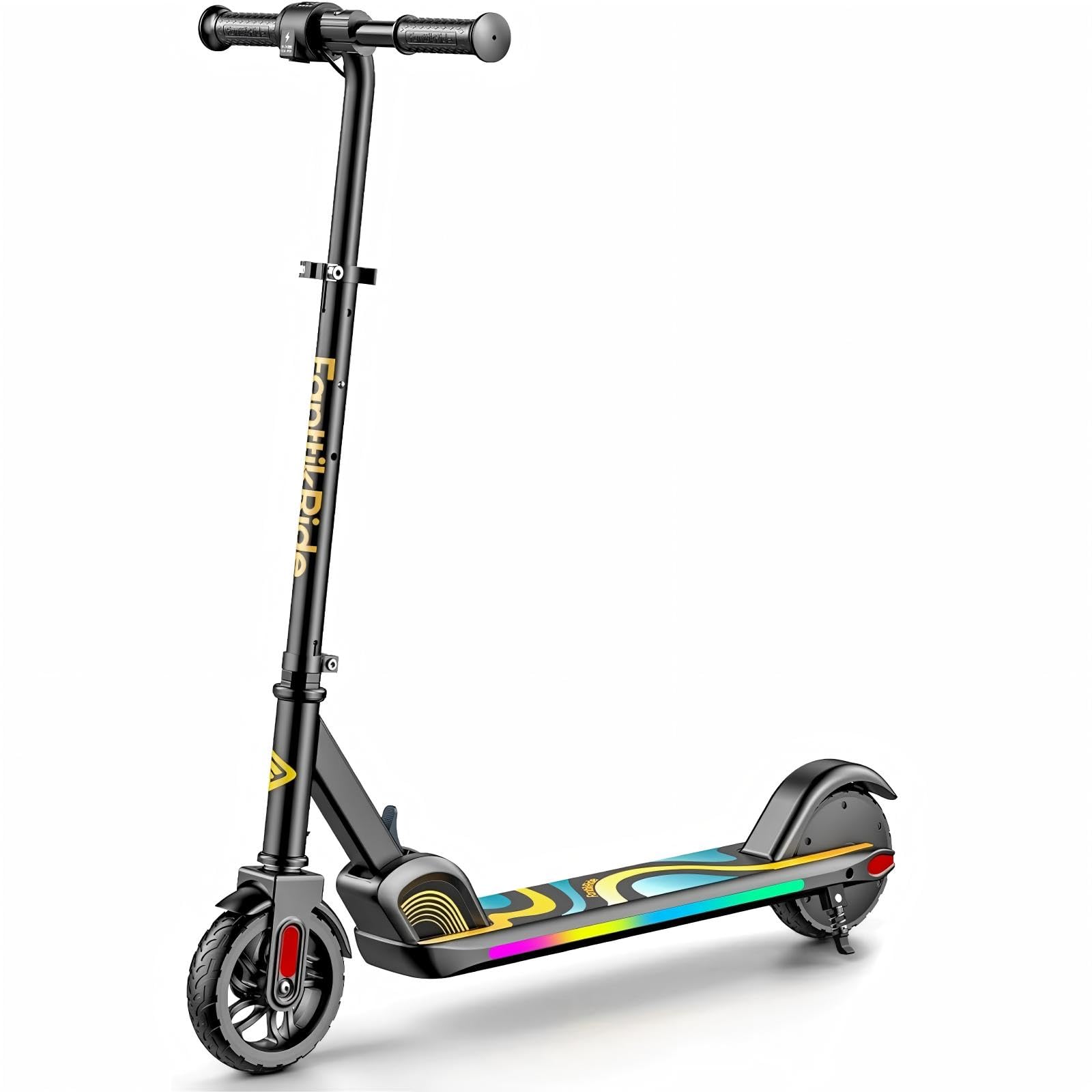
1. FanttikRide C9 Pro
Our pick — 4.5★ from 650+ verified ratings; the strongest balance of quality and price.
The three-speed scooter that keeps up with a growing child from 8 to 12 years old.
You get three speed settings (5, 8, and 10 mph) so a beginner starts slow, then advances to faster riding without needing a new scooter. The handlebar adjusts to three specific heights (31.7, 34.1, or 36.5 inches), fitting a rider between 3.9 and 5.2 feet tall. That means the handlebar can grow as your child does.
Build quality is the top talking point here — over 670 owners have rated this scooter, and the most-discussed aspect is its solid feel. The battery, by contrast, is the point of honest debate. The scooter runs for about 40 minutes per charge, and some owners say the battery fades noticeably within a month. Buyers report that the battery lasts roughly a week with daily use, so if your child rides hard every afternoon, expect to plug in every few days. The integrated LED lights near the pedals flash in five patterns, making evening rides visible without being distracting.
What wins parents over
- Aluminum frame and one-step folding make it easy to toss in a trunk
- Three speed modes (5/8/10 mph) let you lock in a safe setting for new riders
- LED display shows speed and battery level so there are no mid-ride surprises
The honest trade-off
- Battery is the most mixed topic — some owners get consistent runtime, others see early drop-off
- Durability gets split reactions; a few units arrive with issues on the first ride
Reach for this if: your child is in the 8-12 range and you want a scooter they won’t outgrow in 18 months — the adjustable handlebar and 132-lb weight limit make it a multi-year buy.
Look elsewhere if: your kid is under 8 and needs a lower, gentler ride; the C9 Pro is tall and feels best for older elementary riders.
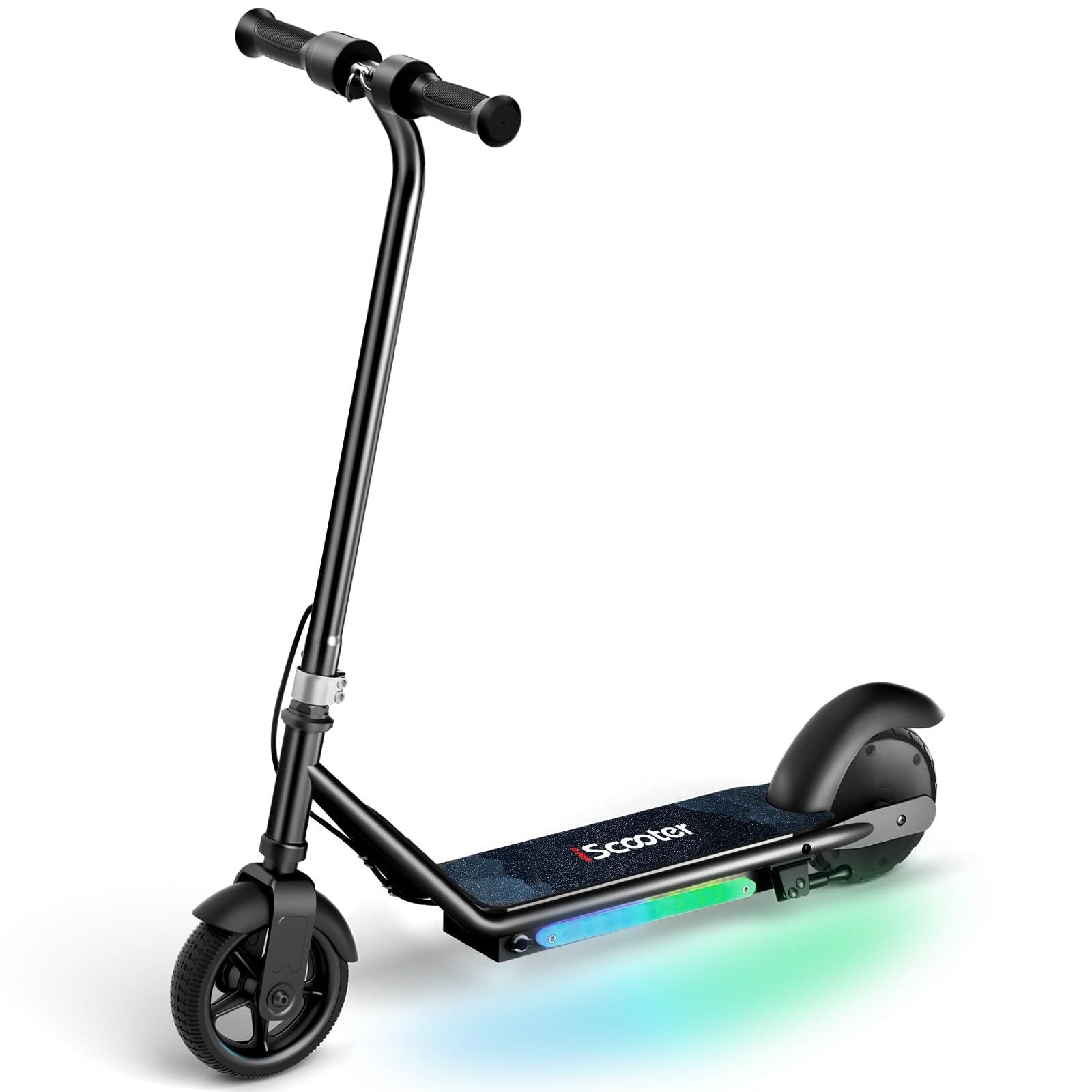
2. iScooter IK3
A 154-pound weight ceiling (the highest in this group) with magnetic charging that clicks on securely.
This scooter stands out for its 150W motor and three speed modes (3, 6, and 10 mph) that cover the full beginner-to-confident rider spectrum. The magnetic charging port is a real parent convenience — the cable clicks on securely with no fiddling, and the battery takes around 2.5 hours to fully charge. Owners mention a runtime between 60 and 80 minutes per charge, which is roughly double the runtime of the FanttikRide C9 Pro. That longer session makes it a better fit for neighborhoods where kids ride for whole afternoons rather than quick loops.
Quality is the single most-discussed positive — over 60 owners specifically mention how solid the scooter feels. The dual braking system combines an electronic brake with a foot brake, which gives you two layers of stopping power for confidence. The catch: battery life is genuinely mixed, with some owners saying it runs 30 minutes before fading, not 60. The speed modes also get divided feedback — the 10 mph top end is fast enough that parents of cautious 6-year-olds may want to lock it to the middle setting permanently. The scooter supports up to 154 lbs, the highest capacity in this whole list, so a growing pre-teen can ride it well into middle school.
top-tier details
- Magnetic charger is simple to use for young riders to plug in themselves
- Dual brake system (e-brake and footbrake) gives reliable stopping power
- Highest weight limit (154 lbs) extends usable years
Where it frustrates
- Battery runtime varies widely — some owners get 60-80 min, others report closer to 30 min
- Durability gets negative marks from 27 owners, mostly around mechanical parts
Who it fits: families with a 6- to 12-year-old who wants one scooter that lasts through several growth spurts, thanks to the 154-lb capacity.
skip it if: you need a guaranteed long battery session every time — the mixed reports make runtime a gamble.
3. Droyd Romper Electric Tricycle
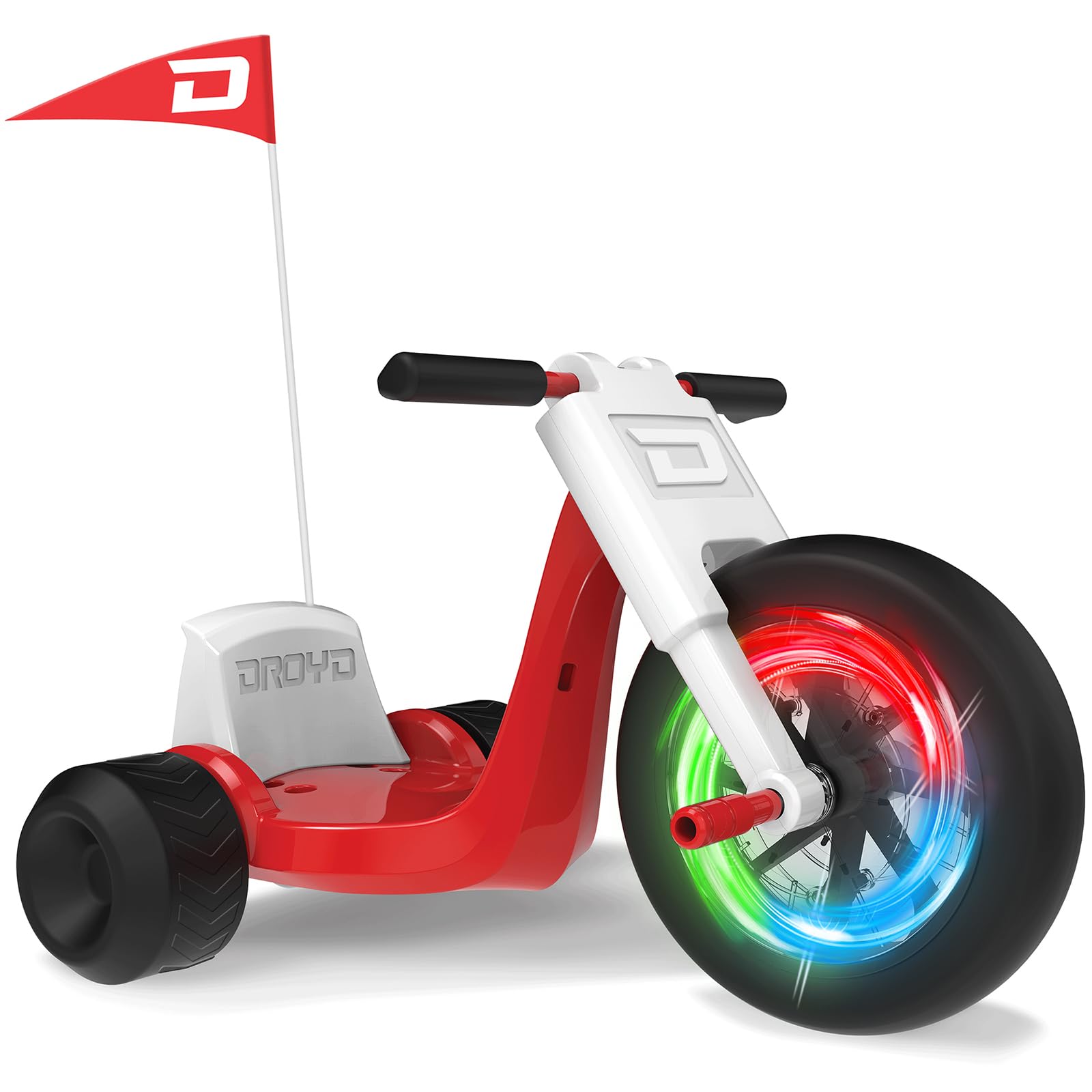
The classic Big Wheel feel, now with a 24V motor and no pedaling required — a sit-down tricycle, not a stand-up scooter.
This is not a stand-up scooter but a sit-down electric tricycle, and that distinction matters for the youngest riders. The Droyd Romper uses a 24V motor paired with a 25.2V 2Ah lithium-ion battery for up to 3 miles of playtime (about 45 minutes in practice). There is a parental speed control that lets you toggle between 3 mph for absolute beginners and 6 mph for thrill-seekers — the smooth-start function and electronic brakes make the transition low-maintenance. The 16-inch front wheel and built-in safety flag give it real presence, and the UL 2272 certification (an independent safety standard for electrical systems) adds an extra layer of confidence for parents.
Quality is the most-praised aspect, with 38 owners applauding the build. The adjustable seat grows with the child, supporting up to 66 lbs, and the soft rubber grips keep little hands comfortable. The hard plastic wheels, however, can spin out on smooth pavement, especially when acceleration kicks in — one owner notes that only one wheel spins on acceleration, which reduces grip. The 22-pound weight makes this the heaviest pick in the roundup, so it stays in the yard or driveway rather than going in the car for park trips. The charging time is 5 hours for a 45-minute ride, which is worth factoring into your daily routine.
What stands out
- Parental speed control with two modes (3 mph / 6 mph) fits toddlers and more adventurous kids
- Battery holds charge well; several customers note 2-hour run time on high speed
- Classic trike design with modern motor — no pedaling required
The honest limits
- Hard plastic wheels lose traction on smooth surfaces, causing spin-outs
- Heavier than most stand-up scooters (22 lbs), making it less portable
Grab it for: a 3- to 5-year-old who wants the iconic Big Wheel experience with zip.
Skip it for: a child over 5 or over 66 lbs — the weight limit and smallish wheels make it a short-term ride.
4. ELECOSMOS KS20 Mini
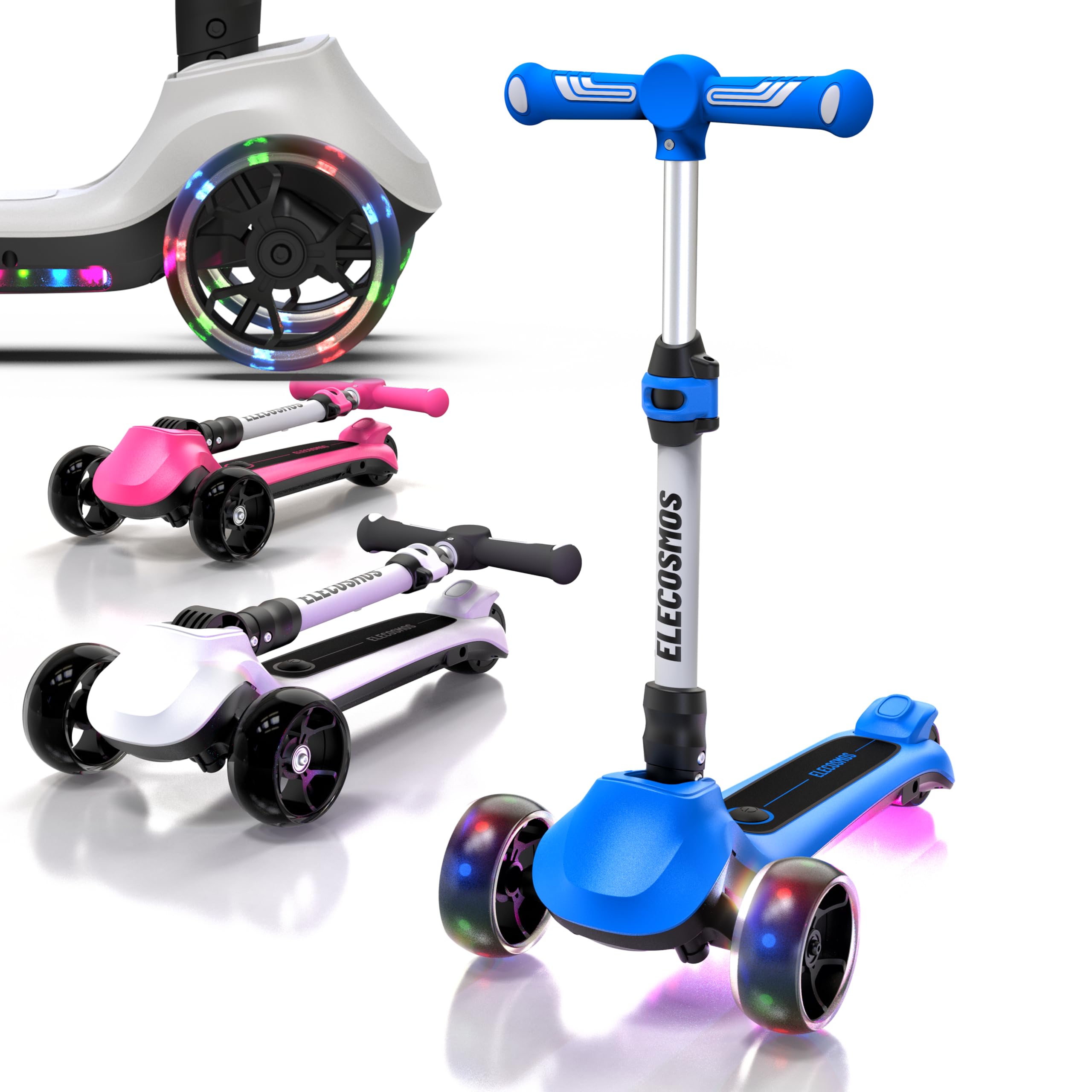
An 80-minute battery that keeps rolling longer than most kids want to ride — the longest claim in this group.
This scooter focuses on one thing: giving a young child a safe, long session without hitting confusing speeds. The KS20 Mini locks the top speed at 5 mph, which is ideal for ages 4-9. The 80-minute ride time is the longest claim in this group, and the battery takes about 80 minutes to fully charge — a nearly 1:1 charge-to-ride ratio that many parents appreciate. The triangle-shaped 3-wheel structure provides inherent stability, and the lean-to-steer system (where you lean your body to turn the front wheels) helps kids develop balance naturally without needing training wheels.
The 5×2-inch wide light-up wheels and the flashing LED deck make this scooter highly visible at dusk. Age-appropriateness is the top praise from owners, with 9 specifically calling out how well it fits younger children. The build quality, however, is the most-mixed aspect with 16 owners split — some say it feels well-made, while others report issues with handlebar installation or early mechanical failure. The scooter holds up to 130 lbs, giving it a surprising amount of room for a beginner-focused model. On one unit that failed, the company offered responsive customer service with replacement parts, which is a good sign.
Why it works
- 80-minute runtime is the longest of any scooter here — good for whole afternoons
- Lean-to-steer helps young kids build balance in a stable 3-wheel frame
- Quick folding and lightweight enough to carry into a car trunk
Where to be cautious
- Build quality is split — 16 owners gave it mixed marks, so inspect on arrival
- The motorized function draws negative attention from 7 owners, so check the motor on the first ride
Best for: a 4- to 7-year-old whose main need is battery endurance and gentle speed.
Not for: a child over 9 or one who wants a scooter that folds into a truly compact package.
5. Elecorange T200

A nine-pound travel companion that glows from stem to wheel — lighter than any other scooter here.
At just 9 lbs, the Elecorange T200 is the lightest scooter in this roundup — light enough that a parent can carry it in one hand while holding a child’s hand with the other. The maximum speed is 5 mph, and the battery promises 70-80 minutes of riding after a 2-hour charge. The four adjustable height settings (26.5 to 31.5 inches) cover ages 4-9, and the aluminum frame gives it a sturdy feel despite the low weight. The entire body lights up — wheels and deck — creating a rainbow glow that improves visibility and makes kids feel special on evening rides.
The three-wheel design with lean-to-steer technology (you lean your body to turn) makes turning intuitive even for toddlers. The anti-slip deck coating and metal-reinforced rear fender brake keep stops controlled. Quality is praised most, with 14 owners calling the build solid, and the speed is considered safe without being boring. The main gap here is the missing battery display — you have no way to know the remaining charge until the scooter stops. Battery life is the most-discussed issue at 18 mentions, with mixed feedback on consistency. The max load is 110 lbs, which fits most kids through age 9.
Lightweight highlights
- 9 lbs makes it the most portable pick — easy for kids to carry up steps
- Full-body LED lighting improves visibility significantly
- Kick-start safety prevents accidental acceleration
What to consider
- No battery display means you cannot plan ride time around remaining charge
- 110 lbs weight limit is moderate; heavier kids will outgrow it sooner
Reach for this if: you regularly pack the scooter for park trips or vacations — the 9 lb weight is a real advantage.
pass on it if: your child is close to 110 lbs or you need to monitor remaining battery while riding.
6. ANHAO E9
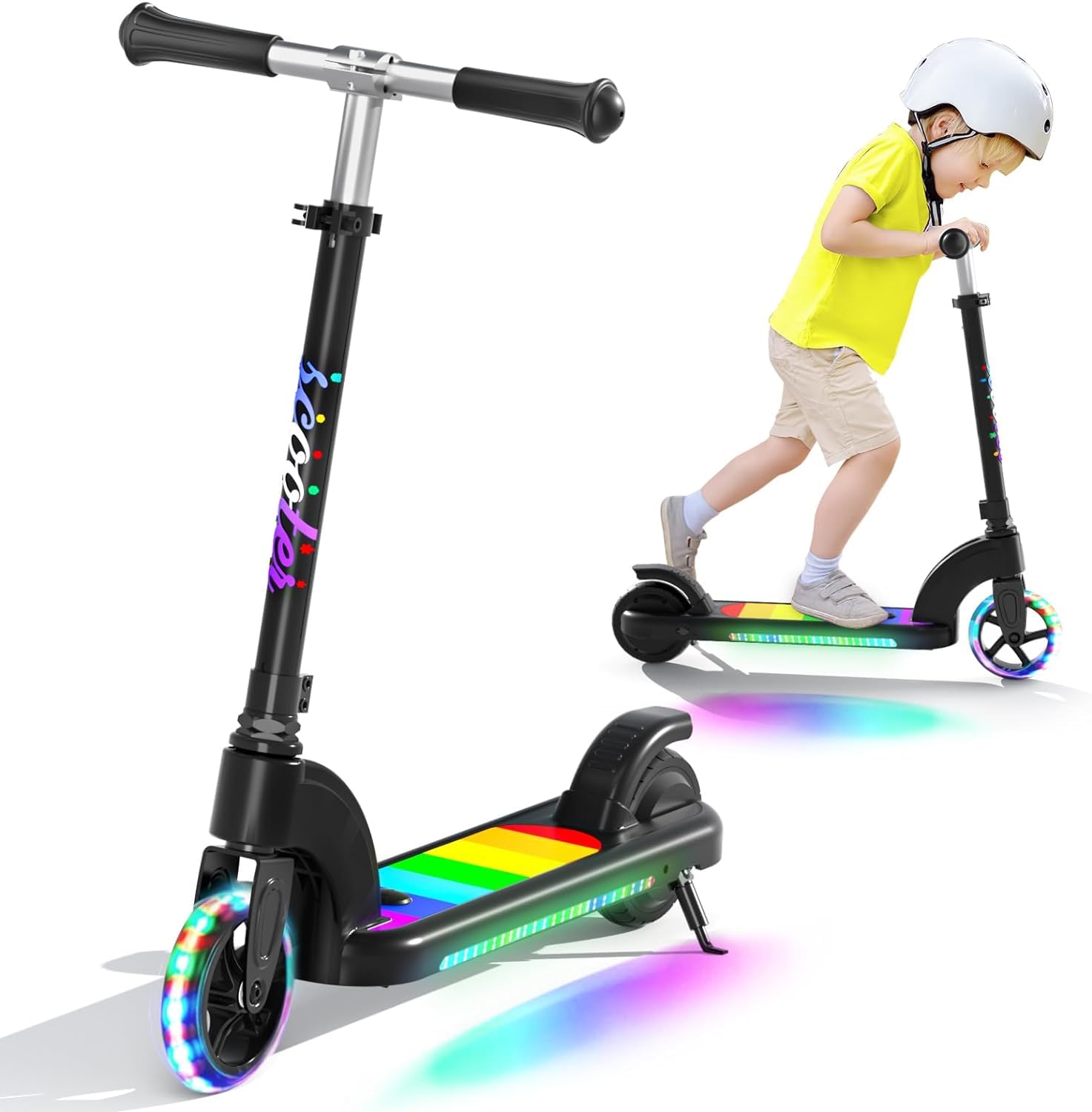
A starter scooter with two gentle electric speeds (4 and 6 mph) and a fresh pair of LED wheels — plus a kick-scooter backup when the battery dies.
The ANHAO E9 is priced for parents who want to test whether a kid is ready for electric riding without spending a lot. It offers two electric speed modes (4 mph and 6 mph), plus the scooter also works as a kick scooter when the battery is low — giving an unpowered backup option. The motor will not start until the rider pushes to 2 mph, which eliminates the sudden lurch that scares young beginners. Assembly is genuinely easy; most reviewers point out it takes just a few minutes using included tools.
LED lights are built into the front wheel and the deck, so the scooter becomes visible at dusk without requiring separate clip-on lights. The handlebar adjusts to four height settings supporting children up to 52 inches tall (roughly ages 6-10). The steel and aluminum construction gives it a reassuring heft — the build quality is the most-praised aspect with 38 positive mentions. The durability score, however, is negative: 21 shoppers say broken bolts, charger failures, or the front wheel separating after a few months. As one owner wrote, the scooter was great at first, but after about eight months, the front wheel just fell off. Consider this a fair-weather starter for occasional use, not a daily driver.
Value highlights
- Dual speed modes (4/6 mph) give beginners a safe, low-speed start
- LED lights on the front wheel and deck improve low-light visibility
- Simple assembly with included quality tools
Cost-saving trade-offs
- Durability is negative across 21 owner reports — typical failure point around 8 months
- Battery life and functionality are the next most-common complaints
Best for: a cautious 6- to 8-year-old getting their first taste of electric riding on flat sidewalks.
Think twice if: your child rides daily or on rough pavement — the long-term durability pattern may cut the fun short.
7. IRIMMY KS01

A Bluetooth-enabled scooter with a thumb throttle and LCD display — zero assembly required from the start.
This is the most tech-forward scooter in the list, combining a 150W motor, a thumb throttle on the handlebar, an LCD screen showing speed and battery, and Bluetooth speakers for music. There is no foot sensor to stomp on — just a gentle thumb press to accelerate. The scooter arrives fully assembled, so you pull it from the start, unfold it, and ride. The deck, wheels, handlebars, and stem eyes are all wrapped in LED lights, creating a light show that grabs kids’ attention. Three adjustable heights (25, 28, and 31 inches) fit kids from 3 to 12 years old.
The stable three-wheel design makes it easy for a 4-year-old to balance, and the 5 mph speed limit keeps things safe for new riders. Quality is the top positive aspect, with 32 owners praising the sturdiness. Speed and suitability for kids both get strong marks. The battery — the most-discussed aspect at 30 mentions — is genuinely mixed. Some buyers report excellent range, while others say the charger stopped working within months. Two units stopped charging entirely before the 5-month mark, and the seller’s replacement policy is limited. This scooter is best treated as an notable first electric ride with the understanding that its electronics are less resilient than simpler models.
Why kids love it
- Bluetooth music and full LED lighting make every ride feel special
- Thumb throttle is intuitive and safe — no jumping on a foot sensor
- Zero assembly means you can ride within 60 seconds of opening the box
Why parents should watch
- Battery and charger failures are the most-cited complaint (30 owners flag it)
- Reliability is rated negative by 19 owners, so service might be needed early
Perfect for: the tech-curious 4- to 8-year-old who wants lights, music, and a screen on their first scooter.
it’s not for you if: you expect this to be a high-mileage daily rider without electronics hassle.
Understanding the Specs
Weight Capacity (lbs)
This is your scooter’s growth window. A 66-pound limit works for a 3- or 4-year-old, but a 132-pound ceiling lets an 8-year-old ride through middle school. The higher the number, the longer the scooter fits your child. Remember that a heavier rider reduces both speed and battery range from the published numbers, so if your kid is near the upper limit, expect slightly slower acceleration and shorter ride times.
Kick-to-Start Safety
This feature prevents the motor from engaging until the child pushes the scooter to a walking speed, usually around 2 mph. It means no accidental lurching when a small foot lands on the throttle. Every scooter in this list uses either a foot button, a step-on deck pad, or a thumb throttle — but the kick-to-start rule is separate from the throttle type. A scooter that requires a push before the motor kicks in is always safer for a beginner.
Battery Runtime vs. Charge Time
Look at both numbers together. A scooter that runs 80 minutes but needs 5 hours to charge will stop the fun for most of the afternoon. A model that runs 40 minutes but charges in 2 hours can be topped up during lunch. The ratio matters more than either number alone, especially if you have more than one child waiting their turn.
Lean-to-Steer vs. Fixed Handlebar
Lean-to-steer, also called tilt steering, adjusts the front wheels when the rider shifts body weight. This is the natural way young children learn to turn — it builds core balance and feels intuitive. A fixed handlebar with a traditional turning mechanism is better for older kids who have already mastered bike steering. Most scooters designed for ages 3-7 use lean-to-steer; most for ages 8+ use a fixed handlebar.
FAQ
At what age can a child start using a 3-wheel electric scooter?
Is a 3-wheel electric scooter safer than a 2-wheel version?
How long does the battery last on a typical kids’ electric scooter?
What does the kick-to-start safety feature mean?
Can my child use a 3-wheel electric scooter on grass or gravel?
How do I choose between a foot button and a thumb throttle for my child?
What does the weight capacity of a scooter actually mean for my child?
How important are the LED lights on a kids’ electric scooter?
Final Thoughts: The Verdict
For most families, the best 3 wheel electric scooter for kids is the FanntikRide C9 Pro because its three adjustable speeds (5, 8, 10 mph) and 132-pound weight limit give a growing child years of use. If you want a high-tech ride with Bluetooth music and LCD display, grab the IRIMMY KS01. And for the toddler set seeking a classic Big Wheel experience with electric power, the Droyd Romper is the one to reach for.
How We Picked
We do not accept paid placement. Every pick is matched to a real buyer and a real use-case; we do not hands-on test units.
Sources & Methodology
Specifications: manufacturer listings and product documentation. Review insights: verified customer reviews, as of July 2026. Pricing: not shown on this page (it changes often); check the current price via the retailer link.
As an Amazon Associate, Gadgets Feed earns from qualifying purchases. This does not affect which products we feature.