
Our readers keep the lights on and my morning glass full of iced black tea. As an Amazon Associate, I earn from qualifying purchases.
Specs are compiled from manufacturer listings and verified buyer reviews and can change over time — please confirm the key details on the product page before buying.
You want one outdoor condenser to cool three separate rooms—like a bedroom, an office, and a living area—without spiking your electric bill. That works if you choose the right efficiency rating and match each indoor head’s BTU output (the heating/cooling capacity) to the room it serves. Here are ten tri-zone setups, with the real-world specs that matter for distinct spaces.
I’m Min — the founder and writer behind Gadgets Feed. This guide is built by comparing the manufacturers’ published specifications and the patterns across verified customer reviews, so you get each pick’s real strengths and trade-offs instead of marketing spin.
If you are adding comfort to an addition or replacing window units, a 3 zone mini split system lets you control each room’s temperature independently from one efficient outdoor unit.
Our Picks at a Glance
How To Choose The Best 3-Zone Mini Split System
A tri-zone ductless system is a major appliance that will cool and heat your home for years, so the decision deserves more than a quick glance at the price tag. The most important factors are efficiency, the size of the zones you need to cover, and whether you plan a professional install or a careful DIY project.
Efficiency: SEER2 and HSPF2
High efficiency is what makes these systems cheaper to run than window units. A higher SEER2 number means more cooling output per watt of electricity, which directly lowers your monthly bill. Every unit here uses inverter technology, where the compressor speeds up and slows down instead of switching fully off, so it holds a set temperature without wasteful power spikes.
Matching BTU Capacity to Room Size
Each indoor unit has a BTU (British Thermal Unit) rating that roughly maps to a square footage range. A 9,000 BTU head typically suits a smaller bedroom, while a 12,000 BTU head handles a larger living area. If a head is too small for its room, it will run constantly; if it is too big, it will cool the space too fast and leave the room feeling damp.
Installation Reality
These are not plug-in appliances. They require connecting refrigerant lines, pulling a vacuum, and often a dedicated electrical circuit. Some brands encourage skilled DIYers, while others state that a professional licensed technician must perform the first startup to keep the warranty valid. Be honest about your skill level before buying a unit that demands pro installation.
Quick Comparison
| Model | Best For | Capacity | Cooling Power | Coverage | Amazon |
|---|---|---|---|---|---|
| Senville 28K Tri Zone★ Best Overall | Handy Homeowners | 2.3 Tons | 28,000 BTU | 1,500 sq ft | Amazon |
| Hykolity 28K Tri ZoneBest Value | Budget-Conscious Buyers | 2 Tons | 28,000 BTU | 1,650 sq ft | Amazon |
| Albott 22 SEER2 9K+9K+12KTop Performer | High-Efficiency Cooling | — | 30,000 BTU | 1,350 sq ft | Amazon |
| ROVSUN 28K Tri Zone | Cold-Climate Heating | 2.3 Tons | 28,000 BTU | 750 sq ft | Amazon |
| Albott 22 SEER2 9K+9K+9K | Three Equal-Sized Rooms | — | 27,000 BTU | 1,200 sq ft | Amazon |
| YITAHOME 23 SEER2 24K Tri Zone | Smart App Control | 2 Tons | 24,000 BTU | 1,200 sq ft | Amazon |
| TOSOT 30K Cosmo Series | Largest Coverage Area | 2.5 Tons | 28,400 BTU | 1,650 sq ft | Amazon |
| DELLA 28K 2*9K+12K | Whole-Home Even Cooling | 2.34 Tons | 28,000 BTU | 1,350 sq ft | Amazon |
| DELLA 28K 2*9K+18K | Large Open Living Spaces | 2.34 Tons | 28,000 BTU | 1,800 sq ft | Amazon |
| Cooper & Hunter 28K | Long-Lasting Reliability | 2.3 Tons | 28,000 BTU | — | Amazon |
In-Depth Reviews
1. Senville 28K BTU Tri Zone
Our pick — 4.5★ from 150+ verified ratings; the strongest balance of quality and price.
The crowd-pleaser that proves a DIY install can beat a four-thousand-dollar HVAC quote.
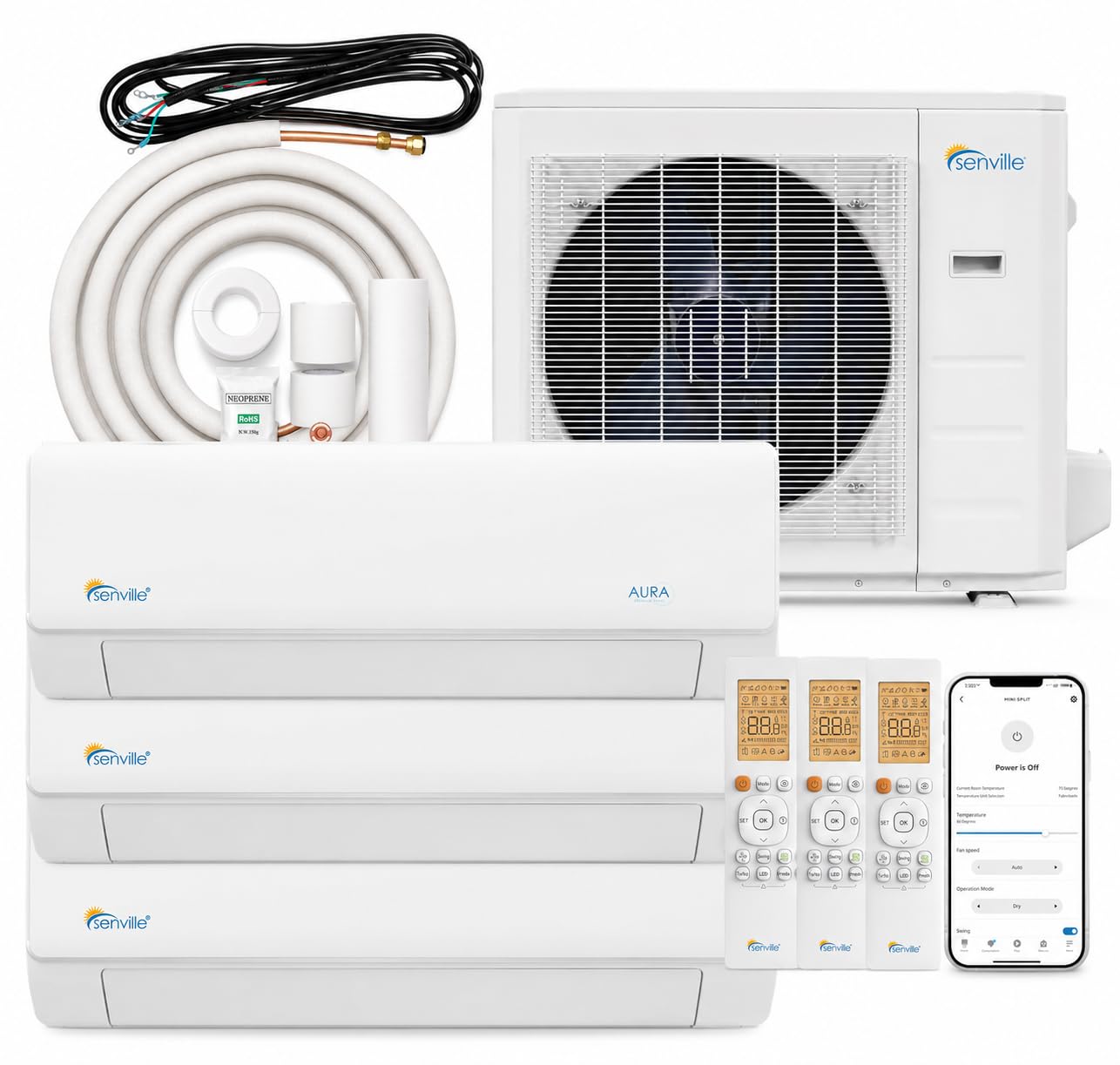
Senville tops this list because it delivers the complete package for a homeowner willing to get their hands dirty. The 2.3-ton, 28,000 BTU system covers up to 1,500 square feet, which makes it a flexible fit for a typical three-bedroom floor plan. Owners who installed it themselves report saving roughly versus hiring a professional, and the consistent chorus in the reviews is that it “works perfectly” once the complex install is done.
Buyers praise the build quality and per-room thermostat control. They report it runs quietly and efficiently, handling hot Florida summers and New York winters without complaint. It is not for a first-timer—the manual skips some valve purge details, and the warranty requires a licensed first start—but the payoff is a system that holds its set temperature day and night for better sleep.
Smart-home fans will appreciate the Alexa compatibility and mobile app support, letting you adjust modes remotely. There is a fair trade-off here: owners note that while the home stays comfortable, it struggles to cool larger 700 sq. ft. open spaces effectively, so this shines brightest when each head serves a closed room. The wiring also runs short, which is a common gripe for runs that need a longer reach.
Owner Consensus: Quality and value for money are the two things buyers praise most, with efficiency and quiet operation close behind.
Honest Fit: This is a get-what-you-pay-for system that rewards capable DIYers who can work through a challenging install.
Reach for this if: you are handy enough to manage a complex multi-day install and want a premium-feeling system without the premium installer fee.
Think twice if: you need a plug-and-play light-commercial unit — the wiring length and valve-purging details demand real HVAC knowledge.
2. Hykolity 28K BTU Tri Zone
The 45-minute install makes this the easiest win for a three-room setup.
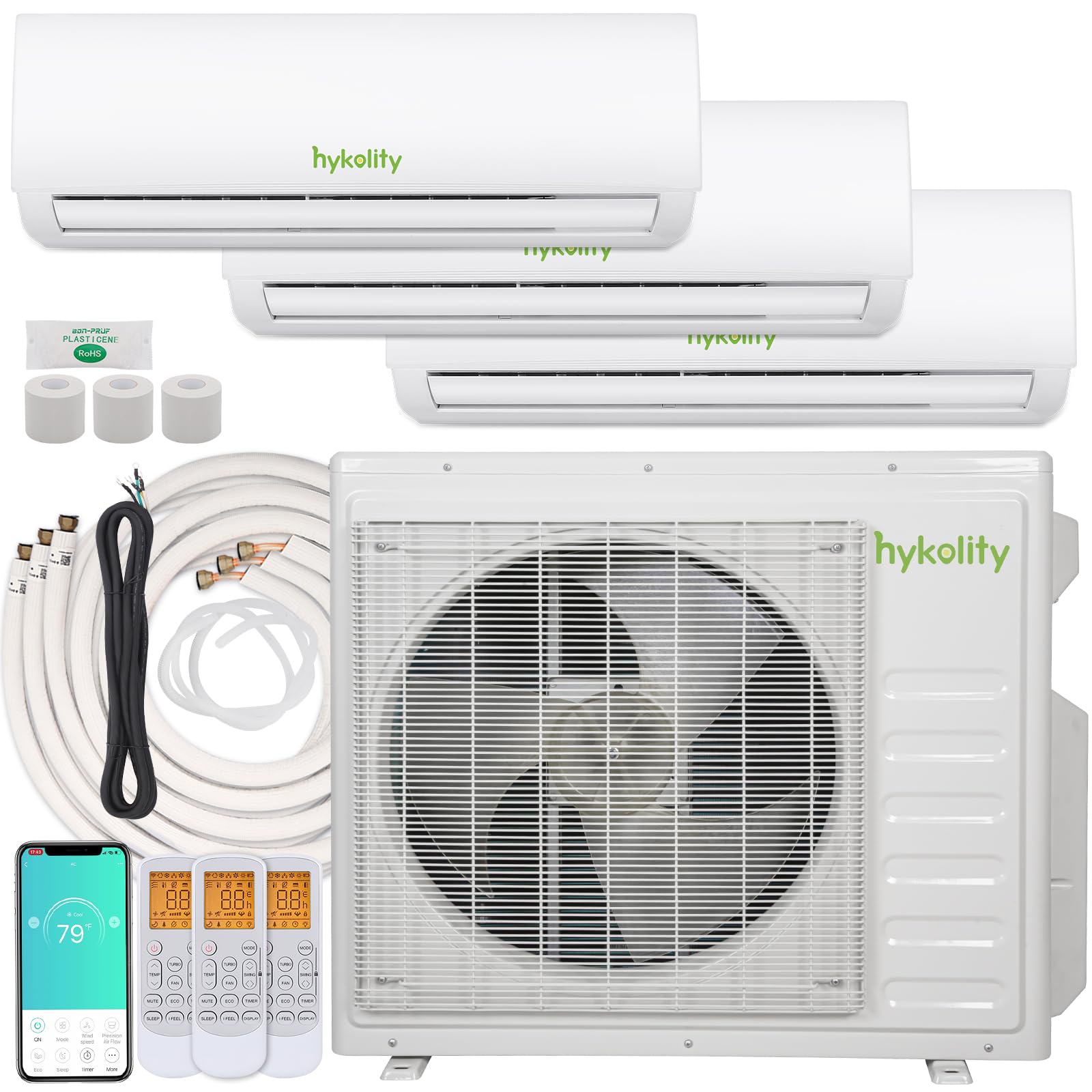
Hykolity earns its value badge by pairing a lower upfront cost with a genuinely simple installation. The system pairs a 28,000 BTU outdoor condenser with two 9,000 BTU heads and one 12,000 BTU head, and one owner had it running just 45 minutes after opening the boxes. The performance is rated at a 20 SEER2 with an 8.5 HSPF2 efficiency, which translates into real energy savings without sacrificing cooling punch.
Buyers consistently highlight the performance and quality, and the included 16-ft line set plus vibration absorber feet mean you are not hunting for extra parts on day one. The WiFi control is a standout, letting you switch on the AC while driving home, and the eco mode works exactly as advertised. Despite being the budget pick, it holds its own against pricier rivals — the 28,000 BTU output matches the Senville, though it covers a larger 1,650 square feet.
The recurring frustration is support: a few buyers report that reaching a human for help is a dead end, which is a real risk when you are dealing with a major appliance. Installation is also not entirely turnkey — you will need a 2.75-inch hole saw, an HVAC vacuum kit, and outdoor mounting brackets. For a buyer who understands these are standard mini-split requirements, the value proposition is tough to beat.
What Wins People Over: Performance and raw quality are the top praised aspects, with installation ease and cooling speed right behind.
The Catch: Support channels are thin, and the box may arrive with cosmetic damage even when the unit inside is fine.
Grab it if: you want the cheapest genuine tri-zone solution with a fast, straightforward install and full WiFi smarts.
Look elsewhere if: you expect responsive after-sales help — this brand is best bought with confidence in your own install skills.
3. Albott 22 SEER2 9K+9K+12K
The 22 SEER2 efficiency king that out-cools its own spec sheet with a 30,000 BTU rating.
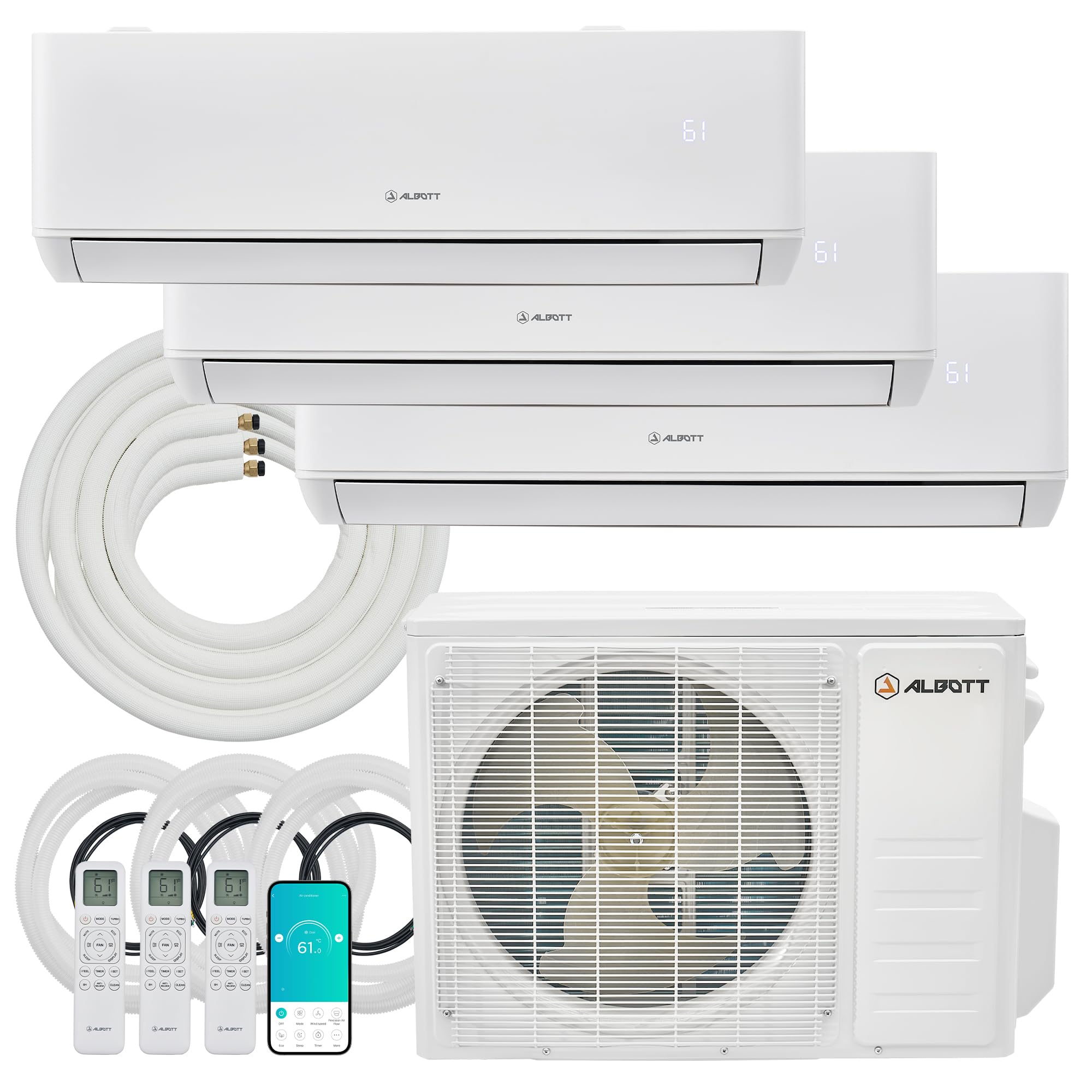
Albott takes the efficiency crown here with a 22 SEER2 rating — the most energy-sipping number on this list — while quietly packing a 30,000 BTU cooling punch. That is 7% more cooling power than the Senville’s 28,000 BTU output., which means it fights harder against a hot afternoon.
The real-world use case is about replacing a swamp cooler. After eight months of use, owners mention it is quiet, reliable, and a clear upgrade, especially with the smartphone app and multiple fan levels. The extreme-weather engineering also stands out: it will still cool at 131°F and heat at -13°F, so it shrugs off climates that would make lesser units shut down.
The downside is a common one for this category — the included line set is only 5 feet long, which is not enough for a normal install. Owners consistently report having to buy a longer line separately to reach a distant room. The 30-minute self-cleaning cycle and 24-hour timer add convenience, but the short line is a planning headache you need to budget for.
Top Praise: The efficiency and sheer cooling force are what owners rave about, outperforming the older swamp-cooler approach by a wide margin.
Plan For: The 5-ft line set is the single biggest complaint — factor in extra copper if your runs are long.
Best for: efficiency-minded buyers who want maximum cooling output per watt and live in a climate with extreme heat or cold.
Who it isn’t for: anyone hoping the box contains everything — you will almost certainly need to buy additional line.
4. ROVSUN 28K Tri Zone 9K/9K/9K
The Vermont-approved heater kept running when three rival systems shut down at -31°F.
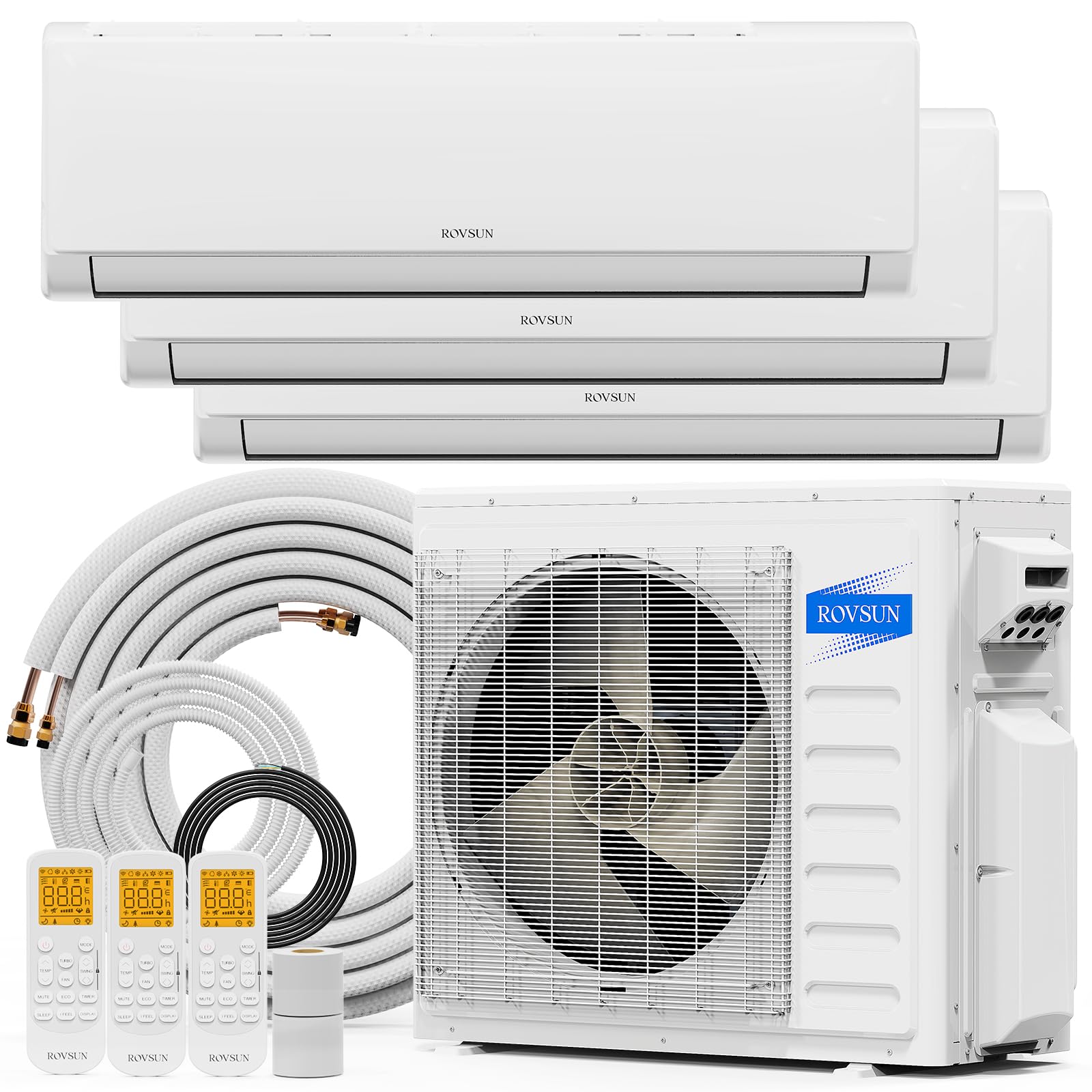
ROVSUN builds its reputation on cold-weather toughness, and the proof is in the reviews. In one striking account, a 12,000 BTU ROVSUN unit kept heating a 900 sq. ft. space to the upper 70s at -31°F while three other brands’ units shut down completely. This tri-zone version pairs a 28,000 BTU inverter condenser with three 9,000 BTU heads and a pre-charged 25-ft line set — the longest included run on this list.
The 20 SEER inverter compressor cuts energy use by up to 30% compared to standard units., and the ultra-quiet operation at just 27–42 dBa means you will barely notice it running during a movie. Reliability is the most-praised aspect, and owners describe the install as a manageable DIY project that takes about four hours, provided you have a vacuum pump and gauges. The 4-way air swing circulates air evenly to eliminate hot and cold spots.
There are two honest caveats. The 750 square feet of rated coverage is significantly less than other 28,000 BTU units, so this is best for a tighter floor plan with well-insulated rooms. And owners note the wiring runs shorter than the line sets, which can be annoying mid-install. The pre-charged 25-foot lines and separate controllers for each room do a lot to make up for those quirks.
Owner Consensus: Reliability and cooling performance are the strengths buyers single out, with big praise for the low power draw in brutal winters.
Fair Warning: The coverage rating is smaller than its power suggests, and the wiring length can test your patience.
Choose this if: you live in a genuinely cold region and need a heat pump that keeps delivering when the thermometer plummets.
Pass if: you are covering a large open-concept floor plan — this is built for compact, well-insulated spaces.
5. Albott 22 SEER2 9K+9K+9K
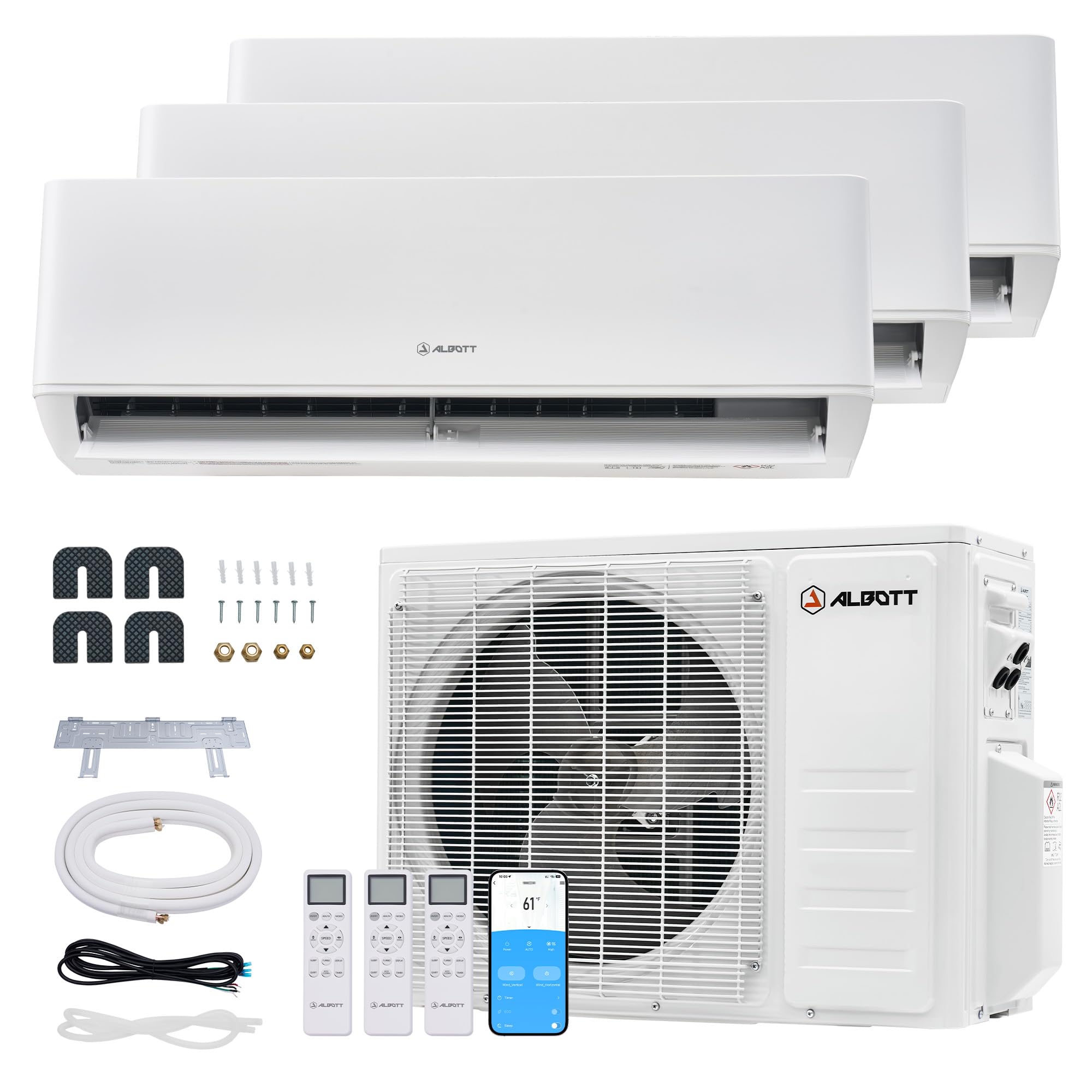
The three-equal-heads setup that solved one homeowner’s perpetually hot upstairs office.
This Albott model is the answer for homes with three similarly sized rooms that need identical treatment. Its three 9,000 BTU indoor units each get independent temperature control, which makes it ideal for a split-level home or an addition with a home office. The 22 SEER2 rating earns Energy Star certification, and the 1,200 square feet of coverage fits a typical three-bedroom layout comfortably.
The defining use case comes from an owner who worked from morning to night in an upstairs home office while central cooling failed to deliver proper cooling to the upper floor. This unit solved that exact problem, delivering 27,000 BTU of cooling power to the rooms that needed it most. Owners describe it as working exactly as it should, with an easy install and reliable performance.
The main limitation, echoing its sibling model, is the lack of an option to buy additional copper tubing and connection wire directly. If you want to install the heads in separate areas of the house, you will need to source extra line yourself. The automatic outdoor defrost function does help maintain reliable performance in cold weather, which extends the system’s lifespan.
Standout Strength: The energy efficiency and independent zone control are the core wins, with owners loving that it easily fixes hot rooms.
Note: There is no easy add-on purchase for longer line sets, so map your runs before you commit.
Reach for it if: you have three roughly equal rooms and want the efficiency of a 22 SEER2 rating with smart app control.
Look elsewhere if: your room sizes vary wildly — the equal 9,000 BTU heads suit uniform spaces best.
6. YITAHOME 23 SEER2 24K Tri Zone

The 50-foot airflow champion freezes a 13×15 room even with the door open.
YITAHOME claims the highest efficiency rating on this list at 23 SEER2, and its 24,000 BTU output still managed to freeze two rooms that share a door in one owner’s home. The system covers 1,200 square feet and throws air up to 50 feet, creating a 4D circulation pattern that owners say reaches every corner. It operates at noise levels below 40 decibels, which keeps bedrooms and home offices pleasantly quiet.
The smart controls are a genuine highlight. It is fully WiFi-enabled and Alexa-compatible, with a well-regarded app that owners say is comparable to name brands from the same factories. The five modes — auto, cool, dry, heat, and fan — plus iFEEL mode and a 24-hour timer give you granular control over every head. All-weather response is solid, operating down to 5°F and up to 118°F.
The honest trade-offs are the installation extras and the physical build. Owners note you will need a wall bracket, disconnect, cable and fuses, vinyl cover, and nyloc sealant for the flares — items that are not in the box. There is also a slightly concerning report that the outdoor fan blades did not spin after day three, even though cooling continued to work. It feels a bit light and cheap in the casing, but the cooling performance is undeniable.
What Shines: The app quality and sheer cooling force earn the praise, with silent operation a close third.
Be Prepared: The install requires several parts you must buy separately, and the casing feels less substantial than premium rivals.
Best for: smart-home enthusiasts who want the highest efficiency rating and reliable app control in one package.
Not for: anyone expecting a complete out-of-the-box install kit — budget for extra mounting parts.
7. TOSOT 30K Cosmo Series
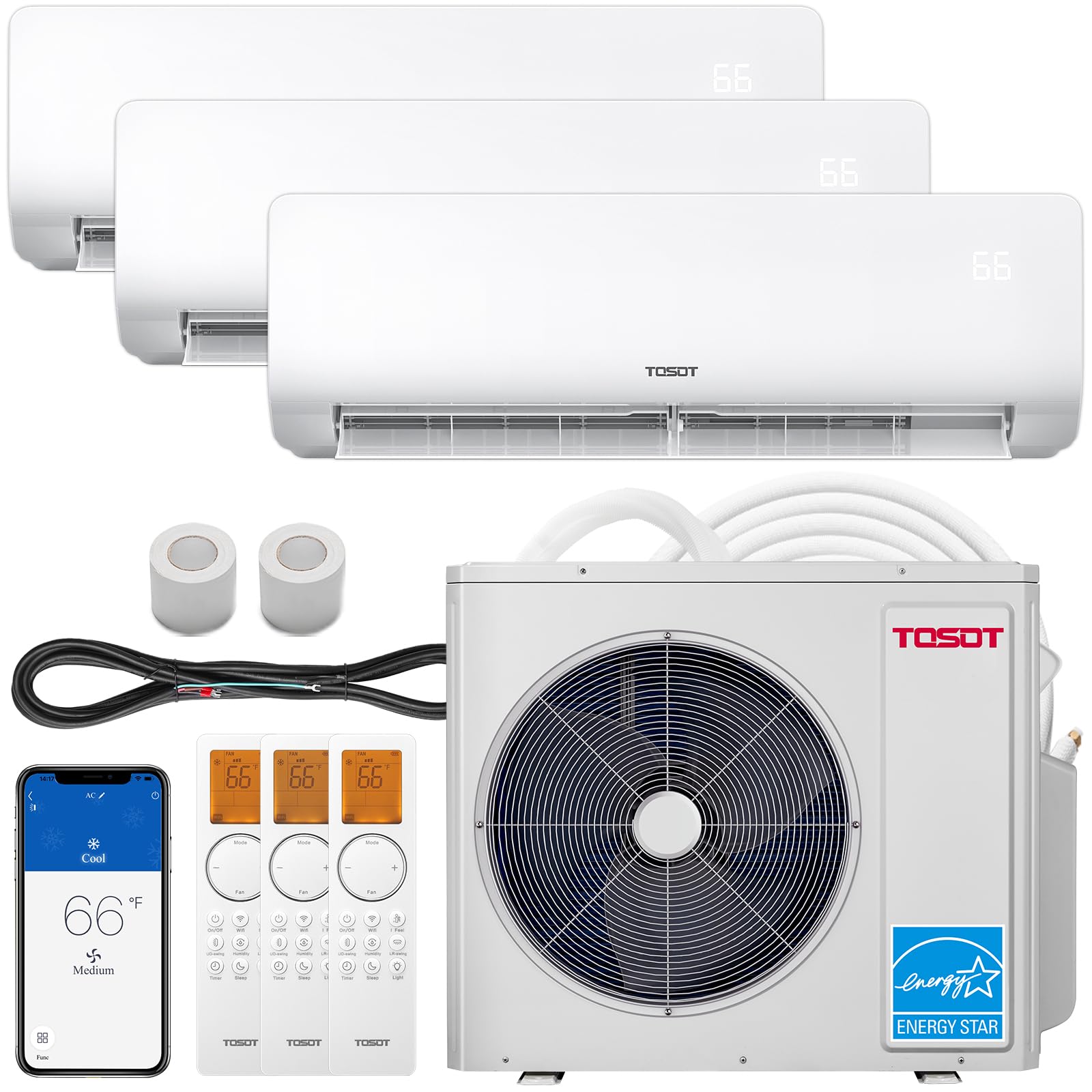
The Gree-built workhorse heated a 950-sq-ft shop for less than one PTAC unit.
TOSOT is a subsidiary of Gree, one of the largest AC manufacturers in the world, and that pedigree shows in the engineering. The 2.5-ton capacity is the highest on this list, delivering 28,400 BTU to cover up to 1,650 square feet. One owner swapped a wood stove for this unit and found it so efficient they could heat both a 950-ft shop with 12-foot ceilings and a 450 sq. ft. apartment for the price of heating just the apartment before.
The Cosmo series runs at 21 SEER2 with a 10 HSPF2, and it operates in ambient temperatures from -22°F to 118°F — a wider window than most rivals. The Gree+ app provides smart control from anywhere, and the intelligent defrost function keeps heating efficiency high in winter. The 16.4-foot copper line set is included, and the five-year warranty adds a layer of long-term confidence.
The most-discussed trade-off is that the system will not run heating in one room while another is in cooling mode — an error persists until the next day. This makes it a poor fit if you want simultaneous heating and cooling across zones. A few buyers also had a rough time with a specific third-party seller, which is a caution about who you buy from rather than the unit itself.
Owners Agree: Effectiveness and quality are the top praised aspects, with impressive efficiency in real-world heating scenarios.
Know This: You cannot run heat and cool at the same time across different zones — plan your usage accordingly.
Choose it if: you need maximum coverage and winter performance from a brand with serious manufacturing weight behind it.
skip it if: you want to heat one room while cooling another — that simultaneous mode is not supported.
8. DELLA 28K 2*9K+12K
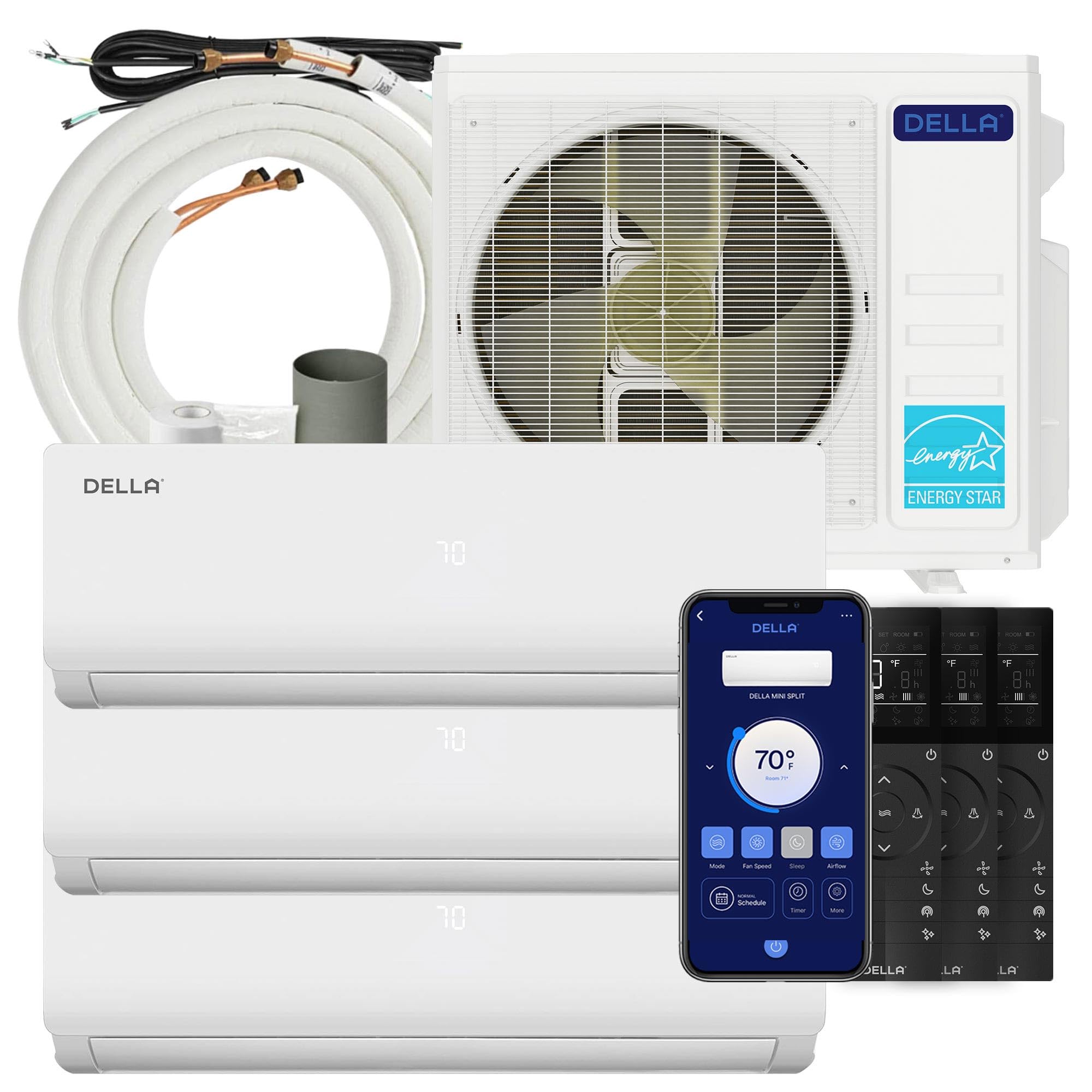
The whisper-silent 29 dBa system that costs half what an Arizona supplier quoted.
DELLA’s 9K+9K+12K configuration is built for the common home layout where two smaller rooms and one larger living space need different treatment. The 20 SEER2 rating with DC inverter tech trims power consumption by up to 30%., and the 28,000 BTU output covers up to 1,350 square feet. One owner in Arizona recommends it at half the cost of what local suppliers wanted, and the app functions well enough to earn consistent praise.
The quiet operation is a defining feature at just 29 dBa — quieter than a library. Each of the three indoor heads adjusts from 60 to 90 degrees Fahrenheit, and the 4D airflow with up-down left-right swing distributes air evenly. The turbo function, iFEEL mode, and sleep mode give you the full range of modern controls, and the pre-charged heat pump works down to 5°F.
There are two honest warnings here. This model explicitly does not support the self-cleaning function — the button will show on the display but the operation will not run. And the included copper lines are a known weak point: one professional installer advised replacing them because they crimp and twist very easily. Professional installation is mandated for this unit, so this is not a DIY project.
What Works: The ultra-quiet operation and easy install win the most praise, alongside the smooth app experience.
Watch Out: The self-cleaning mode is a display-only feature, and the stock copper lines are prone to kinking.
Pick this if: you want a professional-grade install with exceptionally quiet operation and strong smart-home integration.
Look past it if: you plan any DIY — the mandated pro install and delicate copper lines make that a risky path.
9. DELLA 28K 2*9K+18K
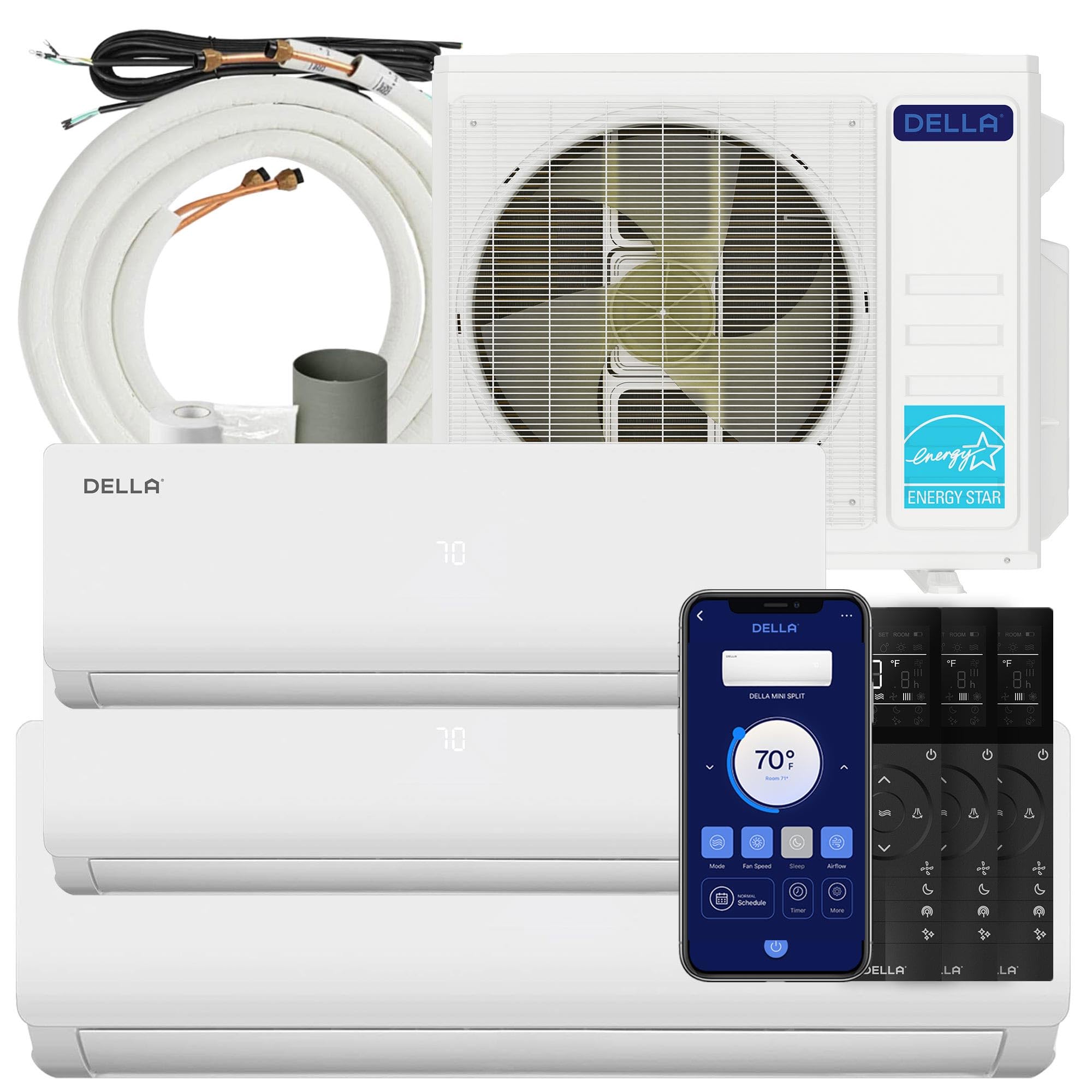
The open-concept answer that replaced an 18-thousand-dollar central system with a DIY install.
This DELLA variant solves the problem the others cannot: a genuinely large open living space. Its three heads — two 9,000 BTU and one 18,000 BTU — cover up to 1,800 square feet, with the big head handling up to 1,000 sq. ft. on its own. One owner replaced a failed central heat pump with this unit in exactly that size home and found it more efficient with whisper-quiet turbo fan operation.
The 20 SEER2 DC inverter tech reduces power draw by up to 30%., and the system maintains a steady 72°F across all rooms even on 90°F+ days. The dehumidifier works exceptionally well, which owners in humid climates really appreciate. With three 16-foot copper line sets and three installation kits included, it arrives as a genuinely complete package for an ambitious DIYer with proper tools.
The catch is that the 16-foot line sets are often too short for a typical 1,200 sq. ft. house, and you will likely need to buy longer lines and cables. The drain tubes are also described as cheap, with a recommendation to upgrade them during install. Like its sibling, this model does not support the self-cleaning function despite the button showing on the display.
Owner Praise: The ability to hold a constant temperature in a large home while cutting electric bills from + down is the standout win.
The Reality: Plan on buying extended line sets and better drain tubes for most real-world installations.
Ideal for: homes with one large great-room or open living area that needs serious BTU muscle beyond what standard heads provide.
Not ideal if: you are unwilling to source extra line — the stock 16-ft runs rarely reach a distant condenser.
10. Cooper & Hunter 28K 3-Zone
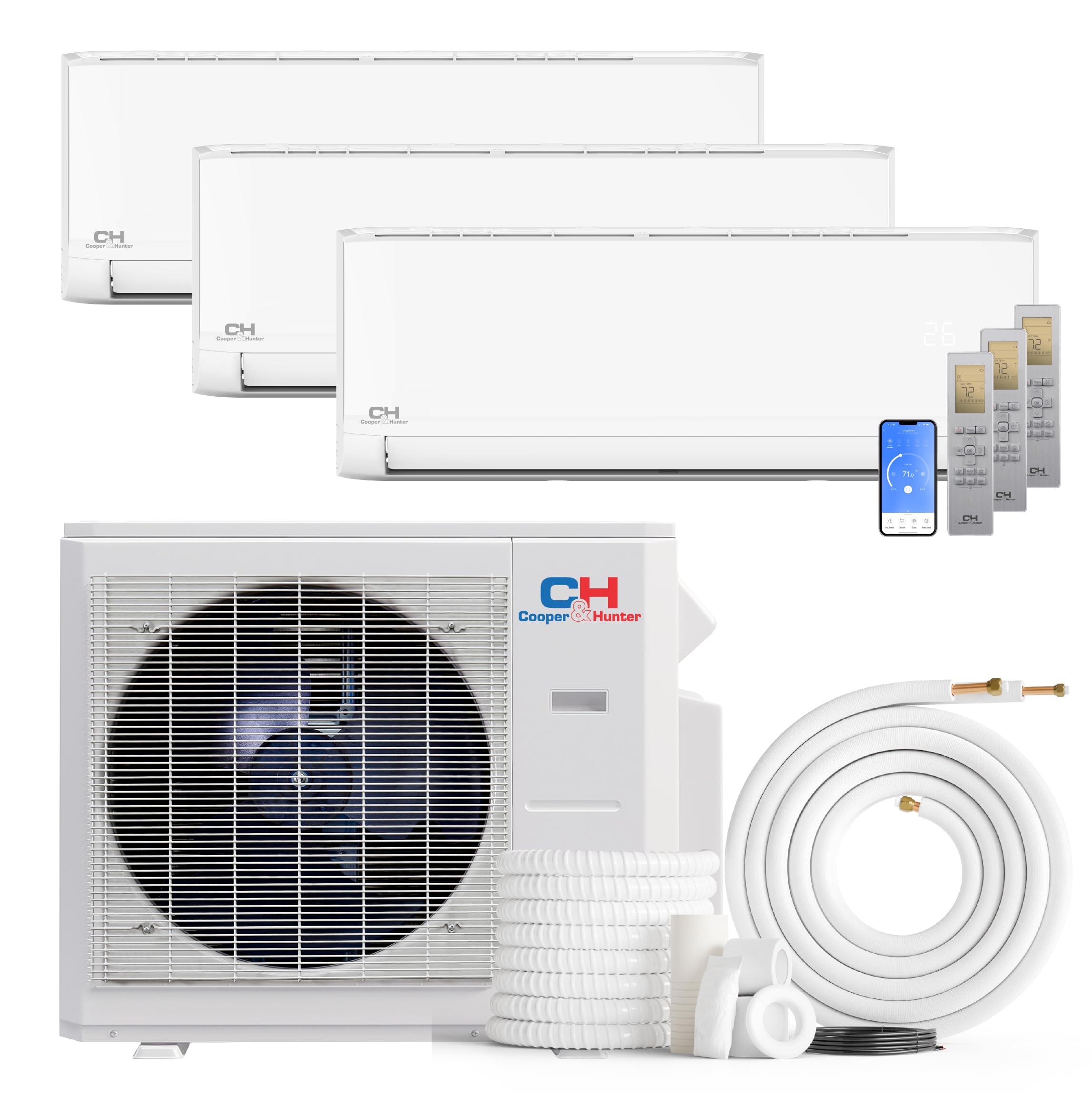
The 25 SEER2 flagship whose WiFi lets you cool the house before you leave the office.
Cooper & Hunter is the premium play here, and you get what you pay for: a 25 SEER2 efficiency rating that is the highest on this list, backed by three smart kits for full smartphone control. The system pairs a 28,000 BTU condenser with three heads sized 9,000 + 12,000 + 12,000 BTU, and the included 25-foot insulated copper line sets give you far more installation flexibility than the 16-foot kits elsewhere.
The defining owner experience is the electric bill. One buyer cut their usage from 1,500 kW one month to just 800 kW the next, using the WiFi adapter to turn units on from the car while driving home. With three units cooling 2,700 square feet in total, the system stays silent even on high settings — owners describe the outdoor unit as sounding like a low box fan. US-based technical support adds a layer of reassurance that budget brands lack.
This is explicitly not a DIY system — professional installation is required, and the unit ships via freight to your nearest accessible point. The factory flares are a known weak point that owners recommend replacing to avoid leaks. It is the most expensive unit here by a wide margin, but for buyers who want maximum efficiency and proven reliability, the premium is justified.
What You’re Paying For: Installation ease, near-silent operation, and the strongest efficiency rating — the three most-praised aspects.
Fair Caution: The factory flares are subpar, and the professional-install requirement adds cost on top of the premium price.
Best for: buyers who want a top-tier efficiency rating, long 25-ft line runs (the refrigerant tubing length), and US-based support.
Think twice if: you are budget-focused or plan a DIY install — this one demands a licensed professional and a premium budget.
Understanding the Specs
SEER2 and HSPF2 Ratings
SEER2 measures cooling efficiency, and HSPF2 measures heating efficiency. A higher number means the system uses less electricity to produce the same amount of heating or cooling. On this list, ratings range from 20 SEER2 to 25 SEER2, and every point higher translates directly into lower monthly energy bills over the life of the unit.
BTU Capacity and Coverage
BTU stands for British Thermal Unit, a measure of heating and cooling power. A 28,000 BTU system can move more heat than a 24,000 BTU system, which lets it cover more square footage. The key is matching each indoor head’s BTU to the room it serves — a 9,000 BTU head suits a bedroom, while a 12,000 or 18,000 BTU head handles a living room or open space.
FAQ
How much area can a 3-zone mini split system cover?
Can I install a 3-zone mini split myself?
What does the included line set mean for installation?
Is a higher SEER2 rating worth the extra cost?
Can I heat one room while cooling another with a 3-zone system?
How quiet are these mini split systems?
What is the difference between a 9K, 12K, and 18K indoor head?
Do these systems work in extreme cold or heat?
Will a 3-zone mini split lower my electric bill?
What extra parts will I need for installation?
Final Thoughts: The Verdict
If you want one dependable pick, the 3 zone mini split system winner is the Senville 28K Tri Zone because it pairs proven build quality with a 1,500 square feet of coverage and a DIY-friendly path that has saved owners thousands. If you want the highest possible efficiency for a large open home, grab the Cooper & Hunter with its 25 SEER2 rating and long 25-foot line sets. And for a budget-conscious buyer who still wants WiFi smarts and real cooling power, the Hykolity is the one to reach for.
How We Picked
We do not accept paid placement. Every pick is matched to a real buyer and a real use-case; we do not hands-on test units.
Sources & Methodology
Specifications: manufacturer listings and product documentation. Review insights: verified customer reviews, as of August 2026. Pricing: not shown on this page (it changes often); check the current price via the retailer link.
As an Amazon Associate, Gadgets Feed earns from qualifying purchases. This does not affect which products we feature.