
Our readers keep the lights on and my morning glass full of iced black tea. As an Amazon Associate, I earn from qualifying purchases.
Specs are compiled from manufacturer listings and verified buyer reviews and can change over time — please confirm the key details on the product page before buying.
The hard part of buying a receiver with three separate zones is not picking a brand — it is knowing whether that third zone can actually run on its own. On some units the third room just mirrors whatever the main room is playing. On others it is a genuinely independent output with its own source, so the kids can watch a disc inside while the patio speakers run the radio. That difference decides whether zone 3 is useful to you or just a line on the box.
I’m Min — the founder and writer behind Gadgets Feed. This guide is built by comparing the manufacturers’ published specifications and the patterns across verified customer reviews, so you get each pick’s real strengths and trade-offs instead of marketing spin.
This page covers three receivers that genuinely carry three zones — an RV wall-mount unit, a home theater workhorse, and a flagship AVENTAGE model. By the end you will know which one keeps your third room independent. Here is how to read a 3 zone receiver spec sheet before you buy one.
Our Picks at a Glance
How To Choose The Best 3 Zone Receiver
A three-zone receiver sends sound to three separate sets of speakers, and the only question that really matters is how much freedom each of those rooms gets. Some designs give every zone its own source selection — a separate feed you choose per room — while cheaper implementations simply pipe the same thing everywhere. Before you spend anything, work out where the third set of speakers will physically live and whether anyone in that room will want different audio from the main space.
Zone independence beats zone count
Three zones only means three speaker outputs. What you want is three source selections — the ability to send one input to the main room and something else to the patio. A wall-mount RV unit handles this differently from a home theater receiver, so check how the maker describes zone 3 specifically rather than assuming all three behave the same way.
Match the ports to what you actually own
Count your sources before you count your zones. If a game console, a streaming stick, and a disc player all need to live on the receiver at once, you need enough HDMI inputs and at least one HDMI output that supports ARC or eARC — the audio return channel that lets the receiver pull sound from your TV over the same cable instead of a separate optical lead. Receivers that support 8K60 and 4K120 pass-through can carry the higher-bandwidth signals modern consoles output, so you get sharp, smooth gameplay without extra cables.
Think about calibration and setup time
Room calibration uses a small microphone to measure how your speakers sound in your actual room, then adjusts levels and timing to compensate. It is the difference between a receiver that measures well on a spec sheet and one that sounds right with a sofa in the way. Budget at least a short calibration pass into your install night, plus the time to label and route the zone 2 and zone 3 speaker runs.
Quick Comparison
| Model | Best For | Zones / Channels | HDMI Ins/Outs | Zone 3 Independence | Amazon |
|---|---|---|---|---|---|
| iRV Technology iRV34★ Best Overall | RV and camper wall-mount replacement | 3 zones / 7 speakers | 2 in + 1 front in / 2 out | Independent zone 3 source, outdoor speakers controlled separately | Amazon |
| Sony STR-AN1000 | Everyday home theater with a second room | 7.2 channel / Zone 2 & Zone 3 | 6 in / 2 out (HDMI 2.1) | Zone 2 and Zone 3 distribution | Amazon |
| Yamaha RX-A8A AVENTAGE | Large multi-room and gaming setups | Zone 2/3/4 / 11.2 channel | 7 in / 3 out (8K60, 4K120) | Zone 2, 3 and 4 with MusicCast distribution | Amazon |
In‑Depth Reviews
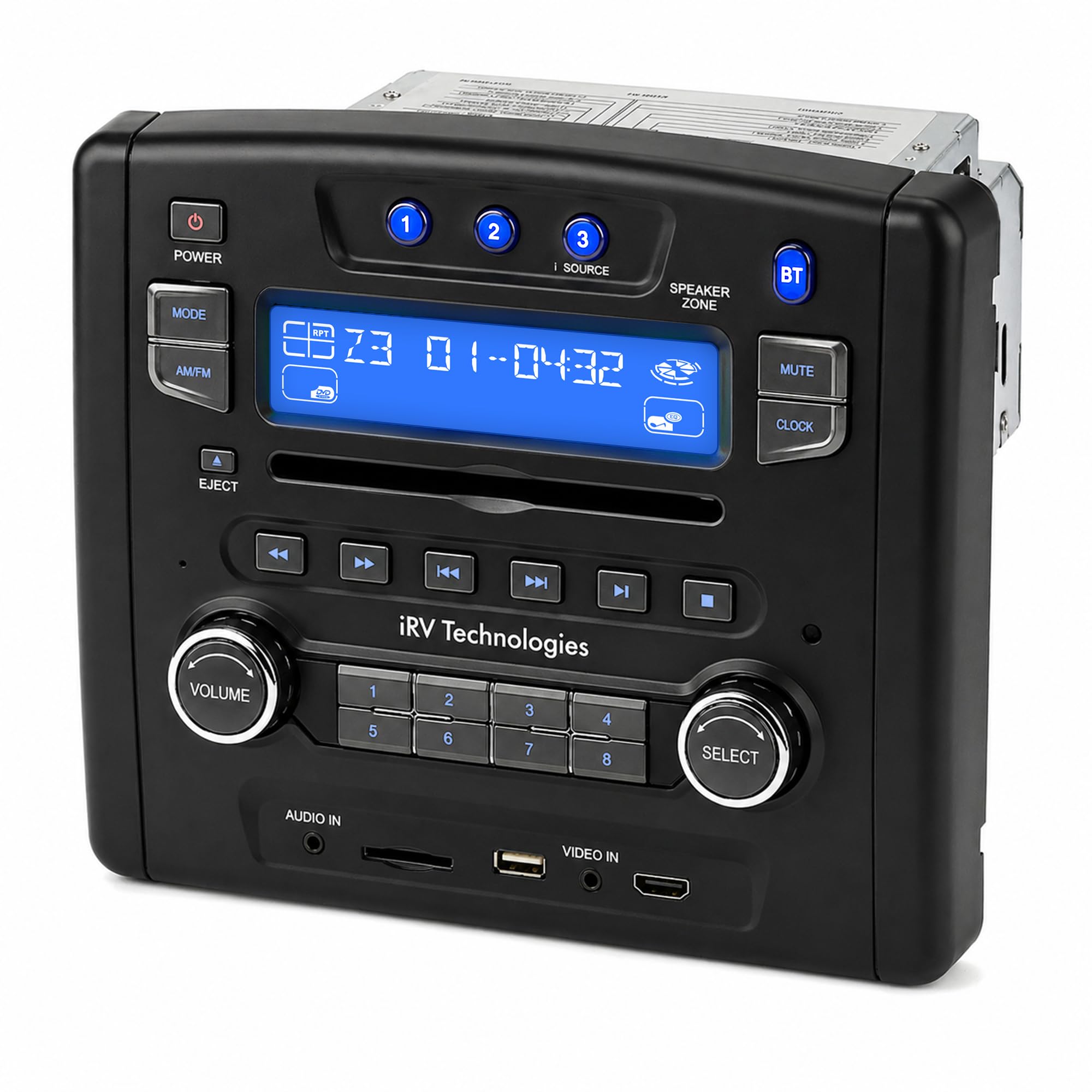
1. iRV Technology iRV34 Wall Mount RV Radio Stereo
Our pick — over 4★ from 550+ verified ratings; the strongest balance of quality and price.
The wall-mount three-zone unit built to drop straight into a camper’s existing radio hole.
The faceplate measures W 9-5/8″ x H 8-1/2″ x D 1″ with a mounting hole of W 7-3/4″ x H 7-1/2″ x D 5″, so it drops into the same cavity your old unit came out of. Buyers report it drops into the existing wiring harness, and many say the original composite connection works before you touch the HDMI runs.
Zone 3 is the part that earns this unit its place. That third output is an independent audio source, so the speakers you mount on the outside of the rig run on their own feed and get controlled separately from whatever is playing inside. One owner pulled an old external speaker switch out of the loop and wired the outdoor speakers straight to output number three. Rounding it out, you get Bluetooth 5.0 with a dedicated button for pairing a phone, HDMI output with ARC so TV audio can route back through the stereo and out to your speakers, and a free Android and Apple app that turns your phone into a wireless remote.
Two honest limits are worth knowing before you commit. The trim strips also lack give and will not clip tightly onto a slightly warped cabinet face, and the EQ settings are not documented anywhere obvious — the trick is tapping the center volume button, while holding it switches between USA and Europe tuning modes. At 4.3 stars from 565 ratings, it is the crowd favorite of this trio; the Sony below carries more channels and more modern ports, but it will not bolt into an RV cabinet without cutting.
What the install crowd keeps saying
- Replacement and installation are the two things owners praise most about it — the fit into an existing RV cavity is the headline
- Zone 3 runs as a genuinely separate audio source with its own control, so outdoor speakers stop depending on the indoor feed
- Bluetooth 5.0, HDMI ARC, and a free Apple/Android remote app cover the modern conveniences without an adapter
- 7 speakers and a 6-pound build that stays put in a wall cavity
Where it asks for patience
- DVD only — no Blu-ray, and some discs from an older library may not read
- Trim strips have no flex, so a warped cabinet face will not clip flush
- Input switching pauses a few seconds while a disc initializes
- EQ adjustments are undocumented; the center volume button holds the tuning-region setting
Made for the swap: camper and RV owners replacing a Genesis GT-2.0 or Elite-series factory radio who want the patio speakers on their own channel.
Look elsewhere if: you need Blu-ray playback or you are building a living-room theater rather than fitting a mobile cabinet.
2. Sony STR-AN1000 7.2ch Home Theater 8K A/V Bluetooth Receiver

A 7.2-channel workhorse with 360 spatial sound and enough HDMI for a whole rack of gear.
The number to start with is 165 — as in 165 watts per channel at 6 ohms, which is the honest measure of whether this thing can drive a room full of speakers without straining. Power draw tops out at 240W on a 120V 60Hz supply, and the box carries 7.2 channels of surround processing with Dolby Atmos and DTS:X decoding, meaning sound objects get placed in three-dimensional space rather than assigned to fixed speakers. What owners keep coming back to is Sony’s 360 Spatial Sound Mapping, which synthesizes extra phantom speakers to widen the soundstage — the effect is described as the single biggest uptick in immersion, and it is what pushes this unit past the iRV34 above for pure movie duty. Setup is the second thing people mention most, and with a graphical interface walking you through each step, that reputation is earned.
The connectivity list is the long one: HDMI 2.1 with 6 inputs and 2 outputs, 8K and 4K/120 pass-through, eARC, Dolby Vision, HDR10, Hybrid Log Gamma and IMAX Enhanced support, plus Bluetooth, Wi-Fi, Chromecast built-in, Spotify Connect, Apple AirPlay and Google Assistant voice control. It also carries the “Works With Sonos” certification, so it can fold into an existing Sonos setup instead of fighting it. For a two-room job, Zone 2 and Zone 3 give you the multi-zone distribution — and one owner’s practical advice is worth stealing: when Zone 2 refused to cooperate with a second receiver, Zone 3 was the output that worked.
This is where the experience gets uneven, because the quirks are real and repeat across the review pages. Startup takes roughly two minutes, some units bounce between inputs on power-up and need a manual source pick, and there is a noticeable thunk when the amp engages. A known issue blocks Dolby Vision passthrough from an Apple TV 4K, and the front display is hard to read in a lit room. The bundled remote is the other recurring complaint — plasticky, with about a five-meter range. One owner sent a unit in for two repairs and still hit HDCP errors a few times an hour, so check the return window before a full install. It is worth checking your return window before you commit a full install.
Why the sound wins: 360 Spatial Sound Mapping plus crisp Atmos and strong bass is the combination owners rave about, and the 4K upscaling holds up well on 2160p HDR content.
The honest trade-off: slow boot, input quirks, a weak remote, and no Dolby Vision passthrough from an Apple TV 4K — feature-rich, but not plug-and-forget.
The pick if you want maximum immersion per dollar and can live with a two-minute warm-up before movie night.
Skip the install if your household needs everything to just work on the first button press with no manual input juggling.
3. Yamaha RX-A8A AVENTAGE 11.2-Channel AV Receiver

The 47.2-pound flagship that gives you a fourth zone before you have even filled the third.
At 47.2 pounds, this is the one you buy when the house itself is the project. Yamaha builds the AVENTAGE line as its top tier, and this 11.2-channel unit drives Zone 2, Zone 3 and Zone 4 — a fourth room beyond the three this guide is about. That extra output is the clearest illustration of the whole category: three zones is a starting point here, not a ceiling, and the 18.75″D x 17.13″W x 7.5″H chassis needs a real cabinet shelf rather than a nook. Where the Sony above offers two zone outputs, this one offers three plus a phono input for a turntable, which the Sony does not carry.
The video side is built for current consoles: 7 HDMI inputs and 3 outputs, all inputs supporting 8K60 and 4K120 at 40 Gbps, with HDCP 2.3, eARC, ALLM (auto low latency mode, which tells the TV to switch into game mode the moment a console boots) and VRR (variable refresh rate, which keeps fast motion smooth). Dolby Vision, HDR10+, HLG and BT.2020 cover the HDR formats. On the audio side you get Dolby Atmos, DTS:X and Auro-3D, plus Surround:AI, which watches the content and re-tunes the effects in real time without you touching a menu. YPAO R.S.C. with 3D and multipoint measurement is the calibration system — it measures from several positions in the room and applies precision EQ, so a sofa full of listeners all get a decent seat.
Streaming is where Yamaha’s MusicCast platform does the heavy lifting: Wi-Fi, Bluetooth, AirPlay 2, Spotify Connect and MusicCast cover the multi-room routing, with Spotify, Apple Music over AirPlay 2, Amazon Music HD, SiriusXM, TIDAL, Pandora, Deezer and Qobuz all along for the ride, plus Roon Tested certification. It works with Sonos through a Sonos Port, which is sold separately. Voice control runs through Amazon Alexa, Siri via AirPlay 2, and Google Assistant. The caveat is scale — this is a large, heavy flagship at 4.2 stars from 89 ratings, and if your plan is one extra room rather than a whole-home audio map, you are paying oversize money for headroom you will never switch on.
What justifies the footprint
- 11.2 channels with Zone 2, 3 and 4 — the most multi-room flexibility of anything here
- Every HDMI input carries 8K60 and 4K120 at 40 Gbps, with ALLM and VRR for gaming
- YPAO R.S.C. calibration with 3D and multipoint measurement tunes the room, not just the speakers
- Auro-3D and Surround:AI round out an object-based audio package that also includes a phono input
What to weigh first
- 47.2 pounds and a deep chassis demand a sturdy, well-ventilated shelf
- Sonos integration requires a Sonos Port purchased separately
- Four zones is more capability than a two- or three-room setup will ever call on
Built for the whole-house build: anyone routing audio to three or more rooms with a turntable and a modern console in the mix.
Overkill when: your plan is a single extra room and a modest speaker set — the Sony covers that for far less bulk.
Understanding the Specs
Zone independence and source routing
A zone is a separate set of speaker outputs, and the useful kind is one you can point at its own source. The iRV34 makes that explicit — zone 3 is described as an independent audio source whose outdoor speakers are controlled separately. On the Sony, zone 2 and zone 3 handle distribution, and owners found zone 3 the more reliable of the two when a second receiver was in the chain. The Yamaha goes further with a MusicCast platform that routes audio to zone 2, 3 and 4 across a network.
Channels, watts, and what actually fills a room
Channel count tells you how many speakers the receiver can drive at once, while wattage tells you how hard it can push them. The Sony runs 7.2 channels at 165 watts per channel into 6 ohms, and the Yamaha runs 11.2 channels. The iRV34 takes a different route entirely, driving 7 speakers as a wall-mount system. More channels means more speakers to place and more wire to run before the first movie night.
HDMI versions and why 2.1 matters
HDMI 2.1 is the newer port standard that carries higher-bandwidth signals, which is what lets a receiver pass 8K60 and 4K120 video through to your display. The Sony offers 6 inputs and 2 outputs on HDMI 2.1; the Yamaha offers 7 inputs and 3 outputs, with all inputs supporting 8K60 and 4K120 at 40 Gbps. The iRV34 keeps it simpler with 2 HDMI in, 2 HDMI out and a front HDMI input on the faceplate.
Room calibration systems
Calibration uses a microphone to listen to your speakers in your room and corrects the levels and timing so everything lands together. Sony’s system is Digital Cinema Auto Calibration IX; Yamaha’s is YPAO R.S.C. with 3D and multipoint measurement. Both ship with the microphone needed to run it. Skip calibration and a 165-watt receiver can still sound flat in a hard-walled room.
FAQ
What does zone 3 actually mean on a receiver?
Can I run different music in two rooms at once?
Will the iRV34 fit my existing RV radio cutout?
Does the Sony STR-AN1000 pass through 8K and 4K at 120Hz?
Do I need a separate amplifier for the third zone?
How much speaker wire do I need for three zones?
Is the Yamaha’s extra zone worth the extra bulk?
Can these receivers work with Sonos?
Do I need a turntable input on a 3 zone receiver?
What is the difference between Dolby Atmos and Auro-3D?
Final Thoughts: The Verdict
For most buyers chasing a 3 zone receiver, the winner is the iRV Technology iRV34 because it treats zone 3 as a real, separately controlled source and drops into an existing RV cavity without a cabinet rebuild. If your third room lives in a house and you want the most rich surround for the money, the Sony STR-AN1000 is the one — just budget for its two-minute startup and plan around zone 3 for the second room. And for a whole-home build with a turntable, a gaming console, and rooms three and four already wired, the Yamaha RX-A8A AVENTAGE is the long-term answer.
How We Picked
We do not accept paid placement. Every pick is matched to a real buyer and a real use-case; we do not hands-on test units.
Sources & Methodology
Specifications: manufacturer listings and product documentation. Review insights: verified customer reviews, as of September 2026. Pricing: not shown on this page (it changes often); check the current price via the retailer link.
As an Amazon Associate, Gadgets Feed earns from qualifying purchases. This does not affect which products we feature.