
Our readers keep the lights on and my morning glass full of iced black tea. As an Amazon Associate, I earn from qualifying purchases.
Specs are compiled from manufacturer listings and verified buyer reviews and can change over time — please confirm the key details on the product page before buying.
Buying the wrong 30 amp generator plug wastes a whole afternoon, not a whole paycheck. The real job is matching the plug blade pattern to your generator, your transfer switch, or your RV inlet — a NEMA L14-30P will never fit an L5-30R outlet, no matter how hard you push. Get that match right and the rest (wire gauge, weather sealing, twist-lock locking force) falls into place fast.
I’m Min — the founder and writer behind Gadgets Feed. This guide is built by comparing the manufacturers’ published specifications and the patterns across verified customer reviews, so you get each pick’s real strengths and trade-offs instead of marketing spin.
Below you will find nine verified 30 amp power connections, ranked from full extension cords to bare plug-and-connector sets, so you can match the exact blade pattern your equipment needs. This breakdown of the 30 amp generator plug covers the plug types that actually fit generators, transfer switches, and RV inlets.
Our Picks at a Glance

How To Choose The Best 30 Amp Generator Plug
Most people buy this part backwards. They pick the cheapest connector set, then discover the blades do not match the outlet on their generator or the inlet on their house. Start with the blade pattern, and the shopping gets easy.
Match the NEMA code before anything else
Every 30 amp plug has a NEMA code stamped on it, and that code is the whole ballgame. An L14-30P is a four-blade twist-lock male plug that carries both 125 and 250 volts — the standard for a portable generator feeding a transfer switch. An L5-30P is a three-blade twist-lock male rated for 125 volts only. An L6-30P is a three-prong 250-volt locking plug common on welders and industrial gear. A TT-30R is the flat-blade female receptacle found on most travel trailers and campground pedestals. If the letters and numbers do not match the equipment, the plug is useless to you, no matter how well it is built.
Decide if you need a cord or just the ends
Two very different buyers shop under this keyword. One has a generator sitting ten feet from the house and needs a finished cord with molded ends already attached. The other already owns a length of 10-gauge cable and only needs a male plug and female connector to terminate it. Cord sets cost more because the wire is included. Bare plug sets are cheaper and let you build to your own exact length. Know which one you are before you scroll.
Check the wire gauge and the safety listing
Look for 10 AWG stranded copper. Thinner wire on a 30 amp circuit builds heat, and heat is what melts a plug housing. A listing mark matters too — ETL and UL both mean the device was tested against published safety standards by a recognized lab, and that mark is what your insurance and your electrician care about.
Quick Comparison
| Model | Best For | NEMA Type | Amps / Volts | Wire / Length | Amazon |
|---|---|---|---|---|---|
| PlugSaf 15FT 30 Amp Generator Cord★ Best Overall | Whole-house backup on a short run | L14-30P to L14-30R | 30 A / 125–250 V | 10 AWG / 180 in | Amazon |
| Nilight 30 Amp to 30 Amp RV Adapter CordCampground Mate | Campground pedestal to RV inlet | L5-30P to TT-30R | 30 A / 125 V | 10 AWG / 14.3 in | Amazon |
| Nilight 30Amp Generator Twist Lock PlugsBuild-It-Yourself | Building your own 4-wire cord | L14-30P and L14-30R | 30 A / 125–250 V | Accepts #8 AWG / 4 wires | Amazon |
| MECMO L6-30P & L6-30R Set | Welder and 250 V jobsite gear | L6-30P to L6-30R | 30 A / 250 V | 3 wire, 2 pole | Amazon |
| ELEGRP L6-30P & L6-30R Set | Industrial 250 V replacement ends | L6-30P to L6-30R | 30 A / 250 V | 3 wire, 2 pole | Amazon |
| AIDA L14-30P & L14-30R Set | Home generator transfer setups | L14-30P to L14-30R | 30 A / 125–250 V | 4 wire, 3 pole | Amazon |
| Generator to RV Power Adapter | Generator feeding a travel trailer | L14-30P to TT-30R | 30 A / 125 V | 10 AWG / 12 in | Amazon |
| STARELO 30 Amp Locking Female Plug Box | Outdoor fixed female outlet | NEMA L5-30C | 30 A / 125 V | 3 wire, 2 pole | Amazon |
| PlugSaf 25FT 30 Amp Generator Cord | Long runs across the yard | L14-30P to L14-30R | 30 A / 125–250 V | 10 AWG / 300 in | Amazon |
In‑Depth Reviews
1. PlugSaf 15FT 30 Amp Generator Cord 4 Prong, 10AWG 125/250V 3750/7500W STW
Our pick — over 4.5★ from 800+ verified ratings; the strongest balance of quality and price.
The finished cord that ends the guesswork — molded L14-30 ends, 10-gauge copper, 15 feet of reach.
If your generator sits a short distance from the house and you want a cable that arrives ready to plug in, this is the one to take home. Both ends are molded on — a NEMA L14-30P male and a NEMA L14-30R female — so there is no wiring, no terminal screws, and no chance of getting neutral and hot backwards. The blades twist and lock rather than push straight in, which means a bump or a gust will not walk the plug out of the socket mid-storm. The 15 foot (180 inch) length reaches the transfer switch inlet while keeping the generator far enough from the house to muffle the noise.
The build is where buyers keep landing. What wins people over is the sheer heft of the thing — a heavy-duty feel backed by 10 AWG stranded copper inside an STW jacket, which is the tougher outdoor-rated cord jacket rather than a soft indoor one. The connector housings are thick and the strain relief is designed so the plug can bend without cracking. Owners run it outdoors through rain and sun and report no heat buildup in the cable or the plugs. The listing matters too: this cord is ETL Listed, meaning a recognized lab tested it against published safety standards, which keeps the run inside code.
What you give up is sharpness on price. That difference is the price of convenience — the ends are already done. Weight is noticeable when you coil it, though an adjustable cord organizer is included to keep the loops neat on the shelf. As owners put it: “Great product, good, strong durable quality. I’d buy it again without hesitation!” For a plug-and-play house backup cable, that sentiment is exactly what you want to hear.
Heavy 10AWG Copper
- Molded NEMA L14-30P/L14-30R ends — zero wiring required, arriving ready to plug in
- 10 AWG stranded copper conductors with an STW outdoor jacket
- IP65 waterproof rating for outdoor use in sun, rain, and temperatures down to -40°C
- Twist-lock plug-and-socket design resists vibration and accidental pull-out
Bulky Storage
- Shorter 15 ft length than the 25 ft sibling — long runs across a yard may need the bigger one
- Heavier to coil than a bare connector set once the cable is on it
Long Runs: you want a house-to-generator cable that comes fully assembled with 10-gauge wire and molded twist-lock ends.
Tight Spaces: your generator is far from the house, in which case the longer 25 ft cord model makes more sense.
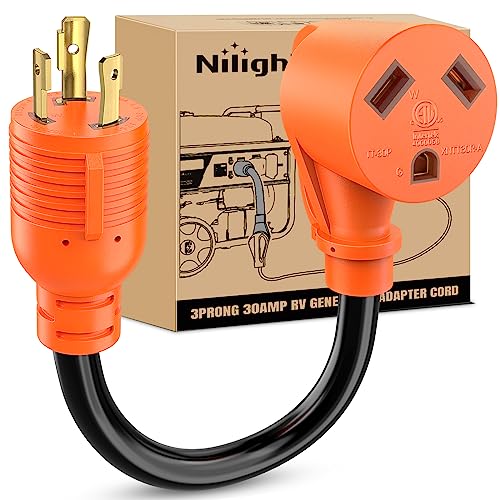
2. Nilight 30 Amp to 30 Amp RV Generator Adapter Cord ETL Listed L5-30P TT-30R
A 14.3-inch bridge between a twist-lock generator outlet and a plain-flat trailer inlet.
This is the adapter for the RVer whose generator has an L5-30P twist-lock outlet but whose trailer takes a flat-blade TT-30R plug. Those two patterns do not match on their own, and this short cable solves exactly that mismatch. One end is the three-prong locking male, the other a 30 amp female receptacle for a standard RV power cord. Rated 125 volts and 3750 watts, enough to run a refrigerator, air conditioner, microwave, or roaster on one 30 amp circuit. The cord reaches 14.3 inches, long enough to relieve strain on the generator socket without dangling.
Inside the jacket is the part that matters. Nilight builds this from 100% pure copper stranded wire in full 10 gauge, which keeps current flowing with low resistance under load. The jacket is STW-rated PVC — a flame-retardant, heat-resilient sheath that stands up to wind, rain, snow, soil, and rocks, and it gets the ETL listing to back its safety claims. The bright orange coloring is a small touch that pays off: you will not leave it behind on the pedestal at the campground.
The realistic trade-off is that this is an adapter, not a solution for every camping setup. It fits a 30 amp three-prong generator outlet and a 30 amp RV inlet, and that is the whole job — anything else and you have the wrong pattern. It is also short, so the generator needs to sit near the trailer inlet. At 14.3 inches it will not stretch across a site, and unlike the 25 ft PlugSaf cord above, it is not meant to. Buyers report it working cleanly on a Predator 3500 generator, and the fit-and-finish gets consistent praise for locking securely into the shoreline cord.
ETL Safety Mark: owners describe this as built heavy-duty the way it should be, with a tight twist-lock that refuses to wander out of the socket.
RV Hookups: a camper converting an L5-30 generator outlet to the standard TT-30 trailer inlet.
Home Standby: your generator uses a four-prong L14-30 outlet — you need a different pattern entirely.
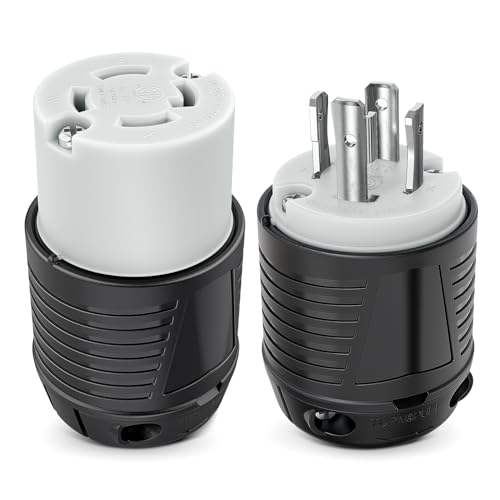
3. Nilight 30Amp Generator Twist Lock Plugs ETL Listed L14-30P L14-30R
The bare ends for the owner who already has 100 feet of cable on a spool.
If you already own a roll of #8 AWG, four-conductor cable and want to terminate it yourself, this male-and-female locking set is the practical answer. It ships as an L14-30P male plug plus an L14-30R female connector, both rated 30 amps at 125/250 volts, with four wires inside. That four-wire setup carries two hot legs, a neutral, and a ground — the arrangement a transfer switch expects, and the reason this pattern is the standard for home generator hookups. Colored terminals simplify the wiring: green lands on the ground wire, white on neutral, and black and red on the two hots.
One thing buyers flag is the housing material. The body is ABS plastic rather than a denser nylon, so while it resists high temperatures and flame and does not oxidize thanks to nickel-coated copper poles, it is a plastic shell, not a machined metal housing. That is the practical trade for the low price tag. Owners who mention it say the ends lock into place firmly and the install is straightforward, and the ETL certification gives the safety side the same weight as an Underwriter Laboratories listing. One owner on a 100 foot cord noted the set was well built, and the general verdict across the reviews is an easy one to sum up: “Excellent quality. Excellent Functionality. Just what I needed 3 days ago.”
This set is not plug-and-play. If you have never wired a four-wire 30 amp connection before, you will strip the jacket, cut conductors, and tighten terminal screws, with the neutral and both hots going to the right spot. Get one wrong and you have a problem. That is why a pre-made cord like the PlugSaf 15 footer up top is the safer call for most buyers, while this is the choice for someone who wants a custom length and knows their way around a cable termination.
Replacement Plugs: you want to build a generator cord to your own exact length and you are comfortable terminating four wires.
Complete Kits: you want to open a box and plug in — this set needs your wire and your labor first.
4. MECMO 30A/250V NEMA L6-30P & L6-30R Generator Locking Plug Connector Set
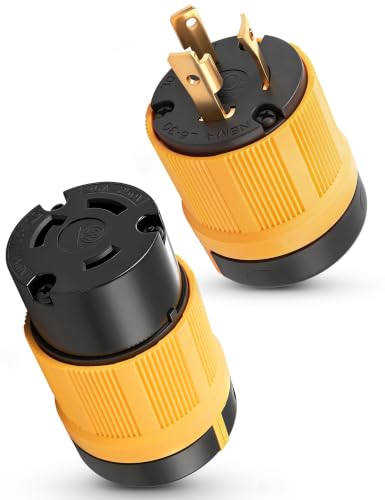
A 250-volt three-prong locking set for welders, jobsites, and gear that never touches a house panel.
The L6-30 pattern is a different animal from the L14-30 that dominates home generator hookups. This set is a three-prong, 250-volt locking pair — an L6-30P male and an L6-30R female, 3-wire grounding with 2 poles plus ground. That is the configuration you find on welding equipment, jobsite power drops, and marine or industrial gear, and it is rated for up to 7500 watts at 30 amps. The male end carries a UL listing and the female end an ETL listing, so both halves came through lab testing against published safety standards. Wiring is labeled and separated: each terminal is clear and distinct, which makes solid connections easier when you are terminating a cable.
The housing is the honest weak spot. Owners who have compared it to heavier-priced brands note the plastic feels thinner and more brittle than the thick nylon used on pricier sets, and a few mention that the screws are not captured — meaning they can be dropped and lost during installation. Threads on the housing screws sit at the same thickness as the shaft, which makes them more prone to stripping than a reinforced design. Inside, though, the copper contacts fit tight and positive, and the set works at full load. One buyer summed up the value honestly by saying the most popular brand costs nearly twice as much and they liked this set anyway.
The locking mechanism is the one thing to test on arrival. A share of feedback describes the lockup feeling soft compared to a factory-molded connector, with one report of the connection working loose from a knock and needing a zip tie for extra security. Copper contacts seating solidly in the receptacle gets consistent praise, and the twist-lock ground contact is cited as reliable under load. For a welder extension cord, a compressor feed, or shop equipment where the connector lives indoors or in a protected spot, this set handles the job at half the cost of the top brand. For outdoor installs, add a weatherproof enclosure.
L6-30 Locking Fit: 30 A / 250 V of 3-prong locking power at a price that undercuts the top-name connector set.
Limited Amperage: the plastic housing and un-captured screws are lighter-duty than they look — snug those housing screws by hand and plan on a zip tie if the lockup feels loose.
Workshop Tools: you need a 250 V three-prong locking set for a welder or shop tool and want to save against the premium brand.
50A Devices: the connection will see constant vibration outdoors without a protective enclosure.
5. ELEGRP NEMA L6-30P & NEMA L6-30R Locking Plug and Connector Set
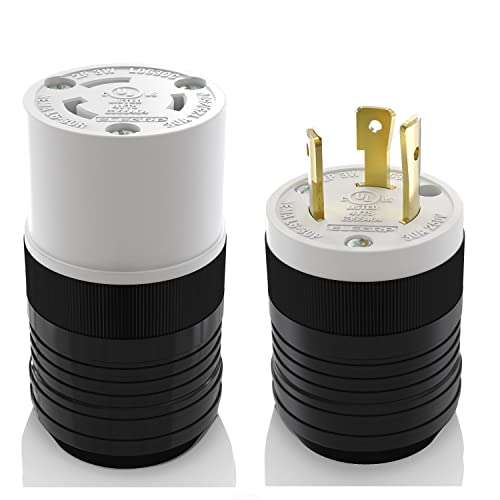
The 250-volt connector set built for abuse — single-piece brass contacts and crack-resistant nylon.
This is the same L6-30 pattern as the MECMO set above, but built for buyers who care more about housing durability than saving five dollars. The shell is toughened nylon, which will not crack in high-abuse applications, and the insulating design keeps non-current-carrying parts from becoming energized. The contacts are formed from a single piece of solid brass rather than stamped pieces, which reduces friction at the connection point and cuts the heat that builds up under a serious load. The result is conductivity that stays clean over years of use, and it is the kind of detail that separates a jobsite-grade set from a weekend one.
The fastening system is worth a close look because it is the part you will touch every time you install this. Each wire slides into its own separate tube and gets tightened down to prevent stray strands from shorting against a neighbor. Grip screws install from the same side, so tightening is quick, and there are pocketed recesses so the screwdriver will not slip off the head and strip it. A flexible rubber dust seal keeps moisture and contaminants out of the wiring chamber — a small feature, but one that pays off in a damp basement or a humid shop. The face and body have alignment features that make assembly fall into place instead of fighting you.
What you give up against the MECMO is purely cost — this set carries the higher price tag but does not shrink the housing to get there. What you give up against a pre-made cord is convenience; you supply the wire and the time. One buyer running a tankless water heater setup said these worked well and another said the wire holes fit 10/3 SO cord with no stripped screws, which is the whole point. On an industrial portable cord, that is the difference between finishing the job and starting over with a new connector. Buyers consistently point to the quality first and the value second when they explain why they picked this set.
250V Circuits: the connector will see hard daily use and you want a nylon housing with single-piece brass contacts that will not fall apart on you.
120V Gear: the plug will live indoors on a light-duty extension cord — the cheaper L6-30 set handles that just fine.
6. AIDA NEMA L14-30P & NEMA L14-30R Locking Plug and Connector
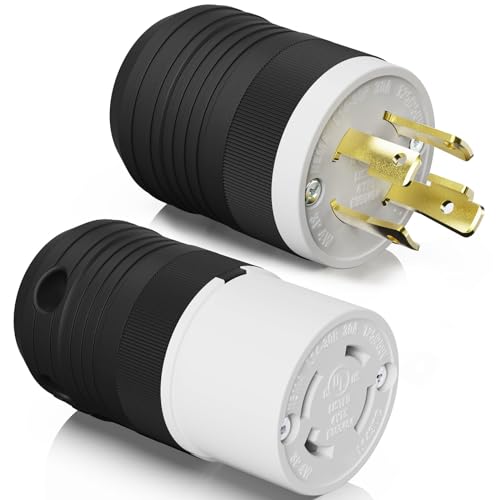
Four-wire home generator ends with a split-circuit trick that changes how you feed a panel.
The interesting engineering here is the split circuit capability. This L14-30 set — 30 amps at 125/250 volts, 3 poles, 4 wires with grounding — is built so you can configure it in the field for split circuit use, which matters when you are feeding separate branch circuits from one generator rather than a single panel. The nylon body is high-impact and heat-resistant, and the brass contacts are one-piece for conductivity and heat-rise resistance. The fluted body with the radial grip ridge is shaped for a full hand, so turning and pulling feel deliberate rather than fiddly. An alignment feature on the face and body helps the halves mate correctly before you tighten anything down.
Installation is where this set shines. It accepts both stranded and solid wire, and it is designed to be forgiving for the homeowner doing their first generator hookup. The grip screws tighten from the same side, so you are not flipping the connector around to reach the second screw — a small ergonomic detail that saves real time. UL and CUL listings back the safety side, which is what your electrician will want to see on any 30 amp equipment in a home runs. Owners mention it assembles easily onto 10-gauge cord and locks securely once it is together.
The one thing to check the moment the box is open is that all four wire locks are present. A share of the feedback mentions a missing lock on the receptacle end showing up on arrival, though when that happens the company has been responsive about making it right. The same feedback calls the connectors well built and sturdy, so this reads as a consistency issue rather than a design one. If your set arrives complete, as the vast majority do, you are getting a solid home generator connector at a price that sits comfortably in the middle of the field.
Transfer Switches: the homeowner wiring a four-prong generator cord for a transfer setup, with the flexibility to run split circuits.
Compact Jobs: inspect the wire locks the minute it lands — a missing one has shown up on a few orders.
7. Generator to RV Power Adapter NEMA L14-30P to TT-30R

A 12-inch adapter that turns a four-prong generator outlet into the flat 30 amp RV inlet.
This is the piece a lot of RVers need but do not know exists until they are standing at a campsite with a mismatch. Your portable generator has a four-prong NEMA L14-30P outlet. Your trailer takes a standard flat-blade TT-30R plug, rated 125 volts and 30 amps for 3750 watts. This 12 inch adapter bridges the two so you can run the trailer’s AC, microwave, water heater, or refrigerator from the generator. The 12 inch cord is long enough to relieve strain without turning into a mess, and the female end has a grip handle that makes disconnecting from a tight outlet something you can actually do with your hands.
Inside, the adapter is built from 100% copper contacts under a heavy-duty PVC jacket that is rated for both heat and cold, so it stays usable through a hot summer dash and a cold-weather start-up. ETL listing covers the safety side. The functional story is what carries it — this is the adapter buyers reach for when they want to power a trailer from a generator with one part, and it strips out the need for a separate cable and matching ends. Customers note it fitting a Honda 3000 and running a camper’s 30 amp breaker without problems.
The pattern detail is where the money is, so be sure before you buy. This adapter will only work with a four-prong L14-30 male generator outlet and a flat-blade TT-30 RV inlet. If your generator has a three-prong twist-lock L5-30 outlet, you want the Nilight adapter above instead, not this one. If your trailer uses a twist-lock inlet, you want a different set entirely. The adapter also does not add capacity — it makes the connection, it does not let you run more devices at once. Check the total load before stacking appliances on one 30 amp circuit, the same discipline you would apply to any generator feed.
TT-30 RV Fit: the reliability — this is the connector that makes a Honda 3000 and a 30 amp travel trailer finally speak the same language, and it does it without drama.
Campground Power: you are connecting a four-prong generator to a standard flat-blade RV inlet with a single part.
50A Rigs: your generator outlet or your RV inlet uses a different blade pattern — the adapter has to match both ends or it does nothing.
8. STARELO 30 Amp Locking Female Plug Box NEMA L5-30C Generator Twist Lock Adapter
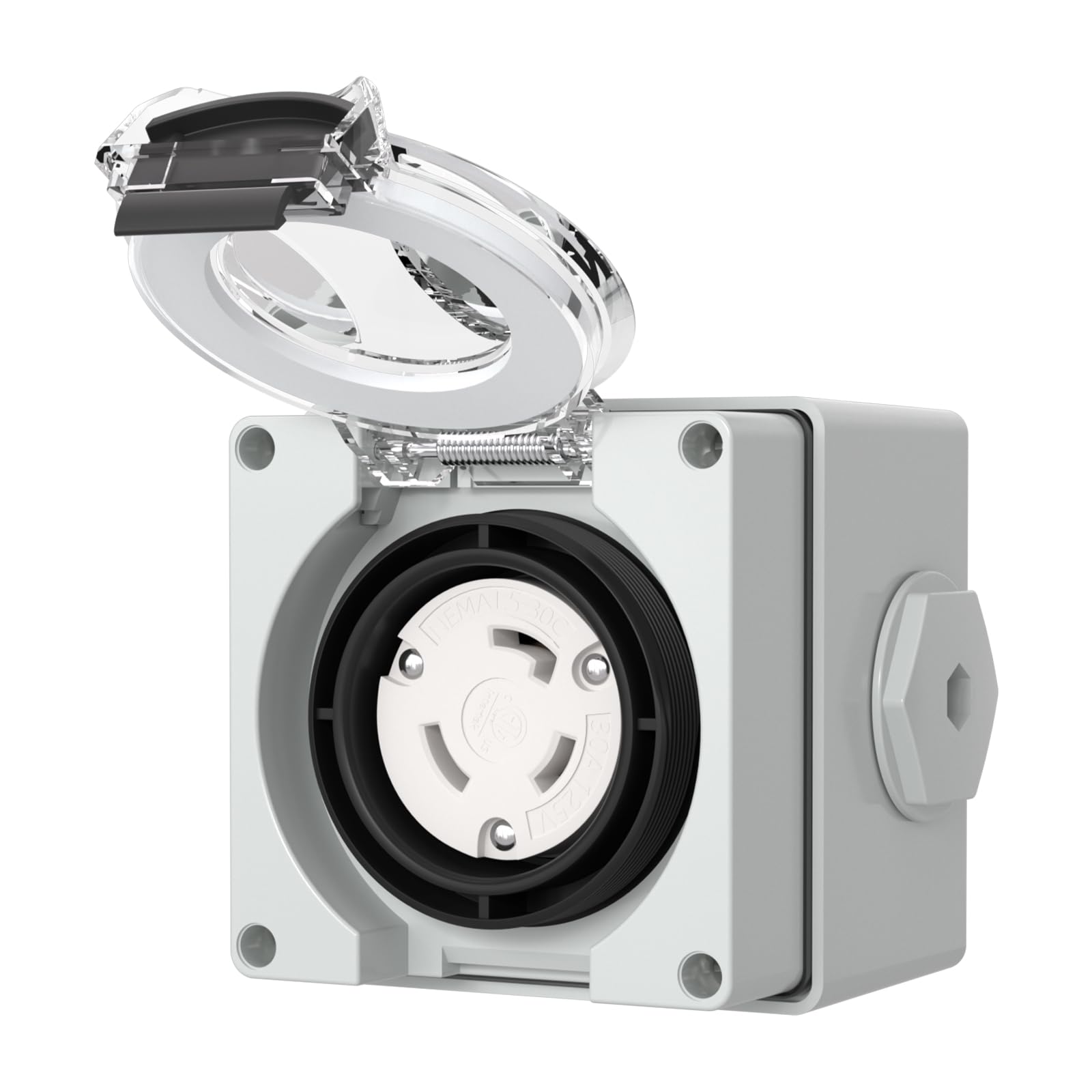
A permanently mounted outdoor female outlet with a sealed cover for a welded or generator feed.
Not everyone is trying to move power across a yard. Somebody needs to install a fixed outdoor female receptacle that a generator or welding machine can plug into, and that is what this box does. It is an L5-30C locking female plug rated 125 volts and 30 amps, 2 poles and 3 wires with grounding, set inside a protective plastic box with an IP66 weather rating. That rating means the sealed cover keeps out dust and driving water when the plug is capped, so the outlet survives outdoors between uses. When the cover is closed, dust and radiation are kept off the contacts — a small thing, but it is the point of buying a boxed outlet rather than a bare receptacle.
The housing is where this piece earns its keep. The box is made of high-quality ABS plastic and owners describe it as solidly built. One buyer installed it outside with no trouble and called it heavy-duty and nice looking, which matches the pattern across the feedback — the physical construction is what people notice first, and the durability gets called out right behind quality. For a generator transfer switch feed or a welding machine outlet that lives exposed to the elements, that is exactly the property you want your money going toward.
The wiring is where you need to slow down. The receptacle’s connectors are not marked except for the ground terminal, and the included directions describe a 220 volt L6-30 style install rather than the 125 volt L5-30 you actually have. You have to be careful not to reverse the hot and neutral. It is not a hard job if you have the NEMA wiring diagram in front of you, and the diagram for an L5-30R is easy to find online, but this is not the connector to wire by guesswork. Plan on pulling up the schematic before you touch a screwdriver, and give yourself a few extra minutes for the first installation. That is a fair trade for a sealed outlet designed to live outdoors.
Outlet Additions: an outdoor fixed female outlet that needs to stay sealed and survive the weather on a generator or welder feed.
Full Cords: you are wiring it yourself — the labels are thin, and the hot and neutral need to go where the schematic says, not where the instructions imply.
9. PlugSaf 25FT 30 Amp Generator Cord 4 Prong, 10AWG 125/250V 3750/7500W STW

The 25-footer that actually reaches — 10 feet of extra slack over the 15 ft cord for a yard crossing.
Same 4-prong design as the 15 foot PlugSaf cord that starts this list, but the 25 foot version is the one for the house at the end of a long driveway or the generator parked at the property line. It runs L14-30P to L14-30R, 30 amps at 125/250 volts, 3750 watts on one leg and 7500 on the other, with the same 10 AWG stranded copper conductors under the STW jacket. IP65 water resistance handles sun, rain, and temperatures down to -40°C. It arrives with an adjustable cord organizer, which keeps 25 feet of heavy cable tidy on a shelf rather than tangled on the floor. Reach is the whole reason to pick it, and 25 feet means the generator can sit far enough away that you stop hearing it in the house.
What buyers bring up most is the cold-weather performance. In colder months, cheap cords stiffen into a log that will not coil; this one stays pliable. Then there is the strain handling. Owners running a heavy outage load through this cable report no heat buildup in the wire or plugs and no flickering, which points to solid internal connections. Owners who used it through multi-day outages call it reliable and say it kept the central air running alongside lights and freezers. The twist-lock ends go in easily and stay put, and the jacket takes being dragged around a yard without showing wear.
The one honest note is weight. Longer, heavier cable is more awkward to coil and carry, and 25 feet of 10 AWG is not something you flip over your shoulder without thinking about it. If you only ever need to bridge the ten feet from house to generator, the 15 foot version up top is lighter and easier to store. Choose the 25 footer when the distance is real and a shorter cord would leave the generator parked too close to the bedroom window.
25FT Extra Length
- 25 ft of reach separates the generator from the house by a real distance
- 10 AWG stranded copper in an STW jacket, IP65 rated and good to -40°C
- Stays pliable in cold weather instead of stiffening into a coil that fights you
- Cord organizer keeps the length stowed cleanly between outages
Heavy Coil
- Heavier to coil than the 15 ft cord — that extra length costs you carrying effort
- More cable than you need if the generator and house inlet sit close together
Large Yards: your generator sits far from the inlet and you want 25 feet of 10-gauge copper between the two.
Small Patios: the run is under 15 feet — the shorter PlugSaf cord is lighter and stores more easily.
Understanding the Specs
NEMA Blade Patterns
The NEMA code printed on the plug tells you the exact blade arrangement, and that arrangement has to match the outlet on both ends. L14-30P is the four-blade twist-lock male that carries both 125 and 250 volts, and it is the standard for a portable generator feeding a home transfer switch. L5-30P is a three-prong twist-lock male rated for 125 volts only, common on smaller generators. L6-30P is a three-prong 250-volt locking plug used on welders and industrial gear. TT-30R is the flat-blade female receptacle found on travel trailers and campground pedestals. Get the code wrong and the plug will not seat, no matter how well it was made.
Twist Lock and 10 AWG Wire
Twist lock means the plug turns and mechanically engages the outlet, which is what keeps it from vibrating loose or pulling out when the cord gets bumped. It matters most on a generator running outdoors, where wind and vibration are constant. The wire gauge matters just as much. 10 AWG stranded copper carries the full 30 amps comfortably on a short-to-medium run, and the stranded construction keeps the cable flexible enough to coil without cracking. Thinner wire on a 30 amp circuit builds heat, and heat is what degrades a connector over time.
FAQ
What is the difference between L14-30, L5-30, and L6-30 plugs?
Will a 30 amp generator plug work with my transfer switch?
How much power can a 30 amp plug actually carry?
Can I leave a 30 amp generator plug outside in the rain?
What gauge wire should a 30 amp plug use?
Is a twist-lock plug better than a straight plug?
Can I use a 30 amp generator plug for an RV?
How do I wire a 30 amp plug without reversing the connections?
Do I need a UL or ETL listing on a generator plug?
Why does my 30 amp plug feel warm after running the generator?
Final Thoughts: The Verdict
For most people, the 30 amp generator plug winner is the PlugSaf 15FT 30 Amp Generator Cord because it arrives with molded NEMA L14-30 ends already on 10 AWG copper, so there is nothing to wire and nothing to get backwards. If you are feeding a travel trailer from a four-prong generator, grab the Generator to RV Power Adapter — it matches both ends in one short part. And if your run crosses a long driveway, the PlugSaf 25FT 30 Amp Generator Cord is the one to reach for, since the extra length keeps the generator far from the house.
Before you add any of these to a cart, do one thing first: look at the outlet on your generator and the inlet on whatever it feeds. Write down both NEMA codes. That single step is what keeps you from buying a well-made connector that simply will not fit. The PlugSaf cord at the top of this list is the crowd favorite here, holding the highest score of the finished cords with thousands of owners behind it — a safe first stop if your two codes are L14-30 on both sides.
How We Picked
We do not accept paid placement. Every pick is matched to a real buyer and a real use-case; we do not hands-on test units.
Sources & Methodology
Specifications: manufacturer listings and product documentation. Review insights: verified customer reviews, as of September 2026. Pricing: not shown on this page (it changes often); check the current price via the retailer link.
As an Amazon Associate, Gadgets Feed earns from qualifying purchases. This does not affect which products we feature.