
Your camper’s 30-amp shore power inlet expects exactly one thing: a steady flow of 120-volt current without dangerous dips or spikes. The wrong generator either trips your RV’s breaker the moment the air conditioner kicks in or leaves you with a bricked control board from dirty power. A true 30-amp generator isn’t just about having a TT-30R receptacle — it’s about matching your RV’s load profile with a unit that delivers clean sine-wave electricity at 3,600 watts sustained.
I’m Min — the co-founder and writer behind Gadgets Feed. I’ve spent hundreds of hours cross-referencing load bank tests, THD measurements, and real owner reports to separate the portable inverters that genuinely hold 30 amps from those that can only flash the spec sheet.
This guide cuts through the noise to identify the best 30 amp generator for your specific RV, job site, or home backup needs based on verified performance data rather than marketing claims.
How To Choose The Best 30 Amp Generator
Buying a 30-amp generator is about sustaining 3,600 watts continuously, not just producing it for a moment. Most buyers get tripped up by peak wattage numbers — the number that matters for a 30-amp trailer is the generator’s *rated* running wattage. If the rated output is below 3,000 watts, your RV’s air conditioner will likely drag down the voltage and potentially damage the compressor.
Dual Fuel vs. Single Fuel
A dual-fuel generator runs on gasoline and propane. Propane never goes stale, doesn’t clog carburetors, and is allowed in many campgrounds where gas cans are banned. The trade-off is roughly a 10–15% derate on peak and running watts when using propane. A single-fuel unit is simpler and cheaper but leaves you vulnerable if gas is scarce during an emergency. Serious RVers almost always prefer dual-fuel.
Inverter vs. Conventional
Inverter generators produce clean power with total harmonic distortion under 3%, safe for the sensitive control boards found in modern RVs and home electronics. Conventional generators often exceed 10% THD, which can fry a TV or a furnace motherboard. For a 30-amp setup that powers laptops, microwaves, and AC units, inverter technology is mandatory — not optional.
Portability and Noise Floor
A 30-amp inverter generator can weigh anywhere from 45 pounds to over 180 pounds. If you camp frequently and load the generator yourself, weight and integrated wheels matter as much as power output. Noise matters at campgrounds with quiet hours — anything above 64 dBA at 23 feet will draw complaints. Eco-throttle modes reduce engine speed under light load, cutting both fuel consumption and noise by up to 50%.
Quick Comparison
On smaller screens, swipe sideways to see the full table.
| Model | Category | Best For | Key Spec | Amazon |
|---|---|---|---|---|
| Champion 4000-Watt Inverter | Premium | Dual-fuel RV reliability | 3000W running / 25 hrs on propane | Amazon |
| Westinghouse iGen12000DFc | Premium | Whole-home backup | 9000W running / 19 hrs runtime | Amazon |
| Westinghouse 4021 | Premium | Remote start convenience | 3300W running / 52 dBA | Amazon |
| Pulsar 7250W Inverter | Mid-Range | 240V output & high surge | 6000W running / 312cc engine | Amazon |
| WEN DF360iX | Mid-Range | Lightweight dual-fuel | 2900W running / 49 lbs | Amazon |
| WEN 56360i | Mid-Range | Ultra-light RV companion | 2900W running / 46 lbs | Amazon |
| ERAYAK 4500W Inverter | Mid-Range | Auto-switch dual-fuel | 3500W running / 54 lbs | Amazon |
| PowerSmart PS5046CE | Mid-Range | Electric start value | 3500W running / 5 hr runtime | Amazon |
| Westinghouse iGen2800DFc | Mid-Range | Compact dual-fuel camping | 2200W running / 45 lbs | Amazon |
In‑Depth Reviews
1. Champion Power Equipment 4000-Watt Dual Fuel RV Ready Portable Inverter Generator

Champion’s 4000-watt inverter generator delivers 3,000 running watts on gasoline and 2,700 running watts on propane, putting it squarely in the 30-amp sweet spot for travel trailers and small home backup loads. The CO Shield auto shutoff system and less-than-3% THD make this unit safe for both lungs and electronics — a rare combination at this price tier. Recoil start is simple and reliable, and the 149cc engine runs up to 25 hours on a 20-pound propane tank at quarter load, which effectively eliminates fuel-storage concerns for weekend trips.
Owners consistently report that this unit handles a 13,500 BTU RV air conditioner, a refrigerator, and lights simultaneously without the voltage sag that plagues cheaper conventional generators. The dual-fuel switching is tool-free: just connect the included propane hose and flip the selector. At 53 pounds it requires two hands to lift into a truck bed, but the integrated handle makes rolling it across a campsite manageable. The three-year warranty and free lifetime technical support add genuine long-term confidence.
The main drawback is the lack of a remote or electric start — you’ll always need to pull the cord. Some owners also note that the parallel kit is sold separately, so doubling power for a larger RV means an extra purchase. For a 30-amp primary that balances proven reliability, clean power, and low noise, this Champion is the benchmark.
Why it’s great
- Ultra-long 25-hour propane runtime at quarter load
- True ≤3% THD protects RV electronics and control boards
- CO Shield system adds essential safety redundancy
- Three-year warranty with genuine parts support
Good to know
- Manual recoil start only — no electric or remote option
- Parallel kit required for more than 30A output
2. Westinghouse 12000 Peak Watt Dual Fuel Portable Inverter Generator
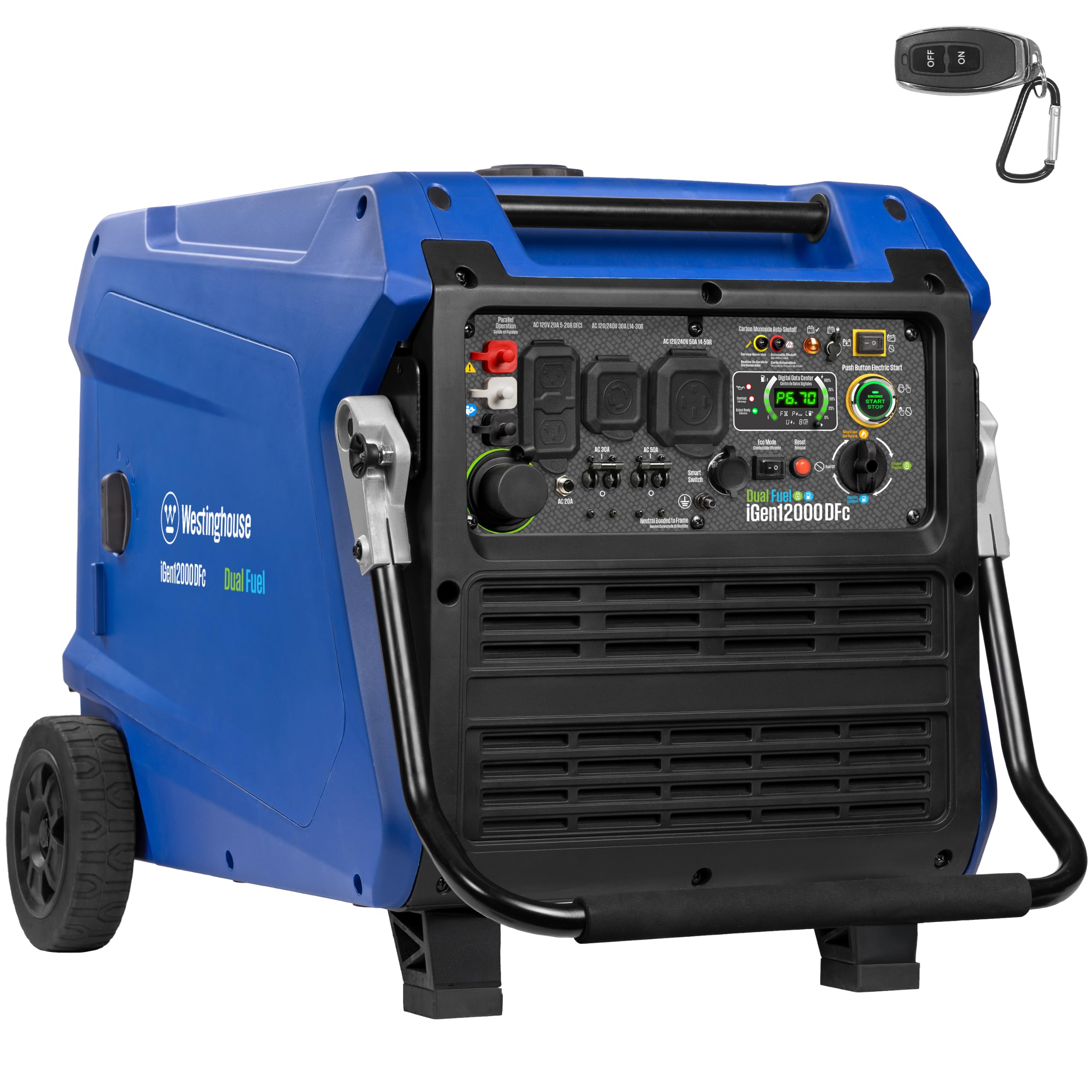
When your home or large RV demands more than 30 amps, the Westinghouse iGen12000DFc is the proper step-up. On gasoline it produces 12,000 peak watts and 9,000 running watts — enough to run a 4-ton heat pump, well pump, and refrigerator simultaneously through a transfer switch. The 50-amp 14-50R outlet directly feeds the standard RV pedestal or home interlock, while the L14-30R provides a secondary 30-amp circuit for tools or smaller loads.
The 457cc engine, remote start key fob, and 7.9-gallon fuel tank deliver up to 19 hours of runtime at 25% load, and the ECO mode cuts fuel consumption by roughly half when demand is low. At 64 dBA it is noticeably quieter than any comparable open-frame generator, though at 187 pounds it needs its built-in wheels and foldable handle to move around a driveway. The digital display shows real-time load, voltage, frequency, and remaining run time, which makes load management straightforward.
Owner reports confirm the smooth sine-wave output powers sensitive electronics — several units have successfully charged Teslas through the 14-50R at 20–25 miles per hour. The CO sensor and low-oil shutdown provide standard safety layers. The minor trade-off is fuel consumption at full load: expect refueling every 4–5 hours when pushing 9,000 watts. For whole-home backup that also handles a 50-amp RV, this is the definitive heavy-lift option.
Why it’s great
- Both 50A and 30A outlets for transfer switch readiness
- Remote start with key fob works from 50 feet away
- True inverter THD under 3% for all electronics
- 19-hour runtime at quarter load
Good to know
- Requires 5W-30 synthetic oil for cold-weather operation
- Heavy despite wheels — not for frequent loading
3. Westinghouse 4000 Peak Watt Super Quiet Portable Inverter Generator
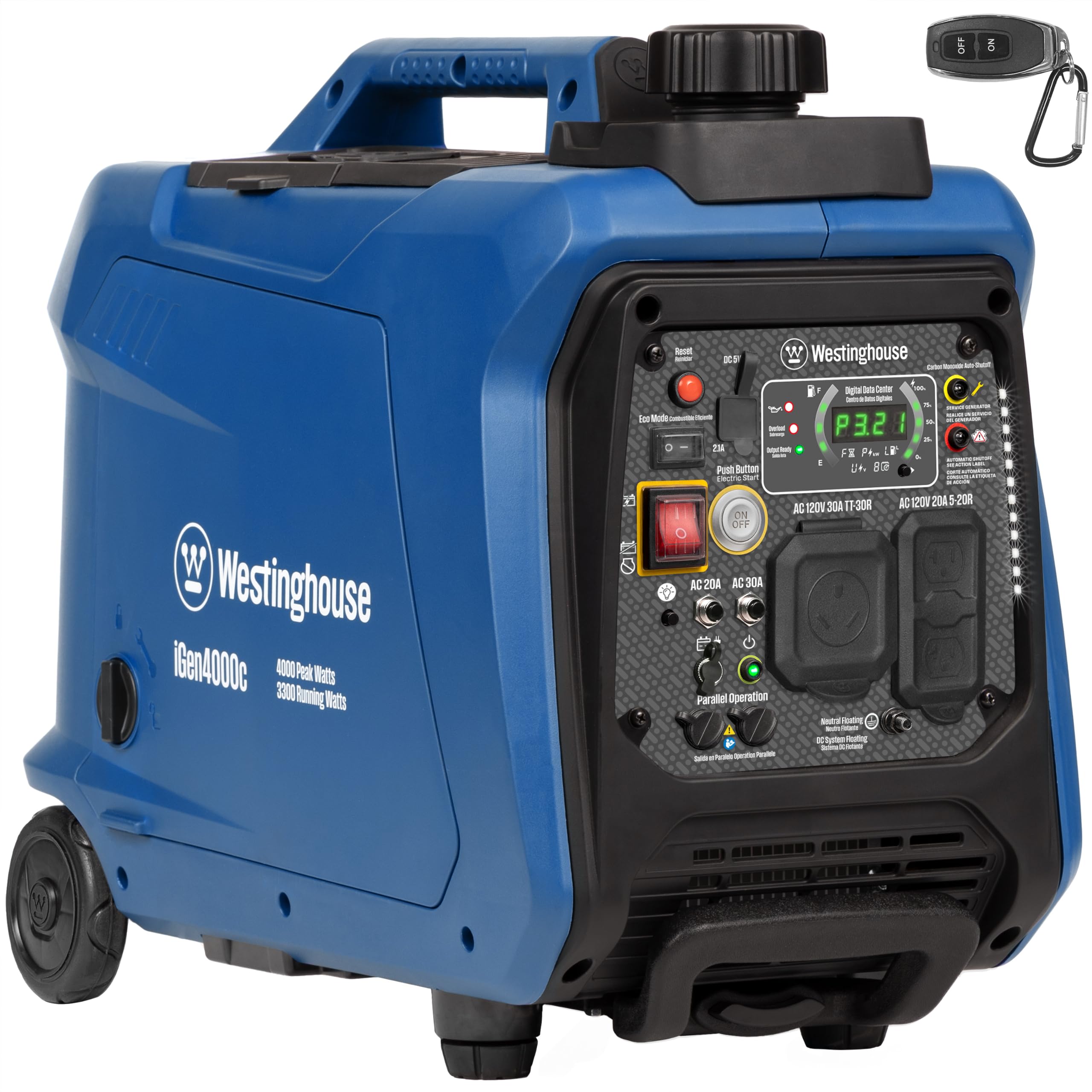
Westinghouse’s 4021 model packs 3,300 running watts and remote start capability into a 61.7-pound package with a telescoping handle, making it one of the most user-friendly 30-amp-ready inverters available. The TT-30R outlet provides the direct drop-in for any standard RV shore power connection, and the duplex household outlet handles additional tools. At 52 dBA in ECO mode you can hold a conversation right next to it — critical for campgrounds with strict quiet hours.
The LCD data center cycles through fuel level, power output, remaining runtime, voltage, and lifetime hours, giving you instant visibility into generator health. Owners consistently praise the remote key fob start, which allows turning the unit on from inside an RV or house during cold weather. The fuel tank holds 1.69 gallons and provides up to 7 hours of runtime at full load, or closer to 12 hours in ECO mode. The low-oil and CO shutdown sensors add essential safety without adding complexity.
The main limitation is the small fuel tank — you will refuel every 4–6 hours when running the air conditioner and microwave. Also, the unit is gasoline-only, so you lose the fuel flexibility that dual-fuel buyers want. For RV owners who prioritize push-button convenience and near-silent operation, this is the best one-person portable in the 30-amp class.
Why it’s great
- Remote start key fob eliminates cold-weather pull-start frustration
- 52 dBA noise floor is among the quietest in its power class
- Telescoping handle and wheels make single-person transport easy
- Live data center tracks fuel, watts, and runtime
Good to know
- Gasoline only — no dual-fuel option
- Small 1.69-gallon tank requires frequent refueling
4. Pulsar 7,250-Watt Super Quiet Dual Fuel Inverter Generator

The Pulsar 7250W inverter generator stands apart in the 30-amp category because it outputs both 120V and 240V — a capability that matters for well pumps, compressors, and home subpanels that require split-phase power. On gasoline it delivers 7,250 peak and 6,000 running watts, while on propane those numbers drop to 6,500 peak and 5,500 running watts. The L14-30R twist-lock provides the 240V connection, and the TT-30R handles standard RV 120V loads.
The 312cc engine is the largest in this comparison group, yet the enclosed inverter design keeps noise reasonable for a dual-voltage machine. Remote, electric, and recoil start options mean you have redundancy if the battery runs low. The digital control panel displays hours, voltage, load, and frequency, and the parallel capability lets you pair two units for over 14,000 peak watts. Owners note the low-idle feature is particularly effective — the engine barely hums when nothing is drawing power.
Build quality has been criticized, with some owners reporting failed electric start solenoids after a few days. The fix is a common solenoid, but having to DIY a new component on a generator in this price range is frustrating. The 118-pound weight also limits portability despite the wheel kit. For buyers who genuinely need 240V output from a 30-amp inverter, the Pulsar delivers unmatched versatility at its price.
Why it’s great
- True 240V split-phase output via L14-30R receptacle
- Three-way start (remote, electric, recoil) for maximum reliability
- Dual-fuel capability with long propane runtime
- Parallel ready for doubled power
Good to know
- Reported solenoid defects on early units
- 118 pounds is heavy for frequent transport
5. WEN Quiet and Lightweight 3600-Watt Dual Fuel RV-Ready Portable Inverter Generator (DF360iX)

The WEN DF360iX bridges the gap between budget-friendly and genuinely useful 30-amp performance. It produces 3,600 surge and 2,900 running watts on gasoline, with 3,500 surge and 2,600 running watts on propane — enough to run a 13,500 BTU RV air conditioner, microwave, and lights simultaneously, provided you manage the load. The TT-30R outlet is built directly into the panel, so you do not need adapters for your shore power cord.
At 49 pounds the DF360iX is one of the lightest dual-fuel inverters on the market, making it practical for solo RV travelers who load and unload at every campsite. The WEN Watchdog CO sensor automatically shuts the unit down if carbon monoxide accumulates, and the fuel shutoff valve lets the carburetor run dry before storage — a critical feature that prevents ethanol-related gumming. Owners report first-pull starts even after months of storage when using this shutoff routine.
The dual USB ports and 12V DC outlet add convenience, and the integrated display shows voltage, frequency, and runtime. Some owners note the 20-amp household outlets hold plugs loosely, which can be annoying with heavy-gauge extension cords. For the price, you sacrifice the 3600-watt surge rating slightly compared to higher-priced competitors, but the DF360iX represents the best per-pound value in the dual-fuel 30-amp segment.
Why it’s great
- Only 49 pounds with dual-fuel and true 30A outlet
- Fuel shutoff valve extends carburetor life and storage reliability
- CO Watchdog auto-shutdown adds essential safety
- Three-year warranty with dedicated support
Good to know
- 20A household outlets reported to hold plugs loosely
- 2,600 running watts on propane may not start some large AC units
6. WEN 3600-Watt Portable Inverter Generator (56360i)

The gasoline-only WEN 56360i is the lightest generator in this roundup at 46 pounds, and it still delivers a true 30-amp TT-30R receptacle with 3,600 surge and 2,900 rated watts. For campers who never want to lift more than 50 pounds, this unit is practically a carry-on compared to the 120-pound competitors. The 149cc engine starts reliably in two pulls when warm, and four pulls at 14°F according to verified owner reports — impressive for a sub- inverter.
Noise output is genuinely quiet: owners describe it as an “audible purr” that does not disturb conversations or campground neighbors. The fuel shutoff is the same carburetor-clearing design that WEN uses on its more expensive models, and the parallel readiness means you can pair a second 56360i for 7,200 surge watts when needed. The three-year warranty at this price point is outstanding, especially considering that Honda equivalents cost triple the price.
The trade-off is the lack of dual-fuel capability and the 22.5-amp current rating — technically below the 30-amp nominal rating, though real-world tests show it runs 13,500 BTU AC units without issue. The 1.2-gallon tank provides roughly 4 hours runtime at full load. For a budget-focused buyer who weighs every pound and wants reliable 30-amp RV power, this WEN is the clear value champion.
Why it’s great
- 46 pounds is the lightest 30-amp inverter on the market
- Reliable cold-start with 4-pull performance at 14°F
- Fuel shutoff preserves carburetor during long storage
- Three-year warranty is exceptional at this price tier
Good to know
- Gasoline only — no propane option
- 22.5 amp rating is slightly below 30A nominal
7. ERAYAK 4500W Dual-Fuel Portable Inverter Generator
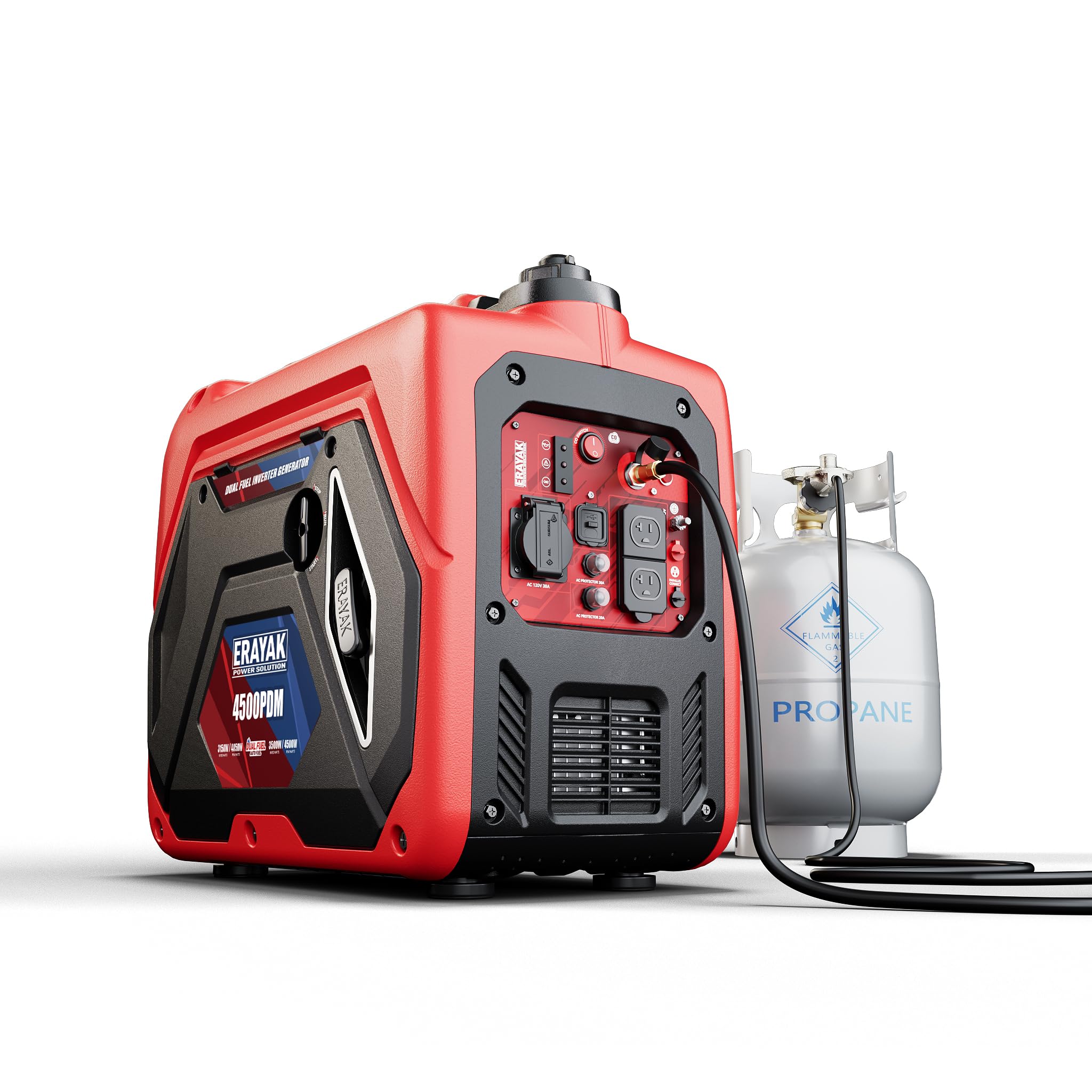
ERAYAK’s 4500PDM inverter generator packs a unique feature that no other unit in this comparison offers: automatic fuel switching. When the gasoline runs dry, the generator seamlessly transitions to propane without any shutdown or manual selector flipping — a true convenience if you run out of gas in the middle of the night. On gasoline it delivers 4,500 peak and 3,500 running watts, while on propane it outputs 4,050 peak and 3,150 running watts.
At 54 pounds with a compact 20 x 11.7 x 19.3-inch frame, this is one of the most space-efficient 30-amp dual-fuel inverters available. The pure sine wave inverter technology delivers THD between 0.2% and 1.2%, which is comfortably within the safe zone for laptop chargers, battery tenders, and RV control boards. The USB-A and 18W USB-C ports are a rare addition that eliminates the need for separate adapters when charging modern devices.
The electronic speed control extends runtime to roughly 16 hours at 25% load on a 2.25-gallon tank, and 20+ hours on propane. The CO sensor and circuit breaker protection cover basic safety bases. Reliability concerns appear in some owner reports — one unit failed on the first day of a holiday trip due to speed control issues. While ERAYAK offers a three-year warranty and lifetime technical support, the mixed early reviews suggest this is a promising design that still needs a longer track record.
Why it’s great
- Auto fuel switch prevents power interruption when gas runs out
- Ultra-low THD (0.2%–1.2%) for sensitive electronics
- 54 pounds and compact footprint for easy storage
- USB-C 18W port built into the control panel
Good to know
- Mixed early reliability reports with some engine speed failures
- Recoil start only — no electric or remote option
8. PowerSmart 4800W Portable Inverter Generator (PS5046CE)
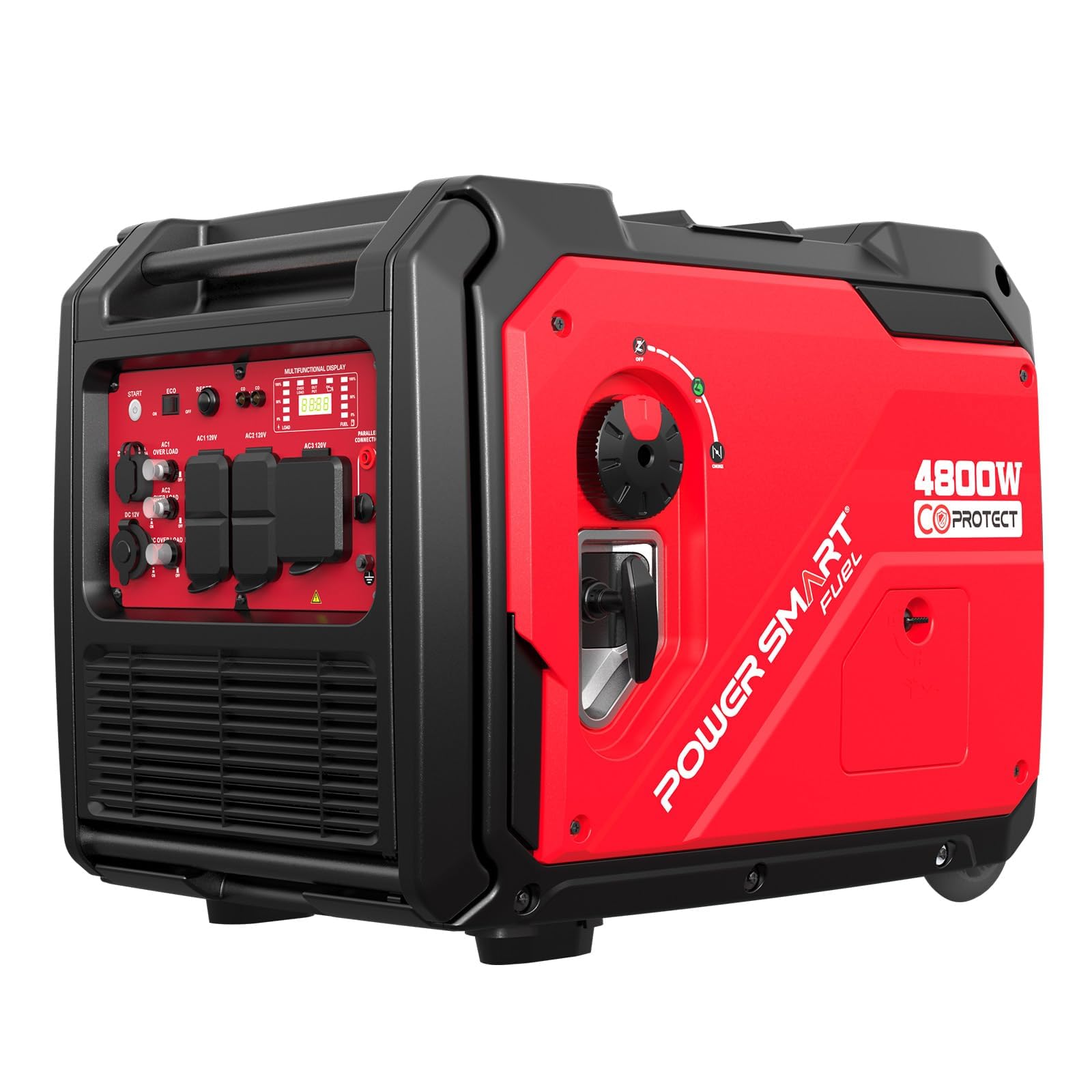
For buyers who want electric start without paying premium-tier prices, the PowerSmart PS5046CE delivers 4,800 surge and 3,500 running watts with a one-touch push-button ignition. The dedicated 30-amp TT-30R outlet is matched with two 20-amp household outlets and USB ports, giving you enough flexibility to power an RV and campsite accessories simultaneously. The fully enclosed body keeps noise to roughly 59 dBA in ECO mode — genuinely conversation-friendly.
The 3.4-gallon fuel tank provides approximately 5 hours of runtime at full load, and ECO mode extends that considerably when the AC compressor cycles off. The parallel-ready design allows pairing two units for over 9,600 surge watts, which is a practical upgrade path for buyers who expect to eventually need more power. The low-oil shutdown, overload protection, and CO sensor all meet current safety compliance standards.
One significant red flag: multiple owners report that the 120V household outlet failed after short-term storage, and PowerSmart’s customer service response was slow and ultimately unable to source replacement parts. The generator sounds excellent when it works, but warranty support has been described as “horrible” by verified purchasers. For buyers comfortable with DIY repair or who prioritize budget-friendly electric start, this is a high-risk, high-reward pick.
Why it’s great
- One-touch electric start eliminates recoil strain
- 59 dBA noise floor in ECO mode is impressively quiet
- Parallel capable for power upgrade without a new generator
- CO sensor, low-oil, and overload protection included
Good to know
- Customer support and parts availability are inconsistent
- Reported outlet failures after short storage periods
9. Westinghouse 2800 Peak Watt Super Quiet Dual Fuel Portable Inverter Generator (iGen2800DFc)
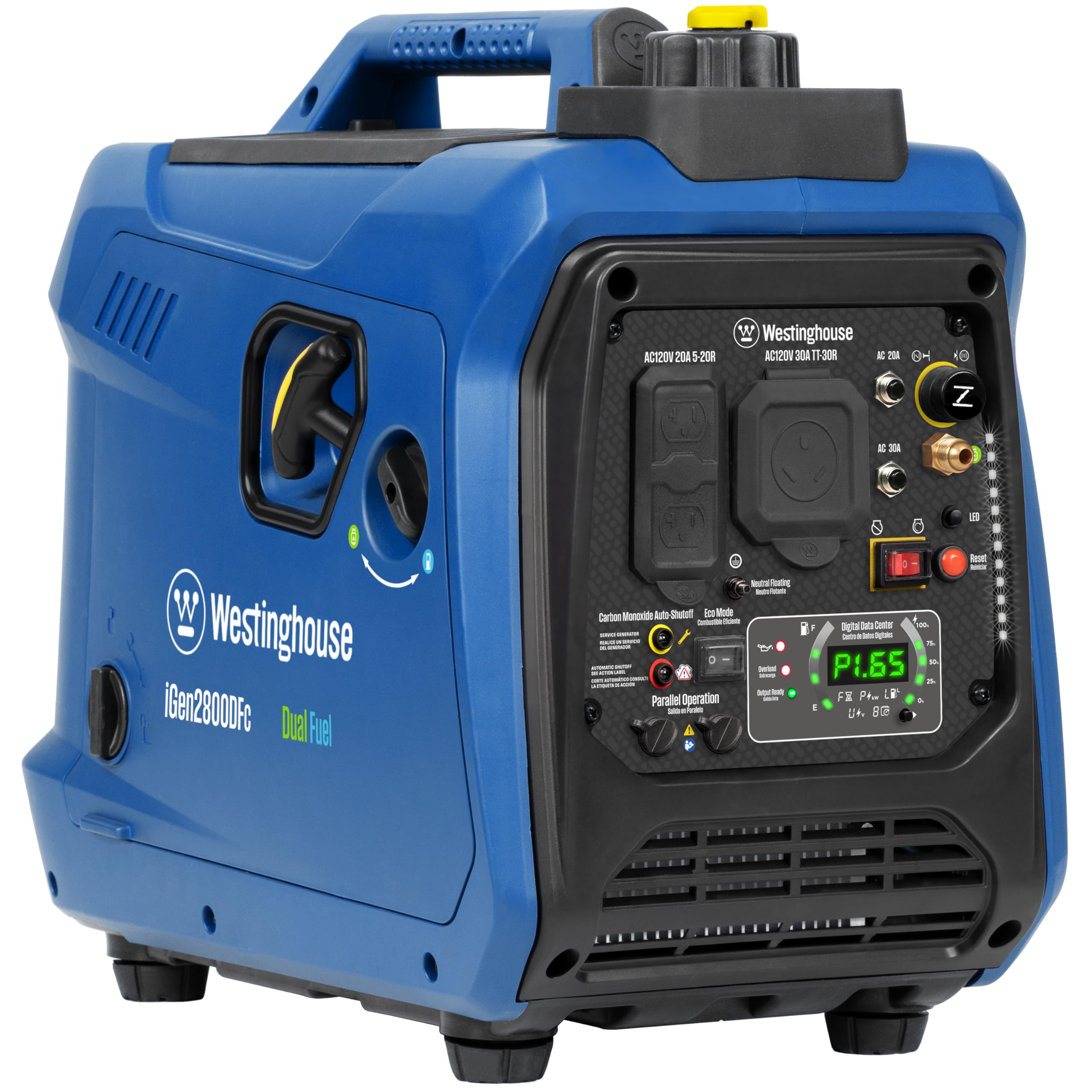
At 45 pounds with dual-fuel capability, the Westinghouse iGen2800DFc is designed for the lightweight camper who wants propane convenience without the 55-pound weight of larger units. On gasoline it peaks at 2,800 watts and runs at 2,200 watts, while on propane it peaks at 2,520 watts and runs at 1,980 watts. This is not enough to simultaneously run a 13,500 BTU AC unit and a microwave — but for smaller pop-up campers, van conversions, or tailgating setups, the wattage is perfectly adequate.
The TT-30R 30-amp outlet is present, and the LED data panel shows fuel level and remaining run time, which is rare for a sub-50-pound generator. The noise floor measures around 52 dBA at quarter load, making it one of the quietest portable inverters on the market. Owners praise the instant first-pull start and the rubber feet that virtually eliminate vibration transfer to the ground. The inclusion of a propane hose means you can run on a 20-pound BBQ tank immediately out of the box.
The small fuel tank holds less than one gallon, which means you will refuel every 3–4 hours at moderate load. Some owners also express concern about future parts availability due to Westinghouse’s non-functional website for spare part orders. For the ultralight backpacker or small-trailer owner who prioritizes portability and dual-fuel flexibility over raw running wattage, the iGen2800DFc is a specialized fit.
Why it’s great
- 45 pounds with dual-fuel is the lowest weight-to-capacity ratio in class
- 52 dBA noise floor matches premium Honda-level quietness
- LED panel shows fuel level and run time simultaneously
- Rubber feet eliminate frame vibration for stable operation
Good to know
- Small fuel tank requires frequent refueling under load
- 2,200 running watts cannot handle most RV AC units
FAQ
What does it mean when a generator is RV-ready with a 30-amp outlet?
Can I run a 50-amp RV on a 30-amp generator?
How do I calculate the minimum running watts my RV needs?
Final Thoughts: The Verdict
For most users, the best 30 amp generator winner is the Champion Power Equipment 4000-Watt Dual Fuel Inverter because it delivers proven dual-fuel reliability, propane runtime measured in days, and clean power at a weight that still allows solo loading. If you want remote start from inside your RV, grab the Westinghouse 4021. And for whole-home backup through a transfer switch, nothing beats the Westinghouse iGen12000DFc.