
Our readers keep the lights on and my morning glass full of iced black tea. As an Amazon Associate, I earn from qualifying purchases.
Specs are compiled from manufacturer listings and verified buyer reviews and can change over time — please confirm the key details on the product page before buying.
Before you buy a 30 Amp GFCI Breaker, check one thing: does it physically fit the panel you already own? A GFCI breaker (a ground fault circuit interrupter, which watches for current leaking where it should not and cuts power before that leak can shock you) is almost never interchangeable between brands. GE breakers go in GE load centers, Homeline breakers go in Homeline panels, and Siemens QP breakers go in Siemens panels. Match your panel brand first, then let rating and price decide the rest. This guide covers nine real 30-amp, two-pole GFCI breakers, explains what each number on the label means for you, and points you to the one that fits your job.
I’m Min — the founder and writer behind Gadgets Feed. This guide is built by comparing the manufacturers’ published specifications and the patterns across verified customer reviews, so you get each pick’s real strengths and trade-offs instead of marketing spin.
Electrical panels are unforgiving about brand loyalty, and the wrong breaker will sit in the box while you make another trip. The first thing to nail down with any 30 amp gfci breaker is which panel brand it is built to plug into.
Our Picks at a Glance


How To Choose The Best 30 Amp GFCI Breaker
The fastest way to end up frustrated is to buy a breaker that does not fit the panel in your wall. Here is the order of decisions that keeps you out of that situation, and what each spec on the label actually does for you.
Match the panel brand before you look at anything else
Every load center — the metal box where your breakers live — is designed around one family of breakers. A Siemens QP breaker seats in a Siemens panel. A Square D Homeline breaker seats in a Homeline panel. An ABB or GE THQL breaker seats in a GE panel. If you already own the panel, read the label inside the door and buy the matching family. If you are building out a new sub-panel for a hot tub or a garage, choose the panel first and let that decision dictate the breaker.
Two poles, because 30-amp loads in homes are almost always 240-volt
A 30-amp GFCI breaker used for a hot tub, an electric dryer, a workshop compressor, or a level-2 EV charger is almost always a two-pole breaker — two switch handles linked so both hot legs cut together. Almost every pick on this list is two-pole, and a couple of them fit a double slot in the panel. The one single-pole entry is only correct for a 120-volt circuit, so make sure the job calls for 120 volts before you buy that one.
GFCI versus AFCI — and why you cannot just buy one and hope
A GFCI (ground fault circuit interrupter) watches for current escaping to ground, which is the fault path that can travel through a person. An AFCI (arc fault circuit interrupter) watches for dangerous arcing in wiring instead. They protect against different hazards, and a plain breaker protects against neither. On this list, “circuit breaker type” reads GFCI on every product — that is the whole point of the category.
Self-test and 10,000 AIC — what those numbers actually buy you
Self-test means the breaker runs its own internal check on a schedule and alerts you if the ground-fault detection has failed, rather than silently sitting there doing nothing. The 10,000 AIC (ampere interrupting capacity) rating is the maximum fault current the breaker can safely interrupt without damage; higher is safer for serious short-circuit events. Both are printed on the nameplate of most modern GFCI breakers in this class.
Quick Comparison
| Model | Best For | Poles | Interrupt Rating | Mount Type | Amazon |
|---|---|---|---|---|---|
| Siemens QF230AP★ Best Overall | Hot tubs, spas, outdoor sub-panels | 2 | 10,000 AIC | Plug-In | Amazon |
| Cutler Hammer GFTCB230Best Value | Eaton BR panels, workshop air compressors | 2 | 10 KAIC | Wall Mount | Amazon |
| Square D HOM230GFICBest for Hot Tubs | Homeline panels, garage receptacles | 2 | 10,000 AIR | Plug-In | Amazon |
| General Electric THQL1130GFT | 120-volt GE circuits, code-driven installs | 1 | 10 KA | Plug-In | Amazon |
| Siemens QF230A | Laundry circuits, kitchens, dryer circuits | 2 | 10,000 AIC | Plug-In | Amazon |
| ABB THQL2130GFTP | GE and ABB-style panels, code-driven installs | 2 | — | Plug-In | Amazon |
| ABB THQL2130GFT | GE panels, pool equipment, garage sub-panels | 2 | — | Plug-In | Amazon |
| Eaton CH230GFT | Type CH panels, hot tub and pool feeds | 2 | 10000 | Plug-In | Amazon |
| Cutler Hammer GFCB230 | Eaton BR panels, pool pump circuits | 2 | — | DIN Rail | Amazon |
In‑Depth Reviews
1. Siemens QF230AP 30 Amp, 2 Pole, 120/240V Ground Fault Circuit Interrupter with Self Test and Lockout Feature
Our pick — over 4.5★ from 450+ verified ratings; the strongest balance of quality and price.
The double-pole 30-amp for hot tubs and outbuilding feeds that buyers report surviving stormy winters outdoors.
For anyone feeding a hot tub, a spa, or a detached outbuilding on a 240-volt circuit, this Siemens QF230AP is the strongest pick in this group. It carries a 4.7 rating across nearly 500 ratings — the highest confidence footprint on the list. It is a double-pole (two linked handles that cut both hot legs together), 30-amp, 120/240-volt GFCI breaker with self-test and a lockout feature, and it plugs into a Siemens QP panel.
What wins people over is how completely it disappears into service. One buyer with an outbuilding install wrote: “This was used to replace the OEM at the the fuse box to an ‘outbuilding’. It has survived several stormy winters and last year’s torrential rains that created massive flooding in VT.” Hot tub owners mention the same thing: the breaker keeps doing its job quietly, without nuisance trips wiping out the soak. That is the whole point of a GFCI breaker on a wet-location feed.
The 10,000 AIC rating (the amount of short-circuit current the breaker can safely interrupt) means it can stop a substantial fault without welding its contacts, so it stands up to real fault events rather than just the daily load. It is larger than the Square D Homeline — 7 inches deep by 5 wide by 2 high, versus 2.98 x 2 x 3.13 on the Square D Homeline — so double-check the physical space inside the panel before you slide it in. If you have a Siemens QP panel and a 240-volt wet-location load to protect, this is the one to grab.
What earns the top spot
- Double-pole 30-amp GFCI built for 120/240-volt feeds
- 10,000 AIC interrupting rating takes real fault current
- Self-test and lockout as required by UL 943
- Class A GFCI protection — the tier that actually guards people
- Owners running spa, hot tub, and outbuilding circuits report it just keeps working
Fit notes worth checking first
- Only fits Siemens QP panels — not Homeline, GE, or Eaton
- Noticeably bulkier than the Square D Homeline it is frequently compared to
- No single-pole option here; this is strictly a 240-volt two-pole part
Pick this if: you own a Siemens QP panel and need 240-volt GFCI protection on a hot tub, spa, or detached outbuilding circuit.
Look elsewhere if: your panel is Homeline, GE, or Eaton — the breaker simply will not seat, so start with the matching brand instead.
2. CUTLER HAMMER GFTCB230 #14-4 AWG, 10 KAIC, 120/240 VAC, 2 Pole, 30 A, 60 HZ, BR, GFST
A 12-ounce two-pole for Eaton BR panels that runs a 3/4 hp workshop air compressor without tripping mid-use.
If your panel is an Eaton BR, this Cutler Hammer GFTCB230 is the mid-priced option that gets the job done. At 12 ounces it is three-quarters the weight of the 16-ounce Siemens QF230A — you notice that in the hand, and it matters when you are holding it one-handed on a ladder.
It is a two-pole, 30-amp, 120/240 VAC GFCI breaker rated for #14-4 AWG wire and a 10 KAIC interrupting capacity. Owners running workshop equipment tend to be happy with the straightforward side of it — an air compressor on a 3/4 hp motor is a common install. But the biggest quirk with this one is reliability itself. The pattern across feedback is uneven: some customers note it works great, others describe it tripping immediately from the start or needing replacement. That is not a knock on the design so much as a reminder that this is an electrical part — buy new and test it before committing to a circuit.
One thing the shop crowd keeps running into, reported by buyers: the breaker occasionally trips after a thunderstorm overnight even when nothing was running. So if your install is somewhere with real lightning activity, expect to reset it now and then. It has never tripped mid-use in the compressor scenario, which tells you the ground-fault sensing is doing what it should — it just takes a suspicious view of storms.
Where it shines: weight and cost. Twelve ounces, 10 KAIC, two poles — a leaner physical breaker than the Siemens QF230A for a BR panel, and it seats and works cleanly when the unit you receive is good.
Who this is not for: if you want the highest-confidence single-brand purchase and can spend a bit more, the Siemens or Square D above are a better fit. This one is the choice when your panel is a BR and you want a solid, mid-priced, no-frills GFCI breaker.
Suited to: Eaton BR panel owners who need a 30-amp two-pole GFCI feed for a workshop, spa, or garage circuit.
Slow down if: you are in lightning country — plan on the occasional trip and reset after storms.
3. Square D by Schneider Electric Square D – HOM230GFIC Homeline Circuit Breaker, 30-Amp, 120/240V, 2-Pole, GFCI, Plug-In Mount
The compact Homeline two-pole that owners keep re-buying for hot tub and garage-receptacle feeds.
Square D Homeline panel owners have an obvious favorite, and it shows — a 4.7 rating across more than 400 ratings puts this HOM230GFIC right alongside the Siemens QF230AP at the top of the group. It is a 30-amp, 120/240-volt, two-pole, plug-on GFCI breaker rated for 10,000 AIR, and its size tells the whole story against the big Siemens.
At 2.98 inches deep by 2 wide by 3.13 high, this Homeline is dramatically smaller than the 7 x 5 x 2 Siemens QF230AP, so it slides into tight Homeline slots where a bigger breaker would not. The most-repeated buyer story is a hot tub feed: replacing a worn-out unit and having it come right back to life. As one garage owner sums it up, “Using for 30 amp garage receptacle that I plug compressor, heater or EV into as needed. Solid, quality device.” That is the right read — reliability is the theme here, and the plug-on design makes the swap itself painless.
Two honest notes. Homeline’s plug-on design is quick, but the durability signals are a little mixed — a handful of owners have found their breaker does not last as long as they hoped. The Homeline format is also strictly for Homeline load centers and CSED devices, so it will not fit a GE, Siemens, or Eaton panel. If you own a Homeline panel, this is a near-automatic pick. If you do not, skip it.
Best fit for: Homeline panel owners replacing a 30-amp two-pole GFCI on a hot tub, garage receptacle, or heavy-duty outdoor circuit.
Not the one for: non-Homeline panels — GE, Siemens, and Eaton owners need the matching brand instead.
4. General Electric THQL1130GFT 1 Phase, 1 Pole, 10 KA, 120/240 VAC, 30 AMP, Circuit Breaker, Ground Fault Circuit INTERRUPTERS with SELF-Test

The only single-pole 30-amp here — for 120-volt circuits only, not 240-volt hot tub or dryer feeds.
Pay close attention to this one, because it is the only single-pole breaker on the list. The General Electric THQL1130GFT carries one linked handle instead of two — one pole against the two-pole Siemens QF230A at the top. That means it protects a 120-volt circuit, not a 240-volt one. Buy it only when the job actually calls for a single pole.
Owners who needed a single-pole GFCI 30-amp and could not find one locally are consistently happy: “Code required this in my state. Easy to install. Worked perfectly.” That is the whole story for this breaker — it steps in where code compliance on a specific circuit is the driver. It has a 10 KA interrupting rating and self-test, and it plugs into a GE panel.
The honest note is that a single-pole 30-amp GFCI is a niche part, so double-check the amperage on the breaker you are replacing before ordering. If your old breaker had two handles tied together, this is not the one. If your job really is a single-phase, single-pole, 120-volt GFCI 30-amp circuit, this GE steps up neatly and installs without drama.
Understood when installed right: single-pole only, 1 phase, 120/240 VAC, 30 amp, 10 KA, self-test. Code-driven installs are its natural home.
Watch out for: the wrong-pole mistake. If your circuit is 240-volt two-pole, you need any of the double-pole options above — this is not it.
Right for: GE panel owners whose code or application specifically calls for a single-pole 120-volt GFCI 30-amp breaker.
Wait if: you are feeding a 240-volt load like a hot tub or dryer — you want a two-pole breaker, not this one.
5. Siemens QF230A 30 Amp, 2 Pole, 120/240V Ground Fault Circuit Interrupter with Self Test and Lockout Feature, Cardboard Packaging
The cardboard-packaging twin of the top pick, for Siemens QP laundry, dryer, and kitchen circuits.
Consider this the cardboard-packaging sibling of the QF230AP at position one. Same double-pole, 30-amp, 120/240-volt QPF2 GFCI design with self-test, 10,000 AIC interrupting rating, class A protection, and UL 943 self-test compliance. It also weighs in at 16 ounces, identical to the QF230AP, and it seats in the same Siemens QP panels. The difference is packaging and shelf presentation, not the electrical guts.
The buyer profile leans toward code-driven work on laundry and kitchen circuits. The most useful field report describes a code upgrade: meeting “the latest (2023) NEC code requirement for GFCI protection for laundry circuits” on an electric dryer feed. A commercial-scale install — a one-piece unit run repeatedly in studio apartment kitchen and rangetop circuits — is also in the feedback pile. That tells you what this breaker is good at: high-volume, straightforward, code-focused 120/240-volt work where the electrician needs a known-good part at a fair price.
The honest catch is reliability reception. Feedback on this specific model is more divided than on its AP sibling — quality lands as a clear strength, while reliability itself gets a mixed read, with some buyers finding it fails on first use. Buy it from a reputable seller, test it before you button up the panel, and it does the job.
Go-to for: Siemens QP panel owners who need a 30-amp, two-pole GFCI on a laundry, dryer, or kitchen circuit and want the self-test spec.
Think twice if: you want the highest-confidence single-buy — the QF230AP at the top of this list has the stronger track record of the two Siemens models.
6. ABB Q-Line THQL2130GFTP 30A Double Pole Circuit Breaker • 30 Amp Double Pole Ground Fault Breaker with Self-Test • 120/240 VAC 2-Pole Ground Fault Circuit Interrupter • GFCI Interrupter
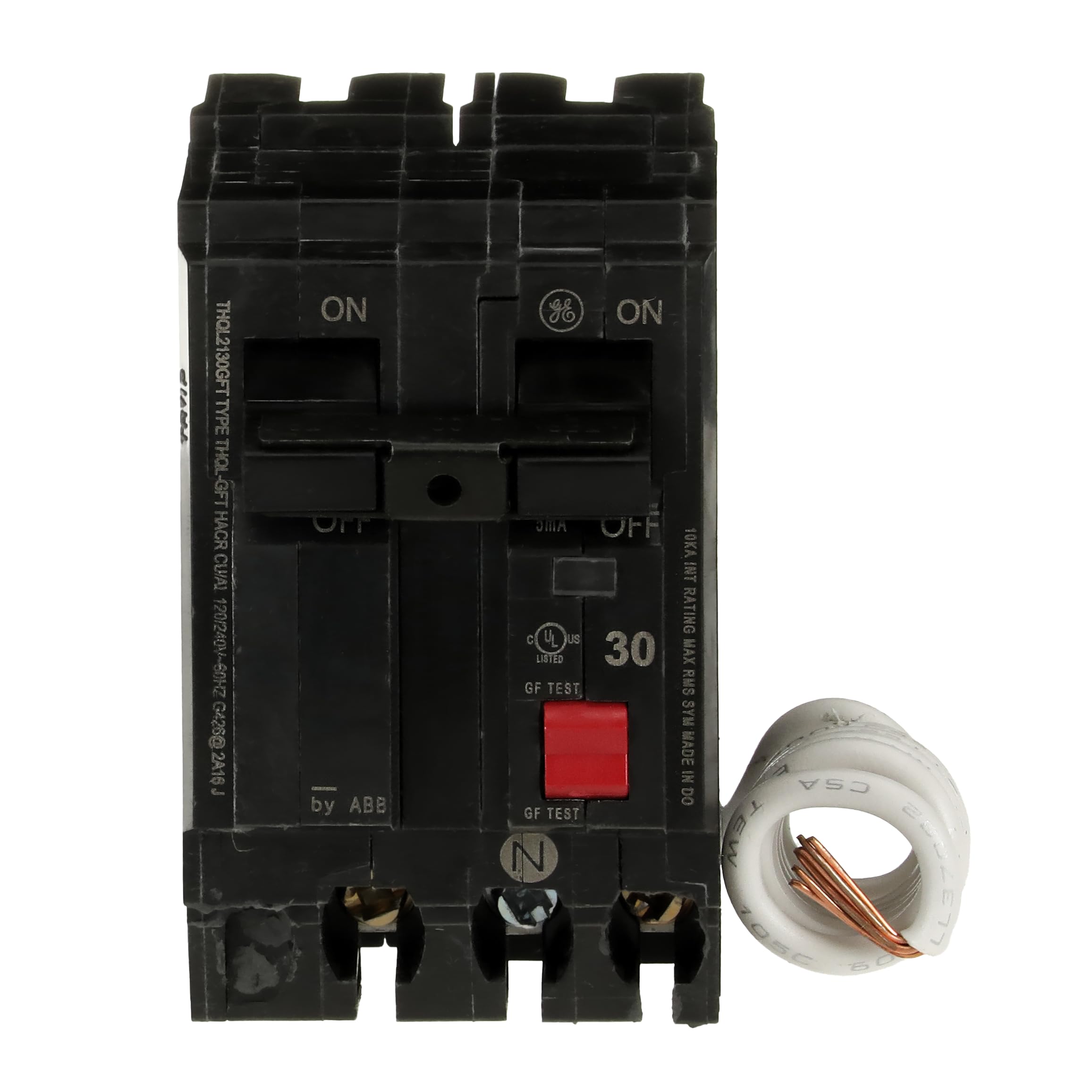
A mid-priced self-testing two-pole for GE-pattern Q-Line panels — measure the slot before ordering.
If your panel is a GE load center and you want a two-pole 30-amp GFCI without moving up to premium, this ABB THQL2130GFTP is the value entry. ABB took over GE’s residential electrical line in 2018, so this is the same GE-compatible Q-Line format under a new label. It is a 30-amp, 120/240 VAC, two-pole, plug-in GFCI breaker with self-test, and at 12.8 ounces it is a moderate-weight part — about the same ballpark as the Cutler Hammer above, lighter than the Siemens 16-ounce units.
Owners who know their panel are typically happy: one GE-panel owner bought it because local stock was gone. Nuisance tripping is not the story here. But there is a genuine fit risk in the feedback — some buyers ordered this for a hot tub and found it did not physically fit their circuit box even though the specs matched the electrical job. If you are not sure which Q-Line variant your panel wants, check the physical layout inside the door before ordering.
ABB’s pitch on this breaker centers on the self-test function and the low-leakage detection that trips the power before a serious shock. The GFCI circuitry itself will not complain about the load you connect — the question is whether the breaker chassis seats on your panel’s bus.
Where it earns its slot: a mid-priced, self-testing 30-amp two-pole GFCI that drops into the same Q-Line footprint as the premium ABB THQL2130GFT, for buyers who do not need the top-end features.
The one real caution: double-check the panel fit before you buy. A few reviewers point out the breaker arrives electrically correct but will not physically seat in a specific box, and by the time an electrician arrives the return window can close.
Reach for it if: you own a GE-pattern Q-Line panel and want a self-testing 30-amp two-pole GFCI at a value-tier percentage of the premium ABB.
Change course if: you cannot confirm the panel footprint — a physical mismatch here is the difference between a same-day install and a return-paperwork headache.
7. ABB Q-Line® THQL2130GFT 30A Double Pole Circuit Breaker • 30 Amp Double Pole Ground Fault Breaker with Self-Test • 120/240 VAC 2-Pole GFCI Breaker • Ground Fault Circuit Interrupter
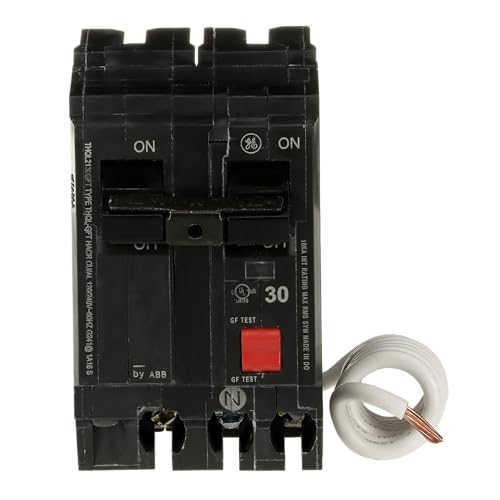
The 45-gram, 1.25-inch-tall thermal-magnetic ABB for GE load centers and 240-volt pool equipment.
GE load center owners who want the top of ABB’s Q-Line get this THQL2130GFT. It is a 30-amp, 120/240-volt, two-pole, plug-in GFCI breaker with self-test, thermal magnetic trip technology (a trip mechanism that responds to both heat and magnetic surges), and load side lug terminals. Two things set it clearly apart from the value ABB above: it is explicitly built for GE load centers (the manufacturer states it is compatible with GE, not ABB, not any other brand), and it is dramatically more compact — 3 inches deep by 4.5 wide by 1.25 high, and just 45 grams on the scale.
That footprint matters. If your panel is packed and you need a GFCI breaker that still leaves room for other circuits, a 45-gram, 1.25-inch-high part opens up slot space that a bulkier breaker would eat. Buyers running 240-volt pool equipment tend to install it and move on: “Fit perfectly into a double slot in the GE panel. Used it to protect 240v pool equipment.” The self-test runs on its own, so you are not asked to remember to press a button.
The catch worth naming is panel brand lock-in. It explicitly will not fit ABB’s own panels or another manufacturer’s load center — the manufacturer states the fit is GE only. There is also a mild mixed note on functionality feedback that suggests these breakers occasionally want a careful install to behave perfectly, which for a premium electrical part is worth treating seriously.
Where it wins
- Only 45 grams and 1.25 inches tall — leaves panel slot space
- Thermal magnetic trip plus GFCI plus load side lugs in one breaker
- Self-test maintains NEC compliance automatically
- Explicitly stated compatible with GE load centers
Know before you buy
- Not compatible with ABB panels or any other manufacturer’s load center
- Mildly mixed functionality feedback in the review stream
- Premium-tier asking price against the value ABB at position six
Matches this job: a GE load center that needs a slim, self-testing 30-amp two-pole GFCI to protect pool pumps, spas, or garage sub-panels with limited slot room.
Not for: ABB panels or any non-GE load center — the manufacturer explicitly limits compatibility.
8. Eaton CH230GFT Breaker, 30A, 2P, 120/240V, 10 kAIC, Type CH Ground Fault

A 240-volt two-pole GFCI that seats only in Eaton Type CH panels — no cross-brand fit.
Eaton Type CH panel owners have a specific part to hunt down, and this CH230GFT is it. It is a 30-amp, 2-pole, 120/240-volt miniature ground-fault breaker rated 10 kAIC, and it plugs into a Type CH panel. At 14.4 ounces it lands in the middle of the weight range of this list — heavier than the 12-ounce Cutler Hammer entry but lighter than the 16-ounce Siemens pair.
This one leans toward hot tub and pool feeds, and the install experience tends to be positive. As one buyer puts it, “Item was shipped and arrived on time. Fit my application perfectly and was easy to install.” Buyers also note why 30-amp Type CH two-poles are hard to find compared to the much more common 50-amp version used for hot tubs and pools — a legitimate observation about how rarely this specific part is stocked, not a defect.
The word of caution here is about shipping accuracy. Type CH breakers physically look similar across amperages, and buyers have reported receiving a 50-amp unit in a box labeled 30-amp on the end but 50-amp on the side. That is a fulfillment issue you can protect against by verifying the printed amperage on the breaker itself before you wire it, not just on the packaging.
Its lane: Eaton Type CH panels, 30-amp two-pole GFCI, 120/240 VAC, 10 kAIC, plug-in. If you own that panel, this is the drop-in part.
Verify on arrival: check the amperage printed on the breaker body itself before you install it — the occasional mislabeled shipment is a known risk with this part.
Belongs with: Eaton Type CH panel owners running a hot tub, pool, or 240-volt outdoor feed who need a 30-amp two-pole GFCI.
Walk on by if: your panel is BR, Homeline, Siemens, or GE — the Type CH footprint will not accept another brand’s breaker, and vice versa.
9. GFCB230 CUTLER HAMMER 30 Amp Double Pole BR Type GFI Breaker 2P GFCI EATON

An Eaton BR successor to the classic GFI breaker — same familiar panel story.
This GFCB230 sits at the top of the price range in this group, and it has the older, more storied label — the classic Cutler Hammer GFI two-pole. It is a 30-amp, 2-pole, 240-volt GFCI breaker with a DIN rail mount, and it is the model that the Eaton BR ecosystem replaced over time. Buyers who specifically want this model number typically own a panel that has always taken this footprint.
The longevity conversation is what distinguishes it. Buyers compare it against a pool pump that ran for 14 years and against other GFI breakers that historically went 30 years — so the bar for this class of part has been set high by owners who know the historical record, and that is why some of them buy spares. Hot tub and pool installations are the common use case, and the “no tamper” feel is a detail a few buyers specifically appreciate.
There is also a mixed reliability note worth raising honestly — one buyer had a unit fail in fewer than six months. It is on the pricier side for the brand family, so it is best reserved for cases where you specifically want the GFCB230 model number and cannot use the newer BR-style replacement instead. Check your panel documentation before ordering to confirm which of the two BR-family footprints your breaker slot actually takes.
For the specific buyer: an Eaton BR or Cutler Hammer panel that takes this exact GFCB230 model and a pool pump or hot tub circuit that needs 30-amp two-pole GFCI.
Look further if: your panel takes the newer BR-style footprint — the GFTCB230 at position two is the newer generation of the same concept.
Understanding the Specs
Amperage and Poles
The 30-amp rating is the maximum continuous current the breaker is designed to carry. On this list, every breaker is a 30-amp unit — which is the right rating for a typical hot tub, an electric dryer, a 30-amp workshop compressor, or a level-2 EV charger on a 120/240-volt circuit. The pole count tells you what kind of circuit it can feed. Two-pole breakers carry both hot legs of a 240-volt circuit and cut both together when a fault happens, which is why almost every pick here is two-pole. The single-pole GE THQL1130GFT is built for a 120-volt circuit only — a completely different job.
GFCI Function, Self-Test, and AIC
GFCI means the breaker watches for current leaving the circuit and returning somewhere other than the neutral wire — the fault path that can run through a person. When it detects that leak, it cuts the power in a fraction of a second. Self-test means the breaker performs its own internal check on schedule and would signal if the detection circuitry failed, which is a much better safety posture than a silent failure. The AIC (ampere interrupting capacity) figure — 10,000 AIC on most of these — is the maximum short-circuit current the breaker can survive interrupting without damage. Higher is safer for a fault event, but all 10,000 AIC breakers here handle residential faults with headroom to spare.
FAQ
Will a 30 amp GFCI breaker from one brand fit another brand’s panel?
What is the difference between a 30 amp GFCI breaker and a standard breaker?
Is a two-pole breaker the same as a double pole breaker?
Do I need a self-test 30 amp GFCI breaker?
What does 10,000 AIC mean on a 30 amp GFCI breaker?
Can a 30 amp GFCI breaker replace a 40 amp or 50 amp breaker?
Does the breaker arrive with installation hardware and lugs?
Why does my GFCI breaker trip after a thunderstorm?
Is a 30 amp GFCI breaker the same as an AFCI breaker?
Can I install a 30 amp GFCI breaker myself?
Final Thoughts: The Verdict
For most panel owners, the 30 amp gfci breaker that gets the job done is the Siemens QF230AP, because it combines a double-pole 30-amp 120/240-volt build, 10,000 AIC interrupting capacity, self-test per UL 943 (a safety standard for GFCI devices), and the most consistent field record in the group. If you own a Homeline panel instead, grab the Square D HOM230GFIC — its reliability record in the same category is equally strong, and its compact 2.98-inch depth slides into tighter Homeline slots. For a 240-volt workshop air compressor on an Eaton BR panel, the Cutler Hammer GFTCB230 is the one to reach for — just plan around its occasional post-storm trips. Confirm your panel brand, confirm the pole count, and the right breaker for your job is one of these nine.
How We Picked
We do not accept paid placement. Every pick is matched to a real buyer and a real use-case; we do not hands-on test units.
Sources & Methodology
Specifications: manufacturer listings and product documentation. Review insights: verified customer reviews, as of September 2026. Pricing: not shown on this page (it changes often); check the current price via the retailer link.
As an Amazon Associate, Gadgets Feed earns from qualifying purchases. This does not affect which products we feature.