
Our readers keep the lights on and my morning glass full of iced black tea. As an Amazon Associate, I earn from qualifying purchases.
Specs are compiled from manufacturer listings and verified buyer reviews and can change over time — please confirm the key details on the product page before buying.
One miswired pedestal at a campground can send a surge straight into your converter, your fridge board, and your air conditioner. A 30 amp RV surge protector sits between the park’s outlet and your rig and takes that hit for you. The short answer: buy the GEARGO FC-03 if you want the strongest overall mix of protection, diagnostics and owner satisfaction, and only step up to a smart unit if you want remote alerts.
I’m Min — the founder and writer behind Gadgets Feed. This guide is built by comparing the manufacturers’ published specifications and the patterns across verified customer reviews, so you get each pick’s real strengths and trade-offs instead of marketing spin.
You will see joule ratings, waterproof ratings and circuit-analyzer charts explained in plain terms, plus how each pick behaves in real campground conditions, so you can pick the right unit for your trailer with confidence when shopping for the best 30 amp rv surge protector.
Our Picks at a Glance

How To Choose The Best 30 Amp RV Surge Protector
Start with the plug shape, because nothing else matters if it will not fit your rig. A 30 amp RV hookup uses the TT-30P plug (the three-prong paddle-shaped connector) going into the pedestal and a TT-30R receptacle coming out to your shore cord. A 50 amp unit will not fit a 30 amp outlet, and a 20 amp household adapter will not carry your air conditioner.
Joules: how much of a hit it can swallow
Joules measure how much surge energy a unit can absorb before it gives up. Entry-level protectors here sit in the low thousands, mid-range units run into the 10,000 to 13,000 range, and the highest in this group is 18,000. More joules means more headroom during a lightning-heavy storm season. It does not mean the unit lasts forever — a protector that absorbs a big hit has done its job and may need replacing.
Circuit analyzer: the part that saves your trip
A circuit analyzer reads the pedestal’s wiring before you connect your rig. It flags open ground (no safety path back to earth), reverse polarity (hot and neutral wired backwards), open neutral, and open hot. Any of those can damage appliances or create a shock risk. A unit with a diagnostic chart and clear indicator lights lets you walk to the park office with proof instead of guessing.
Weatherproofing and housing
These units live outdoors at the pedestal, often in rain, dust and sun. Look for a waterproof cover, a flame-retardant housing, and — where listed — an IP rating (a standard score for dust and water resistance; IP67 means it shrugs off heavy rain and brief immersion, IP65 handles water jets). A UV-stable or Lexan housing resists cracking over a season of sun.
Auto shutoff versus absorb-only
Some protectors only absorb surplus energy. Others, like the smart and voltage-monitoring units here, cut power when voltage swings too low or too high, then reconnect when it settles. That protects against brownouts and over-voltage, which are quieter killers of RV converters and AC compressors than a single big spike.
Quick Comparison
| Model | Best For | Surge Rating | Circuit Analyzer | Waterproofing | Amazon |
|---|---|---|---|---|---|
| GEARGO FC-03★ Best Overall | Best overall for most rigs | 12,000 Joules | Yes, diagnostic chart | IP68 waterproof cover | Amazon |
| Nilight 50351RVBudget Bolt | Budget-friendly ETL-certified pick | 2,100 Joules | Yes, LED guide | Weatherproof cover | Amazon |
| MILLIONHOME DF-01Budget Max Joules | Big joule number on a budget | 13,000 Joules | Not listed | Waterproof design | Amazon |
| GEARit GI-RVSP-30A | Voltage monitoring on a budget | 2,700 Joules | Yes, LED analyzer | Weather-resistant PVC housing | Amazon |
| EyGde FC-04 | Anti-theft lock ring and big cover | 6,500 Joules | Yes, 3 indicator lights | Upgraded waterproof cover | Amazon |
| Docusvect DF-11 | Auto shutoff plus LED display | 10,000 Joules | Yes, plus voltage and temperature | IP67 waterproof | Amazon |
| Progressive Industries SSP-30XL | Proven campground workhorse | 825 Joules | Yes, smart fault detection | All-weather shield, Lexan housing | Amazon |
| Kohree KR6493C | Big screen with 18,000J | 18,000 Joules | Yes, LED display | IP67 waterproof | Amazon |
| Power Watchdog PWD30W | Remote monitoring via Wi-Fi | Replaceable surge module | Voltage, amperage and wattage monitoring | IP65 water-resistant | Amazon |
In‑Depth Reviews
1. RV Surge Protectors 30 Amp RV Circuit Analyzer (GEARGO FC-03)
Our pick — 4.5+★ from 950+ verified ratings; the strongest balance of quality and price.
The one that does the most for the money — and the one owners stick with.
The headline here is 12,000 joules of surge absorption. That is the amount of electrical energy the unit can soak up in one hit, which means your converter and fridge board have a real cushion when a storm rolls through the campground. It is also the biggest protector in this group by that measure — the figure towers over the Nilight’s 2,100 joules and the Progressive Industries’ 825 joules, so you are buying noticeably more headroom for roughly the same everyday spend. With 4.5+ stars from 900+ owners, it is the most satisfying pick in this lineup.
What wins people over is the build quality, and then the price. The housing feels solid in the hand, the indicator lights read clearly across a dim pedestal, and the waterproof cover is rated IP68 — the highest water-and-dust rating in this group, meaning it shrugs off heavy rain, dust and blowing sand. The right-angle male plug keeps the shore cord from kinking against the pedestal. Owners also like that the diagnostic chart is printed right on the unit, so you can confirm correct wiring, open ground, open neutral, reverse polarity, hot/ground reversed or no power without digging out a manual.
Here is the honest trade-off. It analyzes and absorbs, but it does not auto-shutoff the way the Docusvect or the Kohree do, so a sustained low-voltage brownout will not trip it. If your priority is cutting power during a slow voltage sag, you want one of those two instead. For most weekenders and full-timers, the GEARGO covers the two things that actually cause damage: wiring faults and sudden surges.
Where it wins
- 12,000 joules — the strongest surge headroom in this group.
- IP68 rating for rain, sand and dust at an open pedestal.
- Full fault chart covers the wiring errors that actually damage RVs.
- Three-year warranty and straightforward plug-and-play setup.
What to know going in
- No auto shutoff for sustained low or high voltage.
- Analyzer chart lives on the unit, so you read it at pedestal height.
Built for: the owner who wants one strong protector and no fuss — the GEARGO’s 12,000 joules and IP68 cover carry most campgrounds.
Look elsewhere if: you specifically want the unit to cut power during a brownout, which this one does not do.
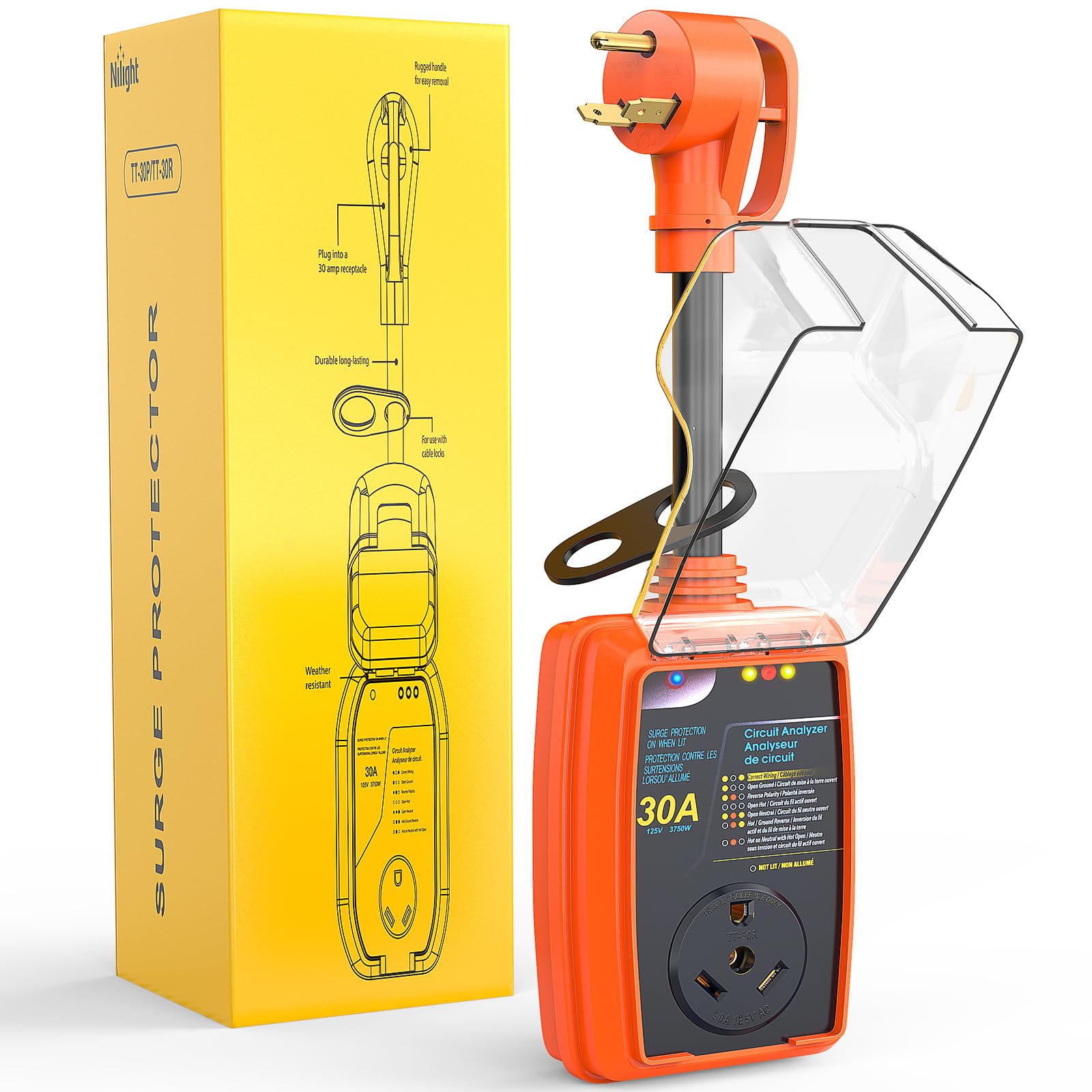
2. Nilight 30Amp RV Surge Protector ETL Listed TT-30P TT-30R
An entry-level protector with a third-party safety stamp the cheap tier usually skips.
Two numbers do the talking on the Nilight. The first is 2,100 joules, which is the surge energy it can absorb — enough to cover a typical spike but a long way from the GEARGO’s 12,000 or the Kohree’s 18,000. The second is the ETL listing. ETL certification means an independent lab tested the unit against published safety standards, and the maker notes it follows the same safety standard structure UL uses. If a recognizable safety mark matters to you on a device that lives at a 125-volt pedestal, that is the real reason to pick this one.
Rated for 125 volts and 3,750 watts, it uses the standard TT-30P and TT-30R connections so it drops straight onto any 30 amp shore-power outlet. The inside is built with pure copper and 10-gauge wire, and the maker fits eight MOVs (metal-oxide varistors, the components that sacrifice themselves to eat a surge) to cut fire risk from lightning strikes. The PVC sheath is flame-retardant and heat-resistant, and there is a weatherproof cover for outdoor use. In real campground use the LED fault chart is the payoff — plug in, read the pattern, and take the proof to the park office.
The honest limit is that 2,100-joule figure. If you camp in a lightning-heavy region or want maximum headroom, the higher-joule units above make more sense. And the orange housing shows dirt from a season of pedestals. For a first protector or a backup in the storage bay, the ETL mark and standard plug shape are the reasons it earns a spot.
Best-value angle: ETL-tested safety and standard copper wiring at the entry tier.
The trade to accept: 2,100 joules is the lowest in this lineup — fine for routine campgrounds, thin for a storm belt.
Worth it for: budget-first buyers who still want a lab-tested unit in the pedestal.
Think twice if: you want maximum joule headroom for storm season.
3. MILLIONHOME RV Surge Protector 30 Amp
A big surge number on a lean budget, with one plastic weakness to keep in mind.
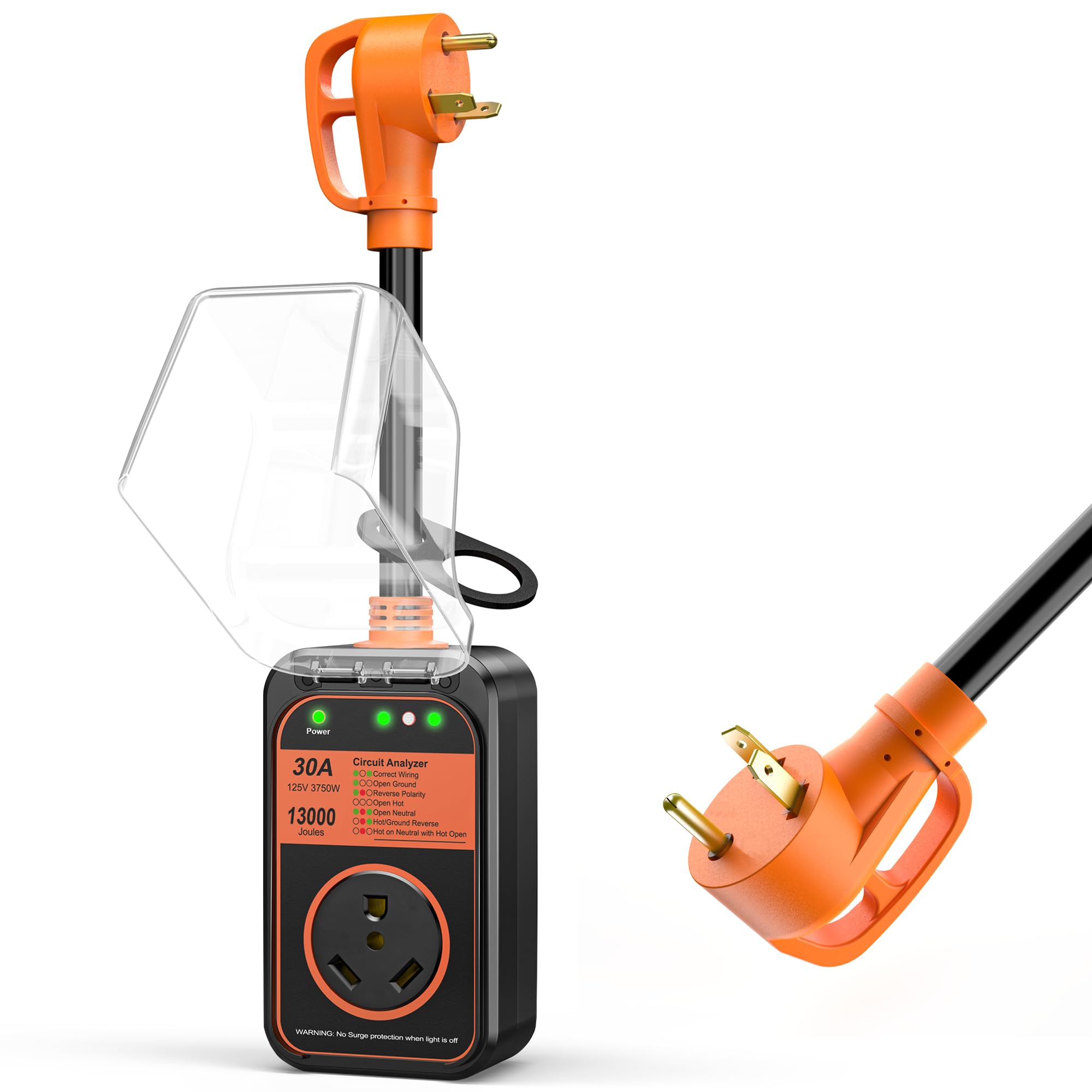
The MILLIONHOME leans on a 13,000-joule protection level, which is the highest figure among the budget-tier picks and enough to cover the high-power appliances most rigs run — air conditioning, microwave, water heater. It is a plug-and-play unit: standard 30 amp connection, waterproof design, flame-retardant materials, and a simple green-light readout to confirm the pedestal is behaving. For a newer camper who wants a real surge cushion without paying for every diagnostic feature, that 13,000J is the compelling number.
The unit is rated for a maximum load of 30 amps, and the maker is explicit that you must not exceed it. It is a 1.5-pound box, so it stows easily in a storage bay, and the waterproof housing is built to shed rain, wind and sandstorms. The common uses — travel trailers, toy haulers, campers — all take the standard plug. Owners like that it is plug-and-play, with green lights confirming a good connection, and several report it held up through hard rain.
The recurring gripe is durability of the plastic casing — a few report cracking within a year of use. Treat it gently, avoid dropping it on pavement, and it holds up. This is a straightforward value pick for someone who wants a big joule rating and does not need a full LED display or auto shutoff. If you want more diagnostic detail, the Docusvect or Kohree are worth the step up.
Reasons to grab it
- 13,000 joules for serious appliance coverage at the entry tier.
- Lightweight 1.5-pound build that stores easily.
- Green-light readout and waterproof housing for routine campgrounds.
Reasons to hesitate
- Plastic casing has a few durability reports — handle with care.
- No LED display or auto-shutoff features.
The right call for: campers who want the biggest joule figure without paying mid-range money.
Skip if: you plan to treat it roughly or want a display readout.
4. GEARit 30 Amp RV Surge Protector with Circuit Analyzer

A quiet workhorse that watches pedestal voltage as well as wiring.
The number that matters here is 2,700 joules. That is modest next to the 13,000 of the MILLIONHOME or the 12,000 of the GEARGO, but the GEARit makes up for it in what it watches. Onboard LEDs flag open ground, reverse polarity and miswired pedestals before you connect. Then a built-in voltage monitor and protector functions spot brownouts and over-voltage — the slow, invisible problems that can quietly kill a converter or AC compressor over a season.
The housing is a UV-stable thermoplastic that is built to live outdoors. There is a waterproof-rated enclosure, full-grip molded ends, and a TT-30P plug and TT-30R receptacle that drop straight onto any 30 amp shore-power hookup — travel trailers, fifth wheels, Class C motorhomes, popups, toy haulers, even campers and mobile homes. It plugs in inline between the pedestal and your rig with no tools. The UV-stable thermoplastic housing feels solid in the hand, which is rare at this price.
The honest limit is the joule count — 2,700 is a sensible moderate rating, but it is not a max-headroom option for lightning-heavy regions. It also does not auto-shutoff; the voltage monitor warns but does not cut power. If you want the safest low-drama setup, pair it with discipline about checking those LEDs before you connect. At 4.5+ stars it earns its spot as the value voltage-watcher in this lineup.
The value read: circuit analysis and voltage monitoring in one modestly priced housing.
What you give up: a max joule number and auto shutoff — this one warns, it does not trip.
Pick it if: brownouts worry you as much as lightning spikes.
Keep shopping if: you want the biggest surge absorption number in the group.
5. EyGde RV Surge Protector 30 Amp with Waterproof Cover

The one that solves the campsite theft problem most protectors ignore.
The standout feature is not a number — it is an anti-theft lock ring. Most protectors are small, expensive-looking, and easy to walk off with, which is why experienced campers chain them to the pedestal. The EyGde builds a lock ring into the unit so you can secure it directly. Combined with a 6,500-joule rating, a larger waterproof cover sized 2.1 x 2.7 inches, and green indicator lights, it is a thoughtfully designed protector rather than a plain surge box.
The analyzer is simple and clear: three indicator lights, and when two green lights are on at once the wiring is correct. If not, it flags open ground, reverse polarity, or another fault. Owners like that two green lights confirm correct wiring before they plug in the rig. The cover protects against rain, wind and sandstorms, and the ergonomic grip handles make plugging and unplugging easy even with cold hands. It carries a three-year warranty and the maker keeps the after-sales line open.
One honest note: some buyers report the power-protection itself felt inconsistent, and there are reports of near-misses rather than clean protection under heavy surge conditions. That is a real consideration if you camp in a storm belt. For routine campgrounds and for anyone who has lost or nearly lost a protector to theft, the lock ring and the build make this a smart pick. The smaller joule figure than the top pick is a fair trade for the added security feature.
Ideal for: campers who leave their setup unattended and want theft resistance.
Best avoided if: lightning surge protection is your single priority — the joule count trails the top picks.
6. Docusvect Smart RV Surge Protector 30 Amp

The one that cuts the power for you when the grid misbehaves.
The Docusvect’s defining feature is auto shutoff with auto reset. When it detects faulty power it shuts down like a circuit breaker, then restores power when the circuit stabilizes. The maker makes a pointed argument that most protectors merely absorb excess energy as an “electricity sink” and cannot guarantee that every harmful joule is blocked. This one closes the line instead. Set against a 10,000-joule rating, that is real protection across the two failure modes that hurt RVs: spikes and sustained bad voltage.
The feature set is the deepest here. It monitors voltage and temperature, detects low voltage below 104V and high voltage over 132V, high temperature over 230°F, open ground, reverse polarity, no power, and open hot or neutral. An LED display shows real-time voltage and reports errors as code numbers, which is more informative than plain indicator lights. The cover is extra-large, and the housing is rated IP67 (dust-tight and able to handle heavy rain).
The honest caveat is a mix of owner experience on the electronics themselves — functionality and durability both draw mixed feedback, with some units reported to stop working and a few noting a short service life. That is worth knowing before you commit, and it is the reason this sits below the best-overall pick despite the richer features. For a camper who wants the unit to cut power during a brownout and does not mind watching the display for codes, it is a capable choice.
Why it earns attention
- Auto shutoff and reset — protects against brownouts, not just spikes.
- 10,000 joules and IP67 waterproofing.
- LED display with real-time voltage and code-based error reporting.
- Temperature monitoring up to a 230°F threshold.
Where it needs care
- Owner reports on long-term reliability are mixed.
- More features to learn than a plug-and-forget unit.
Reach for this if: you want the protector to automatically cut power during a voltage sag.
Otherwise consider: a simpler unit if you prefer the longest track record — the electronics here are the uncertain part.
7. Progressive Industries SSP-30XL Portable RV Smart Surge Protector

The veteran pick with the deepest install base and a smart fault brain.
The SSP-30XL is the most established name in this group, and it built that reputation on smart fault detection rather than a big joule number. It is rated for 30 amps and 120 volts with a 3,600-watt capacity and absorbs surges up to 825 joules — modest by the standards of the 12,000 and 18,000 units above. What it does instead is warn against over and under voltage, open ground and neutral, reverse polarity, surge failure, and AC frequency issues. That AC frequency check is a capability most of the others here do not list.
It ships with an all-weather shield assembly, a locking bracket and cover, and a durable Lexan housing for rough environments. LED indicators are positioned to be visible in low light, which matters when you are plugging in at dusk. It is proudly made in the USA, which some buyers weigh heavily. Owners mention the fault detection correctly flags miswired pedestals at campgrounds and RV parks. In heavy-use terms it is the one most likely to already be bolted to the pedestal next to yours.
The honest trade-offs are on both ends. The 825-joule figure is the lowest here, so this is not the max-headroom option. Durability reports are mixed — some units last years, others fall short. And the quality side draws a noticeable share of negative comments, which is worth weighing against its genuine strengths. If you value a proven fault-detection brain over a big number, it remains a solid choice.
What it brings: AC frequency detection, all-weather shield and USA manufacturing in one package.
The honest read: 825 joules is low for a premium-positioned unit, and owner reports on long-term quality are uneven.
For the buyer who: values fault detection and a recognizable RV name over a big joule number.
Maybe not if: you want the highest surge absorption available for the money.
8. Kohree RV Surge Protector 30 Amp 18000J

The highest joule rating here, paired with the most informative screen.
The Kohree holds the top joule figure in this whole lineup at 18,000J — enough to absorb a serious high-voltage spike, and the maker says it does so within one nanosecond. That is the largest surge cushion in this comparison, far above the 2,100 on the Nilight or the 2,700 on the GEARit. It also pairs that number with a large LED display that shows real-time voltage and current status, so you can confirm the pedestal is running within the safe 104-132V range before you trust the grid.
The auto power off protection is the other head-turner. When voltage drops below 104V or climbs above 132V, the unit cuts power automatically, then reconnects when voltage returns to normal — no manual intervention. The IP67 waterproof cover is enlarged to fit most RV power plugs, and the enclosure is flame-retardant. The right-angle male plug and molded grip handles match the best layouts in this lineup. It is also protected by two U.S. design patents, which tells you the layout was deliberately designed rather than assembled.
The honest limit is simply that this is the newest brand in the group and the reviewer base is smaller than the veterans — there is less volume of long-term experience to draw on. Weight is 2.29 pounds, so it is not a featherweight in the bay. For a camper who wants the biggest number, a clear screen, and auto shutoff without stepping into Wi-Fi territory, it is a very strong fit.
Standout specs
- 18,000J — the highest surge rating in this lineup.
- LED display shows real-time voltage and current.
- Auto cut-off below 104V and above 132V, then reconnect.
- IP67 waterproof housing with a cover sized for RV plugs.
Points to weigh
- Newest brand here, with a shorter track record.
- 2.29 pounds is heavier than the entry units.
Suits the camper who: wants the largest joule shield with a readout, and is comfortable with a newer name.
Weigh instead if: you want decades of install history over a big number.
9. Power Watchdog PWD30W Smart RV Surge Protector, Wi-Fi & Bluetooth

A smart protector that phones your rig’s electrical health to your handset.
The Power Watchdog is the one that connects. Patented Wi-Fi and Bluetooth monitoring lets you read voltage, amperage and wattage from anywhere within range, and you get wireless fault alerts when something goes sideways. Owners cite the app monitoring as the reason to pick it — checking voltage from inside beats walking out to the rig in the rain. It is the only Wi-Fi-enabled unit in this group, so if remote monitoring is a must, it is the only real answer.
The other distinctive feature is the replaceable surge module. After a major spike sacrifices the protection element, you swap the module instead of replacing the entire protector. That is a genuine money-saver for anyone who camps often in storm country, and it is a design choice none of the others here offer. The unit is IP65 water-resistant (protected against water jets, though not complete submersion) and is housed in a rubber enclosure. It also accepts dogbone adapters, so it integrates with the cords you already carry.
This is a premium-positioned unit with a smaller owner base than the veterans here, so the long-term record is shorter. Weigh that when you decide whether the connectivity and replaceable module are worth the step up in tier. For the tech-forward camper — the one who wants a live dashboard of their rig’s voltage and current — it is the clear choice.
Meant for: the connected camper who wants voltage and amperage in an app, plus a replaceable surge module.
Not needed if: you plug in and forget, in which case a plain analyzed unit does the job.
Understanding the Specs
Joules vs. amps: two different numbers
Amps tell you the size of the electrical pipe — a 30 amp unit carries your rig’s normal load. Joules tell you how much surge energy the protector can absorb in one hit. You need a 30 amp unit for a 30 amp hookup, and within that, more joules generally means more headroom for spikes. The highest figure in this group is 18,000 and the lowest is 825, so the range is wide; higher is better for storm-prone camping.
IP ratings explained
An IP rating is a two-digit score for dust and water resistance. IP68, the highest here, means dust-tight and able to withstand heavy water contact. IP67 handles rain and brief immersion. IP65 resists water jets but not prolonged soaking. Match the rating to where you camp — a coastal or storm-belt camper should favor IP67 or IP68.
Circuit analyzer fault types
Open ground means the safety path is missing. Reverse polarity means hot and neutral are swapped. Open neutral means the return path is broken. Open hot means power is not arriving. Any of these can damage appliances or create shock risk. A diagnostic chart tells you which fault you are looking at so you can report it to the park staff with confidence.
Auto shutoff vs. absorb-only
Absorb-only protectors eat excess energy but keep the line live. Auto-shutoff protectors cut the line when voltage goes out of a safe band (often cited as below 104V or above 132V) and reconnect when it settles. Shutoff is the better choice for rigs with sensitive electronics, while absorb-only units are simpler and longer-lived when hit hard.
FAQ
Will a 30 amp RV surge protector fit a standard TT-30 campground outlet?
What is the difference between a 30 amp and a 50 amp RV surge protector?
How many joules do I need for real storm protection?
Does a surge protector work if the campground wiring is miswired?
Can I leave my surge protector plugged in during rain?
What does auto shutoff actually protect against?
Do I need a replaceable surge module?
Will a higher joule protector last longer than a lower one?
Can I use one on a travel trailer as well as a motorhome?
Is a surge protector the same as an EMS?
Final Thoughts: The Verdict
For most rigs, the 30 amp rv surge protector winner is the GEARGO FC-03 because 12,000 joules and an IP68 cover handle both the sudden spike and the wet pedestal, and the full analyzer chart catches the wiring faults that actually damage RVs. If you want the biggest joule number with a clear screen and auto cut-off, the Kohree KR6493C is the one to reach for. And for remote monitoring, the Power Watchdog PWD30W is the connected pick, with a replaceable surge module that saves you swapping the whole unit after a big hit. If your campground grid runs low and high, the Docusvect DF-11 auto-cuts and resets without you lifting a finger.
Whichever you choose, plug the analyzer in before you plug the rig in. That one habit turns a surprise wiring fault into a two-minute walk to the park office, and it is the difference between a protected season and a fried converter. The GEARGO’s 4.5+ stars across 900+ owners is the strongest signal in this lineup that the protection actually holds up where it counts.
How We Picked
We do not accept paid placement. Every pick is matched to a real buyer and a real use-case; we do not hands-on test units.
Sources & Methodology
Specifications: manufacturer listings and product documentation. Review insights: verified customer reviews, as of November 2026. Pricing: not shown on this page (it changes often); check the current price via the retailer link.
As an Amazon Associate, Gadgets Feed earns from qualifying purchases. This does not affect which products we feature.