
Our readers keep the lights on and my morning glass full of iced black tea. As an Amazon Associate, I earn from qualifying purchases.
Specs are compiled from manufacturer listings and verified buyer reviews and can change over time — please confirm the key details on the product page before buying.
Buy the wrong 30-to-50 amp adapter and your rig sits dead at the pedestal while everyone else’s air conditioning hums. The tricky part is that these adapters run in both directions and use several different plug shapes, so the same word (“adapter”) can mean three completely different things. This guide decodes the plug ends and points you at the adapter that matches your pedestal outlet and your rig’s inlet.
I’m Min — the founder and writer behind Gadgets Feed. This guide is built by comparing the manufacturers’ published specifications and the patterns across verified customer reviews, so you get each pick’s real strengths and trade-offs instead of marketing spin.
You will learn which plug ends go where, why a built-in breaker matters on a campground pedestal, and how cord length and a grip handle change your setup. Every pick below is a real 30/50-amp adapter — converting in either direction — checked against its published specs and owner reviews.
Our Picks at a Glance


How To Choose The Best 30 To 50 Amp Adapter
The first thing to settle is direction. An adapter either takes 30 amps in and sends 50 amps out, or takes 50 amps in and sends 30 amps out. Both are sold as “30 to 50 amp adapters,” and picking the wrong one leaves you holding a cord that will not seat at either end.
Match the plug code, not the marketing name
Every connector carries a code. TT-30 is the familiar three-prong 30-amp campground plug, L14-30 is a four-prong twist-lock 30-amp plug often found on generators, and 14-50 is the four-prong 50-amp receptacle on bigger RVs and EV chargers. Read the code on your pedestal and on your rig’s cord, then buy the adapter that joins those two exactly. That single step prevents most wrong orders.
Know when you need a breaker
Feeding a 30-amp RV from a 50-amp outlet sends more current than your rig’s wiring is built for. An adapter with a built-in circuit breaker cuts the power when the current exceeds its rating, and you press a reset button to resume once you fix the cause. If you regularly plug a smaller rig into a bigger pedestal, that protection is the feature worth hunting for.
Decide how much length and grip you want
A 12-inch dogbone is the compact standard, while an 18-inch cord gives you more room to route the cable without bending it sharply at the plug. Grip handles and disconnect handles make unplugging easier without yanking on the wire. For a semi-permanent setup, a locking ring that threads down over the connection adds a measure of weather resistance.
Quick Comparison
| Model | Best For | Amperage | Cord Length | Gauge | Amazon |
|---|---|---|---|---|---|
| RVGUARD 4 Prong 30A to 50A RV Generator Adapter Cord★ Best Overall | Generator to 50A RV | 30 A | 12 inches | 10 | Amazon |
| 50 Amp to 30 Amp RV Adapter with Breaker (Gociean)Breaker Built In | Small rig on a big pedestal | 30 A | 18 inches | 10/3 STW | Amazon |
| RVGUARD 30 Amp to 50 Amp RV Adapter with Locking ConnectorLocking Connection | Locking campground feed | 30 A | 12 inches | 10/3 | Amazon |
| CircleCord 4 Prong 30 Amp to 50 Amp Generator to RV/EV Adapter Cord | Generator to RV or EV | 30 A | 12 inches | 10 | Amazon |
| MECMO NEMA 14-50P to L14-30R Transfer Switch Adapter Cord | Generator to house panel | 50 A | 1.5 ft | 10 | Amazon |
| Camco Power Grip Electrical Offset Adapter (55133) | Tight pedestal spaces | 30 A to 50 A | Offset block | — | Amazon |
| CircleCord 30A to 50A RV Surge Protector Adapter Cord | Surge protection on 50A rigs | 30 A | 12 inches | 10 | Amazon |
| Camco 55173 18″ PowerGrip 50A Male to 30A Female Dogbone | Extra reach at the pedestal | 50 A | 18 inches | — | Amazon |
| CircleCord 50A to 30A RV Surge Protector Adapter Cord | Small rig, full protection | 50 A | 12 inches | 10 | Amazon |
In‑Depth Reviews
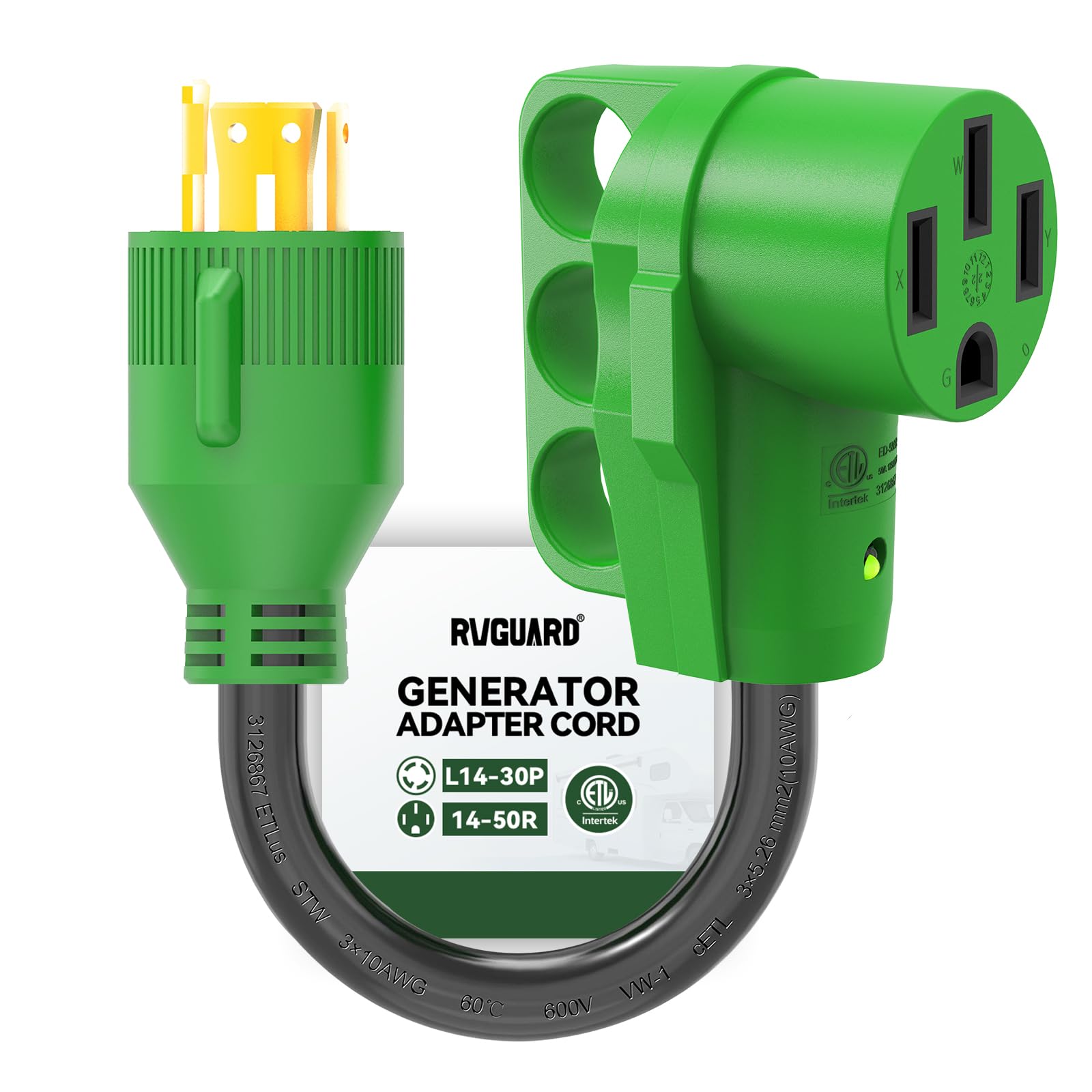
1. RVGUARD 4 Prong 30A to 50A RV Generator Adapter Cord, ETL Listed
Our pick — 4.5+★ from 550+ verified ratings; the strongest balance of quality and price.
A generator-side adapter whose twist-lock L14-30P end stays seated all weekend.
What seals this as the top pick is the generator end. The NEMA L14-30P male plug twists and locks securely into your generator’s outlet, so the cord cannot slip out of the holster mid-run. That is exactly the connection that fails on cheaper adapters, and it is the one you do not want wiggling loose at 2 a.m. when the furnace is cycling.
It is a 30A male to 50A female adapter rated for 30 amps, built with 100% copper wiring inside a flame-retardant and UV-resistant PVC sleeve. Ten-gauge wire carries the load, and the outdoor-rated jacket shrugs off sun and rain. There is a disconnect handle molded in, so you can pull the plug without yanking the cable, plus an LED indicator that tells you the cord is live before you walk away. Compared with the MECMO transfer-switch adapter at 50 A, this one is the 30-amp-in direction — it feeds a 50-amp RV from a smaller generator.
The pattern across owner feedback is that this thing just fits — campers, generators, and 50-amp cords all seat cleanly, and the value for the money comes up again and again. What wins people over is compatibility, closely followed by how much cord you get for the outlay. The honest limit: it assumes a twist-lock L14-30 outlet on your generator, so a plain three-prong generator will need a different adapter entirely.
Why it earns the top spot
- Locking L14-30P male end grips the generator outlet and resists slipping
- 12-inch length keeps the run compact and tidy at the generator
- LED indicator confirms live power before you head inside
- 10-gauge copper with UV-resistant, flame-retardant PVC jacket for outdoor use
Where it asks you to check first
- Needs a twist-lock L14-30 generator outlet, not a standard three-prong
- Short 12-inch cord leaves little slack if the generator sits far from the RV inlet
Go for it if: you run a 50-amp RV off a 30-amp twist-lock generator and want a connection that will not shake loose.
Think twice if: your generator uses a plain TT-30 three-prong outlet — you need the reverse-direction adapter instead.
2. 50 Amp to 30 Amp RV Adapter with Breaker, 14-50P to TT-30R, ETL Listed
For the 30-amp camper stuck at a pedestal that only offers a big 50-amp outlet.
Here is the campground scenario this solves. You pull into a site, and the only working outlet is a four-prong 50-amp receptacle — or the three-prong 30-amp one is broken. This adapter lets your 30-amp RV draw from that 50-amp outlet, and a built-in circuit breaker automatically cuts the power when the current exceeds 30A. Once you find and fix the cause of the trip, you press the reset button and you are back on.
The cord runs 18 inches, among the longest of the cabled adapters here, which gives you real slack to route the cable without a hard bend right at the plug. Wire is 10/3 gauge STW, load is rated at 3750W across a 114V to 126V range, and the whole product is ETL Listed — tested by Intertek to meet American national standards. That full-product certification is meaningfully different from brands that only certify the plug or the cord, and it is the kind of safety detail that matters when you are drawing campground power through a reducer.
The people who use it are happy with how it behaves — good, solid ends and a breaker that does its job when a site is misbehaving. The catch worth flagging up front: the breaker will trip and interrupt your power when you overload it, which is the point, but it means you need to know where the reset button is and keep your amp draw honest.
What the breaker buys you: Real overload protection between an oversized pedestal and your smaller rig’s wiring, with a reset button instead of a dead pedestal.
Where to set expectations: That same breaker will cut power on a genuine overload, so a heavy appliance load needs managing.
Reach for this if: your 30-amp RV needs to run from a 50-amp site and you want protection built into the adapter.
Look elsewhere if: you actually need to feed a 50-amp RV from a 30-amp outlet — this one runs the other direction.
3. RVGUARD 30 Amp to 50 Amp RV Adapter with Locking Connector
A threaded ring that screws down over the connection and keeps out the weather.
Feed a 50-amp RV from a campground’s 30-amp service with one simple dogbone. This is the 30A male to 50A female conversion — a NEMA TT-30P plug into a 30-amp pedestal, and a NEMA SS2-50R receptacle on the other end for your bigger rig. Rated for 125V and 3750W, it is built with 10/3 gauge wire and ETL/cETL certified as a whole unit rather than just the plug.
The standout is the locking connector. A threaded ring regulates and waterproofs the joint, so a downpour on a beachfront site does not leave you wondering about the connection. Molded copper under a heavy-duty flame-retardant, UV-resistant polyvinyl sleeve handles the outdoor abuse, and there is a power indicator light so you know it is live. The molded disconnect handle keeps your fingers away from the socket when you pull it, which is a small thing that grows on you over a season.
Value is what owners point to first here — it does the job for modest money and the green indicator is a welcome reassurance. The recurring gripe is the locking mechanism: some find it fiddly to thread, and a few have wrestled with getting it snug. It works when you take the second to line it up properly, but go in expecting a deliberate twist rather than a quick push-and-go. Compared with the Camco 55173’s 18-inch reach, it stays compact at 12 inches.
Pick this one when: weather resistance and a lock-down connection matter more to you than a lightning-fast hookup.
Skip if: you dislike threads — the locking ring rewards patience, and a quick slap-on connector will suit a hurried setup better.
4. 4 Prong 30 Amp to 50 Amp Generator to RV/EV Adapter Cord
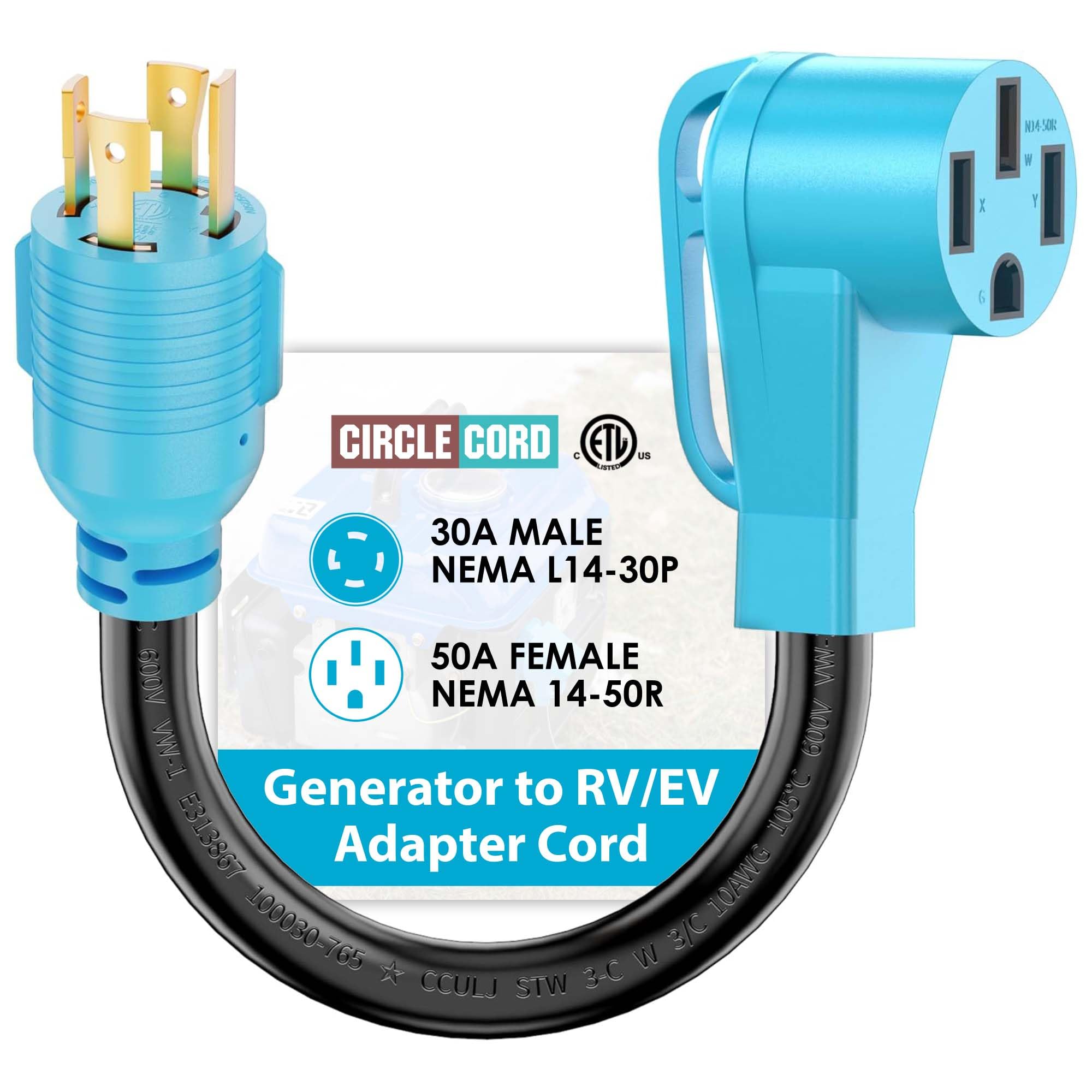
A bright blue dogbone with a grip handle that is easy to spot in a tote of black cords.
This one converts a 30-amp 125/250V NEMA L14-30P locking male plug to a 50-amp 125/250V NEMA 14-50R female receptacle — the standard way to power a 50-amp RV from a generator. The female end carries an ergonomic grip handle, so plugging and unplugging takes a squeeze rather than a yank on the cable. At 1.2 pounds it is light enough to toss in the toolbox and forget until you need it.
Construction is serious for the money: molded plugs, copper wiring, a flame-retardant and UV-resistant STW water-resistant PVC jacket under UL 62, and plugs built to UL 817 standards. Ten-gauge wire handles the current. The color is not a gimmick — that bright blue makes it the easy one to spot when a tote has swallowed five other black adapters, and the reviewed data flags Tesla Model S/3/X/Y charging and generator-to-house use among the intended jobs.
Owner experience clusters around it simply working: power stays on through outages, a 50-amp RV plug connects to a 30-amp generator plug without drama, and it fits perfectly. Functionality and build quality are what people talk about most. The fair caveat is that it is a 12-inch cord — if your generator sits a distance from the RV inlet, you will want an extension rather than a longer adapter.
Standout for the toolbox: The grip handle and loud blue jacket turn a fumble at the plug into a one-hand job you can spot across a cluttered bin.
The honest limit: Twelve inches of cord is the whole run, so distance between generator and inlet needs planning.
Worth grabbing if: you want a generator-to-50A-RV adapter that is easy to grip, easy to find, and certified for outdoor use.
Pass it by if: you need to connect a 30-amp RV to a 50-amp pedestal — that is the opposite direction.
5. MECMO NEMA 14-50P to L14-30R Generator Transfer Switch Adapter Cord

Built for the outage night, when a generator needs to feed your house panel.
This is the house-power adapter, not the campground one. A NEMA 14-50P four-prong straight-blade male plug — the 50-amp, 125/250V connection you find at RV parks, EV charging stations, and on generators — mates to a NEMA L14-30R 30-amp twist-lock female connector for a house transfer switch. It can temporarily supply power from your generator to the manual switch box, so your essential circuits stay alive when the grid drops.
The build is a little over 1.5 feet of molded plug with pure copper wiring, a heavy-duty flame-retardant and UV-resistant jacket, and 10 gauge 3C STW wire supporting a max 30AMP load. That works out to 125V/3750W on one leg or 250V/7500W on the other. Compared with RVGUARD’s 12-inch generator adapter at 30 A, this is the 50-amp-in direction — the reverse of the same handy conversion, aimed at a home panel rather than a rig.
Owners find the quality solid and say it works perfectly, with the transfer-switch job — running an essential loads panel — coming off without issue. What to weigh before buying is the shape of your setup: this is a 30-amp feed at the female end, so it matches a transfer switch built for L14-30, not a 50-amp panel inlet. Pair it with the right switch and the night goes smoothly; pair it wrong and you are back at the drawing board.
Best for: homeowners with an L14-30 transfer switch who want to feed the panel from a 50-amp generator outlet during an outage.
Not the right fit: anyone trying to hook up an RV at a campsite — this is a house-backup connector, not a pedestal adapter.
6. Camco Power Grip Electrical Offset Adapter – 30 amp to 50 amp RV Power Adapter

No dangling cord — a rigid offset block that keeps weight off the pedestal receptacle.
Most adapters hang off the outlet and pull down on the receptacle with the weight of the cord. This one takes a different approach. The offset design shifts the load away from the receptacle, reducing the strain that slowly wears out a campground pedestal’s outlet, and the Power Grip handle gives you something solid to hold when you plug in and unplug. It connects a 50-amp RV to a 30-amp campground pedestal and works alongside your existing 50-amp extension cords and dogbones.
It measures 6 1/2″ x 4″ x 2 1/2″ and weighs 15.2 ounces — compact enough to live in an RV storage bay without hogging space. There is no long cord to coil, so setup and teardown take seconds. It is built for RV use only, which tells you the plug shapes are aimed squarely at campground pedestals rather than generators or home panels.
The trade-off with a rigid offset block is that it is exactly as long as it is — there is no cable give. If your pedestal sits in a tight cabinet or the outlet angle fights the block, a flexible dogbone like the RVGUARD 12-inch cord will fit where this one cannot. For a straightforward pedestal hookup with room around the outlet, the strain relief and grip handle are genuinely useful additions.
What makes it clever: The offset body takes the cord’s weight off the receptacle, and the Power Grip handle makes connect and disconnect a comfortable two-finger job.
What to plan around: A rigid block has zero flex, so an awkwardly angled or cramped pedestal may not accept it as easily as a cabled adapter.
Choose it if: your pedestal outlet has room around it and you want to stop the cord’s weight from stressing the connection.
Better to skip if: your outlet sits in a tight recess where a rigid body will not seat cleanly.
7. CircleCord 30A to 50A RV Surge Protector Adapter Cord with Circuit Breaker
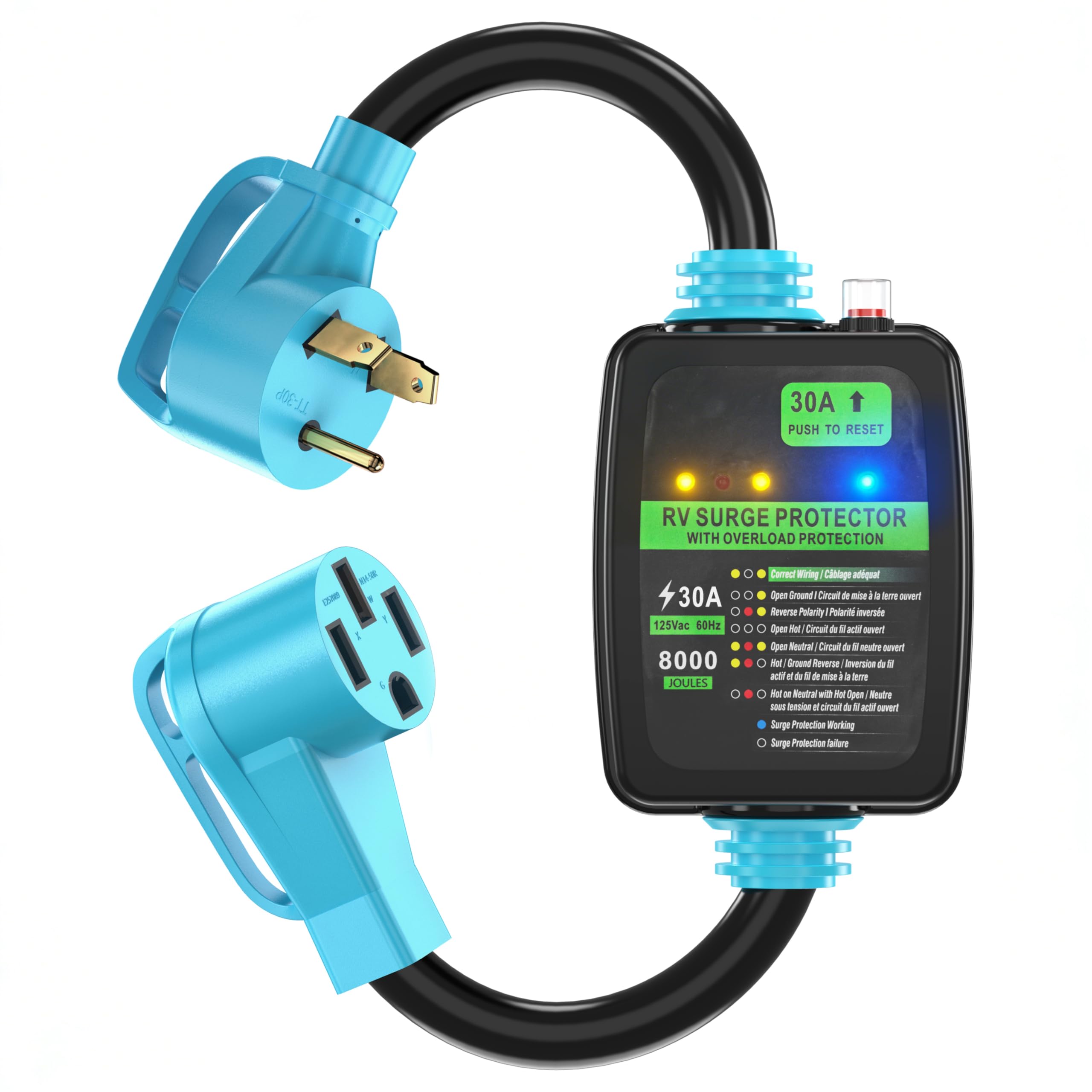
A 30-to-50 dogbone with 8000 Joules of surge protection for your fridge and electronics.
Converting a 30-amp campground pedestal to feed your 50-amp RV is the basic job here. The extra is protection. Inside sits 8000 Joules of surge protection, which absorbs a sudden power spike before it can reach the appliances in your rig. An integrated circuit analyzer also checks the pedestal’s wiring for faults before you connect, so a miswired site does not become your problem. An LED indicator lets you monitor the connection status at a glance.
The cord itself is 12 inches of heavy-duty 10 gauge STW pure copper wire with a UV-resistant casing, rated and ETL Listed. On the plug ends it goes from NEMA TT-30P to NEMA 14-50R — the standard three-prong pedestal plug into your 50-amp RV inlet. The blue color is deliberate: it is the one that stands out in a tote of black adapters, so you find it fast on a rainy setup.
Owners describe it as exactly what was advertised, and what gets mentioned most is straightforward function followed closely by build quality. It feels heavy-duty without being overpriced, the durability holds up season to season, and the molded handles make separating it from the cord easy. A worthwhile note: surge protection is not the same as a full surge suppressor’s readout, so if you want amps and voltage displayed, that is a different product.
Made for you if: you run a 50-amp RV and want surge protection and a wiring check built into the adapters you already carry.
Look past it if: you only need a plain, cheaper conversion and do not care about spike protection.
8. Camco 55173 18″ PowerGrip 50A Male to 30A Female Dogbone Adapter

Eighteen inches of cable and a 180-degree turn to keep the cord off a low pedestal outlet.
Length is the whole reason to pick this Camco. At 18 inches it gives you a longer run from the 50-amp pedestal outlet to your 30-amp rig than the 12-inch adapters on this list — useful when the pedestal box sits low, or when a hard bend right at the plug is what keeps failing. Rated 50A male to 30A female at 125V/3750W, it is the standard way to run a smaller rig from a bigger outlet.
The handles are molded from heavy-duty polyvinyl plastic, so you get something to grab when pulling the plug. Then there is the 180-degree turn from the male end to the female end — that routing reduces stress on the connection instead of letting the cord pull straight down on the outlet. It is a simple design choice that makes a difference over a long trip.
Owners mostly report clean, solid connections and say it does the adapting job without fuss — perfect for putting a 30-amp RV plug onto a 50-amp connection. What it does not have is surge protection or a breaker, so it is a plain converter. If your priority is protection against spikes or an oversized pedestal, the CircleCord 50A to 30A adapter with 8000 Joules covers more ground.
Why the length earns its place: Eighteen inches and a 180-degree turn let you route the cord away from the outlet instead of hanging dead weight on it.
What you give up: No joules, no breaker, no analyzer — this is pure conversion with a comfortable grip.
The one to add if: your pedestal is awkward to reach and you want extra cabling with stress-relieving handles.
Better served elsewhere if: you need built-in surge or breaker protection, which this adapter does not carry.
9. CircleCord 50A to 30A RV Surge Protector Adapter Cord with Circuit Breaker

The same 8000 Joules and circuit analyzer, wired 50-amp-in to 30-amp-out for a small rig.
This is the mirror of CircleCord’s 30-to-50 model, and the direction is what matters: it takes the 50-amp campground outlet and feeds your 30-amp RV. The protection loadout is identical — 8000 Joules of surge protection to shield the appliances from a spike, plus an integrated circuit analyzer that checks the pedestal’s wiring for faults before you connect. An LED indicator shows you the connection status, and an ETL Listing covers the whole assembly.
The 12-inch cord is heavy-duty 10 gauge STW pure copper with a UV-resistant casing, built to hold up outdoors. The tagline is the same: it is the adapter that stands out in a tote of lookalike black cords. It works with a NEMA 14-50P plug into a NEMA TT-30R receptacle — the exact shape of a bigger outlet feeding a smaller rig, which is the opposite of the 30A-to-50A version.
What comes through in use is quality and heavy-duty construction, with the 180-degree turn between the male and female plugs behaving as intended. Durability holds up over trips. The consideration to weigh: this is the 50-in, 30-out direction, so it will not feed a 50-amp rig — if that is your setup, the 30-to-50 model is the correct match, not this one.
Where it shines: The 50-amp-in, 30-amp-out direction pairs an 8000 Joules surge rating with a wiring analyzer — a lot of safety for a 12-inch dogbone.
Keep in mind: It will not run a 50-amp RV. Direction matters here more than any other spec.
Right for you if: you have a 30-amp RV and want a 50-amp pedestal to feed it with full surge and wiring protection.
Wrong turn if: your rig is the 50-amp side — you want the 30A to 50A version instead.
Understanding the Specs
NEMA plug codes (TT-30, L14-30, 14-50)
Every connector has a code, and it is the fastest way to buy the right adapter. TT-30 is the plain three-prong 30-amp campground plug; L14-30 adds a twist-lock collar and appears on generators and transfer switches; 14-50 is the four-prong 50-amp receptacle on big RVs and EV chargers. Read both ends before you order — the same product name can describe a 30-to-50 or a 50-to-30 adapter.
Amperage, watts, and voltage
Amperage is how much current flows; watts is the useful power that results. A 30-amp adapter at 125V and 3750W is the standard campground rating, while a 50-amp connector at 250V carries more. A breaker on a 50-to-30 adapter exists to cap that current at 30 amps when a 30-amp rig is fed from an oversized outlet. Match the rating to your rig’s inlet, never the other way around.
Gauge and jacket (10 AWG, STW, PVC)
Gauge describes wire thickness — lower numbers carry more current, and 10-gauge is the standard here. STW and PVC describe the outer jacket, which is what protects the copper from sun, rain, and abrasion. STW is rated for outdoor use, and a UV-resistant, flame-retardant jacket means the cord survives a season on a pedestal without cracking.
Joules and circuit analyzers
Joules measure how much energy a surge protector can absorb in one hit — 8000 Joules is a serious rating for an RV adapter. A circuit analyzer checks that the pedestal’s hot, neutral, and ground are wired correctly before you draw power. Together they guard the sensitive electronics inside your rig, which is why the surge-equipped adapters cost more than a plain dogbone.
FAQ
Will a 50-amp to 30-amp adapter work to plug my 30-amp RV into a 50-amp pedestal?
What is the difference between a 30 to 50 amp adapter and a 50 to 30 amp adapter?
Do I need a circuit breaker in my RV adapter?
Can I use a 30-amp to 50-amp adapter with my generator?
What does 8000 Joules surge protection actually protect on an RV?
Does a longer dogbone like 18 inches fit better than a 12-inch adapter?
Can I use these adapters to charge my electric car from an RV outlet?
What is the difference between ETL Listed and UL certified on these cords?
Is a rigid offset adapter better than a flexible cord at the pedestal?
Can I feed my house transfer switch with a 30 to 50 amp adapter?
Final Thoughts: The Verdict
For most setups, the 30 to 50 amp adapter that earns its keep is the RVGUARD 4 Prong 30A to 50A Generator Adapter — the locking L14-30P end grips the generator outlet, the LED tells you it is live, and 10-gauge copper under a UV-resistant jacket holds up outdoors. If you are feeding a 30-amp rig from a bigger pedestal, grab the Gociean 50 Amp to 30 Amp Adapter with Breaker for its built-in overload protection. And when spike protection matters most, the CircleCord 30A to 50A Surge Protector Adapter pairs 8000 Joules with a circuit analyzer so your rig’s electronics travel safer.
The one thing to do before you order: read the plug code on your pedestal and on your rig, then match the direction. Get that right, and any adapter on this list will keep your power flowing all season.
How We Picked
We do not accept paid placement. Every pick is matched to a real buyer and a real use-case; we do not hands-on test units.
Sources & Methodology
Specifications: manufacturer listings and product documentation. Review insights: verified customer reviews, as of November 2026. Pricing: not shown on this page (it changes often); check the current price via the retailer link.
As an Amazon Associate, Gadgets Feed earns from qualifying purchases. This does not affect which products we feature.