
A 300-foot Ethernet cable run is a different beast than a short patch cord. At this distance, signal degradation, physical durability, and the right conductor gauge matter more than raw category numbers. Whether you’re burying a line to a shed, running cable through an attic, or wiring an outbuilding for PoE security cameras, the choice between copper-clad aluminum and solid bare copper determines whether your connection survives a year or a decade.
I’m Min — the co-founder and writer behind Gadgets Feed. I’ve spent hundreds of hours dissecting Ethernet cable specifications, comparing conductor materials, and analyzing real-world performance data at extreme lengths to separate marketing hype from measurable throughput.
The market is flooded with options, but true reliability at 300 feet comes down to specific engineering choices. This guide cuts through the noise to help you select the 300 foot ethernet cable that actually delivers consistent speed and withstands the elements.
How To Choose The Best 300 Foot Ethernet Cable
Selecting a 300-foot Ethernet cable requires shifting your focus from what works at 10 feet to what survives at 10 times that distance. The physics of signal attenuation, voltage drop for PoE devices, and environmental exposure all become dominant factors at this scale.
Conductor Material: CCA vs. Solid Bare Copper
Copper-Clad Aluminum (CCA) is cheaper and lighter but suffers from higher resistance and brittleness. At 300 feet, CCA can cause significant voltage drop for PoE cameras or access points, leading to intermittent resets or outright failure. Solid bare copper (23AWG or 24AWG) maintains signal integrity and delivers consistent power over the full length, making it the only reliable choice for direct burial or long-term PoE installations.
Jacket Rating and Environmental Protection
An outdoor-rated cable needs more than a basic PVC jacket. Look for LLDPE (Linear Low-Density Polyethylene) outer jackets that resist UV degradation, moisture, and temperature swings. For direct burial, the cable must have a floodant or gel-filled core to prevent water ingress. CM (Communication Multipurpose) or CMR (Riser) ratings are for in-wall indoor use only and will degrade quickly if exposed to sunlight or soil.
Category and Bandwidth Reality
At 300 feet, most Cat6 cables are certified for 10Gbps only up to roughly 165 feet, after which they revert to 1Gbps. Cat6a extends the 10Gbps reach to the full 300 feet, while Cat7 and Cat8 offer higher theoretical bandwidths but are often overkill for residential runs and may use non-standard connectors. For most users, a quality Cat6 or Cat6a with solid copper conductors will provide a rock-solid 1Gbps link at this distance.
Quick Comparison
On smaller screens, swipe sideways to see the full table.
| Model | Category | Best For | Key Spec | Amazon |
|---|---|---|---|---|
| UbiGear CAT6 300ft | Cat 6 | Direct burial reliability | Solid bare copper 23AWG | Amazon |
| Veigrvy CAT6A 300ft | Cat 6a | Full 10Gbps over 300ft | 23AWG CCA, LLDPE jacket | Amazon |
| Kxable CAT7 300ft | Cat 7 | Triple shielded interference rejection | 26AWG pure copper, SFTP | Amazon |
| Cable Matters Cat6 300ft Bulk | Cat 6 | In-wall professional installation | 23AWG solid bare copper, CM rated | Amazon |
| ecjtu CAT6 300ft | Cat 6 | Budget outdoor/direct burial | 24AWG CCA, UV jacket | Amazon |
| Conable Cat5e 300ft | Cat 5e | Entry-level outdoor run | 24AWG CCA, double jacket | Amazon |
| LEKVKM Cat8 300ft | Cat 8 | Future-proof maximum bandwidth | 40Gbps, 2000MHz, SFTP | Amazon |
In‑Depth Reviews
1. UbiGear CAT6 Outdoor 300ft

This UbiGear cable is built around pure oxygen-free solid copper conductors (23AWG), not the cheaper CCA alternative found in many competitors at similar price points. At 300 feet, that conductor choice directly translates to lower resistance and consistent Power over Ethernet delivery—critical for PoE cameras or access points at the far end of the run.
The waterproof outer jacket is UV-resistant and rated for direct burial, and the gold-plated RJ45 connectors ensure corrosion resistance over years underground. Multiple customer reports confirm this cable surviving snow blower accidents, five years of burial, and maintaining full throughput without signal degradation, which speaks to its build quality.
The cable is notably stiff due to the solid copper and thick dual-layer jacket, so plan for gentle sweeping bends rather than sharp 90-degree corners during installation. It’s a premium feel at a mid-range price point, making it the most balanced choice for anyone who prioritizes long-term reliability over upfront cost.
Why it’s great
- Solid bare copper 23AWG provides superior signal integrity and PoE delivery over the full 300 feet
- Extremely durable jacket survives direct burial and tough environmental conditions
Good to know
- Very stiff cable requires careful routing; not suitable for tight bends
- One report of a connector fault at 51 meters that was resolved by re-terminating the end
2. Veigrvy CAT6A Outdoor 300ft
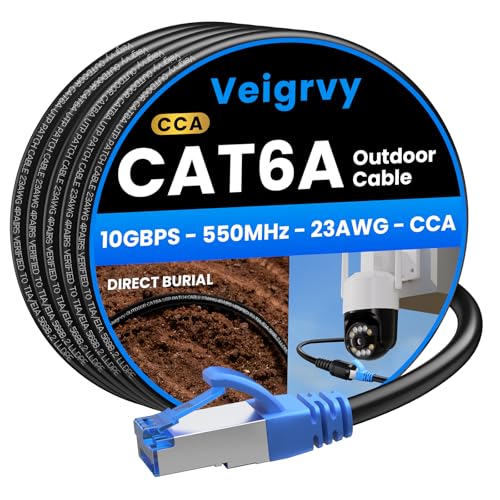
Cat6a is the sweet spot for long runs because it’s certified for 10Gbps at the full 300 feet, unlike standard Cat6 which drops to 1Gbps beyond approximately 165 feet. This Veigrvy cable uses 23AWG CCA conductors and an LLDPE outer jacket that provides enhanced weather resistance compared to standard PVC, making it a strong candidate for outdoor exposed or direct burial installations.
The cable includes 80 cable ties and two dust caps in the box, small but appreciated details for keeping the installation organized. Users report it being noticeably more flexible than typical outdoor cables of this gauge, which eases routing through conduit or around corners—a clear advantage over stiffer solid-copper alternatives.
Keep in mind that the conductors are CCA rather than solid bare copper. For high-wattage PoE applications like pan-tilt-zoom cameras or outdoor access points at 300 feet, the voltage drop from CCA may cause issues. This cable is best suited for data-only runs or low-power PoE devices.
Why it’s great
- Cat6a certification supports 10Gbps at the full 300-foot length without speed degradation
- More flexible than solid-copper alternatives, simplifying installation through conduit
Good to know
- CCA conductors are not ideal for high-power PoE devices at extreme distances
- LLDPE jacket is durable but not as thick as some direct-burial specific cables
3. Kxable Cat7 300ft
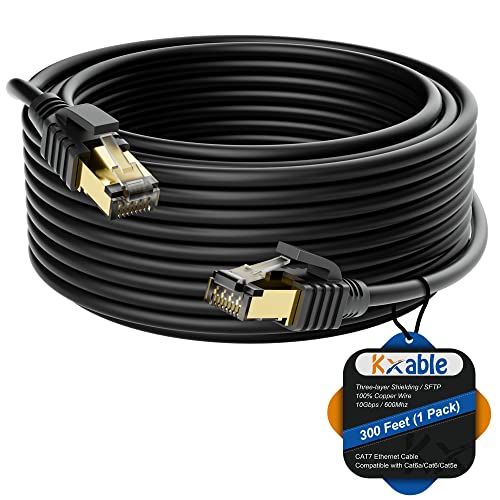
Cat7 cables use SFTP (Screened Foiled Twisted Pair) construction with double aluminum Mylar foils and an aluminum-magnesium wire braid, providing maximum rejection of electromagnetic and radio frequency interference. For 300-foot runs that parallel power lines or pass near industrial equipment, this shielding can be the difference between a stable link and intermittent drops.
The pure copper 26AWG conductors ensure lower resistance than CCA, though the gauge is slightly thinner than the 23AWG found in heavy-duty Cat6/Cat6a cables. Backward compatibility with all previous RJ45 equipment means you don’t need specialized connectors, though the cable itself is thicker and less flexible due to the triple shielding layers.
Users consistently report full 10Gbps throughput and excellent build quality. The one-year warranty provides some peace of mind, but be aware that Cat7 uses a proprietary GG45 connector interface that is fully backward compatible with standard RJ45 ports—not a concern for most home installations.
Why it’s great
- Triple SFTP shielding virtually eliminates EMI/RFI interference in noisy environments
- Pure copper conductors provide better conductivity than CCA alternatives
Good to know
- 26AWG is thinner than the 23AWG used in heavy-duty runs; may have slightly higher resistance at 300 feet
- Stiffer and bulkier than Cat6 or Cat6a, making tight routing more difficult
4. Cable Matters [UL Listed] Cat6 Bulk 300ft
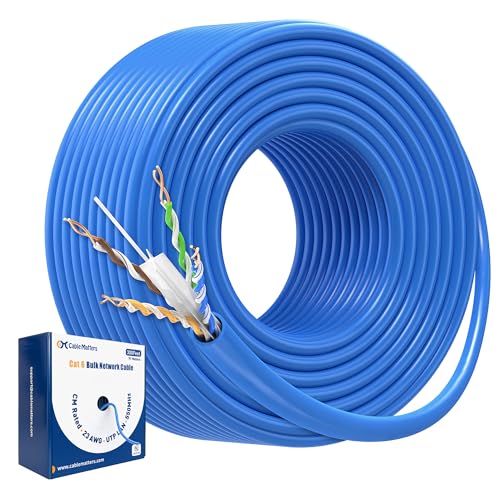
This is bulk cable on a spool, not a pre-terminated patch cord—you terminate the ends yourself with RJ45 connectors or keystone jacks. For running through walls, ceilings, or conduit, bulk cable is the professional standard because you can cut exactly the lengths you need and terminate after pulling through tight spaces, avoiding connector damage.
The 23AWG solid bare copper conductors are UL Listed and CM-rated for in-wall installation, meeting fire code requirements for residential and commercial use. The jacket is foot-marked so you can track exactly how much cable you’ve used, and the TIA/EIA-568-C.2 compliance ensures consistent performance. Users report speeds of 890 Mbps over long runs and reliable PoE delivery for cameras at 175 feet.
Because this is solid conductor wire, you must use solid-wire rated RJ45 connectors and a proper crimping tool. The center plastic spline makes termination slightly more fussy than stranded patch cables, but the long-term reliability is worth the extra effort.
Why it’s great
- UL Listed solid bare copper meets in-wall fire codes for professional installations
- Bulk form factor allows precise custom lengths and clean terminations
Good to know
- Requires termination tools and solid-wire RJ45 connectors; not plug-and-play
- Indoor CM rating means it is not suitable for outdoor or direct burial use
5. ecjtu CAT6 Outdoor 300ft
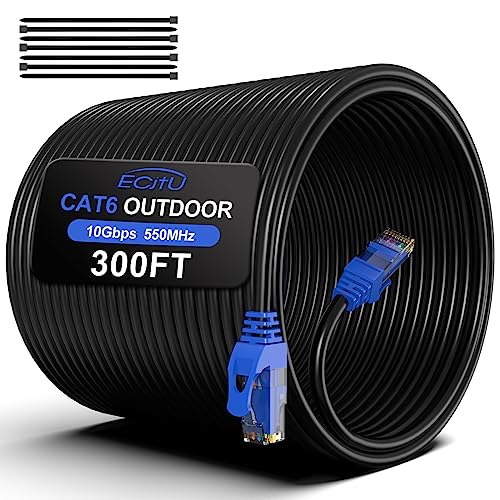
This ecjtu cable offers Cat6 performance at a price point that undercuts most competitors. The 24AWG CCA conductors and UV-resistant jacket deliver serviceable performance for outdoor runs where budget is the primary constraint, and the included 25 cable ties help manage the 300-foot length during installation.
Users confirm stable 1Gbps throughput at 300 feet when used with compatible equipment, and the cable has survived tree falls and outdoor exposure without issues. The two-year warranty provides a safety net, though CCA cables are inherently more brittle and have higher resistance than solid copper, which can cause problems with high-power PoE devices at this distance.
The cable is noticeably rigid, which is typical for outdoor-rated CCA cables. One user noted it was too long for a Starlink V3 setup (which requires under 100 feet), so measure your exact run before committing. For light-duty outdoor runs or temporary installations, this is a solid value pick.
Why it’s great
- Cat6 rating at an entry-level price makes it accessible for budget-conscious projects
- Includes 25 cable ties and a two-year warranty for peace of mind
Good to know
- CCA conductors may cause voltage drop issues with PoE devices at 300 feet
- Cable is stiff and kinks easily when snaking through walls, potentially requiring re-termination
6. Conable Cat5e Outdoor 300ft

Cat5e remains a perfectly capable standard for 1Gbps networks at 300 feet, and this Conable cable offers double-layer protection with a UV-resistant LLDPE outer jacket over a PVC inner jacket. The 24AWG CCA conductors and gold-plated RJ45 connectors with snagless boots represent a functional, no-frills approach to outdoor cabling.
Users describe the cable as heavy and thick, and its double-jacket construction delivers genuine moisture and cold resistance for long-term outdoor exposure. The 25 included cable ties are a practical addition, and the one-year warranty adds a modest safety net. Multiple customers have successfully run this cable to garages and outbuildings with consistent signal quality.
At 1Gbps max, this won’t support future 10Gbps upgrades, and the CCA conductors are not suitable for high-wattage PoE applications. For basic internet connectivity to an outbuilding where speed demands are modest, this is a functional and affordable solution.
Why it’s great
- Double-jacket (LLDPE + PVC) provides excellent moisture and UV protection for outdoor use
- Snagless boots and gold-plated contacts protect connector integrity during installation
Good to know
- Cat5e limits future speed upgrades to 1Gbps maximum
- CCA conductors are prone to brittleness and higher resistance over time
7. LEKVKM Cat8 300ft

Cat8 is the current top-tier standard, supporting 40Gbps data rates at 2000MHz bandwidth. For a 300-foot run, this LEKVKM cable uses S/FTP shielding with four pairs of bare copper conductors to maintain those speeds, though it’s worth noting that Consumer Cat8 cables are typically tested to 30 meters (about 100 feet) for full 40Gbps; beyond that, speeds may throttle down to 10Gbps or lower depending on the cable’s actual certification.
The PVC jacket is thickened for environmental protection and is rated for both indoor and outdoor use. The cable weighs over 4 kilograms, reflecting the heavy-duty shielding and conductor mass. Users have successfully run it to outbuildings and through brick walls, reporting excellent durability and sustained throughput for live TV streaming and multi-device WiFi backhaul.
The flexible PVC jacket is easier to work with than many outdoor cables, but the sheer weight and bulk of 300 feet make installation a two-person job for long runs. For anyone building a network that needs to handle future 40Gbps or 25Gbps standards, this is the most future-proof option available today.
Why it’s great
- 40Gbps and 2000MHz bandwidth rating provides maximum headroom for future network upgrades
- S/FTP shielding with bare copper conductors delivers excellent interference rejection
Good to know
- At 300 feet, full 40Gbps speed is unlikely; expect 10Gbps or lower in practice
- Extremely heavy (4.28 kg) and bulky, making installation physically demanding
FAQ
Can a 300-foot Ethernet cable still deliver 1Gbps speed?
Is CCA copper-clad aluminum cable bad for outdoor runs?
Do I need shielded Cat7 or Cat8 cable for my home network?
Final Thoughts: The Verdict
For most users, the 300 foot ethernet cable winner is the UbiGear CAT6 300ft because its solid bare copper 23AWG conductors deliver the best combination of signal integrity, PoE capability, and direct-burial durability at a reasonable price. If you need full 10Gbps over the entire 300-foot run, grab the Veigrvy CAT6A 300ft. And for a professional in-wall installation where you terminate your own ends, nothing beats the Cable Matters Cat6 Bulk 300ft.