
A 300 watt amplifier sits at a specific crossroads—it delivers enough headroom to drive bookshelf speakers, tower speakers, and subwoofers with authority, yet it avoids the bulky chassis and commercial-grade power draw of a massive rack-mount unit. Whether you are building a dedicated two-channel stereo system for vinyl, a 2.1 home theater setup, or a garage system that can actually keep up with your playlist, the 300-watt class is the sweet spot where raw power meets practical size. The challenge is that not every amplifier labeled “300W” delivers clean, continuous power into real speaker loads—some peak at that number, while others sustain it with low distortion.
I’m Min — the co-founder and writer behind Gadgets Feed. I’ve spent hundreds of hours cross-referencing amplifier datasheets, customer measurements, and real-world owner feedback to isolate which 300-watt models actually deliver on their power claim and which ones fall short when you push them past 50% volume.
Whether you need a compact Class D desktop unit, a professional rack-mount powerhouse, or a luxurious hybrid tube design, this guide breaks down nine of the most competitive models on the market right now and helps you find the right 300 watt amplifier for your specific speaker pairing and listening habits.
How To Choose The Best 300 Watt Amplifier
A 300-watt amplifier purchase often confuses buyers because the number “300W” can mean four different things depending on the manufacturer: peak power into 2 ohms, continuous RMS into 4 ohms, bridged mono output, or a short-burst dynamic rating. Understanding these distinctions is the difference between an amp that sounds effortless and one that clips or overheats with your speakers.
RMS Continuous Power vs. Peak Power
RMS (Root Mean Square) is the real-world measure of how much power an amplifier can deliver continuously without distortion. Peak power is the absolute maximum for a fraction of a second. A genuine 300W RMS amplifier into 4 ohms will comfortably drive most bookshelf and tower speakers. If the spec sheet only advertises “300W peak” or “300W max,” the continuous output is likely half that or less. Always look for the RMS rating at a specific impedance—4 ohms, 8 ohms—and at a stated distortion level, typically 0.1% THD or lower.
Speaker Impedance Matching
Amplifiers produce different wattage at different impedances. A model delivering 300W into 4 ohms may only produce 150W into 8 ohms, and vice versa. If you own 8-ohm speakers, an amp that peaks its power at 4 ohms will not give you full output. Conversely, driving 4-ohm speakers with an 8-ohm-rated amplifier can overload the circuitry. Check that your chosen amplifier’s power curve matches your speaker’s nominal impedance for headroom without distortion.
Amplifier Topology: Class D vs. Class A/B vs. Hybrid Tube
Class D amplifiers—especially those built around the Texas Instruments TPA3255 chip—dominate the 300W category because they combine high efficiency (typically 85-90%) with compact chassis and minimal heat output. Class A/B amplifiers like the Rockford Fosgate P300X2 are less efficient and run warmer, but some listeners prefer their characteristic sound. Hybrid tube amplifiers, such as the Juson Audio JTA200, use vacuum tubes in the preamp stage for warmth and a Class AB solid-state output stage for power, offering a tonality that digital-only designs cannot replicate.
Input Connectivity and System Integration
Consider how the amplifier will integrate into your current system. A 2.1 channel setup requires a subwoofer pre-out or a high-pass filter to keep low frequencies from the main speakers. A turntable user needs a built-in phono preamp (MM input). For multi-room setups, Bluetooth with LDAC or aptX HD and Wi-Fi streaming (Google Cast, AirPlay 2) are essential rather than nice-to-haves. HDMI ARC is a crucial feature for TV-based systems, allowing the amp to auto-power on and off with the television.
Heat Management and Physical Space
Amplifiers dissipating 300W generate significant thermal energy. Compact Class D units rely on aluminum chassis fins and ventilation slots. Some, like the Fosi Audio BT20A MAX, add active cooling fans for extra margin. Pro units like the Crown XLS1002 use forced-air fans that are quiet under normal operation but audible in silent listening rooms. Measure your rack or shelf depth and ensure at least two inches of clearance above any passive-cooled unit for proper airflow.
Quick Comparison
On smaller screens, swipe sideways to see the full table.
| Model | Category | Best For | Key Spec | Amazon |
|---|---|---|---|---|
| AIYIMA A07 MAX | Desktop Hi-Fi | Stereo/Mono flexibility | 300Wx2 @ 4Ω (Stereo) | Amazon |
| Nobsound NS-13G MAX | Desktop Hi-Fi | Phono input & tone control | 300Wx2 @ 4Ω, 0.005% THD | Amazon |
| Fosi Audio V3 | Desktop Hi-Fi | Op-amp upgrade path | 300Wx2 @ 4Ω, SINAD 88dB | Amazon |
| Ampapa D1 | Smart 2.1 Amp | Digital VU meters & HPF | 300Wx2 @ 4Ω, OLED Display | Amazon |
| Rockford Fosgate P300X2 | Car Audio | Vehicle 2-channel install | 150Wx2 @ 2Ω, Class A/B | Amazon |
| Fosi Audio BT20A MAX | Streaming Hi-Fi | LDAC Bluetooth & 2.1 system | 300Wx2 @ 4Ω, PFFB tech | Amazon |
| WiiM Amp | Smart Streamer | Multiroom & HDMI ARC | 120Wx2 @ 4Ω, AirPlay 2 | Amazon |
| Crown XLS1002 | Pro Audio | PA & subwoofer duty | 350Wx2 @ 4Ω, DSP onboard | Amazon |
| Juson Audio JTA200 | Hybrid Tube | Warm tube sound + power | 150Wx2 @ 4Ω, EL34 Tubes | Amazon |
In‑Depth Reviews
1. AIYIMA A07 MAX

The AIYIMA A07 MAX uses the Texas Instruments TPA3255 chip paired with NE5532 op-amps, Japanese ELNA capacitors, and German WIMA film capacitors to deliver clean 300W per channel into a 4-ohm load. A flip of a bottom switch converts the unit from a 2-channel stereo amplifier into a bridged mono amplifier rated at 600W, making it one of the most flexible compact amps in this category. The included DC 36V 6A power supply provides sufficient current for bookshelf speakers in a desktop or small-room setting, though upgrading to a 48V/10A adapter nearly doubles the mono-mode output to 315W per channel.
Measured THD stays below 0.01% at moderate listening levels, and the signal-to-noise ratio of 110dB ensures a black background even with high-sensitivity speakers. The chassis measures just 6.02 x 3.94 x 1.57 inches, using side and bottom venting that keeps dust out while maintaining thermal stability. Owners report the case temperature hovers around 100°F regardless of volume, indicating efficient heat transfer from the TPA3255 die to the aluminum enclosure.
The NE5532 op-amps are socketed rather than soldered, providing an upgrade path to Sparkos, MUSES, or OPA2604 chips that further refine soundstage and transient response. The volume knob doubles as a power switch—a minor inconvenience for some since it lacks detents and the usable range starts around 9 o’clock. There is no Bluetooth or optical input, so it is best paired with an external DAC or streamer if digital sources are required.
Why it’s great
- Switchable stereo/mono mode provides exceptional system-building flexibility
- Socketed op-amps allow sonic customization without soldering
- High 110dB SNR and clean power delivery at the price point
Good to know
- No Bluetooth, optical, or coaxial inputs
- Volume/power knob lacks detents, making precise low-volume adjustment tricky
- Included 36V/6A PSU limits full power potential
2. Nobsound NS-13G MAX

The Nobsound NS-13G MAX brings a built-in moving magnet phono preamp to the 300-watt Class D category, a rare feature that eliminates the need for an external phono stage when connecting a turntable. Powered by the same TPA3255 chipset and NE5532P preamp chips, it delivers 300W per channel into 4 ohms with a THD of just 0.005% and a signal-to-noise ratio of 107dB. The bass and treble controls offer ±6dB of adjustment, allowing listeners to compensate for room acoustics or speaker voicing without resorting to an external equalizer.
The CNC-milled aluminum body measures only 5.1 x 4 x 1.5 inches, making it slightly more compact than the AIYIMA A07 MAX while still accommodating dual RCA inputs, banana speaker outputs, and a 3.5mm AUX passthrough that is volume-synced for subwoofer integration. The included 48V/5A power supply provides a higher voltage rail than the AIYIMA’s stock adapter, which contributes to the NS-13G MAX’s tighter bass control and lower distortion at high output levels.
One consistent user observation is that the unit runs warm even at idle, a characteristic of the TPA3255’s bias current rather than a design flaw. A quiet USB fan can be added for extended high-volume sessions. The phono stage is competent enough for entry-level tables but does not compete with dedicated external phono preamps in terms of noise floor or gain staging. Some units have been reported with a constant hum, which appears to be a unit-specific grounding issue rather than a design-wide problem.
Why it’s great
- Integrated MM phono preamp saves cost and rack space for vinyl listeners
- Bass and treble controls offer genuine room compensation without equalizer
- 48V/5A PSU drives clean 300W into 4-ohm loads
Good to know
- Runs warm at idle; sustained high output may require supplemental cooling
- Phono stage hum reported in a small percentage of units
- No balanced inputs or digital connectivity
3. Fosi Audio V3

The Fosi Audio V3 is built around the TPA3255 chip but distinguishes itself with a measured SINAD of 88dB, a signal-to-noise ratio of 110dB, and a noise floor of only 140µV. These metrics place it among the cleanest implementations of the TPA3255 in this price bracket. The amplifier uses Japanese NCC and ELNA capacitors paired with WIMA film capacitors and Sumida inductors, a component mix that reduces power supply ripple and maintains signal integrity even at high output levels.
Heat management is handled by top and bottom ventilation slots combined with a full-body aluminum heatsink. The design ensures that the chassis operates below 120°F under continuous load, eliminating the need for a fan. The pre-out function is controlled by the volume knob, enabling a 2.1 setup where the subwoofer level tracks the main channel volume without needing a separate subwoofer remote.
The op-amp sockets accept standard 8-pin dual packages, allowing upgrades to Sparkos SS3602, MUSES02, OPA2604, or LM4562 chips. Users report that the stock NE5532 op-amps already deliver excellent clarity, but swapping to a Sparkos SS3602 noticeably widens the soundstage and improves transient attack. The 48V/5A power supply is required to achieve the 300W rating; the standard 32V/5A adapter significantly reduces output. For low-efficiency speakers like the ELAC B6 (86dB), the V3 provides sufficient headroom for most listening levels but does not sustain 150W continuously into demanding loads.
Why it’s great
- Industry-leading noise floor (140µV) for a black background
- Op-amp upgrade path without soldering
- Effective passive cooling keeps fan noise at zero
Good to know
- Maximum output requires 48V/5A PSU, sold separately or as a bundle
- No Bluetooth, HDMI, or phono input
- Limited connectivity—RCA input only
4. Ampapa D1
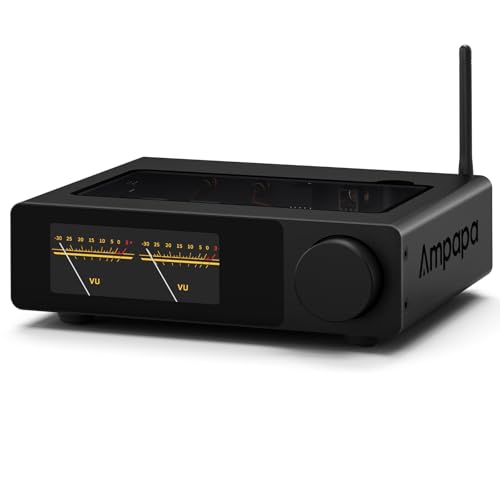
The Ampapa D1 is a collaboration between Ampapa and Douk Audio that builds on the Douk Audio A5 platform. It retains the TPA3255 chip, PFFB technology, and high-pass filter of its predecessor while adding an OLED digital VU meter with seven display styles, TRS balanced inputs, Bluetooth 5.2, and a full ±10dB tone control system. The GaN 48V/5A power adapter delivers clean DC with minimal switching noise, and the NJW1194 volume control chip ensures precise channel matching from silent to full output.
The adjustable high-pass filter operates from 30 to 200 Hz, removing low frequencies from the main outputs and sending a clean full-range signal to the pre-out port for an active subwoofer. This makes the D1 a competent 2.1 system core without requiring external crossovers. The 2-ounce copper PCB and SAGAMI inductors contribute to a measured SINAD that competes with more expensive implementations. The socketed NE5532 op-amps are accessible through a glass top panel, allowing hot-swap upgrades.
A notable design quirk is the non-defeatable auto-standby feature that kicks in after five minutes of inactivity. For some users, this is a welcome power-saving feature; for others, it is an annoyance during long listening sessions. The IR remote provides convenient volume, source, and tone control, but the D1 lacks Wi-Fi streaming. At approximately 80W per channel into 8 ohms, real-world output into 8-ohm speakers is lower than the 300W 4-ohm rating, though still ample for near-field listening with high-efficiency speakers.
Why it’s great
- Adjustable HPF and pre-out enable a proper 2.1 system setup
- Digital VU meter with multiple themes adds visual appeal
- Balanced TRS input and tone controls offer flexibility
Good to know
- Auto-standby cannot be disabled; reactivation takes a few seconds
- 8-ohm power output is significantly lower than 4-ohm rating
- Glass top panel may shift during handling
5. Rockford Fosgate P300X2

The Rockford Fosgate P300X2 is the only Class A/B amplifier in this roundup, delivering 150W per channel into a 2-ohm load or 300W bridged into a 4-ohm load. Class A/B topology means it runs warmer and is less efficient than Class D designs, but it offers a different sonic character that many car audio enthusiasts prefer: punchier midbass and smoother high-frequency roll-off. The P300X2 features a variable 12dB-per-octave Butterworth crossover and the Punch EQ circuit, which adds up to +18dB of boost at 45Hz for subwoofer applications.
The RCA inputs accept both high-level and low-level signals without an external converter, simplifying integration with factory head units. The C.L.E.A.N. setup system uses clip-detection LEDs to help the installer set gain correctly without a scope or distortion detector. The chassis measures 9.9 x 7.8 x 2.4 inches and weighs 6 pounds, requiring a substantial mounting location in a vehicle, but the metal build quality is well above typical budget car amplifiers.
Real-world measurements show the P300X2 delivers its rated power into 2 ohms without the overheating issues reported in earlier Punch models. The on-board crossover and Punch EQ are effective for both full-range component systems and dedicated subwoofer duty. For home audio use, the 12V DC power requirement means a high-current power supply is needed, though some hobbyists do repurpose it for desktop systems with a suitable SMPS.
Why it’s great
- Genuine 300W RMS capability in bridged mode for subwoofer applications
- High/low level inputs simplify integration with factory car stereos
- Punch EQ provides real bass boost without muddying the signal
Good to know
- Requires 12V DC power supply for home use—not plug-and-play
- Class A/B efficiency means significant heat dissipation in enclosed spaces
- No built-in DSP or Bluetooth
6. Fosi Audio BT20A MAX
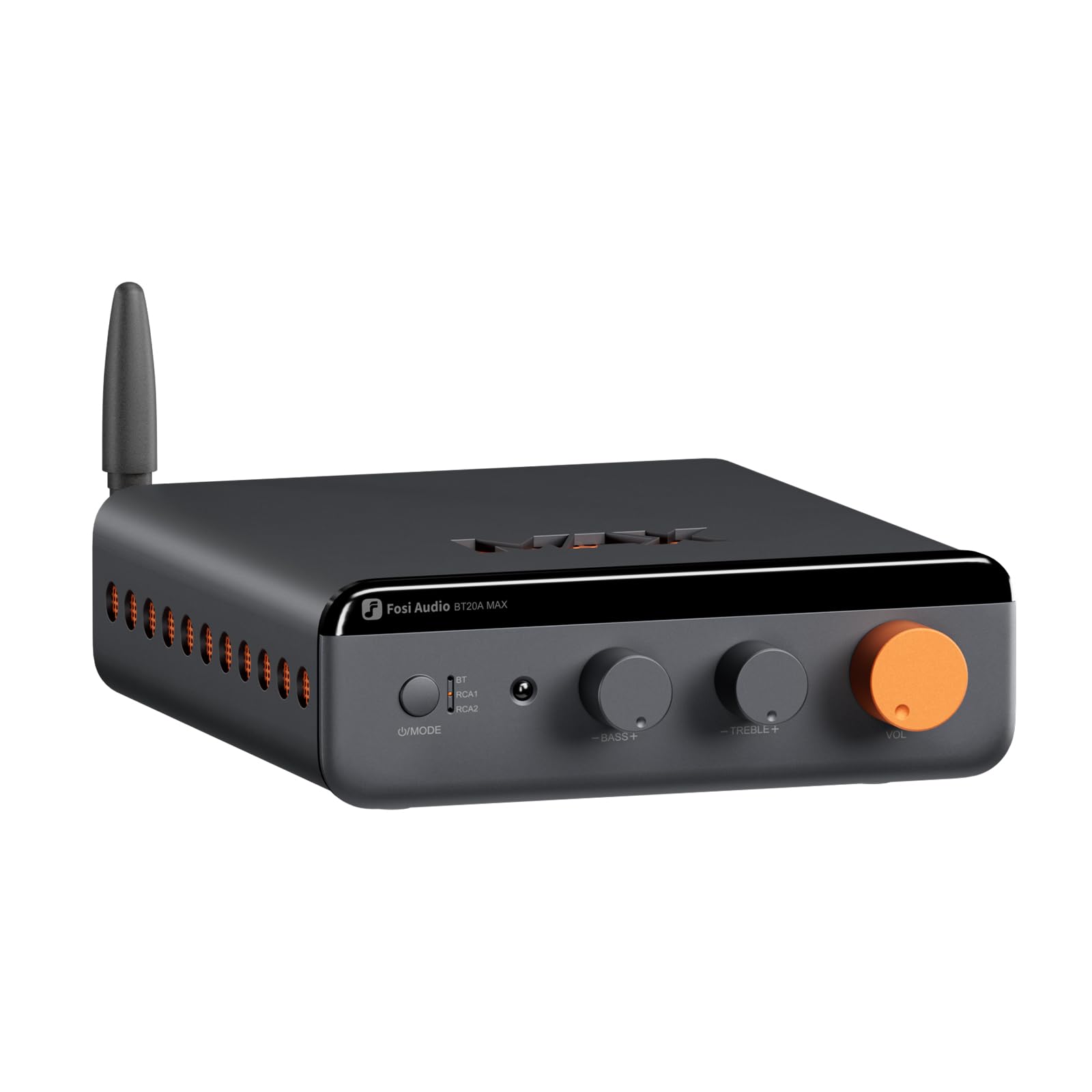
The Fosi Audio BT20A MAX represents a significant upgrade over the BT20A Pro, incorporating PFFB (Post-Filter Feedback) technology that reduces load dependency and achieves a THD+N of less than 0.003% with a signal-to-noise ratio of 112dB. The dual independent power supply configuration digitally separates the amplification and pre-amplification stages, minimizing noise injection from the high-current output section into the sensitive input circuitry. The Qualcomm QCC3095 chip provides Bluetooth 6.0 with full LDAC, aptX Lossless, aptX HD, AptX Adaptive, AAC, and SBC codec support, streaming PCM up to 24-bit/96kHz.
The dedicated CS4398 DAC chip handles Bluetooth decoding with a dynamic range of 120dB and THD+N as low as -107dB, which is unusual for an integrated amplifier at this level. A built-in fan improves cooling efficiency by 30% compared to the PRO version, though some users report the fan is audible in quiet rooms. The motorized analog potentiometer allows precise volume adjustments via the included IR remote, and the 12V trigger input enables synchronized power-on with other components in a rack.
Bypass mode sends the signal through with no tone shaping, while Tone mode activates independent bass and treble controls. The HPF adjustment protects main speakers from deep bass when paired with a subwoofer. Owners report that the BT20A MAX drives Klipsch RP-500M speakers with a warm, clean sound that finally addresses the sterile, harsh character of earlier Fosi Class D designs. At its price point, it is a serious contender for a desktop 2.1 system where Bluetooth quality matters.
Why it’s great
- Bluetooth 6.0 with LDAC/aptX Lossless for near-wireless hi-res streaming
- Dedicated CS4398 DAC outperforms typical integrated solutions
- PFFB technology reduces speaker load dependency for consistent sound
Good to know
- Built-in fan is audible; not silent enough for critical listening rooms
- Runs hot even at idle—some users reported chassis temperatures concerning enough to return
- No phono input or balanced analog inputs
7. WiiM Amp

The WiiM Amp is fundamentally different from the Class D chip-based amplifiers in this roundup: it is a network streaming amplifier with built-in Wi-Fi, AirPlay 2, Google Cast, Alexa, and Siri voice control, plus HDMI ARC, USB, Toslink, and RCA inputs. Its output is rated at 60 watts per channel into 8 ohms and 120 watts per channel into 4 ohms—lower than the 300W peak of the TPA3255-based units, but the true value lies in the software ecosystem. The WiiM Home App provides gapless playback, multi-room grouping, parametric EQ, subwoofer high/low pass filters, and room correction equalization that normally requires a separate DSP unit costing hundreds of dollars.
The HDMI ARC port automatically powers the amplifier on and off with the TV, switching inputs seamlessly. The voice remote handles basic functions, but the full feature set requires the mobile app. The AKM-based DAC delivers a clean, neutral sound that pairs well with bookshelf speakers like the KEF Q150 or ELAC Debut 2.0 series. The parametric EQ has enough bands to correct for room modes and speaker response anomalies without needing a separate measurement microphone, although the WiiM app does support microphone-based room correction for users who want automated calibration.
There is no built-in phono preamp, no coaxial input, and no line-level output for daisy-chaining additional amplifiers. The subwoofer output is a summed mono jack that works with powered subwoofers, but it does not provide crossover control at the subwoofer itself—the high-pass filter for the main channels is adjustable in the app. At 4.1 pounds, the chassis is compact enough for a bookshelf or AV rack, but the lack of a fan means it should not be enclosed in tight cabinets without ventilation.
Why it’s great
- Integrated streaming, HDMI ARC, and multi-room support in a single chassis
- Parametric EQ and room correction eliminate the need for a separate DSP
- Superb app ecosystem with regular firmware updates
Good to know
- 120W per channel into 4 ohms is less than competing 300W Class D units
- No phono input, balanced input, or line output for external amplifiers
- Full features require smartphone app—front panel controls are minimal
8. Crown XLS1002

The Crown XLS1002 is a professional-grade amplifier that bridges the gap between pro audio and home high-fidelity systems. Using Crown’s DriveCore Class D technology, it delivers 350 watts per channel into 4 ohms, 215 watts into 8 ohms, and 1100 watts bridged into 4 ohms. The onboard DSP provides configurable high-pass, low-pass, and band-pass filters, along with Peakx limiters that protect drivers without audible compression until the absolute limit of the amplifier is reached. The PureBand crossover system allows for precise frequency splitting without external crossovers, making the XLS1002 an excellent choice for bi-amping or subwoofer duty.
Input connections include balanced XLR, ¼-inch TRS, and unbalanced RCA jacks, making it compatible with both consumer and professional source equipment. The selectable input sensitivity (1.4V RMS or 0.775V RMS) ensures the amplifier can reach full output with either consumer preamps or professional mixers. The forced-air cooling system uses a variable-speed fan that is quiet during normal operation but can become audible under heavy load. At 8.6 pounds and 19 inches wide, it is a standard rack-mount unit that takes up 1U of space.
Owners report that the XLS1002 requires a 48-100 hour break-in period during which the sound transitions from bright and bass-shy to open and detailed. The amplifier runs cool even at high output levels thanks to the switching power supply and efficient Class D topology. For home theater or stereo systems using lower-sensitivity speakers or long cable runs, the XLS1002 provides massive headroom with no strain. The standby mode activates after a period of inactivity but consumes only a few watts, so many users leave it on continuously.
Why it’s great
- Onboard DSP with configurable filters and Peakx limiters protects speakers
- Professional connectivity (XLR, TRS, RCA) simplifies integration with any system
- Dual impedance / bridged output capability makes it versatile for PA and home use
Good to know
- Rack-mount 19-inch width may not fit standard home audio shelving
- Forced-air fan can be audible in quiet listening rooms
- Requires break-in period to reach full sonic performance
9. Juson Audio JTA200
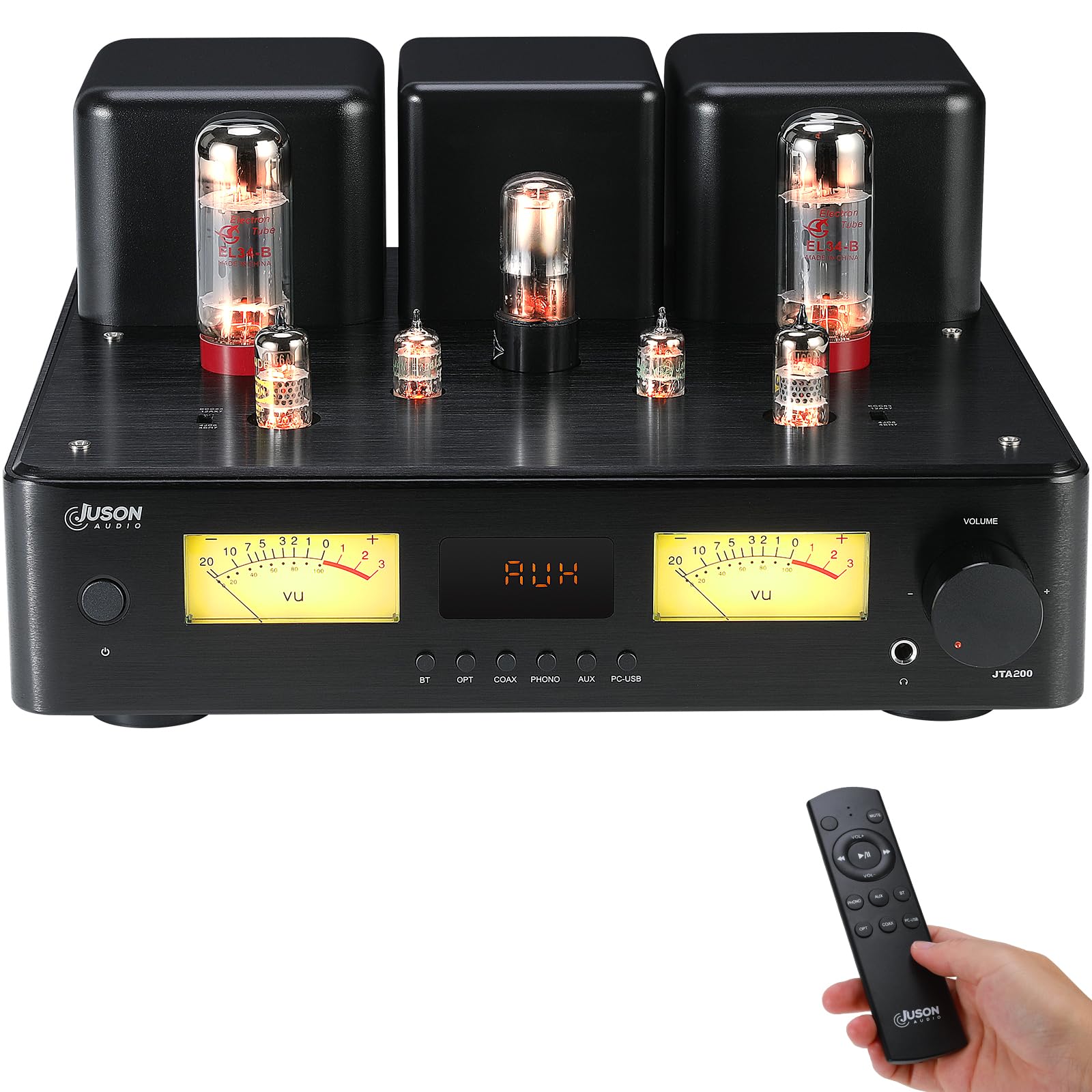
The Juson Audio JTA200 is a Class AB hybrid tube amplifier that combines an EL34 push-pull output stage with Toshiba 2SA1943/2SC5200 bipolar transistors, producing 150 watts RMS per channel into 4 ohms. Two 4JC6 preamp tubes run in the front end for voltage gain and harmonic coloration, while two 5726 rectifier tubes and a WY-4P Stabilivolt voltage regulator ensure stable DC rail voltages. The resulting sound is distinctly warmer and richer than any pure solid-state Class D design in this roundup, with the characteristic tube mid-range bloom and gentle high-frequency roll-off that vinyl and analog lovers seek.
Input connectivity is extensive: AUX, coaxial, optical, USB, phono (MM), and Bluetooth 5.4 via the Qualcomm QCC3095 chip with support for LDAC, aptX Adaptive, and aptX HD codecs. The headphone output includes a high/low impedance switch that accommodates 16-600 ohm headphones, and the subwoofer output allows 2.1 channel expansion. The LED display and analog VU meters provide real-time level feedback and an aesthetic focal point for the listening room.
The JTA200 weighs 31.9 pounds and measures 14.88 inches square, requiring a sturdy shelf or equipment rack. The built-in DAC is limited to 16-bit/44.1kHz resolution, so users seeking higher sample rates should bypass it with an external DAC connected via the coaxial or optical input. Unit-to-unit reliability varies: some owners report defective preamp tubes within the first 24 hours, while others describe a completely silent noise floor and outstanding soundstage depth after swapping the 4JC6 preamp tubes with NOS 12AX7 types. Customer support from Juson Audio has been responsive in replacing defective components under warranty.
Why it’s great
- Genuine tube preamp stage provides warmth and harmonic richness no Class D chip can match
- Bluetooth 5.4 with LDAC, phono input, and headphone output in one chassis
- VU meters and LED display create a premium aesthetic
Good to know
- Heavy (31.9 lbs) and large—requires dedicated space
- Built-in DAC limited to 16/44.1; external DAC recommended for hi-res audio
- Two-year record shows occasional preamp tube failures requiring warranty replacement
FAQ
Can a 300W amplifier damage my bookshelf speakers?
What is the real-world power difference between a 48V/5A PSU and a 36V/6A PSU on these Class D amps?
Should I use a 300W amplifier with a subwoofer?
Does the amplifier chip (TPA3255, Infineon MA12070, etc.) actually change the sound quality?
How do I know if my amplifier is truly delivering 300W or just advertising it?
Final Thoughts: The Verdict
For most users, the 300 watt amplifier winner is the AIYIMA A07 MAX because its flexible stereo/mono switching, low-distortion TPA3255 implementation, and op-amp upgrade path deliver genuine 300W performance at a price that undercuts nearly every competitor. If you need Bluetooth with LDAC and a dedicated DAC chip for a desktop 2.1 system, grab the Fosi Audio BT20A MAX. And for a smart, streaming-centric system with HDMI ARC and app-based room correction, nothing beats the WiiM Amp.