
Our readers keep the lights on and my morning glass full of iced black tea. As an Amazon Associate, I earn from qualifying purchases.
Specs are compiled from manufacturer listings and verified buyer reviews and can change over time — please confirm the key details on the product page before buying.
That buzz from a cheap power inverter is more than just annoying — it can damage sensitive electronics. When you plug in a CPAP machine (Continuous Positive Airway Pressure — a medical sleep device), a laptop, or a camera charger, you hope the power coming out of your 12V socket is clean enough not to fry it. A solid 300-watt inverter fixes that by giving you safe, reliable AC power (Alternating Current — the type from a wall outlet) on the road. But the specs you actually need to check — pure sine wave vs. modified sine wave, USB-C wattage (Power Delivery, or PD — the fast-charging standard), and idle current draw (the power the inverter uses when nothing is plugged in) — are often buried in fine print. This guide focuses on the models that deliver real power without the hum.
I’m Min — the founder and writer behind Gadgets Feed. This guide is built by comparing the manufacturers’ published specifications and the patterns across verified customer reviews, so you get each pick’s real strengths and trade-offs instead of marketing spin.
For a mobile office running a laptop or a camping trip keeping a CPAP machine running, the right model makes the difference between a smooth trip and a dead battery. Here are the inverters that actually do the job without catching fire or buzzing through your audio gear.
Our Picks at a Glance


How to Choose a 300 Watt Inverter
Picking the right inverter is about matching the power output to the gear you plug in. Most 300W inverters have a “continuous” rating (what they run for hours) and a “peak” rating (a few seconds for a motor startup). Here is what to look at first.
Pure Sine Wave vs. Modified Sine Wave
This is the single biggest decision. A pure sine wave inverter makes AC power (Alternating Current) that looks exactly like the power from your home wall outlet. It is essential for sensitive electronics like CPAP machines, laptops with large power bricks, variable-speed power tools, and audio gear — because modified sine wave (a cheaper, choppier form of AC) can cause buzzing, overheating, or outright failure in those devices. Modified sine wave works fine for simple resistive loads like incandescent lights, basic phone chargers, or fans.
USB-C Power Delivery (PD) Wattage
Modern laptops and tablets charge over USB-C PD (Power Delivery, a fast-charging protocol over USB-C), and the wattage matters a lot. An 18W USB-C port (meaning 18 watts of power output) is fine for phones but too slow for a MacBook Pro. A 65W USB-C PD port (65 watts of power output) can charge a full-sized laptop at its regular speed, letting you skip the AC outlet entirely. Check the specific PD wattage in the specs.
Idle Current Draw
When the inverter is switched on but nothing is plugged into the outlets, it still pulls a small amount of power from your car battery. This is called idle current or no-load draw. A good 300W inverter pulls around 0.3 to 0.4 amps at idle. If you leave it plugged in for days without starting the car, even that small drain can leave you with a dead battery. Look for a unit with a low idle current rating.
Quick Comparison
| Model | Best For | Waveform | USB-C PD Output | Weight | Amazon |
|---|---|---|---|---|---|
| Giandel 300W Pure Sine Wave (PS-300B)★ Best Overall | Sensitive electronics & clean power | Pure Sine Wave | None | 1.65 lbs | Amazon |
| Giandel 300W Pure Sine Wave (PS-300B-CAR)Top Performer | Starlink & sensitive gear | Pure Sine Wave | 30W | 1.7 lbs | Amazon |
| DrimMek 300W Car Inverter | Ultra-portable travel & laptop fast-charge | Modified Sine Wave | 65W | 0.5 lbs | Amazon |
| ALLWEI 300W Car Power Inverter | Budget-friendly value | Modified Sine Wave | 27W | 0.95 lbs | Amazon |
| ISELECTOR 300W Inverter | High-power USB-C charging | Modified Sine Wave | 65W | 0.5 lbs | Amazon |
| BESTEK 300W Inverter | Long warranty & EV compatibility | Modified Sine Wave | 65W | — | Amazon |
| Cummins CMN400 400W Inverter | Higher power ceiling (400W) | Modified Sine Wave | 3.0A USB-C | — | Amazon |
In-Depth Reviews
1. Giandel 300W Pure Sine Wave Inverter (PS-300B)
Our pick — over 4★ from 850+ verified ratings; the strongest balance of quality and price.
Protects sensitive electronics with clean power because it uses pure sine wave technology — no buzz, no glitch, no risk of damage.
This Giandel inverter uses pure sine wave technology to output power as clean as the grid at home. That matters for any device with a digital clock, a variable-speed motor, or a sensitive power supply — think CPAP machines, camera chargers, or a nebulizer. The unit is built around an aluminum alloy housing (the data says it weighs 1.65 lbs) that is tough enough to handle a drop and also helps dissipate heat. It delivers 300 watts continuous through two AC outlets and includes two smart USB ports that the maker says deliver up to 2.4 amps per port (enough for phones and tablets, but not for laptop fast-charging).
The idle current draw is just 0.35 amps at maximum, thanks to the solid copper wire design. That means you can leave this plugged into your car without worrying it will drain the battery overnight while you are not running the engine. It also comes with a replaceable 30-amp fuse and the maker provides an 18-month warranty. Buyers report the fan runs very quietly under normal loads, so it won’t interrupt a conversation or a nap in the back seat.
Owners mention that the 6.22-inch length fits easily under a car seat, and the red aluminum shell feels well-made. The trade-off is that this model has no USB-C Power Delivery port — so to fast-charge a modern USB-C laptop, you will still need to use the AC outlet with its own charger. That makes it less convenient than the DrimMek for a laptop-first road warrior.
Why It Leads the Pack
- Pure sine wave protects sensitive medical and audio gear.
- Low idle current (0.35A max) protects your car battery.
- Aluminum alloy housing and replaceable 30A fuse add durability.
- UL listed for safety compliance.
The One Limitation
- No USB-C PD port — can’t fast-charge a modern laptop directly.
Reach for this if: you run CPAP, Starlink, audio gear, or any sensitive electronics that require pure sine wave protection.
Look elsewhere if: you need a USB-C port to fast-charge a laptop without plugging in an extra power brick.
2. Giandel 300W Pure Sine Wave Inverter (PS-300B-CAR) with USB-C PD 30W
Delivers the same clean pure sine wave power as the top pick, but now adds a USB-C PD 30W port for tablets and Starlink gear.
If you wanted the clean power of the Giandel above but also need a modern USB-C charging port, this is the direct upgrade. It adds a USB-C PD 30W port and a QC3.0 USB-A port (Quick Charge 3.0 — a faster charging standard for compatible phones) on top of the same pure sine wave output and two AC outlets. The maker specifies a peak efficiency of 91% and a total harmonic distortion (THD, a measure of electrical noise) of less than 3% — that is better than most household wall outlets. For gear like a Starlink terminal (a satellite internet dish) or a photography strobe that hums on modified sine wave, this level of purity makes a real difference.
The dimensions are slightly larger at 6.5 x 4.3 x 1.9 inches (up from the previous model) and it weighs 1.7 pounds. The idle current is even lower than the basic version at just 0.3 amps max (3.6 watts standby). That makes it among the most battery-friendly pure sine wave inverters in the 300W class. The aluminum alloy housing and built-in cooling fan are the same, and it carries the same UL listing. One owner mentioned that the USB-C port charged their iPad Air from dead to full during a road trip without needing a separate wall charger.
The catch is that the USB-C PD port puts out 30W — that is fast for a tablet or a phone but slower than a 65W PD port, so it won’t run a MacBook Pro at full speed. For that, you will need a 65W model (like the DrimMek or ISELECTOR below), but those use modified sine wave, which is a trade-off on the clean-power side. This unit is the one to pick if you value clean power over raw laptop charging speed.
Pure Power Plus: The best pick if you need pure sine wave reliability and moderate USB-C fast charging for tablets, Starlink, or cameras — but not a power-hungry laptop.
The Quiet Trade-off: The 30W USB-C PD is fast enough for tablets, but the modified sine wave competitors below offer 65W PD for laptop users who can accept the less-clean power waveform.
Grab this unit for: powering Starlink terminals, sensitive medical gear, or audio equipment that demands pure sine wave, plus a USB-C port for tablets.
Skip it for: fast-charging a full-sized laptop over USB-C — you need a 65W PD port for that.
3. DrimMek 300W Car Power Inverter with 65W USB-C
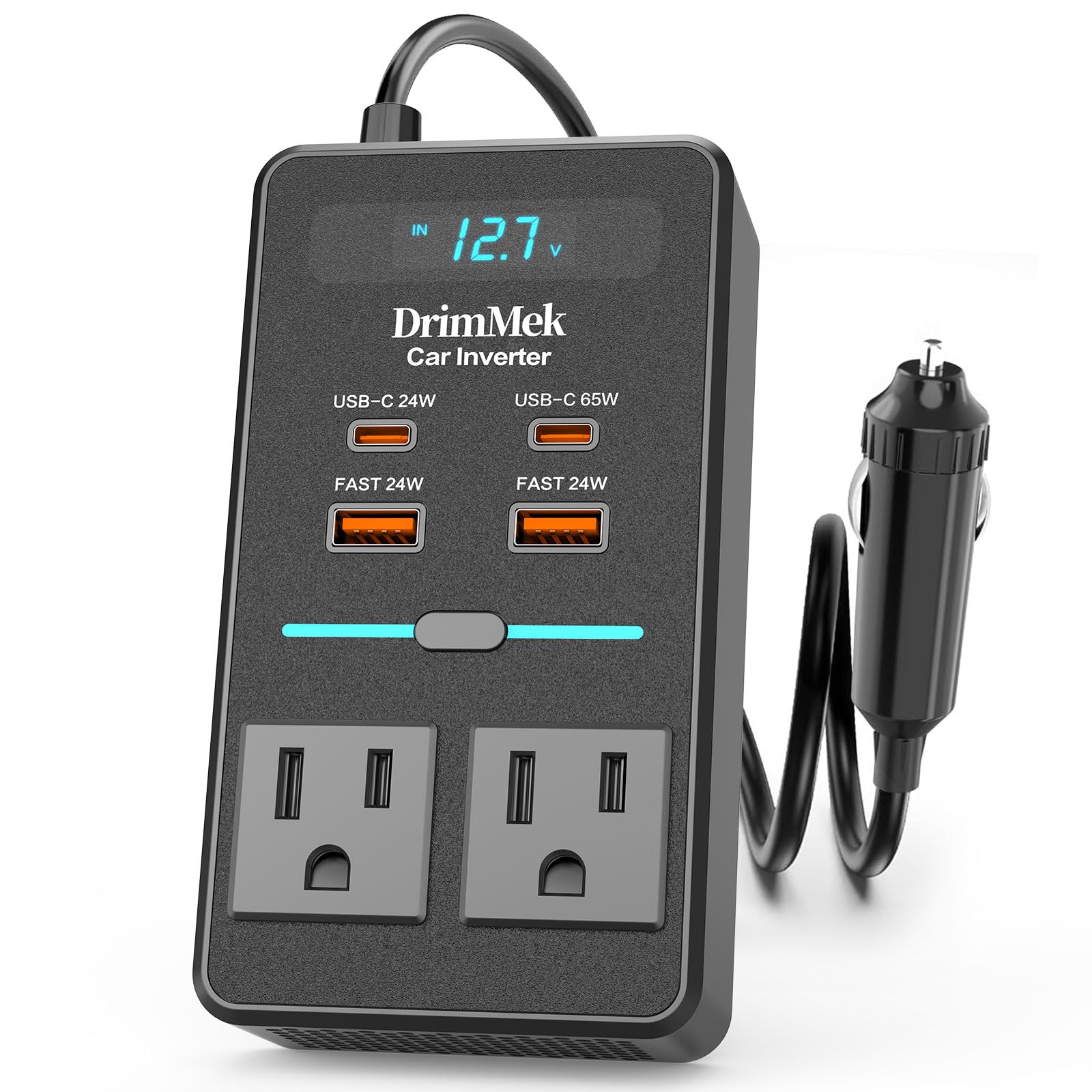
Weighs just 0.5 pounds but packs a 65W USB-C port that fast-charges a MacBook Pro at full speed.
At just 0.5 pounds, this DrimMek inverter is the lightest unit in this lineup — the comparison data shows it is a 3.3x weight gap versus the 1.65-pound Giandel above. The dimensions are also tiny at 5.5 x 3.0 x 1.4 inches, so it disappears into a glove box or a center console. Despite the small size, it delivers a 65W USB-C Power Delivery port, which is fast enough to charge a MacBook Pro 13 at full speed. That is a big deal: you can keep a laptop running on battery without using an AC outlet at all. This is the clear advantage over the Giandel PS-300B, which lacks any PD port.
It uses a modified sine wave output, which is the standard trade-off for this size and price. It works fine for laptops, phone chargers, and most small appliances, but avoid plugging in variable-speed power tools, CPAP machines, or audio equipment that hums on non-sine-wave power. The unit has two AC outlets, one 65W USB-C port, one 24W USB-C port, and two USB-A 24W ports — enough to charge six devices at once. An LCD display shows real-time information, and the built-in quiet fan stays near-silent during normal use. The package includes a one-year replacement-only warranty.
A reviewer noted that this inverter powered a 70W gaming laptop through the USB-C port without any heat issues during a four-hour drive, which echoes the reliable multi-protection system (overload, short circuit, overheat, low voltage) built into the unit.
Why It Stands Out
- Extremely portable at 0.5 lbs — the lightest pick here.
- 65W USB-C PD port fast-charges a full-sized laptop.
- Six total ports for simultaneous charging.
The Catch
- Modified sine wave — not suitable for sensitive medical or audio gear.
Perfect for: road warriors who need to fast-charge a USB-C laptop on the go without adding bulk to the car.
Not for: CPAP users or anyone who needs pure sine wave for sensitive electronics.
4. ALLWEI 300W Car Power Inverter
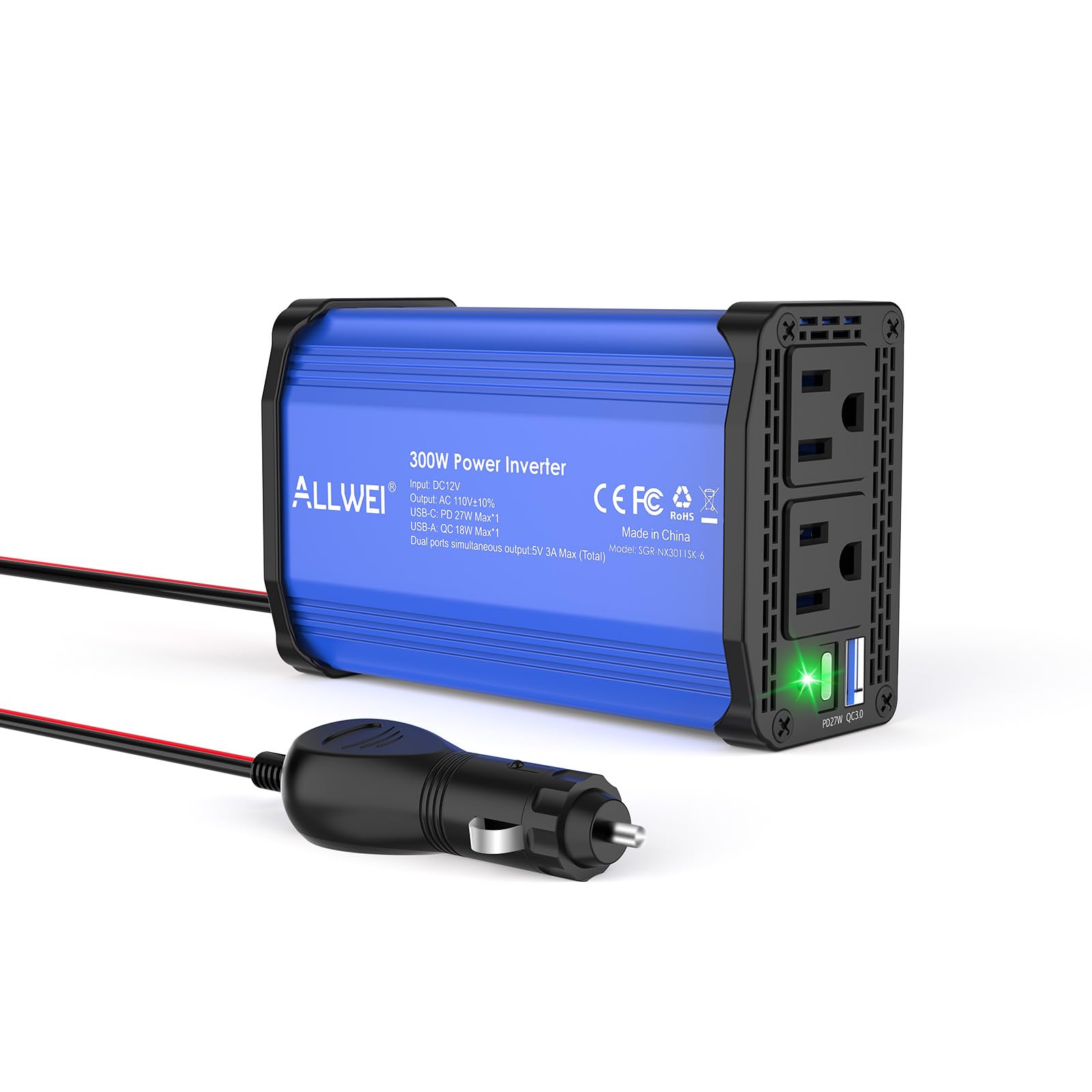
Gives you an aluminum alloy housing and a smart temperature-controlled fan at a budget-friendly price.
The ALLWEI 300W inverter uses an aluminum alloy housing (rare at this price point) and a smart temperature-controlled fan that ramps up only when needed. It runs on modified sine wave, which is expected for the price bracket, and offers two AC outlets plus a 27W USB-C PD port and an 18W USB-A port. The 27W USB-C is fast enough for phones and tablets, though it won’t power a laptop at full speed — a clear step down from the 65W DrimMek and ISELECTOR picks. The unit matches the other smaller inverters closely — the dimensions are 4.71 x 3.2 x 1.81 inches and it weighs 0.95 pounds.
The manufacturer includes an 18-month warranty and states that the inverter uses an advanced intelligent chip to automatically detect voltage and current, protecting against overload, overheat, and short circuits. A key note from the product data: the maker advises using battery clamps (not the cigarette lighter plug) for devices drawing over 180W continuous — that is a standard limitation for plug-in inverters and applies to all the 12V-plug models here. Reviewers appreciated the compact size (about the size of a cell phone, per the data) and the quiet fan operation.
Solid Budget Choice: If your budget is tight but you want a safe, well-cooled inverter with fast charging for phones and tablets, this pick is tough to top.
Know the Limit: At 27W, the USB-C port will charge a phone quickly, but a laptop will be stuck at slow charging — you will need the 65W models above for a laptop.
Buy this if: you need a reliable, affordable inverter for phones, tablets, and small electronics on a road trip.
Pass on this for: laptop fast-charging over USB-C or powering sensitive gear that needs pure sine wave.
5. ISELECTOR 300W Power Inverter with 65W USB-C
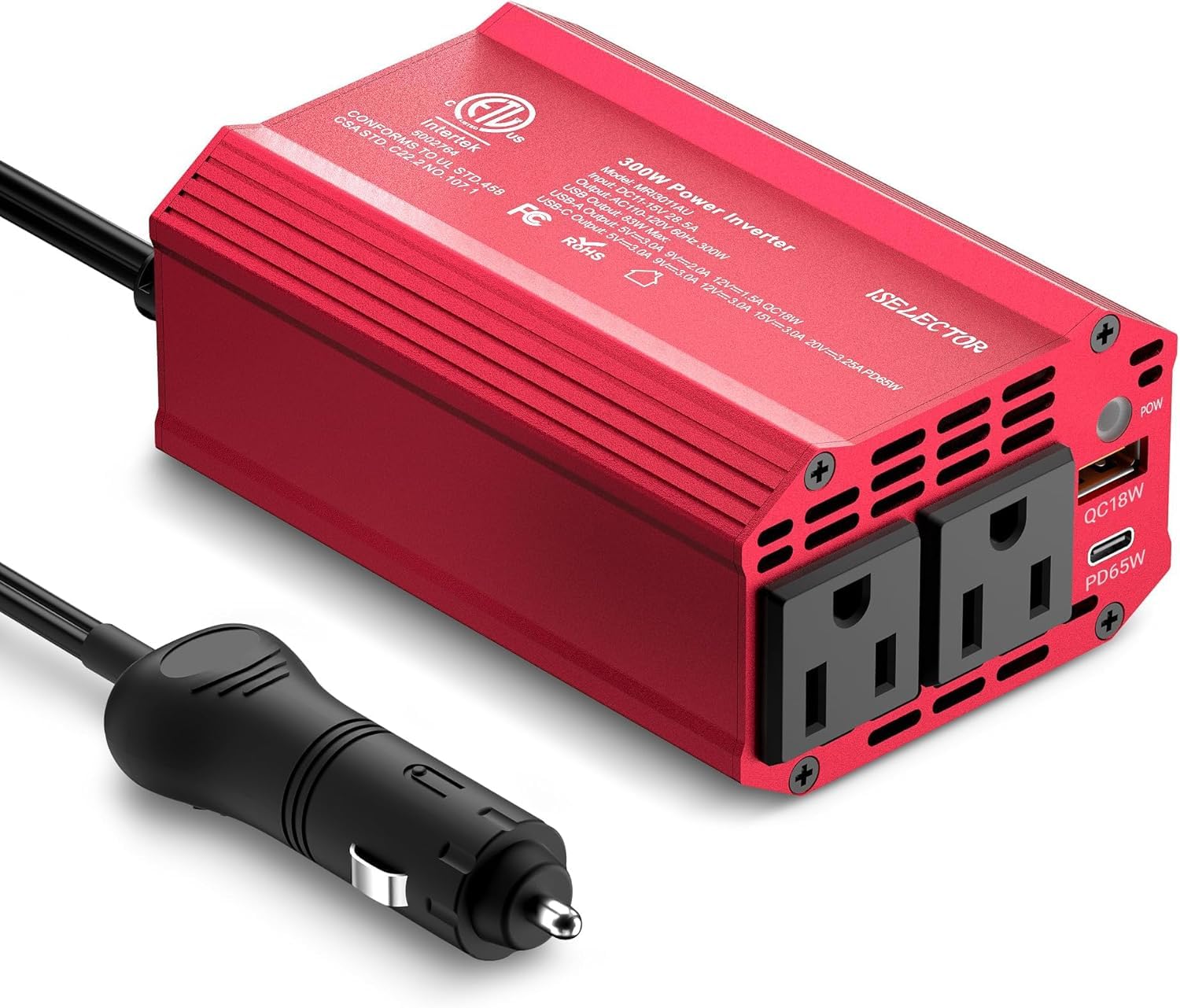
ETL-certified safety (third-party tested) and a 65W USB-C port in a body that is 42% shorter than the top pick.
The ISELECTOR inverter is a close competitor to the DrimMek above, sharing a similar 65W USB-C PD port and two AC outlets, and it also uses modified sine wave. Its dimensions come in at 4.37 x 3.47 x 1.89 inches — the comparison data shows that is 42% narrower in length than the first Giandel (6.22 inches), making it one of the shortest units in this list. It weighs just 0.5 pounds, matching the DrimMek for portability. The 65W PD port is advertised as being “6X faster than a 2.4A USB charger,” which tracks with real-world laptop charging speeds. This is your pick if you want that 65W speed but prefer the ETL safety certification over the DrimMek’s warranty setup.
It is ETL certified (a mark from Intertek, a third-party safety testing lab), which means it has been tested against standards for overheating and short circuits. The unit has a built-in 40-amp fuse and an LED indicator that lights up for protection statuses. The manufacturer offers a 90-day refund guarantee and a 12-month product replacement warranty. The quiet cooling fan automatically ramps its speed based on the load, so it stays silent when charging a phone but spins up when running a laptop. One owner mentioned it was small enough to fit inside the small storage cubby of their sedan’s center console, leaving the rest of the space free.
Top Selling Points
- 65W USB-C PD port for fast laptop charging.
- Very compact at 4.37 inches long — easy to hide away.
- ETL certified with a 40A fuse for safety.
Room for Improvement
- Only one USB-C port (the DrimMek offers a second 24W USB-C).
- Modified sine wave waveform limits gear compatibility.
Great for: laptop commuters who need a tiny, safety-certified inverter with genuine 65W fast charging.
Not ideal for: multiple USB-C laptops or sensitive electronics that require pure sine wave.
6. BESTEK 300W Power Inverter with 65W USB-C & QC3.0

The 5-year warranty and wide 11-17V input range make it the only inverter in this list designed for Tesla and other EVs.
BESTEK is a well-known brand in the car inverter space, protected by a US patent. This 300W model offers a 65W USB-C PD port and a QC 18W USB-A port (Quick Charge 3.0 for compatible phones) alongside two AC outlets. what separates it is the wide input voltage range of 11V to 17V. The manufacturer explicitly states it is compatible with Tesla and other new energy vehicles (EVs, or electric vehicles), where the accessory voltage can fluctuate. Most standard inverters only accept 12V nominal and may shut off if the voltage rises to 14.5V, which happens in some EV auxiliary systems. The inverter also has a peak power rating of 700W for brief surges.
The package comes with a 24-inch cigarette lighter cord and an ultra-compact body. The built-in cooling fan is smart and adjusts its speed automatically. The biggest differentiator here is the warranty: BESTEK backs this unit with a 5-year warranty and a 180-day money-back guarantee, plus 24/7 customer support. That is significantly longer than the 12-18 month warranties on most competitors. Customers note that the unit works well in both standard gas vehicles and EVs, and the 65W PD port successfully charged a Dell XPS 13 laptop during a commute.
EV-Ready & Ultra-Supported: If you own a Tesla or another EV and need a 300W inverter that won’t trip on fluctuating voltage, this is your pick. The 5-year warranty is class-leading in this category.
One Trade-off: It uses modified sine wave, so it is not for CPAP or audio gear, and the dimensions are slightly larger at 6 x 4 x 2 inches.
Choose this unit if: you need the widest vehicle compatibility (including EVs), a 5-year warranty, and 65W laptop charging.
Avoid it if: pure sine wave output is non-negotiable for your sensitive electronics.
7. Cummins CMN400 400 Watt Car Inverter

Steps up to 400W continuous power and includes a full cable kit for a direct battery connection so you can run larger appliances.
This unit steps slightly outside the 300W class — it is rated for 400 watts continuous — but it is included here because buyers searching for a “300 watt inverter” often want a little extra headroom for small power tools or larger appliances. The Cummins CMN400 runs on modified sine wave and features two AC outlets, a standard 2.4A USB-A port, and a fast-charge 3.0A USB-C port. It is not a pocket-sized unit: the dimensions are 5.6 x 3.6 x 10.8 inches, making it the largest and most substantial inverter on this list, designed for semi-permanent mounting in a truck or RV.
The key selling point is the “full cable kit included” in the packaging, which means you get heavy-gauge wiring and clamps for direct battery connection — not just a cigarette lighter plug. That matters because the 12V socket in a car is typically limited to about 180W continuous, while a direct battery connection can handle the full 400W. The unit has a backlit power switch for low-visibility operation, and Cummins provides overload, short circuit, and temperature protection. It is an officially licensed Cummins product.
Why It Earns a Spot
- 400W continuous — more headroom for power tools or larger appliances.
- Full cable kit included for direct battery hookup.
- Backlit switch and rugged build from Cummins brand.
The Considerations
- Larger size — not a glove-box inverter.
- Modified sine wave restricts sensitive gear use.
- USB-C port is 3.0A only; no PD wattage spec for laptop charging.
Best for: truck, van, or RV owners who need semi-permanent power for small tools or appliances and want the reliability of a direct battery connection kit.
Less suited for: those who need a portable, glove-box-sized inverter or pure sine wave output for sensitive electronics.
Understanding the Specs
Pure Sine Wave vs. Modified Sine Wave
Pure sine wave inverters (like the Giandel models) create AC power that is identical to what comes out of a wall outlet at home. Modified sine wave inverters create a stepped, choppy waveform that is cheaper to make but can cause buzzing in audio gear, overheating in induction motors, and complete failure in devices with digital timing circuits, variable-speed drives, or CPAP machines. If you are powering a laptop charger or a simple light, modified sine wave works fine. For medical, audio, Starlink, or any sensitive gear, spend the extra for pure sine wave.
USB-C Power Delivery (PD) Wattage
USB-C PD (Power Delivery) is the standard for fast charging modern laptops, tablets, and phones. The wattage number tells you how fast the port can deliver power. An 18W port is good for a phone. A 27W port charges a tablet at full speed. A 65W port can run a full-sized laptop (like a MacBook Pro or Dell XPS) at its normal charging speed, making the AC outlet unnecessary. Always check the specific PD wattage, not just “USB-C” — a generic 10W USB-C port is useless for a laptop.
FAQ
Can a 300 watt inverter run a CPAP machine?
What is the difference between continuous and peak power on a 300W inverter?
Can I plug a 300W inverter into my car’s cigarette lighter?
Will a 300W inverter drain my car battery?
What does idle current mean and why does it matter?
Is modified sine wave bad for laptops?
Can I use a 300W inverter for a small refrigerator?
What size wire do I need for a 300W inverter installation?
Which 300W inverter is best for a Tesla or EV?
Final Thoughts: The Verdict
For most people, the 300 watt inverter winner is the Giandel 300W Pure Sine Wave (PS-300B) because it delivers the cleanest power for sensitive electronics, has a low idle current that doesn’t drain your battery, and is UL certified. If you need pure sine wave plus a USB-C port for your tablet or Starlink, grab the Giandel PS-300B-CAR. And if you are a laptop road warrior who prioritizes portability and 65W fast charging, the ultra-light DrimMek 300W with 65W USB-C is your best bet.
How We Picked
We do not accept paid placement. Every pick is matched to a real buyer and a real use-case; we do not hands-on test units.
Sources & Methodology
Specifications: manufacturer listings and product documentation. Review insights: verified customer reviews, as of July 2026. Pricing: not shown on this page (it changes often); check the current price via the retailer link.
As an Amazon Associate, Gadgets Feed earns from qualifying purchases. This does not affect which products we feature.