
A 300-watt solar panel is the sweet spot for serious off-grid power—enough to run a small refrigerator, charge a power station in a few hours, or keep an RV’s batteries topped off through cloudy stretches. But the market is flooded with panels that claim 300W yet deliver far less, and the choice between rigid rooftop installs and portable foldable sets can make or break your system’s real-world output.
I’m Min — the co-founder and writer behind Gadgets Feed. I’ve spent countless hours cross-referencing real-world output tests, efficiency specs, and durability reviews across the to range to separate the panels that actually deliver their rated power from those that fall short.
This guide analyzes nine of the most compelling contenders to help you identify the best 300 watt solar panel for your specific setup—whether you’re outfitting a van roof, building a ground-mount array, or keeping a portable kit in your trunk for emergencies.
How To Choose The Best 300 Watt Solar Panel
Picking the right 300W panel means looking past the headline wattage. The real performance depends on cell technology, voltage compatibility, build quality, and whether the panel is designed for stationary or portable use. These are the factors that separate a reliable energy source from a disappointing investment.
Cell Technology: P-Type vs. N-Type vs. Bifacial
Standard panels use P-Type cells with 9 busbars, which suffer from Light Induced Degradation (LID) and drop efficiency over time. N-Type cells, common in the higher-efficiency panels, eliminate LID and often feature 16 busbars for better current collection and reduced micro-crack risks. Bifacial panels add a transparent backsheet to capture reflected light, boosting output by up to 30% in ideal ground-mount conditions but adding weight and complexity.
Voltage Matching: 12V vs. 24V vs. High-Voltage
Most 300W panels output around 36V to 40V (Voc), which is fine for charging a 12V battery bank through an MPPT controller. But portable panels designed for modern power stations often push 45-50V to maximize the input voltage range of high-capacity units like EcoFlow Delta or Anker C1000. Always confirm your power station’s maximum solar input voltage; feeding 50V into a unit that caps at 30V can damage the electronics.
Portable vs. Rigid: Weight, Durability, and Mounting
Rigid panels (45-65 lbs) with aluminum frames and tempered glass are built for permanent roof or ground-mount installations and can handle decades of weather. Portable foldable panels (15-22 lbs) use ETFE or fiberglass laminates with kickstands for quick setup, but they are less rugged and more expensive per watt. Choose rigid for a fixed off-grid system; choose foldable for camping, emergency backup, or renters who can’t bolt panels to a roof.
Quick Comparison
On smaller screens, swipe sideways to see the full table.
| Model | Category | Best For | Key Spec | Amazon |
|---|---|---|---|---|
| Renogy 300W Suitcase | Portable | Premium portable setup | 25% N-Type efficiency, 18.74 lbs | Amazon |
| ZOUPW 350W Foldable | Portable | High-voltage power stations | 50.2V Voc, 25% efficiency, 22.2 lbs | Amazon |
| BougeRV Bifacial 300W | Rigid | Fixed roof or ground mount | 25% bifacial, 16BB, 32.8 lbs | Amazon |
| PECRON 300W Foldable | Portable | Pecron ecosystem users | 23.5% efficiency, MC4 output | Amazon |
| DOKIO 300W 36V Foldable | Portable | Ultra-light < 16 lbs travel use | 15.21 lbs, folds to 1.1″ thick | Amazon |
| JJN Solar Panel Kit | Rigid Kit | First-time off-grid buyers | 22% efficiency, includes 40A PWM | Amazon |
| TWELSEAVAN 400W Foldable | Portable | Budget-friendly high wattage | 24% efficiency, 8-in-1 MC4 kit | Amazon |
| ZOUPW 450W Foldable | Portable | Maximum portable output | 45.9V Voc, 25% N-Type, 29.5 lbs | Amazon |
| Jackery Solar Generator 300 | System | All-in-one portable power | 292Wh LiFePO₄ + 40W panel | Amazon |
In‑Depth Reviews
1. Renogy 300W Portable Solar Panel Suitcase
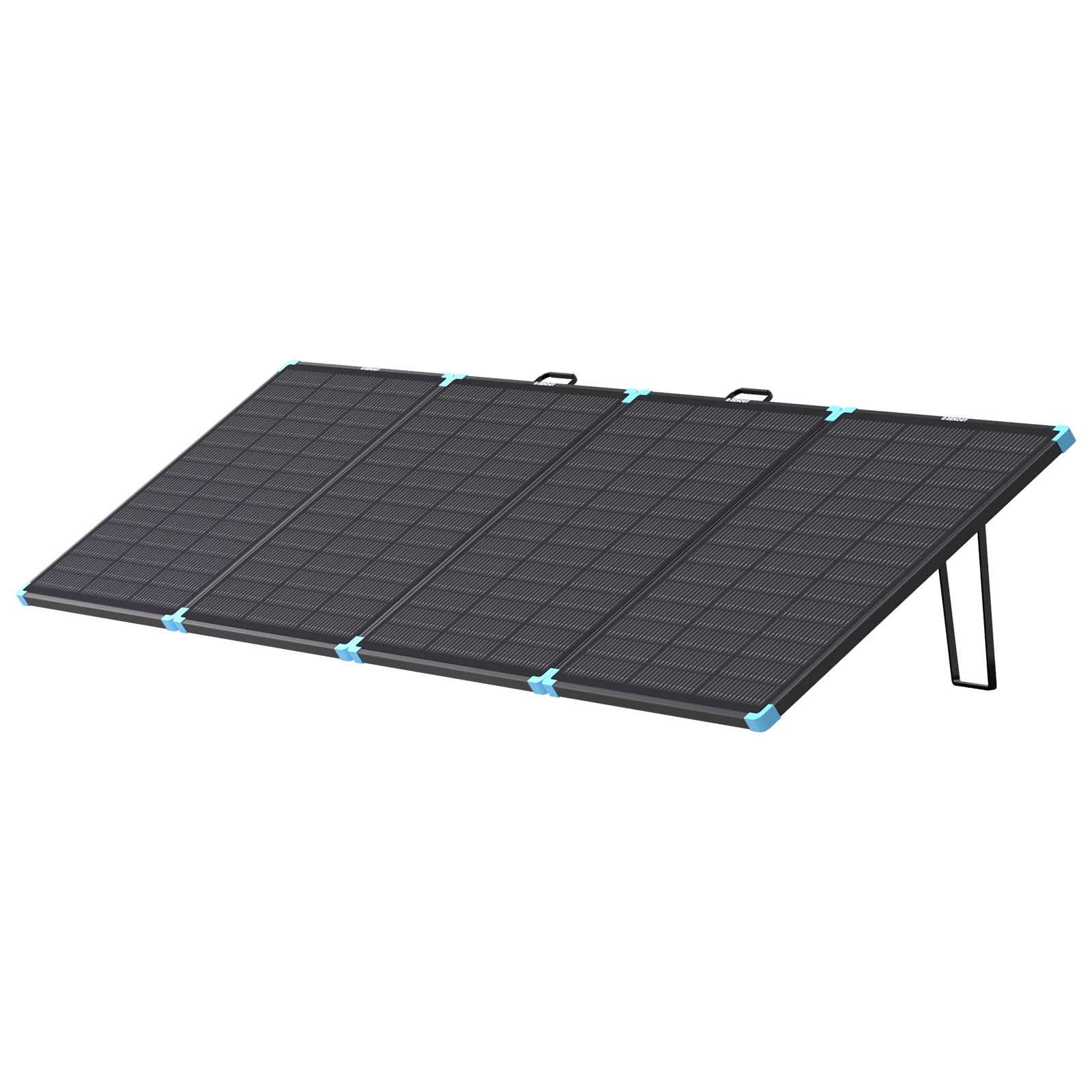
The Renogy 300W Suitcase sets the benchmark for portable solar with N-Type 16BB cells hitting 25% efficiency—well above the 22% from typical 9BB panels. In real-world testing, users consistently reported 270-280W in full sun, and the parallel-wired design means partial shading on one panel section doesn’t cripple total output. The ETFE coating and IP67 rating handle hail and snow without degradation.
At 18.74 lbs, Renogy shaved 17% off the weight of standard portable panels, and the rust-proof kickstands deploy in under a minute with zero tools. The folded dimensions (23.2″ x 29.3″ x 3.2″) slide easily into an RV storage bay or car trunk. Buyers should note the kit does not include cables or a charge controller, so factor in an extra investment for your power station or battery bank.
Renogy backs it with a 3-year output warranty and material/workmanship coverage. For anyone prioritizing portability without sacrificing efficiency, this is the most balanced 300W panel on the market right now.
Why it’s great
- Industry-leading N-Type cells with 25% efficiency
- IP67 waterproof, hail-resistant ETFE coating
- Parallel wiring maintains output under partial shade
Good to know
- No cables or charge controller included
- Kickstands may need angle adjustment for exact sun angle
2. ZOUPW 350W Portable Solar Panel
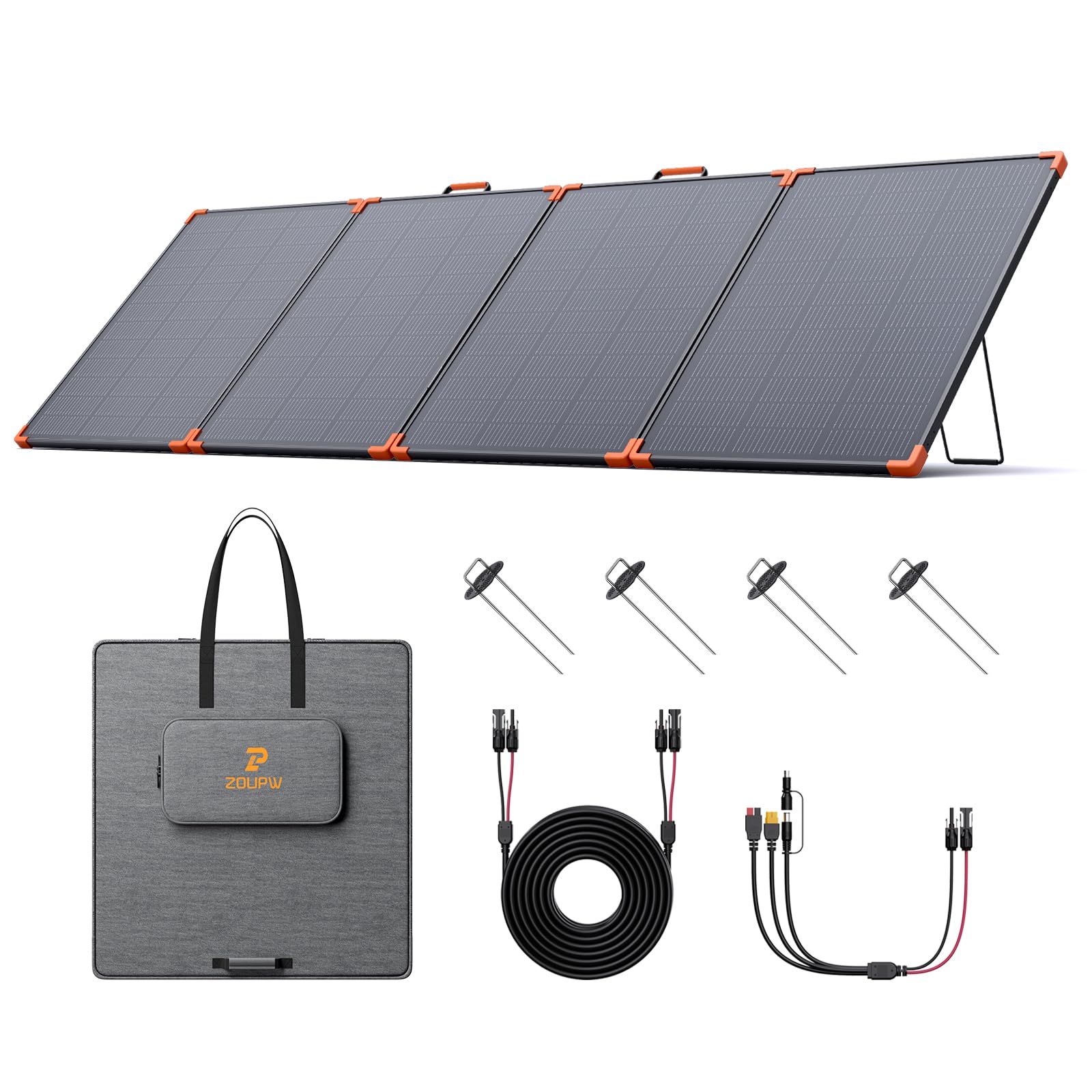
ZOUPW pushes 350W into a foldable 22.2 lbs package with a 50.2V open-circuit voltage—perfect for high-capacity power stations like EcoFlow Delta 2/3 and Anker C1000 that can accept 48-60V input. Users report consistent 330-340W output and even spikes above the 350W rating in ideal conditions. The N-Type 16BB cells eliminate LID, so efficiency stays high year after year.
The 4-in-1 connector cable (XT60, Anderson, DC7909, DC8020) covers the major power station brands out of the box, and the IP68 ETFE coating shrugs off rain and dust. The four reinforced kickstands adjust to 45° for up to 30% more sunlight capture than flat placement. At 22.2 lbs, it’s heavier than the Renogy but delivers 50W more rated capacity.
The high Voc means this panel is not compatible with low-voltage units like Jackery 300/500 or Bluetti EB70S. ZOUPW provides a 3-year warranty and lifetime technical support, making it a strong pick for those with compatible gear who need maximum portable wattage.
Why it’s great
- Delivers up to 350W+ sustained output
- High 50.2V Voc for modern power stations
- IP68 waterproof, durable ETFE build
Good to know
- Not compatible with low-voltage (under 30V) power stations
- Kickstand angle limited to ~31° flat, needs propping for winter
3. BougeRV Bifacial N-Type 300W Mono Solar Panel
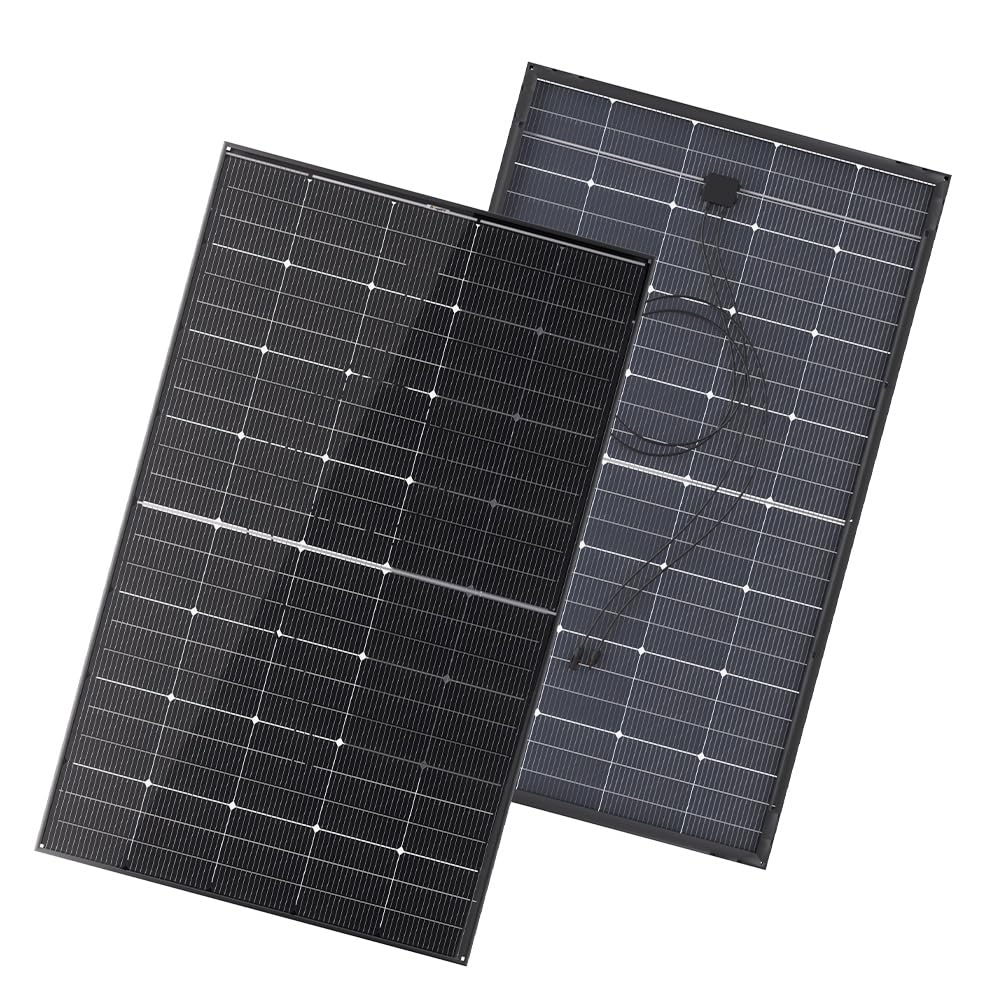
The BougeRV Bifacial panel is a rigid 32.8 lbs powerhouse that captures light from both sides, boosting real-world output by up to 30% in ground-mount setups with reflective surfaces. The N-Type 16BB cells and 25% efficiency are top-tier, and the transparent backsheet means snow, sand, or water beneath the panel contributes to energy generation rather than blocking it.
At 61.3″ x 37.4″ x 1.4″, it’s a full-sized rigid panel suited for RV roofs and fixed ground arrays. The IP68 junction box with pre-installed diodes and 3ft cables simplifies installation, and the corrosion-resistant aluminum frame handles harsh outdoor conditions. Multiple users confirmed individual panel peaks around 285W, with some underperforming units around 225-238W, suggesting quality control inconsistencies.
BougeRV offers 10 years of product technical support and a 12-month warranty. The bifacial advantage is real for those who can mount it with clearance underneath—on a white RV roof, light-colored gravel, or a deck surface.
Why it’s great
- Bifacial design adds up to 30% more output
- N-Type 16BB cells with 25% efficiency
- IP68 junction box, pre-drilled holes for easy mounting
Good to know
- Some units underperform rated wattage (Q.C. variability)
- Large footprint, not for portable/car-top use
4. PECRON 300 Watt Solar Panel
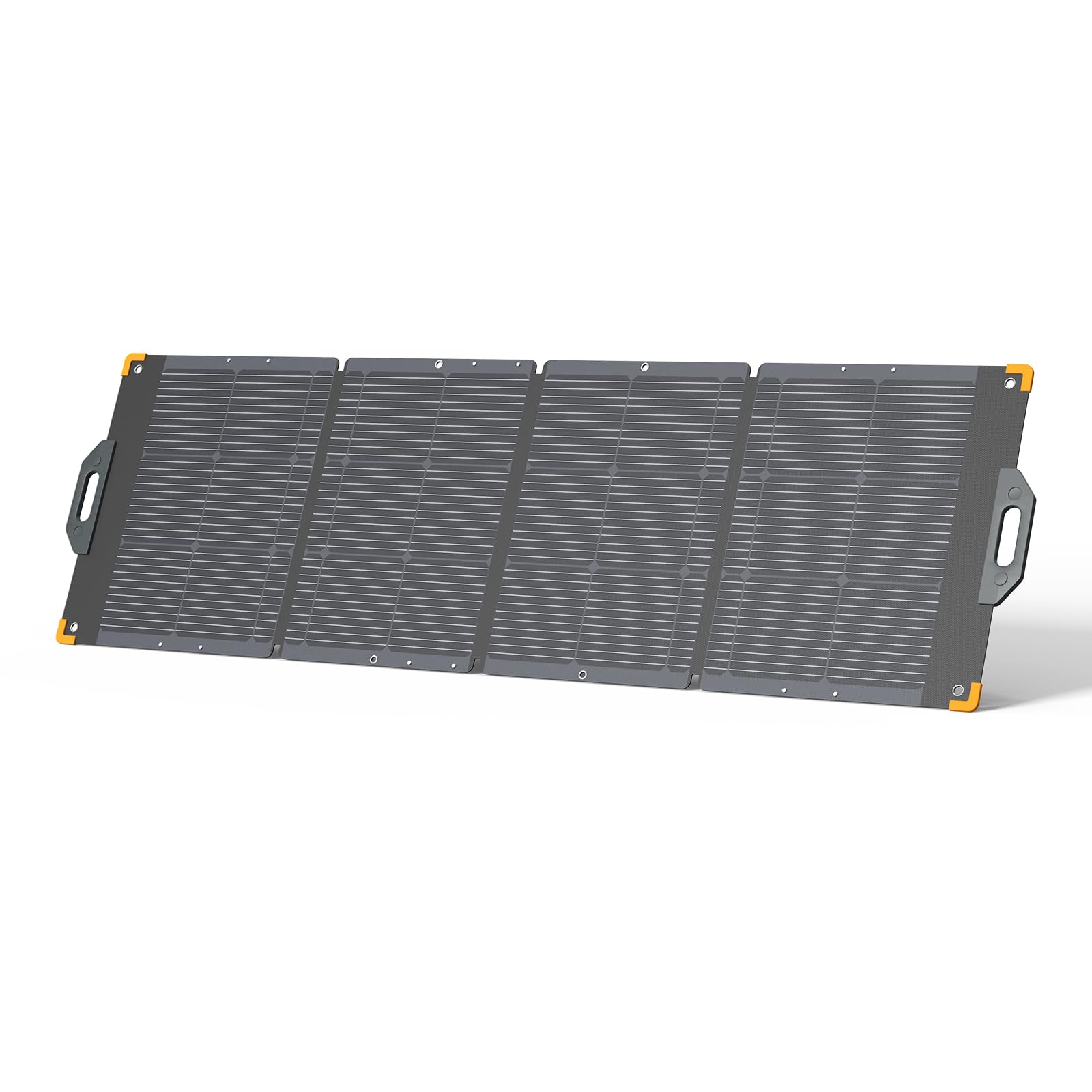
PECRON’s 300W foldable panel achieves 23.5% conversion efficiency with monocrystalline cells and MC4 output, making it a natural match for the Pecron E-series power stations. Real-world output reached 285W with angle adjustments and peaked at 330W in one user’s test, indicating honest STC ratings. The super-thin, lightweight design folds compactly for trunk storage.
The panel includes a 15-16ft cable for flexible placement, and the ETFE and tempered glass construction provide decent weather resistance. PECRON backs it with a 1+1 year warranty and 24/7 customer support—and one user reported a delaminated panel was replaced quickly and graciously by the seller. The main limitation is the fixed-angle kickstands, which users had to supplement with jack stands for optimal tilt.
For anyone building a Pecron-based solar generator system, this panel pairs seamlessly. But general buyers may find the 23.5% efficiency and MC4-only connectors less versatile than competitors with higher efficiency or universal adapters.
Why it’s great
- Honest 300W output, with peaks above rating
- Lightweight and thin, easy to store
- Strong customer service reputation
Good to know
- Limited angle adjustment without props
- MC4 connectors only; no universal adapter included
5. DOKIO 300W 36V Portable Foldable Solar Panel Kit

The DOKIO 300W is the lightest portable panel in this roundup at 15.21 lbs, folding to just 1.1 inches thick—small enough to slide under an RV bunk or into a car trunk without crowding. It outputs at 36V, making it compatible with 24V battery banks and PWM charge controllers. One user reported output exceeding 160W from a single panel in midday sun, and the 9.8ft cable allows the panel to stay in sun while the controller stays shaded.
The included PWM controller supports LiFePO4 batteries and provides reverse polarity, overcharge, and short-circuit protections. However, buyers should know the panel uses SAE connectors rather than standard MC4, which can expand and lose connection in heat. The stand design is flimsy, and the panel is fragile under bending stress—users recommend placing it flat on the van roof rather than flexing it.
For weight-conscious campers, backpackers, or anyone needing a backup panel that won’t eat storage space, the DOKIO is hard to beat. Just treat it carefully and budget for an aftermarket MPPT controller to maximize output.
Why it’s great
- Extremely portable: 15.21 lbs, folds paper-thin
- Includes PWM controller for LiFePO4 batteries
- 9.8ft cable for flexible sun/shade placement
Good to know
- SAE connectors, not MC4 (prone to heat expansion issues)
- Delicate; avoid flexing or bending during setup
6. JJN Solar Panel Kit 300 Watt 12 Volt

The JJN 300W kit is the complete all-in-one package for first-time off-grid buyers: you get the panel, a 40A PWM charge controller, two pairs of solar cables, three sets of Z brackets, and a 4-way connector—everything except the battery. The half-cut cell technology and 10BB design deliver 22% efficiency, and the panel is rated for 12V battery systems (wet, gel, MF, EFB, AGM).
At 45 lbs and 44″ x 23″ x 1.5″, this is a rigid panel intended for permanent mounting on RVs, campers, boats, or ground-mount frames. One verified user reported 92W output at 4 PM in Texas (scaled from a smaller review), and the thin aluminum frame bent slightly during shipping but remained functional. The included PWM controller is functional but basic—no backlight, small text.
JJN offers an extra-long 25-year power output warranty, adding confidence for a system that’s meant to last decades. The cables are 12-gauge aluminum (sufficient but not copper), and while the kit is a phenomenal value for the price, serious off-grid users will eventually want to upgrade to an MPPT controller.
Why it’s great
- Complete kit: panel, controller, cables, brackets included
- 25-year power output warranty
- Half-cut cell technology for better shade tolerance
Good to know
- PWM controller is basic; upgrade to MPPT for efficiency
- Thin aluminum frame may bend in shipping
7. TWELSEAVAN 400W Portable Solar Panel
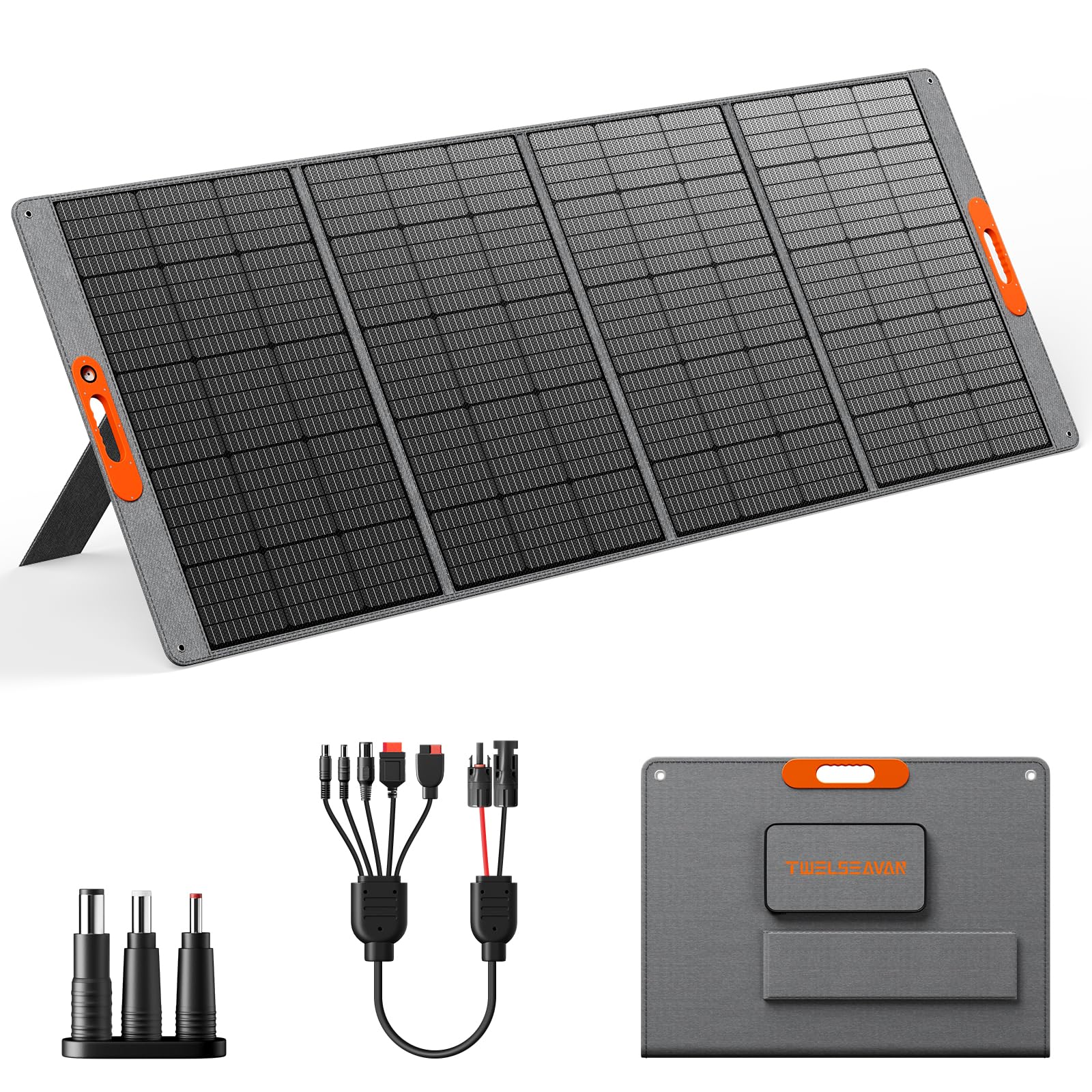
The TWELSEAVAN 400W panel delivers 400W rated capacity at 24% efficiency for roughly the same price as many 300W panels. It uses A+ grade monocrystalline cells with ETFE laminate (95%+ light transmission) and an 8-in-1 MC4 connector kit (Anderson, XT60, DC8020, DC7909, 5521) for broad power station compatibility. Real-world output from users hit 375-385W in optimal sun, with one user in Boston seeing 367W in May.
Weighing 22 lbs with a folded size of 26″ x 35.5″, it’s portable enough for camping but heavy compared to the lightweight DOKIO. The high-density polyester canvas back is wear-resistant, and the four adjustable kickstands make setup easy. Buyers should note the 46.9V open-circuit voltage—not suitable for small 12-20V power stations. The 2-year warranty and 30-day money-back guarantee add peace of mind.
For budget-conscious buyers who want the highest wattage per dollar in a portable form, the TWELSEAVAN is the clear winner. Just verify your power station can accept its voltage before purchasing.
Why it’s great
- 400W for the price of many 300W panels
- 8-in-1 connector cable fits most major power stations
- ETFE laminate with 95%+ light transmission
Good to know
- 46.9V Voc incompatible with low-voltage units
- Heavier than comparable 300W foldable panels
8. ZOUPW 450W Portable Solar Panel
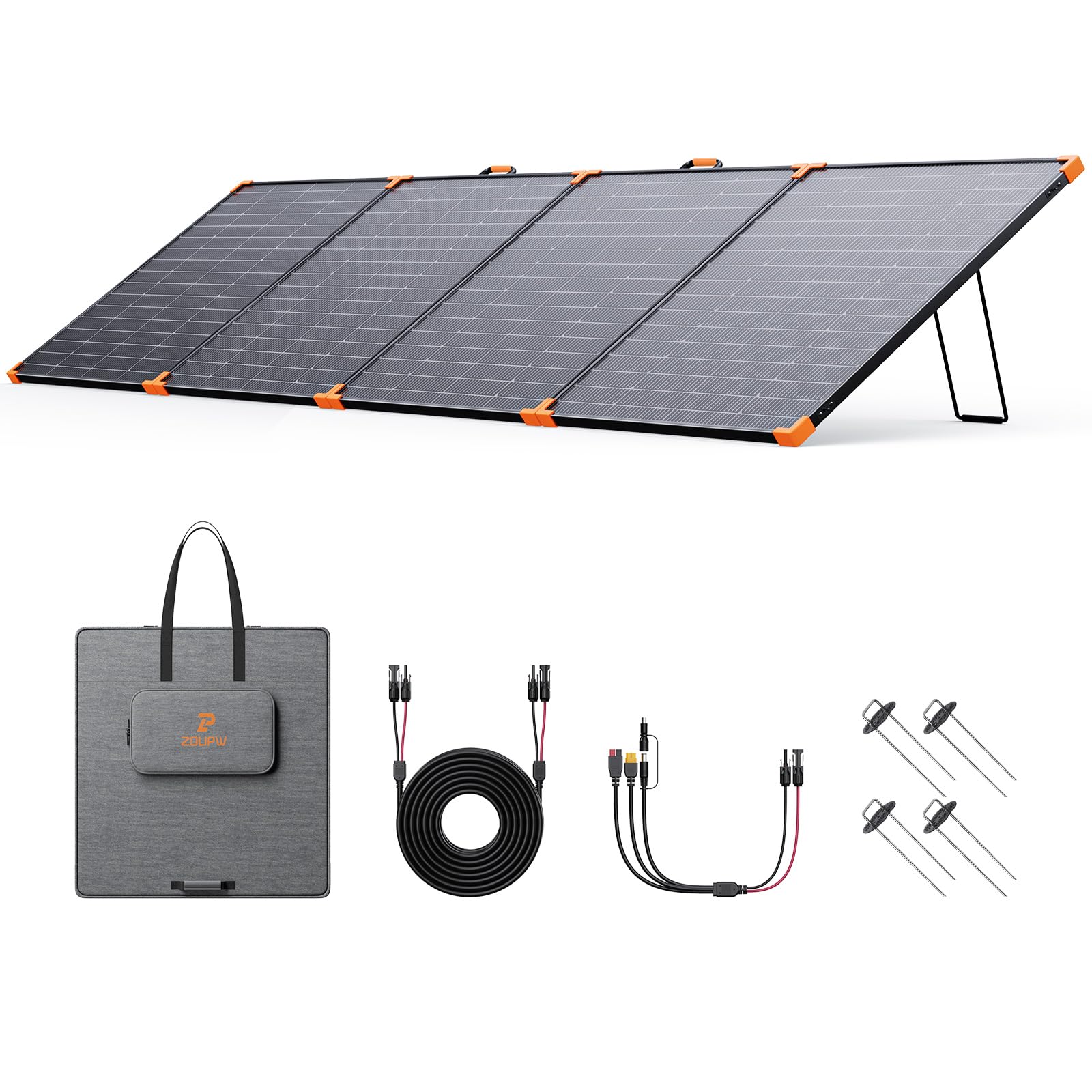
The ZOUPW 450W is the highest-rated panel in this lineup, using N-Type 16BB cells at 25% efficiency in an aerospace-grade fiberglass frame that cuts weight by 30% compared to rigid panels of similar capacity. Multiple verified buyers confirmed sustained output above 450W, with spikes beyond 500W in winter conditions when low temperatures boost voltage. The 45.9V Voc is designed for 40-60V input power stations.
Weighing 29.5 lbs with folded dimensions of 30.43″ x 34.56″ x 3.54″, it’s the heaviest foldable panel here but still manageable for one-person setup. The four reinforced kickstands adjust to 45° and include ground stakes for windy conditions. The IP68 ETFE coating and smart bypass diodes handle partial shade well, though one user noted voltage drops by more than 50% with even a 1-inch shadow stripe.
ZOUPW provides a 36-month warranty—the longest in this segment. This panel is for users with large capacity power stations (2kWh+) who need maximum portable wattage and don’t mind the size and weight penalty.
Why it’s great
- Proven 450W+ real-world output, spikes over 500W
- Fiberglass frame shaves 30% weight vs. rigid panels
- 36-month warranty, longest in class
Good to know
- Heavy for a foldable panel at 29.5 lbs
- Dramatic voltage drop with even slight shading
9. Jackery Solar Generator 300
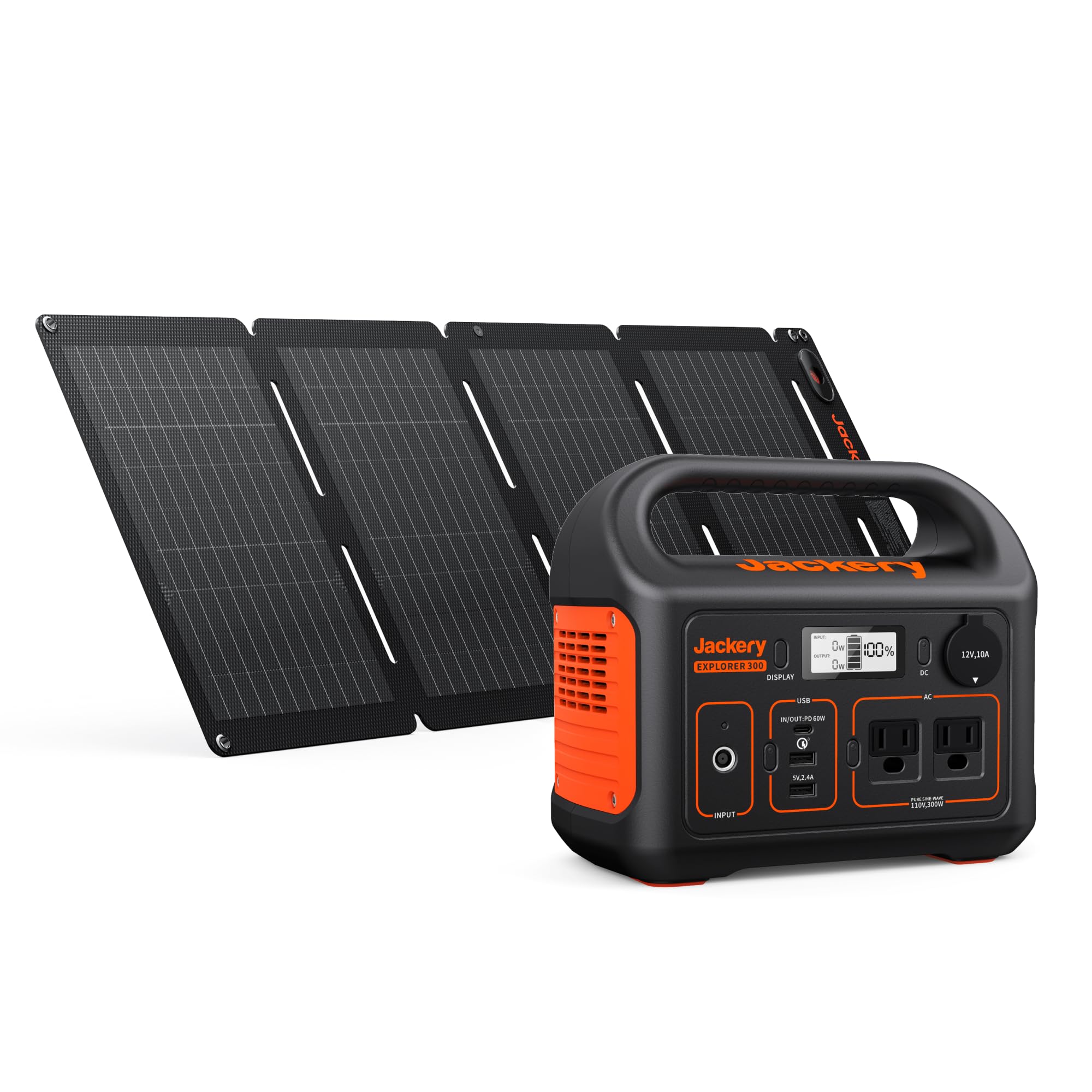
The Jackery Solar Generator 300 pairs a 292Wh LiFePO₄ power station (300W pure sine wave inverter, 600W surge) with a 40W portable solar panel. This is not a standalone 300W panel—it’s a complete system that demonstrates Jackery’s ecosystem approach. The power station weighs only 7.5 lbs (17% lighter than average for its class) and features a 100W USB-C PD port, dual AC outlets, and dual USB-A ports.
The 40W panel alone provides a slow recharge (80% in 7.5 hours), but the system can accept higher-wattage Jackery panels for faster solar refill. The Explorer 300 uses premium LiFePO₄ chemistry rated for 4,000 cycles to 70% capacity—over 11 years of daily use. The integrated handle and compact footprint make it ideal for day hiking, CPAP battery backup, or powering small devices at campsites.
This is the right choice for users who want a turnkey solar generator rather than building a custom system from separate components. For those needing actual 300W of solar capacity, pair this with a compatible Jackery 100W or larger panel instead.
Why it’s great
- Ultra-light power station at 7.5 lbs
- LiFePO₄ chemistry, 4,000 cycles (11 years of life)
- Seamless ecosystem with Jackery panels
Good to know
- Included 40W panel is slow; upgrade for full capacity
- Not a standalone 300W panel—sold as complete system
FAQ
Can a 300 watt solar panel charge a 12V battery directly?
How many amp hours can a 300W panel produce per day?
What is the difference between 12V and 24V solar panels?
Can I mix a 300W panel with my existing 100W panel?
Do portable solar panels need to be angled toward the sun?
Final Thoughts: The Verdict
For most users, the best 300 watt solar panel winner is the Renogy 300W Portable Solar Panel Suitcase because its N-Type 25% efficiency, IP67 durability, and 18.74 lbs lightweight design deliver the best balance of output and portability. If you need a complete off-grid kit with everything included for a first-time install, grab the JJN Solar Panel Kit. And for ultra-light travel where every ounce matters, nothing beats the DOKIO 300W Foldable Panel at 15.21 lbs with a paper-thin 1.1-inch folded profile.