
Our readers keep the lights on and my morning glass full of iced black tea. As an Amazon Associate, I earn from qualifying purchases.
Specs are compiled from manufacturer listings and verified buyer reviews and can change over time — please confirm the key details on the product page before buying.
You want gut-punching, chest-thumping bass that you feel in your bones, not a weak thump that gets drowned out by road noise. The problem is that a 3000-watt amp can sound incredible or be a total headache depending on which one you buy and how you set it up, with too many models promising big power on the box but delivering heat and distortion in real life. This guide cuts through the peak-power hype and focuses on what actually matters for loud, clean, and reliable bass from your car audio system.
I’m Min — the founder and writer behind Gadgets Feed. This guide is built by comparing the manufacturers’ published specifications and the patterns across verified customer reviews, so you get each pick’s real strengths and trade-offs instead of marketing spin.
After digging into the specs and real ownership experiences of the most popular models, here is your complete guide to finding the 3000 watt amp that will actually make your subs pound without leaving you stranded with a blown fuse or a fried amp.
Our Picks at a Glance


How To Choose The Best 3000 Watt Amp
Buying a 3000-watt amp means you want serious power, but the big number on the box is almost always a “peak” or “max” rating, not the continuous power your subs actually feel. The real spec that matters is the RMS power rating, which tells you how much power the amp can deliver cleanly for hours. You also need to match the amp’s stable impedance (ohm load) to your subwoofer wiring, and use thick enough power and ground wire to feed it without voltage drop or overheating. Ignore marketing claims and focus on these three pillars — RMS power, impedance stability, and wiring requirements — and you will end up with an amp that pounds reliably instead of one that goes into protect mode every time you turn it up.
RMS Power vs. Peak Power: The Real Number
The peak power rating is the absolute maximum the amp can produce in a split-second burst, which is almost useless for real-world listening. What you need is the RMS (Root Mean Square) rating, which tells you the continuous power the amplifier can output cleanly without distorting or overheating. A true 3000-watt amp should have an RMS rating somewhere between 750 and 3000 watts, depending on the ohm load. A model that only lists a peak wattage but hides its RMS value is usually a lower-powered amp dressed up with marketing numbers, so always look for the RMS spec in the details.
Impedance and Stability: Matching Your Subs
Amplifiers are rated to be stable at a certain minimum impedance, measured in ohms. A monoblock amp that is “1 ohm stable” can drive a 1-ohm load without overheating or shutting down, which lets you wire multiple subwoofers for maximum power. Some models are only stable at 2 ohms, which limits your wiring options and reduces the total power you can achieve. Always check the amp’s minimum stable impedance and then wire your subwoofers to match that number. Wiring a 1-ohm stable amp to a 0.5-ohm load will likely send it into protect mode or damage it, so get this match right the first time.
Wiring and Electrical System
A 3000-watt amp draws a lot of current, often over 100 amps at full tilt. If you use a thin power wire like 8-gauge, the resistance will cause voltage drop, the wire will get hot, and the amp will keep going into protection mode or simply not deliver its rated power. You almost always need a 4-gauge or 0-gauge (also called 1/0 AWG) wiring kit, preferably with oxygen-free copper (OFC) wire rather than cheaper copper-clad aluminum (CCA). You might also need to upgrade your car’s battery or add a second battery if you plan to run the amp hard at idle for long periods. Buy the best wiring kit you can afford — it makes the difference between an amp that pounds and one that frustrates.
Quick Comparison
| Model | Best For | RMS Power | Stable Impedance | Weight | Amazon |
|---|---|---|---|---|---|
| Rockville RPA9★ Best Overall | Home theater or pro DJ use | 800 W RMS | — | — | $184.95Amazon |
| PRV Audio QS3000True RMS Beast | True RMS performance for pro audio | 3000 W RMS | 1 Ohm | — | $189.91Amazon |
| Taramps Smart 3 BassMulti-Impedance Champ | Multi-impedance subwoofer power | 3000 W RMS | 0.5-2 Ohms | 6.6 lbs | $239.99Amazon |
| Stetsom Bravo Attack 3000 | High RMS with smart cooling | 3000 W RMS | 1 Ohm | — | $208.99Amazon |
| Taramps MD 3000.1 | Compact full-range power | 3000 W RMS | 2 Ohms | 5.5 lbs | $227.00$239.00Amazon |
| Planet Audio AC3000.1D | Versatile monoblock for subs | 1000 W RMS @ 4 Ohm | 1 Ohm | 9.7 lbs | $142.66Amazon |
| Rockville dB13 | Budget mono sub amp | 750 W RMS @ 2 Ohm | 2 Ohms | 8 lbs | $154.95Amazon |
| BOSS Audio OX3KD | Entry-level monoblock with features | — | 1 Ohm | 6.5 lbs | $145.75Amazon |
In‑Depth Reviews
1. Rockville RPA9
Our pick — over 4★ from 900+ verified ratings; the strongest balance of quality and price.
A 2-channel pro rack amp built for DJs, not car doors — and it sounds warm.
The Rockville RPA9 is a different beast from the other picks: it is a 2-channel pro DJ power amplifier in a 2U rack-mount chassis, designed for home theater, live sound, or studio use rather than car audio subwoofers. It delivers 3000 watts peak and 800 watts RMS, with a rugged metal chassis, XLR, 1/4-inch, and RCA inputs, plus Speakon and banana jack outputs, so it integrates with professional mixers, speakers, and PA systems. The dual-fan cooling system and heat sink design prevent overheating during long gigs or studio sessions, and the front-panel controls give you volume knobs and signal monitoring LEDs for quick adjustments in low-light environments.
Buyers praise its performance, with one reviewer saying it “drives Mach2 160W speakers” and has been “still going strong” after months of use for recreational DJing. Another buyer, a self-described “critical audio snob,” likes it as an A/B amplifier for vintage speakers, calling the sound “warm” with no hiss or hum, and noting it is light with easy connections. However, they point out the small power supply limits headroom (the extra power needed for dynamic peaks), and the fans are too loud for quiet living room use — it is fine for band settings. One buyer mentions that rack mounting requires drilling new holes because the front flanges are misaligned, and the bottom screw can grind on adjacent gear unless you countersink it. This is a very different use case — if you want a car subwoofer amp, skip this; if you need a reliable pro PA amp for live sound or home theater, it is a great value.
Pro-grade connectivity: XLR, 1/4-inch, RCA, Speakon, and banana outputs give you total flexibility for any pro audio setup. The warm, clean sound is a bonus for vintage speaker fans.
Best for: DJs, mobile entertainers, or home theater enthusiasts who need a 2-channel rack amp for passive speakers, not car subwoofers.
Not for: anyone building a car audio system — this is a different category entirely, and the fan noise and rack-mount form factor do not suit a vehicle.
2. PRV Audio QS3000
Brazilian engineering that delivers honest 3000-watt RMS you can actually trust.
This is the rare amplifier that publishes its RMS power directly at 3000 watts, not a peak number that is three times higher than what it can actually sustain. The PRV Audio QS3000 uses Class D Brazilian technology (a specialized, efficient power delivery design from Brazil) to push a full 3000-watts RMS into a 1-ohm load, making it an ideal choice if you are running a serious pro-audio system with multiple mid-bass speakers or a high-power subwoofer array. It is a full-range amplifier, meaning it can drive mids and highs cleanly, not just sub-bass, which gives you more flexibility in system design. The compact chassis measures just 7.30 inches wide by 8.66 inches long by 3.00 inches high, so it fits in tight spaces under seats or in custom panels.
Comparing it directly to the Rockville dB13, which delivers 750 watts RMS, the PRV Audio QS3000 offers a massive gap in continuous power — 3000 watts versus 750 watts — which means it can drive much larger speaker arrays without distorting. The built-in 4-way protection circuitry guards against high voltage, low voltage, shortage, and current issues, with Power, Protection, and Clip LED indicators on the top panel so you can see the amp’s status at a glance. Buyers report it is an “awesome amp” with impressive power and looks, and one professional installer noted it works well for mid-bass speakers even though you have the option to run a sub or tweeters on it. The single real trade-off is that its impressive RMS power demands a very stout electrical system — you will need 0-gauge wire and likely a high-output alternator to keep it fed, and the smaller footprint means cooling relies on that efficient class-D design rather than massive heatsinks, so ensure you have some airflow around it.
Clean power to spare: This is the pick for the buyer who wants genuine 3000-watts RMS certified power and is willing to invest in the electrical system to support it. The full-range capability makes it unusually versatile compared to a pure subwoofer amp.
Reach for this if: you are building a serious pro-audio install with multiple mids and a sub, and you want an honest RMS rating you can plan your system around.
Look elsewhere if: your electrical budget stops at a standard battery and 4-gauge wire — this amp needs serious current delivery to live up to its 3000-watt RMS potential.
3. Taramps Smart 3 Bass
A bass-dedicated monoblock that adapts to almost any subwoofer wiring scheme.
The Taramps Smart 3 Bass is different from most amps because it uses Multi-Impedance technology, which lets it operate from a 0.5-ohm load all the way up to 2 ohms while still delivering its full 3000-watts RMS. That means you can wire your subwoofers in multiple configurations — series, parallel, or a mix — without worrying about dropping below the amp’s minimum stable impedance, which is a common cause of protection mode and overheating. The positive and negative power terminals accept a minimum of 4 AWG and a maximum of 1/0 AWG wire, giving you flexibility to use the thick cable this power level needs, and it uses a 200A circuit breaker or fuse.
Buyers with a year of ownership report it produces “great power and bass response,” with one reviewer pushing a 10-inch CT Sounds MESO subwoofer in a tuned enclosure at 32Hz and noting the amp “loves to push power.” Another owner runs it with two Skar 12-inch subs and says it “pounds” even at a quarter of the gain setting. The protection circuitry covers output short circuits, high and low voltage, and thermal issues, and it includes an LED indicator system and a separate M1 LED monitor in the box. The catch is that because it is a bass-only amp (not full range), you cannot use it to power mid-range or tweeter speakers — it is strictly for subwoofers. A few users also mention needing oxygen-free copper (OFC) wire rather than cheaper CCA (copper-clad aluminum) to avoid ground loop issues and wire heating, so factor that into your total build cost.
Flexible subwoofer power: The Multi-Impedance feature is a genuine advantage if you are experimenting with different wiring setups or swapping subwoofers down the road. The bass-dedicated crossover and bass boost are tuned specifically for low-end output.
Best for: the subwoofer enthusiast who might change their sub setup or wants the convenience of a wide impedance range without worrying about protection mode.
One thing to know: this is a subwoofer-only amplifier, so if you ever want to run a full-range speaker from the same amp, this is not the one — it is pure bass.
4. Stetsom Bravo Attack 3000

A full-range class D with smart cooling and crossover control that rivals pro amps.
The Stetsom Bravo Attack 3000 delivers 3000 watts RMS at 12.6 volts into a 1-ohm load, making it among the most powerful RMS-rated amps in this roundup. It is a full-range monoblock, meaning it can drive subwoofers, mid-bass speakers, tweeters, or a combination, and its crossover system is unusually comprehensive for this class: a high-pass filter (HPF) adjustable from 10Hz to 700Hz, a low-pass filter (LPF) from 90Hz to 20KHz, plus separate bass boost frequency control from 30Hz to 60Hz, a mid-bass boost at 270Hz, and a mid-high boost at 2KHz. There is also a Flat mode that disables all internal adjustments so you can control everything from your head unit or processor.
The “Smart Coolers” system provides improved ventilation for better heat management, and the protection system uses LED blink patterns for diagnosis — different blink counts tell you exactly what type of fault occurred. Owners mention it “rocks” and produces “thunder sound for its quality,” with one reviewer noting it was easy to dial in after tuning with a 40Hz signal. The power and ground terminals accept up to 4 AWG wire, with the speaker output using 8 AWG. On the downside, the compact size means the fan can be audible in quiet listening environments, and the detailed crossover setup takes time to learn — you will need to read the manual closely to use the bass boost and flat mode correctly. It is also on the premium side of the price range, but the 3000-watt RMS at 12.6V is a rare spec that justifies the cost if you run the system at typical car voltage.
Pro-grade tuning options: The separate bass, mid-bass, and mid-high boosts give you studio-like control over the sound signature. The Smart Coolers and diagnostic LED system are thoughtful reliability touches.
Choose this for: a serious full-range build where you want to actively dial in every frequency band without adding a separate DSP. The Flat mode is a godsend if you prefer external processing.
skip it if: you are a low-maintenance buyer — the extensive controls require some effort to master, and the fan may be too loud for a sound-quality-focused daily driver.
5. Taramps MD 3000.1
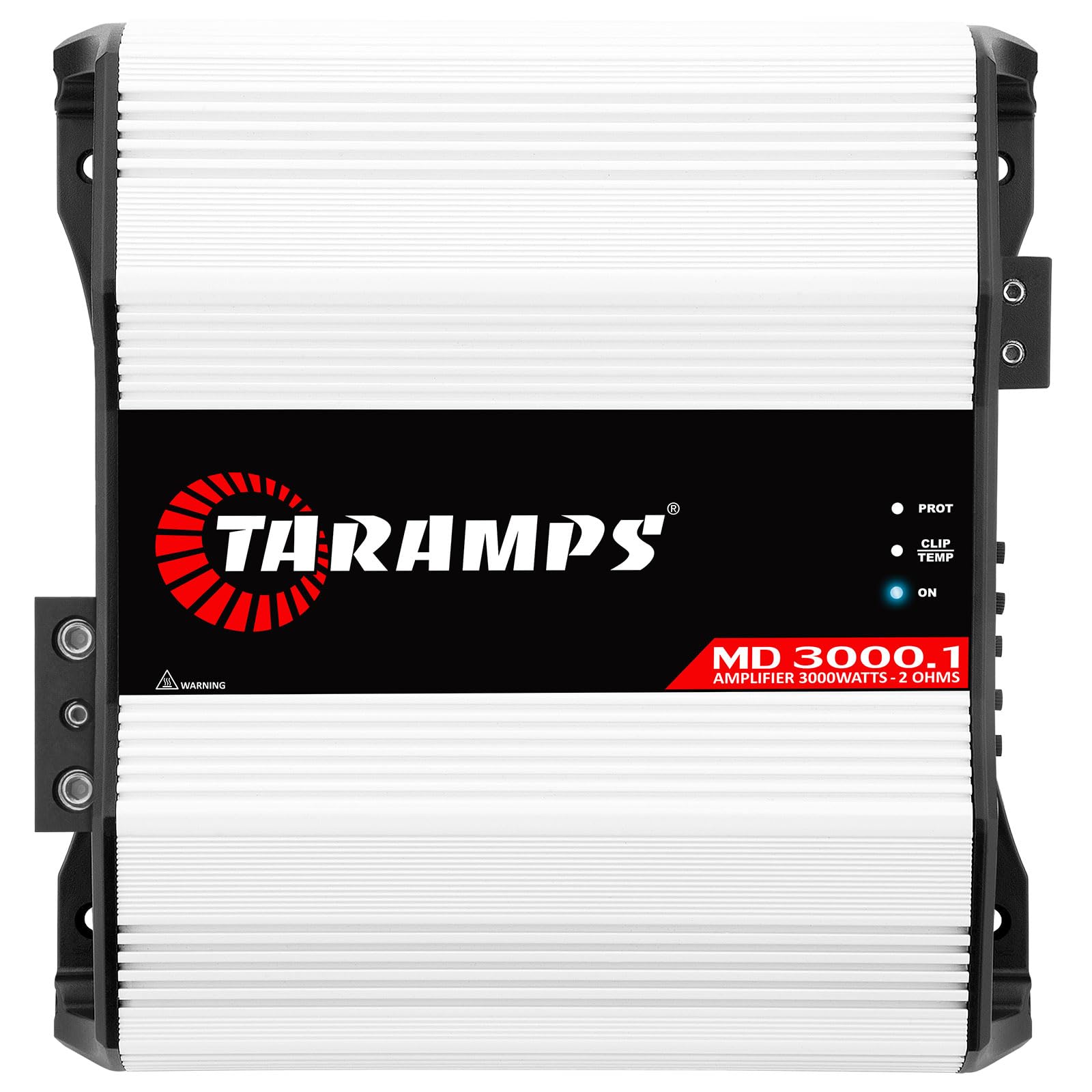
A shockingly small monoblock that packs full-range versatility into a 5.5-pound package.
Weighing only 5.5 pounds and measuring about 9 inches on each side, the Taramps MD 3000.1 is one of the lightest and most compact 3000-watt RMS amplifiers you can buy, which makes it easy to mount under a seat, in a glove box, or behind a panel. It is a full-range Class D monoblock, meaning it can drive subwoofers, mid-bass drivers, or even tweeters, and it has a built-in crossover and bass boost. The amplifier is stable at 2 ohms and delivers its full 3000-watts RMS at that impedance, so it is ideal if you have a 2-ohm subwoofer load or you wire two 4-ohm subwoofers in parallel to hit that 2-ohm balance.
Customers note that it is “tiny but powerful,” with one reviewer using it to push four CT Sounds Meso 6.5-inch subwoofers in a pickup truck build and saying it is “compact, powerful and efficient.” Another owner had two units and said they are “super powerful” and surprising for the size, though they mentioned that if the amp tops out, it can stop working correctly — suggesting you respect the 2-ohm minimum impedance. The included cooling fan rarely needs to kick on because the class-D design runs very cool, but some users wish the crossover were better designed for subwoofer integration, recommending the Taramps Smart 3 Bass instead if subwoofers are your only goal. For a space-constrained build that still needs full-range versatility, this is a standout performer that punches way above its tiny weight.
Incredible space savings: At 5.5 pounds and a near-square footprint, you can shoehorn this into places most 3000W amps will never fit. The full-range flexibility adds to its utility.
Ideal for: truck builds, hidden installs, or anyone who needs 3000-watt RMS from an amp that barely takes up any room.
Watch out for: the 2-ohm minimum stability — you cannot wire to 1 ohm, so make sure your subwoofer setup matches before buying.
6. Planet Audio AC3000.1D

A strap-capable class D monoblock that runs cool and delivers clean, crisp bass.
The Planet Audio AC3000.1D is a 1-ohm stable monoblock that offers 3000 watts max power and 1000 watts RMS x 1 at 4 ohms, making it a solid mid-range option for powering a pair of subwoofers. It uses a Class D topology, which means it converts excess energy into stored power rather than heat, so the amp runs very cool even during extended listening sessions — one reviewer noted it stayed cool after an hour at three-quarters volume. The variable subsonic filter prevents your subwoofers from bottoming out by filtering out ultra-low frequencies, and the variable low-pass crossover lets you dial in exactly where the bass rolls off. A remote bass knob is included for adjusting the low end from the driver’s seat.
Reviewers point out it “powers 3×12″ subs well” with “clean, crisp bass,” and another owner runs two Alpine Type-R 10-inch subs (500 watts RMS each) without issue. The main complaint from that same reviewer is that the 12V and ground terminals only accept up to 8-gauge wire, not the 0-gauge you might expect for this power level — so plan your wiring accordingly. The amplifier is also strapping capable, meaning you can link two AC3000.1D amps together to double the power output to your subwoofer array. Weighing 9.7 pounds and measuring 13 x 10 x 2.4 inches, it is significantly larger than the Taramps MD 3000.1, so check your mounting space before buying. A small number of users report failures after several months, often citing overheating — likely due to insufficient wiring gauge, so use that 8-gauge or upgrade to a larger terminal block.
Well-rounded subwoofer amp: The subsonic filter, low-pass crossover, and bass boost give you solid tuning tools for a clean subwoofer setup. The strapping feature is a nice upgrade path for later.
Reach for this if: you want a reliable, cool-running monoblock for a pair of subwoofers and you are comfortable with 8-gauge wire connections.
Look elsewhere if: you plan to run 0-gauge wire or need more than 1000-watts RMS into 4 ohms — the terminal size is a hard limit here.
7. Rockville dB13

A budget-minded monoblock that delivers 750-watts RMS with a full set of tuning controls.
The Rockville dB13 is a 3000-watt peak / 750-watt RMS at 2 ohms monoblock amplifier that is CEA compliant (the Consumer Electronics Association standard for honest power ratings), giving you some confidence that the published numbers are tested rather than exaggerated. It features a high-speed MOSFET power supply for consistent power delivery, an adjustable 12dB per octave crossover, a subsonic filter adjustable from 15Hz to 55Hz, and a 12dB bass equalizer, so you have enough control to fine-tune your subwoofer output. The remote dashboard subwoofer control lets you adjust bass level from the driver’s seat, and the LED-illuminated logo adds a touch of style.
At just 3 x 3 x 3 inches in reported dimensions — though that appears to be a listing error compared to the actual size — it is a compact chassis that fits in tight spaces. Its 750-watts RMS at 2 ohms is a significant step down from the PRV Audio QS3000’s 3000-watts RMS , so it is best suited for a single moderate-power subwoofer rather than a massive wall of subs. The built-in IC-controlled protection system guards against overheating, voltage issues, and short circuits. The power and ground connections use standard 4-gauge wire, which is adequate for its current draw. Buyers generally find it delivers good value for its price point, though because the data lacks reviews, we recommend checking recent buyer feedback for long-term reliability notes. If you are on a tight budget and only need moderate subwoofer power, this is a functional entry point.
Honest power for the price: The CEA compliance and 750-watts RMS rating at 2 ohms make this a straightforward amp for a single sub. The protection system gives confidence for basic installations.
Best for: a first-time car audio builder who wants a simple, protected amp for a single 2-ohm subwoofer while staying affordable.
One limitation: the 750-watts RMS is well below the 3000-watts RMS of the premium picks, so it cannot drive a high-power subwoofer array to its full potential.
8. BOSS Audio OX3KD

A lightweight, feature-packed monoblock that makes 3000-watt car audio accessible.
The BOSS Audio OX3KD Onyx is a 3000-watt peak monoblock amplifier that is 1-ohm stable and weighs just 6.5 pounds, making it one of the lighter options that is still easy to mount in standard locations. It uses a PWM MOSFET power supply for efficient power conversion and includes RCA input and output jacks, a low-pass filter, a subsonic filter, bass boost, phase control, and a remote subwoofer control knob. The illuminated LED logo adds a bit of visual flair to your install, and the strapping capability lets you pair two amps for more power later. Measuring 12.25 x 7 x 2.3 inches, it has a relatively slim profile that fits under many seats.
Shoppers say it is “pushing 2 15’s no problem,” with one reviewer upgrading from an 8-year-old BOSS 1500W amp and saying this one is “legit.” Another owner runs it with two Kicker VR 12-inch subs and says they “really hit” with this amp. The most common issue reported is that the included bass boost knob does not always function, with multiple buyers noting the knob seems non-responsive. You definitely need thick wiring — one reviewer warns that 8-gauge wire caused the amp to overheat and go into protection mode, recommending at least 4-gauge OFC wire. For a budget-conscious build that still needs 1-ohm stability and a full set of tuning options, this is a capable entry point, but plan to bypass or replace the bass knob if that feature is important to you.
Budget-friendly feature set: The subsonic filter, phase control, and remote sub control give you more tuning tools than most amps in its price bracket. The lightweight design makes installation easy.
Reach for this if: you are building your first real subwoofer system on a budget and you want 1-ohm stability and all the essential controls.
Watch out for: the bass boost knob seems unreliable per multiple reviews, and you must use 4-gauge OFC wire to avoid overheating.
Understanding the Specs
RMS Power: What Your Subs Actually Feel
RMS (Root Mean Square) is the continuous power your amplifier can deliver without distorting or overheating. A 3000-watt peak amp might have an RMS rating of only 750 to 1500 watts, and that RMS number is the one you use to match your subwoofer’s power handling. Always multiply your subwoofer’s RMS rating by the number of subs and make sure the amp’s RMS output at the correct impedance is the same or slightly below that total. Exceeding the sub’s RMS rating with a high-gain setting is the fastest way to blow a voice coil.
Impedance: Ohms and Wiring Options
Impedance, measured in ohms, is the electrical resistance your subwoofer presents to the amplifier. A lower ohm load (like 1 ohm) lets the amp produce more power, but only if the amp is rated to be stable at that impedance. If you wire a 1-ohm stable amp to a 0.5-ohm load, you risk triggering protection mode or damaging the amplifier. The most common wiring schemes are: single 4-ohm DVC (dual voice coil) sub wired to 2 ohms, or two 4-ohm SVC (single voice coil) subs wired in parallel to 2 ohms. Check your subwoofer’s coil configuration and match it to the amp’s stable impedance for maximum safe power.
FAQ
Can I use a 3000-watt amp with a stock car battery?
What gauge wire do I need for a 3000-watt amp?
What does “1 ohm stable” mean?
Is a 3000-watt amp too much for a single subwoofer?
What is the difference between a monoblock and a 2-channel amp?
Can I run mid-range speakers from a monoblock subwoofer amp?
How do I set the gain on a 3000-watt amp?
Can I bridge a 2-channel amp to power a subwoofer?
What does the subsonic filter do?
Why does my amp go into protection mode?
Final Thoughts: The Verdict
For the majority of shoppers, the 3000 watt amp winner is the PRV Audio QS3000 because it delivers an honest 3000-watt RMS rating in a compact chassis, giving you genuine pro-level power for both mid-bass speakers and subwoofers. If you want a subwoofer-specific amp that adapts to virtually any wiring setup, grab the Taramps Smart 3 Bass with its Multi-Impedance technology. And for a high-RMS full-range option with extensive tuning controls, the Stetsom Bravo Attack 3000 has the crossover flexibility and smart cooling that power users will appreciate.
How We Picked
We do not accept paid placement. Every pick is matched to a real buyer and a real use-case; we do not hands-on test units.
Sources & Methodology
Specifications: manufacturer listings and product documentation. Review insights: verified customer reviews, as of July 2026. Pricing: not shown on this page (it changes often); check the current price via the retailer link.
As an Amazon Associate, Gadgets Feed earns from qualifying purchases. This does not affect which products we feature.
Related Guides
Product prices and availability are accurate as of the date/time indicated and are subject to change. Any price and availability information displayed on Amazon at the time of purchase will apply to the purchase of this product. As an Amazon Associate I earn from qualifying purchases.
CERTAIN CONTENT THAT APPEARS ON THIS SITE COMES FROM AMAZON. THIS CONTENT IS PROVIDED "AS IS" AND IS SUBJECT TO CHANGE OR REMOVAL AT ANY TIME.
Amazon and the Amazon logo are trademarks of Amazon.com, Inc. or its affiliates.