
Our readers keep the lights on and my morning glass full of iced black tea. As an Amazon Associate, I earn from qualifying purchases.
Specs are compiled from manufacturer listings and verified buyer reviews and can change over time — please confirm the key details on the product page before buying.
You need a 3000-watt inverter to get real, wall-outlet-quality power where there is no wall outlet. But a 3000W continuous unit isn’t one product — you must choose between pure sine wave and modified sine wave, quiet fans and loud ones, and a unit that handles a refrigerator’s startup surge versus one that trips at the first spike. This guide matches the right 3000-watt unit to the job you actually need it to do.
I’m Min — the founder and writer behind Gadgets Feed. This guide is built by comparing the manufacturers’ published specifications and the patterns across verified customer reviews, so you get each pick’s real strengths and trade-offs instead of marketing spin.
From RV trips to home backup duty, these are the top ways to bring reliable AC power anywhere your battery can go. 3000 watt inverter models differ hugely in waveform, noise, and efficiency, and this guide reveals which ones are worth your money.
Our Picks at a Glance

How To Choose The Best 3000 Watt Inverter
Before you click buy, you need to know what you are plugging in. The biggest mistake is buying a modified sine wave inverter for sensitive electronics — it can cause a laptop charger to whine or a refrigerator compressor to run hot. Here is what actually matters.
Pure Sine Wave vs. Modified Sine Wave
Pure sine wave inverters mimic the smooth, consistent power from your home’s wall outlets. This clean power keeps sensitive loads like televisions, home theaters, and variable-speed tools running safely and quietly. Modified sine wave units are cheaper but can cause humming in some devices and are harder on motor-driven appliances. If you are powering a refrigerator or a CPAP machine, pure sine wave is the safer bet.
Continuous vs. Peak Power
Continuous power is what the inverter can deliver steadily. Peak (or surge) power is the brief burst needed to start motors and compressors. A well-built 3000W unit might offer 6000W of surge to start a fridge. Always match your appliance’s starting surge to the peak rating, not the other way around.
The Hidden Costs: Idle Draw and Noise
An inverter that sits connected to your battery but does nothing still uses power — that’s idle draw. A high idle draw drains your RV or truck battery overnight. Equally important is the cooling fan. Quiet fans that only spin up under load are the difference between peaceful sleep in a camper and a constant whirring distraction.
Quick Comparison
| Model | Best For | Waveform | Continuous Power | Efficiency | Amazon |
|---|---|---|---|---|---|
| BELTTT 3000W★ Best Overall | Sensitive electronics & RV setups | Pure Sine Wave | 3000W | >93% | Amazon |
| Junbpaw 3080WSilent Performer | Ultra-quiet, high-performance rigs | Pure Sine Wave | 3080W | 93% | Amazon |
| Giandel PS-3000SARMost Versatile | Off-grid solar & home backup | Pure Sine Wave | 3000W | — | Amazon |
| VOLTWORKS VS-3000PCR | Hardwired installs in motorhomes | Pure Sine Wave | 3000W | — | Amazon |
| ALLWEI P3000-3 | Hurricane prep & heavy startup loads | Pure Sine Wave | 3000W | >91% | Amazon |
| VEVOR SGPE-3000W | Multi-device charging in outages | Pure Sine Wave | 3000W | 88% | Amazon |
| EGSCATEE 12V-3000W | Budget van life & solar builds | Modified Sine Wave | 3000W | — | Amazon |
| PowerDrive PWD3000P | Smartphone control in semi trucks | Modified Sine Wave | 3000W | — | Amazon |
| EDECOA 19-3000W | Basic tools & entertainment gear | Modified Sine Wave | 3000W | >90% | Amazon |
| Cantonape 3000W | Multi-port charging on a budget | Modified Sine Wave | 3000W | >90% | Amazon |
In‑Depth Reviews
1. BELTTT 3000W Pure Sine Wave Inverter
Our pick — 4.5★ from 400+ verified ratings; the strongest balance of quality and price.
The dependable all-rounder that powers sensitive electronics with clean, grid-quality sine wave power.
The BELTTT earns the top spot because it pairs a >93% conversion efficiency with a true pure sine wave output, so your TV, home theater, and other delicate loads run exactly as they would from a wall socket. It delivers a continuous 3000W from a 12V battery with a 6000W peak surge for starting motors, and its UL-listed safety protections (undervoltage, overload, short circuit, and reverse connection) keep both your gear and your battery safe.
Truckers and RV owners like this unit because it gives you dual AC sockets, a 20A outlet, a 5V 2.1A USB port, a hardwire port, and a remote controller with a 23Ft cable — so you can monitor voltage and load from the driver’s seat. Buyers report it handled a 3000W load continuously in a very warm 85°F room without breaking a sweat, and that it powers an 800-watt refrigerator with ease.
The recurring trade-off is the noise level and the cable gauge. The cooling fans are effective but can get loud above a 500W load, and the red battery cap threading on one unit stripped easily. Also, the included battery cables tend to get hot at full load — serious users recommend upgrading to 4/0 cables with a larger fuse for sustained heavy use.
What wins people over
- Clean pure sine wave output protects sensitive loads like TVs and home theaters
- 23-foot remote cable gives clear status updates from the driver’s seat
- Value for money is the most-cited praise — 35 buyers single it out
The honest trade-offs
- Fans measure around 55dB above a 500W load — noticeable in a quiet room
- Idle draw sits around 19-21W, which will drain a battery if left on
- Stick with supplied cables only for light loads; upgrade for continuous 3000W
Reach for this if: you run sensitive electronics or a refrigerator in an RV and want clean, low-maintenance power with a long-range remote.
Look elsewhere if: your setup demands silent operation — the cooling fans make their presence known under load.
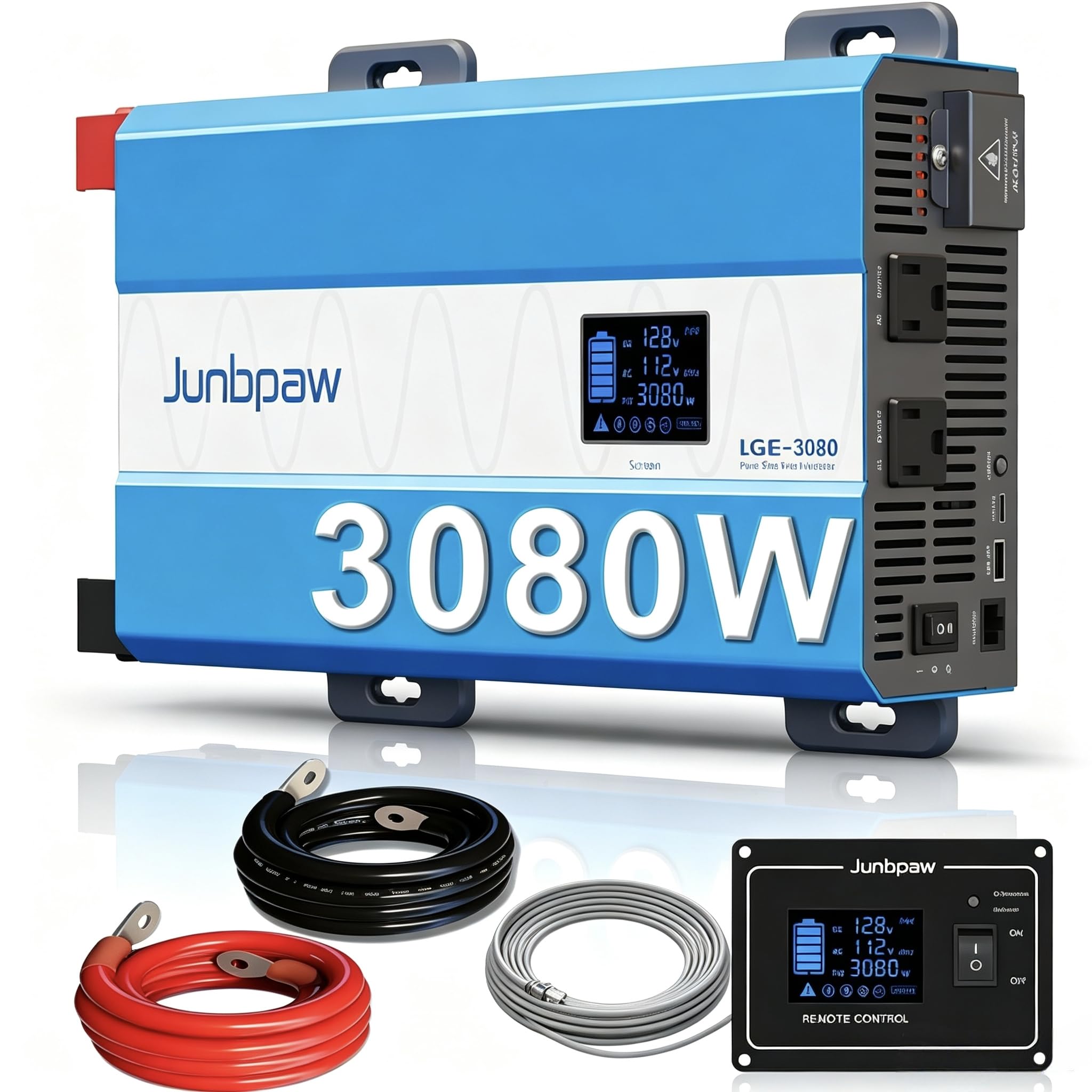
2. Junbpaw 3080W Pure Sine Wave Inverter
The 35dB whisper-quiet powerhouse that runs a fridge and freezer without the fans even kicking on.
The Junbpaw flips the script on the usual inverter complaint — noise. Its noise-reduction design reaches as low as 35dB, and the reviews back it up: owners note it handles a fridge, freezer, and fan without the cooling fans spinning up at all, which means no whirring in the middle of the night. It pushes a continuous 3080W with 93% conversion efficiency and a 9000W surge for demanding starts like a 1.5hp pump.
This unit is genuinely more efficient than a typical 2000W unit, and owners mention it extends their battery life noticeably. The advanced pre-charge function protects your BMS (battery management system) from high instantaneous current at startup, and dual AC/DC protection ensures no smoke or fire risk even if an insect ingress causes a component malfunction.
The catch is the accessories and the wiring. The supplied cables are on the smaller side, and some owners found the small Phillips screws on the high-current terminals make wire attachment frustrating — they recommend replacing the supplied cables with 3/0 pure copper for a permanent install. The wired remote cable must be T-568B standard; using T-568A wiring can damage the unit.
The quiet edge: This is the pick for anyone who values silence — it holds a fridge, freezer, and fan without the fans activating, a claim few 3000W-class inverters can make.
The fit note: It’s a true 3080W continuous performer with a 9000W surge, but expect to budget for thicker, higher-quality battery cables to match its appetite.
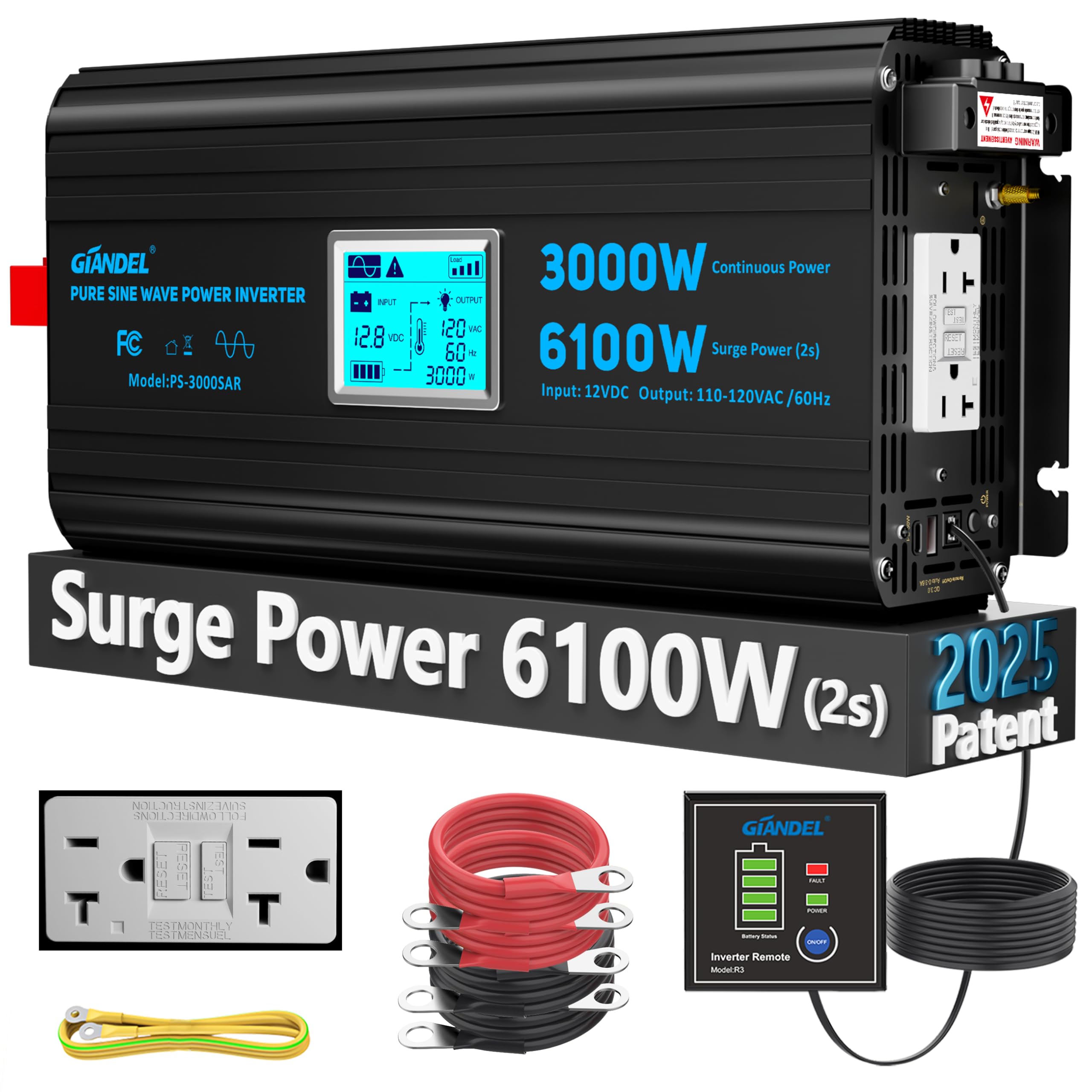
3. Giandel PS-3000SAR 3000W Pure Sine Wave Inverter
The battery-smart inverter with selectable lithium profiles and a 30-foot remote for total off-grid control.
The Giandel is the thinking person’s inverter because it adapts to your battery chemistry. With adjustable input voltage protection from 9.5V to 11.5V, you can select the right profile for AGM, lead-acid, deep-cycle, lithium, or LiFePO4 batteries — a feature most units in this class simply lack. It outputs a continuous 3000W with 6100W surge for two seconds, enough to kick-start a water heater, air conditioner, or a 1500-watt microwave.
Safety is a step above the rest here. The UL-listed 20 Amp GFCI outlets protect against electric shock, and the main components — the PCBs, built-in fuses, and transformers — all carry UL approval. The big full-angle LCD screen shows input voltage, output wattage, battery status, and protection codes, and you can even read the inverter temperature directly from the display.
The honest downsides are the noise and the included cabling. Customers note the fan is noticeable when it does spin up, and the supplied wires are too small — under heavy load they heat up, so owners recommend upgrading to 2/0 gauge cable and adding a 100A fuse. One very vocal owner had a unit that shut down above 95°F, though the company replaced it and the support experience turned the rating around.
The battery matchmaker: This is the go-to for solar and off-grid builders who run lithium or LiFePO4 batteries and want an inverter that talks to them properly.
Plan for it: Budget for aftermarket 2/0 cables — the included wiring is the weak link for anything near full 3000W draw.
4. VOLTWORKS 3000 Watt Pure Sine Wave Inverter

The smart-cooling hardwire specialist that stays silent until the load passes 1400W.
The VOLTWORKS is built for permanent installations, and its smart cooling fan is the standout feature. The fan stays completely off at startup and only begins spinning when the temperature hits 104°F or the load exceeds 1400W — which means a motorhome running a 1100W coffee maker and a foot massager stays whisper-quiet. It provides 3000W continuous pure sine wave power through 2 AC outlets, a hardwire terminal, and a 2.4A USB port.
It comes with the longest remote in this lineup at 30Ft, using an RJ10, 4P4C connector that’s easy to DIY into even longer cables. The battery monitoring on the remote helps you avoid draining your battery. The aluminum housing protects it from drops and bumps, and the AIG-backed product liability insurance plus 18-month warranty add real confidence for a hardwired install.
The main caution from owners is the idle draw and the meter. The idle draw measures around 0.7A — about 24Ah per day — so you’ll want to switch it off when not in use. Also, the battery meter is useless with LiFePO4 batteries, as it always shows full. And note it has a bonded neutral, so you absolutely must connect a ground wire.
Built for the long haul
- Smart fan stays silent below 1400W or 104°F, saving battery and sanity
- 30-foot remote with battery monitoring for motorhome or truck installs
- Handles microwave and convection oven startup without tripping
Know before you wire it
- Idle draw of 0.7A requires switching it off when parked
- Battery meter doesn’t work accurately with LiFePO4 batteries
- Bonded neutral means a ground connection is mandatory
Best for: motorhome and truck owners who want a permanent, hardwired unit with a far-reaching remote and quiet running for daily use.
Think twice if: you run LiFePO4 batteries and need an accurate battery readout — the meter won’t help you there.
5. ALLWEI 3000 Watt Pure Sine Wave Inverter

The ETL-certified surge handler that starts window ACs and pool pumps without the startup struggle.
The ALLWEI is engineered for the brutal startup demands of heavy appliances. With 6000W of peak surge during load start-up, it handles window air conditioners, microwaves, and pool pumps without the startup power struggle that kills lesser inverters. It delivers a continuous 3000W with >91% conversion efficiency and carries the ETL UL458 certificate, making it a credible choice for RV and emergency power systems.
The fan behavior is what owners rave about — it absolutely does not come on unless there’s a draw of about 100 watts or more, which means no fan, no noise, and no wasted battery when idle. The LCD screen displays input/output voltage, battery level, and output power, so you always know what’s happening. The 8-fold protection system (low/high voltage, over/under temperature, overload, over-current, reverse polarity, and short circuit) plus buzzer alerts keep your gear safe.
Two things to know going in. First, battery cables are not included in this model — you’ll need to supply your own. Second, the fan is “fairly loud” when it does activate, per the review pages. One owner also found the 6000W peak is optimistic; an AC unit at 830W startup triggered the alarm when the inverter was already on, though adding the AC after startup worked fine.
The storm-season champ: This is the pick for hurricane prep and garage door openers — it handles sudden surge loads reliably, and the fan stays silent until there’s a real draw.
Note it: You’re buying an inverter, not a complete kit — battery cables are sold separately.
6. VEVOR Pure Sine Wave Inverter 3000 Watts
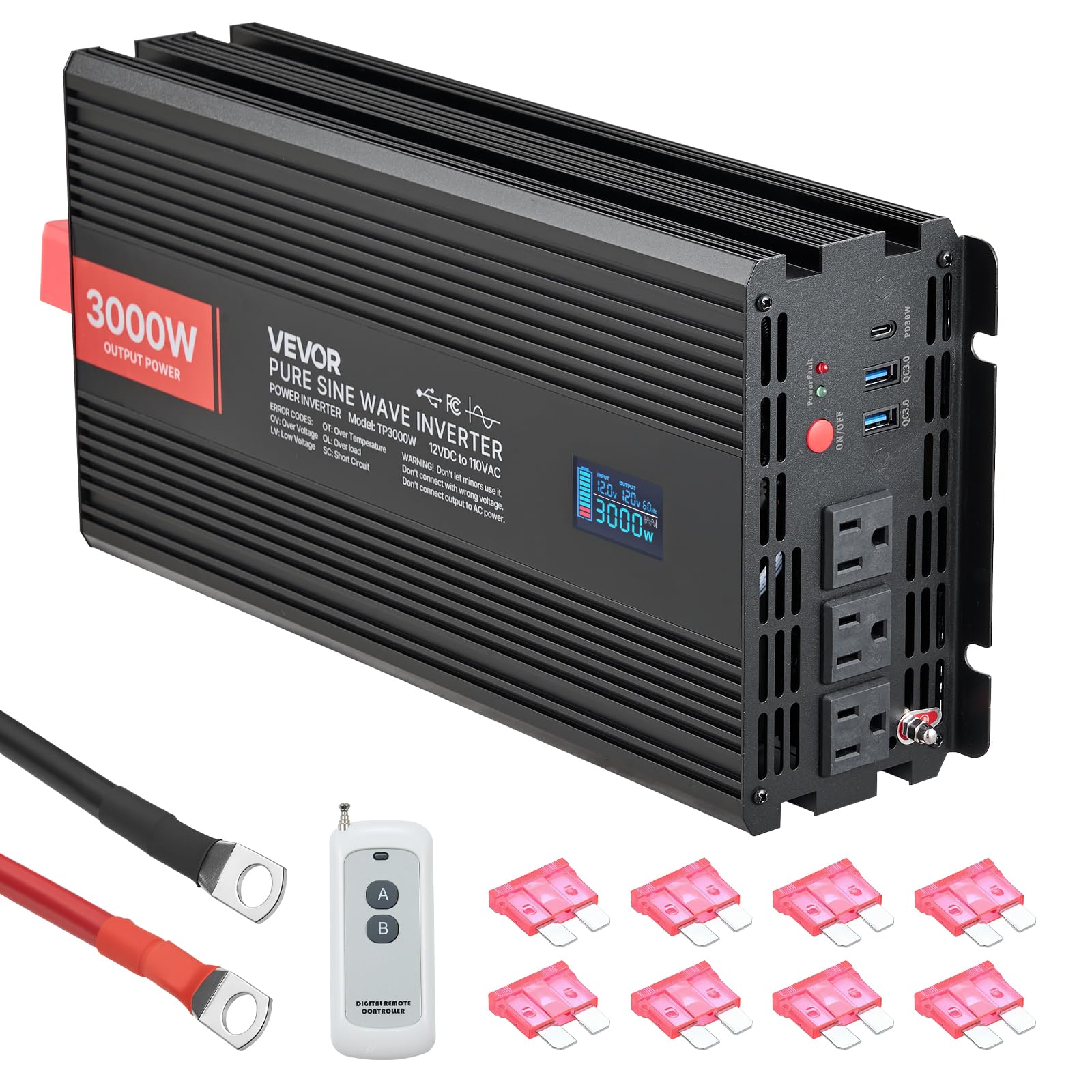
The 5-device juggler with a 100-meter wireless remote and a temperature-controlled silent fan.
The VEVOR stands out for sheer versatility in output options. In addition to 2 AC outlets, it packs 2 USB ports (18W combined) and a Type-C port with a 30W maximum output, so you can keep laptops, phones, and tools charged simultaneously. Its wireless remote works across a 100-meter range — far longer than any wired remote in this list — letting you kill the power without leaving your chair.
It delivers 3000W continuous and 6000W peak pure sine wave power with full-load efficiency up to 88%, and the intelligent temperature-controlled fan only starts spinning when the temperature exceeds 40°C/104°F. The aluminum alloy body aids heat dissipation, and CE/FCC certification plus 6-layer protections (over/under voltage, overload, over-temperature, short circuit, reverse polarity) keep everything safe.
The flip side is durability — the review pages note some units have died after about 6 months of light use, which is a real concern for a backup-power device. Power output is also a mixed bag: some owners say it doesn’t reach the advertised 120V, though others confirm a clean full sine wave on an oscilloscope. One owner’s output wattage display didn’t work at all.
The device charger: With dual USB, a 30W USB-C port, and a wireless remote, this is the pick for powering and charging several gadgets at once during an outage.
The caution: Reviewers point out some long-term reliability questions — this is best treated as a solid backup, not a 24/7 workhorse.
7. EGSCATEE 3000W Power Inverter
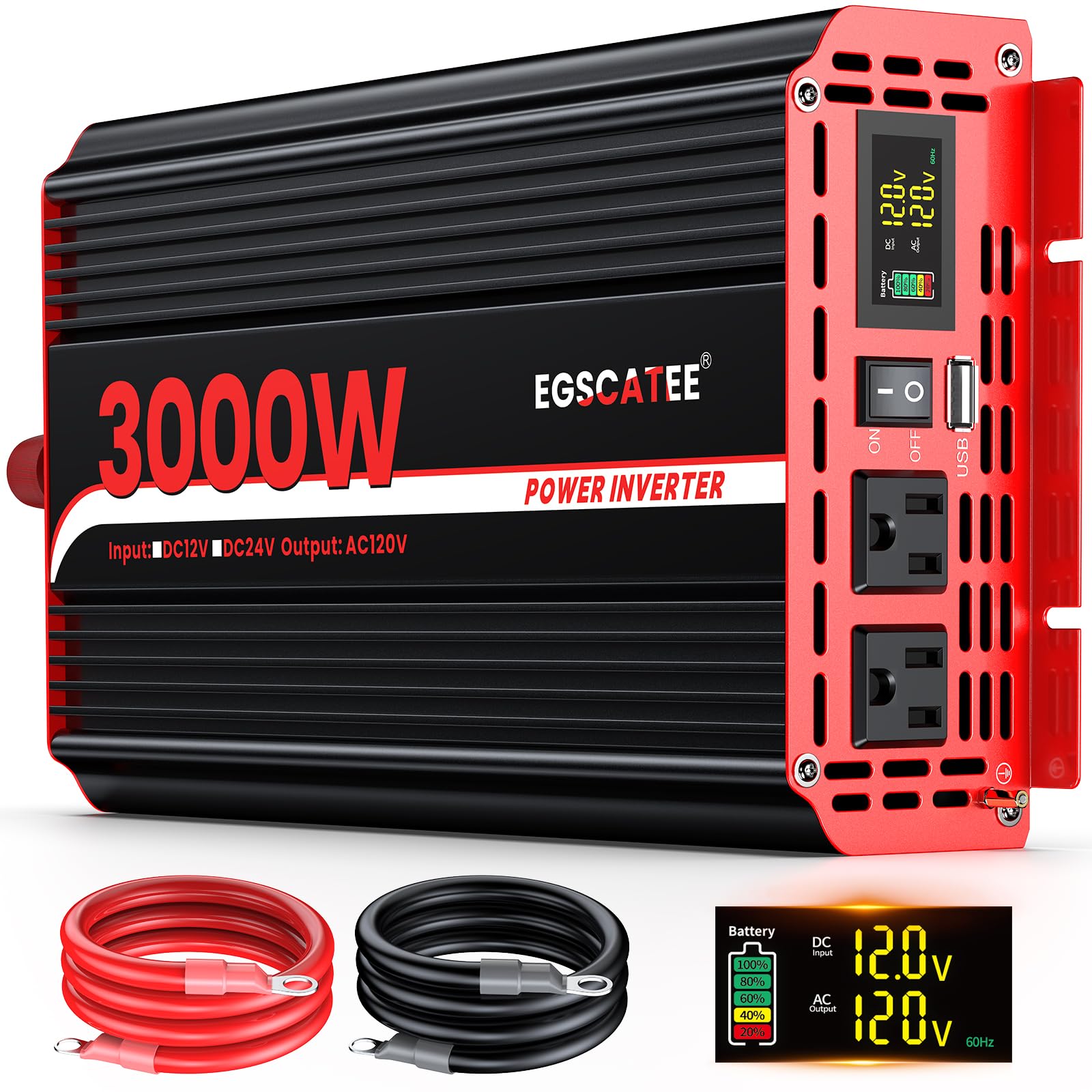
The tiny-but-mighty modified sine wave unit that fits tight van builds and inflates tubes on camping trips.
At just 7.87″L x 4″W x 2.28″H, the EGSCATEE is the most compact inverter in this lineup — small enough to tuck into a van-life build or a boat console without eating your storage. It puts out a continuous 3000W with a 6000W peak surge, converts 12V to 110V/120V, and is compatible with all common 12V batteries including LiFePO₄, AGM, GEL, and lead-acid. The 5-layer intelligent protection (under/over voltage, overload, overheating, short circuit) plus built-in fuses cut power instantly if something goes wrong.
For the entry-level price, it delivers reliable modified sine wave power for everyday appliances. The aluminum alloy case dissipates heat efficiently, and the 2 AC outlets plus a 3.1A USB port cover the basics. Owners confirm it powers a high-powered sump pump without issues and keeps a fridge, chargers, and other devices running smoothly. The LCD shows real-time input/output voltage and battery status.
The main consideration is that it’s a modified sine wave unit, so it’s best matched to basic tools, appliances, and resistive loads rather than sensitive electronics. One owner noted the voltage display light failed after 2 months, making it harder to track input/output voltage — a key feature of the unit.
The space saver: This is the pick for van lifers and boaters who need 3000W capability in the smallest possible footprint, with the simplest battery compatibility.
Set expectations: Modified sine wave means it’s best for tools and appliances — treat sensitive electronics with care.
8. PowerDrive PWD3000P 3000 Watt Inverter
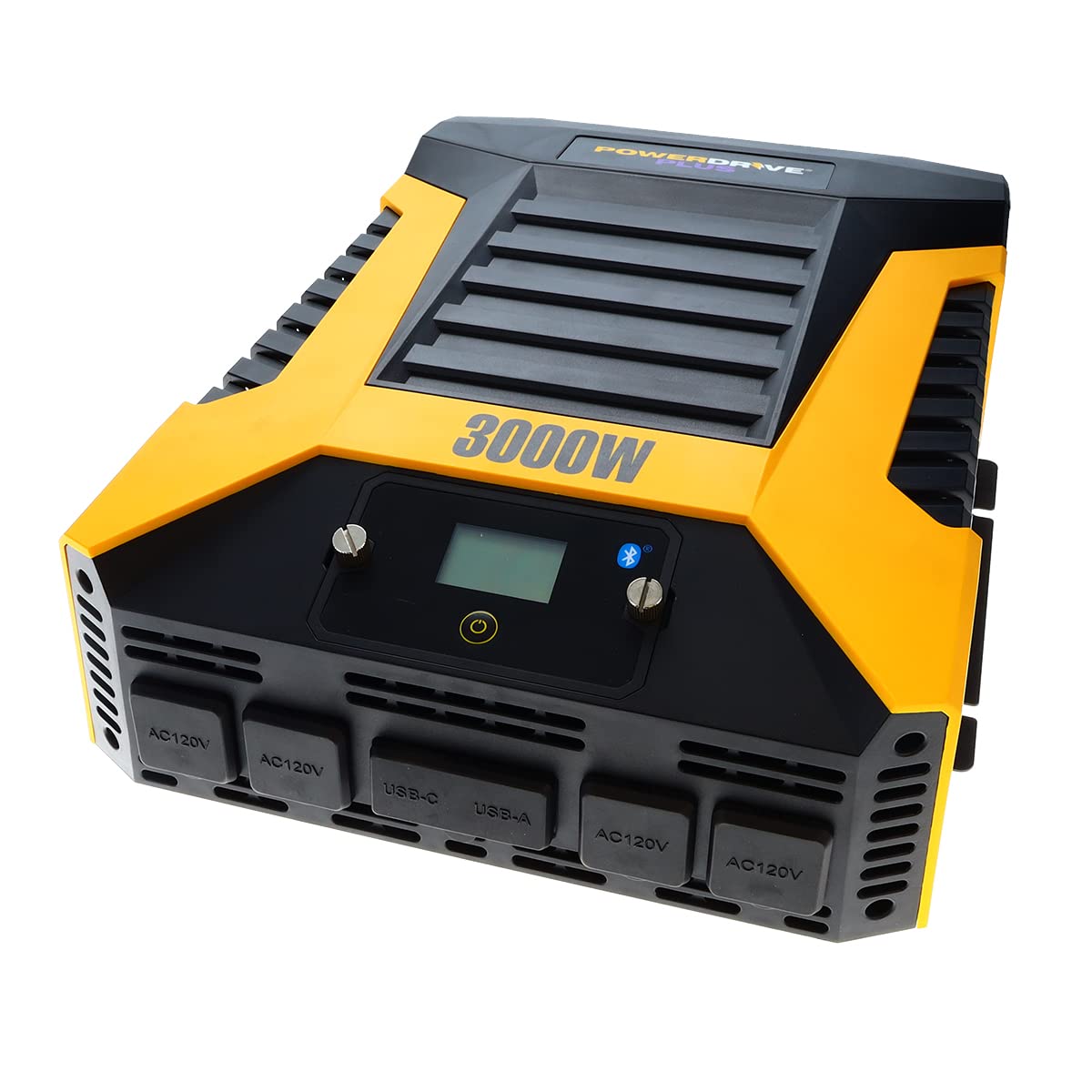
The Bluetooth-connected inverter that lets you control and monitor your truck’s power from your smartphone.
The PowerDrive is the only inverter in this list with Bluetooth wireless technology, pairing with a free PowerDrive Plus app so you can remotely access features and settings from your phone. It provides 3000W continuous power across four 3-prong AC outlets, plus a standard USB 2.4 Amp port and a USB-C fast charge 3.0 Amp port for devices. The detachable LCD screen removes from the unit body entirely, allowing remote monitoring and testing without standing over the inverter.
For semi-truck drivers, this is the standout convenience — the review pages show it powers a fridge with freezer, Keurig coffee maker, 3-in-1 microwave, laser printer, toaster, and laptop charger all at once without draining the batteries. The digital display shows battery voltage, power in watts, and any error codes, while LED lights indicate power and voltage status. Heavy-duty 39-inch cables and mounting brackets are included for immediate installation.
The catch is waveform and quality control. It’s a modified sine wave unit, so it’s better matched to standard appliances than sensitive electronics. Quality feedback is genuinely mixed — some owners receive a solid, durable unit, while others report defective units on arrival. It also carries a CE certification rather than UL, which matters if you need a specific listing for insurance or marine use.
The app advantage
- Bluetooth app control is unique here — adjust settings from your phone
- Detachable LCD gives you remote monitoring without wires
- Four AC outlets handle a fridge, microwave, printer, and toaster at once
The mixed notes
- Modified sine wave output, not for delicate electronics
- Some owners receive defective units; check it on arrival
- CE certified rather than UL listed
Choose this for: the trucker or tech-forward user who wants to manage power from a phone app and monitor from a detached screen.
Pass on it if: you need UL certification for insurance or marine compliance, or you’re powering sensitive audio-video gear.
9. EDECOA 3000 Watt Power Inverter

The entry-level modified sine wave unit with automatic voltage regulation for basic home and office loads.
The EDECOA is the budget pick that still brings smart power management. It features automatic voltage regulation (AVR), intelligent power management (IPM), and intelligent fan control (IFC) — features you usually find on more expensive units. It converts 12V DC to 110V/120V AC with 3000W continuous and 6000W peak for surges under 10ms, operating at greater than 90% efficiency with a no-load current draw of less than 1.7A.
It comes with 2 AC outlets and a remote controller with a humanized LCD that displays battery capacity, load level, temperature, fan status, frequency, DC input voltage, and AC output voltage. Owners have used it to run an office setup with a 1000W PC, lights, and chargers around the clock without overheating, and it even handled a 110V window AC in 100°F heat. The temperature protection kicks in at 167°F/75°C.
The durability record is the honest caveat here. The review pages show some units stopped working within six weeks, and one owner reported zero response from the company after four months. It’s also a modified sine wave unit, so it’s not recommended for microwaves or compressor-heavy appliances — a mini fridge is fine, but a window AC needs more headroom.
The value angle: This is the most affordable way to get steady 3000W power with voltage regulation for a workshop or office — just give it 50% headroom for cooling.
The risk: Reliability is the trade-off at this price; treat it as a good-value backup, not a lifetime workhorse.
10. Cantonape 3000W Power Inverter
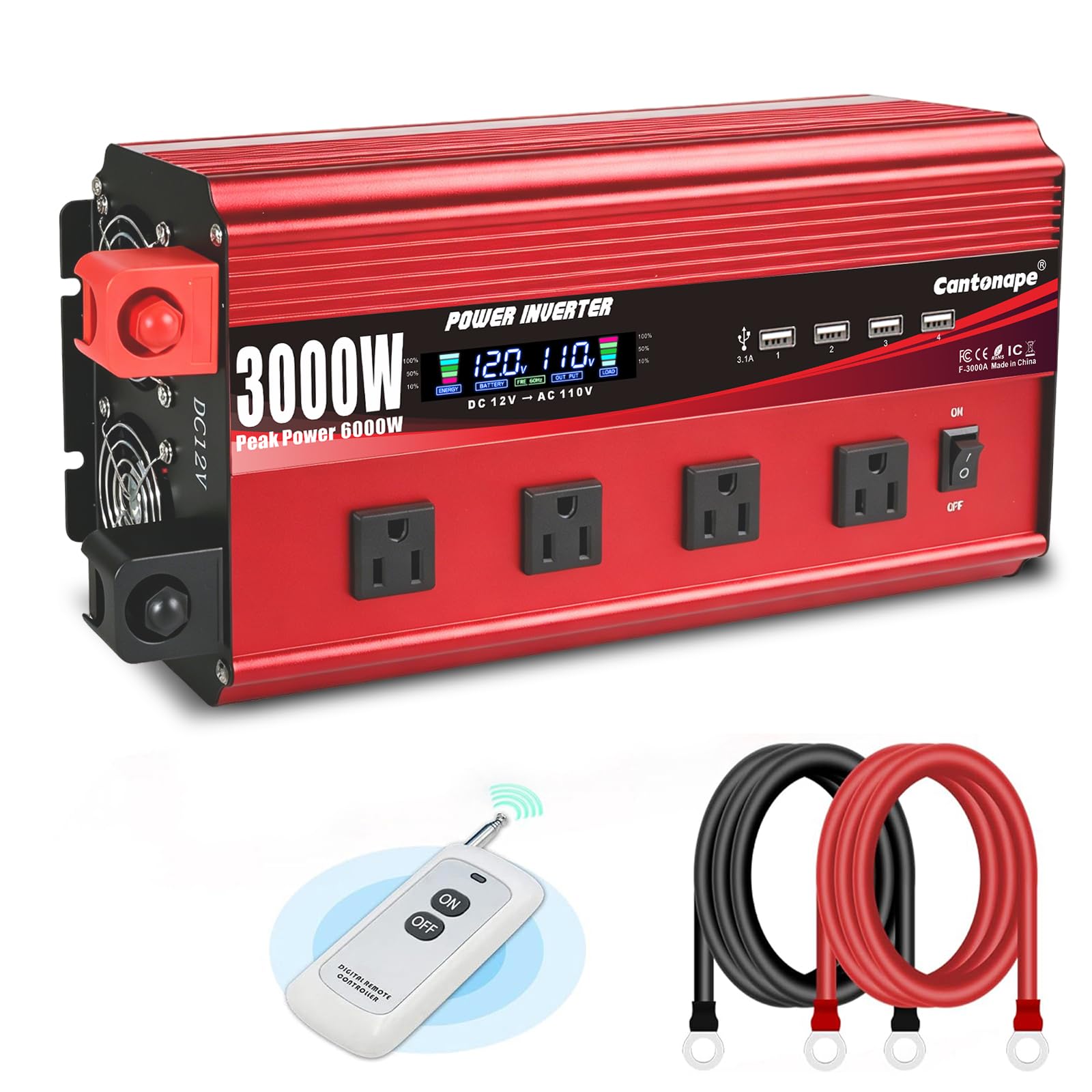
The budget multi-port inverter with four outlets and four USBs for the most charging flexibility per dollar.
The Cantonape delivers the most outlets for the money: 4 AC outlets and 4 USB ports, so you can run a fan, game console, TV, and charge phones and tablets simultaneously. It converts 12V DC to 110V/120V at 60Hz with 3000W continuous and 6000W surge power, at an efficiency greater than 90%. The intelligent LCD displays input/output voltage, battery capacity, load capacity, and output frequency, switching to error codes (E-1 through E-6) when something’s wrong.
The 6 kinds of protection (overload, short circuit, overheat, reverse polarity, under/over voltage) plus the durable aluminum body with a built-in temperature-controlled fan make it a solid budget option for camping, home backup, and work trips. Owners have used it to run a CPAP machine and charge phones and hearing aids in a camper, with the battery dropping only 0.2 nightly and solar recharging it daily. The remote controller makes ON/OFF control easy.
Reliability is the honest concern in the data. While some shoppers say it works spectacularly and provides plenty of power, others report malfunction after two days or struggling with 2000-watt loads. One owner’s unit failed 11 days after the return window, though the company responded fast and sent a replacement immediately. It’s also a modified sine wave unit, so it’s best for intermittent and moderate use rather than pushing the full 3000W continuously.
Best for: the budget-conscious camper or emergency kit that wants maximum outlet flexibility and won’t push the full 3000W all day.
Keep expectations real: Expect great value and good support, but treat it as an intermittent-use unit, not a continuous-duty powerhouse.
Understanding the Specs
Waveform: Pure vs. Modified Sine Wave
Pure sine wave inverters produce power that matches your home’s wall outlet — smooth and consistent. This clean waveform means sensitive electronics like TVs, laptops, and refrigerator compressors run safely without humming or overheating. Modified sine wave units are cheaper but can cause some devices to buzz, run warm, or behave erratically. If your load includes motors or medical devices like CPAP machines, pure sine wave is the responsible choice.
Continuous Power vs. Surge Power
Continuous power is what an inverter sustains for hours, while surge (or peak) power is the brief burst needed to start motors and compressors. A refrigerator might run on 600W but needs 1800W for a split second to start. Always check both numbers — a 3000W continuous unit with 6000W surge gives you room for startup spikes. Pushing an inverter to its continuous limit for long stretches causes heat, which triggers protective shutdown.
FAQ
What is the difference between pure sine wave and modified sine wave inverters?
Will a 3000 watt inverter run a refrigerator or an air conditioner?
How long will a 3000W inverter run on a 100Ah battery?
Can I use a 3000W inverter with a LiFePO4 battery?
Why does my inverter’s fan run so loudly?
What size battery cables do I need for a 3000W inverter?
Is the surge power rating safe to rely on for starting appliances?
What does idle draw mean and why does it matter?
Can I wire a 3000W inverter into my RV or truck permanently?
Is a modified sine wave inverter bad for my electronics?
Final Thoughts: The Verdict
If you want one dependable pick, the 3000 watt inverter winner is the BELTTT 3000W Pure Sine Wave because it delivers clean, UL-listed grid-quality power with a >93% efficiency rating and a 23-foot remote — the complete package for RV, truck, and off-grid use. If you want silent operation for a fridge and freezer setup, grab the Junbpaw 3080W. And for off-grid solar builders running lithium batteries, the Giandel PS-3000SAR is the one to reach for with its selectable battery profiles and UL-listed GFCI outlets.
How We Picked
We do not accept paid placement. Every pick is matched to a real buyer and a real use-case; we do not hands-on test units.
Sources & Methodology
Specifications: manufacturer listings and product documentation. Review insights: verified customer reviews, as of August 2026. Pricing: not shown on this page (it changes often); check the current price via the retailer link.
As an Amazon Associate, Gadgets Feed earns from qualifying purchases. This does not affect which products we feature.