
Standard 1,500-watt space heaters hit a wall when you need to warm a drafty garage, a sprawling workshop, or a greenhouse through a hard freeze. At 3,000 watts, you double the heat output and move from supplementary spot heating to real space-dominating warmth that can maintain 40°F above outdoor temperature in insulated structures. The difference isn’t incremental — it’s the threshold between a heater that struggles and one that actually wins against winter.
I’m Min — the co-founder and writer behind Gadgets Feed. I’ve spent hundreds of hours parsing the technical specifications, BTU ratings, amperage requirements, and real-world customer data across every serious high-wattage heater on the market to separate the units that deliver sustained, safe performance from those that burn out mid-season or require electrical upgrades you didn’t budget for.
This guide breaks down the nine strongest contenders for the 3000 watt space heater category, comparing coverage area, heating element type, mounting flexibility, and the actual electrical infrastructure each unit demands so you can match the right machine to your space without costly surprises.
How To Choose The Best 3000 Watt Space Heater
Before you buy a high-wattage heater, you need to understand that 3,000 watts at 240 volts draws 12.5 amps — which means most of these units require a dedicated circuit and a specific NEMA outlet configuration. Plug compatibility, mounting type, and heating method determine whether a unit will work for your space or sit unused.
Electrical Requirements: NEMA Plugs and Circuit Capacity
A 3,000-watt heater on a 240-volt circuit pulls 12.5 amps. That means you need a minimum 15-amp double-pole breaker and the correct receptacle. Some units use a NEMA 6-15P (standard 240V 15A), others require a NEMA 6-20P (20A with a horizontal blade), and industrial models demand a NEMA 6-30P (twist-lock 30A). Check your existing outlet before ordering — the wrong plug makes the heater unusable without an electrician visit.
Heating Method: Forced Air vs. Radiant vs. Convection
Forced-air heaters move heat fast across large areas but produce fan noise comparable to a shop vac on low. Radiant models like infrared units heat objects and people directly, offering quieter operation but slower ambient temperature rise. Convection panel heaters are silent and maintain oxygen levels well, but their heat output per watt is lower, making them better for 24/7 background warmth in occupied rooms than for rapid recovery in freezing garages.
Coverage Area and Insulation Reality
Manufacturer coverage claims assume perfect insulation and floor plans with no drafts. In real-world conditions, an uninsulated 2-car garage stays comfortable at 45°F with a 3,000W heater only if outdoor temps stay above 20°F. For every drop of 10°F outside, you lose roughly 5-8°F of interior temperature rise. If you’re heating a drafty space, overshoot the coverage rating by 30% and choose a model with a high BTU rating.
Thermostat Quality and Control Precision
The cheapest heaters use a simple screw-knob thermostat with a mechanical bi-metallic strip that can swing 10°F before cycling. Premium models feature electronic thermostat sensors that maintain temperature within 2°F of the set point. A bad thermostat means the heater either runs constantly or cycles too often, wasting electricity and creating temperature swings that make the space feel unevenly heated.
Quick Comparison
On smaller screens, swipe sideways to see the full table.
| Model | Category | Best For | Key Spec | Amazon |
|---|---|---|---|---|
| Cadet Com-Pak Twin CSTC302TW | Wall Heater | Permanent whole-room install | 10,236 BTU at 240V | Amazon |
| DR. INFRARED HEATER DR966 | Hardwired Shop | Large garages and workshops | 20,520 BTU at 6000W | Amazon |
| Convection Space Heater Leavesden | Convection Panel | Silent bedroom or office use | 1500W infrared carbon fiber | Amazon |
| Dura Heat 240V Industrial | Forced Air | High-output supplemental heat | 12,800 BTU at 4000W | Amazon |
| VEVOR Electric Garage Heater | Wall/Ceiling Mount | Permanent garage installation | 5000W digital control | Amazon |
| Vornado Velocity 5 | Whole Room | Fast warm-up for occupied rooms | 1500W forced air | Amazon |
| Vornado Velocity CUBE 5 OSC | Oscillating Cube | Compact personal or bathroom heat | 1500W with 70° oscillation | Amazon |
| DR. INFRARED HEATER DR218-3000W | Greenhouse | Protected greenhouse and plant care | IPX4 water splash rated | Amazon |
| Comfort Zone 4,800W Industrial | Industrial Forced Air | Extreme cold in large garages | 17,065 BTU at 4800W | Amazon |
In‑Depth Reviews
1. Cadet Com-Pak Twin Wall Heater CSTC302TW
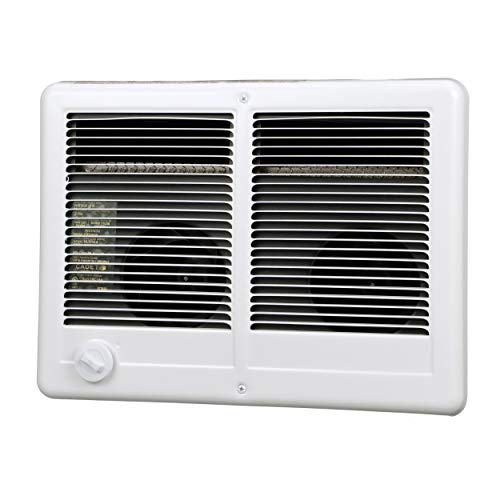
The Cadet Com-Pak Twin sets the standard for permanent 3,000-watt wall heaters because it solves the two biggest pain points of high-wattage heating: installation simplicity and thermostat accuracy. At 3,000 watts and 240 volts, this unit delivers 10,236 BTUs through a forced-air fan that circulates heat evenly across a 450-square-foot area without the deafening noise of industrial blowers. The multi-watt configuration lets you run it at 2,250 watts on a 208-volt circuit if your home uses that voltage, adding installation flexibility most competitors lack.
Assembled in the USA with a 2-year warranty, the heater includes a built-in thermostat that users consistently report maintains set temperature within a few degrees. The twin-fan design pushes air horizontally through a low-profile grille that protrudes only about 3 inches from the wall, making it an ideal choice for finished living rooms, converted basements, or large bedrooms where floor-space consumption is unacceptable. The high-temperature safety shut-off provides genuine peace of mind for permanent installations inside occupied walls.
The 30-inch height and 8-inch width make it large enough to move serious air but compact enough to fit between standard 16-inch stud spacing with the included mounting bracket. Owners consistently report this heater warming entire homes under 1,200 square feet when installed in a central location. The forced-air design produces noticeable fan noise — comparable to a loud computer tower — but the trade-off is heat output that keeps a 16×16-foot room comfortable through sub-zero winters without the unit ever feeling strained.
Why it’s great
- Permanent in-wall installation saves floor space and looks integrated
- Multi-watt support (3,000W at 240V / 2,250W at 208V) adds circuit flexibility
- Reliable thermostat holds temperature within a tight range without constant cycling
Good to know
- Requires professional electrical installation into a wall can (not a plug-and-play device)
- Fan noise is noticeable during operation
- Covers 450 sq ft — adequate for large rooms but insufficient for open-plan garages
2. DR. INFRARED HEATER DR966 240V Hardwired Shop Garage Commercial Heater

The DR. INFRARED HEATER DR966 is the only unit on this list that gives you a genuine dual-power option between 3,000 watts and 6,000 watts, making it the most versatile solution for anyone who might need to upgrade heat output later without buying a second heater. In low-power 3,000-watt mode, it pulls 12.5 amps on a 240-volt circuit and delivers radiant infrared heat across 600 square feet. Flip to high-power 6,000-watt mode, and the output jumps to 20,520 BTU — enough to warm a three-car garage through the worst of a northern winter.
The 8-inch dynamically balanced fan minimizes turbulence and keeps noise levels reasonable for a unit this powerful, and users report it effectively heats a freezing Idaho garage to comfortable working temperatures. The unit is UL/CUL listed and includes a wall or ceiling mounting bracket for overhead installation that saves valuable floor space in crowded workshops. Hardwiring requires 8 AWG copper wires and a 35-amp breaker, so factor in a dedicated circuit install if you don’t already have one.
The adjustable thermostat with high and low settings works reliably, and owners who installed this unit years ago still report it’s “the best purchase they made” for garage heating. The 25-pound weight and 14.5-inch cube dimensions make it substantial but manageable for a single person to mount. The trade-off is that this is a pure forced-air radiant heater — it warms objects and people directly rather than raising ambient air temperature slowly, so it works best in spaces where you want quick heat-on-demand rather than steady background warmth.
Why it’s great
- Dual 3,000W / 6,000W power modes provide flexibility for different seasons and spaces
- 20,520 BTU peak output rivals much larger industrial units
- Wall or ceiling mount frees up floor space in tight workshops
Good to know
- Requires professional hardwiring with 8 AWG copper wire and a 35-amp breaker
- Heater is heavy at 25 pounds — two-person installation is recommended
- Fan produces moderate noise; not suitable for quiet home-office environments
3. Convection Space Heater Leavesden Infrared Panel

When absolute silence matters more than raw BTUs, the Leavesden convection panel heater redefines what a 1,500-watt heater can do. Its X-shaped aluminum fin design distributes heat through natural convection — no fan, no moving parts, no noise beyond the faint tick of the metal expanding. The infrared carbon fiber heating element maintains oxygen and humidity levels much better than forced-air units, making it the best choice for bedrooms, nurseries, or offices where dry air and fan hum ruin comfort.
The 21.3-inch-wide by 37.3-inch-tall panel comes with a pedestal stand and rolling wheels for portability, plus a wall-mount option for permanent installation. The electronic smart temperature sensing system cycles between four modes — Auto, Manual, Economy, and Comfort — and maintains set temperature within a tight range. The 24-hour programmable timer lets you schedule warm-up before you wake or return home, and the 41-95°F temperature range offers finer granularity than any thermostat-knob heater on this list.
Safety features include tilt protection, flame-retardant materials, and a child lock, and users consistently report the unit performs well for overnight use in medium to large bedrooms. However, the 1,500-watt output and 350-square-foot coverage mean this is a background warmth solution rather than a rapid-response heater for freezing garages. In large vaulted-ceiling rooms, owners report it heats too slowly to provide immediate relief — it’s designed for steady, silent maintenance, not blast-furnace recovery.
Why it’s great
- Completely silent operation with no fan noise — ideal for sleep and workspace
- Infrared carbon fiber element preserves humidity and oxygen levels
- 24-hour programmable timer with four intelligent heating modes
Good to know
- Output is limited to 1,500W — not suitable for rapid warming of large or drafty spaces
- Convection heating takes longer to raise ambient temperature than forced-air units
- At 29.9 pounds, the rolling stand feels sturdy but limits easy wall relocation
4. Dura Heat 240V Industrial Garage Heater
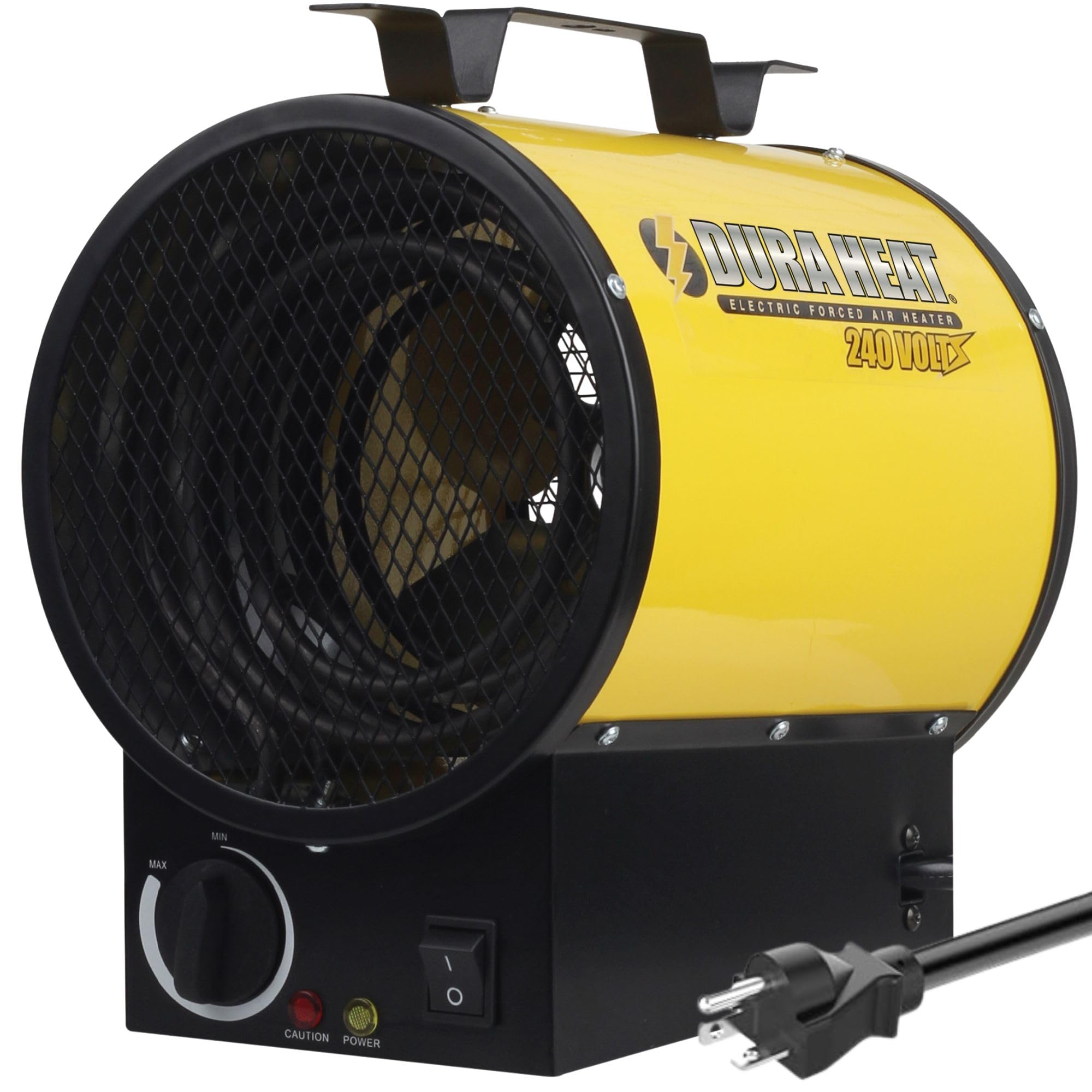
The Dura Heat industrial heater delivers 12,800 BTU at 4,000 watts from a compact 9x12x11-inch yellow steel cabinet that mounts to the wall or ceiling with the included bracket. It uses a 20-amp 240-volt NEMA 6-20P plug — the one with the horizontal blade — so check your existing receptacle before buying, as standard 240V 15A outlets won’t accept it. The single heat setting runs the fan continuously when powered on, then energizes the heating coil only when the thermostat calls for heat.
Real-world testing shows this unit can raise an 850-square-foot shop with 10-foot ceilings from 50°F to 66°F in about two hours when outdoor temperatures hover near 40°F. The fan produces noise comparable to a 20-inch box fan on medium — loud enough to require ear protection for long exposure but acceptable for intermittent workshop use. The absence of a low-heat setting means the unit is either full-on or full-off, which can feel wasteful during milder weather when you only need a few degrees of lift.
Construction quality is solid for the price point, with a heavy steel shell that shows no flex during mounting. However, the constant-fan design has drawn criticism from users who note the unit blows alternating warm and cool air as the coil cycles, wasting electricity on continuous fan operation. The strongest use case is supplemental heat in an uninsulated garage or construction site where you need rapid heat delivery and don’t mind the fan running 24/7 to keep the space above freezing.
Why it’s great
- Compact footprint for the heat output — fits easily in tight garage corners
- Heats large uninsulated spaces quickly with its 12,800 BTU output
- Sturdy steel build with wall/ceiling mounting bracket included
Good to know
- NEMA 6-20P plug is incompatible with standard 240V 15A outlets
- Fan runs continuously when powered on, whether heating or not
- Single heat setting offers no adjustment between low and high output
5. VEVOR Electric Garage Heater 5000W

The VEVOR 5,000-watt digital heater brings precision temperature control to the garage-heater category, with an electronic thermostat that maintains set temperature within about 2°F — a massive improvement over the 10°F swings common with mechanical bi-metallic thermostats. The unit is ETL-listed and constructed from SPCC cold-rolled steel, and it offers two adjustable power levels plus a 9-hour timer so you can schedule the garage to be warm before you start working without running it all night.
The forced-air design moves heat effectively across the manufacturer-rated 50-square-meter (538-square-foot) coverage area, and owners report it can keep a two-car uninsulated garage comfortable. The NEMA 6-30P twist-lock plug requires a 30-amp 240-volt circuit — a higher amperage than the 20-amp units — so verify you have the right breaker and receptacle. The remote control adds real convenience for changing settings without walking across a cold garage at 6 AM.
A notable quirk: the unit defaults to a 3,000-watt “energy saver” mode when it approaches the set temperature, which causes the fan to cycle on and off more frequently than users would like. Some owners wish for a slower fan speed in maintenance mode to reduce noise during long heating sessions. The wall-mount or ceiling-mount design includes flexible louver adjustment for directing airflow, and the automatic fan delay function ensures residual heat is pushed out after the element shuts off — a useful feature that extends element life.
Why it’s great
- Precise electronic thermostat maintains temperature within 2°F of set point
- Remote control and 9-hour timer offer genuine operational convenience
- ETL-listed with overheat protection and automatic fan delay for element safety
Good to know
- NEMA 6-30P twist-lock plug requires a 30-amp dedicated circuit
- Default energy-saver mode can cause frequent fan cycling in maintenance mode
- Unit does not have WiFi control despite digital interface
6. Vornado Velocity 5 Whole Room Heater

The Vornado Velocity 5 uses the company’s Velocity Tuned Heat technology to push air farther and faster than standard forced-air heaters, effectively moving heated air across the full room rather than just warming the spot directly in front of the unit. At 1,500 watts, it draws 12.5 amps on a standard 120-volt household circuit — no special wiring needed, which makes it the most accessible option on this list for anyone who wants 3,000-watt-class heat output without electrical work. The auto climate control feature senses the room temperature and adjusts heat output and circulation automatically to maintain the set temperature.
The cool-touch exterior, locking controls, tip-over protection, and automatic safety shut-off make this heater one of the safest choices for occupied spaces like bedrooms or living rooms. The 1-12 hour timer and LED touch controls are intuitive to use, and the nighttime mode turns off non-essential display lights for sleep-friendly operation. Users report it can raise a 220-square-foot room from 64°F to 70°F in about 5 minutes, then cycle on and off efficiently to hold temperature.
The trade-off is that the Vortex technology runs about 10 decibels louder than standard Vornado heaters — closer to a loud conversation than a whisper. Some users report the integrated thermostat reads about 3-5°F off from their separate room hygrometer, requiring a few adjustments to find the ideal set point. The 6-foot power cord is shorter than ideal for some room layouts, and the glossy white finish shows dust more readily than the matte options.
Why it’s great
- Plugs into any standard 120V 15A outlet — no electrician required
- Auto climate control adjusts heat output based on real-time room temperature
- Rapid warm-up: raises room temp by about 6°F in 5 minutes
Good to know
- Operates about 10 dB louder than non-Vortex Vornado models
- Thermostat may read slightly off from independent temperature sensors
- Limited to 1,500W on 120V — lower total heat output than 240V units
7. Vornado Velocity CUBE 5 OSC
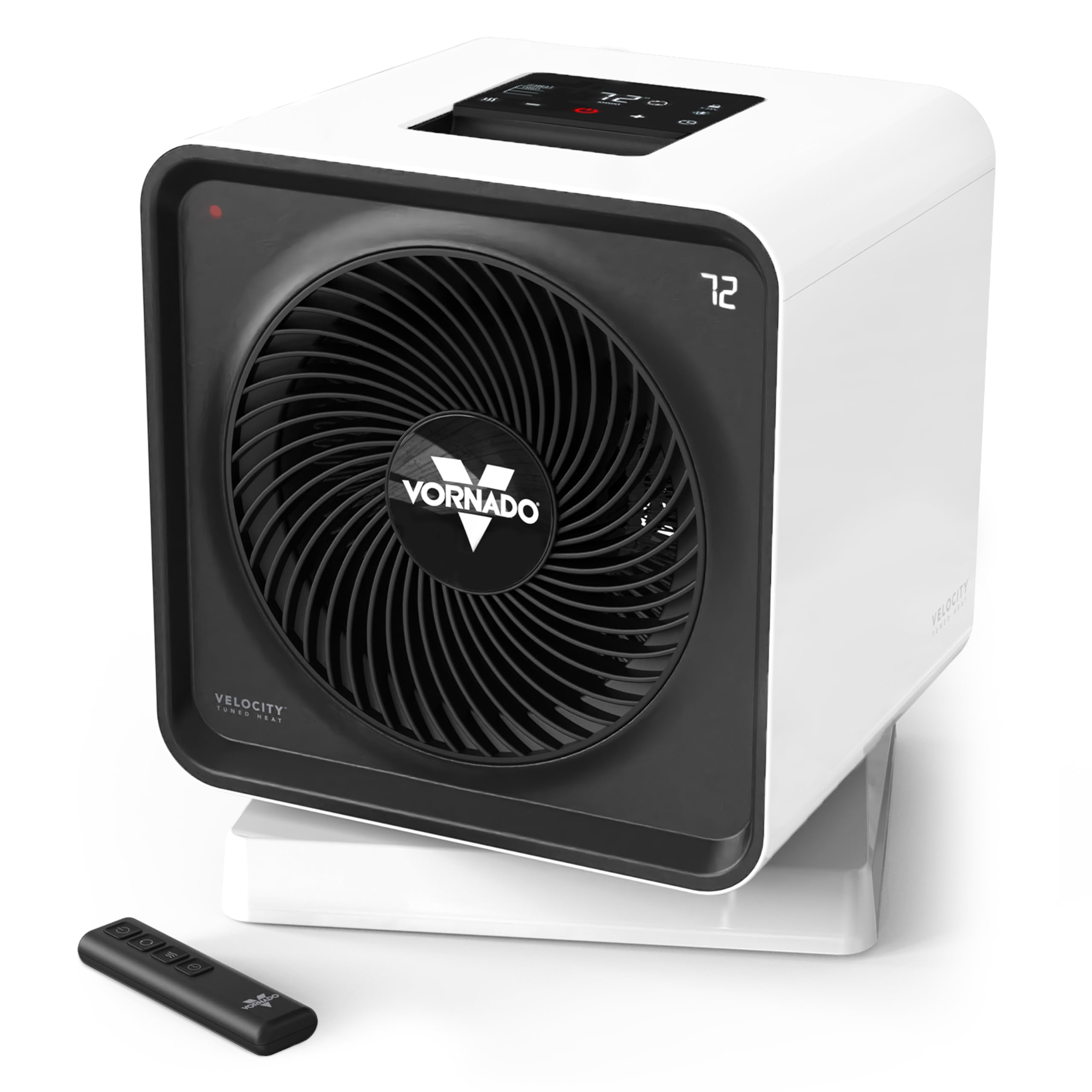
The Vornado Velocity CUBE 5 OSC packs 1,500 watts of Vortex heat into a 8.9-inch cube that fits on a desk, nightstand, or bathroom counter without dominating the space. Its signature 70-degree oscillation spreads heat across a wider area than stationary cube heaters, making it suitable for small living rooms, home offices, or master bathrooms where you want even warmth rather than a single hot spot. The Velocity Tuned Heat technology moves air faster and farther than the heater’s tiny footprint would suggest.
Three heat settings plus a fan-only mode give year-round utility, and the remote control lets you adjust oscillation, temperature, and timer from across the room. The Night Mode turns off non-essential LED display lights, and the cool-touch case, lockable controls, and tip-over protection provide genuine safety for bedroom use. Vornado backs it with a 5-year satisfaction guarantee — if the product doesn’t meet your expectations, they’ll replace it.
Performance in real-world conditions is mixed for larger spaces. Users report it does an excellent job keeping a bathroom warm during a shower but struggles to adequately heat a 6×10-foot space in cold climates. Some owners received units with a clicking noise during oscillation and had to return them before getting a quiet replacement. The 7.3-pound weight makes it genuinely portable, but the output tops out at 1,500 watts — ideal for targeted personal warmth, insufficient for whole-room heating in drafty or oversized spaces.
Why it’s great
- Ultra-compact 8.9-inch cube design with 70-degree oscillation for wide heat distribution
- Remote control, three heat settings, and fan-only mode for year-round use
- Vornado’s 5-year replacement guarantee provides long-term peace of mind
Good to know
- 1,500W output is insufficient for heating large rooms or uninsulated spaces
- Some units have reported clicking noises during oscillation
- Best suited for bathrooms, small offices, or personal desk use
8. DR. INFRARED HEATER DR218-3000W Greenhouse Garage Workshop Infrared Heater

The DR. INFRARED HEATER DR218 is purpose-built for greenhouse and workshop environments where moisture resistance matters more than aesthetic polish. Its IPX4 rating means the enclosure is protected against water splashing from any direction — you can hose down plants nearby or work in condensation-heavy environments without worrying about electrical failure. The 3,000-watt heating element delivers 10,236 BTU of radiant heat across 600 square feet on a 240V 20A circuit using a standard NEMA 6-20P plug.
The radiant heating method means it warms objects, plants, and surfaces directly rather than heating the air first, which is exactly what you want in a greenhouse where maintaining soil temperature prevents root shock during frost events. Users report it maintains 42-48°F in a 6×8-foot greenhouse during 22°F weather, and a 12-gauge extension cord works for positioning flexibility as long as the run stays reasonable. The compact 10x10x13-inch tower shape takes up minimal floor space, and the enclosed heating element requires almost no maintenance — just keep the intake clear of debris.
Reports of thermostat wiring failure in some units are concerning. Two separate users reported that the wiring inside the control box burned up, though the damage was contained within the metal housing and did not spread. This appears to be an issue with the thermostat connection rather than the heating element itself, and the manufacturer replaced the first unit under warranty. The fan produces moderate noise that blends easily into a workshop environment, and the sealed motor design prevents dust infiltration that kills unsealed fan heaters in dirty workshops.
Why it’s great
- IPX4-rated for wet greenhouse and workshop environments
- 600 sq ft coverage from a compact, portable 13-inch tower
- Sealed, low-maintenance design with enclosed heating element
Good to know
- Reports of thermostat wiring failure in some units
- Radiant heat only reaches about 8 feet — not suitable for tall spaces
- Uses NEMA 6-20P plug — incompatible with standard 240V 15A outlets
9. Comfort Zone 4,800W Industrial Space Heater

The Comfort Zone 4,800-watt industrial heater is the raw-power champion of this list, generating 17,065 BTU from its heavy-gauge steel body using a coil element and forced-air design. The NEMA 6-30P twist-lock plug requires a 30-amp 240-volt dedicated circuit — the highest amperage draw of any unit here — so this is strictly a workshop or garage tool, not a homeowner-friendly plug-and-play option. The rubber feet and integrated carry handle make it portable despite the industrial build, and the power cord wraps around the handle for tidy transport.
Real-world performance is genuinely impressive: one owner permanently installed this unit in a 30×32-foot garage with R19 walls and R21 ceiling, and it maintained 40°F above outdoor temperature using a WiFi thermostat and contactor setup. In a drafty cellar at -2°F outdoor temperature, the heater kept the space at 42°F with the thermostat set to its minimum. The screw-knob thermostat on the back is basic but reliable, and users report the unit cycles off for about 20 minutes per hour in maintenance mode.
The fan noise is the defining trade-off — owners consistently describe it as “like a hairdryer on low but with a different pitch” and “comparable to a 20-inch shop fan.” This is not a heater for occupied living spaces. Electricity consumption is substantial: one owner reported a monthly increase running it 24/7 in a drafty cellar. The unit’s simplicity is also its limitation — there’s no digital control, no timer, no remote, and the single fan speed runs constantly when the unit has power. For raw heat output per dollar, nothing else on this list competes.
Why it’s great
- Highest heat output on the list at 17,065 BTU from 4,800 watts
- Maintains 40°F above outdoor temperature in insulated garages
- Heavy-gauge steel construction with carrying handle for portability
Good to know
- Requires a 30-amp 240V dedicated circuit with NEMA 6-30P twist-lock plug
- Fan noise is significant — akin to a shop fan or hairdryer
- Electricity consumption can increase monthly bills by hundreds of dollars during continuous use
FAQ
Can a 3000 watt space heater run on a standard 120V outlet?
What size room does a 3000 watt space heater effectively heat?
Which NEMA plug type do most 3000 watt heaters use?
Are 3000 watt space heaters safe for indoor use?
How much electricity does a 3000 watt space heater use per hour?
Final Thoughts: The Verdict
For most users, the 3000 watt space heater winner is the Cadet Com-Pak Twin CSTC302TW because its permanent wall installation saves floor space, its multi-watt support fits both 208V and 240V circuits, and its built-in thermostat delivers the consistent temperature control that makes a heater feel like part of the home. If you need raw garage-warming power and maximum coverage area, grab the DR. INFRARED HEATER DR966 with its dual 3,000W/6,000W modes and 20,520 BTU peak output. And for silent, 24/7 background warmth in a bedroom or office where noise is the primary concern, nothing beats the Leavesden Convection Panel Heater.