
Our readers keep the lights on and my morning glass full of iced black tea. As an Amazon Associate, I earn from qualifying purchases.
Specs are compiled from manufacturer listings and verified buyer reviews and can change over time — please confirm the key details on the product page before buying.
If you want one honest answer before you scroll: the Anker SOLIX C300 DC is the smartest buy for most people chasing a 300W portable power station, because it pairs a real 300W output with a compact shell and a bundled solar panel. A quick heads-up on how this list was built — because “300W” is a size class, not an exact number, I included same-class stations in the roughly 250 to 350 watt band rather than only units stamped with the precise figure. That way every pick here actually serves the same job you came for.
I’m Min — the founder and writer behind Gadgets Feed. This guide is built by comparing the manufacturers’ published specifications and the patterns across verified customer reviews, so you get each pick’s real strengths and trade-offs instead of marketing spin.
You will see capacity in watt-hours, battery chemistry, and port counts explained in plain terms throughout. What separates a keeper from a regret here is matching the run time and outlet type to your actual gear, so this breakdown of the 300w portable power station keeps every number tied to a real-world outcome.
Our Picks at a Glance


How To Choose The Best 300W Portable Power Station
A 300W portable power station is a battery box that stores energy and pushes it back out through wall-style outlets and USB ports, so you can run a laptop, a fan, or a CPAP machine when there is no wall socket nearby. The watt number is the ceiling on how much power it can push at once; the watt-hour number is how long it can keep pushing. Getting those two straight is the whole game.
Capacity in watt-hours decides run time
Watt-hours (Wh) is the size of the fuel tank, measured as watts multiplied by hours. A 288Wh station can, in theory, push 288 watts for one hour, or 28.8 watts for ten. Bigger numbers mean longer stretches between charges — but also more weight to lug. For a night of CPAP use or a full phone-and-tablet weekend, the picks clustered around 230 to 292Wh here cover the job without hauling a boat anchor.
Battery chemistry decides how long it lasts
LiFePO4 (lithium iron phosphate) is the newer, tougher battery type; it survives more charge-and-drain cycles before it ages out, so you get more years before a replacement. Standard lithium-ion packs are lighter and cheaper but tend to wear faster. If you plan to keep this for a decade of camping trips, the LiFePO4 units in this list are the ones built for that kind of mileage.
Outlets and ports must match your gear
AC outlets (the standard three-prong wall type) run appliances that plug into a wall, like a mini-fridge, a TV, or a laptop brick. USB-C and USB-A ports (the small rectangle connectors) run phones, tablets, and radios, and the newer USB-C PD ports can recharge the station itself fast. A pure sine wave AC outlet is the clean form of AC power that sensitive electronics prefer — worth knowing when you read the spec sheets below.
Quick Comparison
| Model | Best For | Capacity | Rated Output | Battery Type | Amazon |
|---|---|---|---|---|---|
| Anker SOLIX C300 DC★ Best Overall | All-round camping and off-grid gear | 288Wh | 300W | LiFePO4 | Amazon |
| VTOMAN FlashSpeed 300Best Value | Budget campers wanting AC outlets | 230Wh | 300W | LiFePO4 | Amazon |
| Bailibatt 300WLightest Carry | Lightest carry for RV and camping | 257Wh | 300W | Li-ion | Amazon |
| EF ECOFLOW TRAIL 300 DC | Backpackers running DC-only gear | 288Wh | 300W DC | LiFePO4 | Amazon |
| GRECELL 330W | Home backup on a budget | 230.88Wh | 330W | Li-ion | Amazon |
| Apowking 300W | Tent and truck camping | 220Wh | 300W | Li-ion | Amazon |
| DARAN NEO300L | Blackout backup for families | 288Wh | 350W | LiFePO4 | Amazon |
| EF ECOFLOW RIVER 2 | Fastest wall recharge available | 256Wh | 300W | LiFePO4 | Amazon |
| Jackery Explorer 300 | Long shelf life and durability | 292Wh | 300W | LiFePO4 | Amazon |
In‑Depth Reviews
1. Anker SOLIX C300 DC Portable Power Station and 60W Solar Panel
Our pick — over 4.5★ from 250+ verified ratings; the strongest balance of quality and price.
Seven charging ports, two of them 140W USB-C, packed into a shell a third smaller than its rivals.
The standout number here is 288 watt-hours of LiFePO4 (lithium iron phosphate — the long-life battery type) storage running through a 300W output, and it does that in a body just 4.88 x 4.72 x 7.87 inches. That footprint is what makes the C300 the pick for anyone who moves their power around, because it leaves real room in a car or a pack where a bulkier station would not. This is also the rare pick that ships with its own 60W solar panel, so off-grid recharging does not mean buying a second box.
The fast-charging story is the part owners keep returning to. Two 140W two-way USB-C ports mean the station itself can top up fast and then pour that speed back into a laptop, and the DC adapter route has proven itself on genuinely demanding gear — buyers report the SOLIX C300 DC ran a ResMed AirSense 11 on DC for 6 nights at Scout camp with no recharging, finishing at 2%. Solar charging works around cloud too: through a stretch of cloudy and rainy camp days, the 60W panel kept a mix of phones, a speaker, and USB-C fans running nonstop. The app connects over Bluetooth for remote checks, which helps when the station is buried in the tent.
What wins buyers over most is raw performance — it’s the quality that gets singled out more than any other, followed closely by reliability. A wall outlet gets you to 80% in about 50 minutes, and the same 60W panel takes roughly 4 hours. The catch worth naming: a solar panel hung off a folding kickstand is fussy about shading and angle, and a light stand will not hold a perfect tilt all afternoon, so budget for slower solar days. For car camping and cabin trips it’s ideal; if you plan to strap this to a backpack, know it carries real heft.
solar bundle ready
- 300W output and 288Wh capacity in a shell you can actually move around
- Two 140W two-way USB-C ports for fast in and out
- Seven ports including a 120W car socket, so most crews share without swapping
- 60W solar panel bundled in — no separate purchase to go off-grid
solar input slow
- The bundled panel punishes partial shade and steep angles
- Heavier than it looks for a long walk in
- The shoulder strap is sold separately
campers: you want one station that handles camping, Starlink, and CPAP duty in a body that still fits on a car seat.
fast charging: you’re counting every ounce for a multi-mile hike or expect flawless panel output in dappled shade.
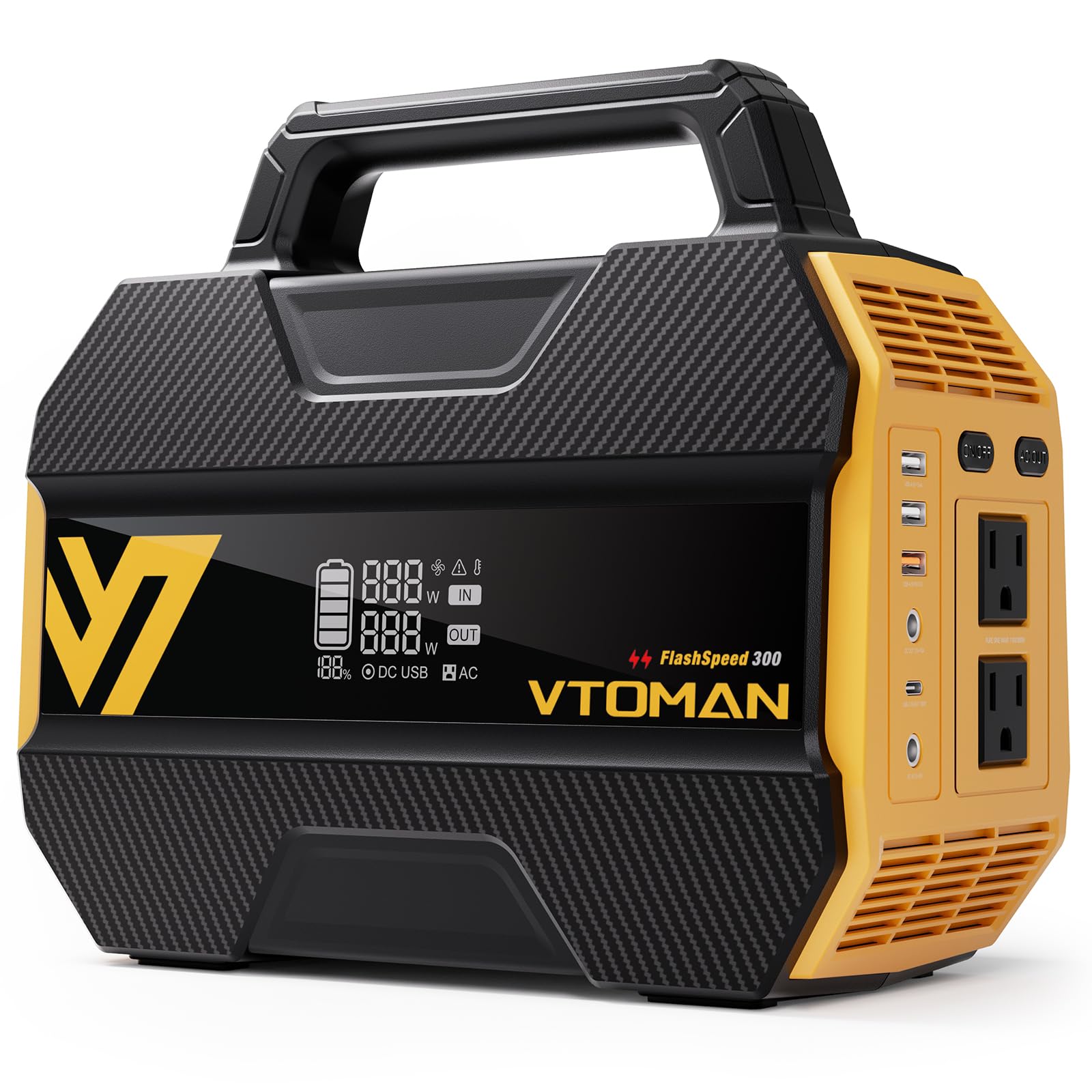
2. VTOMAN FlashSpeed 300 Portable Power Station
A 100W PD recharge that fills to 80% in about two hours — the quickest turnaround on this list.
Where the Anker relies on compactness, the FlashSpeed 300 leans on turnaround speed and reach. Its 300W output and 230Wh capacity run through 7 outlets — 2 AC, a 100W USB-C, 3 USB-A, and a DC port — so a family can run a phone, a speaker, a camera, and a drone without unplugging anything. That 100W PD USB-C input is the headline: it doubles as both the fastest way to refill the station and a fast output for a MacBook or Dell XPS, which is uncommon at this tier.
Owners routinely stretch this one well past a weekend. One is powering a whole kitchen setup through hurricane outages, another uses it with a larger unit to keep a spouse’s CPAP running, and a third rigs it for amateur radio field work — with a 100W solar panel it drives a 20W HF radio indefinitely, and on its own a QRP radio lasts all day, 5 to 6 hours. USB output keeps a tablet alive for POTA spotting, and the whole thing tips the scales at about 7 lbs, light enough for one hand out of the truck.
The honest trade-off is draw down the road. Reliability and charging speed both split feedback — most are delighted, but a few note the unit draining faster than expected, and the inverter keeps sipping power even with nothing plugged in, so switch it off between uses. There’s also a 3-mode LED light built into the body — steady, strobe, and SOS — that earns its place when the power goes out. In a straight spec margin the Anker C300 edges ahead on the solar bundle, but the VTOMAN asks less for the same 300W job and adds outlets the smaller unit can’t match.
campfire value: fast PD recharge, seven outlets, and a built-in emergency light make this the pick that does real work for a modest outlay.
idle draw: the AC inverter keeps draining the battery when switched on, so turn the outlet off between uses to protect your charge.
budget buyers: campers, radio operators, and anyone who wants AC outlets and a fast refill without paying premium money.
always-on: you need a station that carries its own solar panel from day one.
3. Bailibatt Portable Power Station 300W
Eight ports on a chassis weighing 4.6 lbs — you feel the difference at the trailhead.
If you carry your station rather than roll it, this is the one to weigh first. The Bailibatt packs 257Wh into a 4.6 lb body with a built-in 69,600mAh battery, and the double-count is real: it runs 2×120V pure sine wave (clean, electronics-friendly) AC outlets plus dual DC 12V ports, a USB-C PD, a QC3.0 port, and 2 USB-A ports — 8 outputs total, capped at a combined 300W. That’s more ports than either the Anker or the VTOMAN, in a lighter shell.
The port-count edge is why it appeals to mixed households. Owners mention running it as a camper TV source on the road and as a CPAP backup at home — one literally runs a Philips CPAP for two days off the 12V adapter when the power cuts — and it happily charges phones, tablets, laptops, and flashlights off one unit. A multi-layer BMS (the internal safety brain that watches voltage, current, and temperature) plus a clear LCD showing live status keeps the whole thing legible at a glance, and three recharge routes — wall, 12V car outlet, or solar — mean you’re never stuck without a top-up option.
What buyers rate highest is overall quality, with power delivery close behind — the sense that this thing is built solid shows through. That drain is typical for a 257Wh pack under heavy load. It’s still the lightest 300W station worth recommending, and its port spread puts heavier units to shame.
basic backup: lightness and jack count matter more than raw run time on the biggest appliances.
off-grid: you routinely drain a battery to zero in one sitting — the pack empties quicker than you might expect under heavy load.
4. EF ECOFLOW TRAIL 300 DC Portable Power Station
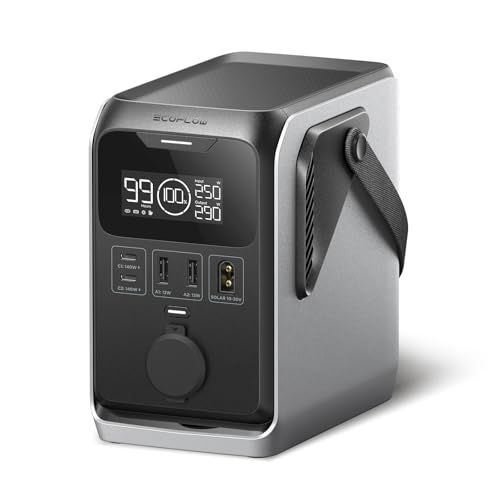
No AC outlets at all — and that’s exactly why it fits where the others don’t.
The TRAIL 300 DC takes the opposite bet from the rest of this list: skip the wall-style outlet entirely, keep the DC and USB-C power, and shrink the whole box. For comparison, the Anker is 4.88 x 4.72 x 7.87 inches; the TRAIL is the taller-lipping, shorter-footprint twin, and for a pocket or a daypack lid that geometry matters more than outright bulk.
Charging speed is what owners keep bringing up first, and it’s earned. Dual USB-C inputs at up to 140W each take the unit from 0 to 80% in about 85 minutes, and the port selection — 2×140W USB-C PD3.1 (in and out), 2 USB-A at 12W, and a 12V car port pulling 10A — runs five devices at once. One buyer reports it kept a 12V fridge cold through the night on a single charge, taking roughly 30% of the battery for every 10 hours; another powers a Starlink Mini with a projected 10+ hours of runtime while a vehicle is off. LiFePO4 cells rated to 3,500 cycles to 80% mean the cell outlasts the trip you bought it for.
The compromise is plain once you name it: no AC outlet means anything that needs a standard wall plug simply won’t run — no coffee maker, no mini-fridge plugged into a three-prong socket. And no AC inverter means no fan, which is a boon for tents and quiet rooms. Buyers also note the charging cable isn’t in the box, so plan for a 140W USB-C charger to open up that fast refill. For anyone whose gear is DC-native — fridges, Starlink dishes, camera rigs, telescope drives — this is the most honest match here.
dc-only efficiency: 140W dual USB-C in and out, 0–80% in about 85 minutes, and 288Wh in a shell built to ride in a pack.
no ac outlet: if your gear doesn’t run on DC or USB-C, this isn’t the station for you — it’s a specialist’s tool, not a catch-all.
dc devices: hikers, van-lifers, and photographers whose gear lives on 12V and USB-C.
ac needs: anyone who needs to plug in a standard AC appliance.
5. GRECELL Portable Power Station 330W

330 watts and a 600W surge ceiling — just enough headroom for a laptop frenzy or a small appliance.
The GRECELL’s edge is on the output side: a 330W continuous rating with 600W peak surge, versus the straight 300W the Anker and VTOMAN sit at. That extra headroom is what lets it start small motor-driven gear that trips a tighter station. Its 230.88Wh capacity runs through 9 outputs — 1 AC, a 60W PD USB-C, 3 USB-A fast-charge ports, a DC car port, 2 DC 5521 ports, and a 5W wireless charging pad on top. A pure sine wave AC outlet handles sensitive electronics cleanly, and a dual-fan cooling system keeps the unit’s temperature in check under load.
Run time depends entirely on what you plug in. One owner runs a mini PC for 4 to 5 hours gaming or 6.5 hours browsing; another cooks a cup of rice in a 200W rice cooker at about 50% per cup; a third powers a small TV, phone, tablet, and fan on a camping trip with charge to spare. The BMS covers overload, overcharge, and short-circuit protection, and the built-in 3-level LED light handles campsite duties after dark. Three recharge paths — 120V wall in 6–7 hours, a 100W solar panel in about 5–9 hours, or a 12V car socket — mean you’re never fully stuck.
The one thing to check before you buy: recharge time. Charging speed and battery life both split feedback — a slow 7-hour fill from a wall socket and a car adapter that only adds about 5% an hour are real limits for some owners. That said, for a starter unit that sits by a wall socket and jumps in when the grid blinks, the numbers land where they should. Power quality is what owners rate highest here, with functionality right behind it — the sense that this thing does its job without drama.
short trips: you want a starter station for outage duty and light camping, with a wireless pad and a higher output ceiling than most at this tier.
heavy loads: you need to refill on a strict timetable — a wall recharge takes most of an afternoon.
6. Apowking 300W Portable Power Station with 40W Solar Panel

A 220Wh pack at 5 lbs with the 40W panel already in the box.
The Apowking trades some capacity for lightness and a bundled panel. It carries 220Wh (60,000mAh) and weighs 5 lbs in a body measuring 8.5×6.7×4.1 inches — the smallest combination footprint here. It runs 7 ports: 2×110V AC pure sine wave outlets rated at 300W with a 600W peak, plus 4 USB ports including QC fast-charge, and a 12V carport. The included 40W solar panel uses 24% high-efficiency monocrystalline cells that keep producing even in low light, and comes with 10 DC connectors so it plays with most stations on the market.
Portability is where this one shines in owner reports. It fits tent life and truck camping well — one buyer used it on a truck setup to charge a phone and power a Dish modem off-grid all evening — and another ran a small TV with a built-in DVD player plus a sump pump during heavy rain on a single charge. The 300W rated output handles laptops, CPAP machines, mini-fridges, and sensitive electronics cleanly through the pure sine wave outlets, and the integrated LED floodlight throws light across a wide area for 30+ hours on one charge, which is a genuine tent-reading upgrade over a tiny built-in flashlight.
The honest catch: solar recharging from the bundled 40W panel is slow. Charging speed is the single most-discussed point for this model, and the split runs slow — one owner’s 40W panel needed roughly 8 hours to add only a couple of bars. It fills nicely from house current (the AC adapter uses DC 5.5×2.1mm at 15V/2.4A), so a wall top-up before a trip is easy. Just don’t expect the solar side to keep pace with a demanding weekend. For a light station that sits in a daypack and tops off gadgets, that trade is fine — heavy loads and fast solar are the two spots where it underdelivers.
solar starters: the lightest carry and a bundled panel — ideal for tent campers and day-trippers who mostly charge small devices.
portability: you need fast solar recharges or plan to run bigger appliances for long stretches.
7. DARAN NEO300L Portable Power Station 350W
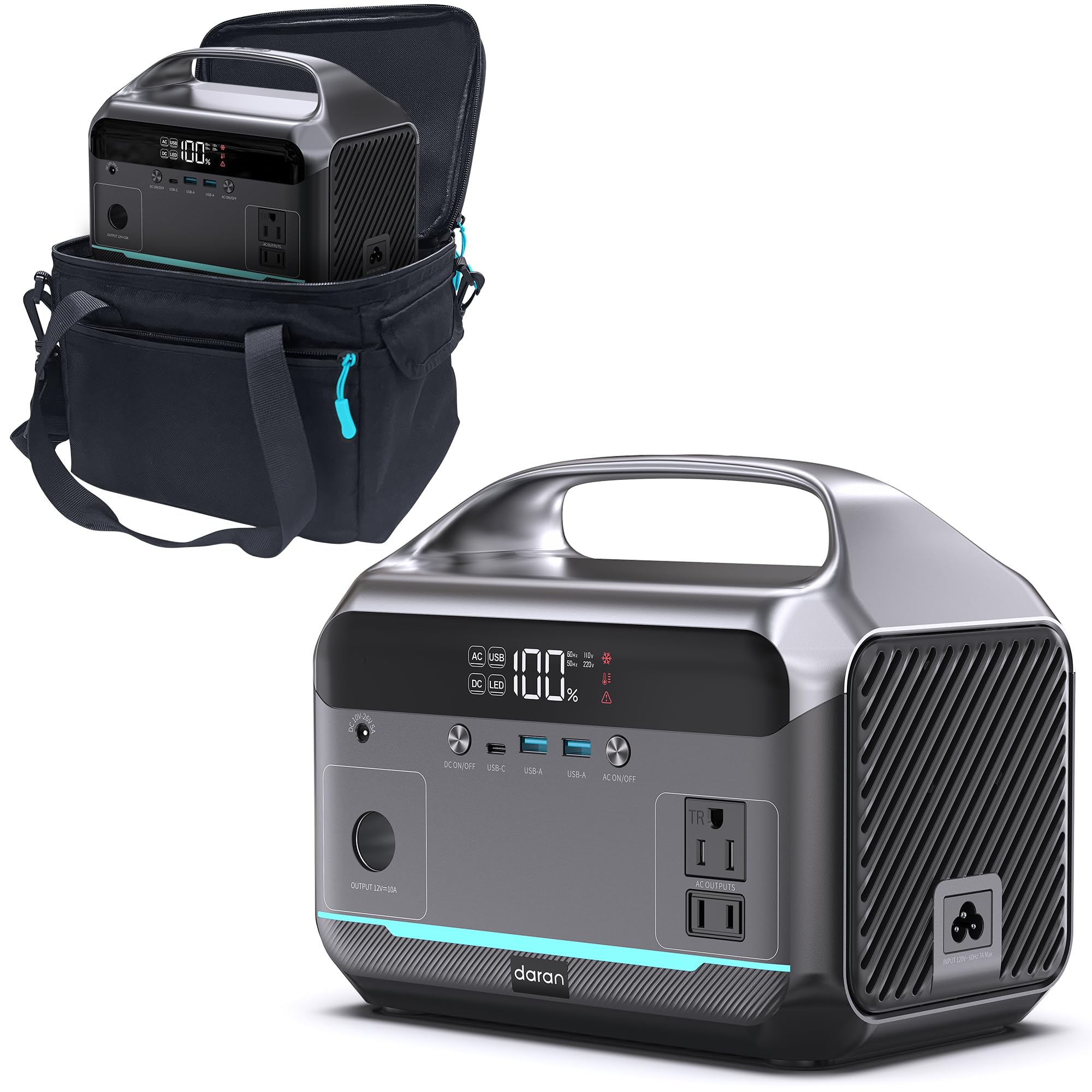
350W of rated power and a 288Wh LiFePO4 core — the workhorse that wants to live in your emergency kit.
The NEO300L brings a bit more rated wattage to the table than the field — 350W continuous with 600W surge, versus the straight 300W of the Anker. That headroom and the 288Wh LiFePO4 capacity combine for serious real-world runs: it’s rated to support a 30W CPAP machine for up to 8.16 hours or a 100W stew pot for about 2.44 hours, which is the kind of appliance math a lot of stations this size duck out of. Seven ports — 2×350W AC, a 60W PD USB-C, 2×18W USB-A, and a DC I/O — let a family run the essentials simultaneously without swapping cables.
Where this one earns its keep is 350 watts of practical output that the tighter units can’t match. It weighs 8.2 lbs and sits at 10.0 x 6.6 x 8.2 inches, so it’s a shelf or trunk resident rather than a backpack item. Owners power Starlink Mini rigs through the AC outlet, run ham radios for about 12 hours on a single charge, and use it as a UPS (uninterruptible power supply — swaps to battery automatically when the wall dies) so a router or computer never sees an outage.
Reliability is the standout here — buyers rate it highest, with value for money right behind it. On the downside, charging speed is the most-discussed point and it’s not unanimous: some customers note slow fills, and the internal fan spins up noticeably loud while charging on AC, which is a nuisance in quiet rooms. It still delivers its rated 350W, so treat it as backup power rather than a fast-recharge unit.
rugged build
- 350W continuous and 600W surge — a real step above the straight-300W crowd
- 288Wh LiFePO4 core rated to power a 30W CPAP for up to 8.16 hours
- Seven ports let a whole family charge at once
- Operates as a UPS, cutting over to battery during outages
fan noise
- The cooling fan gets audible on AC charging
- At 8.2 lbs it’s a shelf resident, not a backpack companion
- Refill speed won’t suit you if you hate waiting midday
Anchor your emergency kit with it if: 350W matters more than a featherlight shell, and you want a station that quietly covers CPAP or a small appliance for hours.
basecamp: you need to carry it on your back or want silent AC charging.
8. EF ECOFLOW RIVER 2 Portable Power Station

An hour on a wall outlet fills this thing — the fastest turnaround here by a wide margin.
The RIVER 2’s signature is X-Stream charging, which takes a 256Wh LiFePO4 pack from empty to full on a wall outlet in about 1 hour. That is the spec owners keep coming back to, and it changes how you use a station — a lunch break at home refills it for the whole evening. It also powers up to 600W of appliances through 300W AC outlets plus USB-C, and uses LFP cells rated to over 3,000 cycles to 80%, which the company frames as almost 10 years of regular use. A lightweight 7.7 lbs body with a built-in handle makes carting it easy.
What owners actually run on it ranges wider than you’d expect. It’s served as a UPS for an NVR and PoE switch drawing roughly 300W AC for about 75 minutes, powered a fish-light rig for 2.5 hours, and run an ICECO fridge for 8 hours over DC before dropping from 100% to 31%. Solar works too: with a 100W panel it pulled 70–80W and reached a full charge in about 2 hours. Fast charging — the ability to refill quickly from a wall socket — is the quality most praised here, followed by overall build. From phones to laptops to routers, it covers the essentials without fuss.
The trade is in how much it holds under certain loads. Battery life and reliability split feedback — most units run for days on light duty, but a share of owners see faster drain, especially when the AC inverter is converting DC up to wall-level voltage for heavy appliances. Its 256Wh pack won’t run a space heater overnight. For most people, that’s fine — the fast 1-hour fill and light LiFePO4 cells make it the set-and-go option for short trips and quick emergencies, where wall access is a given.
fast recharge: 4,550+ owners back this one, and the 1-hour AC recharge is what keeps it at the top of the pile.
pricey: the AC inverter is the hungry part — running big appliances through it empties the pack faster than DC or USB draws will.
frequent use: anyone with wall access nearby who wants a station they can refill in about an hour and carry one-handed.
tight budget: your gear lives on 12V DC fridges and you need the longest possible run time away from a socket.
9. Jackery Explorer 300 Solar Generator with 40W Solar Panel
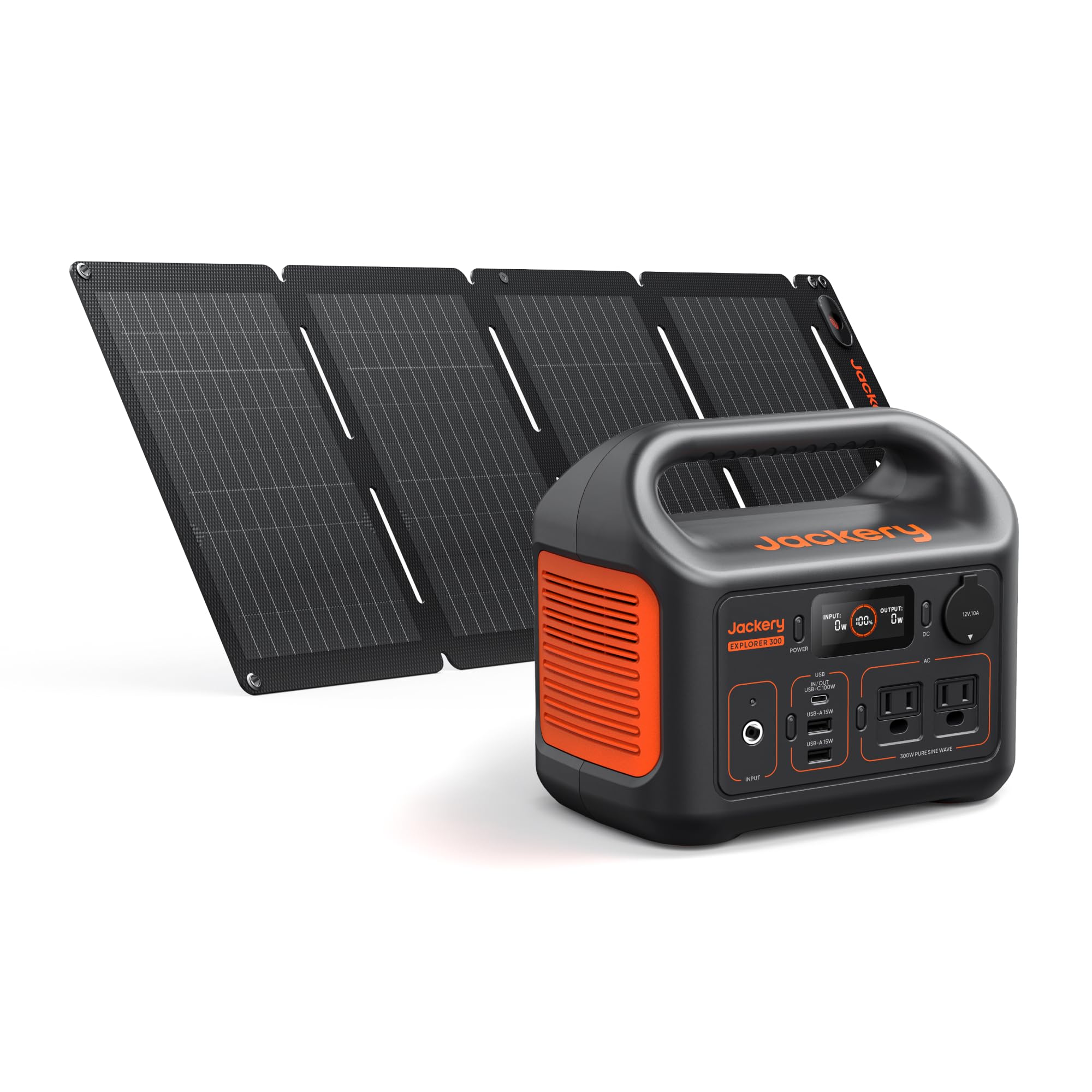
Over 4,000 charge cycles before the battery hits 70% — built to outlast the trips that use it.
The Explorer 300 leads with battery life on paper: it uses LiFePO4 cells rated for more than 4,000 charge cycles before dropping to 70% capacity, which the maker frames as over 11 years of service. That’s the longest cycle rating on this list, and for a station that lives in a van or a garage, cycle count is what decides whether you replace it in three years or keep it for a decade. Its 292Wh capacity and 300W output (600W peak surge) run through 2 AC outlets, a 100W USB-C PD port, 2 USB-A ports, and a 120W car port — six devices at once.
Owners put it through proper trips. On an 8-day overlanding run it charged a 12V fridge overnight and used less than half the battery after 10–12 hours while holding the fridge at 30°F. One buyer runs laptops and phones several times over and lights a string of 100 bulbs for 3 hours off a single charge. A bundled 40W solar panel, an AC adapter, and a car charger cable are all in the box, and its handle-integrated design makes the 7.5 lbs easy to haul. Fast solar is available too — reach 80% in about 2.8 hours with a 100W panel, though the 40W bundled one gets there in around 7.5 hours.
The pairing to watch: the included 40W panel is the slow side. On its own, the Explorer 300 hits its rated 292Wh and 300W. Only downside: it’s the priciest station here, so budget-conscious buyers will find equal capacity elsewhere for less. If longevity and a bundled panel matter more than upfront savings, this is the pick.
brand trust: you want the longest-rated battery life and don’t mind the premium to get it.
value seekers: the 40W panel feels too slow for your solar-only trips or you want the same capacity for less.
Understanding the Specs
Watts vs Watt-Hours
Watts is the ceiling on power at any moment, and watt-hours (Wh) is the fuel tank. A 300W station can push up to 300 watts at once, and its 288Wh tank can hold that pace for under an hour — or feed a 30W CPAP for a much longer stretch. When you compare stations, the watt number tells you what will run, and the watt-hour number tells you how long.
LiFePO4 vs Lithium-Ion
LiFePO4 is the long-life battery chemistry; lithium-ion is the older, lighter, cheaper option. LiFePO4 packs are rated for more charge-and-drain cycles before they wear down, which is why the stations here that tout 3,000+ or 4,000+ cycles use it. If you plan to keep a station for years, that cycle rating is the number that protects your money.
AC Pure Sine Wave Outlets
Pure sine wave is the clean form of AC power that sensitive electronics prefer. A station with pure sine wave AC outlets can safely run a laptop, a CPAP machine, a TV, or a mini-fridge without the choppy power that can strain certain devices. If your station will power anything with a motor or sensitive circuit, this spec matters.
Recharge Time and Solar Input
Recharge time is how long the station takes to refill from empty — from a wall outlet, a car socket, or a solar panel. Wall charging is fastest (some here refill in about an hour), car sockets are slowest, and solar depends on the panel and the sun. Match the recharge route to where you’ll actually be, because a station that fills fast on the wall is useless if you plan to go remote with a small panel.
FAQ
How long will a 288Wh station run a CPAP machine overnight?
What is the difference between AC outlets and USB-C ports on these stations?
Can a 300W portable power station run a mini-fridge?
Is LiFePO4 better than lithium-ion for a power station?
How long does it take to recharge a 300W portable power station?
Can I charge these stations with a solar panel, and how fast is it?
What can I actually run on 300 watts?
Do I need to buy a separate solar panel for these stations?
Can these stations be used as a UPS during a power outage?
How often should I recharge a power station in storage?
Will a 300W station power a Starlink dish or a 12V fridge?
Final Thoughts: The Verdict
For most people, the 300w portable power station winner is the Anker SOLIX C300 DC, because it delivers 288Wh of LiFePO4 power through two 140W two-way USB-C ports in a shell small enough to live in a car seat — and it ships with its own 60W solar panel. If raw output and a wall socket for a whole family matter more, the DARAN NEO300L gives you 350W continuous and a 288Wh core rated to run a CPAP for hours. And if you want the fastest refill and the longest-rated battery life, the EF ECOFLOW RIVER 2 fills in about an hour on the wall, while the Jackery Explorer 300 carries the highest cycle rating here for a decade of trips. Match the watt-hours and outlets to your actual gear, keep the AC inverter off when not in use, and any of these nine will carry you through the next outage or campsite.
How We Picked
We do not accept paid placement. Every pick is matched to a real buyer and a real use-case; we do not hands-on test units.
Sources & Methodology
Specifications: manufacturer listings and product documentation. Review insights: verified customer reviews, as of September 2026. Pricing: not shown on this page (it changes often); check the current price via the retailer link.
As an Amazon Associate, Gadgets Feed earns from qualifying purchases. This does not affect which products we feature.