
The moment the outdoor sensor loses sync after a storm, the indoor display starts flashing dashes instead of readings, and the whole morning routine hinges on whether that remote connection holds. A 308-10847 wireless color weather station lives or dies by its ability to maintain a stable RF link between the console and its sensor array, delivering temperature, humidity, barometric pressure, and forecast data without dropout drama.
I’m Min — the co-founder and writer behind Gadgets Feed. I’ve spent countless hours analyzing technical specifications, filtering through user reports on sensor range consistency and display readability in this category to separate reliable weather monitoring tools from units that degrade quickly after installation.
A solid 308-10847 wireless color weather station brings your microclimate into sharp focus without demanding constant troubleshooting or recalibration.
How To Choose The Best 308-10847 Wireless Color Weather Station
Not all color weather stations handle signal penetration through walls equally, and the outdoor sensor’s ability to report without interference determines whether you get reliable morning data or random blanks. Focus on three decisive factors before comparing any two models.
Sensor Radio Frequency and Effective Range
The 308-10847 standard uses 433 MHz RF, which offers better wall penetration than 915 MHz or Wi-Fi-only connections. A station that lists 300 feet in open air may only reach 80 feet through brick or stucco. Check whether the outdoor sensor uses a directional antenna or a simple wire whip — directional antennas reduce dropouts in multi-room homes.
Multi-Sensor Capacity and Channel Management
If you plan to monitor a greenhouse, basement, and backyard simultaneously, the console must support at least three remote channels without channel bleeding. Look for explicit per-channel alerts and individual min/max memory. Some budget stations share the same RF channel for all sensors, causing data overlap when sensors are close together.
Display Readability and Night Mode
Color LCD screens vary widely in contrast ratio and viewing angle. VA panels maintain readability up to 170 degrees, while basic IPS panels wash out at 120 degrees. A station that lacks an automatic dimming or scheduled night mode will glare through a dark bedroom — priority for nurseries or bedside placement.
Quick Comparison
On smaller screens, swipe sideways to see the full table.
| Model | Category | Best For | Key Spec | Amazon |
|---|---|---|---|---|
| Newentor Q3 | Mid-Range | Color display with atomic clock | 7.5″ LCD, 3 channels | Amazon |
| Newentor Z1 | Mid-Range | Three-sensor coverage out of box | 7.5″ VA, 3 sensors included | Amazon |
| VEVOR 7-in-1 | Premium | Wi-Fi app integration with solar sensor | 7.5″ display, 492 ft range | Amazon |
| Raddy UV-6 | Premium | Professional sensor suite with UV/light | 6″ VA, 5 brightness levels | Amazon |
| Urageuxy WS0330U | Premium | Large 8″ screen with WiFi upload | 8.07″ LCD, WU support | Amazon |
| AcuRite Iris 01532M | Premium | Lightning detection and app alerts | HD display, 25 mi lightning | Amazon |
| ECOWITT Wittboy Pro HP2564 | Premium | Haptic rain sensor and expandable ecosystem | 7″ TFT, 915 MHz | Amazon |
In‑Depth Reviews
1. Newentor Weather Station (Q3) — 2 Sensor

The Newentor Q3 packs a 7.5-inch color LCD that shows indoor and outdoor temperature, humidity, barometric pressure, moon phase, and a 12-24 hour forecast, all on one crisp screen. The display offers four adjustable brightness levels via the included power adapter, and the atomic clock syncs to WWVB for automatic time and date without manual setting. Two remote sensors are included in the box, covering two zones immediately with room to expand to a third.
Users report that sensor pairing completes within minutes and the forecast accuracy improves after roughly a week of local calibration. The large font sizing makes it legible from across a living room, though the viewing angle narrows noticeably when approaching from above or below. The 3-channel RF link maintains connectivity through standard drywall but may drop in basements with concrete reinforcement.
Several long-term reviews note that the backlight switches to a dimmer power-saving mode on battery-only operation, so keeping the adapter plugged in is recommended for consistent daytime readability. The wall mount design has received criticism for being flimsy — some owners switched to adhesive Velcro strips for a secure hold.
Why it’s great
- Vivid 7.5-inch color LCD with four brightness levels
- Atomic clock synchronization eliminates time drift
- Two sensors included for multi-zone monitoring
Good to know
- Wall mount bracket is poorly engineered
- Screen goes dim without AC adapter plugged in
- Narrow vertical viewing angle
2. Newentor Weather Station (Z1) — 3 Sensor
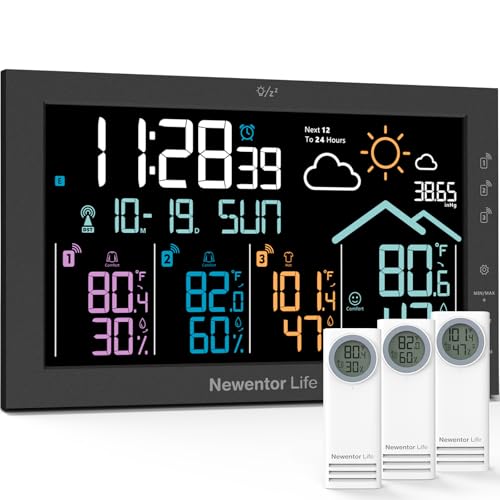
The Newentor Z1 differentiates itself from the Q3 with a 7.5-inch VA panel that delivers a 170-degree wide viewing angle and deeper color contrast, making it easier to read from the side or while walking past the console. It ships with three remote sensors out of the box, each with a 328-foot open-air range, so you can monitor three distinct locations — front porch, basement, and garage — right after setup without buying extra hardware.
The outdoor sensor housing uses thermal isolation technology and nine times the standard ventilation hole count, which users confirm produces faster temperature and humidity response readings compared to sealed sensor designs. The atomic clock requires setting the correct time zone (HAT/AKT/PST/MST/CST/EST/AST) manually on first boot to avoid synchronization errors, a step that some owners missed initially.
Reports indicate that the display stays bright when the AC adapter is connected but dims significantly in battery-only mode. A small number of customers experienced complete console failure within three to four months, with neither AC nor battery power restoring function, suggesting a possible quality variance in the power regulation circuit.
Why it’s great
- Three remote sensors included for immediate multi-zone coverage
- VA panel with 170-degree viewing angle for flexible placement
- Ventilated sensor housing improves accuracy response time
Good to know
- Brightness drops significantly on battery power
- Some units reported complete failure within months
- Time zone must be manually set for atomic sync
3. VEVOR 7-in-1 Wi-Fi Weather Station
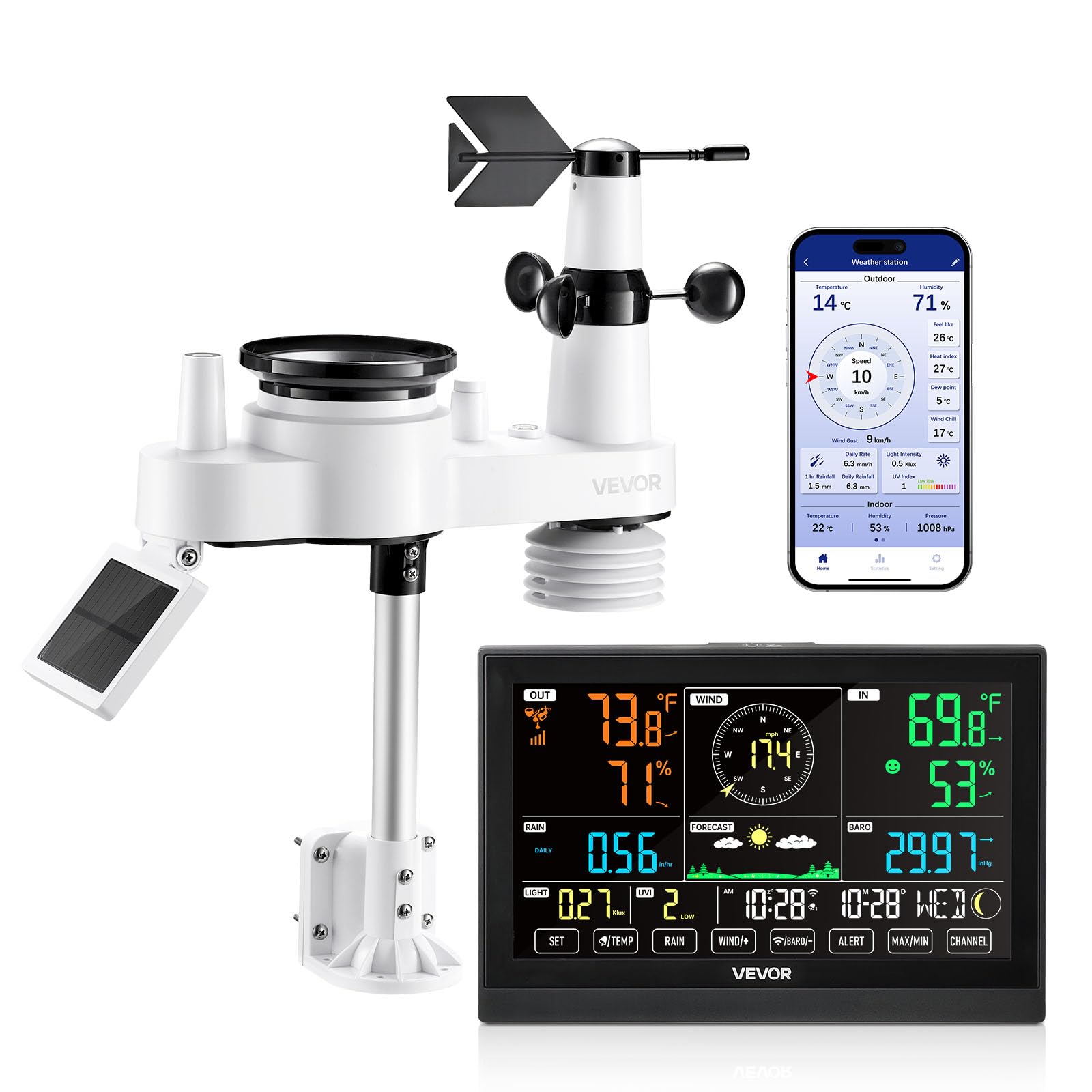
The VEVOR 7-in-1 moves beyond basic temperature and humidity by integrating a full sensor array that measures wind speed, wind direction, rainfall, UV intensity, and light levels, plus barometric pressure and a 6-12 hour forecast. The outdoor sensor is solar-powered with a NiMH battery backup, and the 492-foot transmission range covers larger properties, gardens, or farms without a repeater.
Wi-Fi connectivity syncs to the SmartLife app, bypassing the need to register with Weather Underground or similar platforms, and provides real-time data graphing and history access from anywhere. The 7.5-inch indoor display offers four brightness settings, and the aluminum alloy mounting bracket simplifies pole installation — though users note the anemometer can freeze up during freezing rain conditions, a known design limitation of mechanical cup anemometers.
Some early adopters reported humidity readings running 20-30% high initially before settling closer to airport data within 5% after a week of operation. The customer support process for warranty claims has drawn criticism for requiring excessive documentation and sometimes redirecting to battery purchase links instead of addressing unit defects.
Why it’s great
- Full 7-in-1 sensor array including UV and wind speed
- Solar-powered outdoor sensor with battery backup
- SmartLife app for remote monitoring without ad platforms
Good to know
- Anemometer can freeze in freezing rain
- App features are limited compared to WU platforms
- Warranty support process is frustrating for some users
4. Raddy UV-6 Professional Weather Station
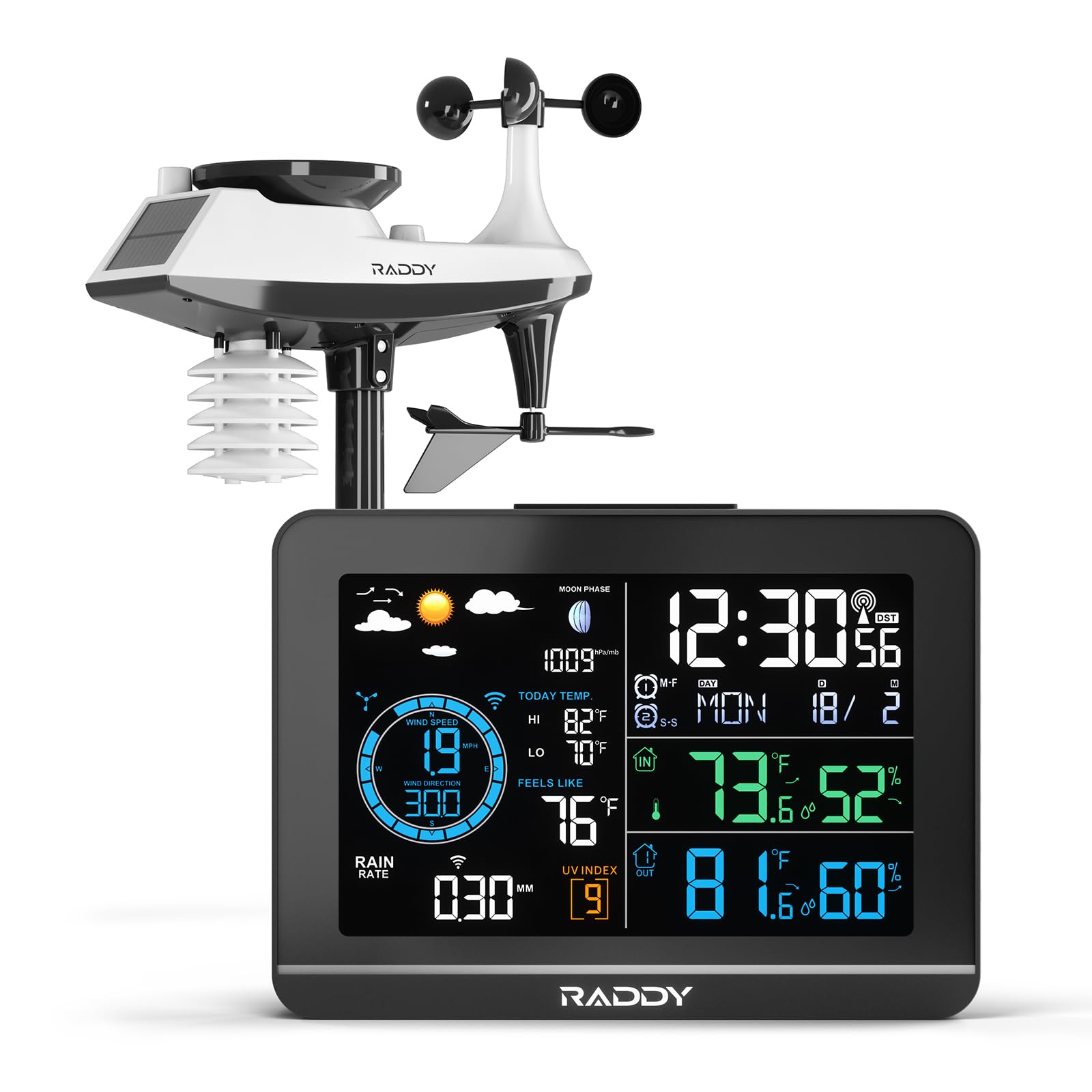
The Raddy UV-6 packs a dense amount of environmental data into a 6-inch VA display, including indoor/outdoor temperature and humidity, barometric pressure with trend arrows, wind speed and direction, rainfall totals, UV index, light intensity, sunrise/sunset times, and moon phase. The outdoor sensor integrates a rain funnel, wind vane, anemometer, radiation-shielded temperature and humidity sensor, UV/light sensors, and a solar panel for extended operation without battery swaps.
The console supports monitoring up to five areas when you add optional R5 remote sensors, and the auto-cycle mode rotates through all zones on the display without manual switching. Atomic clock syncs to the RCC signal, and the dual alarms with snooze function make it practical for bedside use. The five-level adjustable brightness includes a programmable night mode timer that dims the screen automatically at set hours.
Users praise the 300-foot transmission range and the wide viewing angle of the VA panel, though several reports indicate that the rain gauge readings can deviate from local weather service data. A small percentage of buyers received units with defective temperature sensors or completely inaccurate rainfall measurements across two consecutive replacements, raising consistency concerns in the manufacturing batch.
Why it’s great
- Comprehensive sensor suite including UV and light index
- Five brightness levels with programmable night mode
- Five-zone monitoring capacity with optional sensors
Good to know
- Rain gauge accuracy can be inconsistent
- No Wi-Fi for data logging or remote access
- Quality control issues reported on some units
5. Urageuxy WiFi Weather Station
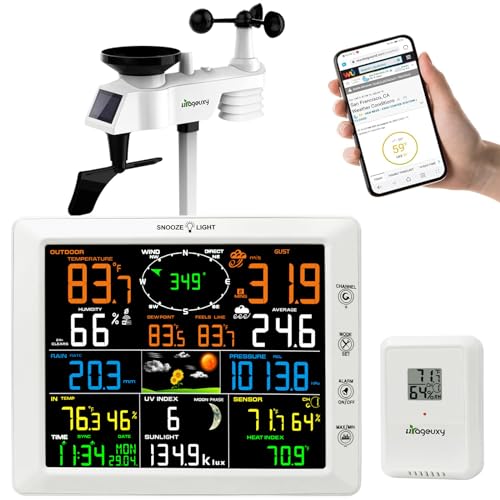
The Urageuxy stands out with its 8.07-inch color LCD — the largest screen in this lineup — making it ideal for wall-mounted viewing from across a kitchen or home office. It measures indoor/outdoor temperature and humidity, wind speed and direction, barometric pressure, UV index, light intensity, and rainfall with totals for the hour, day, week, month, and year. Wi-Fi uploads data automatically to Weather Underground, PWSweather, and WeatherCloud without manual intervention after initial setup.
The console supports manual calibration for temperature, humidity, wind speed, barometric pressure, and rainfall, allowing you to fine-tune readings against a local reference. Users confirm the 328-foot RF range holds up through standard wood-frame construction, and the backlight offers four adjustable brightness levels. The remote sensor array includes a solar panel that keeps the internal batteries charged, though some owners report that the panel does not fully recharge the batteries during overcast winter weeks.
Critics note the lack of up/down trend arrows for barometric pressure, requiring you to mentally track changes between glances. The wind vane uses a non-calibratable square mounting pole that can introduce a 10-15 degree directional error if not aligned perfectly during installation. Customer support has received positive marks for responsiveness when addressing setup issues.
Why it’s great
- Massive 8.07-inch color display for easy reading at distance
- Auto-uploads to multiple weather services via Wi-Fi
- Full manual calibration for all key sensors
Good to know
- No barometric trend arrows on display
- Wind vane alignment can introduce directional error
- Solar panel may not fully charge in low light conditions
6. AcuRite Iris Wireless Weather Station
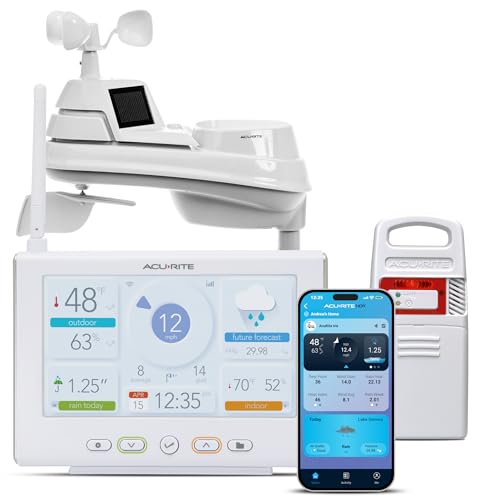
The AcuRite Iris 01532M includes a dedicated lightning detection sensor that detects strikes up to 25 miles away, giving you early warning of approaching thunderstorms before rain or wind arrives. The HD direct-to-Wi-Fi display connects to the AcuRite NOW app for push notifications when lightning is detected, alongside real-time readings for indoor and outdoor temperature, humidity, wind speed and direction, rainfall, and barometric pressure with trend arrows.
The sensor array also calculates dew point, heat index, and feels-like temperature, and the in-sensor barometer provides a hyperlocal 12-hour forecast based on your exact location rather than a regional weather feed. The fold-out tabletop stand keeps the console stable on a desk or shelf. Setup requires connecting your phone to the AcuRite network temporarily during configuration — a step that some users found unintuitive but solved by following the printed instructions closely.
Accuracy reports are mixed: some owners find temperature readings within 1-2 degrees of reference stations, while others report indoor and outdoor temperatures 5 degrees higher than their previous AcuRite unit. The lightning detector can lose signal from the display even when both are indoors and only 10 feet apart, though when it works, strike detection during storms is reliable.
Why it’s great
- Built-in lightning detection with 25-mile range
- App push notifications for storm alerts
- Hyperlocal 12-hour forecast from on-board barometer
Good to know
- Lightning detector can lose connection intermittently
- Wi-Fi setup requires network temporary switch
- Temperature accuracy variability between units
7. ECOWITT Wittboy Pro HP2564
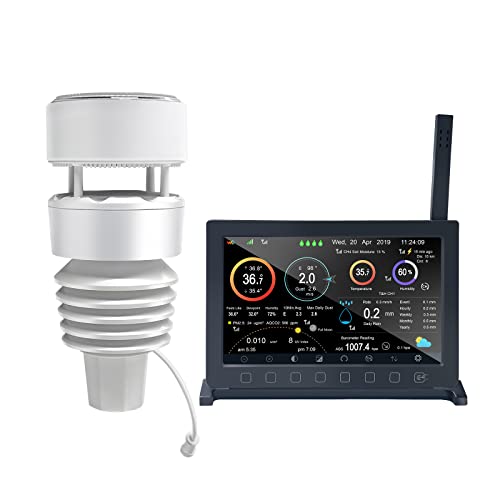
The ECOWITT Wittboy Pro uses a haptic piezoelectric rain sensor in the WS90 outdoor unit instead of a traditional tipping bucket, measuring rainfall volume through vibration detection without moving parts that can jam or freeze. The indoor HP2560 console features a 7-inch TFT display with crisp graphics, adjustable brightness, and the ability to connect with ECOWITT’s entire sensor ecosystem — up to 8 soil moisture sensors, 8 thermo-hygrometers, pool thermometers, leak detectors, and air quality monitors.
The 915 MHz RF frequency provides a longer open-air range of up to 1,000 feet, though it may have more difficulty penetrating concrete than lower-frequency 433 MHz systems. The console uploads data to Weather Underground, WeatherCloud, WOW, and the free ECOWITT Weather server with graph history and email alerts. An SD card slot supports firmware updates and data backup. Users can calibrate temperature, humidity, barometric pressure, and rainfall gain factor directly from the console menus.
Rain data variance is a known characteristic of the haptic sensor — raindrop size and wind speed affect output, so daily readings can deviate from a bucket gauge by a larger margin. ECOWITT openly acknowledges this and recommends pairing the WS90 with a separate WH40 rain gauge for users who demand precision. A small number of customers reported receiving units with non-functional wind or rainfall sensors, and the customer service response time during warranty claims has been criticized as slow.
Why it’s great
- Haptic rain sensor with no moving parts to jam
- Expandable ecosystem with soil, air, and leak sensors
- SD card for firmware updates and data backup
Good to know
- Rain data variance higher than tipping bucket gauges
- Customer support response can be slow
- 915 MHz may struggle through concrete walls
FAQ
Can I add more sensors to a 308-10847 weather station later?
How long does the atomic clock take to sync on first power-up?
Why does my outdoor sensor show dashes instead of readings?
Final Thoughts: The Verdict
For most users, the 308-10847 wireless color weather station winner is the Newentor Q3 because it combines a large 7.5-inch color display, atomic clock sync, and two included sensors at a balanced price point without needing Wi-Fi setup complexity. If you want three-zone coverage right out of the box, grab the Newentor Z1. And for remote monitoring with app integration and a full professional sensor array, nothing beats the VEVOR 7-in-1 Wi-Fi Weather Station.