
Joining stainless steel to mild steel, or repairing a cracked exhaust manifold, demands a filler rod that can handle the thermal stress of two very different metals. The wrong rod leads to cracking, porosity, or a weld that fails under heat; the right rod creates a strong, ductile bond that lasts.
I’m Min — the co-founder and writer behind Gadgets Feed. I’ve spent countless hours comparing chemical compositions, tensile strengths, and amperage ranges across dozens of stainless filler rods to separate the reliable performers from the slag-heavy disappointments.
This guide breaks down the top options available today, covering TIG wires and stick electrodes for every project scale. Whether you need a rod for a high-temperature furnace repair or a quick fix on a trailer hitch, this is the definitive guide to the best 309 welding rod for the job.
How To Choose The Best 309 Welding Rod
Selecting the right 309-series filler rod means matching the chemical composition, diameter, and flux coating to your base metals and welding process. The 309L designation indicates a low-carbon formula (≤0.03% C) that prevents carbide precipitation and maintains corrosion resistance in the weld zone. Here are the key factors to evaluate.
TIG vs. Stick: ER309L vs. E309L-16
For precision work on thin-gauge sheet or where cosmetic bead appearance matters, ER309L TIG wire (GTAW) gives you full control over heat input and filler deposition. Stick electrodes (E309L-16) are better suited for outdoor work, dirty metal, or thicker sections where manual arc striking is acceptable. The “-16” suffix means the electrode operates on AC or DC+ and has a rutile-based flux that produces a smooth arc with moderate slag coverage.
Diameter and Amperage Matching
A 1/16-inch rod is ideal for 18-to-22-gauge sheet at 30-50 amps. Jump to 3/32-inch for 1/8-inch plate (60-90 amps), and use 1/8-inch for sections 1/4-inch and thicker (90-130 amps). Pushing too many amps through a thin rod causes burn-through; using an undersized rod on a heavy joint forces multiple passes and wasted time. Check the manufacturer’s recommended amperage range for each diameter.
Quantity and Packaging
Most brands offer 1-pound, 2-pound, and 5-pound packages. A 1-pound tube holds roughly 10-15 rods of 3/32-inch diameter — enough for a single repair job. For regular fabrication, the 5-pound bundle saves money per rod and reduces the chance of running out mid-project. Storage matters: rods should be kept dry and free from oil or grease. Many premium rods ship in resealable plastic tubes that double as storage cases.
Quick Comparison
On smaller screens, swipe sideways to see the full table.
| Model | Category | Best For | Key Spec | Amazon |
|---|---|---|---|---|
| Forney 48520 | TIG Wire | Dissimilar joints with heat treatment | 85,000 PSI Tensile Strength | Amazon |
| SÜA ER309L 5 Lb | TIG Wire | Multi-size bulk projects | 1/16″ x 36″ x 5 Lb | Amazon |
| Blue Demon E309L-16 5LB | Stick Electrode | Thick plate & structural repair | 3/32″ x 14″ x 5 Lb | Amazon |
| SÜA E309L-16 2 Lb | Stick Electrode | Thin stainless and low-amp stitching | 0.04% Max Carbon | Amazon |
| WeldingCity ER309L 1/8″ | TIG Wire | Heavy TIG overlay & filler | 1/8″ x 36″ x 1 Lb | Amazon |
| Blue Demon ER309L 1/16″ | TIG Wire | Detailed cosmetic TIG beads | 1/16″ x 36″ x 1 Lb Tube | Amazon |
| Basic ER309L 1 Lb | TIG Wire | Budget learning and scrap practice | 3/32″ x 36″ x 1 Lb | Amazon |
In‑Depth Reviews
1. Forney 48520 ER309L TIG Filler Metal (1/16″ x 36″, 1 lb)
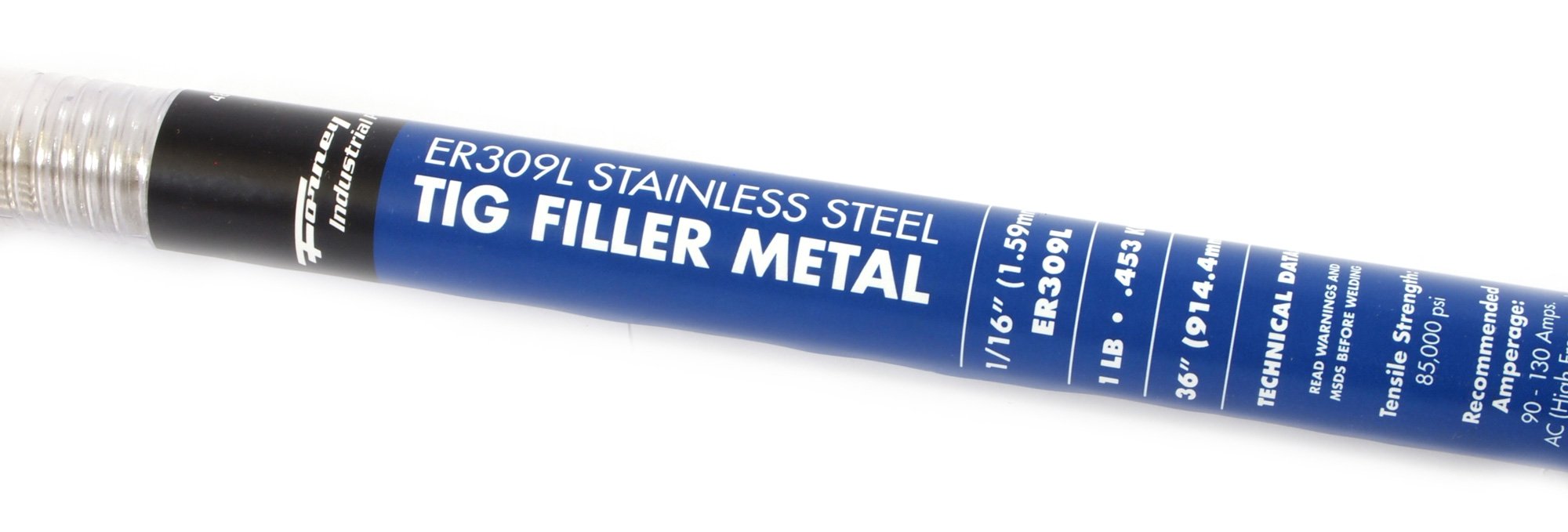
The Forney 48520 is widely considered the benchmark for ER309L TIG wire in the 1/16-inch size class. Its 85,000 PSI tensile strength and ultra-low carbon content (less than 0.03%) deliver outstanding corrosion resistance and ductility when welding dissimilar joints that will later undergo heat treatment. The recommended polarity is DCEP at 90 to 130 amps, giving you solid overhead margin for 1/8-inch to 3/16-inch plate.
Users consistently report clean arc starts and smooth puddle flow with minimal contamination, a direct result of Forney’s quality control on the draw finish. The 1-pound tube is the right size for a weekend repair job or a small fabrication run, and the 1/16-inch diameter is versatile enough for thin stainless sheet as well as light structural work. Reviews also note it works surprisingly well as a knitting blocking wire, though its primary purpose is clearly welding.
In practice, this rod produces a bright, shiny bead with little to no sugaring on 304 and 409 stainless when back-purged with argon. If you need a single reliable roll for stainless-to-mild steel joining, this is the box to reach for.
Why it’s great
- 85,000 PSI tensile strength provides strong, durable welds on dissimilar metals.
- Ultra-low carbon composition protects against intergranular corrosion after heat treatment.
- Contamination-free surface gives smooth, consistent arc starts.
Good to know
- 1-pound tube runs small for larger fabrication projects.
- 1/16-inch diameter is less efficient on material over 1/4-inch thick.
2. SÜA ER309L TIG Stainless Steel Welding Rod (1/16″ x 36″, 5 lb)

The SÜA ER309L 5-pound pack is the right choice for fabricators who burn through wire regularly. It ships in a sturdy plastic tube that protects the rods from bending and moisture, and the 1/16-inch diameter is ideal for welding 18-gauge to 1/8-inch stainless. The rods arrive clean and straight — several buyers note they could use them straight out of the tube without acetone wiping, which saves setup time on repetitive joints.
Welding 304 and 409 stainless, users report a stable puddle with minimal arc wander when using DCEN polarity and 100% argon shielding at 15-20 CFH. The wire handles back-purged welds cleanly, though skipping the purge on 409 leads to the expected sugaring inside the tube. SÜA’s chemical composition stays within AWS A5.9 specs — 24.5% Cr, 13% Ni — giving you the high ferrite content needed to resist hot cracking in dissimilar-metal joints.
If you are welding furnace parts, kiln liners, or structural brackets in a production environment, the 5-pound package eliminates mid-project reordering. The per-rod cost is significantly lower than the 1-pound tubes, making this the more economical path once you surpass a few hours of arc time.
Why it’s great
- 5-pound bulk pack delivers strong per-rod value for regular fabricators.
- Rods arrive clean, straight, and ready to weld without prep.
- AWS A5.9 compliant composition handles 304, 409, and mild steel junctions.
Good to know
- 1/16-inch diameter is not ideal for material thicker than 1/4-inch.
- Storage tube is functional but not as durable as a metal case.
3. Blue Demon E309L-16 Stainless Steel Arc Welding Electrode (3/32″ x 14″, 5 lb)

The Blue Demon E309L-16 stick electrode is engineered for welders who need a forgiving rod on dirty or rusty metal. The rutile-based flux provides a smooth arc with moderate penetration, making it suitable for 2F (horizontal fillet) welding and light vertical work. Users running these at 65-70 amps on DC+ report easy arc restrikes and minimal sticking — a major plus when tacking thin exhaust pipe or sheet metal where burn-through is a constant risk.
In practice, the rod lays down a uniform bead with about 50% slag coverage that chips off cleanly, revealing a shiny stainless weld underneath. Several buyers successfully welded 316 stainless hinges to mild steel brackets, and one user repaired a snapped trench tool with no cracking. The 3/32-inch diameter is a sweet spot for 14-gauge to 1/8-inch material — thick enough to carry current, thin enough to avoid gouging the base metal.
The 5-pound box provides roughly 50-60 rods, enough for a full day of repair work. If you rely on stick welding for field repairs or prefer the portability of a DC inverter over a gas bottle setup, this Blue Demon pack will likely become your go-to consumable.
Why it’s great
- Rutile flux delivers smooth arc starts and easy slag removal.
- 5-pound box provides many electrodes for extended job runs.
- 3/32-inch diameter runs well at low amperage (65-70A) without sticking.
Good to know
- Produces significant slag that requires cleaning between passes.
- Not ideal for thin-gauge stainless below 16 gauge.
4. SÜA E309L-16 Stainless Steel Welding Electrode (3/32″ x 12″, 2 lb)

The SÜA E309L-16 electrode shines on thin stainless where controlling heat input is critical. Its low carbon content (0.04% max) preserves intergranular corrosion resistance while producing a higher ferrite number (typically over 8 FN) to resist hot cracking in the weld deposit. Several users ran this rod at 45-55 amps, successfully stitching 20-gauge stainless sheet without blow-through — a challenging task for most 3/32-inch electrodes.
The 12-inch length gives you a short arc gap that is easier to control in tight quarters, such as furnace housing repair or thin-wall exhaust fabrication. The flux coating produces a stable arc column even on restart, which matters when you need to lay down a series of short tacks without waiting for the rod to cool. One user did report heavy slag buildup that required frequent stops on a trench tool repair, but the final weld held strong under load.
For hobbyists and light repair shops working with thin stainless, the 2-pound box is a practical size — enough rods for several jobs without committing to a full 5-pound bundle. The short length also makes it less wasteful on short beads since you can use nearly the entire rod.
Why it’s great
- Excels at low amperage (45-55A) for thin stainless sheet work.
- Short 12-inch length improves control in tight or vertical positions.
- High ferrite content (8+ FN) resists hot cracking on dissimilar metals.
Good to know
- Slag can be heavy and requires frequent cleaning on longer beads.
- 12-inch rods run out faster than standard 14-inch electrodes.
5. WeldingCity 1-Lb ER309L Stainless Steel TIG Welding Rod (1/8″ x 36″)

The WeldingCity ER309L in 1/8-inch diameter is built for heavy TIG overlays and thick-plate repair. With a low carbon content of 0.025%, balanced chromium at 24.5% and nickel at 13%, this rod delivers the high strength and oxidation resistance needed for 2000°F service environments. The 36-inch length gives you excellent reach for large-format work like furnace part cladding or structural steel buildup, and each rod is stamped on one end for quick identification.
Users welding 1/4-inch plate and above praise the rod’s smooth puddle fluidity at 100-130 amps on DCEN. The bead appearance is consistently shiny with minimal grey oxide when using 100% argon shielding at 20 CFH. The plastic shipping tube doubles as a short-term storage case, keeping rods organized and free from oil contamination between uses.
WeldingCity is a US-based supplier with responsive customer service, which adds reassurance if you need to verify batch certifications or return a defective lot. For fabricators who frequently lay down multiple passes on thick stainless, this 1/8-inch rod fills the gap that thinner wire leaves wide open.
Why it’s great
- 1/8-inch diameter efficiently fills thick joints on 1/4-inch and heavier plate.
- Ultra-low 0.025% carbon content maximizes corrosion resistance in high-heat service.
- Single-end stamped for quick grade verification in a mixed rod inventory.
Good to know
- 1-pound tube provides only a few rods of this large diameter.
- Not suitable for thin sheet — amperage requirement is too high.
6. Blue Demon ER309L TIG Welding Rod (1/16″ x 36″, 1 lb Tube)

The Blue Demon ER309L 1/16-inch TIG rod is a top contender for welders who prioritize bead cosmetics and fine heat control. It is widely praised for its forgiving arc on mild steel, producing stacked dime appearances that look professional without excessive manipulation. The extra low carbon formula is engineered for dissimilar joints that will undergo post-weld heat treatment, so you get the corrosion margins needed for food-grade or pharmaceutical material.
Users running this wire on 20-22 gauge cold-rolled sheet report it flows smoothly at 30-40 amps, reducing heat input and preventing warpage. The 1-pound plastic tube is compact enough to toss in a welding cart drawer, and the 36-inch length gives ample reach for most bench-top TIG applications. A few buyers noted the tube can crack during shipping if not packed well, but the rods themselves arrived undamaged.
Blue Demon has built a reputation for consistent quality across product lines, and this 309L rod lives up to that standard. If you are learning stainless TIG or need a clean, reliable wire for detailed weld joints, this tube is a strong choice for the money.
Why it’s great
- Produces attractive stacked-dime beads on mild and stainless steel.
- 1/16-inch diameter runs smoothly at low amperage (30-40A) on thin sheet.
- Extra low carbon formula preserves corrosion resistance in heat-treated joints.
Good to know
- Plastic shipping tube is not impact-resistant — may arrive cracked.
- 1-pound quantity is small for regular production work.
7. Basic ER309L Stainless Steel TIG Welding Rod (3/32″ x 36″, 1 lb)

This unbranded ER309L rod is the entry point for budget-conscious welders who need 309 stainless filler without the packaging premium. At this price point, the primary appeal is accessibility — anyone with a TIG torch can grab a pack to practice welding stainless to cast iron or mild steel without worrying about wasting expensive consumables on learning curves. Users report it “seemed to work well” for a wastegate flange repair and “it’s just wire” for basic overlays, confirming it meets the fundamental requirement of being ER309L filler.
The 3/32-inch diameter is a middle-ground size that works for 1/8-inch plate at 60-80 amps, but be prepared for slightly less consistent arc starts compared to the Forney or Blue Demon offerings. Some rods may have surface oils that require a quick acetone wipe before striking an arc. The packaging is minimal — a simple plastic sleeve — but the rods arrived straight and unblemished for the reviewers.
If you are a hobbyist or need a sacrificial test rod for dialing in machine settings, this is the most budget-friendly way to get 309 composition into your shop. It is not the smoothest or cleanest rod, but it will get the job done when the budget is tight and the weld does not need a show-quality finish.
Why it’s great
- Lowest entry cost for getting ER309L stainless filler in your shop.
- 3/32-inch diameter is versatile for 1/8-inch plate and general repair.
- Good option for practice and learning stainless TIG without premium material cost.
Good to know
- Surface may contain light oil residue requiring cleaning before welding.
- Arc start consistency is less reliable than premium brand rods.
FAQ
Can I use 309L to weld stainless steel to mild steel?
What is the difference between 309 and 309L welding rod?
Final Thoughts: The Verdict
For most users, the best 309 welding rod winner is the Forney 48520 because its 85,000 PSI tensile strength and ultra-low carbon formulation provide reliable, clean welds on dissimilar joints at a fair per-rod cost. If you need bulk wire for regular TIG production, grab the SÜA ER309L 5 lb pack. And for stick welding in the field where portability matters, nothing beats the Blue Demon E309L-16 5 lb box for easy arc starts and solid bead deposition on carbon-to-stainless repairs.