
A 32-key keyboard shrinks the piano down to its most essential two octaves — a format that either unlocks your workflow or frustrates every creative session with cramped, unresponsive keys. The difference comes down to which controller you pair with your software.
I’m Min — the co-founder and writer behind Gadgets Feed. I’ve spent hundreds of hours analyzing MIDI controller specs, sorting through user benchmarks on key feel, sequencing latency, and DAW compatibility to separate the genuinely useful 32-key keyboards from the ones that belong in a toy bin.
Whether you’re laying down basslines in Logic Pro, sketching chord progressions on an iPad, or teaching a child their first scale, choosing the right 32 key keyboard means knowing which model delivers velocity sensitivity you can actually feel and which one is just plastic under your fingers.
How To Choose The Best 32 Key Keyboard
Every 32-key keyboard fits on a cramped desk, but the internal feature set determines whether it becomes a daily creative tool or a dust collector. The three decisions that matter most are whether the keys respond to your touch, whether you need built-in sounds, and how easily it connects to your existing gear.
Velocity Sensitivity and Key Action
A velocity-sensitive key registers how hard you press, translating that force into louder or softer notes inside your DAW. Without it, every note hits at the same volume — fine for triggering samples but useless for expressive piano passages. The cheaper controllers use spring-loaded mini keys that feel spongy, while premium models like the Arturia KeyStep mk2 use a slimkey design with aftertouch, letting you add vibrato or filter sweeps by pressing deeper into the key after the initial strike.
Standalone Sound Engine vs. Pure MIDI Controller
If you want to play immediately without a computer, you need a keyboard with built-in sounds and speakers — the Casio Casiotone SA-51 gives you 100 tones and 50 rhythms straight out of the box. If you already own a laptop with Ableton, Logic, or Studio One, a pure MIDI controller like the Donner N-32 or the Midiplus AKM322 is lighter, cheaper, and routes all sound through your software, giving you access to infinite virtual instruments.
Connectivity and Portability
The best 32-key keyboards for travel weigh under three pounds and run on USB bus power, meaning one cable from the keyboard to your laptop is all you need. For hardware synth rigs, CV/Gate outputs — found on the Behringer SWING and Arturia KeyStep mk2 — let you control modular synthesizers without a computer in the chain. Also check the connector type: USB-C is becoming standard on newer models, while older units still use USB-B.
Quick Comparison
On smaller screens, swipe sideways to see the full table.
| Model | Category | Best For | Key Spec | Amazon |
|---|---|---|---|---|
| Arturia KeyStep mk2 | MIDI Controller | Studio sequencing & hardware synth control | Aftertouch + CV/Gate outputs | Amazon |
| Behringer SWING | MIDI Controller | Step sequencing & arpeggiation | 64-step polyphonic sequencer | Amazon |
| Casio Casiotone SA-51 | Digital Keyboard | Portable standalone play for beginners | 100 built-in tones + speakers | Amazon |
| Midiplus AKM322 | MIDI Controller | Budget DAW control with knobs & arpeggiator | 3 rotary knobs + chord/scale modes | Amazon |
| Donner N-32 | MIDI Controller | Travel-friendly composition & teaching | USB-C + 40 teaching courses | Amazon |
| Kmise Mini Keyboard Piano | Digital Keyboard | Children’s first keyboard & family jam sessions | 128 tones + 128 rhythms + LCD screen | Amazon |
| Midiplus AKM320 | MIDI Controller | Ultra-budget notation & basic MIDI input | 32 mini keys, plug-and-play USB | Amazon |
In‑Depth Reviews
1. Arturia KeyStep mk2
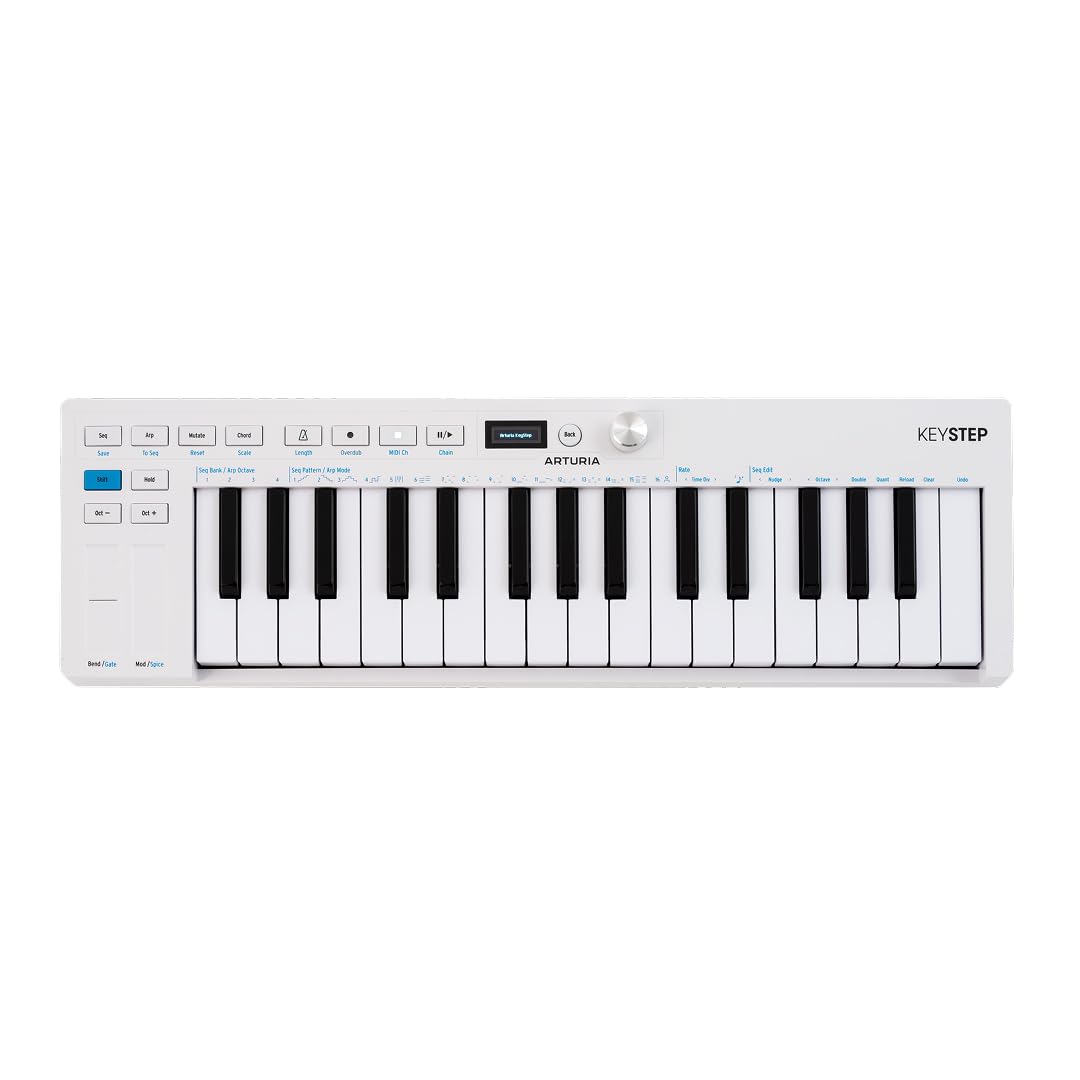
The KeyStep mk2 is the gold standard for 32-key MIDI controllers because it packs a full studio-grade feature set into a footprint that slides into a backpack. Its velocity-sensitive Slimkey design includes aftertouch — a rare feature at this size — letting you add expressive modulation by pressing deeper into the keys after the initial strike. The polyphonic step sequencer supports pattern chaining and mutation, meaning you can build a sequence, then let the onboard tools generate variations automatically.
Connectivity is where this controller leaves the competition behind: alongside USB-C and standard MIDI DIN, it offers four configurable CV outputs (Pitch, Gate, Mod 1, Mod 2) that can send velocity, aftertouch, or mod wheel data straight to modular synthesizers without a computer. The 16-mode arpeggiator and chord/scale modes make it equally effective for songwriting sketches on a laptop and live hardware jams.
Users consistently praise the immediacy of the sequencer and the quality of the slimkey action, with many noting it replaced bulkier controllers in their studio. The main trade-off is the compact key size — players with very large hands may find the reduced key length less comfortable for extended piano-style passages compared to a full-size 49-key board.
Why it’s great
- Aftertouch-enabled slimkeys give genuine expressive control rare in this form factor
- Polyphonic step sequencer with mutation tools turns simple riffs into evolving compositions
- CV/Gate outputs connect directly to modular gear without a computer in the chain
Good to know
- Compact key size may feel cramped for pianists used to full-width keys
- Premium tier pricing — more than double the cost of entry-level 32-key controllers
2. Behringer SWING

The Behringer SWING directly challenges the Arturia KeyStep lineage with a 64-step polyphonic sequencer that supports up to eight notes per step with rest, tie, and legato entry — a hardware sequencing engine that punches well above the price segment. Its 32 compact keys offer both velocity sensitivity and aftertouch, giving you the same foundational expression tools as the premium competition. The Chord Play mode lets you stack up to 16 notes per chord, making it viable for rich ambient pads and layered sample playback.
Pitch and modulation touch strips replace traditional wheels, keeping the surface flat and backpack-friendly. The arpeggiator fires eight simultaneous notes per step across eight styles, giving you plenty of rhythmic variety for techno, house, or experimental work. Users coming from the Arturia ecosystem note the SWING is functionally a clone of the KeyStep 32 at a noticeably lower cost, though some report the modulation strip can be finicky out of the box.
Setup requires a 9V DC center-positive adapter — it does not run on USB power alone, which is a consideration for mobile rigs. The step sequencer interface has a learning curve; reviewers mention that the documentation could be clearer, but once the workflow clicks, the SWING becomes a powerful groovebox companion for hardware synths.
Why it’s great
- 64-step polyphonic sequencer with eight-note capacity per step is rare at this price
- Aftertouch and velocity sensitivity on compact keys match premium controller feel
- Chord Play mode with 16-note stacking unlocks lush layered arrangements
Good to know
- Requires external 9V DC power — not USB bus-powered for portable use
- Some units have reported modulation strip failures shortly after purchase
3. Casio Casiotone SA-51

The Casio Casiotone SA-51 is the only standalone digital keyboard in this lineup, meaning it produces sound through its own built-in speakers without needing a computer, tablet, or external amplifier. Its 100 instrument tones cover piano, strings, organ, percussion, and more, while 50 built-in rhythm patterns give young beginners or casual players instant accompaniment. The one-touch tone selection buttons (piano, trumpet, drum set) make it exceptionally intuitive for children — there is no menu diving.
The 32 mini keys are sized for smaller hands, and the octave shift buttons extend the playable range across the full keyboard spectrum despite the physical limit of two octaves. Power comes from six AA batteries, so the SA-51 can go to the park, the car, or a family gathering without hunting for an outlet. Weighing just 2.2 pounds, it is the lightest fully self-contained option here.
Reviewers love the build quality — Casio’s reputation for durability in the entry-level keyboard space holds up here, with many users reporting years of use from children and casual adult strummers. The compromise is the lack of any MIDI or USB connectivity, so you cannot use it as a controller for software instruments. The piano tone is serviceable but not on par with weighted digital pianos, which is expected at the price point.
Why it’s great
- Fully standalone with built-in speakers and 100 tones — no computer required
- Intuitive one-touch tone buttons make it ideal for young children
- Battery-powered and lightweight (2.2 lbs) for true portability
Good to know
- No MIDI or USB output — cannot be used as a DAW controller
- Mini keys and lack of weighted action limit adult piano practice value
4. Midiplus AKM322

The Midiplus AKM322 brings genuine DAW integration tools — three programmable rotary knobs, an endless encoder, and 11 backlit function buttons — to the value tier of 32-key controllers. The chord mode lets you trigger full triads and seventh chords from single fingers, while the scale mode restricts playback to only the notes in a selected key, eliminating wrong notes for beginners or fast sketching. The onboard arpeggiator syncs to internal or external MIDI clock, giving you rhythmic patterns without touching your DAW.
Velocity-sensitive mini keys give you dynamic control over your software instruments, though the key action is noticeably spongier than the Arturia or Behringer offerings. The compact footprint — roughly 18 inches wide — fits comfortably on a lap or a crowded desk, and the unit runs entirely on USB bus power with no wall wart needed. A shift button provides a second control layer, doubling the eight hardware buttons to 16 functions.
Budget-conscious users appreciate the sheer number of features packed at the price point: transport controls (play, stop, record, scene navigation), tap tempo, metronome, and marker controls are all available from the front panel. The main complaints center on the key feel — the short hinge and heavy springiness make rapid, quiet playing difficult — and the USB cable included is too short for comfortable desktop placement.
Why it’s great
- Programmable knobs and encoder provide hands-on DAW control missing from cheaper alternatives
- Chord and scale modes make music theory accessible for beginners
- Fully bus-powered with a small footprint ideal for tight workspaces
Good to know
- Spongy key action requires practice to control velocity accurately
- Included USB cable is very short — plan to buy a longer replacement
5. Donner N-32

The Donner N-32 distinguishes itself with a USB-C connector — a modern convenience that eliminates the need for adapter dongles when connecting to newer MacBooks, iPads, and Android tablets. Its 32 velocity-sensitive keys are scaled down in both width and length compared to full-size keys, but the springy action is consistent and responsive enough for on-the-road composition in GarageBand or Ableton Note. The included 40 keyboard-teaching courses (beginner through advanced) make it a compelling option for someone buying their first MIDI controller as a learning tool.
A unique breathing light around the pitch/mod joystick adds visual feedback that helps you locate the control in low-light studio environments. The N-32 offers chord arpeggiator, octave switching, pitch shifter, a built-in sequencer, and a sustain pedal input — all control features that are usually cut from budget controllers. Compatibility spans Mac, Windows, iOS, and Android, and the unit is thin enough to slide into a laptop bag alongside a 13-inch notebook.
Users highlight the plug-and-play simplicity: reviewers mention it works instantly with Linux aseqdump and iOS GarageBand without any driver installation. The main drawbacks are the cheap feel of the plastic chassis and the fact that it cannot change MIDI channels — a significant limitation if you want to control multiple virtual instruments from the same keyboard. The springy key action also gets mixed reviews from pianists accustomed to weighted keys.
Why it’s great
- USB-C connectivity works natively with modern laptops, iPads, and Android devices
- 40 built-in teaching lessons add real educational value for beginners
- Breathing light joystick for pitch and modulation is visible in dark studios
Good to know
- Cannot change MIDI channel — limits multi-instrument workflows
- Plastic chassis and spongy keys feel less durable than premium alternatives
6. Kmise Mini Keyboard Piano

The Kmise Mini Keyboard Piano packs 128 tones, 128 rhythms, and 30 demo songs into a chassis that weighs 2.7 pounds, making it one of the most feature-dense standalone keyboards at the budget level. The multifunctional LCD screen shows which effects are active and guides correct finger placement during demo songs — a genuinely useful learning aid for children. A 3.5mm headphone jack allows silent practice, and the built-in speakers are surprisingly loud for the size, with clear tone quality that reviewers describe as “not a toy.”
Power options include USB cable, AC adapter, or battery, though notably none of these are included in the box — you must supply your own source. The 32 keys are smaller than standard piano keys, which helps children build accuracy but can feel cramped for adult hands. The LCD screen is a standout feature at this price level, giving real-time visual feedback that most budget keyboards omit entirely.
Customer feedback is largely positive for sound quality and value, with several reviewers noting it has lasted through years of children’s use without issue. However, multiple reports mention that the headphone output is extremely quiet — barely usable for monitoring. There are also isolated reports of units failing after a few months, often traced to loose battery contacts rather than internal electronics failure.
Why it’s great
- 128 tones and 128 rhythms offer massive variety for a compact standalone keyboard
- LCD screen displays note guidance and effects — rare at this price point
- Three power modes (USB, adapter, battery) for flexible use anywhere
Good to know
- No power cable or batteries included in the box — purchase separately
- Headphone volume is very low, limiting quiet practice usability
7. Midiplus AKM320

The Midiplus AKM320 is the simplest, most affordable gateway into 32-key MIDI control: a barebones 32-mini-key controller with a volume slider, octave shift buttons, and chord/note adjustment features. There are no knobs, no screens, no arpeggiator — just plug-and-play USB-MIDI that Windows and macOS recognize instantly without drivers. At roughly 18 inches wide and 1.2 inches tall, it is one of the slimmest controllers on the market, easily fitting into a laptop sleeve.
The keys are velocity-sensitive, so your software instruments still respond to playing dynamics, but the action is light and plasticky — fine for triggering virtual instrument samples or entering notes into MuseScore or Sibelius, but not expressive enough for nuanced piano performances. The unit is fully USB bus-powered, and the included cable is adequate for a tidy desk setup.
Long-term reviews are surprisingly positive for the price: one reviewer reported daily heavy use for four years before a key broke, which is remarkable durability for a budget controller. The AKM320 lacks the production features of its more expensive sibling (the AKM322), so it is best suited for notation input, basic beat sketching, or as a cheap MIDI trigger for a hardware sound module. It offers no standalone sound capability — it is purely a controller.
Why it’s great
- Ultra-slim profile (1.2 inches) fits into a laptop bag easily
- Genuine plug-and-play on Mac and Windows with no driver installation
- Velocity-sensitive keys provide dynamic control even at the entry-level price
Good to know
- No programmable knobs, pads, or arpeggiator — barebones feature set
- Key action is light and plasticky, not suited for expressive piano playing
FAQ
Can I use a 32-key MIDI controller without a computer?
What is the difference between mini keys and full-size keys?
How do I connect a 32-key keyboard to an iPad or Android tablet?
Final Thoughts: The Verdict
For most users, the 32 key keyboard winner is the Arturia KeyStep mk2 because its aftertouch-enabled slimkeys, polyphonic sequencer with mutation tools, and CV/Gate outputs make it the most versatile controller for both studio DAW work and modular hardware rigs. If you want a budget-friendly standalone keyboard with built-in speakers and 100 tones that works without any computer, grab the Casio Casiotone SA-51. And for pure hardware sequencing power at a lower price than the Arturia, nothing beats the step-sequencing depth of the Behringer SWING.