
Our readers keep the lights on and my morning glass full of iced black tea. As an Amazon Associate, I earn from qualifying purchases.
Specs are compiled from manufacturer listings and verified buyer reviews and can change over time — please confirm the key details on the product page before buying.
You want big bass, but that “3500 watt” sticker on an amp can mean very different things depending on which brand you trust. This guide cuts through the numbers game and shows you which mono amplifiers actually drive a subwoofer without overheating, blowing fuses, or dying after a few months.
I’m Min — the founder and writer behind Gadgets Feed. This guide is built by comparing the manufacturers’ published specifications and the patterns across verified customer reviews, so you get each pick’s real strengths and trade-offs instead of marketing spin.
Whether you are wiring up a single 15-inch sub or a pair of 12s, finding the right 3500 watt amp depends on build quality, true RMS output, and honest customer feedback — not just the biggest number on the box.
Quick Picks
- Stetsom Bravo Full 3000 — Pro Grade
- Power Acoustik RZ1-3500D — Best Value
- Rockville dBcomp5 Competition 3500W — Feature Packed
- Crunch GP-3500.1D — Budget Bundle
How To Choose The Best 3500 Watt Amp
A 3500 watt amp is meant to push serious air, but not every unit on the shelf can do it safely. Focus on three things: the real RMS power the amplifier sustains, the quality of its internal components, and whether your car’s electrical system can feed it.
RMS Power vs Peak Power — The Real Number
“3500 watts” is often a peak or maximum power number that the amp can hit for a split second. The number that matters for daily listening is RMS (Root Mean Square), which is the continuous power the amp produces. An honest amp will have an RMS rating close to its peak rating; a weak one will be miles apart. For a 3500 watt peak amp, look for at least 1000-1500 watts RMS to know it can actually drive a subwoofer.
Build Quality and Cooling
A Class D monoblock runs more efficiently than older Class A/B designs, which means less heat. But cheap capacitors, thin circuit boards, and undersized heatsinks still cause failures. Look for MOSFET (Metal-Oxide-Semiconductor Field-Effect Transistor) power supplies in the specs — they handle current more cleanly and run cooler. If the amp is small and light for its claimed wattage, that is often a red flag.
Wiring and Electrical Requirements
You cannot hook a high-power amp to factory wiring. Most of these amplifiers need at least 4 AWG (American Wire Gauge) power and ground cables, and often 0 AWG for the top-tier models. The fuse rating on the amp itself tells you roughly how much current it draws — an amp with a 150A fuse needs a serious charging system and possibly a battery upgrade to run without dimming your lights or dropping voltage.
Quick Comparison
| Model | Best For | Class | RMS Power | Dimensions | Amazon |
|---|---|---|---|---|---|
| Stetsom Bravo Full 3000 | Proven Daily Driver | Class D | 3100W RMS | 9.29 x 9.11 x 3.14 in | $229.00$269.99Amazon |
| Crunch GP-3500.1D | Budget Bundle | Class D | — | 16 x 10 x 4 in | $124.95Amazon |
| Power Acoustik RZ1-3500D | Compact & Cool | Class D | — | 16.75 x 5.25 x 2 in | $144.52Amazon |
| Rockville dBcomp5 | Competition Features | Class D | 3500W RMS | 5 x 11.5 x 27.6 in | $399.00Amazon |
In‑Depth Reviews
1. Stetsom Bravo Full 3000

You get honest RMS power (3100W) that buyers confirm keeps a 15-inch sub pounding hard daily — no peak-power fantasy here.
This is the growler that proves itself on a dyno (a machine that measures real output). The Stetsom Bravo Full 3000 pumps out 3100 watts RMS at 12.6 volts and hits 3500 watts peak RMS at 14.4 volts into 1 ohm — making it a rare amp where the peak number is not a fantasy. Stetsom is rated at 3100W RMS, while the Power Acoustik RZ1-3500D is rated at 3500W peak, according to the published specs. Buyers report they have “ran amp daily for 6 months with 3500W 15″ sub; pushes it hard with zero issues,” which tracks with the premium build quality.
It uses a MOSFET Class D topology and packs a compact cooler for long listening sessions without thermal shutdown (automatic turn-off from overheating). The crossover section is versatile, letting you send only the right frequencies to your sub. It has a high-pass filter from 10Hz to 90Hz and a low-pass filter from 90Hz to 22KHz, plus a bass boost you can tune from 30Hz to 70Hz with 0dB to +10dB of gain — so you can dial in exactly how much low-end punch you want. The 150-amp fuse and 4 AWG power/ground inputs tell you this amp needs a serious electrical system — one reviewer noted, “You will need electrical upgrade. You can not just slap this one into any car and go.”
Its dimensions are 9.29 x 9.11 x 3.14 inches, making it more compact than many lower-power amps. That helps with mounting in tight trunks or under seats. The all-aluminum body and smart cooler keep heat away from the internal electronics. If you want an amp that under-promises and over-delivers on the actual power that reaches your voice coil, this is your pick.
What You Actually Get
- 3100W RMS real-world power, not just a peak claim
- Compact aluminum chassis with effective smart cooler
- Full-range crossover and bass boost controls
- Proven reliability — “zero issues” in 6-month daily use
The Catch
- Requires a serious electrical system upgrade to perform
- Higher entry cost than budget competitors
Reach for it if: you want a real 3000-watt-class RMS amp that you can trust to hammer a sub every day.
Look elsewhere if: you are on a tight budget or cannot upgrade your alternator and battery wiring.
2. Power Acoustik RZ1-3500D

Slides into cramped spaces (just 2 inches tall) and runs cool, so you can fit bass under a seat without the amp overheating.
At just 2 inches tall and 16.75 inches wide, the Power Acoustik RZ1-3500D slides under seats or into tight spaces that full-size amps cannot go. It uses a Class D design with a MOSFET PWM (Pulse Width Modulation) power supply — that means it switches the current on and off rapidly to stay efficient and cool. Multiple buyers confirm “it never gets hot” even when driving two 15-inch subwoofers hard. But the trade-off shows in the numbers: while the Stetsom is rated at 3100W RMS (continuous power), the RZ1-3500D is a 3500-watt peak amp, and one reviewer’s clamp test estimate puts real output around 1112W RMS based on its 80-amp fusing.
The sound character is good for the price, though owners mention it “does tend to get a little muddy down around 35 Hertz” — a common trait for budget amps trying to reproduce ultra-low bass. Compared to the Crunch GP-3500.1D, the Power Acoustik has a much slimmer profile (5.25 x 2 inches depth versus 10 x 4 inches) and a cooler reputation in user reviews. It runs two 1600-watt subs without thermal shutdown, according to owner reports.
One buyer bought it in 2017 and it lasted until the following year, then they bought another — suggesting decent longevity for the price bracket. The metal chassis feels basic but solid, and the bare-bones controls keep installation simple. If you need something thin that will not cook itself and you are willing to accept lower real-world power than the sticker claims, this amp gets the job done.
Slim but honest: real output is far below the peak claim, but it runs cool, stays compact, and delivers clean sound above 35Hz for budget builds.
Pick it for: a tight installation space where a full-size amp won’t fit, paired with moderate subwoofers.
skip it if: you need true 3500W RMS power or clean low-bass under 35Hz.
3. Rockville dBcomp5 Competition 3500W

Delivers dyno-confirmed 3500W RMS (continuous power) — a rare honest rating — but its chassis is a massive 27.6 inches long.
The Rockville dBcomp5 claims 3500 watts RMS at 1 ohm — a rare full-RMS rating that earns a spot on the board. It backs that up with a fully adjustable 24dB-per-octave crossover, a subsonic filter adjustable from 15Hz to 55Hz, and a 12dB bass equalizer. You also get a remote dashboard subwoofer control with a clipping indicator (a light that warns when the signal is distorted) and a digital voltage display on the amplifier chassis. These are serious features for a serious setup, and one buyer confirmed it “exceeded certified RMS dyno ratings.”
But length is a real issue here: the Rockville measures 27.6 inches from end to end, while the Power Acoustik RZ1-3500D is 16.75 inches. You need a large mounting space, and the first batch of reliability reports are mixed. A verified buyer wrote simply: “Junk; first amp failed after 1 month, second smelled used and didn’t work (red light).” Another user had a better experience, running two 12-inch American Bass subs with “power to spare.”
The IC-controlled protection circuitry (a chip that monitors temperature, voltage, and shorts) should theoretically guard against overheating, voltage swings, and short circuits, but the failure reports suggest QC inconsistency. The amplifier uses high-speed MOSFET components for efficient power delivery. For buyers who land a good unit, this amp is a beast; for others, it has been a frustrating expense.
The High Notes
- 3500W RMS at 1 ohm — honest dyno-confirmed power
- Full competition crossover, subsonic filter, and clipping indicator
- Remote bass knob with voltage display integrated
The Risk
- Extremely long chassis (27.6 inches) is hard to fit
- Inconsistent quality control — some units fail quickly
- Premium price tag that puts it in a higher-risk bracket
Buy it for: competition-level tuning features and dyno-verified RMS power if you have the space and are willing to gamble on QC.
Avoid it if: you cannot fit a 27.6-inch amp or want a model with more consistent long-term reliability data.
4. Crunch GP-3500.1D
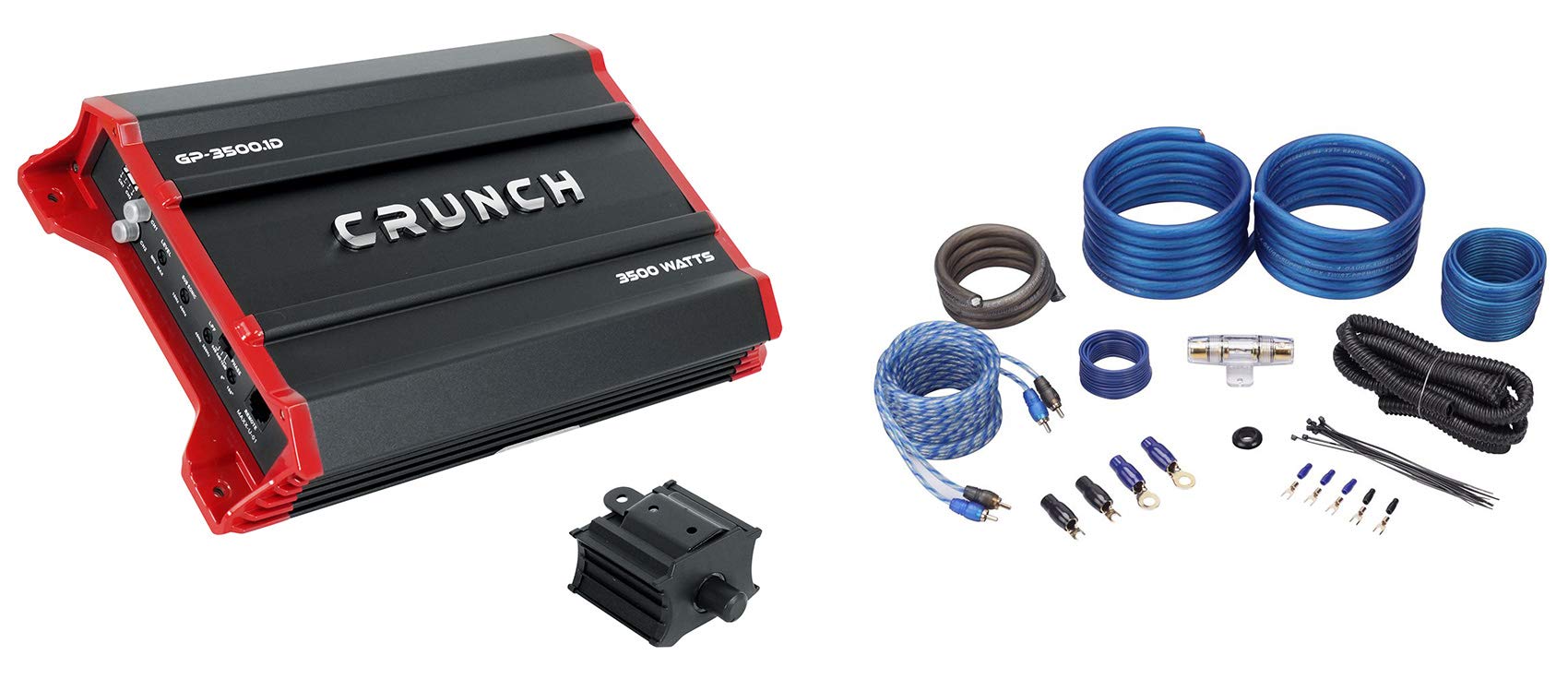
Comes with a wiring kit so you can install it on day one, but buyer reports of smoking and blown fuses make it a risky daily driver.
The Crunch GP-3500.1D is a Class D monoblock that claims 3500 watts peak at 1 ohm and comes bundled with a Rockville RWK41 4-gauge wiring installation kit — a complete package that includes a 17-foot RCA cable, 100-amp and 60-amp AGU fuses, and all the connectors you need. That makes it tempting for a first-time installer who wants everything in one box. The amplifier uses Crunch’s exclusive SPEED-FET MOSFET components and a low-noise preamplifier circuit to keep distortion down.
But the customer reviews tell a hard story. One verified buyer wrote: “This amp blew 4 fuses and started smoking in the back of my car.” Another said: “Bought 2 installed 2 both blowed in a little over 2 months.” That kind of failure pattern is tough to ignore. The positive reviews mention that it pushes Jensen 12s and MTX Terminators with “amazing bass,” but the smoke-and-fuse reports suggest the amp does not survive its own power claims under load — especially compared to the Stetsom, which has no such failure pattern in buyer reviews.
At 16 x 10 x 4 inches, it is a standard-size monoblock — nothing unusually compact or long. The included wiring kit is a real bonus if you are starting from scratch, but the metal connectors and fuse holder are budget-level. For the low price, you are rolling the dice. A few buyers got good units that play loud; several others watched theirs die.
High-risk entry point: the wiring kit adds value, but the amp’s reliability is a coin toss — buyer reports of smoking and blown fuses outweigh the positive bass stories.
Only consider if: your budget is tight and you are willing to accept a gamble on longevity in exchange for immediate bass output.
Stay away if: you need a daily driver that you can count on for more than a couple of months of regular use.
Understanding the Specs
Class D Amplification
Class D amps use switching transistors that pulse on and off rapidly to create the audio signal. This is much more efficient than older Class A/B designs — more power reaches your subwoofer and less is wasted as heat. All four amps here are Class D, which means they run cooler and can be built in smaller chassis than equivalent-power Class A/B amps.
Impedance and 1-Ohm Stability
Impedance (measured in ohms) is how much electrical resistance the subwoofer presents to the amp. A 1-ohm load demands more current from the amp than a 4-ohm load. A “1-ohm stable” monoblock can safely drive a subwoofer or a wiring configuration that presents a 1-ohm total load. Running a non-stable amp at 1 ohm will overheat and destroy it. Every amp in this list is rated for 1-ohm operation, which is standard for high-power bass setups.
FAQ
Will a 3500 watt amp drain my car battery?
What size fuse do I need for a 3500 watt amp?
What gauge wire do I need for a 3500 watt amp?
What does RMS mean on a car amplifier?
Can I run a 3500 watt amp with stock electrical?
How do I know if my 3500 watt amp is real?
What is the difference between a monoblock and a 2-channel amp for subwoofers?
Why does my 3500 watt amp keep going into protect mode?
Final Thoughts: The Verdict
For the majority of shoppers, the top 3500 watt amp is the Stetsom Bravo Full 3000 because it delivers honest RMS power (3100W) in a compact chassis that buyers confirm runs daily without issues. If you want competition-level tuning features and dyno-verified RMS numbers, grab the Rockville dBcomp5. And for tight installation spaces with a cool-running, budget-friendly option, the Power Acoustik RZ1-3500D gets the job done without overheating.
How We Picked
We do not accept paid placement. Every pick is matched to a real buyer and a real use-case; we do not hands-on test units.
Sources & Methodology
Specifications: manufacturer listings and product documentation. Review insights: verified customer reviews, as of July 2026. Pricing: not shown on this page (it changes often); check the current price via the retailer link.
As an Amazon Associate, Gadgets Feed earns from qualifying purchases. This does not affect which products we feature.
Related Guides
Product prices and availability are accurate as of the date/time indicated and are subject to change. Any price and availability information displayed on Amazon at the time of purchase will apply to the purchase of this product. As an Amazon Associate I earn from qualifying purchases.
CERTAIN CONTENT THAT APPEARS ON THIS SITE COMES FROM AMAZON. THIS CONTENT IS PROVIDED "AS IS" AND IS SUBJECT TO CHANGE OR REMOVAL AT ANY TIME.
Amazon and the Amazon logo are trademarks of Amazon.com, Inc. or its affiliates.