
Our readers keep the lights on and my morning glass full of iced black tea. As an Amazon Associate, I earn from qualifying purchases.
Specs are compiled from manufacturer listings and verified buyer reviews and can change over time — please confirm the key details on the product page before buying.
Buying a 3500 watt inverter generator is about one thing: keeping your fridge cold and your lights on without wrestling a screaming, fuel-hungry machine. These picks deliver quiet, clean power that’s safe for your laptop and TV.
I’m Min — the founder and writer behind Gadgets Feed. This guide is built by comparing the manufacturers’ published specifications and the patterns across verified customer reviews, so you get each pick’s real strengths and trade-offs instead of marketing spin.
You’ll find the best 3500 watt inverter generator for your RV, your home backup, or your job site below, ranked by real owner experiences and hard specs.
Our Picks at a Glance

How To Choose The Best 3500 Watt Inverter Generator
Before you pick, you need to know what you will actually power. A 3500 running watt unit handles a fridge, a few lights, and a TV easily, but it will struggle if you add a big air conditioner at the same time. Match the generator to your actual wattage needs, not just the peak rating.
Peak vs. Running Watts: The Two Numbers That Matter
Every generator has two wattage figures. Peak watts (also called surge or starting watts) is the short burst of power needed to start a motor, like the compressor in a fridge. Running watts is what the generator produces continuously. If your fridge needs 600 watts to run but 1200 to start, you need a generator whose peak wattage clears the 1200 mark, not just the running number.
Fuel Options: Gas, Propane, or Both
Gasoline gives you the highest wattage and is easiest to find, but it goes stale if left in the tank. Propane stores indefinitely, burns cleaner, and often costs less per hour, but produces slightly fewer watts. Dual fuel units let you switch between the two and are a favorite of RV owners who want options during an outage.
Clean Power and THD: Protecting Your Electronics
Inverter generators use special electronics to produce power with very low Total Harmonic Distortion (THD), a measure of how “clean” the electricity is. High THD can damage sensitive devices like phones, laptops, and CPAP machines. Models with THD under 3% are safe for everyday electronics, which is why inverters dominate this category over older conventional generators.
Quick Comparison
| Model | Best For | Peak Watts | Runtime | Weight | Amazon |
|---|---|---|---|---|---|
| Westinghouse iGen5000c★ Best Overall | Whole-house essentials + remote start | 5000 | Up to 18 hrs (gas) | 105.8 lbs | Amazon |
| Aceup Energy AI4000DsBudget Champion | Budget dual-fuel RV use | 4000 | Up to 5 hrs (gas) | 51.8 lbs | Amazon |
| maXpeedingrods MXR4000App Control Pick | App monitoring on a budget | 4000 | N/A | 48.5 lbs | Amazon |
| ERAYAK 4500PD | Lightweight camping power | 4500 | N/A | 54 lbs | Amazon |
| PowerSmart 4800W | Easy-start home backup | 4800 | 18 hrs (gas) | 89 lbs | Amazon |
| Champion 4250W | Open-frame dual-fuel workhorse | 4250 | Up to 22 hrs (gas) | 79 lbs | Amazon |
| WEN 56477i | Quiet RV power with CO sensor | 4800 | N/A | 72.7 lbs | Amazon |
| maXpeedingrods MXR3500-DC | Triple-start dual fuel | 3500 | Up to 24 hrs (LPG) | 55.1 lbs | Amazon |
| Westinghouse 4024 | Quiet dual-fuel camping | 4000 | Up to 7 hrs (gas) | 59 lbs | Amazon |
| Champion 4000W Dual Fuel | Light dual-fuel portability | 4000 | Up to 25 hrs (propane) | 51.8 lbs | Amazon |
| WEN DF451i | Electric start dual-fuel comfort | 4500 | N/A | 100 lbs | Amazon |
In-Depth Reviews
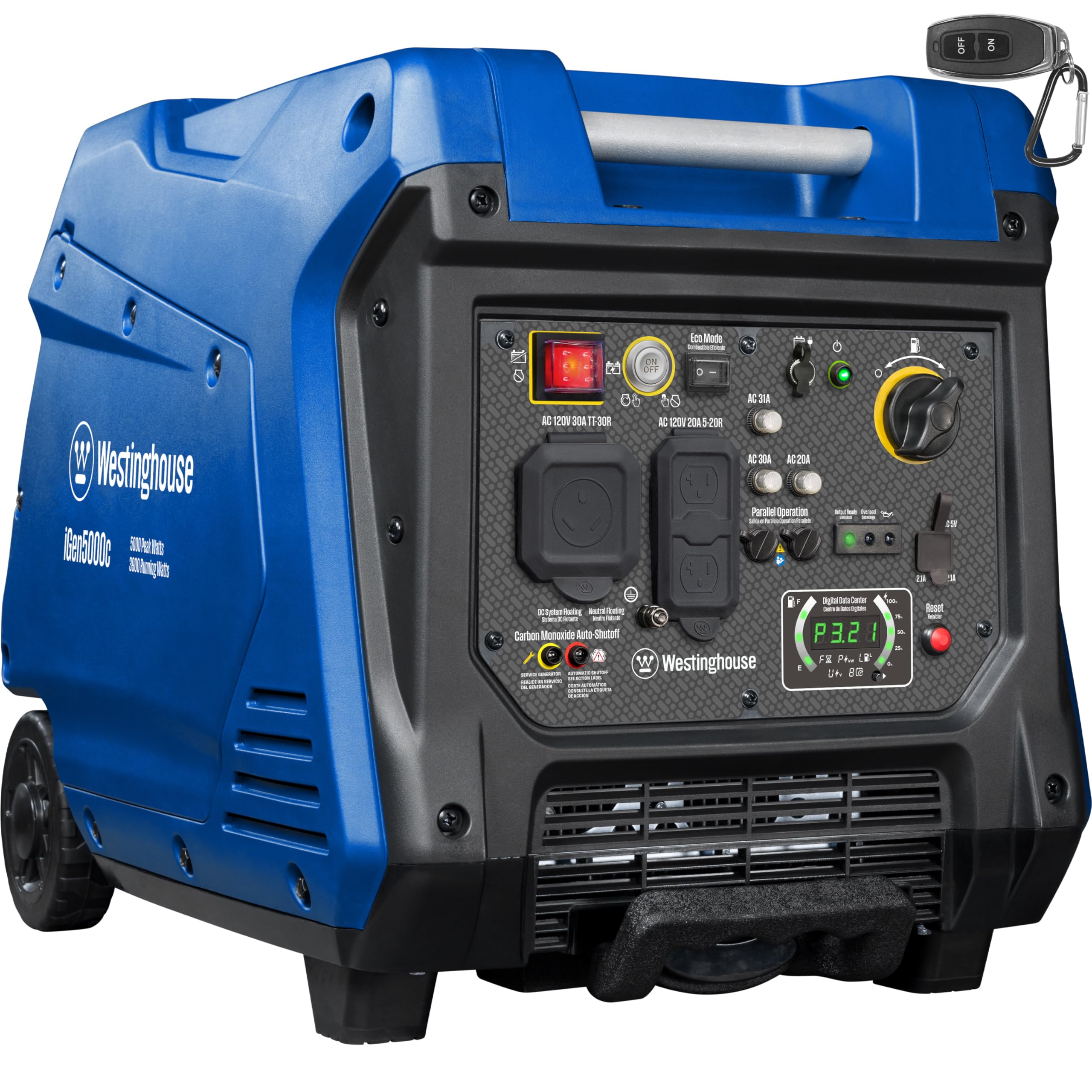
1. Westinghouse 5000 Peak Watt Super Quiet Portable Inverter Generator
Our pick — over 4.5★ from 300+ verified ratings; the strongest balance of quality and price.
The one that starts from your couch and runs your whole RV without flinching
You get 5000 peak watts and 3900 rated watts with less than 3% THD, which means you can run your fridge, lights, and even a window AC without worrying about dirty power reaching your TV. The remote electric start with auto choke lets you fire it up from inside the RV on cold mornings.
It is the most fuel-efficient full-size unit on this list, humming along at as low as 52 dBA and sipping from a 3.4-gallon gas tank for up to 18 hours. The telescoping handle and the LED data center, which shows fuel level, power output, and remaining runtime, make it feel far more premium than its price suggests.
Buyers report “333hrs zero issues; quiet, fuel-efficient, well-built, easy oil change.” The main trade-off is weight: at 105.8 pounds, it is a two-person lift onto a truck bed, and the plastic body can scratch. One unit’s LED panel failed after a year, and the eco mode is slow to ramp up under sudden load.
The Remote-Start Advantage
- Key fob remote start with auto choke means no cold-morning pulls
- RV-ready 30A outlet plus two USB ports cover trailer and devices
- 18-hour runtime on a 3.4-gallon tank means overnight confidence
Where It’s Heavy
- 105.8 pounds is a real lift for solo RV owners
- Eco mode ramps up slowly, so AC start can briefly struggle
- Plastic body scratches easily in rough storage
Reach for this if: you want maximum power, remote convenience, and fuel efficiency in one package, especially for RV travel or whole-essential home backup.
Look elsewhere if: you need to haul it alone every trip — the 105.8-pound weight demands a helper or a sturdy ramp.
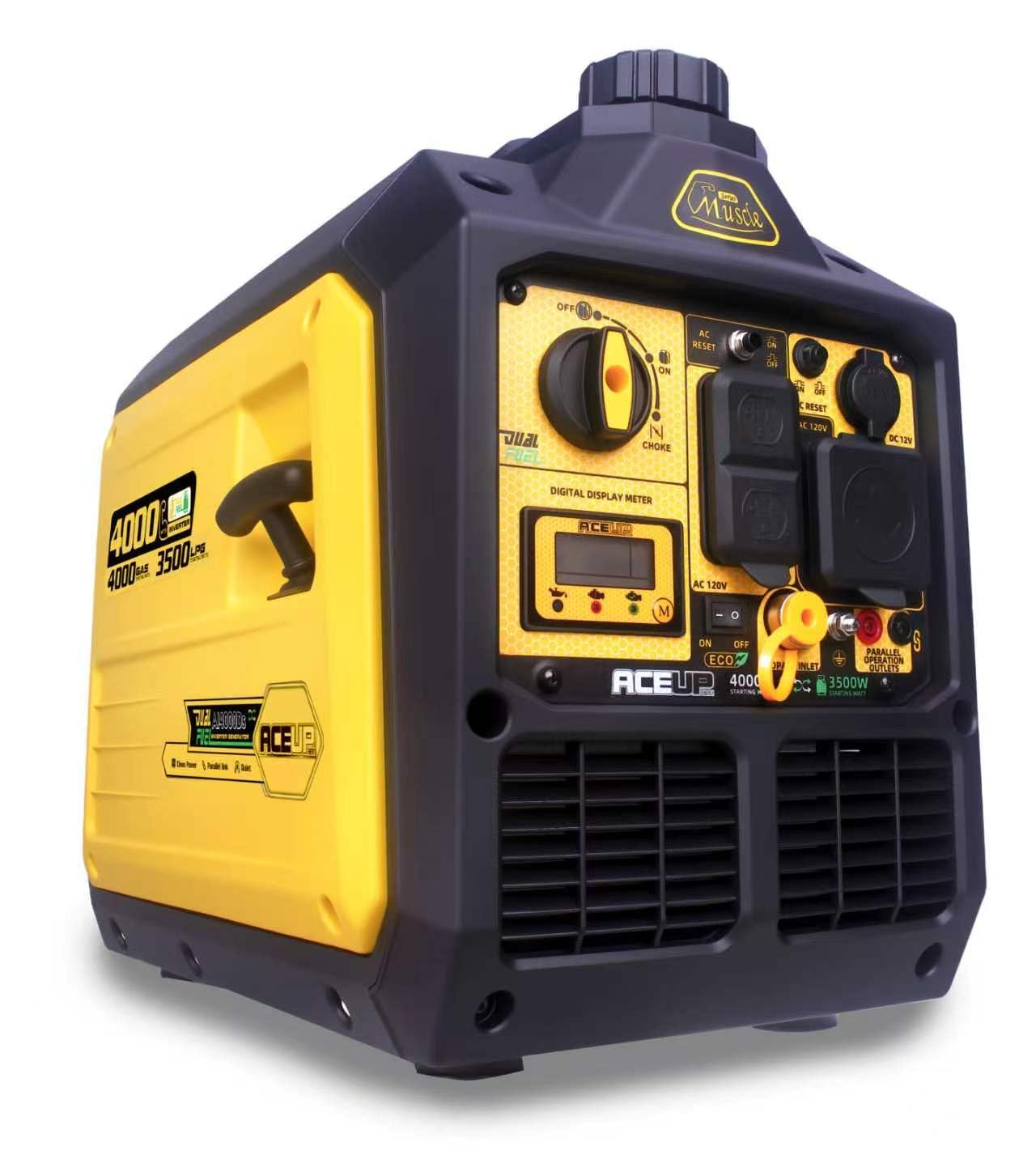
2. Aceup Energy 4000 Watt Dual Fuel Inverter Generator
A compact dual-fuel that sips propane and powers your camper’s AC
You get fuel flexibility without the premium price: this Aceup Energy delivers 4000 peak watts on gas and 3500 peak watts on propane, making it a strong pick for a 3500 watt inverter generator buyer. The 149cc engine (the size of a small motorcycle engine) with recoil start (pull-cord) runs about 5 hours at half-load on a 1.32-gallon gas tank, and propane stretches that even further.
What wins people over is the noise level: about 60 decibels in Eco mode at 23 feet with 25% load, with THD below 1.5% to protect phones and TVs. Owners mention it “powers camper AC well; reasonably quiet but not Honda-level,” and it starts on the second or third pull after the break-in period.
At 51.8 pounds and 19.63 inches long, it fits into tight storage spots, like a closet or truck bed. The trade-off: it won’t run its inverter (the part that makes clean power) if the temperature hits 110°F in direct sun, and it’s a bit heavier and louder than some rivals at the same wattage. For the price, though, the reliability and fuel economy are tough to top.
Value verdict: The best entry-level dual-fuel on the list, with a 2-year limited warranty and free lifetime technical guidance. Its 1.32-gallon tank is small, but propane keeps it running for 20-24 hours per tank, making it ideal for weekend camping.
3. maXpeedingrods 4000 Watt Inverter Generator, Bluetooth App Data Monitor
A featherweight 48.5 pounds with a phone app that watches your power for you
The standout spec is the Bluetooth app, which lets you check power output, fuel level, voltage, and frequency from your phone, plus toggle Eco mode remotely. At 48.5 pounds, it is the lightest genuine 4000-watt unit here, a full 2.2x lighter than the Westinghouse 5000, making it the easiest to toss into an SUV for a weekend out.
Charging your RV is simple with the NEMA L5-30R outlet (a standard 30-amp RV plug) and the included adapter. Its 4000 peak / 3200 running watts handled a 13,500 BTU AC’s 3200-watt start spike, then settled to 1900 watts steady. Customers note it “runs 13,000 BTU AC 1-2 hrs; very quiet,” and one verified owner ran it for 8 days straight after a tornado with zero issues.
The honest catch: reliability is mixed in owner accounts. Some units refuse to stay running, and the app connection is glitchy. A dead battery can prevent starting even with the pull cord because of the electronic choke, and replacements are hard to source. This is a great value if you get a good unit, but a lottery.
Fit note: Best for tech-savvy buyers who want lightweight power and remote monitoring. The 2-year warranty and free lifetime technical assistance are solid, but the app and battery setup are the weak links mentioned most.
4. ERAYAK 4500W Portable Inverter Generator

A 54-pound traveler with USB-C ports and the cleanest power on the list
The ERAYAK produces 4500 peak watts and 3500 running watts with THD between 0.2% and 1.2%, the lowest distortion here, making it genuinely safe for CPAP machines, gaming consoles, and laptops. It runs about 14 hours on a small fridge, fan, lights, and medical devices, per owner reports, and weighs just 54 pounds with a footprint of 20 inches long.
It is 50A parallel-ready, meaning two units can combine for a rated 7000W and peak 9000W, a serious option if you plan to scale up later. The outlet lineup is generous: a 30A L5-30R RV outlet, two 120V AC outlets, a 12V 5A cigarette lighter port, plus USB-A and USB-C for device charging.
At 60.5 dB(A) (about as loud as a normal conversation), reviewers point out it’s “a little louder than expected but very reasonable on decibels.” Reliability is the mixed note — some units arrive with defects and won’t start despite correct oil and gas, so check the break-in procedure carefully. Fuel consumption is efficient at 0.21 gallons per hour at 25% load, so you won’t refill often during light use.
Standout spec: The 0.2%-1.2% THD (total harmonic distortion, a measure of power cleanliness) is the cleanest in this lineup, so it’s safe for medical devices and high-end electronics. The 3-year limited warranty with free lifetime technical support adds real confidence.
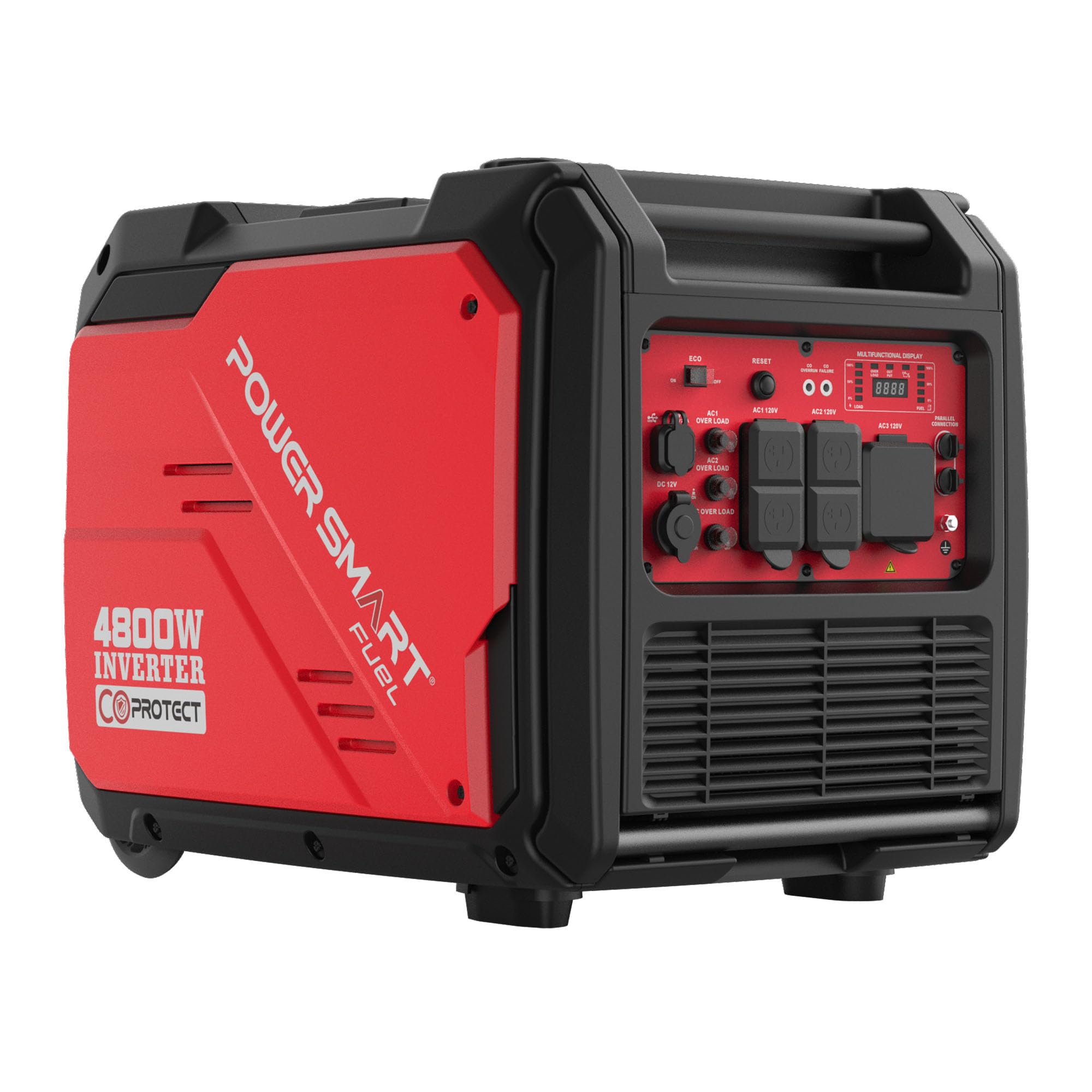
5. PowerSmart 4800 Watt Portable Inverter Generator
One pull and it’s running — even a woman can start this one easily
The PowerSmart’s defining trait is its starting performance: 37 buyer accounts single out how easily it starts, with verified owners reporting “straight from the start it started up. One easy pull.” That Cold Start Technology matters when you’re fumbling in the dark during an outage. It pumps out 4800 starting watts and 3800 running watts with THD under 3%.
The 3.43-gallon fuel tank delivers 18 hours of continuous runtime at 25% load, so you’re not waking up at 3 a.m. to refuel. The control panel is unusually generous: one RV-ready 120V 30A outlet, four 120V 20A outlets, one 12V 8A DC port, and two 5V 2.1A USB ports, plus a digital display for voltage, frequency, and runtime.
Shoppers say it kept refrigerators and a freezer running for 2 days during a hurricane. The trade-off is weight at 89 pounds and a 25.4-inch length, making it a mid-sized unit that fits a garage but needs wheels to move. A few owners note frequent oil changes during break-in with metallic shavings, and the stock spark plug is worth swapping for a BPR6ES for one-pull starts.
Best for: Home backup where you want zero-start hassle and long fuel intervals. The 4-outlet panel is rare at this price and lets you run multiple tools or appliances without adapters.
6. Champion Power Equipment 4250-Watt Dual Fuel Inverter Generator

A 79-pound dual-fuel workhorse that runs 22 hours and powers two ACs
The Champion’s open-frame design is 50% quieter and 20% lighter than a traditional 3500-watt generator, according to the maker, and its 4250 starting watts / 3500 running watts run for up to 22 hours on gasoline. The dual-fuel capability is what owners value most, with one reporting it ran their RV with an 18K AC unit without complaint.
Noise is a subdued rumble at 64 dBA (quieter than a lawnmower), which buyers report is louder before break-in but settles nicely after the 5-hour half-load run. The recoil starter (pull-cord) is genuinely easy, and the EZ start dial is sturdy. It runs on propane for long-term storage, which is a huge plus for boondocking or hurricane prep.
The honest downside: buyers caution the rated output is slightly overstated, and the 30A outlet doesn’t securely hold every plug. The fuel gauge can stick, though Champion sends replacements free. At 79 pounds, it’s not the lightest, but the integrated wheels kit upgrade is worth it if you plan to move it often.
Why it wins: The longest runtime on the list at 22 hours with an open-frame design that’s easier to lock up at a job site. The 3-year limited warranty with free lifetime technical support is among the best in the category.
7. WEN 56477i 4800-Watt RV-Ready Portable Inverter Generator

A 72.7-pound unit that ran 9 days straight and powered a whole house
The 224cc engine produces 4800 surge watts and 4000 rated watts, and the WEN Watchdog CO Shutdown Sensor automatically kills the engine if carbon monoxide builds up — a genuine family-safety feature. Owners mention it ran 9 days straight during the Palisades fire, powering a fridge, freezer, TV, and wifi on about 8 hours per tank.
Owner reviews highlight strong performance (117 mentions) and quiet operation (93 mentions). It starts on the first or second pull, and an electrical engineer verified the output meets or exceeds rated continuous and surge, even starting a 4-ton AC with a soft-start system. The telescoping handle and onboard wheels make the 72.7 pounds surprisingly manageable.
The four three-prong 120V receptacles, one TT-30R RV receptacle, and two 5V USB ports cover every connection you’d need. The recurring gear note is the battery — a few customers note it needs attention, and the fuel shutoff is essential to use every time to boost the carburetor’s lifespan.
The Safety-First Design
- CO Shutdown Sensor protects your household automatically
- Fuel shutoff uses up remaining gas before shutdown, extending carb life
- Four 120V outlets plus RV receptacle handle whole-home setups
The Real Limits
- Wished for higher wattage to run a water heater
- Battery life is a mixed note across owner reports
- 72.7 pounds still needs the wheels to move easily
Pick this if: you want a quiet, powerful, safety-equipped unit for home backup and RV trips, especially if you value the CO sensor’s auto-shutdown.
Think twice if: you need to run a large electric water heater — the 4000 rated watts won’t cover it alongside other loads.
8. maXpeedingrods 3500W Dual Fuel Inverter Generator with E-Start

Three ways to start, and a 24-hour propane runtime
This maXpeedingrods gives you Remote Start, Electric Start, AND Recoil Start, so you’re never stuck with a dead battery and a cold engine. On gasoline it delivers 3500 surge watts and 3200 rated watts; on propane, 3100 surge and 2800 rated. The Eco mode stretches runtime to about 11 hours on gas or a massive 24 hours on propane at 25% load.
The maker says it runs a small house lighting system or an RV’s 15k AC, and one verified owner ran their RV AC at 3500W without issue. The digital display monitors fuel condition, usage, and power generation in real time, and the included battery means no charging is needed when running LPG.
The biggest honest caution: starting issues are the most-discussed aspect across owner reports, with a 56-count mixed signal. Reviewers point out the stock spark plug tool strips and needs a replacement, and noise runs louder than advertised at 63-65 dB instead of 53-55. A dead battery on arrival is rare but real, and the proprietary connector makes replacement hard.
Who it’s for: Dual-fuel buyers who want remote-start convenience and extreme propane runtime. The 55.1-pound weight and metal construction are solid, but check the battery and spark plug on arrival.
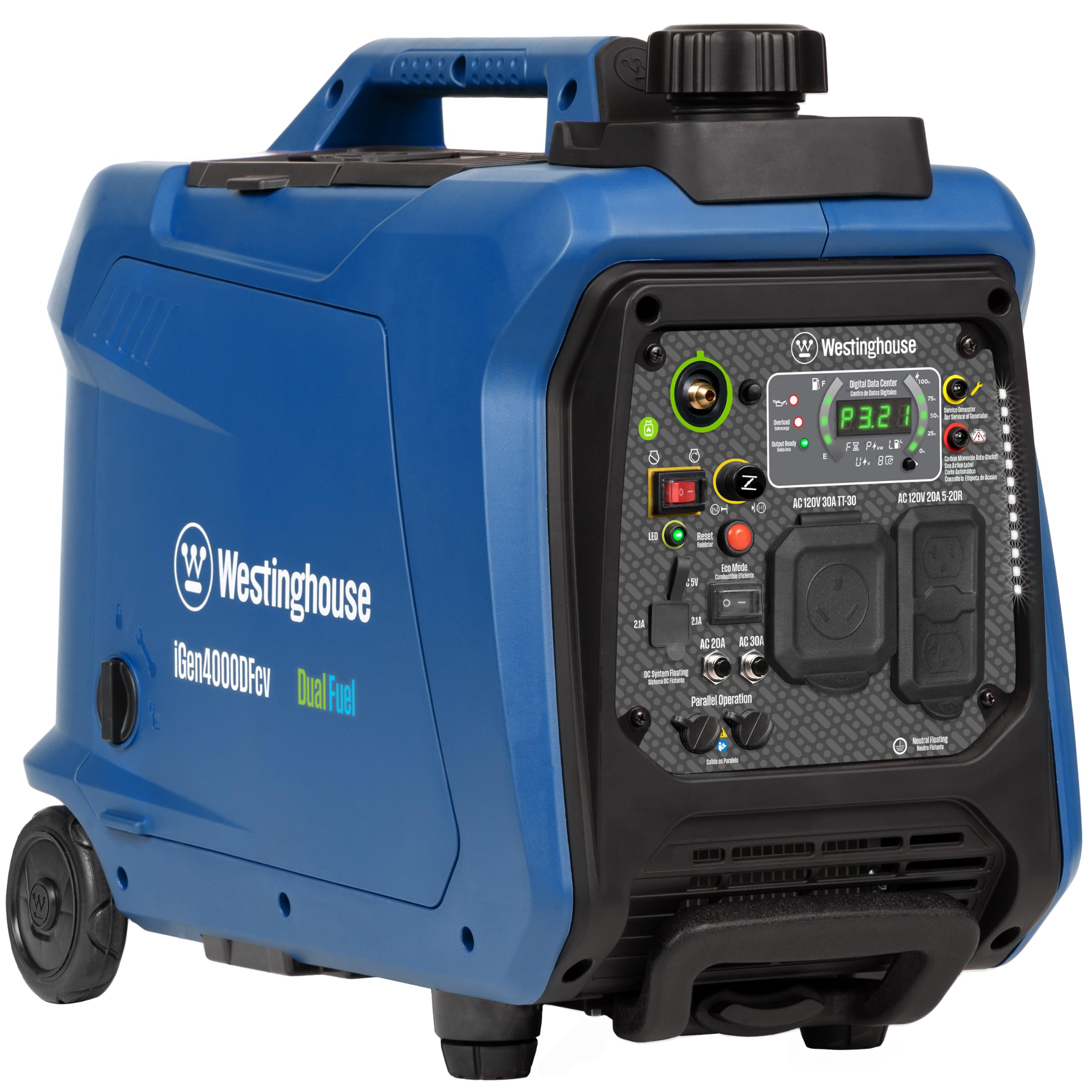
9. Westinghouse 4000 Peak Watt Dual Fuel Portable Inverter Generator
A first-pull-on-propane Westinghouse that’s lighter than a Yamaha 3000i
The 4000 peak watts and 3300 rated watts with less than 3% THD make this a solid dual-fuel choice, and shoppers say it starts on the first pull on propane, which is rare for LPG operation. The 59-pound weight with a telescoping handle makes it significantly easier to move than the 105.8-pound Westinghouse 5000, and one owner noted it’s lighter than a Yamaha 3000i.
Noise is as low as 52 dBA, and buyers report it runs a 15k AC, converter, and LED lights in a trailer easily, with about 60 hours of use and zero issues. The propane option is the favorite for storage — it avoids gas carburetor degradation, and a 20lb tank lasts roughly a day, equivalent to three gas fills.
The trade-off is fuel tank size: a 1.69-gallon gas tank gives only up to 7 hours on gas, so overnight runs on gas aren’t possible. Owners love the 3-year warranty and the ability to sync two units for more power, and one noted their wife can operate it easily.
Standout spec: First-pull propane starting at just 52 dBA, with a rotating LED data center showing fuel level, power output, and remaining runtime. Best for campers who want a light dual-fuel unit that stores well.
10. Champion Power Equipment 4000-Watt Dual Fuel Inverter Generator

Fridge-and-freezer power at just 51.8 pounds
This Champion is the lightest full dual-fuel unit at 51.8 pounds, making it a genuine grab-and-go option for camping or boondocking. You get 4000 starting watts and 3000 running watts on gasoline, with up to 10 hours runtime; switch to propane for 2700 running watts and up to 25 hours, all at a quiet 64 dBA from 23 feet.
The CO Shield carbon monoxide auto shutoff is a standard safety feature, and owners mention running two fridges and a freezer for 6-12 hours on propane without carburetor maintenance. One owner called it “so much lighter than my full size generator and easier to transport when camping.”
Fuel options are the mixed note: some customers note it runs great on propane, while others couldn’t get it to start on that fuel at all. The 120V 25A TT-30R outlet and a 120V 20A duplex outlet with less than 3% THD cover RV and sensitive electronics. Reliability is the recurring caution, with a rare unit failing within months.
Why it’s here: The best power-to-weight ratio for a dual-fuel unit, plus the longest propane runtime at 25 hours. The 17.9-inch length fits tight RV storage bays.
11. WEN DF451i 4500-Watt Electric Start Dual Fuel RV-Ready Inverter Generator

Keyless electric start and auto fuel switching for easy overnight power
The WEN DF451i is the luxury-feel option with keyless electric start, a backup recoil starter, and Auto Fuel Selection Technology that automatically switches from propane to gasoline to extend runtime. It delivers 4500 surge watts and 3500 rated watts on gas, or 4500 surge and 3150 rated on propane, from a 212cc engine that is EPA III and CARB compliant.
Noise is a whisper-quiet 58 dBA at quarter load from 22 feet, and reviewers point out it “runs all my RV toy hauler has and never bogs down,” with gas running all night on a full tank. The electric start works reliably, and the drain hose makes oil changes easy — a magnetic oil plug is recommended by one owner.
The honest trade-offs: at 100 pounds, this is the heaviest unit here, though onboard wheels and a carrying handle mitigate that. Some shoppers say a red light/no power on startup that requires a restart, and the battery hookup instructions are unclear. The propane side runs about 10 hours per tank, per mixed owner feedback.
The Auto Fuel Advantage
- Auto-switches from propane to gas for longer runtime without babysitting
- Keyless electric start plus recoil backup covers every scenario
- 58 dBA is among the quietest on this list
The Weight Reality
- 100 pounds is the heaviest pick here despite wheels
- Occasional red-light startup glitch needs a restart
- Oil fill is hard to access at a low, heavy position
Choose this if: you want a dual-fuel generator that starts with a button and manages its own fuel switching for long RV trips or extended outages.
Skip this if: you need to lift it often — 100 pounds demands a ramp or a helper despite the wheels.
Understanding the Specs
Peak Watts vs. Running Watts
Peak (or surge) watts is the brief punch of power needed to start motors in fridges, AC compressors, and power tools. Running watts is what the generator produces steadily. Check your appliance’s starting wattage, not just its running wattage, or you’ll trip the breaker every time the compressor kicks on.
THD: The Clean Power Number
Total Harmonic Distortion measures how “dirty” the electricity is. Inverter generators keep THD under 3%, which is safe for laptops, TVs, and CPAP machines. Lower THD like the ERAYAK’s 0.2%-1.2% is even safer for the most sensitive medical and audio gear.
FAQ
Will a 3500 watt generator run a refrigerator and a freezer at the same time?
Can I run a 15000 BTU RV air conditioner with a 3500 watt inverter generator?
What’s the difference between gasoline and propane runtime?
How long does a 3500 watt inverter generator run on a full tank?
Is a dual fuel generator worth the extra cost?
What does parallel capable mean and why does it matter?
Why does THD matter for my electronics?
How heavy is too heavy for a portable generator?
What happens if I don’t add oil before first use?
Can I connect a generator directly to my house panel?
Final Thoughts: The Verdict
For most people, the 3500 watt inverter generator winner is the Westinghouse iGen5000c because it pairs 5000 peak watts with remote start and an 18-hour runtime — the complete package for home backup and RV use. If you want a light, app-connected budget option, grab the maXpeedingrods MXR4000 at 48.5 pounds. And for dual-fuel flexibility with the longest propane runtime, the Champion 4000W at 25 hours is the one to reach for. With a 4.6-star rating across hundreds of owner reports, the Westinghouse is the clear crowd favorite.
How We Picked
We do not accept paid placement. Every pick is matched to a real buyer and a real use-case; we do not hands-on test units.
Sources & Methodology
Specifications: manufacturer listings and product documentation. Review insights: verified customer reviews, as of August 2026. Pricing: not shown on this page (it changes often); check the current price via the retailer link.
As an Amazon Associate, Gadgets Feed earns from qualifying purchases. This does not affect which products we feature.