
Dust, scratches, and faded colors don’t stand a chance against a dedicated 35mm negative scanner. Unlike flatbeds that trade resolution for versatility, these purpose-built film digitizers capture the grain and tonal range that make analog photography worth saving — turning decades-old negatives into sharp, shareable digital files without needing a darkroom.
I’m Min — the co-founder and writer behind Gadgets Feed. I’ve spent countless hours analyzing optical sensors, real-world scanning speeds, and software workflows to separate the true archiving tools from the gimmicks in this heavily-reviewed category.
Whether you’re rescuing a box of family slides or digitizing a pro archive, finding the best 35mm negative scanner means balancing true optical resolution against bulk-scanning throughput.
How To Choose The Best 35mm Negative Scanner
Not all film digitizers are built alike. A cheap CMOS scanner might get you rough previews fast, but true CCD scanners deliver the dynamic range and sharpness needed for prints larger than 4×6. Focus on sensor technology, software capability, and workflow speed to match your archive size.
Optical Resolution vs. Interpolated Megapixels
Many affordable scanners claim “22MP” output by software interpolation. The true spec that matters is the optical sensor’s native DPI — a 7200 DPI CCD resolves real film grain, while a 14MP CMOS sensor scales up to 22MP digitally without adding detail.
Infrared Dust and Scratch Removal
A built-in infrared channel detects dust particles on the film surface and removes them automatically during the scan. This feature, branded iSRD on Plustek models, saves hours of manual healing in Photoshop — especially valuable for negatives stored without sleeves for decades.
Workflow: Single-Frame vs. Batch Scanning
If you have 50 slides, a single-frame scanner works fine. If you have 5,000 slides, a batch-loading model like the Pacific Image PowerSlide X Plus processes 50 slides per magazine and keeps your backlog manageable. Speed is measured in slides per minute, not just raw resolution.
Quick Comparison
On smaller screens, swipe sideways to see the full table.
| Model | Category | Best For | Key Spec | Amazon |
|---|---|---|---|---|
| Plustek OpticFilm 8200i SE | Premium | Archival-quality with dust removal | 7200 DPI optical / 48-bit | Amazon |
| KODAK Slide N Scan Max | Mid-Range | Large-volume family scanning | 7-inch tilt screen / 13MP sensor | Amazon |
| ClearClick Virtuoso 3.0 | Mid-Range | Ease of use with 7-inch preview | 22MP interpolated output | Amazon |
| HP Touch Screen Film Scanner | Mid-Range | Touchscreen workflow / USB-C power | 13MP CMOS / 22MP interpolation | Amazon |
| KODAK Slide N Scan | Mid-Range | Budget-friendly for 35mm/126/110 | 5-inch LCD / 22MP output | Amazon |
| KEDOK Photo & Slide Scanner | Budget | Multi-media (photos + business cards) | 5-inch LCD / 22MP output | Amazon |
| Plustek OpticFilm 8100 | Premium | High-res without infrared cleaning | 7200 DPI optical / CCD sensor | Amazon |
| Epson Perfection V800 | Premium | Medium format + 35mm versatility | 6400 DPI / 4.0 Dmax | Amazon |
| Pacific Image PowerSlide X Plus | Premium | High-volume auto batch slide scanning | 10000 DPI / 50-slide batch | Amazon |
In‑Depth Reviews
1. Plustek OpticFilm 8200i SE

The Plustek OpticFilm 8200i SE is the gold standard for serious film archivists who refuse to compromise on grain retention. Its true 7200 DPI CCD sensor captures 69-megapixel-equivalent detail from a single 35mm frame, revealing texture that interpolated scanners simply smear over. The integrated infrared channel (iSRD) detects dust and scratches on the film surface and removes them automatically — a feature that saves literal hours of manual retouching per roll.
Bundled with SilverFast SE Plus 9, the scanning software gives you professional-level control over color depth, multi-exposure, and dynamic range up to 3.6 Dmax. The trade-off is speed: each frame takes roughly 2–3 minutes at full resolution with dust removal enabled, and the learning curve for SilverFast’s advanced modes is real. That said, users consistently report that the output rivals lab-grade Noritsu scanners for color accuracy and sharpness.
Connectivity is USB 2.0 (not USB-C), so you may need an adapter for modern laptops. But for anyone scanning valuable negatives — Kodachrome slides, wedding archives, or fine-art film — the 8200i SE’s combination of optical resolution and automated defect removal makes it the undisputed top performer in its class.
Why it’s great
- True 7200 DPI optical resolution preserves finest film grain
- Infrared dust/scratch removal is a massive time saver
- Includes SilverFast SE Plus for professional color management
Good to know
- Slow scan speed — 2-3 minutes per frame with cleaning
- USB 2.0 only; adapter needed for USB-C machines
- SilverFast has a steep learning curve for beginners
2. Plustek OpticFilm 8100

The Plustek OpticFilm 8100 shares the same optics and CCD sensor as the 8200i but omits the infrared dust removal channel. This makes it a smarter choice for photographers who prefer to handle spot-healing manually in post, or who scan freshly-developed negatives with minimal dust. At 7200 DPI true optical resolution, it delivers the same 69-megapixel-equivalent detail and supports 48-bit color depth for maximum tonal flexibility.
Like its sibling, it bundles SilverFast SE Plus, which provides professional-grade control over exposure, color balance, and multi-exposure blending. Scan times remain about 2–3 minutes per frame at the highest settings, and the single-frame workflow means you’ll be loading one strip at a time. The included protective carry bag is a nice touch for keeping the unit dust-free when not in use.
The main drawback is the lack of USB-C and the same software complexity that frustrates casual users. However, for the price difference versus the 8200i, you get essentially identical optical hardware — just without the automatic cleaning. For clean negatives, that’s a perfectly reasonable trade-off.
Why it’s great
- Same 7200 DPI CCD optics as the 8200i at a lower cost
- Includes SilverFast SE Plus for pro-level editing
- Quiet, well-built with a protective carry bag
Good to know
- No infrared dust removal — you clean in post
- Slow single-frame scanning workflow
- USB 2.0 only; not ideal for modern laptops without an adapter
3. KODAK Slide N Scan Max

The KODAK Slide N Scan Max stands out immediately with its tiltable 7-inch LCD screen — large enough to preview and inspect scans without squinting. Its 13MP CMOS sensor (with 22MP interpolated output) captures 4320×2880 pixel files that satisfy most social sharing and 4×6 prints. The quick-feeding tray technology lets you load strips continuously, enabling a workflow of roughly 150–175 slides per hour after you get the rhythm down.
Auto-exposure handles color and black-and-white inversion well, though the system crops edges slightly — a known design trade-off that means you lose the extreme border of some frames. Exposure compensation is limited to +/-2 EV, so badly underexposed negatives may need post-processing. The device runs standalone from an SD card (up to 32GB), and battery-free operation via USB power makes it portable enough to scan on a coffee table.
Reviewers who scanned 5,000+ slides praise its reliability and speed, while purists note that the 7-inch screen is best used for framing — final edits benefit from transferring files to a larger monitor. The max model adds a gallery mode that doubles as a digital picture frame, a nice touch for family gatherings.
Why it’s great
- Large 7-inch tiltable LCD for easy previewing
- Fast continuous-load tray — 150+ slides/hour
- Standalone operation, no computer required
Good to know
- Crops edges of slides slightly
- CMOS sensor lacks the grain detail of CCD scanners
- Exposure compensation limited to +/-2 EV
4. ClearClick Virtuoso 3.0

The ClearClick Virtuoso 3.0 is a purpose-built standalone scanner that targets users who want to digitize slides and negatives without any computer tethering. Its 7-inch preview screen shows real-time scans at 22MP interpolated resolution, and you save directly to an SD card (32GB max, not included). Supported formats include 35mm, 110, and 126 negatives, plus 50mm mounted slides — covering the vast majority of family archives.
Users consistently report that it’s the easiest scanner in its class to set up: slide in the appropriate holder, adjust brightness and color via the on-screen menu, and press the scan button. The 2-year warranty (extendable to 3) from ClearClick, a USA-based company, adds peace of mind that budget brands often lack. One quirk: the date/time resets whenever unplugged, so you’ll need to set it fresh each session.
Negatives can slide around slightly in the tray, requiring a gentle nudge for perfect centering. And while the 22MP interpolation sounds impressive, remember that the sensor’s true optical resolution is around 14MP — fine for web and small prints, but not archival-grade. For casual family memories, the Virtuoso 3.0 offers the best balance of simplicity and quality in its price tier.
Why it’s great
- Large 7-inch screen with real-time preview
- Standalone — no computer needed
- 2-year warranty from a responsive US-based company
Good to know
- Interpolated 22MP — true optical is around 14MP
- Negatives can shift in the tray
- Date/time resets when disconnected from power
5. HP Touch Screen Film & Slide Scanner
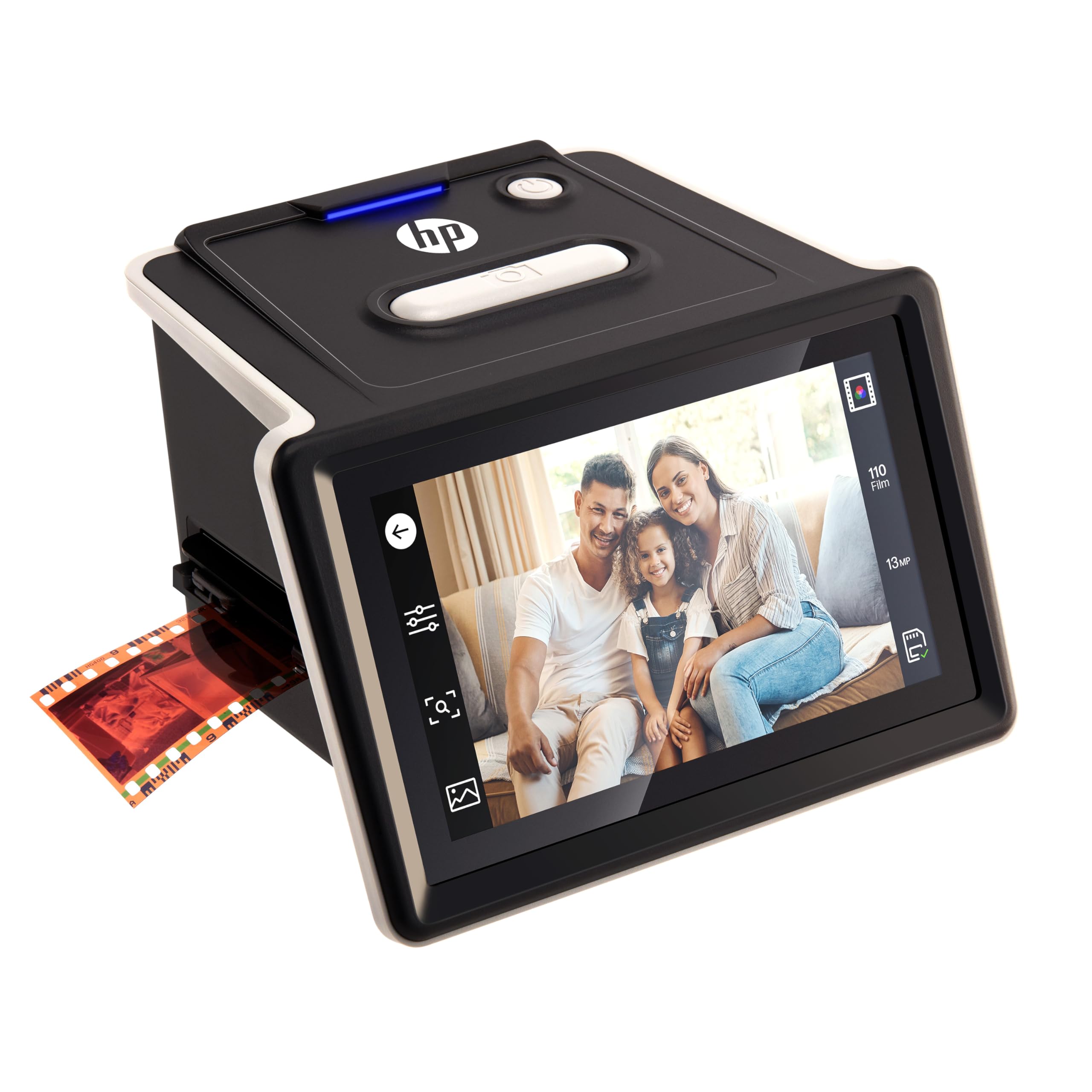
HP brings its design polish to the film-scanning world with the HPFS500, a compact unit built around a 5-inch all-angle touchscreen that makes menu navigation feel natural. Equipped with a 13MP CMOS sensor and 22MP interpolation, it outputs files suitable for 8×10 prints from 135, 126, and 110 film. The refresh rate of the live preview is responsive enough to confirm focus and framing before you commit.
Power is delivered via USB-C, which means you can run it from a laptop, a phone charger, or a power bank — great for scanning at a desk or on the go. The quick-load tray system feeds film strips rapidly, and early adopters report transferring over 2,000 slides in two afternoons without a hiccup. Color accuracy is generally strong, though some users note red saturation can run hot, requiring a quick correction in post-processing.
At 13.4 ounces, it’s the lightest fully-featured option here, and the 1-year limited warranty is standard for consumer HP gear. The absence of a wall adapter in the box means you’ll need a USB-A to USB-C cable for some setups, but the convenience of USB-C power is a significant win for modern travelers.
Why it’s great
- Intuitive 5-inch touchscreen interface
- USB-C powered — works with laptops and power banks
- Lightweight and compact at 13.4 oz
Good to know
- Red saturation can be excessive; light editing needed
- SD card not included
- Only 1-year warranty
6. KODAK Slide N Scan

The original KODAK Slide N Scan remains the most popular entry-level 35mm negative scanner for good reason. Its 5-inch LCD screen provides a clear preview, and the 22MP interpolated output is forgiving enough for social sharing and 4×6 prints. The quick-feeding tray technology supports continuous loading of 35mm, 126, and 110 film strips, and users regularly digitize 500 slides in a single day after the initial learning curve.
Budget buyers will appreciate the included HDMI port, which lets you view scans on a TV — a feature rarely seen at this price point. The main trade-off is build quality: the plastic chassis feels light, and the screen may require a power cycle after transferring files to a computer. Also note that an SD card (32GB or less) is not included, and no wall plug ships in the box — only a USB cable for power.
Despite these corners cut, real-world reviews from the community confirm that the image quality punches above its weight for color and black-and-white negatives. It’s not for pro archiving, but for a family wanting to rescue decades of memories on a tight budget, the KODAK Slide N Scan delivers exactly what’s promised.
Why it’s great
- Affordable entry into 35mm digitization
- Continuous-load tray speeds up bulk scanning
- HDMI output for TV viewing
Good to know
- Plastic build feels lightweight
- Requires ≤32GB SD card (not included)
- Screen may freeze after file transfer; needs power cycle
7. KEDOK Photo & Slide Scanner

The KEDOK Photo & Slide Scanner is the Swiss Army knife of the budget segment, handling not just 35mm negatives and slides but also 110 film, photos up to 5R, and even business cards. Its 5-inch LCD screen offers a wide viewing angle for previewing captures, and the 22MP interpolation produces digital files suitable for sharing and small prints. An 8GB SD card is included in the box — a thoughtful addition that saves a trip to the store.
Setup is straightforward: choose the correct holder (six are included), insert the media, and scan with one button. Color and brightness adjustments are accessible via the on-screen menu, though black-and-white negatives may need some filtering to avoid overexposure. The 3-year warranty and 24-hour online support are unusually generous for this price range and indicate KEDOK’s confidence in the hardware.
Build quality concerns surface in some units — a few buyers report that the scanner glass is prone to scratching, and one reviewer received a unit that wouldn’t power on. The company appears responsive to replacements, but quality control is less consistent than KODAK or ClearClick. As a budget-friendly option for a mixed-media digitization project, the KEDOK covers the most ground for the least money.
Why it’s great
- Scans negatives, slides, photos, and business cards
- Includes 8GB SD card and multiple holders
- 3-year warranty with 24-hour support
Good to know
- Scanner glass can scratch easily
- Black-and-white negatives may overexpose
- Quality control inconsistencies reported
8. Epson Perfection V800

The Epson Perfection V800 is the flatbed king for photographers who shoot both 35mm and medium format. Its dual-lens system switches between lenses optimized for film scanning and reflective photo scanning, achieving 6400 DPI optical resolution with a 4.0 Dmax that captures shadow detail flatbed competitors can’t touch. The 48-bit color depth ensures smooth gradations in skies and skin tones.
Where the V800 truly shines is workflow flexibility: you can scan 12 mounted slides at once on the film area, or a full 9×11-inch print in a single pass. Epson Scan software is notably cleaner than SilverFast for everyday use, though the bundled SilverFast SE Plus is available for those who want advanced features. The main complaint from 35mm specialists is that the dedicated film-holder design introduces slight softness compared to a dedicated CCD scanner like the Plustek 8200i.
At 20.9 pounds, this is not a portable device — it’s a workstation tool. Dust on the internal glass can be an issue after months of use, requiring periodic cleaning. For mixed-format archives that include 120 roll film, 4×5 sheets, and stacks of prints alongside 35mm negatives, the V800 is the most versatile film scanner available.
Why it’s great
- Handles 35mm, 120 medium format, and 4×5 sheet film
- Dual-lens system optimizes resolution for film vs. prints
- 4.0 Dmax for exceptional shadow detail
Good to know
- Heavy at 20.9 pounds — not portable
- Film holders may introduce slight softness vs. dedicated scanners
- Internal dust accumulation requires periodic cleaning
9. Pacific Image PowerSlide X Plus

The Pacific Image PowerSlide X Plus is the only scanner on this list built for true batch automation: load up to 50 mounted slides per magazine, press start, and walk away while it scans each one to a 4000×6000 pixel JPEG (or DNG raw). Its true RGB linear array CCD operates at 10,000 DPI optical — no Bayer pattern interpolation — meaning you get every grain of grain from Kodachrome and Ektachrome slides.
Speed is significantly improved over the previous generation, processing slides about four times faster with reduced noise. Output in DNG format lets professional users post-process raw data without any embedded distortion. The trade-off is complexity: the software has a steep learning curve, and the manual is poor enough that many users rely on community workarounds (like telling the software to scan one more slide than actually loaded). Paper slides with damage or moisture can jam the mechanism — about one jam per 1,000 slides by most accounts.
At nearly four times the weight of a standalone scanner, the PowerSlide X Plus is a permanent desk fixture. For anyone facing a 5,000+ slide backlog, the automation alone is worth the investment — no other consumer scanner comes close to this throughput. Just budget time for the initial setup and software calibration.
Why it’s great
- Auto batch scans up to 50 slides without manual reinsertion
- True 10,000 DPI CCD — best optical resolution available
- DNG raw output for professional post-processing
Good to know
- Expensive — a serious investment for heavy archives
- Software is unintuitive with poor documentation
- Paper slides can jam; ~1 jam per 1,000 scans
FAQ
Can a 35mm negative scanner handle black-and-white negatives that have turned purple with age?
Is 7200 DPI overkill for 35mm negatives scanned for social media?
Why do some scanners crop the edges of mounted slides?
Final Thoughts: The Verdict
For most users, the best 35mm negative scanner winner is the Plustek OpticFilm 8200i SE because it delivers true 7200 DPI CCD resolution with automated infrared dust removal — the closest you’ll get to lab-grade scanning at home. If you want a large preview screen and fast standalone operation for family slides, grab the KODAK Slide N Scan Max. And for high-volume automation with zero manual frame-loading, nothing beats the Pacific Image PowerSlide X Plus.