
Our readers keep the lights on and my morning glass full of iced black tea. As an Amazon Associate, I earn from qualifying purchases.
Specs are compiled from manufacturer listings and verified buyer reviews and can change over time — please confirm the key details on the product page before buying.
Shoeboxes of old negatives and slides sit in closets everywhere. You want them digital, but you don’t want to spend months on a flatbed or pay a lab a fortune. This guide is about the dedicated machines that turn 35mm film into files you can actually share and print, all without a computer on your desk.
I’m Min — the founder and writer behind Gadgets Feed. This guide is built by comparing the manufacturers’ published specifications and the patterns across verified customer reviews, so you get each pick’s real strengths and trade-offs instead of marketing spin.
This is my breakdown of the 35mm scanner landscape, from fast home digitizers to professional 7200dpi workhorses.
Our Picks at a Glance


How To Choose The Best 35mm Scanner
Before you pick, you have to decide how much time you want to spend at a computer. The biggest split in this category is between standalone scanners that work on their own and computer-connected scanners that give you total control. Your film’s condition and your patience level decide which route is right.
Speed vs. Resolution
Speed and quality are a direct trade-off. A standalone unit can scan a slide in two seconds, but it is basically taking a photo of your film. A proper PC scanner takes 30 seconds per frame at its best quality, but it captures real optical detail that survives big prints and crops. If you have a thousand slides to save quickly, speed wins. If you have a hundred precious negatives you want to frame, resolution wins.
Dust and Scratch Removal
Your old film has dust and scratches hiding in it. Some machines have a built-in infrared channel that detects these defects on the surface of the film and removes them without you having to retouch each image in an editor. Without this feature, every spot and hairline scratch in the scan is yours to fix manually. It changes the game if you’re processing decades-old negatives.
Format Compatibility
Not all film is 35mm. You might be holding 110 or 126 cartridges from the 70s, or Super 8 frames from a home movie reel. Each scanner ships with a different set of film holders, so make sure the trays you need for your specific film types are packed in the box. Buying a machine that lacks the right adapter means you’ll be searching for a third-party solution later.
Standalone vs. Computer-Based
Standalone scanners need no computer or drivers, and they let you watch the results on a 5-inch screen as you go. Computer-based scanners bundle powerful software like SilverFast that gives you deep control over color and exposure, but they come with a learning curve. If you are not comfortable tweaking sliders, the standalone route is simpler to live with.
Quick Comparison
| Model | Best For | Resolution | Scan Time | Computer Required | Amazon |
|---|---|---|---|---|---|
| ClearClick Virtuoso 2.0★ Best Overall | Fast home digitizing | 22MP (Interpolated) | 500+ scans in under 8 hrs | — | Amazon |
| Magnasonic FS70Best Value | No-frills speed | 25MP | 450 scans in 2 hrs | — | Amazon |
| KEDOK 4-in-1Most Versatile | Photo + film combo | 22MP | — | — | Amazon |
| Magnasonic FS71 24MP | Old slide recovery | 24MP | Under 5 seconds each | — | Amazon |
| KODAK Slide N Scan | Massive slide batches | 22MP | ~2 seconds each | — | Amazon |
| ClearClick QuickConvert 2.0 | Album shots + film | 14MP (22MP Interpolated) | 2-3 seconds each | — | Amazon |
| HP FilmScan FS500 | Touchscreen ease | 13MP (22MP Interpolated) | ~30 slides/minute | Optional | Amazon |
| Plustek OpticFilm 8200i SE | High-res with dust removal | 7200 dpi (69 MP) | ~30 sec at high res | Yes | Amazon |
| Plustek OpticFilm 8300i Ai | Calibrated color accuracy | 7200 dpi | ~30 sec at 3600 dpi | Yes | Amazon |
In‑Depth Reviews
1. ClearClick Virtuoso 2.0
Our pick — over 4★ from 300+ verified ratings; the strongest balance of quality and price.
The clear crowd favorite for anyone who wants results without fighting the software.
This is the machine that wins people over with sheer ease of use — the thing everyone raves about is how it just works. It converts 35mm, 110, and 126 negatives and 50mm slides to digital at 22 megapixels (interpolated), and the extra-large 5-inch preview screen shows your photos in real time as you scan. You do not need a computer or drivers, which is exactly why it is such a hit with family-archive projects.
The speed here is the real story. Buyers report scanning over 500 negatives and slides in under 8 hours, which makes it ideal for clearing out decades of stored memories in a weekend. The included mini HDMI output lets you beam the images to a TV as you work, so the whole family can watch the old pictures come up on the big screen. The full 2-year warranty from ClearClick, an American small business, is a reassuring safety net.
The honest catch? The buttons feel cheap, and the built-in saturation tends to run too high with no way to dial it back down. Most owners find the fast scan speed compensates for that, and they plan to do a quick color pass in a free editor afterward. The 126 and 120 square slides are supported, and you can even handle 6×6 or 6×7 negatives with a little cropping.
What wins people over
- Fast scanning is the most praised trait — 500+ negatives and slides in under 8 hours.
- Real-time preview on a large 5-inch screen without needing a computer.
- Versatile trays cover 35mm, 110, 126, and 50mm slides plus square 120 formats.
- Full 2-year warranty with free US-based tech support.
Reality-check notes
- Buttons feel inexpensive; treat the controls gently.
- Saturation runs high with no adjustment for it, so some editing is expected.
- Auto-brightness tends to overexpose slightly, needing a stop or two of correction.
Reach for this if: you want the fastest path from a shoebox of slides to a digital library, with no computer in the loop.
Look elsewhere if: you need archival-grade scans for big prints — a DSLR or a proper film scanner will beat it on detail.
2. Magnasonic All-in-One 25MP Film Scanner (FS70)
The budget pick that turns out web-ready scans faster than most pricier units.
This 25MP machine is the one to grab when you just want things done quickly. Owners genuinely appreciate the fast scanning speed — one completed about 450 scans in 2 hours, which is the kind of pace that makes a 500-slide project actually finish. The bright 5-inch TFT LCD previews film and slides right on the device., and an HDMI cable (not included) sends the view to your TV.
There is no software or driver installation here. You adjust brightness, RGB color correction, flip, and mirror right on the scanner, then save to the 64MB of internal memory or an SD card slot that accepts up to 128GB. The fast-loading trays for 35mm negative film are compatible with other film scanners, which is a handy bit of flexibility if you upgrade later.
Be realistic about what 25MP means here. Owners mention there is no sharpness difference between the 13MP and 25MP settings because the 25MP is interpolated, and some dark slides may scan as a pink blob until you check them immediately. It is an honest home-use scanner, not a professional instrument — for web sharing and social posts it is fine, but it is not built for huge archival prints.
Why it earns its place
- Scanning speed is the top praise — about 450 scans in 2 hours.
- No drivers or software needed for basic digitizing.
- Supports 35mm, 110, 126, plus Super 8 and 8mm film.
- SD card slot accepts up to 128GB for a lifetime of photos.
What to expect honestly
- Image quality is mixed; the 25MP claim is interpolated, not optical.
- The film sliding mechanism gets mixed reviews, so loading takes patience.
- Dark slides may show as a pink blob until you re-check them.
Best if: you have a mountain of slides and want them on social media fast without spending much.
Think twice if: you are a perfectionist about color and detail — this one is a tool of convenience.
3. KEDOK Photo, NameCard, Slide & Negative Scanner
The rare multi-tool that handles film, slides, printed photos, and business cards in one box.
You get four scanning jobs in one box: 135 and 110mm negatives, 135 film slides, printed photos in 5R, 4R, and 3R sizes, and business cards — all saved as 22MP digital JPEG files. The included 8GB SD card lets you start scanning right away, and the 5-inch LCD screen gives a wide viewing angle so you can share results with family.
Buyers praise how easy this is to operate, and the speed helps when you have a big stack to digitize. You simply pick photo or film, choose the film type, adjust color, brightness, and resolution, and set a date and time — no complex menus. The 3-year warranty and 24-hour online technical support add confidence for a device in this class.
Scan quality is where this one splits opinions. Some owners get good results with a bit of post-editing, but others report blurred and off-color scans, and there are complaints about scratches appearing on the media. The tricky part is the photo plate: you must remove the acetate sheet on the photo plate for quality scans, and photo scans can show a top light reflection. This is a quick digitizing tool, not a precision instrument.
Editor’s read: Ease of use (its strongest point) makes this a fine gift or starter machine, but the uneven scan quality means it is best for saving memories you just want to see again, not for publishing.
Who should skip: anyone specifically digitizing negatives for fine-art prints — the fuzzy color output will frustrate you.
4. Magnasonic All-in-One 24MP Film Scanner (FS71)

A friendly machine that shines brightest on the oldest, most fragile slides you own.
This is the scanner people reach for when the film is from the 1950s and 1970s. Owners repeatedly describe scanning hundreds of decades-old 135 and 110 slides with excellent results, and the bright, clear 5-inch LCD preview is singled out as a joy to use. It converts 35mm, 110, 126, and Super 8 film plus 135, 126, and 110 slides into 24MP JPEG files, with no computer required.
The bonus 32GB SD card means you rarely need to worry about storage mid-project. The fast-loading film trays get each scan done in less than 5 seconds, and you can adjust brightness, RGB color correction, flip, and mirror directly on the device. It is also a thoughtful gift for non-tech-savvy family members who want to recover lost pictures but would never touch a computer program.
The recurring practical note is about dust: any dust on the media transfers to the next scan, so you will want to clean the film and work area frequently. Dark slides may require maxing the brightness setting and doing some post-correction afterward. Thick 2-piece 110 holders need a manual push-pull, and vertical slides must be fed horizontally then rotated in the software.
Why owners stay loyal: ease of use is the top praise, and the big screen plus simple buttons reduce strain on long digitizing sessions.
The trade-off: the 110 film holders are fiddly, and dust management becomes your job.
5. KODAK Slide N Scan

The undisputed crowd favorite for plowing through an entire carousel of slides in one sitting.
When thousands of owners rally behind one scanner, there’s a reason — and here it is the speed. Buyers scan an entire carousel of slides in about 45 minutes or less, and one enthusiastic owner cleared over 1,200 images without breaking a sweat. The 5-inch LCD’s gallery mode offers a crisp, wide-angle view., making it great for sharing with friends or doubling as a digital picture frame in the living room.
The advanced capture software is the secret weapon. A single-touch ‘Scan’ button enhances, resizes, and converts photos on its own, and the color correction feature is described as amazing — though the adjustment settings are limited. It handles 135, 110, and 126mm negatives and the same slide sizes, with easy-load inserts for continuous feeding. It requires an SD or SDHC card up to 32GB (not included), and connects to any Type-C USB computer.
The recurring gripe is the manual process: inserting and aligning each slide and negative takes practice, and dust can mark your images if you skip the included cleaning brush. The trade-off is that you gain the ability to adjust each picture to perfection — but only if you’re willing to spend the time. It is not a true optical scanner; it captures a screen image, which is fast and adequate for old, low-resolution film.
What the masses praise
- Quality is the top-singled-out trait, with ease of use a close second.
- An entire carousel of slides scans in about 45 minutes.
- Color correction is genuinely impressive for old, faded film.
- Gallery mode turns the 5-inch screen into a family picture frame.
What takes patience
- Manual insertion and alignment of each slide is fiddly at first.
- Dust marks images easily, so the cleaning brush must become a habit.
- SD card is not included, and SDHC above 32GB won’t work.
Grab it because: the sheer owner base — well over ten thousand have weighed in — tells you this is the safest, most proven path to digitizing a huge slide collection.
skip it if: you want true optical resolution for large prints rather than fast web-friendly captures.
6. ClearClick QuickConvert 2.0

The only pick here built for photos still glued inside fragile old albums.
This one earns its premium spot for a single a neat extra: it scans 4×6 photos without you having to pull them out of sticky album mounts. That is a lifesaver when you are dealing with fragile albums from the 1920s through the 1960s and you refuse to tear them apart. The removable base plate saves hours of time on those delicate pages.
It scans at 14 megapixels (22 megapixels interpolated) and saves JPEG files around 3824 x 2512 pixels to an SD card. The built-in rechargeable battery means you can work cord-free anywhere in the house, and the 5-inch instant preview LCD gives you immediate feedback. A full charge should see you through a solid session, though customers note the battery can die after about an hour of heavy use.
Functionality and speed are what win people over — one owner completed 1,850 photo scans in 5 days, which is an extraordinary pace. The software’s auto color level works well for brightening old slides and shadowed negatives, and overexposed negatives can be converted to black and white. The catch is that the tray for negatives tends to cut off a tiny bit of the picture, so you must frame carefully.
Where it excels: the album without disassembly trick is unique in this list and beloved by fragile-photo owners.
The honest limit: image quality is mixed, and the battery life demands you stay near a plug on long days.
7. HP FilmScan FS500
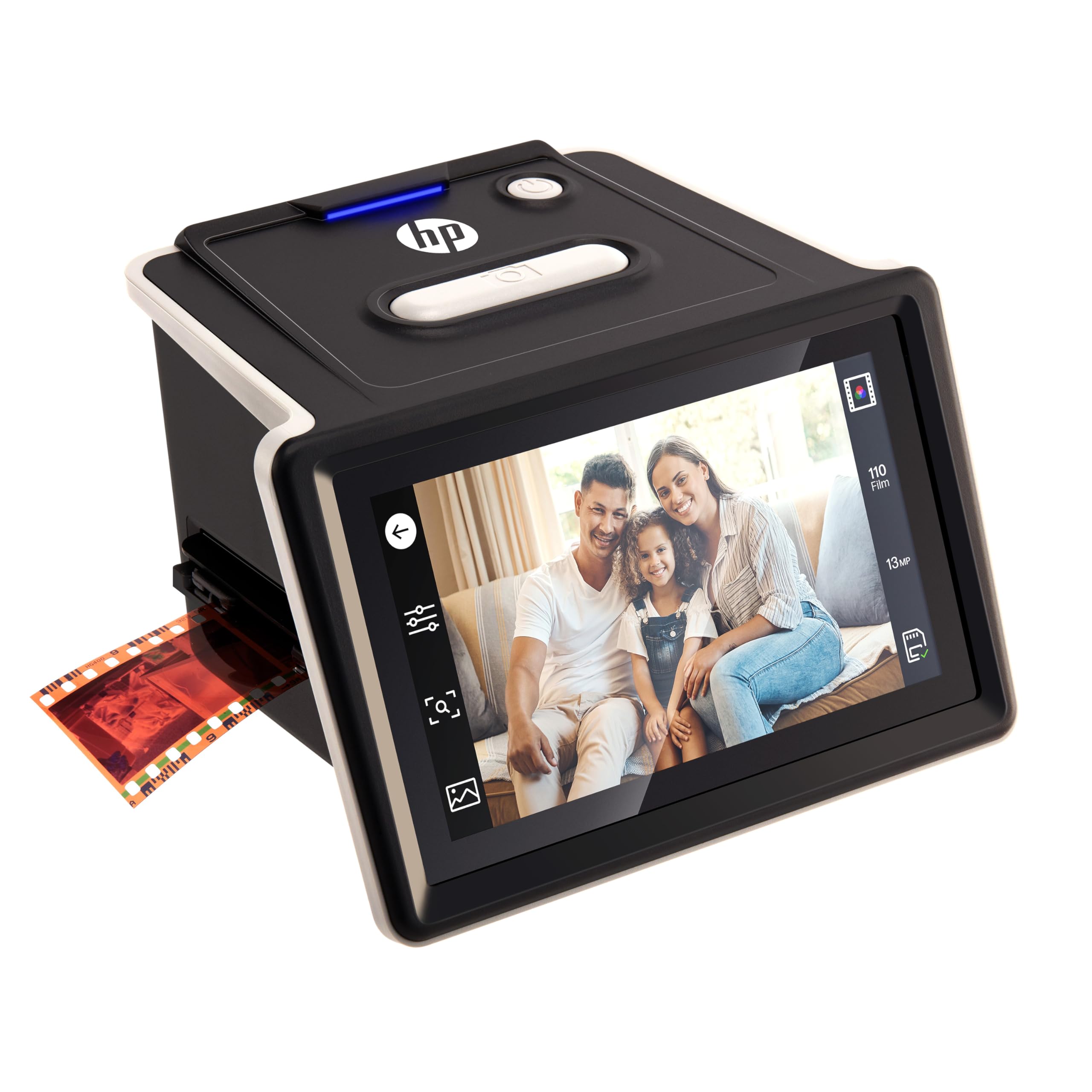
The touchscreen machine that makes slide digitizing feel like a modern tablet experience.
If you want to avoid physical buttons entirely, this HP has a 5-inch all-angle LCD touch screen that lets you preview and edit images directly on the device. The touch interface is intuitive enough that a picky senior with a large batch of slides can master it quickly — the exact audience this product seems designed for. The 13MP CMOS sensor with 22MP interpolation delivers clear images for old color and B&W film.
The quick-load tray handles 135, 126, and 110 film strips plus positive slides, so it covers the common range of retro formats. A standout feature is the speed: reviewers point out roughly 30 slides per minute, which rivals the fastest dedicated units here. It is powered through USB Type-C from a PC or external 5V adapter, and it supports SD cards up to 128GB — far larger than the 32GB ceiling on several rivals.
The value proposition is where opinions split. Some find it great for the price, others find it pricey for what it is, and a reviewer on the fence returned it feeling it was overpriced. The slide alignment and color accuracy can be finicky, and poor-quality slides will scan worse no matter what you do. A bit of post-processing in a free editor is expected for best results.
Why it stands apart: the touchscreen eliminates the button-learning curve entirely, and 128GB SD support is the best in its class.
Who should pass: anyone on a tight budget — the value is debated, and color accuracy needs patience.
8. Plustek OpticFilm 8200i SE

The first true optical scanner here, where 7200 dpi meets a built-in infrared eye for dust.
This is a true scanner, not a camera in a box. It captures 7200 x 7200 dpi, translating to 69 megapixels per 35mm frame., and the built-in infrared channel detects dust and scratches on your film so the software removes them automatically. That dust removal is the most-loved feature, saving owners hours of tedious cleanup.
Quality wins here, and the 48-bit output gives you serious editing headroom. The bundle includes Plustek QuickScan and LaserSoft Imaging SilverFast SE Plus, which is powerful but has a learning curve — owners suggest scanning at 3600 dpi with IR on for a good balance, taking about 3 minutes per scan with IR versus 30 seconds without. At 7200 dpi with heavy IR, a 4-frame strip can take 27 minutes.
The trade-off is speed and setup. It is slow, and installation experiences vary from smooth to nightmarish depending on your system. The bundled SilverFast software is daunting for beginners, and some owners recommend VueScan instead for bulk scanning. The stiff film carrier takes getting used to, but once you are in the rhythm, the output is worth it — 7200 dpi files are huge but capture every bit of fine grain.
The professional wins
- True 7200 dpi optical resolution for archival-grade detail.
- Infrared dust and scratch removal is the most-praised feature.
- 48-bit color depth gives massive editing headroom.
- Quiet, well-built, and easy film holder access.
The professional costs
- Slow scans — 3 minutes per frame at recommended quality settings.
- SilverFast software is powerful but not beginner-friendly.
- Film carrier is stiff at first and can skew slightly.
Choose this when: you have a few hundred precious negatives and slides you want to enlarge and print, and you will invest time in learning the software.
Skip it when: you have thousands of slides to just “see again” — the speed will make you miserable.
9. Plustek OpticFilm 8300i Ai

The color-calibrated heavyweight for anyone who demands the truest tones from old film.
This is the top-tier machine for color accuracy. The included ISO 12641-2-compliant IT8 target adds more calibration points for truer colors., which means less interpolation and more true-to-life tones. Owners describe it as exceeding expectations and worth the money — the most frequently praised traits are scan quality and value.
Its upgraded chip scans 38% faster than the prior model., and the bundled SilverFast 9 Ai Studio includes over 100 functions spanning built-in infrared, iSRD, HDRi, 16-bit histogram, Multi-Exposure, and NegaFix. Plustek Quick Scan Plus is also included as a simpler alternative when you do not want to dive into the deep end. The 7200 dpi resolution matches the 8200i, but the workflow features are the upgrade.
The catch is in the software’s steep learning curve and the speed. It takes about 30 seconds per image at 3600 dpi and up to 3 minutes at 7200 dpi, with manual tray advance and no automation. There is also the occasional hardware failure — one owner’s first unit arrived dead with no light when scanning, requiring a replacement. The result outweighs the frustration for committed archivists, but it is not a casual weekend tool.
Who this is for: the serious hobbyist or small studio that wants calibrated color and is willing to learn SilverFast’s advanced mode.
Who this is not for: anyone seeking quick, automated scanning — this is a deliberate, per-frame craft.
Understanding the Specs
Megapixels vs. DPI
Standalone scanners quote megapixels, while computer scanners quote dpi (dots per inch). A 22MP standalone unit is typically capturing an image of your film on a sensor, and many of those megapixel numbers are interpolated — meaning the software is guessing extra detail. A 7200 dpi optical scanner like the Plustek is measuring real silver grain, so it captures far more actual detail even if the marketing numbers look similar. Watch for the word “interpolated” on the box; it tells you the optical capture is lower than the headline number.
Infrared Dust Removal
Look for a built-in infrared channel if your film has dust or scratches. The infrared light sees surface defects that visible light does not, and the software then removes them automatically. Without this, every speck of dust is burned into your scan and must be cloned out by hand, which is tedious across hundreds of frames. This is the single biggest workflow difference between a premium film scanner and a budget one.
Interpolated Resolution
When a scanner says 22MP interpolated, it means the sensor is physically capturing less and the software is upscaling. This is fine for web sharing and small prints but creates soft detail when you zoom in. If you plan to crop heavily or print large, prioritize optical resolution over the headline megapixel count. If you are just saving memories to share on a phone, interpolated resolution is perfectly adequate.
Color Depth
Color depth is measured in bits — 24-bit is standard on most home scanners, while the Plustek line offers 48-bit output. More bits means smoother gradients and more headroom to correct faded colors before you see banding or noise. Old film often needs aggressive color correction, and extra bit depth gives you room to push before the image falls apart. For simple family memories, 24-bit is fine; for archival work, 48-bit matters.
FAQ
What is the difference between a 22MP interpolated scanner and a 7200 dpi optical scanner?
Can I scan film without a computer?
Will a 35mm scanner work with my 110 and 126 film?
How long does it take to scan a roll of 35mm film?
What does infrared dust removal actually do?
Is a 25MP scanner better than a 22MP scanner?
Do I need special software to edit my scans?
Can I view scans on my TV?
What size SD card do I need for a film scanner?
Will a 35mm scanner handle my old negative strips without cutting them?
Final Thoughts: The Verdict
Across the board, the 35mm scanner winner is the ClearClick Virtuoso 2.0 because it delivers the fastest, easiest path from a shoebox of slides to a digital library with no computer involved. If you want the proven crowd favorite for massive batches, grab the KODAK Slide N Scan. And for archival-grade detail with true dust removal, the Plustek OpticFilm 8200i SE is the one to reach for.
How We Picked
We do not accept paid placement. Every pick is matched to a real buyer and a real use-case; we do not hands-on test units.
Sources & Methodology
Specifications: manufacturer listings and product documentation. Review insights: verified customer reviews, as of August 2026. Pricing: not shown on this page (it changes often); check the current price via the retailer link.
As an Amazon Associate, Gadgets Feed earns from qualifying purchases. This does not affect which products we feature.