
Our readers keep the lights on and my morning glass full of iced black tea. As an Amazon Associate, I earn from qualifying purchases.
Specs are compiled from manufacturer listings and verified buyer reviews and can change over time — please confirm the key details on the product page before buying.
A 36 volt battery decides whether your cart, boat, or DIY build runs all day or taps out halfway through. This guide narrows the field to nine real options across golf carts, trolling motors, and everyday electronics, so you can match a pack to your machine and your budget without guessing.
I’m Min — the founder and writer behind Gadgets Feed. This guide is built by comparing the manufacturers’ published specifications and the patterns across verified customer reviews, so you get each pick’s real strengths and trade-offs instead of marketing spin.
Lithium chemistries and upgraded BMS systems have changed what you can expect from a pack this size, and the picks below cover that whole spread. The right choice starts with matching amp hours and discharge current to your motor, which is the core question every shopper faces when buying the best 36 volt battery.
Our Picks at a Glance

How To Choose The Best 36 Volt Battery
Voltage gets you in the door, but amp hours, discharge current, and the BMS rating decide whether a pack actually powers your machine. Start with what you are running, then work backward to the numbers that match.
Match amp hours and discharge current to your motor
Amp hours (Ah) measure how much energy the pack stores — think of it as the fuel tank size, where more Ah means longer runtime between charges. Discharge current, rated in amps, is how much power the pack can push out at once. A trolling motor rated for 100–120lb of thrust needs a pack that can sustain that flow; a golf cart with a bigger motor needs more still. If the pack’s continuous and peak amp ratings fall short of what your motor pulls, the BMS will trip and cut power.
Understand the BMS before anything else
The BMS — battery management system — is the safety board inside the pack that guards against over-charge, over-discharge, over-current, short circuit, and extreme temperatures. A higher-amp BMS (200A is common in golf-cart packs) handles bigger motors without cutting out. It also governs whether you can run packs in parallel to build a bigger bank, and whether low-temperature charging protection is included.
Big pack or small pack — size to the job
A 100Ah golf-cart pack and a 5000mAh DIY pack both say 36V, yet they serve completely different jobs. The golf-cart pack is built for torque and range over miles of turf; the small pack powers a camera, LED strip, or RC build. You will also see deep-cycle packs clearly marked as not for starting engines — check that label before buying.
Quick Comparison
| Model | Best For | Capacity | BMS / Discharge | Weight | Amazon |
|---|---|---|---|---|---|
| OGRPHY 36V 100Ah LiFePO4★ Best Overall | Golf cart conversions | 100 amp_hours | 200A BMS | 63.5 lb | Amazon |
| Xeanerol 36V 5000mAh PackBest for DIY | DIY, RC, cameras | 5 amp_hours | 12A max | 0.85 kg | Amazon |
| Stihl AK 10 BatteryOEM Replacement | Compact outdoor power tools | 1.6 amp_hours | 16 A | 0.8 kg | Amazon |
| LGECOLFP 36V 50Ah | Trolling motors | 50 amp_hours | 50A BMS | — | Amazon |
| BtrPower 36V 50Ah LiFePO4 | Marine, wheelchairs, RV | 50 amp_hours | 50A BMS | 28 pounds | Amazon |
| Timeusb 36V 50Ah LiFePO4 | Cold-weather trolling motor use | 50 amp_hours | 50A BMS | 33 pounds | Amazon |
| LOSSIGY 36V 100Ah LiFePO4 | Golf carts and big trolling motors | 100 amp_hours | 200A BMS | 78.7 pounds | Amazon |
| DC HOUSE 36V 100Ah Kit | Golf carts, metal-case durability | 100 amp_hours | 200A BMS | 80.5 pounds | Amazon |
| VATRER POWER 36V 105Ah | High-demand golf carts | 105 amp_hours | 200A BMS | 83.8 pounds | Amazon |
In‑Depth Reviews
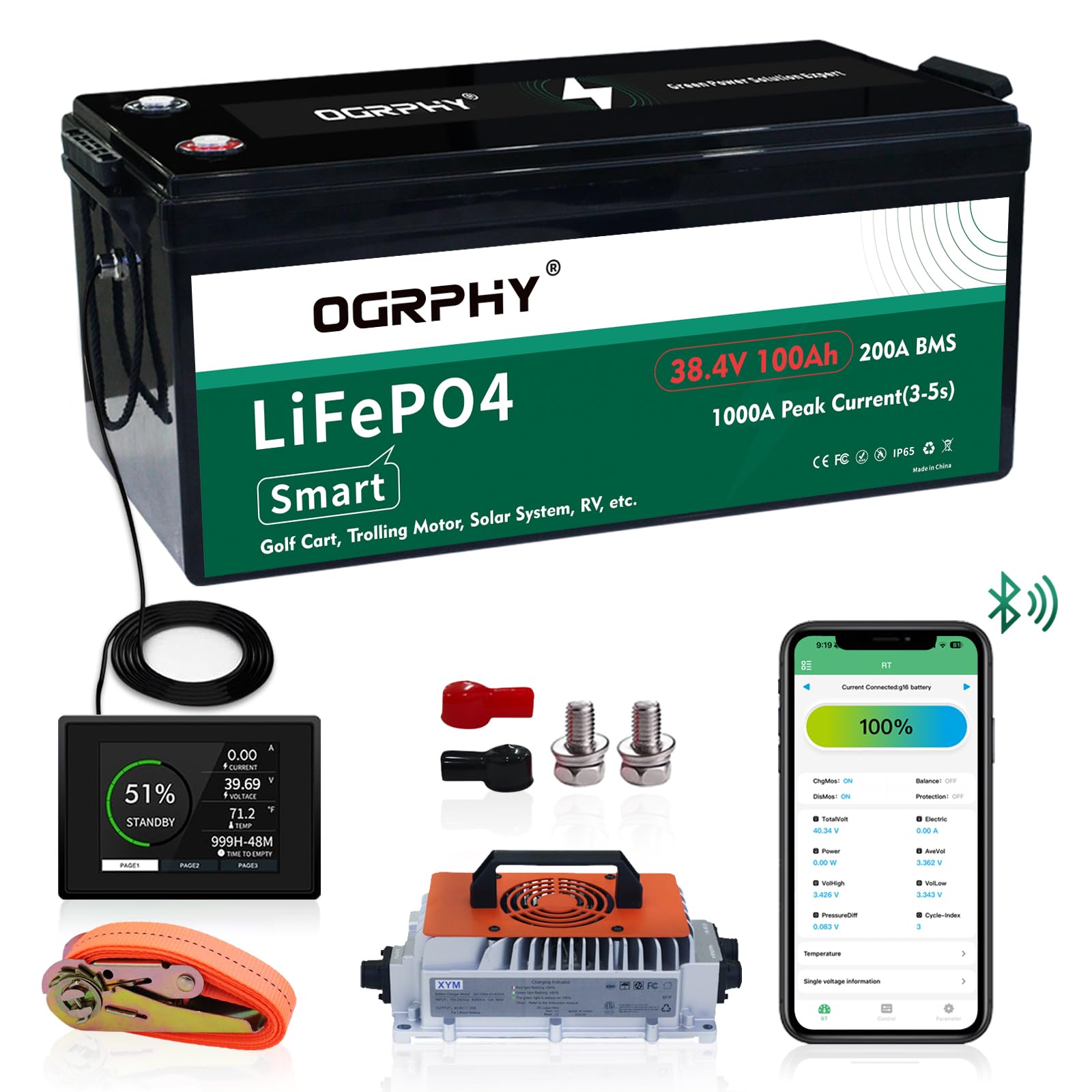
1. OGRPHY 36V 100Ah LiFePO4 Battery with 200A BMS
Our pick — over 4.5★ from 400+ verified ratings; the strongest balance of quality and price.
The 100Ah pack with a 200A BMS that turns a tired cart into a hill-climbing machine
If you are converting a 36V golf cart, this is the pack to beat. It stores 100 amp_hours of capacity — a huge fuel-tank figure next to the Stihl AK 10’s 1.6 amp_hours — which is why one full charge runs a 3kW golf motor for 30 miles and gets you home after eighteen holes. The upgraded 200A BMS (battery management system that protects the cells) pushes a 1000A peak for 3–5 seconds, so a 70lb thrust trolling motor or 8kW golf motor pulls away without the pack cutting out mid-swing.
Owners consistently say the install is straightforward with minimal modification, and the weight saving is the first thing they notice — the cart feels transformed once the lead-acid stack is gone. The Bluetooth BMS app displays all parameters in real time, and a second route to that data comes from the included LCD monitor. Support gets its own praise: buyers report the company responding within 24 hours and resolving issues fully when they do come up.
The catch here is that one buyer’s pack failed to charge after 18 months and a few conversions needed minor trimming to the battery tray, so this is not a drop-in for every cart frame. It also weighs 63.5 pounds — real weight to lift into place. Grade A cells and 5000-plus deep cycles are the manufacturer’s stated build, backed by a 5-year warranty.
What earns the top spot
- 100 amp_hours with a 200A BMS delivers 30 miles of range on a 3kW golf motor
- 1000A peak current for 3–5 seconds handles surge loads from big motors
- Dual monitoring via Bluetooth BMS app and LCD screen
- Charger included — onboard mounting with a 0V wake-up function
Where it needs a check
- 63.5 pounds is a two-person lift into place
- Some cart conversions need minor tray trimming
- A small number of units need support involvement down the line
Built for: anyone swapping lead-acid out of a 36V golf cart and wanting the longest, strongest run per charge.
Gauge the fit: measure your battery tray first, because this pack is large and occasionally needs trimming.
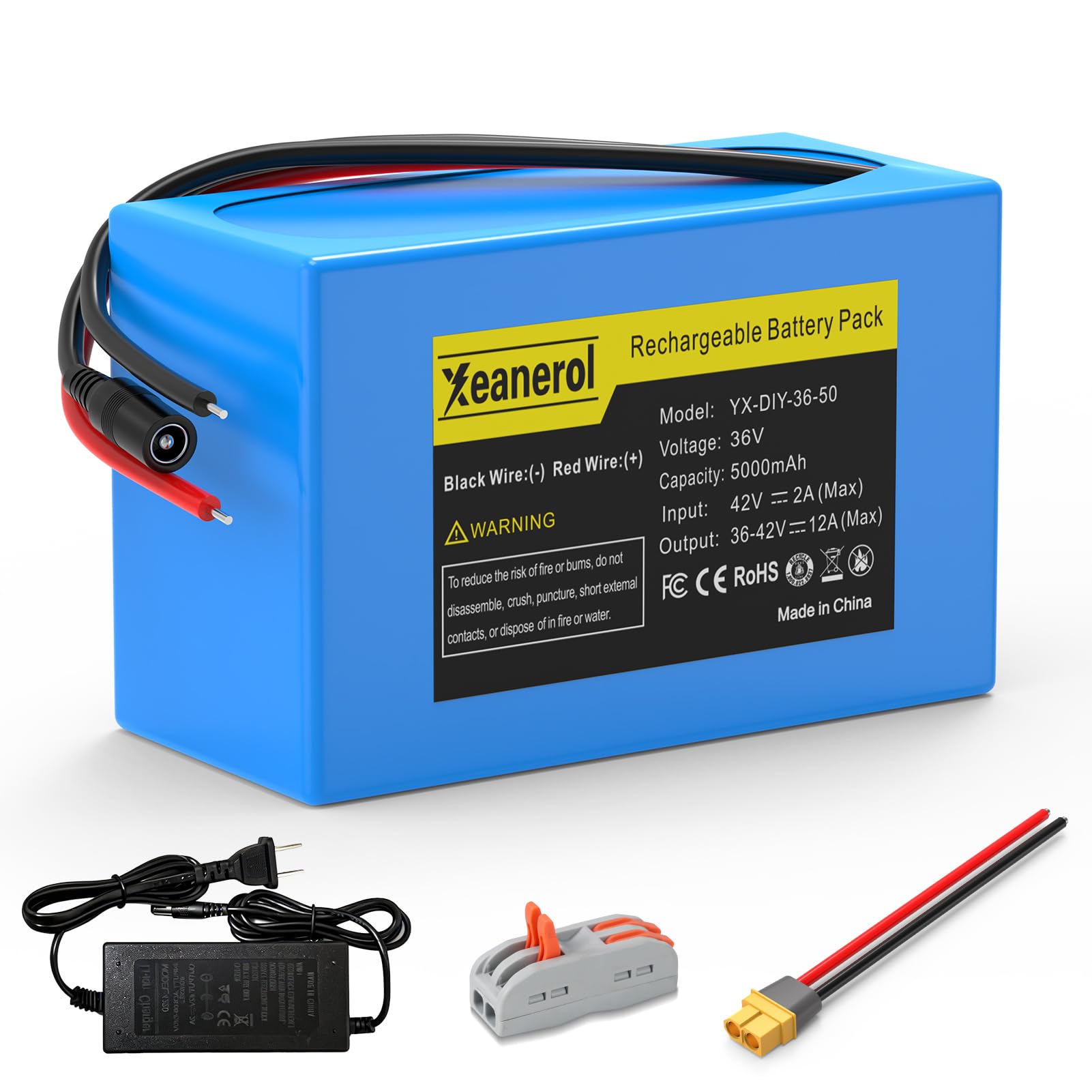
2. Xeanerol 36V 5000mAh Lithium Battery with Charger
A 5Ah lithium-ion pack sized for RC cars, cameras, and low-draw DIY builds
Not every 36V job needs a golf-cart-sized pack. This one holds 5 amp_hours in a lithium-ion cell format, and it sits at the opposite end of the scale from the big 100Ah lithium iron phosphate packs above. Where those weigh tens of pounds, this pack weighs 0.85 kg — light enough to slip into a handheld build. Its continuous discharge of 5 A suits low-draw devices, so check your machine’s working current before buying, as the listing itself recommends.
What wins people over is the versatility. Owners run it in boombox speaker builds, dirtbike headlight and taillight setups, RC cars, robotics, LED strips, and security cameras. The kit arrives complete, with the battery, a charger, a cable connector, and an XT60 extension cord, so there is nothing extra to hunt down. A built-in safety chip guards against over-charge, over-discharge, over-voltage, over-current, over-heat, and short circuit, and the listed cycle life is over 1000 charges.
The recurring gripe is small but real: it charges only through the charging wire and cannot be back-charged, and a few buyers wish it shipped with an on/off switch. That is a wiring habit to know, not a reason to walk away. A 1-year manufacturer warranty covers the pack.
The value read: for a project builder powering cameras, strips, or speakers, this is the light, ready-to-wire option that arrives with everything needed.
Know before you buy: match it to devices that draw 5 A or less, and wire it for charging only.
Reach for this: if your project runs on modest current and you want a kit in one box.
Choose differently: if you need high surge current for a motor, since this pack’s 5 A ceiling will not feed a big draw.
3. Stihl AK 10 Battery, 36V Compact Lithium-Ion
A genuine Stihl compact-system pack for trimmers and mowers, with a 1.6Ah capacity and exact-fit mount
The AK 10 is the specialist here: a compact lithium-ion pack rated at 36.00 V with a 1.6 amp_hours capacity and 59 Wh of energy content. That capacity is tiny next to the deep-cycle packs in this lineup, and that is the point — it is built for short, repeated tool sessions rather than long hauls. It carries a charge indicator so you can see remaining power before you start, and it weighs 0.8 kg, which is genuinely light in hand.
Owners describe a pack that lasts well during use and recharges quickly. For one user, swapping in this fresh pack was the moment they realized just how weak their original trimmer battery had become — a common story when an old cell finally dies. Others use it to replace a worn mower battery, and the fit lands right where it should because this is the official part for that tool system.
Within this comparison it also anchors a couple of the harder numbers. Its 16 A rating sits well above the 5 A ceiling of the small Xeanerol DIY pack, so it feeds power-hungry outdoor tools rather than low-draw electronics. The honest trade-off is capacity: at 1.6 amp_hours, this is for trimmers and mowers, not trolling motors or golf carts.
Straight answer: if you own a Stihl compact-system tool and want the exact replacement cell with a charge indicator, this is the one that fits without an adapter.
One fair note: the compact capacity is a mismatch for anyone chasing long runtime on a big motor.
Pick this when: you need a matching Stihl-pack replacement and value a quick recharge over huge capacity.
Look elsewhere when: your job needs many amp hours of deep-cycle power.
4. LGECOLFP 36V 50Ah Trolling Motor Lithium Battery
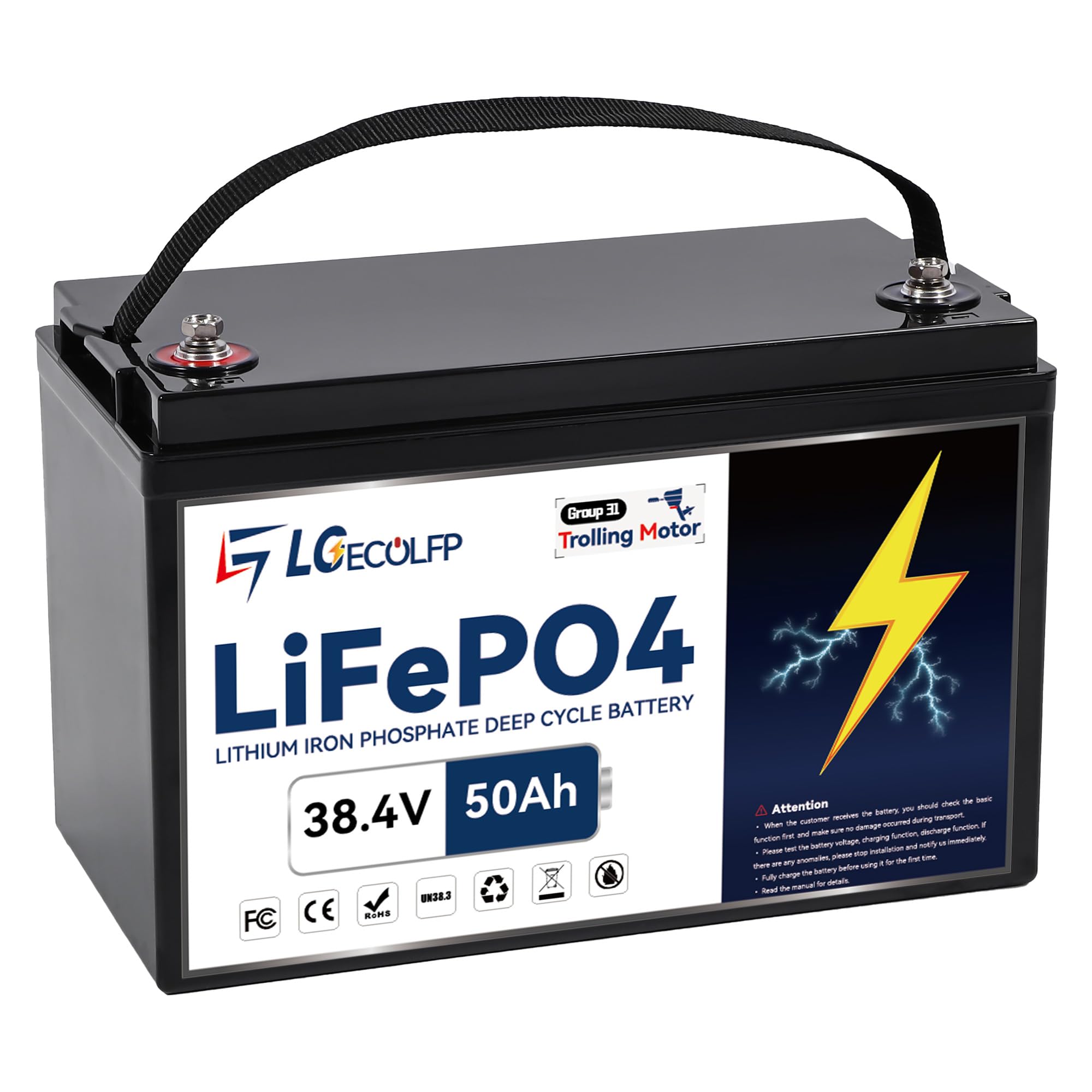
A 50Ah marine pack for 100–120lb thrust trolling motors, with 50A continuous discharge
Built specifically for 100–120lb thrust trolling motors, this 50Ah lithium pack discharges 50 A continuously and holds 60 A for 30 minutes when you hit the throttle hard. LGECOLFP rates it for over 4000 cycles, so it is designed to outlast a lead-acid stack by a wide margin. The ABS housing carries an IP65 rating — meaning it shrugs off water spray and dust — and the dimensions follow BCI standards for Group 31 batteries, so it drops into common marine trays.
Owners rave about how light this pack feels compared to the lead-acid battery they pulled out, and about the value they got for the money. One buyer with a 250W portable power station says it stays fully charged in sunny weather, and the quick charging speed comes up again and again. It also supports expansion: up to four units run in parallel to build a 36V 200Ah system.
One important limit sits in the fine print — this is an energy storage battery, not a starting battery, so it is not meant to crank engines or run a golf cart. One reviewer noted a unit failing after five trips on a trolling motor, a reminder that the return window matters as much as the rating. A 12-month warranty backs it.
Why boaters like it
- 50 A continuous discharge with 60 A for 30 minutes for hard pulls
- IP65 housing resists water spray and dust on an open boat
- Group 31-ish dimensions make it a natural tray fit
- Parallel-ready up to four units for a larger bank
Read this first
- Explicitly not a starting battery — no engine cranking or golf carts
- An isolated failure has been reported on trolling motor use
- Expansion tops out at four units in parallel
Best fit: the trolling motor owner who wants light weight and quick charging at a fair price.
Not the pick for: anyone needing a starter battery or a cart pack, since this is storage-only by design.
5. BtrPower 36V 50Ah LiFePO4 Trolling Motor Battery
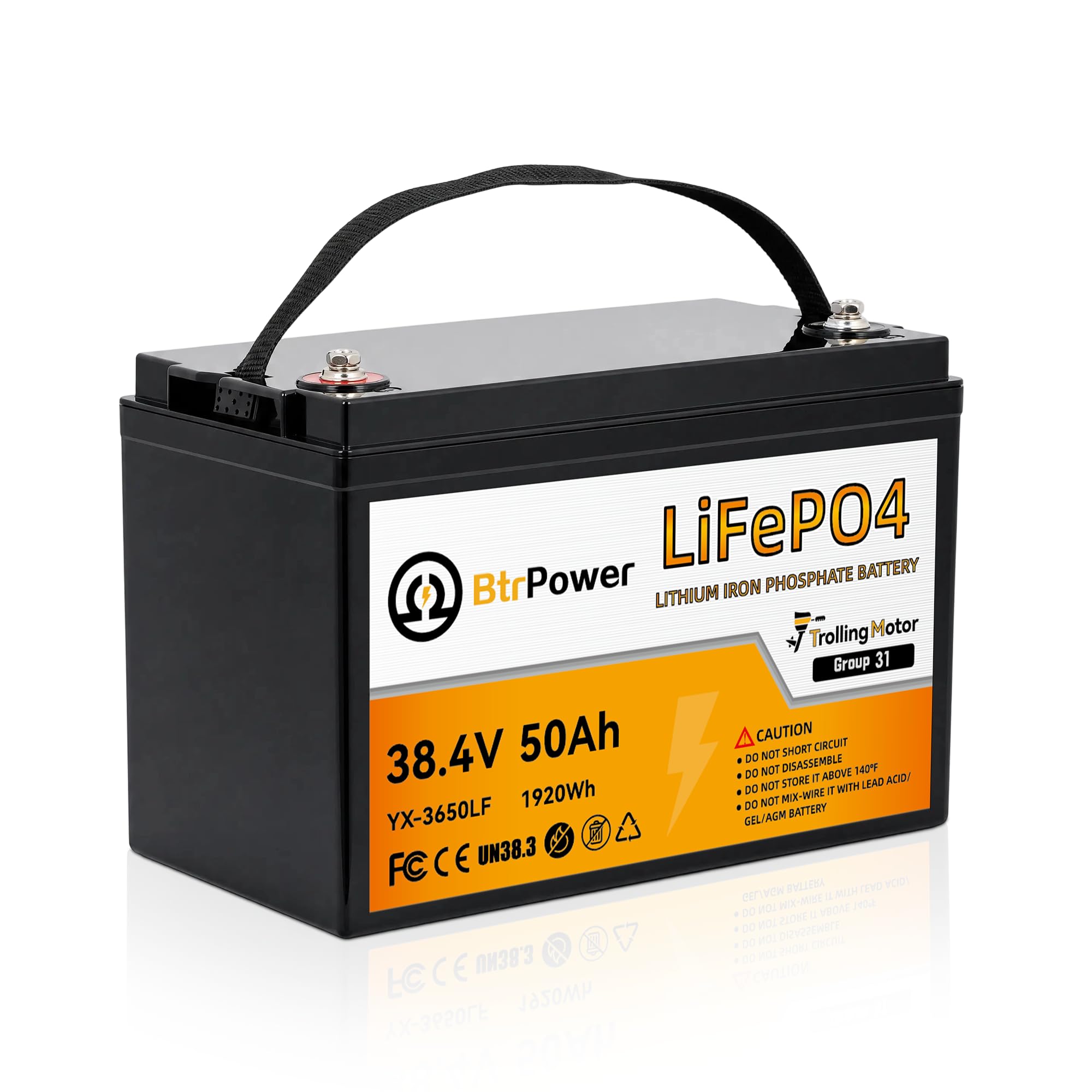
A 28-pound 50Ah marine pack for 100–120lb thrust trolling motors and camper builds
This BtrPower pack is a direct-replacement for most 36V lead-acid or AGM setups, and it works with 100–120lb thrust trolling motors. It holds 50 amp_hours of capacity and weighs 28 pounds, which owners say makes it easy to lift in and out of a boat between trips. Grade A lithium iron phosphate cells give it a rated life of over 5000 deep cycles, plus a compact Group 31 footprint that keeps space free on the deck.
What owners talk about most is the strength — one report has it powering a trolling motor for 12+ hours, and it also runs in wheelchairs and camper builds that previously leaned on lead-acid. The built-in smart BMS handles over-charge, over-discharge, over-current, short circuit, and overheating. BtrPower also markets responsive support, with one owner describing a replacement process that ended in a working unit.
The honest trade-off is battery life consistency. Some owners mention the pack holding a charge well, while others say theirs stopped taking a charge after 8 months — so this is one where the after-sales path and warranty matter as much as the specs. It is covered by a 1-year warranty with a 3-month return window, and it is well-suited to RV, off-grid, and solar roles beyond the water.
The strength: 50 amp_hours in a 28-pound pack is a light, capable marine option for trolling motors and campers.
The inconsistency to weigh: charge retention reports go both ways, so decide with the warranty and return window in mind.
Worth it if: portability and high cycle life top your list and you want a light pack for boat or camper use.
Think twice if: you need proven long-term charge retention, since that is the mixed variable here.
6. Timeusb 36V 50Ah LiFePO4 Marine Battery

A 50Ah marine pack that cuts charging below 32°F and resumes above 41°F to protect its cells
Timeusb’s 50Ah pack stands out for its low-temperature protection, which is the feature most 36V lithium batteries skip. It automatically shuts off charging when the cell temperature drops below 32°F (0°C), then resumes safely once conditions warm above 41°F (5°C). Discharge still works down to -4°F (-20°C), so you can keep boating into cold weather without risking the pack. That is a real advantage when your fishing season runs into frosty mornings.
With 1920Wh of energy, it is explicitly built for 100–120lb thrust trolling motors from brands like Minn Kota, Newport Vessel, and PEXMOR, matching the same thrust class as the LGECOLFP and BtrPower packs. Its 50A BMS delivers a steady 50 A discharge with peaks to 250A, and it supports parallel connection of up to four units to reach a 36V 200Ah system. The IP65 housing resists humidity, salt spray, and water ingress, and it comes with a 5-year warranty.
Two things to know. This is not a starting battery — Timeusb says so plainly, so it is not for golf carts or outboards that crank. And the weight lands at 33 pounds, a touch above the BtrPower pack at 28 pounds, so it is a bit heavier to move. Its included 12 cells and 40-milliohm internal resistance round out a genuinely capable marine build.
The cold-weather edge
- Charging cutoff below 32°F with safe resume at 41°F protects cells in winter
- 50 A steady discharge with 250A peaks for high-demand trolling
- IP65 housing resists salt spray and water ingress
- Expands to a four-unit 36V 200Ah system for bigger boats
Set expectations here
- Not a starting battery — no engine cranking or golf carts
- At 33 pounds it is heavier than some comparable marine packs
- Cold-weather protection is only helpful if you actually fish in the cold
Made for: the angler who fishes cold mornings and wants a battery that protects itself.
skip it if: you need a starter battery, since this is built strictly for deep-cycle trolling use.
7. LOSSIGY 36V 100Ah LiFePO4 Golf Cart Battery
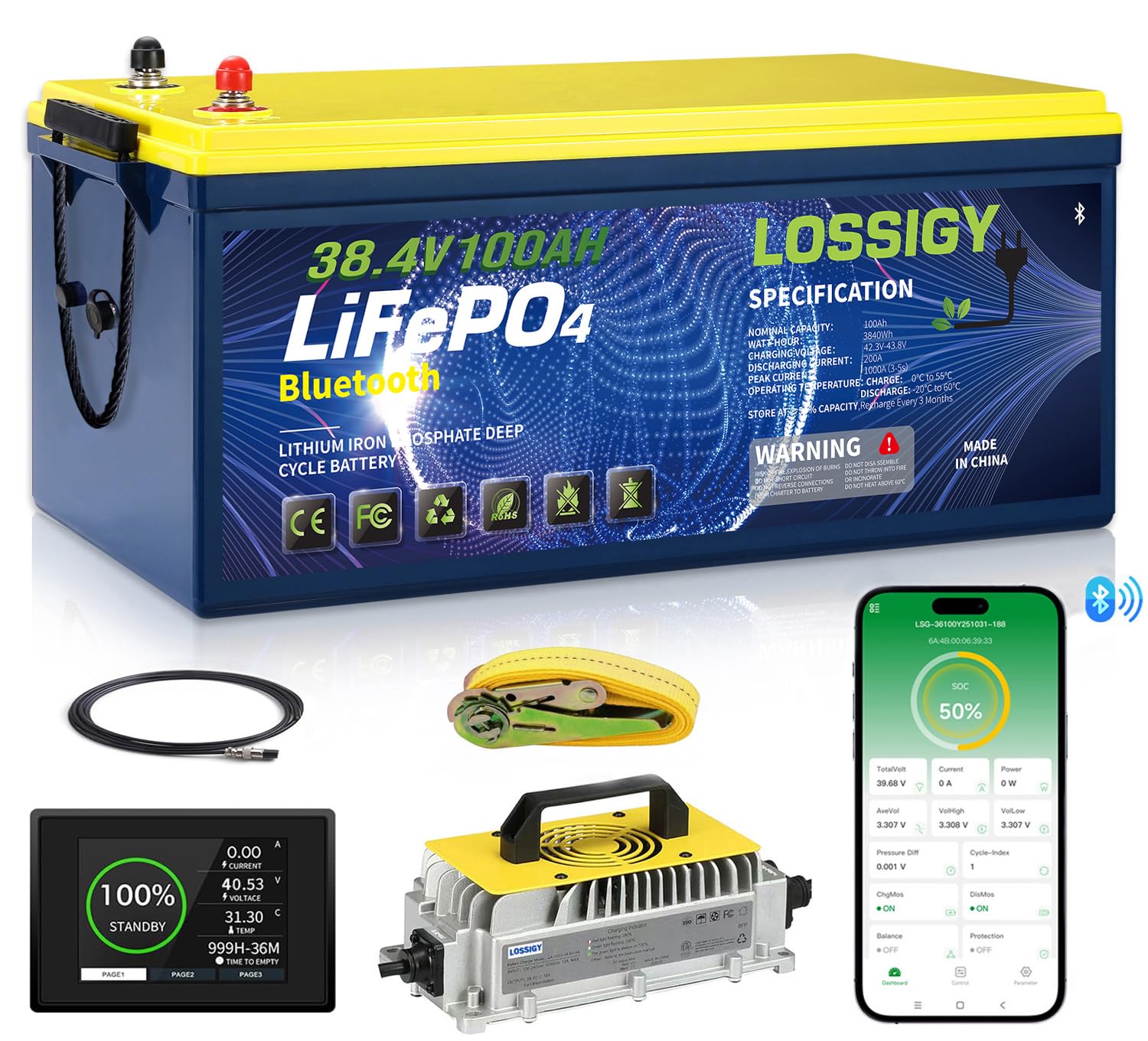
A 100Ah cart battery with a 200A BMS and a 43.8V 25A charger that refills it in four hours
When a 36V cart wants a serious upgrade, this packs 100Ah of lithium iron phosphate capacity — matching the OGRPHY and DC HOUSE packs on raw energy, and far above the 50Ah marine units. The built-in 200A BMS pushes a 1000A peak current and, per LOSSIGY, delivers at least 4000 cycles versus the 300–500 typical of lead-acid. The four-hour charge from 0% to 100% on the included 43.8V 25A charger is a genuine convenience on a daily-driven cart. Owners describe the LOSSIGY performing noticeably faster with stronger hill climbs than their old lead-acid packs.
The monitoring package is thorough: a Bluetooth chip lets you read all battery data on your phone, and a touchscreen monitor displays real-time information as you drive. It is IP65-waterproof, weighs 66.9 pounds, and is 50% lighter than lead-acid of the same capacity, per the manufacturer. It also runs as a trolling motor pack — one buyer powers a Minn Kota 112lb motor and finds it dropped below 70% only after several trips in intercoastal currents.
The one thing to plan around is that switching from six lead-acid batteries to this single pack may require a cart-frame change, since a couple of owners had to cut and weld a new mount. It is backed by a 5-year warranty with 24-hour support.
The premium case
- 100 amp_hours with 4000-plus rated cycles and 5-year warranty
- Fast four-hour charge on a 43.8V 25A charger
- Bluetooth app plus touchscreen monitor for real-time data
- IP65 rating suits both carts and wet marine duty
Plan for this
- Big cart conversions can need frame cutting or welding
- 66.9 pounds takes a careful install
- It only supports parallel connection, never series
Choose it for: a 36V cart owner who wants high capacity, fast charging, and full monitoring in one purchase.
Wait, unless: you are comfortable with the possibility of frame work inside the cart.
8. DC HOUSE 36V 100Ah Lithium Golf Cart Battery Kit
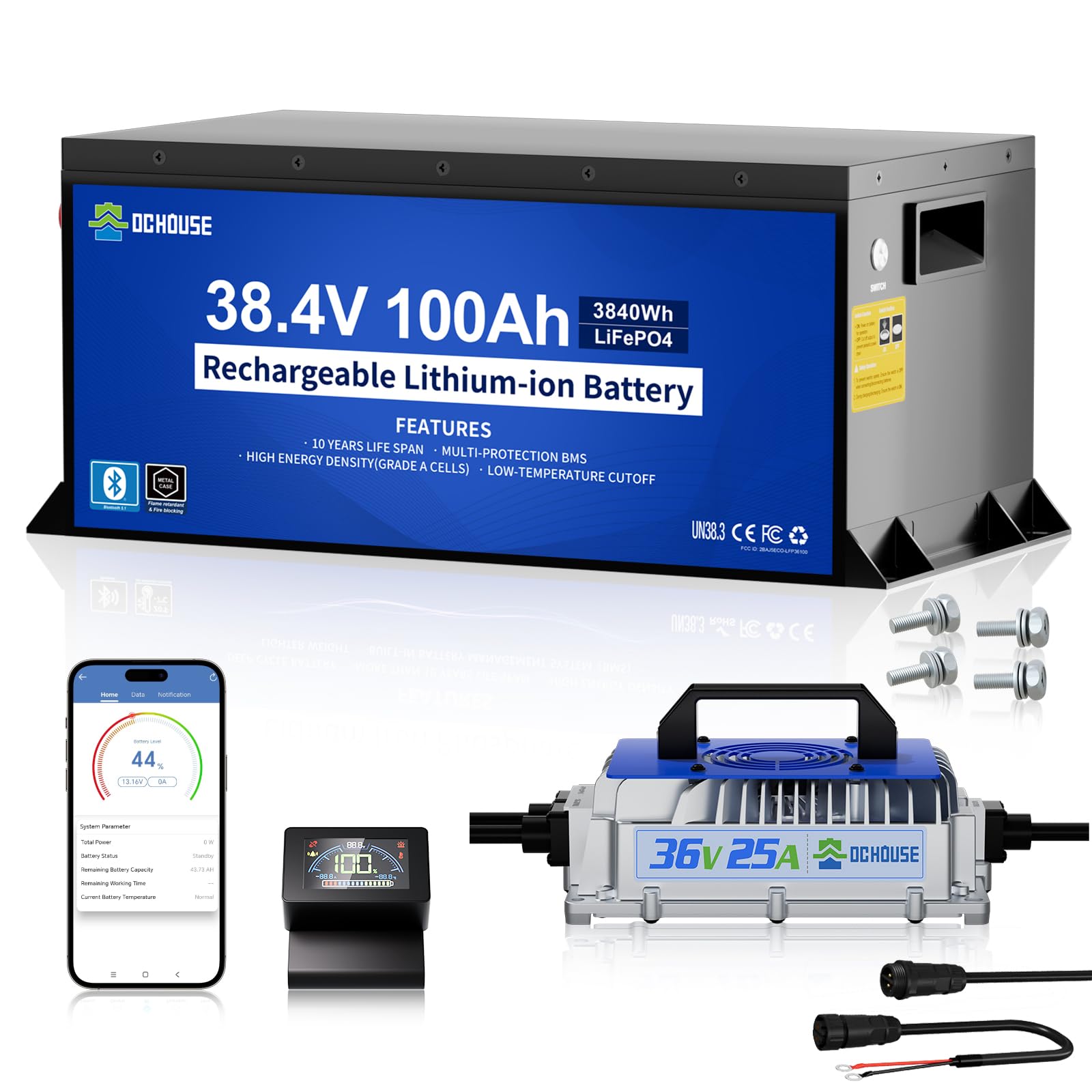
A 100Ah cart kit in a fireproof metal case, with a one-touch power switch and 25A charger
Where most packs wear ABS plastic, this DC HOUSE kit hides its cells inside a metal case that the maker calls fireproof and impact-resistant, plus a one-touch power switch to cut output entirely when the cart sits idle. On top of that, it uses a 3.84kWh capacity and supports motors up to 5kW, delivering 30–40 miles of range or 5–7 rounds of 18-hole golf on a charge. The 200A-class BMS pushes 280A for 30 seconds and a 670A one-second peak — enough climbing power for 20° slopes according to the listing.
Owners note how much easier this install is versus the old approach, since you swap six 6V batteries for a single pack with no complex wiring. The dual monitoring is convenient too, with a Bluetooth app and an LCD monitor to read state of charge in real time. It measures up at 80.5 pounds, making it the heavier option in this comparison class, but the reduction in cart weight once six lead-acid batteries come out is dramatic. It comes with a 25A charger and a 3-year warranty.
The one recurring caveat is the phone app, which several customers note could be polished and one calls awkward — but the hardware itself draws steady praise. The physical strain of a 36.3-kilogram install is also note if you work alone.
What stands out: the metal enclosure and one-touch switch set this apart on cart safety and daily convenience.
Small trade-off: the app feels less refined than the hardware, though the LCD covers most of what you need.
Best if: you favor a rugged, well-protected pack and high-capacity range for a 36V cart.
Reconsider if: a slick smartphone app is central to your decision.
9. VATRER POWER 36V 105Ah Lithium Golf Cart Battery
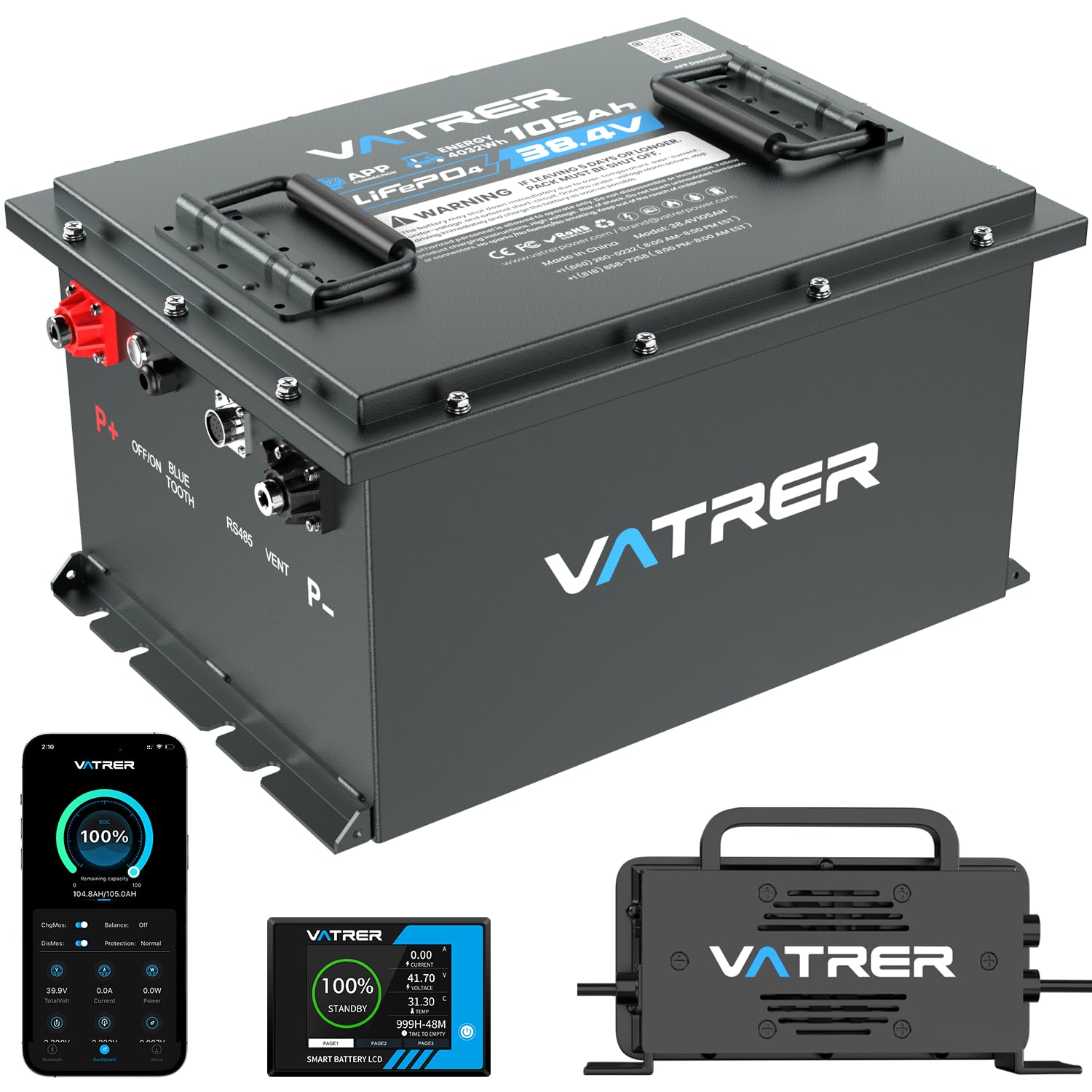
The highest-capacity pick here — 105Ah of floor-punching power for hard-used carts
At 105 amp_hours, this VATRER pack carries the most capacity in the entire roundup, edging past the 100Ah OGRPHY, LOSSIGY, and DC HOUSE options on raw stored energy. Its 4.03kWh throughput and 7680W power figure translate into 30–50 miles of golfing on one charge, and the 200A BMS drives a continuous 200A discharge with 400A peaks for 35 seconds. The maker rates the build for 4000-plus cycles and calls it 50% more powerful than other same-size lithium batteries.
Owners put real miles on this pack and report it holds up — one points to 35 to 40 miles on a charge, another says the cart runs better than ever. The included 43.8V 25A charger gets you from 0% to 100% in about five hours, and a 2.8-inch touchscreen displays real-time battery info. The casing adds heat and chemical stability with an IP67 waterproof rating that exceeds the IP65 covers on several rivals. It is also cleared for trolling motors up to 120lb thrust, and it wires up simply for a first-time lithium swap.
Be aware of the physical reality: at 83.8 pounds it is the heaviest pack here, so lift it with help. And this is a deep-cycle pack, not approved to start engines — buyer reviews note its top speed is governed more by the cart’s controller than the battery itself.
Where it pulls ahead
- 105 amp_hours is the highest capacity on this list
- 200A continuous discharge with 400A peaks drives demanding motors
- IP67 waterproof rating surpasses the IP65 class here
- Charger and touchscreen display included
What to plan around
- At 83.8 pounds it is the heaviest option in this roundup
- Not designed for starting applications
- Speed gains depend on your cart’s existing controller
The one to beat for: a hard-driven cart or long-range build where maximum amp hours and peak power matter most.
Look elsewhere if: you want a light pack to lift solo, in which case the 50Ah 28-pound marine packs win.
Understanding the Specs
Amp Hours (Ah)
Amp hours tell you how much energy the pack stores, like the size of a fuel tank. A 100 amp_hours, 36V pack runs a golf cart many times farther than a 1.6 amp_hours tool pack, but you can’t judge by that number alone — you also need to match the pack to the motor it drives. Bigger Ah means longer runtime between charges.
BMS and Discharge Current
The battery management system (BMS) is the pack’s internal control and safety board. Its amp rating governs how much power can flow out at once — a 200A BMS handles high-draw golf cart motors, while a small pack may cap at a few amps. A higher-amp BMS also opens the door to running multiple packs in parallel for more capacity, and to safety cutoffs for low temperature, over-current, and short circuits.
FAQ
Can I use a 36V lithium battery to replace my old lead-acid golf cart batteries?
What does BMS stand for and why does it matter in a 36V battery?
How many amp hours do I need for a 36V trolling motor?
Is a starting battery the same as a deep-cycle 36V battery?
Can I run two 36V batteries together to get more capacity?
How long does a 36V lithium golf cart battery last per charge?
Will a 36V lithium battery charge in cold weather?
Do I need to buy a charger separately for a 36V lithium battery?
How much lighter is a 36V lithium battery than lead-acid?
What is the difference between LiFePO4 and lithium-ion in a 36V battery?
Final Thoughts: The Verdict
For most buyers shopping a 36 volt battery, the OGRPHY 100Ah with its 200A BMS is the pick — it pairs serious capacity with strong surge power, dual monitoring, and a 5-year warranty, which is why 4.6 stars across 400+ ratings and a mountain of owner praise put it on top. If you want cold-weather protection for a marine setup, grab the Timeusb 36V 50Ah. And for a small DIY, RC, or camera build, the Xeanerol 5000mAh pack is the light, ready-to-wire one to reach for.
How We Picked
We do not accept paid placement. Every pick is matched to a real buyer and a real use-case; we do not hands-on test units.
Sources & Methodology
Specifications: manufacturer listings and product documentation. Review insights: verified customer reviews, as of September 2026. Pricing: not shown on this page (it changes often); check the current price via the retailer link.
As an Amazon Associate, Gadgets Feed earns from qualifying purchases. This does not affect which products we feature.