
Our readers keep the lights on and my morning glass full of iced black tea. As an Amazon Associate, I earn from qualifying purchases.
That one-frame stutter in a firefight isn’t your reaction time—it’s your monitor holding you back. A 360 Hz monitor refreshes the image every 2.78 milliseconds, slashing motion blur to the point where a 240 Hz panel feels sluggish by comparison. For competitive shooters like Valorant or Counter-Strike 2, this isn’t a luxury; it’s the difference between seeing the enemy’s shoulder peek and taking a bullet before your brain registers the threat.
I’m Min — the co-founder and writer behind Gadgets Feed. I’ve spent hundreds of hours cross-referencing panel technologies, response time data, and real-world motion clarity tests to isolate which 360 Hz monitors actually deliver measurable frame-time consistency from the ones that just refresh the spec sheet.
From QD-OLED contenders with true 0.03ms GtG to dual-mode IPS workhorses that shift between 4K productivity and esports speed, this guide breaks down the panels that define pixel persistence. You’re reading the definitive resource for choosing the best 360 hz monitor for your competitive setup.
How To Choose The Best 360 Hz Monitor
Picking a 360 Hz panel isn’t about chasing the highest number. The refresh rate is only half the equation—response time overshoot, input lag consistency, and panel type determine whether those 360 refreshes per second translate to clear frames or artifacts. Here’s what matters.
Panel Technology: OLED vs Fast IPS vs TN
QD-OLED panels deliver a 0.03ms gray-to-gray response time with near-infinite contrast, making motion look impossibly crisp. However, they carry burn-in risk from static HUDs in long sessions. Fast IPS panels hit 0.5ms to 1ms GtG reliably without burn-in worry, but their contrast ratio sits at 1000:1, washing out dark scenes. TN panels are obsolete even at 360 Hz—poor viewing angles kill the advantage of high refresh.
Response Time Overshoot and Overdrive Tuning
A monitor that claims 1ms but overshoots badly on its fastest overdrive setting defeats the purpose of 360 Hz. Look for reviews that measure gray-to-gray transition errors at the refresh rate ceiling. The best 360 Hz monitors keep overshoot under 5% deviation across all pixel transitions at the default optimal overdrive level.
Connectivity and Bandwidth: DisplayPort vs HDMI
DisplayPort 1.4 with Display Stream Compression (DSC) is the only reliable way to hit 360 Hz at native resolution without chroma subsampling. HDMI 2.1 can match this bandwidth, but some monitors cap HDMI at 255 Hz. Verify the port specs—if the monitor ships with an HDMI 2.0 port, you’re locked out of full refresh. USB-C with DP Alt Mode is a bonus for laptop gamers but rarely supports full bandwidth without DSC.
Quick Comparison
On smaller screens, swipe sideways to see the full table.
| Model | Category | Best For | Key Spec | Amazon |
|---|---|---|---|---|
| Samsung Odyssey G6 G60SD | QD-OLED | Competitive FPS + HDR single-player | 360Hz QD-OLED, 0.03ms GtG | Amazon |
| MSI MPG 271QRX QD-OLED | QD-OLED | Color-critical esports + content creation | 360Hz QD-OLED, Delta E ≤2 | Amazon |
| Alienware AW2725DF | QD-OLED | All-around gaming with burn-in warranty | 360Hz QD-OLED, 3yr burn-in coverage | Amazon |
| ASUS ROG Strix XG27ACDNG | QD-OLED | Custom heatsink, anti-flicker tech | 360Hz QD-OLED, custom heatsink | Amazon |
| LG 32GX850A-B | WOLED | Dual-mode 4K/165Hz + FHD/330Hz | 330Hz Dual Mode, glossy WOLED | Amazon |
| Alienware AW2524HF | Fast IPS | Pure speed without OLED burn-in worry | 500Hz OC, 0.5ms GtG (Extreme) | Amazon |
| LG 27G810A-B | Fast IPS | 4K productivity + 360Hz esports hybrid | Dual Mode 4K/180Hz or FHD/360Hz | Amazon |
| Samsung Odyssey G7 G70F | Fast IPS | Budget dual-mode entry | Dual Mode 4K/180Hz or FHD/360Hz | Amazon |
| ASUS ROG Strix XG259QNS | Fast IPS | Pure 24.5″ esports with ELMB Sync | 380Hz OC, 0.3ms (min), ELMB Sync | Amazon |
| INNOCN 40C1U | IPS | Productivity ultrawide, not gaming | 5K2K 21:9, 100Hz, IPS | Amazon |
| Dell UltraSharp U4025QW | IPS Black | Professional productivity workstation | 5K2K 120Hz, IPS Black, 600 nits | Amazon |
In‑Depth Reviews
1. Samsung Odyssey OLED G6 G60SD

The G60SD uses Samsung’s third-gen QD-OLED panel, pushing 360 Hz at 1440p with a true 0.03ms gray-to-gray response. This panel achieves an infinite contrast ratio by turning off individual pixels entirely, so black scenes in Hunt: Showdown or Escape from Tarkov reveal zero backlight bloom—every shadow is a pure void. The 250 nits typical brightness feels dim in SDR out of the box, but HDR highlights punch above the spec, and the anti-glare coating handles room lighting better than glossy QD-OLED rivals.
Samsung’s Dynamic Cooling System uses a pulsating heat pipe to diffuse heat five times better than graphite sheets, which directly addresses OLED burn-in at static HUD elements. The Glare Free technology reduces reflections without diffusing pixel sharpness, and the CoreLighting plus adds ambient rear bias lighting for reduced eye strain in dark rooms. At 3.9mm at its thinnest point, this is the slimmest 360 Hz OLED monitor currently available.
Reviewers note the HDMI 2.1 implementation is technically HDMI 2.0 bandwidth with DSC, causing a 1-2 second black screen when alt-tabbing at 360 Hz. This is a known firmware trade-off—the DisplayPort connection avoids the issue. For users who can tolerate the brief signal renegotiation, the G60SD offers the best motion clarity-to-color accuracy ratio in the 360 Hz class.
Why it’s great
- QD-OLED infinite contrast eliminates all backlight bleed in dark scenes
- Pulsating heat pipe cooling system reduces burn-in risk more effectively than passive heatsinks
- Glare Free matte coating works in bright rooms without washing out HDR highlights
Good to know
- HDMI operates at 2.0 bandwidth with DSC, causing alt-tab black screen delays
- Out-of-box SDR brightness at 250 nits requires manual adjustment to look vibrant
2. MSI MPG 271QRX QD-OLED

The MPG 271QRX pairs a 1440p QD-OLED panel with a 360 Hz refresh rate and a Delta E ≤2 factory calibration, making it the most color-accurate 360 Hz monitor on this list. The 0.03ms GtG response means individual pixel transitions complete within a single 2.78ms refresh window—no ghosting artifacts even during fast strafing in Apex Legends. MSI’s OLED Care 2.0 includes taskbar detection and logo brightness reduction that automatically dims static UI elements by up to 60%.
The KVM functionality is a rare find at this refresh rate tier, allowing a single keyboard, mouse, and monitor setup to toggle between a gaming PC and a work laptop without re-cabling. The Gaming Intelligence App provides on-screen crosshair overlays and system monitoring without installing third-party software. HDMI 2.1 at full 48 Gbps bandwidth ensures console compatibility for PS5 Pro and Xbox Series X at 1440p 120 Hz without DSC.
Users report the 250 nits SDR brightness feels subdued compared to IPS alternatives, and the QD-OLED subpixel layout causes minor text fringing in Windows—a compromise for the pixel response speed. The 3-year burn-in warranty covers permanent image retention, which is essential for anyone using this monitor for both gaming and productivity.
Why it’s great
- Factory Delta E ≤2 calibration makes it viable for color-accurate design work
- Full 48 Gbps HDMI 2.1 enables console 1440p 120 Hz without DSC artifacts
- Integrated KVM eliminates the need for a separate USB switch
Good to know
- QD-OLED subpixel structure causes visible text fringing at standard Windows scaling
- SDR brightness at 250 nits feels dim next to high-nit IPS panels
3. Alienware AW2725DF QD-OLED

The AW2725DF delivers Dell’s most aggressive QD-OLED implementation at 360 Hz with a static contrast ratio of 1.5 million-to-1, meaning black pixels emit zero light—no IPS glow, no clouding. The 0.03ms response time eliminates any perceivable ghosting, and the VESA DisplayHDR True Black 400 certification ensures HDR highlights punch without crushing shadow detail. The factory calibration hits 99.3% DCI-P3 coverage with Delta E <2 accuracy out of the box.
The ergonomic stand offers full height, tilt, swivel, and pivot adjustment—rare even among premium 360 Hz monitors. The 3-year Advanced Exchange warranty includes burn-in coverage, which is the most comprehensive protection available for an OLED gaming panel. Users report the anti-glare coating has a slight purple tint in direct lighting, but this is invisible during normal use and does not affect color accuracy measurements.
Potential buyers should note the 16:10 aspect ratio reported in some technical specifications appears to be a listing error—the panel is 2560×1440 native 16:9. Some users mention faint micro-scratches on the bezel out of the box, though this does not affect the display area. The fanless design runs silent even during extended HDR sessions, which is a meaningful advantage over the LG 27G810A-B’s audible fan.
Why it’s great
- 3-year Advanced Exchange warranty with explicit burn-in coverage removes OLED ownership anxiety
- Full ergonomic stand with pivot is unmatched in the 360 Hz OLED category
- 99.3% DCI-P3 coverage produces reference-grade HDR color volume
Good to know
- Anti-glare coating shows faint purple tint under direct off-angle light
- Some units ship with minor bezel imperfections that don’t affect display function
4. ASUS ROG Strix XG27ACDNG QD-OLED

The XG27ACDNG is ASUS’s top-tier 1440p 360 Hz QD-OLED, distinguished by a custom heatsink and advanced airflow design that keeps pixel temperatures lower than passive-cooled OLEDs. This directly reduces the organic material degradation rate that causes burn-in. ASUS OLED Care+ includes pixel cleaning, screen saver timers, and taskbar detection that activates when static Windows UI elements remain unchanged for more than 60 seconds.
ROG-exclusive OLED Anti-flicker technology modulates voltage during refresh rate fluctuations—this prevents the micro-flicker visible on some QD-OLED panels when frame rates drop from 360 to 240 in cutscenes. The DisplayWidget Center software gives mouse-controlled access to overdrive settings and six-axis color adjustment without reaching for OSD buttons. The 135% sRGB and 99% DCI-P3 coverage ensures the monitor is viable for photo editing between gaming sessions.
The included HDMI and DisplayPort cables support full 360 Hz bandwidth, and the USB-C port with DP Alt Mode allows single-cable laptop connection for on-the-go competitive play. Users report the internal power brick is a welcome convenience, removing the bulky external adapter that clutters setups. The 3-year warranty includes burn-in coverage, matching Dell’s offering.
Why it’s great
- Custom heatsink delays OLED pixel wear, extending panel lifespan during long sessions
- Anti-flicker technology suppresses the micro-flicker common on QD-OLED during variable framerates
- Internal power brick simplifies cable management compared to external adapters
Good to know
- HDR mode requires manual toggling—no auto-switching between SDR and HDR content
- Some vintage games with fixed resolutions do not properly scale to 1440p
5. LG 32GX850A-B UltraGear Glossy OLED
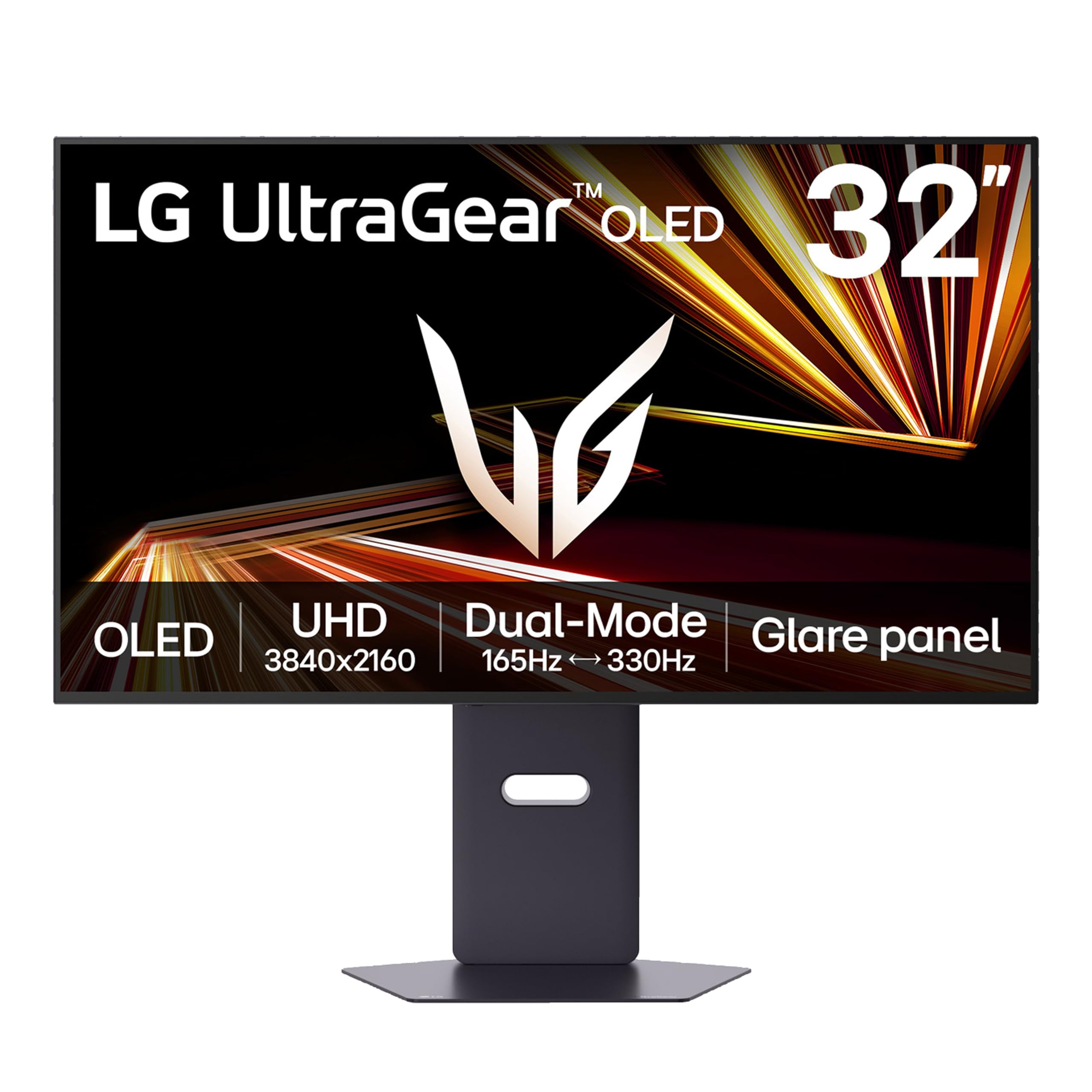
The 32GX850A-B is a 32-inch WOLED panel with Micro Lens Array+ technology, pushing typical brightness to 275 nits with peak HDR highlights that exceed 1000 nits. The glossy finish delivers perfect blacks and natural color saturation without the purple tint complaint of QD-OLED matte coatings. DCI-P3 coverage hits 98.5%, and the 1.5 million-to-1 contrast ratio ensures near-perfect black depth in a well-lit room.
The Dual Mode hotkey switches between native 4K at 165 Hz and FHD at 330 Hz, making this monitor viable for both story-driven single-player titles and competitive shooters. The 0.03ms GtG response keeps motion artifacts invisible in both modes. LG’s Dynamic Action Sync reduces input lag to under 10ms at the 330 Hz setting, and the Black Stabilizer adjusts gamma in dark areas without crushing bright highlights.
The monitor is triple UL-certified for Anti-Glare, Flicker-Free, and Low Blue Light, which makes extended sessions less fatiguing than un-certified OLED options. Users report excellent text clarity relative to QD-OLED panels, as the WOLED subpixel layout avoids the color fringing issue. The built-in fan produces noticeable noise in a silent room—a known trade-off for the Micro Lens Array brightness boost.
Why it’s great
- Glossy WOLED eliminates purple tint and produces deeper perceived black levels in controlled lighting
- Dual Mode hotkey lets you swap between 4K immersion and 1080p 330Hz speed without OSD menus
- UL-certified low blue light reduces eye strain better than competitors’ flicker-free claims
Good to know
- Audible fan noise is present during extended operation, especially at higher brightness levels
- Not all units ship with zero dead sub-pixels—defect lottery applies
6. Alienware AW2524HF Fast IPS

The AW2524HF pushes a 24.5-inch Fast IPS panel to 500 Hz overclocked (480 Hz native), making it the highest refresh rate monitor in this roundup. The 0.5ms gray-to-gray response in Extreme mode ensures each of those 500 refreshes is a clean frame with minimal ghosting. The 400 nits peak brightness and 99% sRGB coverage provide accurate, punchy colors—though the 1000:1 contrast ratio means blacks appear gray in dark rooms compared to OLED.
AMD FreeSync Premium and VESA AdaptiveSync certification ensure tear-free frame delivery across G-Sync and FreeSync GPUs. The matte screen surface eliminates reflections in brightly lit esports venues, and the 99% sRGB coverage guarantees consistent team colors in games like Overwatch 2. The stand offers full height, tilt, swivel, and pivot adjustment, matching the ergonomics of premium OLED models at half the price.
A notable reliability concern: one user reported degradation from 500 Hz to 480 Hz after 4 months, with eventual failure at 360 Hz requiring warranty replacement. HDMI is capped at 255 Hz, so reaching 500 Hz requires DisplayPort 1.4 with DSC. For competitive players who prioritize raw frame rate over HDR and contrast, this is the fastest panel available—but buy from a vendor with a solid return policy.
Why it’s great
- 500 Hz overclock is the highest available refresh rate in a mainstream monitor
- 0.5ms GtG response in Extreme mode keeps motion blur below 1 pixel at 500 FPS
- Full ergonomic stand at a mid-range price point matches premium OLED adjustability
Good to know
- 1000:1 IPS contrast ratio produces gray blacks in dark room gaming
- Several reports of refresh rate degradation after months of use at 500Hz OC
7. LG 27G810A-B UltraGear IPS
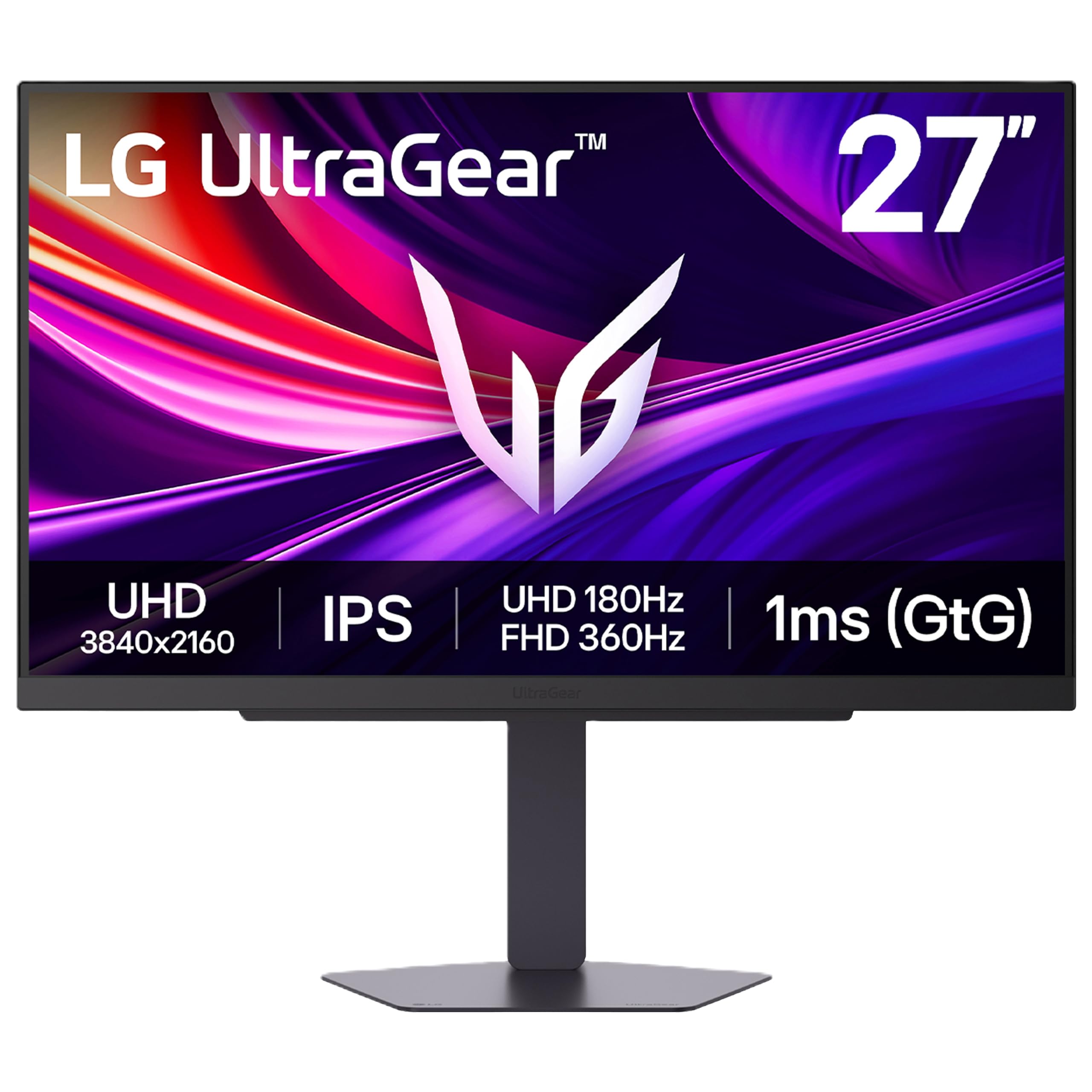
The 27G810A-B is a 27-inch Fast IPS panel with a native 4K resolution that can scale down to 1080p at 360 Hz via the Dual Mode hotkey. This allows one monitor to serve as a 4K productivity display for design work and a 360 Hz esports panel for competitive gaming. The 1ms GtG response in 4K mode keeps text scrolling clean, while the 360 Hz 1080p mode delivers motion clarity that approaches OLED performance without burn-in risk.
Both AMD FreeSync Premium and NVIDIA G-Sync Compatible certification cover the full VRR range from 48 Hz to 360 Hz, ensuring tear-free gameplay regardless of GPU brand. The VESA DisplayHDR 400 certification provides decent HDR highlight brightness for an IPS panel, though the 1000:1 contrast ratio means HDR black levels are more “dark gray” than true black. The 95% DCI-P3 coverage ensures color vibrancy sufficient for most content creation workflows.
Users praise the IPS glow control and text clarity, with no OLED-style subpixel fringing complaints. The monitor includes Dynamic Action Sync for input lag reduction and Black Stabilizer for shadow enhancement. Some users note a persistent fan noise that becomes audible in quiet environments—a known characteristic of this model’s active cooling system.
Why it’s great
- Dual Mode effectively gives you two monitors in one for productivity and competitive gaming
- No OLED burn-in worry during 8-hour workdays with static taskbars and spreadsheets
- G-Sync Compatible certification covers the full VRR range for smooth frame delivery
Good to know
- Active fan cooling produces audible noise that may be distracting in quiet rooms
- 1080p dual mode requires DSC, causing brief black screen when toggling resolution
8. Samsung Odyssey G7 G70F IPS
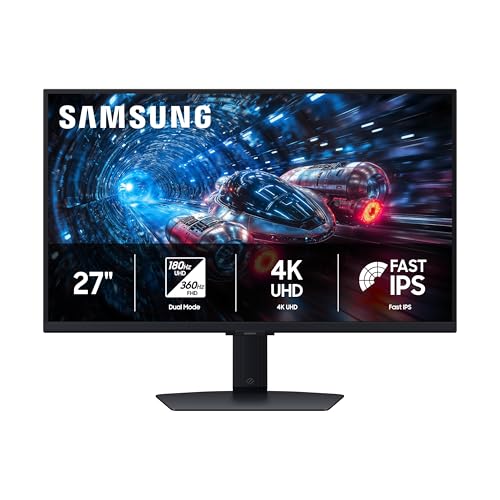
The G70F offers the same Dual Mode concept as the LG 27G810A-B at a lower entry point: 4K at 180 Hz for single-player immersion and FHD at 360 Hz for competitive speed. The Fast IPS panel delivers a 1ms GtG response with 350 nits brightness and 99% sRGB coverage, producing vibrant colors with minimal off-angle gamma shift. Auto Source Switch+ automatically detects connected devices and changes the input without manual OSD navigation.
The ergonomic stand includes height, tilt, pivot, and swivel adjustment, matching the adjustability of monitors costing twice as much. AMD FreeSync Premium reduces screen tearing across the 48-360 Hz VRR range. The HDR10 support provides brighter highlight detail in supported games, though the 1000:1 contrast ratio means HDR shadow depth falls short of OLED or VA panels.
The matte finish reduces reflections effectively in bright rooms, and the VESA mount compatibility (100x100mm) allows arm mounting. Users report no backlight bleed or dead pixels in the majority of units—unusual for budget-friendly IPS panels. The main compromise is the lack of built-in speakers, requiring external audio. The panel cannot match OLED black levels, but it avoids all burn-in concerns for mixed-use buyers.
Why it’s great
- Dual Mode with 4K 180Hz and 1080p 360Hz at a budget-friendly price tier
- Full ergonomic stand with pivot at an entry-level price point
- Auto Source Switch+ eliminates manual input switching with multiple devices
Good to know
- No built-in speakers require separate audio solution for console gaming
- IPS 1000:1 contrast produces visible backlight glow in dark room HDR content
9. ASUS ROG Strix XG259QNS Fast IPS

The XG259QNS is a 24.5-inch Fast IPS panel overclocked to 380 Hz with a minimum 0.3ms response time, designed specifically for professional esports where every millisecond of input delay matters. ASUS Extreme Low Motion Blur Sync (ELMB SYNC) enables stroboscopic backlight reduction simultaneously with FreeSync Premium VRR—a rare combination that eliminates both ghosting and tearing without the brightness penalty of traditional ULMB implementations.
The 110% sRGB color coverage provides oversaturated yet punchy game visuals that competitive players prefer for spotting enemy outlines. The DisplayWidget Center software allows mouse-driven OSD adjustment without reaching for the monitor’s rear joystick. The stand provides full ergonomic adjustment including pivot, making this the most adjustable 24.5-inch 360 Hz+ monitor available.
Users note the 380 Hz overclock yields diminishing returns beyond 360 Hz for most players, and running at the overclocked setting may introduce micro-stutters on some GPU configurations. The HDMI connection caps at 255 Hz, requiring DisplayPort to achieve the full refresh rate. For players who want the smallest pixel pitch (24.5-inch 1080p has 90 PPI) combined with the fastest IPS response, this is the definitive choice.
Why it’s great
- ELMB SYNC combines backlight strobing with VRR, eliminating both ghosting and tearing
- 0.3ms minimum response time is the fastest measured on any Fast IPS monitor
- 24.5-inch 1080p form factor is the standard size for competitive tournament play
Good to know
- 380Hz OC may introduce micro-stutters depending on GPU display output calibration
- HDMI locked to 255 Hz requires DisplayPort connection for full speed
10. INNOCN 40C1U 5K2K IPS

The INNOCN 40C1U offers a 40-inch 5K2K (5120×2160) IPS panel with a 21:9 aspect ratio, providing the pixel density to display four 1440p windows side by side without scaling. The 100 Hz refresh rate is insufficient for competitive 360 Hz gaming, but the 1200:1 contrast ratio and 350 nits brightness deliver solid SDR performance for design, video editing, and financial modeling. Factory calibration targets Delta E <2 for color accuracy.
Connectivity includes HDMI 2.1, DisplayPort 1.4, and USB-C with 65W Power Delivery, allowing single-cable laptop connection with charging. The 5K2K resolution at 21:9 eliminates the need for dual monitor setups in timecode-based editing or multi-asset trading. The built-in 4Ω 5W speakers are adequate for system audio in quiet office environments.
Users report HDR implementation is non-functional on macOS, and the flat 40-inch panel introduces peripheral distortion for users sitting closer than 36 inches. The 100 Hz refresh rate causes visible flicker in bright desktop UI elements for sensitive users, and G-Sync compatibility tests show the monitor does not support adaptive sync despite the Flat Panel Mount standard listing. For the target productivity use case, the value is strong—for gaming, this monitor is off-topic.
Why it’s great
- 5K2K at 21:9 provides 1440p-equivalent pixel density for four-window layouts
- USB-C with 65W PD reduces desk cable clutter for laptop workflows
- Factory Delta E <2 calibration out of box for color-accurate design work
Good to know
- 100 Hz refresh rate causes visible flicker and is unsuitable for competitive gaming
- Flat 40-inch panel causes peripheral image distortion at normal desk viewing distances
11. Dell UltraSharp U4025QW IPS Black

The U4025QW uses Dell’s IPS Black technology, achieving a 2000:1 static contrast ratio—double traditional IPS panels—producing deeper blacks while maintaining the wide viewing angles IPS is known for. The 39.7-inch 5K2K curved (2500R) panel at 120 Hz hits the productivity sweet spot: high resolution for detail work with enough refresh rate to make cursor movement and scrolling appear fluid. The 600 nits peak brightness ensures readability even in brightly lit office environments.
The integrated Thunderbolt 4 hub delivers 140W Power Delivery to a connected laptop, plus USB-A 3.2 Gen2 ports, 2.5 GbE Ethernet, and HDMI 2.1 FRL. The built-in KVM supports two separate PCs with peripheral switching via a single button press—essential for users who toggle between a desktop workstation and a company laptop. The 99% DCI-P3 and VESA DisplayHDR 600 certification ensure reference-grade color reproduction for professional video and photo editing.
The 5ms response time is too slow for 360 Hz gaming, but at 120 Hz the motion clarity is adequate for casual titles. The curved panel (2500R) reduces peripheral distortion compared to the flat INNOCN 40C1U. Some users report that IPS Black’s deeper blacks still cannot match OLED, and the premium price tier puts it well above the cost of four standard 27-inch 4K monitors combined.
Why it’s great
- IPS Black 2000:1 contrast ratio delivers deeper blacks than any standard IPS panel
- Thunderbolt 4 hub with 140W PD charges laptops faster than USB-C alternatives
- 5K2K at 120 Hz provides both high resolution and smooth desktop interactivity
Good to know
- 5ms response time cannot match Fast IPS or OLED for competitive gaming motion clarity
- Premium price tier exceeds the combined cost of multiple smaller high-refresh monitors
FAQ
Can my graphics card actually run 360 Hz at 1440p?
Is 360 Hz worth it over 240 Hz for competitive gaming?
Will a 360 Hz monitor work with HDMI on PS5 or Xbox Series X?
Does OLED burn-in happen on 360 Hz monitors used for productivity?
Final Thoughts: The Verdict
For most users, the best 360 hz monitor winner is the Samsung Odyssey OLED G6 G60SD because it combines QD-OLED motion clarity with a durable cooling system and competitive pricing for the OLED tier. If you want the fastest possible IPS refresh without burn-in worry, grab the Alienware AW2524HF. And for a hybrid productivity-slash-esports setup, nothing beats the LG 27G810A-B with its 4K-to-360Hz dual-mode switching.