
Capturing a fully immersive, reframe-ready 360 video used to mean stitching headaches and visible pole artifacts. Modern rigs deliver native 8K spherical capture, integrated stabilization, and built-in storage that eliminate the biggest friction points—no more framing anxiety during action shots or post-production surprises from misaligned seams. The right camera puts the creative control into reframing, not fixing.
I’m Min — the co-founder and writer behind Gadgets Feed. I’ve spent countless hours dissecting sensor sizes, bit rates, and real-world stitching quality across the widest range of 360 video rigs available today so you can match the right tool to your specific workflow.
This guide ranks the most capable options by image quality, low-light performance, and software ecosystem to help you confidently choose the best 360 video rig for action sports, professional real estate tours, or immersive travel vlogging.
How To Choose The Best 360 Video Rig
360 video cameras are a distinct breed. Unlike standard action cams, the sensor, lens pairing, and stitching algorithm define the final output entirely. Focus on these four criteria to separate genuine pro tools from novelty gimmicks.
Sensor Size and Low-Light Performance
The physical sensor size directly determines how much light the camera can capture. A 1-inch sensor—found in the DJI Osmo 360—pulls ahead of smaller 1/2.3-inch sensors in dim conditions, offering cleaner shadows and richer colors at dusk or indoors. Dual-sensor models like the Insta360 X5 use two 1/1.28-inch sensors paired with AI-driven noise reduction to close the gap, but physics still favors the larger single sensor for dynamic range. If you shoot mostly in bright daylight, smaller sensors suffice. For twilight adventures or indoor vlogging, prioritize the 1-inch platform.
Native Recording Resolution and Reframe Headroom
Every 360 video must be reframed into a traditional flat frame for viewing. The higher the native spherical resolution, the more detail survives the crop. An 8K 360 source (7680 x 3840 for most) provides enough pixel density to reframe into sharp 4K or 1440p clips without visible softening. A 5.7K source leaves less margin for cropping heavy stabilization without introducing softness. If you plan to export 4K final videos, start with an 8K-recording rig. For social-media clips at 1080p, 5.7K can still look excellent.
Stabilization and Horizon Lock Capabilities
Electronic stabilization in 360 cameras differs fundamentally from traditional gimbals. The camera records the full sphere, so it uses the extra field of view to smooth motion computationally. FlowState Stabilization (Insta360) and HyperSmooth (GoPro) both deliver gimbal-like results without hardware. The critical differentiator is Horizon Lock—the ability to keep the horizon perfectly level even during full camera rotation. This matters for first-person POV like mountain biking or skiing where the camera spins but the viewer needs a stable reference line.
Storage, Battery, and Lens Durability
Built-in storage (105GB in many current models) removes the need to buy a memory card and eliminates the risk of forgetting one on a shoot. However, built-in storage cannot be expanded mid-trip. External microSD slots offer flexibility for long shooting days—but require high-speed cards (V30 or U3) for 8K bitrates. Battery life varies widely: the Insta360 X5 claims up to 208 minutes in endurance mode, while the Ricoh Theta X offers around 30 minutes with the screen active. Replaceable lenses are a significant advantage for any rig used in rough environments, letting you swap a scratched lens rather than replacing the entire camera.
Quick Comparison
On smaller screens, swipe sideways to see the full table.
| Model | Category | Best For | Key Spec | Amazon |
|---|---|---|---|---|
| Insta360 X5 Essentials Bundle | Premium 8K Action | All-around action with fastest workflow | 8K30fps, dual 1/1.28″ sensors, 2400mAh | Amazon |
| Insta360 X5 Essentials (No Card) | Premium 8K Bundle | All-day action with extra battery & case | 8K30fps, 185-min battery, replaceable lens | Amazon |
| GoPro MAX2 | Premium Hybrid | True 8K 360 with best audio array | True 8K 360, 29MP photos, 6 mics | Amazon |
| DJI Osmo 360 Essential Combo | Mid-Range 1-Inch | Best low-light with 1-inch sensor | 8K video, 1-inch 360 imaging, 105GB | Amazon |
| DJI Osmo 360 Standard Combo | Mid-Range Entry | Great low-light + built-in storage | 1-inch sensor, 120MP photo, 105GB | Amazon |
| Insta360 X5 Standard | Mid-Range Premium | Full-featured 8K with AI editing | 8K30fps, triple AI chip, waterproof | Amazon |
| Insta360 X5 Starter Bundle | Mid-Range Starter | 8K with selfie stick & extra battery | 8K30fps, FlowState, 208-min battery | Amazon |
| Ricoh Theta X | Premium Still-Focused | Highest resolution stills for real estate | 11K photo, 5.7K video, GPS tagging | Amazon |
| Xtra 360 Camera | Budget 8K | Low-cost entry with huge storage | 8K video, 1-inch sensor equivalent, 105GB | Amazon |
| Trisio Lite 2 | Specialized VR | Automated 360 photo capture indoors | 8K panorama, nodeRotate, anyScene HDR | Amazon |
| SmallRig AD-100 Tripod | Support Rig | Stable platform for heavy camera rigs | 78″ height, carbon fiber, 22lb load | Amazon |
In‑Depth Reviews
1. Insta360 X5 Essentials Bundle

The Insta360 X5 Essentials Bundle delivers the most complete 360 video workflow out of the box. Dual 1/1.28-inch sensors capture 8K30fps spherical video with noticeably cleaner low-light performance than the previous generation, and the triple AI chip design actively reduces noise in dim environments without softening detail. FlowState Stabilization combined with full 360-degree Horizon Lock keeps every frame level even when you spin the camera through a full 360-degree turn, which is a game-changer for POV motorsports and mountain biking footage.
Battery life hits a quoted 208 minutes in endurance mode, and the included fast-charge case recharges the 2400mAh cell to 80 percent in 20 minutes—eliminating the “dead battery on the trail” anxiety entirely. The new four-microphone array with integrated Wind Guard focuses voice clarity during high-wind vlogging, a genuine upgrade for anyone who narrates their POV footage. The Essentials Bundle also ships with a 114cm Invisible Selfie Stick, standard lens guards, and a utility carry case, reducing the “what else do I need to buy” syndrome that plagues most 360 camera purchases.
Waterproof to 49 feet without a housing and featuring user-replaceable lenses with sapphire-level scratch resistance, this rig is built for real-world abuse. The only catch is that you need a V30-or-faster microSD card, which is sold separately, but the overall package leaves very little on the table for action-sports shooters or travel vloggers who demand the highest reframe quality from an 8K source.
Why it’s great
- Best-in-class 8K30fps 360 capture with excellent low-light noise reduction
- Full 360-degree Horizon Lock survives any orientation without drift
- Fast-charge case and 2400mAh battery deliver all-day field use
Good to know
- Requires high-speed microSD card (not included)
- 4-mic array still struggles in extreme wind without accessory windslayer
2. Insta360 X5 Essentials Bundle (No Card)
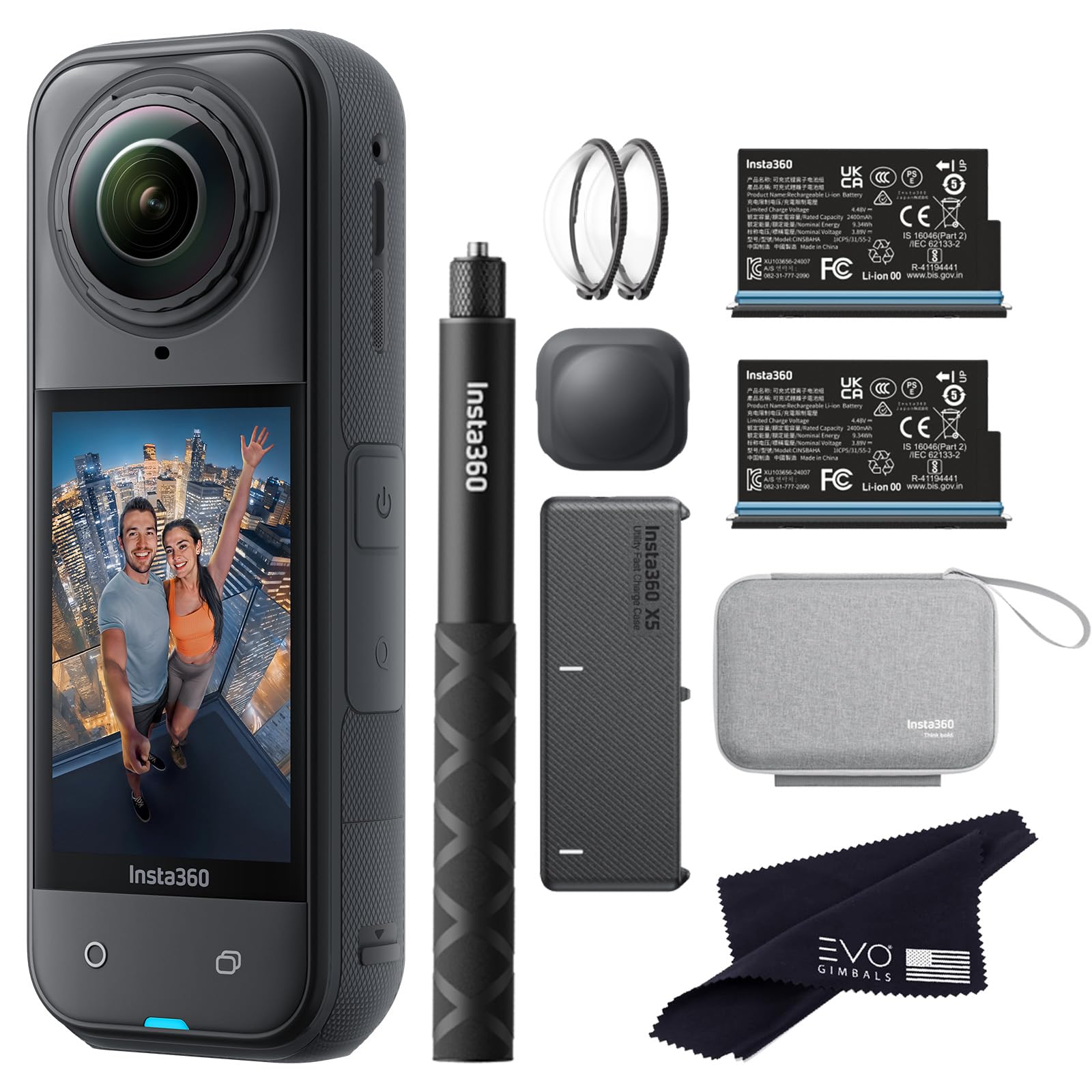
This variant of the Insta360 X5 Essentials Bundle includes an extra battery and the Utility Fast Charge Case but ships without a microSD card, making it the ideal pick for shooters who already own high-speed memory. The core camera is identical to the main Essentials Bundle—dual 1/1.28-inch sensors, triple AI chip, and 8K30fps spherical recording—so image quality and stabilization are identical. The key difference is the 2400mAh battery rated for 185 minutes of endurance-mode recording, plus a second battery in the box for hot-swapping during long shoots.
The bundled accessories cover the essentials: a 114cm Invisible Selfie Stick, standard lens guards, lens cap, and a sturdy carry case. The sapphire-glass-level scratch resistance on the replaceable lenses means you can confidently mount this rig on a mountain bike handlebar or motorcycle helmet without worrying about trail debris. PureVideo 360 mode leverages AI noise reduction specifically for night cycling and city exploration, delivering clean footage in situations where older 360 cameras produced unusable grain.
Waterproofing to 49 feet matches the main bundle, and the fast-charge case brings a drained battery to 80 percent in 20 minutes. The lack of an included SD card is the only friction—you must supply a V30-or-faster microSD. For anyone who already owns a stack of memory cards, this bundle removes accessory bloat and focuses on exactly what an active shooter needs on location.
Why it’s great
- Dual-battery setup with fast-charge case for all-day field coverage
- Replaceable lenses with sapphire-level scratch resistance
- PureVideo 360 delivers clean low-light 8K footage
Good to know
- No microSD card included—requires separate purchase
- Some users report noticeable heating during extended 8K recording
3. GoPro MAX2
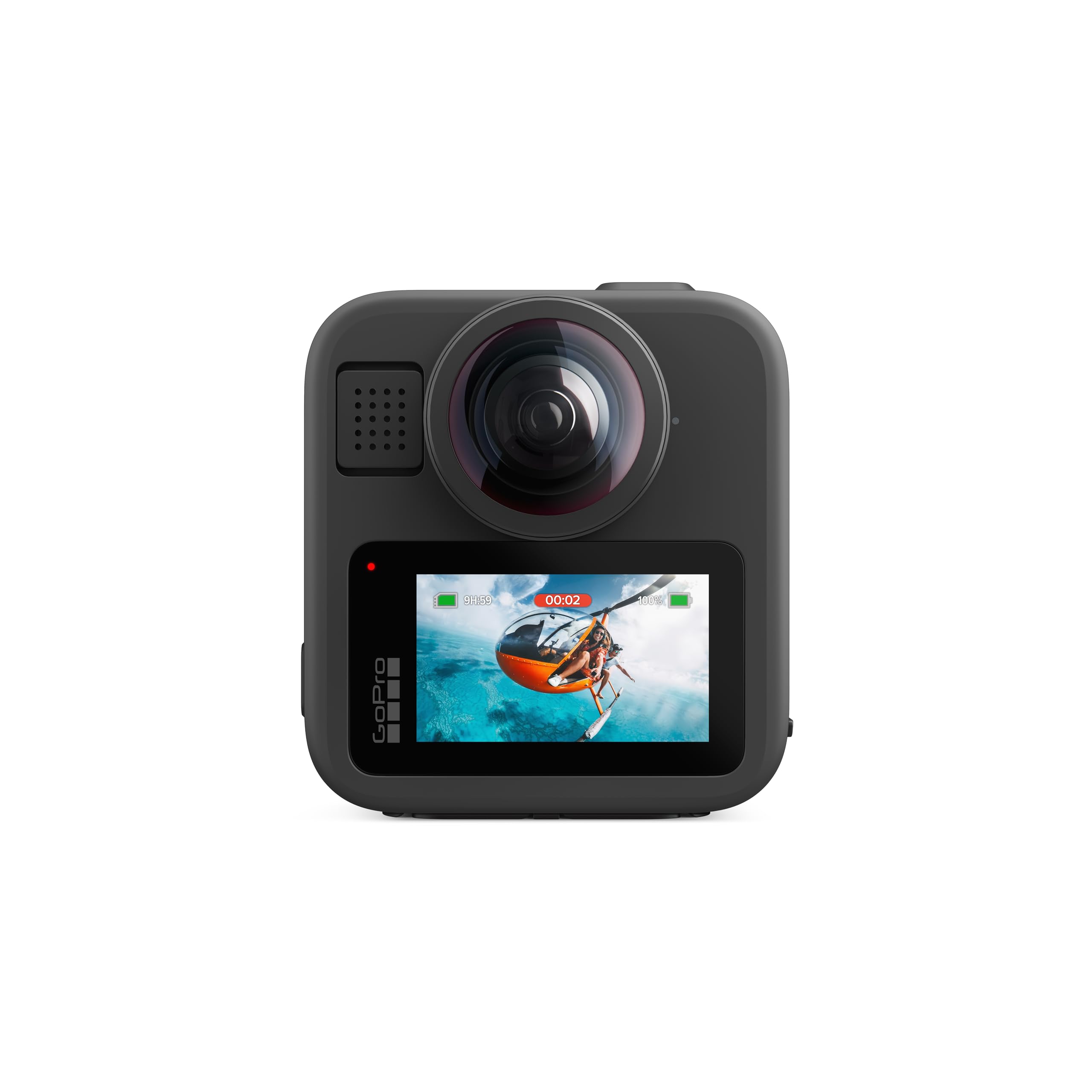
The GoPro MAX2 brings True 8K 360 spherical video with a 21 percent resolution advantage over some competitors at the same stated 8K tier, meaning more usable detail survives the reframing crop into 4K. The six-microphone array captures true ambisonic audio with effective wind reduction, making this the rig to beat for vloggers who narrate on-camera without a separate wireless mic. HyperSmooth stabilization locks the horizon even when you spin the camera rapidly, and the seamless stitching algorithm shows no visible exposure steps across the seam line in testing.
The dual-mode functionality lets you toggle between 360 capture and traditional Hero-mode single-lens shooting instantly, so you can grab standard POV clips without post-processing. Battery life is adequate for a heavy morning of 8K shooting, but heavy use in time-lapse mode draws about 50 percent per hour.
The included magnetic quick-release mount and curved adhesive pad get you started immediately, though the MAX2 uses microSD for storage rather than built-in memory, so factor a high-endurance card into your budget. Some users report heat buildup during extended 8K recording in still air, but the camera’s thermal dissipation is better than previous GoPro generations.
Why it’s great
- True 8K spherical with 21% more resolution for cleaner reframes
- Six-microphone ambisonic audio is best-in-class for 360 cams
- Replaceable glass lenses with water-repelling coating
Good to know
- No built-in storage—requires fast microSD card
- Can heat up during extended 8K recording in warm conditions
4. DJI Osmo 360 Essential Combo
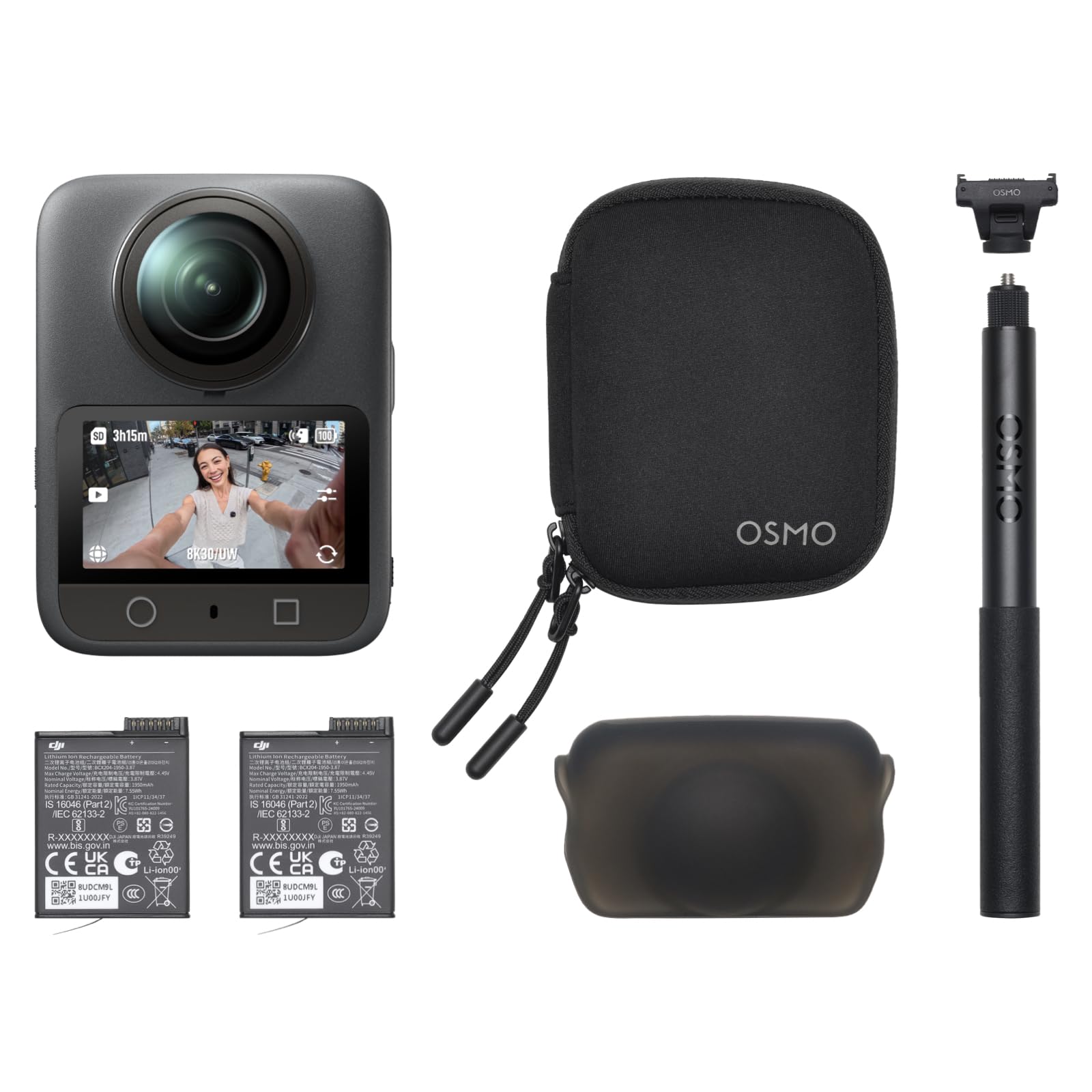
The DJI Osmo 360 Essential Combo packs a native 1-inch 360 imaging system that gives it a genuine low-light advantage over every dual-1/1.28-inch competitor on this list. The larger sensor physically gathers more light per pixel, producing cleaner shadows and richer color saturation at twilight and indoors without relying as heavily on computational noise reduction. Native 8K30fps 360 video captures the full sphere, and the 1.2-meter Invisible Selfie Stick included in this combo enables convincing third-person drone-like angles with zero pole visible in the final frame.
The 105GB of built-in storage is a massive workflow convenience—no memory card to forget, no SD card corruption mid-shoot. The 190-minute battery life on the included 1950mAh Extreme Battery Plus covers a full day of casual shooting, though continuous 8K recording draws power faster. The new DJI Mimo app streamlines post-production with Pano Dewarp and Pano Camera Movement features that let you craft reframed clips quickly. Four onboard microphones capture stereo audio with directional awareness, and the system can connect up to two DJI microphone transmitters via OsmoAudio without a receiver.
The standard combo includes just one battery, so heavy shooters will want the Essential Combo for the extra cell and selfie stick. The magnetic quick-release mounts work seamlessly with DJI’s existing action camera accessory ecosystem. The only genuine drawback is that the app is not available on Google Play—you must download it from the official DJI website, which adds an extra step to initial setup.
Why it’s great
- True 1-inch sensor delivers class-leading low-light 8K 360 capture
- 105GB built-in storage eliminates need for memory cards
- Included 1.2m Invisible Selfie Stick enables drone-like perspectives
Good to know
- App not on Google Play—must download from DJI website
- No 360 Horizon Lock in single-lens Hero mode
5. DJI Osmo 360 Standard Combo
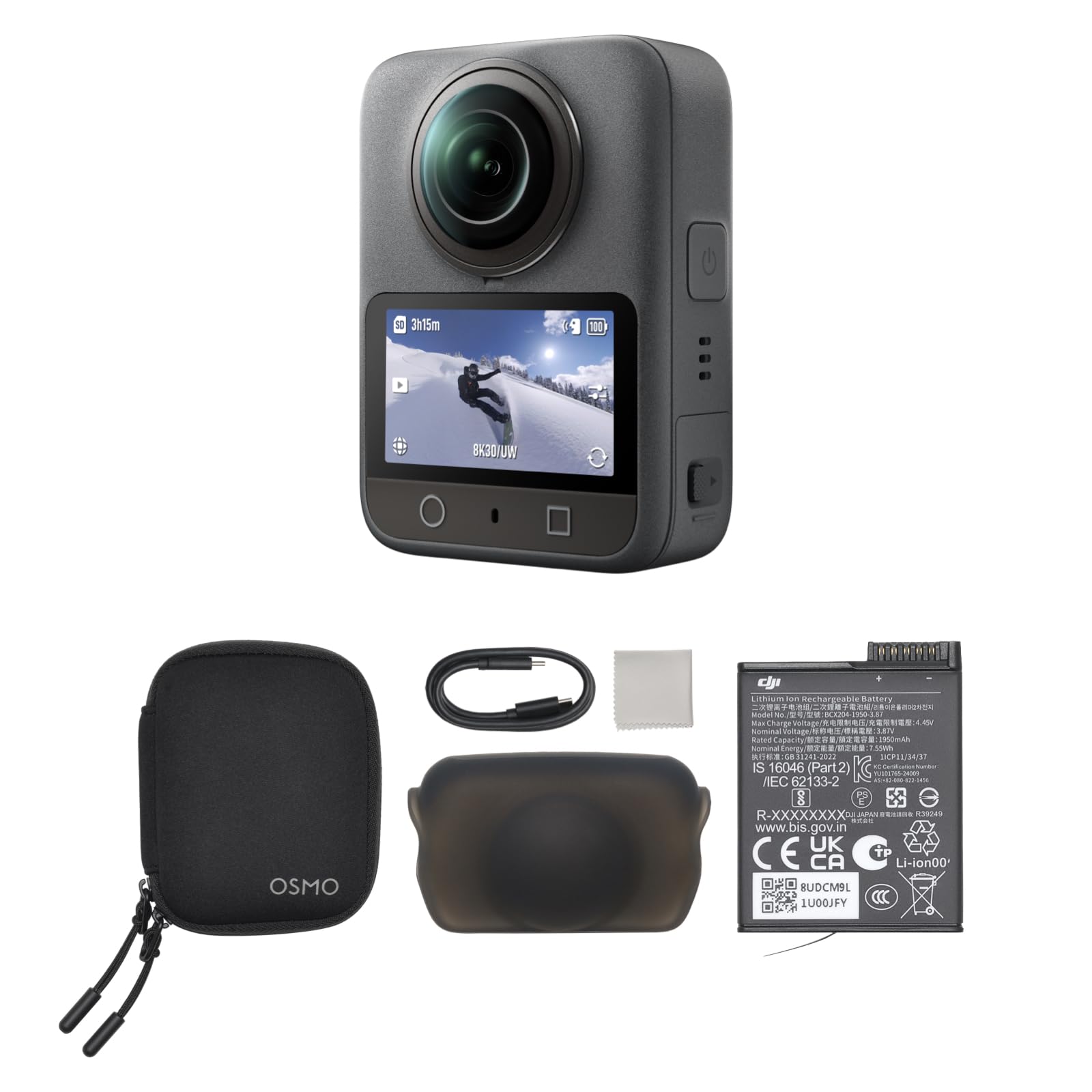
The DJI Osmo 360 Standard Combo offers the same groundbreaking 1-inch 360 imaging sensor and 105GB built-in storage as the Essential Combo but at a lower entry point. You sacrifice the second battery and the 1.2-meter Invisible Selfie Stick, but you retain the core image quality—native 8K30fps 360 video with excellent dynamic range and 120MP 360 photos that capture every detail for immersive virtual tours. For users who already own a selfie stick or shoot primarily from tripods, the Standard Combo delivers the same low-light performance without redundant accessories.
The 100-minute 8K recording capacity on a single charge covers most day excursions, and the USB-C PD cable charges quickly between shots. The magnetic quick-release works with the Osmo Action Quick-Release Adapter Mount, and the 1/4-inch thread fits traditional photo gear. The four-microphone system records stereo audio from all directions and can pair with up to two DJI microphone transmitters via OsmoAudio without a receiver, matching the Essential Combo’s audio capabilities exactly.
The main trade-off is the single battery, which means you’ll need to purchase an extra cell and a selfie stick separately if you want the full third-person POV experience. For studio work, real estate walkthroughs, or any scenario where mains power is accessible between takes, the Standard Combo provides the same professional 8K 360 quality at a significantly lower overall investment.
Why it’s great
- 1-inch 360 sensor beats all smaller-sensor rivals in low light
- 105GB built-in storage is a hassle-free advantage
- 120MP 360 photos are genuinely useful for real estate
Good to know
- Only one battery included—extra purchase needed for extended sessions
- No Invisible Selfie Stick in the box
6. Insta360 X5 Standard

The standard Insta360 X5 delivers the same core 8K30fps spherical capture and dual 1/1.28-inch sensors as the bundled versions, but without the extra battery, selfie stick, and carrying case. This is the smartest choice for users who want the latest Insta360 image quality and stabilization technology and already own accessories from a previous X3 or X4. The triple AI chip design processes advanced noise reduction in real time, and FlowState Stabilization with 360-degree Horizon Lock matches the bundled version identically.
The InstaFrame Mode is a standout feature: you can preview a flat video angle on the camera and export a ready-to-share clip instantly, then revisit the full 360 capture later to pull out different angles. This hybrid workflow saves enormous editing time for social media creators who need quick turnaround. The four-mic array with the new Wind Guard reduces wind interference more effectively than the X4, and the replaceable lenses with enhanced scratch resistance protect the camera from trail debris without requiring a full teardown.
Waterproof to 49 feet and rated for 208 minutes of battery life, the X5 is a complete action-sports tool on its own. The lack of bundled accessories keeps the price lower, but you must supply your own selfie stick, additional batteries, and a V30 microSD card to unlock the full potential. If you already own Insta360 accessories, this is the most cost-effective path to the X5’s imaging.
Why it’s great
- Same 8K image quality and stabilization as higher-priced bundles
- InstaFrame Mode creates flat clips without post-processing
- Replaceable lenses lower long-term ownership cost
Good to know
- No selfie stick, extra battery, or case included
- Requires fast microSD card for 8K recording
7. Insta360 X5 Starter Bundle

The Insta360 X5 Starter Bundle sits between the standard camera and the full Essentials Bundle, shipping with a 114cm Invisible Selfie Stick and an extra battery but omitting the charging case and standard lens guards. This makes it a logical upgrade path for new 360 shooters who want to experience the invisible selfie effect immediately without a separate accessory purchase. The camera hardware is identical to all other X5 variants—dual 1/1.28-inch sensors, triple AI chip, and 8K30fps 360 capture.
The 208-minute battery rating (in endurance mode) with a second battery in the box effectively doubles your total runtime, which is critical for all-day motorsports, hiking, or ski sessions where charging is unavailable. The InstaFrame mode and one-tap AI export work exactly as they do on the standard camera, allowing immediate social media sharing. Waterproof to 49 feet and featuring the same replaceable lenses, this bundle is purpose-built for action users who need extended runtime from the start.
The omission of the Utility Fast Charge Case means you charge the batteries via the camera’s USB-C port, which is slower than the external charger found in the Essentials Bundle. The included standard lens guards are a welcome addition for handlebar mounting, but the lack of a carry case means you’ll need your own storage solution. For beginners who want the selfie stick and extra battery without paying for the full kit, the Starter Bundle hits the sweet spot.
Why it’s great
- Includes Invisible Selfie Stick and extra battery for extended sessions
- Same 8K30fps image quality and AI editing as premium bundles
- Waterproof to 49 feet with replaceable, scratch-resistant lenses
Good to know
- No fast-charge case—batteries charge in-camera
- Requires microSD card, not included
8. Ricoh Theta X

The Ricoh Theta X takes a different approach from the action-camera-focused competition: it prioritizes still-image resolution above all else. Its newly designed dual 48MP lenses capture 11K (60-megapixel) 360-degree photos that stitch into crisp panoramas suitable for printed media and commercial real estate packages. The built-in GPS and A-GPS embed accurate location data into every image, enabling Google Blue Line tour creation without manual geotagging. For video, it records 5.7K at 30fps with enhanced stabilization—lower resolution than the 8K action cameras but sufficient for virtual walkthroughs where video is secondary to stills.
The large OLED touch screen allows full operation without a smartphone, including previewing scenes before capture, adjusting shooting settings, and reviewing images immediately. RAW HDR-DNG 16-bit recording provides professional-grade editing headroom in Adobe DNG-compatible software, a feature missing from most action-style 360 rigs. The interchangeable battery and expandable microSD memory card support extended shooting sessions, though the battery life is short—around 30 minutes with the screen active—so a spare battery is essential.
Stitching is generally clean but can show a visible blur line in high-contrast edges, and low-light performance drops sharply after sunset. The Theta X is not waterproof and lacks the ruggedization of action cameras, making it a dedicated studio or dry-weather tool. For real estate agents, architectural photographers, and VR tour creators who need the highest still resolution and automated GPS tagging, the Theta X remains a specialized leader.
Why it’s great
- 11K / 60MP 360 stills are the highest native resolution available
- Built-in GPS enables one-tap geotagging for tour creation
- RAW HDR-DNG capture provides DSLR-grade editing flexibility
Good to know
- Battery life is short (approx 30 min with screen on)
- Video limited to 5.7K, falls behind 8K action cameras
9. Xtra 360 Camera
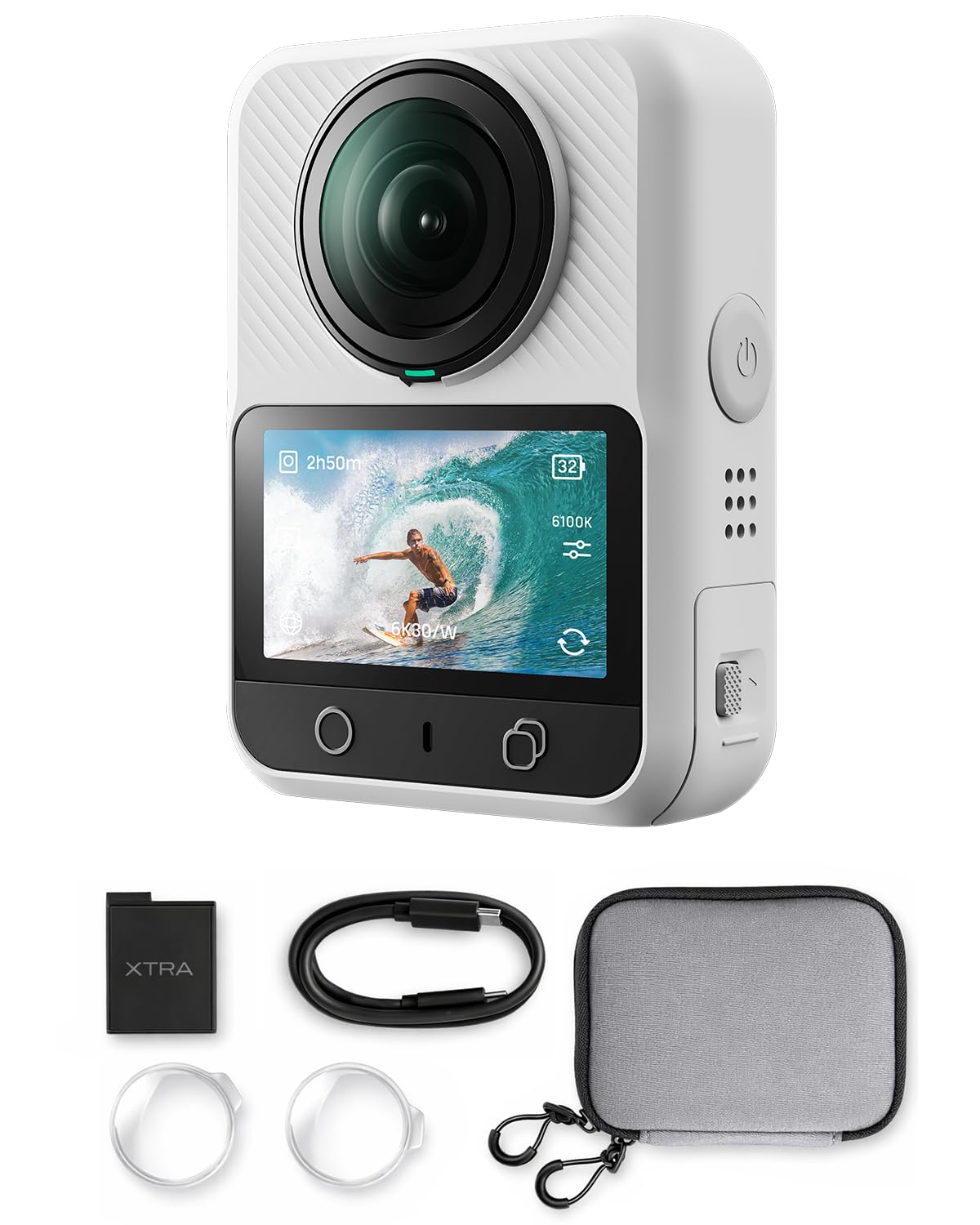
The Xtra 360 Camera enters the budget-friendly 8K tier with specifications that on paper rival far more expensive options. It offers a 1-inch sensor equivalent, native 8K panoramic video, 100MP photo capture, and a massive 105GB of built-in storage—all at a fraction of the premium-tier price. The magnetic quick-release system and waterproof design make it easy to mount and trust in wet conditions, and the included carrying bag, lens protectors, and cold-resistant battery show thoughtful accessory packaging for the price point.
Customer reports confirm that the 8K video appears sharper than the Insta360 X4 in direct comparisons, with excellent stabilization and balanced color in daylight. The built-in storage eliminates the SD card purchase requirement entirely. However, the software ecosystem is a significant weak point: the Xtra currently cannot export individual 360 clips for editing in Final Cut Pro or other professional NLEs, forcing users to work within the proprietary app. This limitation has been a dealbreaker for video creators who need timeline-level control over stitching and reframing.
Battery life is quoted at 1.5 hours, which is adequate for casual shooting but below the 3-hour-plus ratings of the Insta360 and DJI rigs. For social media clips, travel vlogs, and any workflow that can tolerate the mobile-app editing path, the Xtra delivers impressive image quality per dollar. For professional video post-production, the lack of standalone clip export makes it a frustrating secondary camera at best.
Why it’s great
- Stunning 8K quality with 1-inch sensor at an entry-level price
- 105GB built-in storage removes need for memory cards
- Magnetic mounting and waterproof design for active use
Good to know
- Cannot export individual 360 clips for professional NLE editing
- Battery life limited to approximately 90 minutes
10. Trisio Lite 2 VR Camera

The Trisio Lite 2 is not a general-purpose action camera—it is a specialized 8K panoramic VR camera designed for indoor commercial photography. Its nodeRotate technology rotates the camera 360 degrees automatically on a fixed nodal point, capturing distortion-free high-dynamic-range scenes for real estate, renovation documentation, and automotive interior tours. The anyScene self-adaption system balances exposure across dark corners and bright windows better than traditional HDR, producing final images that need minimal post-processing for virtual tour platforms.
Operation is deliberately simple: press a single button and the camera captures the full room, automatically generating 3D/VR scenes without manual stitching. The 8GB of built-in eMMC storage (7.1GB usable) holds enough images for multiple properties, and the 200-minute battery life covers a full day of shooting. The companion smartphone app provides control and quick image transfer, making this a turnkey solution for agents who do not want to learn complex 360 stitching software.
The major limitations are its photo-only capture (no video) and lack of manual controls, RAW output, or adjustable exposure parameters. The anyScene HDR processing can be slow in complex lighting, and occasional stitching artifacts appear near the zenith. For its intended use case—automated, high-quality 360 photos of interior spaces—the Trisio Lite 2 outperforms general-purpose action cameras in convenience and barely needs reframing post-shoot.
Why it’s great
- One-button automated 8K 360 capture ideal for real estate
- nodeRotate eliminates parallax distortion in close interiors
- 200-minute battery covers an entire day of property walkthroughs
Good to know
- Photo-only—no video recording capability
- No manual controls or RAW output for advanced editing
11. SmallRig AD-100 FreeBlazer Tripod

The SmallRig AD-100 FreeBlazer is a heavy-duty carbon fiber tripod designed specifically for video rigs that demand stability at height. It extends to 78 inches, uses a one-step locking system that secures two leg sections with a single toggle, and supports a maximum load of 22 pounds—enough for a 360 camera on a full gimbal rig plus microphones and lights. The damping-adjustable pan fluid head enables smooth 360-degree panning and +/-60-degree tilt with stepless drag control, allowing precise camera movements during reframing or live stitching.
The dual-mode quick-release plate mount supports both DJI RS-series gimbal plates and standard MFT plates, enabling seamless switching between gimbal-based movement and tripod-locked capture. The 75mm detachable bowl head, interchangeable wide feet, and spike feet provide quick leveling on uneven terrain. At 11 pounds, it is light enough for one-person transport but heavy enough to resist wind vibration during outdoor time-lapses.
Build quality is excellent for the price, with reviewers noting it performs comparably to tripods costing five times as much. The plastic locking mechanisms feel less premium than all-metal alternatives but have proven reliable across dozens of event shoots. The telescopic handle extends from 9.1 to 14.2 inches for comfortable reach, and the included carrying bag simplifies transport. This is not a camera—it is the platform that makes every 360 rig on this list more usable.
Why it’s great
- 78-inch max height and 22lb load capacity handle full video rigs
- One-step leg locking cuts setup time significantly
- Dual-mode quick-release works with DJI gimbal plates
Good to know
- Plastic leg locks feel less robust than all-metal alternatives
- Handle extension screw can loosen during transport
FAQ
Why does my 360 camera footage look soft after reframing to 4K?
Can I use a 360 video rig as a standard action camera without reframing?
How important is the Invisible Selfie Stick for 360 video?
Final Thoughts: The Verdict
For most users, the 360 video rig winner is the Insta360 X5 Essentials Bundle because it combines best-in-class 8K30fps spherical capture, true 360-degree Horizon Lock, and a complete accessory kit (fast-charge case, extra battery, selfie stick) that eliminates the most common workflow gaps. If you prioritize low-light performance above all else, grab the DJI Osmo 360 Essential Combo for its true 1-inch sensor. And for professional stills with automated GPS tour creation, nothing beats the Ricoh Theta X.