
Shooting a 360 VR camera flips the creative process on its head. You stop framing shots in the moment and instead capture a full sphere of light, then decide where to point the viewer later. The real challenge isn’t hitting record — it’s choosing a camera whose stitching is invisible, whose stabilization keeps the horizon planted, and whose sensor handles the punishing dynamic range of a sunlit landscape wrapping 360 degrees around the lens.
I’m Min — the co-founder and writer behind Gadgets Feed. I’ve spent countless hours analyzing native 8K resolution metrics, rolling shutter artifacts, 1-inch sensor equivalents versus 1/2.3-inch squeezers, and the software ecosystems that turn spherical raw data into reframed 4K exports that don’t look like a security camera feed.
This guide cuts through the dual-lens noise to help you find the best 360 vr camera for your budget, whether you want pro-grade stills for virtual tours or rugged waterproof 8K for mountain bike POVs.
How To Choose The Best 360 VR Camera
Picking a 360 camera starts with understanding the triangle of resolution, sensor size, and software polish. A camera that shoots 8K native spherical video lets you crop down to 4K without visible pixel loss. A 1-inch sensor (or equivalent) gathers enough light to keep night cityscapes clean. And the companion app’s reframing tools determine whether you produce shareable clips in seconds or curse the workflow all afternoon.
Resolution Is Not Equal: Native vs. Stitched
Every 360 camera stitches two fisheye feeds into one sphere. True native 8K (7680 x 3840) gives you roughly 21 million pixels per hemisphere to play with — enough to pull a crisp 1080p crop from any direction. A camera advertising “5.7K” spherical video reframed to 1080p leaves far less headroom for cropping without softening. If you plan to reframe frequently, prioritize native 8K over stitched 5.7K.
Sensor Size Dictates Your Low-Light Ceiling
Dual 1/2.3-inch sensors are the baseline for most action-oriented 360 cameras. They work brilliantly in sunlight but show noise and desaturated colors once the sun dips. Cameras packing dual 1-inch sensors (or a “1-inch equivalent”) capture roughly four times the light surface area per lens, which transforms twilight handheld shots from grainy messes into usable footage. If you shoot indoors, at dawn, or under streetlights, sensor size matters more than megapixel count.
Software and Stabilization Complete the Camera
A 360 camera is only as good as its app. FlowState or HyperSmooth stabilization that locks the horizon even when the camera spins 360 degrees is non-negotiable for action use. Replaceable glass lenses prevent a scratch from bricking an expensive camera. Built-in storage (at least 100GB) saves you from hunting for the right U3 microSD. And the ability to export a reframed clip without connecting to a desktop app is the difference between shooting daily and shooting once.
Quick Comparison
On smaller screens, swipe sideways to see the full table.
| Model | Category | Best For | Key Spec | Amazon |
|---|---|---|---|---|
| GoPro MAX2 | Premium | True 8K 360 with replaceable lenses | 8K spherical · 29MP stills | Amazon |
| Insta360 X5 Essentials | Premium | Long battery life + AI editing | 8K30fps · 208‑min runtime | Amazon |
| DJI Osmo 360 Standard | Premium | 1‑inch sensor for low light | 8K30fps · 105GB built-in | Amazon |
| DJI Osmo 360 Essential Combo | Premium | Extended kit with selfie stick | 8K30fps · 120MP photos | Amazon |
| Ricoh Theta Z1 | Premium | 23MP · 51GB internal | Amazon | |
| Ricoh Theta X | Mid-Range | 11K stills with GPS tagging | 60MP · 5.7K video | Amazon |
| Xtra 360 Camera | Mid-Range | Built-in 105GB and 1-inch sensor equivalent | 8K video · 100MP panos | Amazon |
| GoPro MAX | Mid-Range | Versatile 360 + HERO modes | 5.6K30 · 16.6MP | Amazon |
| AKASO 360 Creator Combo | Budget | Entry-level 360 with invisible selfie stick | 5.7K video · 72MP photos | Amazon |
In‑Depth Reviews
1. GoPro MAX2
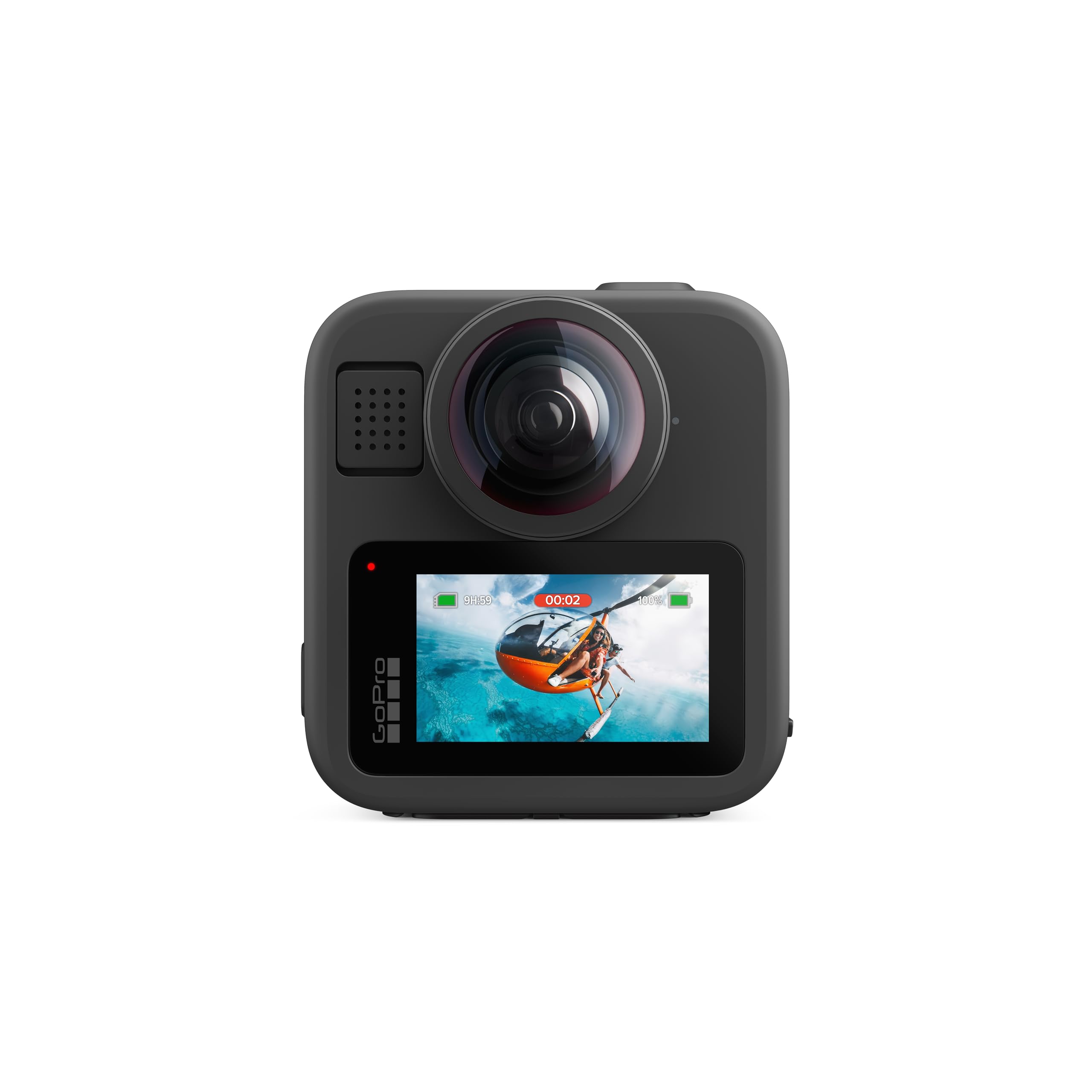
GoPro MAX2 delivers the most complete 360 package we’ve seen from the brand: native 8K30 spherical video that reframes into clean 4K without aliasing, paired with 29MP stills that hold up under pixel peeping. The dual 1/2.3-inch sensors are the same physical size as the original MAX, but GoPro’s new image pipeline and True 8K upscaling algorithm extract noticeably more detail in the highlights and shadows. The 1960mAh Enduro battery keeps the camera running through a heavy morning of shooting, though 8K recording chews through roughly 50% per hour.
HyperSmooth stabilization on the MAX2 is the gold standard — horizon lock stays perfectly level even when you spin the camera a full 360 degrees on a pole, and the stitching seam is virtually invisible in most lighting conditions. The replaceable glass lenses are a huge upgrade: if you scratch a lens on a rock or a ski edge, you swap it in seconds instead of sending the whole camera for repair. The 6-microphone ambisonic audio captures directional sound that shifts perspective when you reframe, and the wind reduction algorithm preserves voice clarity remarkably well.
On the downside, the MAX2 runs noticeably warm during extended 8K recording, and the software learning curve is steeper than Insta360’s one-tap export approach. The Quik app does offer object tracking and reframing, but editing 360 footage on a phone still feels slower than desktop alternatives. If you want the best possible 360 video quality in a rugged, waterproof body with lens insurance built in, this is the one.
Why it’s great
- True 8K spherical reframes to 4K with no visible pixel loss
- Replaceable glass lenses protect your investment from scratches
- 6-microphone ambisonic audio shifts perspective with reframing
Good to know
- Runs warm during extended 8K sessions
- Quik app editing workflow has a steeper learning curve
2. Insta360 X5 Essentials Bundle

Insta360’s X5 is the longest-running 360 action camera out of the box — the upgraded battery offers up to 208 minutes of runtime, and the fast charging case brings it from flat to 80% in roughly 20 minutes. Dual 1/1.28-inch sensors are significantly larger than the typical 1/2.3-inch action camera sensors, giving the X5 a meaningful edge in low-light noise reduction. Shooting 8K30fps spherical video produces reframed 4K exports that retain fine detail in shadows, and the new triple AI chip design powers advanced noise reduction that cleans up grainy city-night footage.
The X5’s FlowState Stabilization combined with 360-degree Horizon Lock delivers buttery-smooth footage even during aggressive mountain biking or full-body rotations. The invisible selfie stick effect works flawlessly up to 114cm, and the InstaFrame mode lets you export a ready-to-share flat video instantly without needing to reframe in post. The new 4-mic array with built-in wind guard captures clear vlog audio even in gusty conditions, and the waterproof rating down to 15 meters means you can take this for surf or pool shoots without a housing.
The biggest trade-off is the software ecosystem: Insta360’s app is incredibly polished for one-tap exports, but advanced users who want to pull individual 360 clips into Final Cut Pro will find the workflow more restrictive than DJI or GoPro. The replaceable lenses are a welcome upgrade, but the lens guards add a tiny bit of softness to the image edges. For sheer battery endurance, fast charging, and effortless AI-assisted editing, the X5 is hard to beat.
Why it’s great
- 208-minute battery life with 20-minute fast charging to 80%
- Dual 1/1.28-inch sensors improve low-light significantly
- One-tap InstaFrame export for instant social sharing
Good to know
- Software limits individual clip export for desktop NLEs
- Lens guards can slightly soften extreme edges
3. DJI Osmo 360 Standard Combo
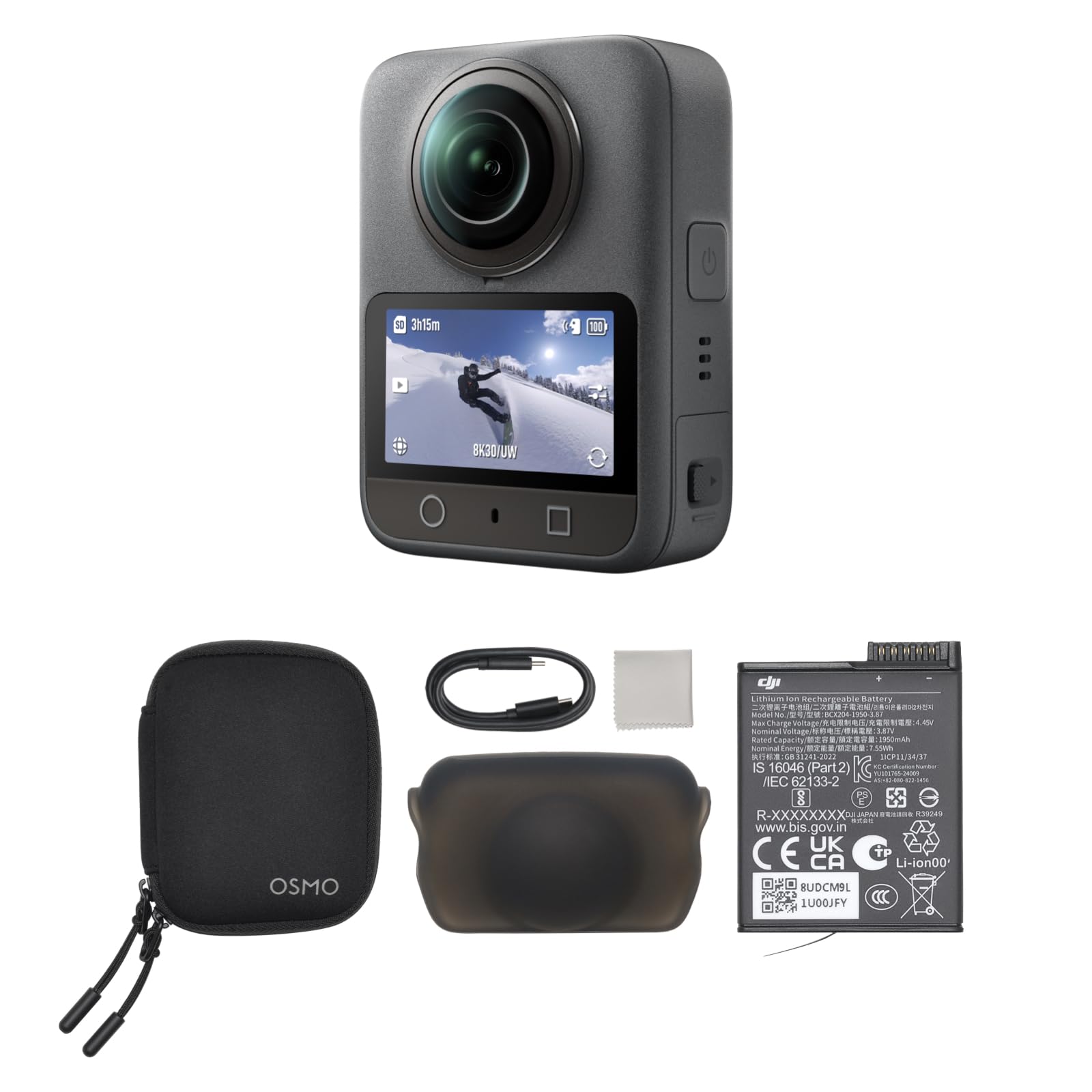
DJI’s Osmo 360 breaks from the 1/2.3-inch herd by pairing two 1-inch sensors (the same physical sensor size found in premium compact cameras like the Sony RX100). This hardware choice alone transforms low-light performance: sunsets, candlelit interiors, and nighttime city walks retain color saturation and shadow detail that smaller sensors lose to noise. The result is 8K30fps spherical video that looks vibrant even in challenging lighting, plus 120MP 360-degree photos that hold up to heavy cropping.
The 1.2-meter invisible selfie stick included in the combo creates convincing third-person POV shots, and the magnetic quick-release system lets you snap the camera onto DJI Action mounts or any standard 1/4-inch tripod thread in seconds. The 105GB built-in storage means you never need a microSD card for a day of shooting, and the stated 190-minute battery life (in mixed use) is generous. The DJI Mimo app offers Pano Dewarp, Pano Pro Color Grading, and camera movement presets that streamline editing — the workflow is more polished than GoPro’s Quik app but less automated than Insta360’s.
The downside? The app must be downloaded from DJI’s website rather than Google Play, which is a minor friction point. The editing workflow, while refined, still has a learning curve for 360 reframing newcomers. And the camera is not rated for deep-water use without a separate housing. If your priority is the best possible image quality in mixed lighting — especially indoors or at twilight — the Osmo 360’s sensor advantage is definitive.
Why it’s great
- Dual 1-inch sensors deliver unmatched low-light 360 footage
- 105GB built-in storage eliminates microSD dependency
- Magnetic quick-release works with DJI and standard mounts
Good to know
- DJI Mimo app not on Google Play — manual download required
- Not waterproof without a separate housing
4. DJI Osmo 360 Essential Combo
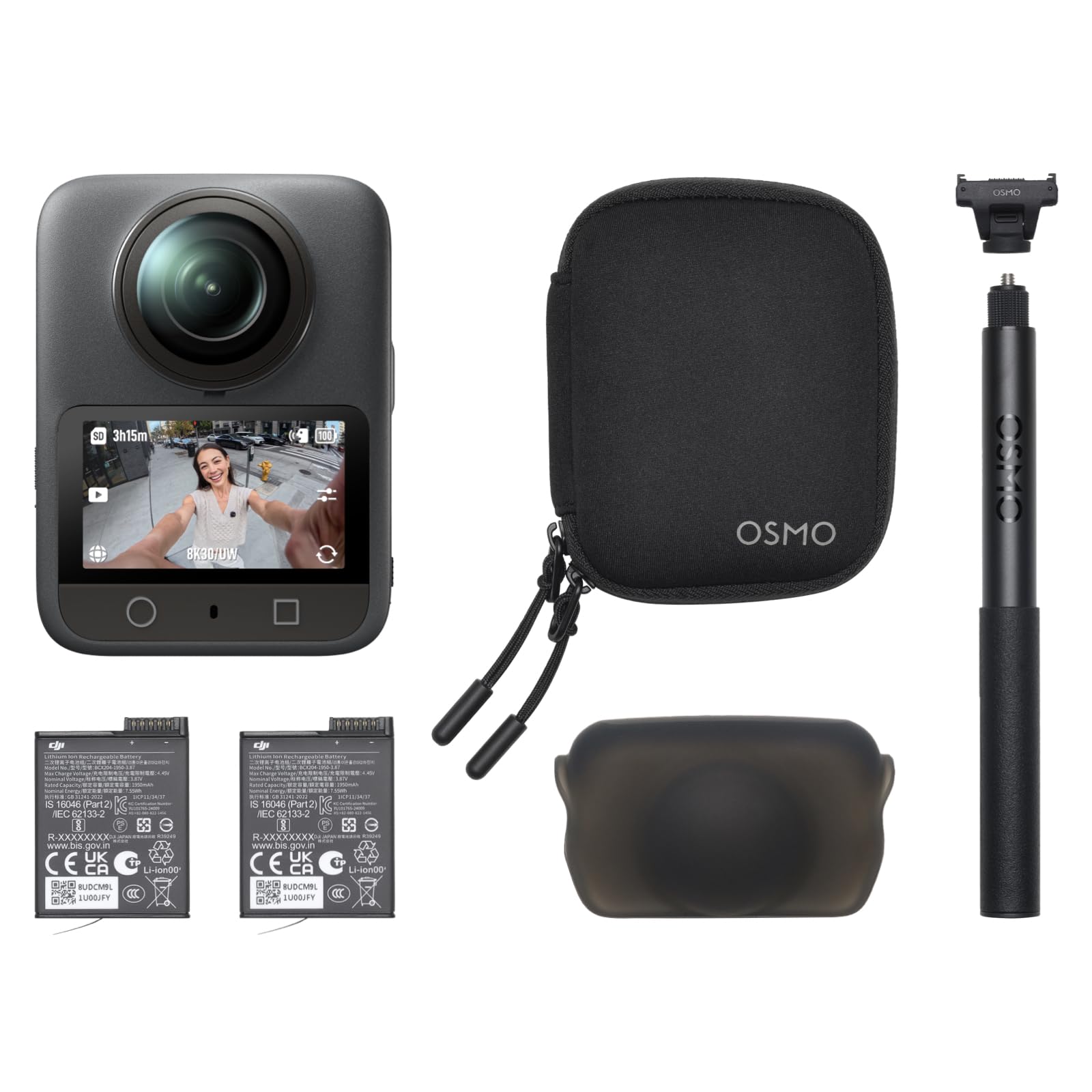
The Essential Combo builds on the Osmo 360 Standard by adding the 1.2-meter invisible selfie stick kit and a second 1950mAh Extreme Battery Plus. This turns the camera into a complete out-of-the-box 360 rig ready for full-day shoots — one battery records while the other charges in the included case. The core camera is identical to the Standard: dual 1-inch sensors, 8K30fps spherical video, 120MP photos, and 105GB of onboard storage. The same sensor advantage applies: clean low-light video, natural color rendition, and wide dynamic range that captures both sky and shadow detail in a single frame.
Having two batteries is genuinely useful for long adventure days. Each battery lasts roughly 100 minutes of continuous 8K recording, so swapping mid-ride keeps the camera running without a recharge stop. The included invisible selfie stick is well-constructed and telescopes to useful lengths, and the magnetic mount system attaches to handlebars, helmets, or tripods with zero fuss. The 360 stitching is seamless in most conditions, and the horizon lock works even through aggressive spins.
On the downside, the full kit is heavy enough that you’ll notice it on a helmet mount, and the app workflow still requires learning DJI’s reframing tools rather than offering one-tap exports like Insta360. If you want the highest-quality 360 sensor platform with enough accessories to shoot all day without stopping, the Essential Combo is the more complete package than the Standard.
Why it’s great
- Two batteries provide hot-swap all-day shooting
- 1-inch sensor platform delivers superior low-light 8K video
- 1.2m invisible selfie stick creates convincing third-person shots
Good to know
- Full kit is heavier than a single-camera setup
- Editing app requires a download outside Google Play
5. Ricoh Theta Z1

Ricoh’s Theta Z1 remains the reference 360 camera for still photography professionals, particularly in real estate and virtual tour production. Two 1-inch back-illuminated CMOS sensors capture 23MP stills (6720 x 3360) with a high-precision stitching algorithm that produces virtually seam-free spherical images. The HDR processing handles the brutal dynamic range of interior scenes with bright windows spilling into dark rooms — skies stay blue, shadows retain detail, and there is no blown-out glass or crushed blacks like you get with smaller sensor cameras. The magnesium alloy body feels premium and durable.
The Z1 shoots 4K36 spherical video with image stabilization, though the video resolution is lower than current-gen 8K competitors. The real strength is stills: the 16-bit HDR-DNG RAW format gives you immense latitude in Adobe Lightroom, and the 51GB internal memory stores roughly 900 RAW+JPEG pairs or 110 minutes of 4K video. The USB 3.0 Type-C connection transfers files quickly to a computer, and Wi-Fi connectivity to the Ricoh app is stable and fast.
The compromises are real: battery life is roughly one hour with the touchscreen on, and the battery is non-replaceable. The lack of a touchscreen means you rely on the smartphone app for previews and settings adjustments. For pure interactive virtual tours, real estate media, or architectural documentation where image quality is the single priority, the Theta Z1 is still the benchmark — but it’s a specialized tool, not an action camera.
Why it’s great
- 1-inch twin sensors produce the best 360 stills on the market
- 16-bit HDR-DNG RAW for professional editing latitude
- 51GB internal paired with fast USB 3.0 transfers
Good to know
- Non-replaceable battery lasts roughly one hour
- No touchscreen — must use app for settings
6. Ricoh Theta X

The Ricoh Theta X steps up from the Z1 by offering a massive 11K (60MP) still resolution, a 2.25-inch OLED touchscreen that makes framing and playback possible without a phone, and built-in GPS/QZSS for geotagging images — a killer feature for Google Blue Line tours and location-based virtual tours. The dual 48MP sensors with f/2.4 aperture produce huge spherical files that hold up to aggressive cropping. The touchscreen interface is responsive and makes changing shooting modes on the fly genuinely convenient.
Video capture reaches 5.7K30 with enhanced stabilization, which is adequate for reframed 1080p clips but not competitive with the 8K action cameras in this guide. The interchangeable battery and external microSD slot mean you can shoot indefinitely with spares — a huge advantage over the sealed Z1. The HDR-DNG RAW format supports full 16-bit editing in Adobe Lightroom with the dedicated THETA Stitcher plug-in, giving you pro-level control over the final spherical output.
The stitching quality is excellent in good light but shows a noticeable seam blur along the stitching line in challenging contrast situations. Low-light performance drops off quickly after sunset, with noise creeping into shadows. Battery life is around 30 minutes with the screen on, so an external battery pack is essential for extended shoots. For real estate, architectural surveys, or any use case that values ultra-high-resolution stills and GPS metadata over video performance, the Theta X is a solid choice.
Why it’s great
- 11K (60MP) stills with HDR-DNG RAW support
- Built-in GPS for geotagging and Google Blue Line tours
- 2.25-inch OLED touchscreen for phone-free operation
Good to know
- 5.7K video max — no 8K spherical option
- Low-light performance drops noticeably after sunset
7. Xtra 360 Camera
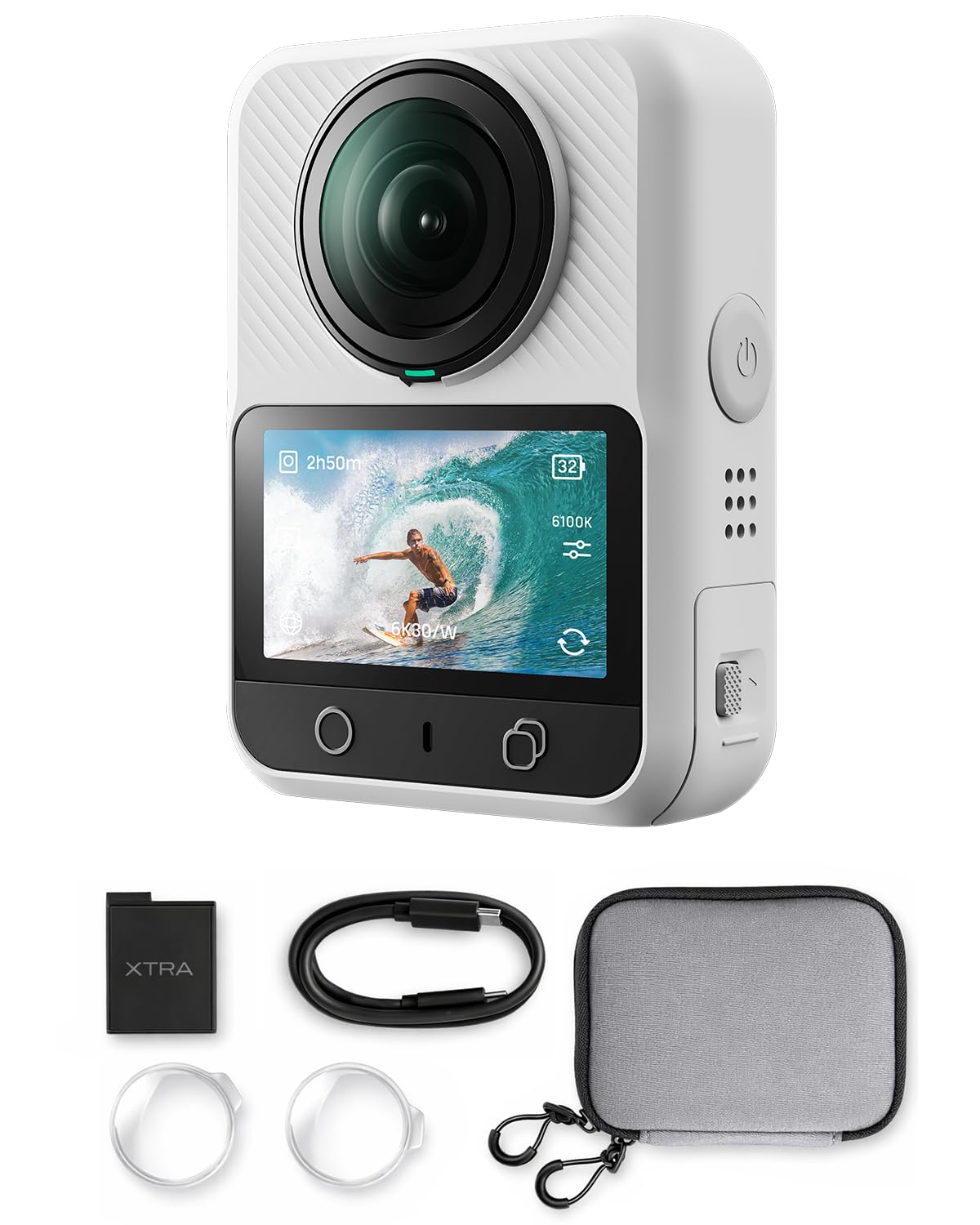
The Xtra 360 Camera enters the market with an aggressive spec sheet: a 1-inch sensor equivalent, native 8K panoramic video, 100MP panoramic photos, and 105GB of built-in storage — all at a budget-friendly price point. The sensor claims to deliver cinema-grade depth and richer colors than the typical 1/2.3-inch action camera, and in bright daylight the results are genuinely impressive. The 8K video captures enough resolution to reframe to 4K without visible artifacts, and the 100MP panoramas stitch together into huge files that look sharp on a monitor.
The 105GB of internal storage means you never have to worry about buying a microSD card, which is a genuine convenience. The magnetic quick-release system is well-designed for fast mounting changes, and the waterproof body handles rain and splashes without issue. The Bullet Time mode is a fun addition, allowing you to swing the camera around for the classic Matrix-style spinning shot.
Where the Xtra falls short is software and workflow. Users report that exporting individual 360 clips for desktop editing in Final Cut Pro is not currently possible, which severely limits its appeal for serious creators. The companion app’s editing tools are basic compared to Insta360 or DJI, and the low-light performance — while better than entry-level 1/2.3-inch cameras — does not match the true 1-inch sensors from DJI or Ricoh. If you want native 8K 360 on a tight budget and primarily shoot in good light, it’s a compelling option, but professional editors will find the workflow restrictive.
Why it’s great
- 1-inch sensor equivalent at a budget-friendly price
- 105GB built-in storage — no microSD needed
- Native 8K video with 100MP panoramic photos
Good to know
- Cannot export individual 360 clips for desktop NLEs
- Basic editing app with limited creative tools
8. GoPro MAX

The GoPro MAX hits a sweet spot for users who want both 360 and traditional action camera modes in one body. The spherical 5.6K30 video is not as high-resolution as the newer 8K generation, but it reframes into clean 1080p clips for social media sharing. The real advantage is the dual-mode design: you can shoot 360 for reframing later, or switch to single-lens HERO mode for 1440p60 widescreen POV footage — effectively carrying one camera that does two jobs. The 16.6MP 360 photos are adequate for social use but won’t compete with 1-inch sensor cameras for detail.
GoPro’s HyperSmooth stabilization is excellent — horizon lock keeps everything level even during aggressive mountain biking or bouncing off rocks. The invisible selfie stick effect works well on a 1/4-20 extension pole, and the GoPro Quik app offers object tracking and simple reframing tools. The Enduro battery included with the latest revision improves cold-weather performance significantly.
The MAX shows its age in several areas. The 5.6K resolution is noticeably softer than 8K competitors when reframing to 4K. The lens glass scratches relatively easily, and there are no user-replaceable lenses on this model — a scratch effectively marks the camera for life. The 16.6MP stills are outclassed by every other camera in this guide for photography. If you want a single rugged camera that can shoot both 360 and traditional action footage without switching devices, the MAX remains a solid mid-range choice.
Why it’s great
- Dual 360 and HERO mode in one rugged body
- Excellent HyperSmooth stabilization with horizon lock
- 1/4-20 mounting threads for standard tripod compatibility
Good to know
- 5.6K spherical video looks softer than 8K when reframing
- Non-replaceable lenses prone to scratches
9. AKASO 360 Action Camera Creator Combo
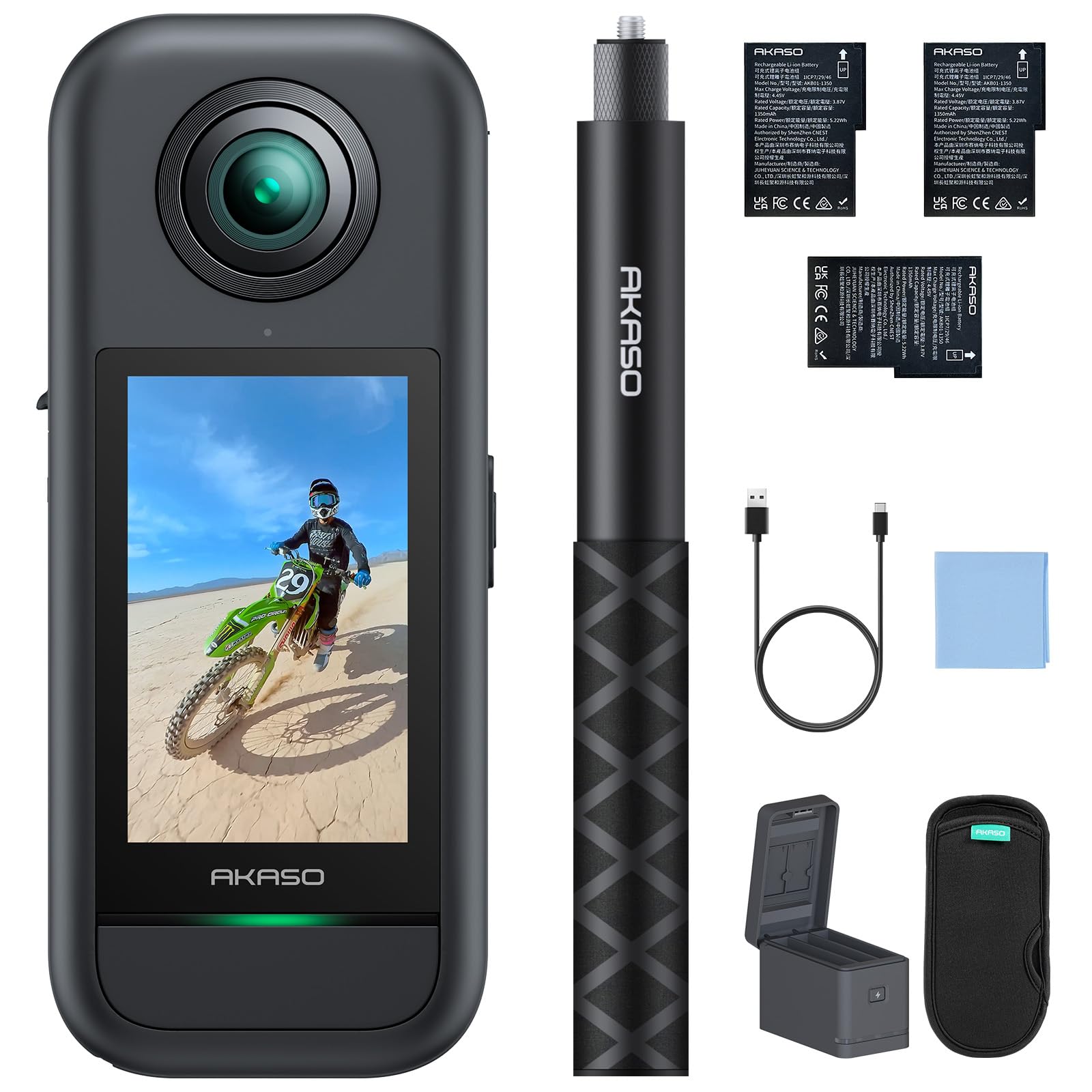
AKASO’s 360 Creator Combo is the most affordable path into 360-degree video, and it punches above its price bracket. Dual 1/2-inch 48MP sensors capture 5.7K spherical video and 72MP 360 photos — both numbers that outclass the GoPro MAX in still resolution. The included invisible selfie stick works surprisingly well, creating convincing third-person shots that vanish from the frame. The in-app stabilization smooths out handheld jitters effectively, and the AI subject tracking keeps a chosen subject centered as they move through the 360 sphere.
The camera is weatherproof against rain and splashes (though not fully waterproof), and the touchscreen interface is intuitive enough for beginners to start shooting immediately. The DNG8 RAW photo mode adds useful editing flexibility, and the ability to record while charging via USB-C means you can shoot indefinitely with a power bank. The AKASO 360 Studio desktop software provides basic reframing and editing tools that get the job done for social media clips.
The compromises are expected at this tier: low-light performance is poor, with noise and detail loss becoming obvious shortly after sunset. The app is functional but lacks the polish of Insta360 or DJI. The standard footage quality is good but not great — fine for social sharing but not for professional work. The camera also requires a high-quality U3 microSD card (sold separately) and the built-in memory is minimal. For beginners who want to test 360 video without a large investment, the AKASO 360 is a low-risk entry point.
Why it’s great
- Lowest-cost entry to 360 video with 5.7K resolution
- 72MP 360 photos and DNG8 RAW support at this price tier
- Invisible selfie stick included in the combo
Good to know
- Low-light video quality degrades quickly after sunset
- App editing tools are basic compared to premium competitors
FAQ
Can I use a 360 VR camera as a normal action camera?
How much storage do I need for 8K 360 video?
Why does invisible selfie stick length matter?
Final Thoughts: The Verdict
For most users, the best 360 vr camera winner is the GoPro MAX2 because it delivers true 8K spherical video, the gold standard in HyperSmooth stabilization, and replaceable glass lenses that protect your investment from the inevitable scratch. If you want the best low-light performance in the category, grab the DJI Osmo 360 Standard Combo with its 1-inch sensors that capture clean, vibrant footage after the sun goes down. And for all-day endurance with AI-powered one-tap exports, nothing beats the Insta360 X5 Essentials Bundle.