
Dropping a 300-pound bank of lead-acid batteries and replacing it with a single 36-volt lithium pack transforms an electric golf cart or trolling motor setup from a weight management chore into a performance tool. The shift isn’t just about shedding pounds — it changes how far you ride, how fast you accelerate up a hill, and how long the power system lasts before you need to think about it again.
I’m Min — the co-founder and writer behind Gadgets Feed. I’ve spent countless hours analyzing cell chemistries, BMS architectures, and real-world discharge curves across dozens of 36V battery systems to separate marketing claims from actual marine and cart performance.
This guide delivers hands-on research into capacity, cycle life, and smart monitoring features so you can confidently choose the right 36v ebike battery for your specific power demands.
How To Choose The Best 36V Ebike Battery
Picking the right 36-volt battery means looking past the Ah sticker and understanding how the BMS, cell chemistry, and physical dimensions work together under your specific load — whether that’s a golf cart climbing a fairway or a trolling motor fighting a current.
Match the BMS to Your Peak Current Demand
A 36V battery’s Battery Management System is the gatekeeper. If your controller or motor pulls 150 amps for a few seconds during startup or hill climbing, a BMS rated at 100A continuous with a 200A peak will cut out. Look for BMS specs that list continuous, 30-second, and 3-second peak ratings — and make sure the peak number exceeds your motor’s surge current.
Capacity vs. Real-World Range
A 100Ah 36V pack stores 3840 watt-hours. In a golf cart drawing around 40 amps at cruising speed, that translates to roughly 2.5 hours of runtime. In a trolling motor pulling 20 amps, you get about 5 hours. Factor in wind, tide, hills, and passenger weight — then add 20 percent headroom to avoid deep discharges that shorten cycle life.
LiFePO4 Chemistry Is the Standard
Lithium iron phosphate cells deliver 4000 to 15000 cycles versus 300 to 500 cycles from lead-acid, and they maintain steady voltage under load instead of sagging. The trade-off is upfront cost, but the per-cycle cost of LiFePO4 is significantly lower for heavy-use applications like daily golf cart operation or weekend fishing trips.
Quick Comparison
On smaller screens, swipe sideways to see the full table.
| Model | Category | Best For | Key Spec | Amazon |
|---|---|---|---|---|
| Cloudenergy GFA36V-105Ah | Premium | Best All-Around Kit | 250A BMS, 6000+ cycles | Amazon |
| VATRER POWER 36V 105Ah | Premium | High Continuous Draw | 200A BMS, 83.8 lbs | Amazon |
| LiTime 36V 100Ah | Mid-Range | Trolling Motor Specialist | ABYC certified, 500A surge | Amazon |
| LOSSIGY 36V 100Ah | Mid-Range | Peak Power for Carts | 1000A peak, 200A BMS | Amazon |
| TEMGO 36V 100Ah Kit | Mid-Range | Complete Upgrade Bundle | 7.68kW, 5000+ cycles | Amazon |
| VEVOR 36V 105Ah | Mid-Range | 50-Mile Range Claim | 200A BMS, 600A peak | Amazon |
| Dumfume 38.4V 100Ah | Mid-Range | Value LiFePO4 Upgrade | 200A BMS, 15000 cycles | Amazon |
| DJLBERMPW 36V 100Ah | Value | Modular 3-Pack System | 100A BMS, 23 lbs each | Amazon |
| Power Queen 36V 50Ah | Budget | Compact Marine Build | Bluetooth 5.0, IP65 | Amazon |
In‑Depth Reviews
1. Cloudenergy GFA36V-105Ah With Charger

The Cloudenergy 105Ah package includes a 20A charger, a 2.8-inch LCD touch monitor, and a mounting strap — everything needed for a straight swap from lead-acid. The built-in 250A BMS handles a 400A surge for 35 seconds and a 600A peak for 3 seconds, which covers even aggressive golf cart controllers without tripping. Users report a 10-mile test that consumed only 6 percent capacity, translating to a real-world range well over 100 miles on a full charge in a moderate golf cart.
A 1999 EZGO TXT owner added a 36V-to-12V converter and reported the cart runs faster and lasts an entire weekend of use without dropping below 50 percent state of charge. The Bluetooth app and LCD screen both display voltage, current, and remaining capacity, giving clear feedback that replaces the guesswork of lead-acid meters. The 61.7-pound weight is a fraction of the six 6V lead-acid batteries it replaces, which typically weigh over 300 pounds.
The ABS casing carries an IP67 rating for dust and water resistance, making it suitable for marine environments and outdoor storage. With 6000-plus deep cycles at 80 percent depth of discharge, this pack should outlast multiple golf cart chassis. The only potential drawback is the 20A charger — upgrading to a faster 25A or 30A model cuts charge time from roughly 5 hours to under 4 if your setup allows.
Why it’s great
- 250A BMS provides headroom for high-torque controllers without cutouts
- Complete kit with charger, monitor, and strap simplifies the conversion
- IP67 casing resists moisture for marine and outdoor cart storage
Good to know
- 20A charger is adequate but slower than premium competitors’ 25A units
- Mounting strap may feel less secure than a custom-built battery tray
2. VATRER POWER 36V 105Ah
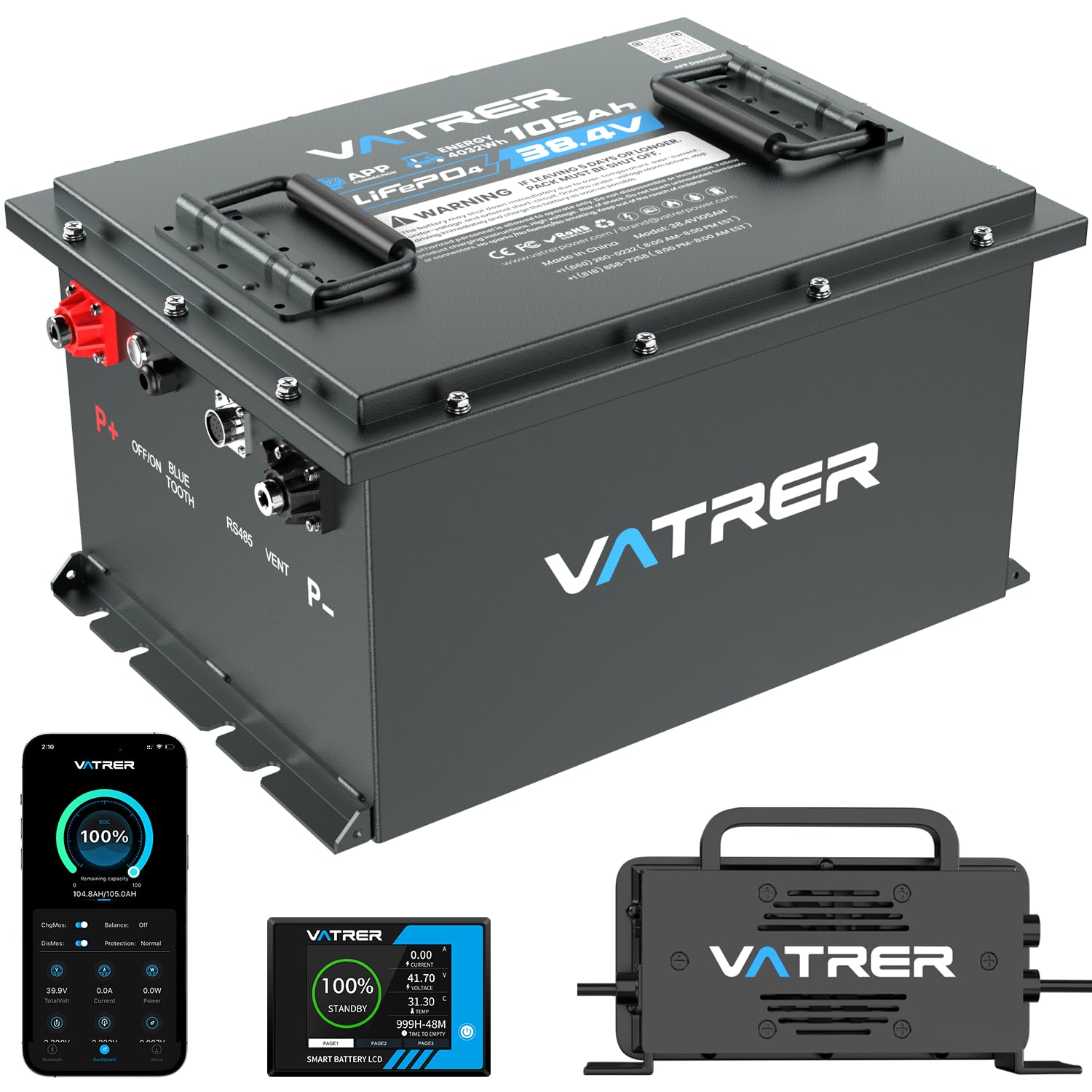
The VATRER POWER 105Ah uses a cold-rolled steel case instead of plastic, giving it a tank-like feel and an IP67 waterproof rating that shrugs off rain and washdowns. Its 200A continuous BMS supports a 400A surge for 35 seconds and a 600A peak for 3 seconds, matching the Cloudenergy on paper but with a heavier build that adds stability in the battery tray. One EZGO TXT owner reported a 30-mile range and a 4-hour recharge time using the included 25A charger.
A second reviewer running three carts noted consistent performance across all units, with the touchscreen providing accurate state-of-charge readings that eliminate the needle-float problem of old lead-acid gauges. The Bluetooth app works from inside the house, so you can check the charge level without walking to the garage. The 83.8-pound weight is higher than most other 105Ah packs, largely due to the steel enclosure, but it’s still less than half the weight of the lead-acid bank it replaces.
Users building trolling motor setups report it powers 112-pound-thrust motors at full speed without voltage sag. The trade-off for the robust case is that you may need to confirm your battery tray dimensions — the 13.1 x 17 x 9-inch footprint is slightly larger than the average 105Ah form factor. The charger ships separately from the battery in some cases, so check delivery tracking for two boxes.
Why it’s great
- Steel IP67 case offers superior physical protection in harsh environments
- 25A charger provides faster recharge than most bundle-included units
- Bluetooth app range is strong enough to monitor from inside the house
Good to know
- Heavier than competing 105Ah packs at 83.8 pounds
- Larger footprint may require battery tray modification for tight fits
3. LiTime 36V 100Ah OBM Bluetooth

LiTime earned ABYC certification for outboard motor compatibility, a distinction that matters when pairing with high-end trolling motors like Torqeedo, ePropulsion, or Garmin Kraken. The 100Ah pack delivers a 500A surge current and a 1.2C continuous discharge rate, with auto-recovery overload protection that resets after 30 seconds if you accidentally exceed the limit. A reviewer running a 112-pound-thrust motor on a 23-foot center console reported 6 hours of fishing in strong tide and still had 87 percent capacity remaining.
The Bluetooth 5.0 monitoring system tracks real-time voltage, current, and capacity, but requires an initial activation charge using a lithium-specific charger — the included 25A unit works perfectly. The IP65 rating handles spray and rain, and the low-temperature cut-off stops charging below 0°C to protect the cells. A Smokecraft owner replaced three heavy gel batteries with this single pack and noted the reduction in front weight noticeably improved the boat’s planing behavior.
The 63.1-pound weight is competitive, and the marine terminals accept large-gauge cables without adapters. The main limitation is the 100A continuous BMS rating — while the 500A surge handles startup loads, sustained high-draw applications like a heavily loaded golf cart on steep grades might push the continuous limit. This battery is optimized for trolling motor duty cycles where average draw stays under 60A.
Why it’s great
- ABYC certification confirms safe integration with outboard motor systems
- 500A surge handles locked-rotor startup on large trolling motors
- Auto-recovery overload protection prevents nuisance lockouts
Good to know
- 100A continuous BMS limits sustained high-draw golf cart applications
- Requires initial activation charge with lithium-specific charger
4. LOSSIGY 36V 100Ah with 25A Charger & Monitor
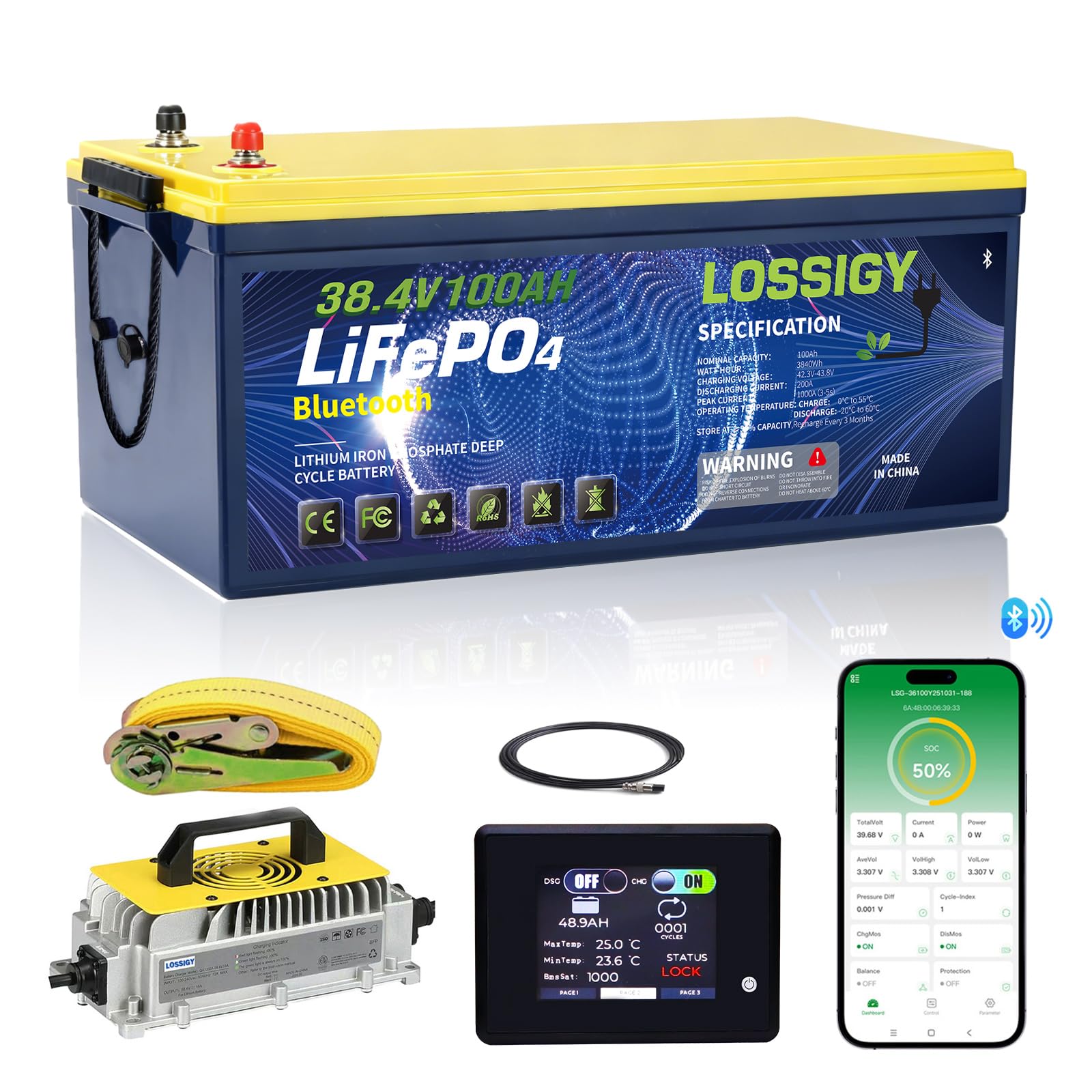
LOSSIGY claims a 1000A peak for 3 to 5 seconds, which is the highest peak current in this roundup and specifically targets golf cart controllers that draw massive surges during initial throttle application. The 200A continuous BMS pairs with Grade A LiFePO4 cells rated for 4000 cycles. A Yamaha G16 owner installed the battery in 30 minutes and reported noticeably faster acceleration and hill-climbing performance compared to old lead-acid packs.
The package includes a 25A charger and a monitoring display that tracks voltage and estimated range. EZGO TXT users report speed increases of 5 mph after shedding the weight of six 6V lead-acid batteries. The 90-day worry-free after-sales service adds confidence early on, though the long-term warranty is 5 years. The battery itself is self-contained with no complex wiring — just connect the main terminals and plug in the monitor cable.
Yamaha G16 owners confirm it works perfectly with the stock controller and motor. The only note is that the monitor cable is relatively short, so plan the display mounting location during installation.
Why it’s great
- 1000A peak current handles the most aggressive golf cart controllers
- 30-minute installation reported by multiple cart owners
- Includes 25A charger for faster top-offs
Good to know
- Monitor cable length may limit display placement options
- Long-term reliability data is limited by the product’s market tenure
5. TEMGO 36V 100Ah Complete Upgrade Kit
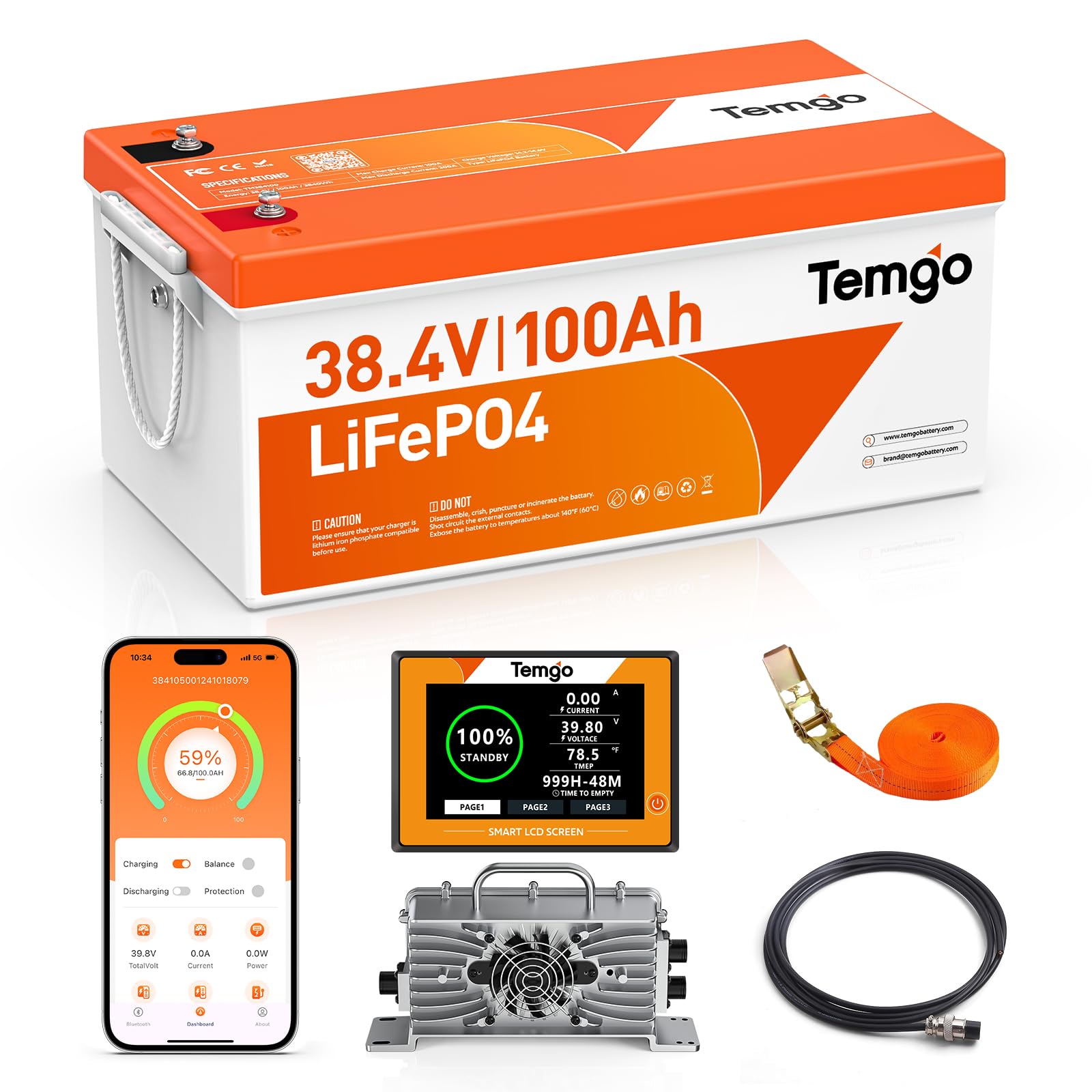
TEMGO bundles the 100Ah battery with a 42.6V 20A charger, a 2.8-inch LCD touch display, and a retention strap — everything needed for a drop-in conversion. The 200A BMS supports 600A peak for 3 seconds, delivering 7.68kW of maximum power. A reviewer who removed six 6V lead-acid batteries from a 36V cart reported a massive weight reduction and noticeably faster speed, with the touch screen accurately showing charge percentage and remaining time to full.
One buyer warned that the physical footprint may not fit older golf carts with center struts, requiring a custom mounting tray. After that adjustment, the same user reported a 5-mile drive consumed only 5 percent of the battery, indicating a real-world range well over 80 miles. The included 20A charger refills the pack from empty in about 5 hours, though upgrading to a 25A charger reduces that to roughly 4 hours.
The Bluetooth app provides remote monitoring of voltage, current, and temperature. The battery supports parallel expansion up to 4 units for a 15.36kWh system, suitable for solar storage or RV backup setups. The product is not compatible with carts that originally used lithium batteries with CAN bus communication, so verify your controller type before ordering.
Why it’s great
- Full kit reduces the number of separate purchases for a conversion
- 5000-plus cycles at 80% DOD provides long-term value
- Parallel support expands usable capacity to 15.36kWh
Good to know
- Large footprint may require tray modification in carts with center struts
- Not compatible with CAN-bus lithium OEM systems
6. VEVOR 36V 105Ah Golf Cart Battery
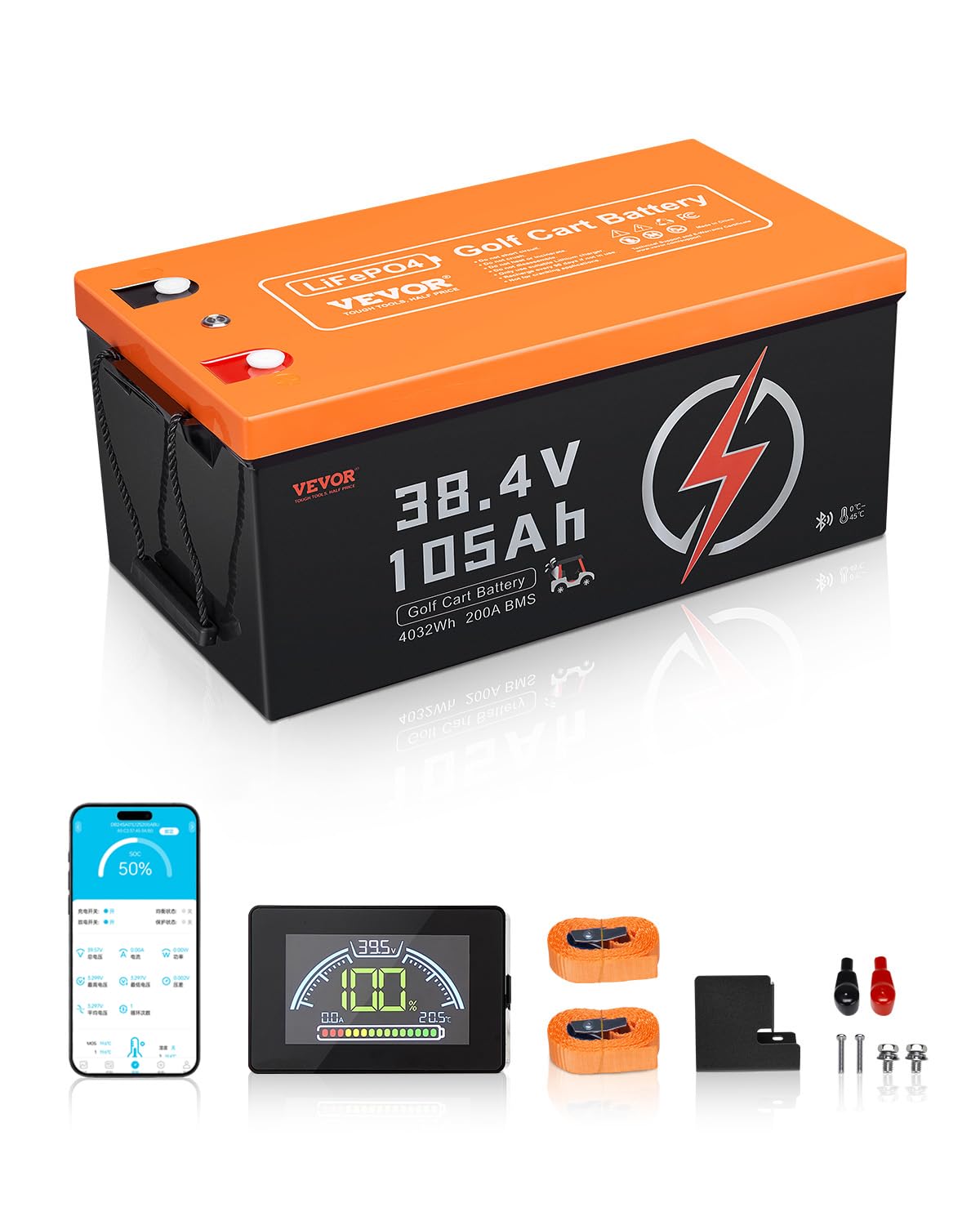
VEVOR’s 105Ah pack features EV-grade LiFePO4 cells and a 200A BMS that supports a 400A maximum discharge for 35 seconds and a 600A peak for 3 seconds. The company claims a 50-mile range on a single charge, which aligns with the 3840Wh capacity in a moderately efficient golf cart. The 2.3-inch LCD screen provides instant visibility into charge and discharge status, and the mobile app offers Bluetooth interaction for remote monitoring.
One reviewer reported that removing 300 pounds of lead-acid batteries made the cart noticeably zippier, and installation required only minor battery tray modifications. The ABS casing with black-and-orange styling fits standard 36V golf cart compartments. A buyer noted that the charger shipped with reversed wiring from the factory, which caused initial charging problems — this appears to be a quality control issue that may not affect every unit.
A long-term reviewer reported the battery failed within 8 weeks and had difficulty reaching customer support, which is a significant red flag for a product in this range. The warranty terms are not clearly stated on the listing. The 62.6-pound weight makes it one of the lighter 105Ah packs, but the mixed reliability feedback makes it a higher-risk choice compared to more established brands.
Why it’s great
- 50-mile range claim fits typical golf cart usage patterns
- LCD and app provide dual monitoring options
- Relatively light at 62.6 pounds for a 105Ah pack
Good to know
- Mixed reliability reports from verified purchasers
- Customer support responsiveness is inconsistent
7. Dumfume 38.4V 100Ah LiFePO4
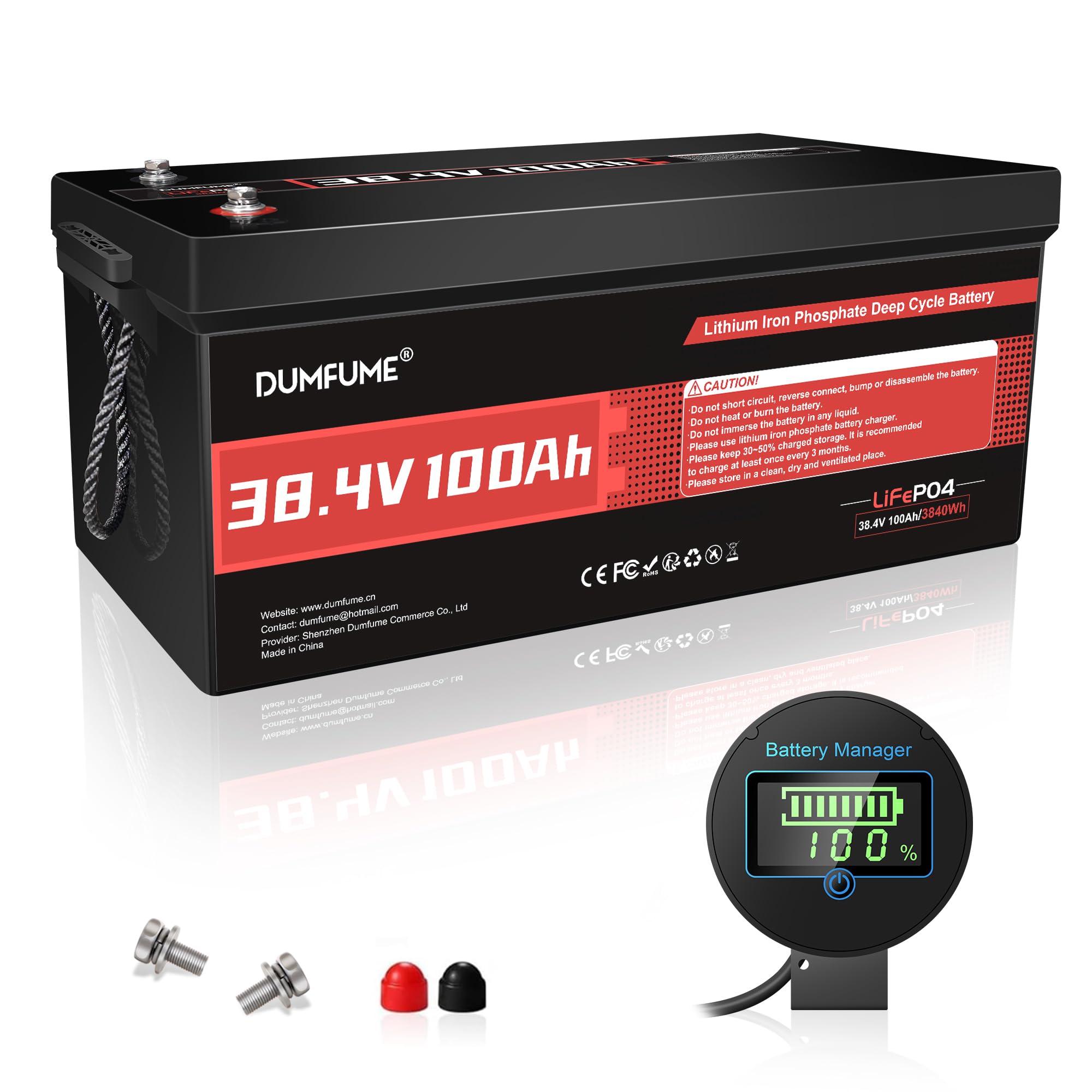
Dumfume’s 100Ah pack uses A+ grade cylindrical cells with full-lug technology designed to reduce internal resistance for better acceleration and hill-climbing. The 200A BMS provides standard protection against overcharge, over-discharge, overcurrent, and short circuits, with an operating temperature range of -20°C to 60°C. The 15000-cycle claim at 60% depth of discharge is among the highest in this comparison, though real-world cycle life depends heavily on average discharge depth.
The 68.8-pound weight is moderate for a 100Ah pack, and the lithium chemistry reduces weight by about 63 percent compared to a lead-acid bank of equivalent capacity. A reviewer using it in a 36V EZGO TXT reported initial BMS cutout due to a current spike from controller capacitors, which was resolved by pre-charging the battery. Once running, both the 36V and 48V versions provided reliable power for daily cart use.
A long-term user reported the battery failed after 1 year of use in a campervan, with the BMS entering low-voltage cutoff and the solar charger unable to recover the cells. The 5-year warranty applies only to direct purchases from Dumfume, not Amazon orders. This distinction means buyer protection depends on the purchase channel, which adds risk for Amazon shoppers.
Why it’s great
- Full-lug cylindrical cells reduce internal resistance for better torque
- 15000-cycle rating at 60% DOD promises exceptional longevity
- 63% weight reduction over lead-acid improves handling and speed
Good to know
- Warranty only valid for direct purchases, not Amazon orders
- Some units required jump-charging to activate the BMS
8. DJLBERMPW 36V 100Ah 3-Pack System

DJLBERMPW takes a modular approach — three 12V 100Ah LiFePO4 batteries wired in series to create a 36V 100Ah system with 3840Wh of capacity. Each unit weighs only 23 pounds, making them easy to move and arrange in odd-shaped battery compartments where a single large pack won’t fit. The 100A BMS on each battery provides protection, but the effective system continuous current is limited by the series wiring to 100A total.
A reviewer who swapped six lead-acid batteries in an EZGO TXT reported saving 264 pounds, improving speed, and achieving 24.2 miles of range with lights on before voltage dropped from 42V to 39.1V. The total swap cost was under , making this the most budget-friendly 100Ah option in this roundup. Another user runnings a 24V trolling motor with two packs reported 5 hours of use with battery still showing 100%, and excellent customer support when one unit failed.
The modular design also allows parallel expansion — up to 4S4P for a 48V 400Ah system with 20.48kWh of energy. The downside is the 100A BMS limits sustained high-draw applications. Golf carts drawing 150A continuous will hit the BMS ceiling. These packs are best suited for moderate loads where the three-unit form factor solves a space problem.
Why it’s great
- Modular 23-pound units fit into tight or oddly shaped compartments
- 264-pound weight savings over lead-acid in a typical golf cart
- Excellent customer support responsiveness reported by multiple users
Good to know
- 100A system BMS limits sustained high-draw applications
- Requires wiring three units in series, adding installation complexity
9. Power Queen 36V 50Ah LiFePO4 with Bluetooth
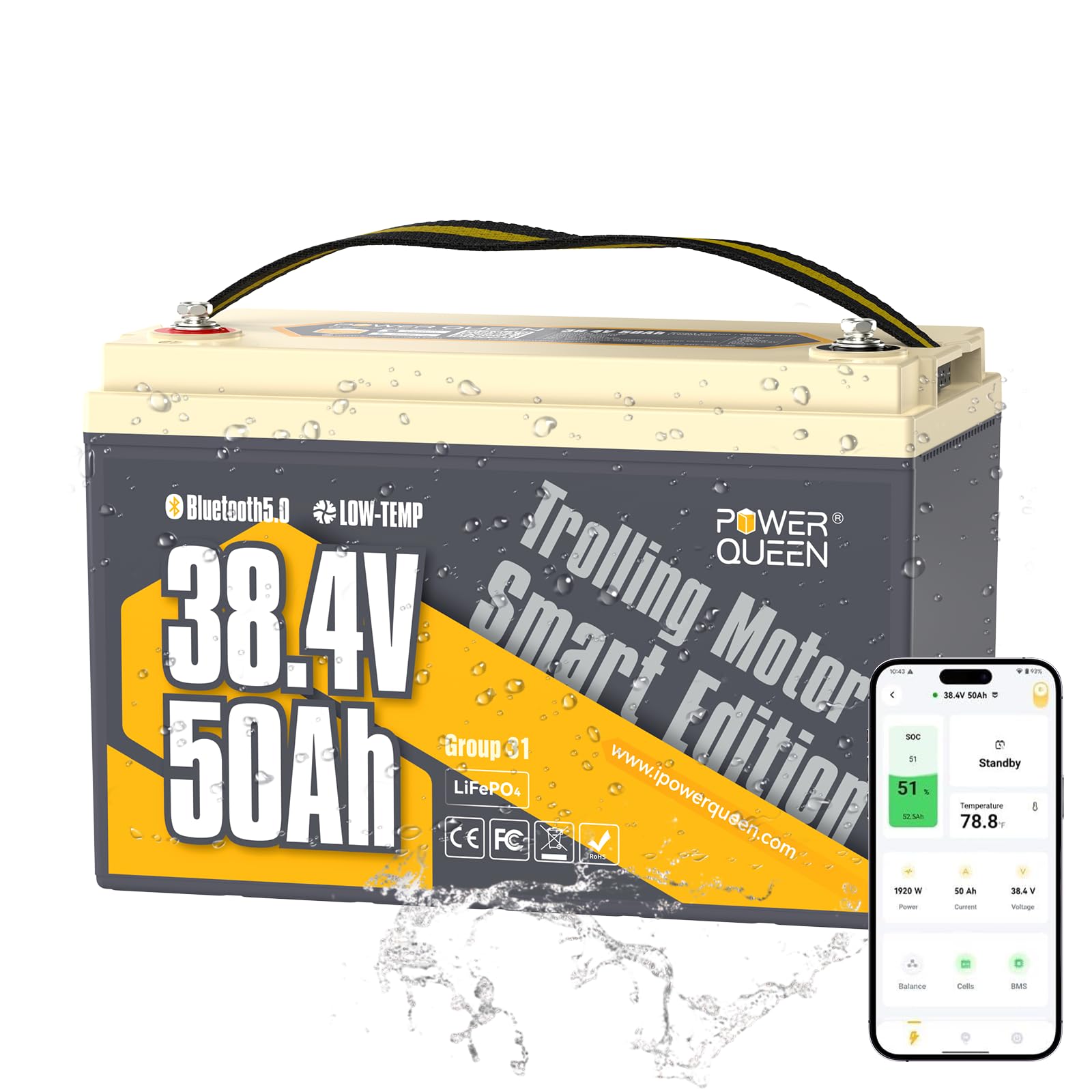
The Power Queen 50Ah is the compact option in this roundup, with a group 31 form factor (13 x 6.77 x 8.5 inches) that fits in spaces where larger packs won’t. The Bluetooth 5.0 remote control allows real-time monitoring of voltage, current, and state of charge from up to 10 meters away. The 1920Wh capacity (50Ah x 38.4V nominal) is designed for lighter loads — a Minn Kota Ulterra user reported it lasted all day in moderate fishing conditions.
The IP65-rated ABS housing resists water and dust, making it suitable for marine environments where splash exposure is common. The built-in low-temperature charging protection stops the charging process below 0°C and resumes above 5°C to protect the cells. A bay boat owner replaced three 12V group 27 lead-acid batteries and reported 8 hours of fishing with only 45 percent of the battery consumed, even in 10-15 mph wind conditions.
The 50A continuous discharge (60A peak for 30 minutes) limits this pack to trolling motors up to 120 pounds of thrust. Golf cart use is not recommended. One user reported Bluetooth connection difficulties and charging issues, though the majority of reviews are positive. The 5-year warranty provides reasonable coverage for the purchase.
Why it’s great
- Compact Group 31 size fits tight spaces where larger packs won’t
- IP65 rating handles marine splash environments effectively
- Bluetooth 5.0 provides reliable remote monitoring up to 10 meters
Good to know
- 50A continuous discharge limits use to trolling motors under 120 lbs thrust
- Some users report Bluetooth pairing difficulties
FAQ
Can I use a 36V lithium battery in a golf cart originally designed for lead-acid?
What does the AH rating mean for my runtime?
Do I need a special charger for LiFePO4 batteries?
Final Thoughts: The Verdict
For most users, the 36v ebike battery winner is the Cloudenergy GFA36V-105Ah because it combines a robust 250A BMS, a complete kit with charger and monitor, and the highest cycle life rating among the all-in-one offerings. If you want a trolling-motor-specific battery with ABYC certification and auto-recovery overload protection, grab the LiTime 36V 100Ah. And for the budget-conscious builder who needs flexibility in compartment layout, the modular DJLBERMPW 3-pack system provides unbeatable value per Ah in a space-saving format.