
Choosing a 36V lithium battery means navigating a landscape where voltage compatibility, energy density, and BMS sophistication separate reliable daily power from a frustrating paperweight. Whether you are repowering a trolling motor on a 23-foot bay boat, swapping out a half-ton of lead-acid bricks in a golf cart, or building a compact off-grid solar bank, the wrong chemistry or protection circuit will cost you time and money at the worst possible moment. This guide isolates the models that earn their keep through real-world cycle life, cold-weather resilience, and communication features that let you trust the readout.
I’m Min — the co-founder and writer behind Gadgets Feed. I’ve spent hundreds of hours analyzing the technical specifications, customer reliability data, and compatibility requirements that matter most in this specific voltage class, so you can shop with a clear hierarchy of what actually matters under the casing.
After evaluating energy capacity, BMS intelligence, and application-specific design across seven contenders, here is the definitive breakdown of the best 36v lithium battery for marine, golf cart, and backup storage systems.
How To Choose The Best 36V Lithium Battery
36V lithium batteries are not commodity items. The difference between a pack that lasts a full day on the water and one that cuts out after an hour comes down to three critical decisions: chemistry type, BMS capability, and physical compatibility with your existing system. Here is how to weigh each factor.
Chemistry: LiFePO4 vs. Standard Li-Ion
Almost every serious 36V battery in this class uses Lithium Iron Phosphate (LiFePO4) chemistry. LiFePO4 offers over 4,000 deep discharge cycles compared to roughly 500 for lead-acid, thermal runaway resistance that makes it inherently safer, and a flat discharge curve that delivers consistent voltage until the very end of the charge. Standard lithium-ion (like NMC) packs higher energy density in a smaller footprint, but for marine and golf cart use cases where safety and longevity are the priority, LiFePO4 is the clear standard.
The BMS Is the Brain
The Battery Management System is the circuit board inside that prevents overcharge, over-discharge, short-circuit, and thermal extremes. A weak or poorly calibrated BMS is the most common cause of premature battery failure. Look for a unit with an amp rating matching or exceeding your motor’s peak draw — 100A for most trolling motors up to 120 lbs thrust, and 200A for golf cart applications that require hill-climbing bursts. Bluetooth connectivity for real-time voltage, current, and temperature monitoring is no longer a luxury; it is the smart buyer’s standard for diagnosing issues before they escalate.
Physical Fit and Weight Reduction
A single 36V lithium battery replaces three series-wired 12V lead-acid batteries in both trolling motor and golf cart setups. That means you are cutting total weight from roughly 150-180 lbs to 30-55 lbs depending on Ah capacity. However, the footprint is not always identical. Check the length, width, and height against your existing battery tray — the BCI Group 31 form factor (13 x 6.77 x 8.5 inches) is common among 50Ah trolling motor packs, while 100Ah golf cart units range from 10-20 inches in length. Measure your compartment before ordering.
Cold-Weather Charging Protection
LiFePO4 cells suffer permanent damage if charged below 0°C (32°F). Reputable 36V batteries include a low-temperature protection circuit that disables charging below a set threshold (typically 0°C or 19.4°F) and automatically resumes when the temperature rises above 5°C. If you store your boat, RV, or cart in an unheated garage through the winter, this feature is non-negotiable to avoid bricking an expensive pack in the first season.
Quick Comparison
On smaller screens, swipe sideways to see the full table.
| Model | Category | Best For | Key Spec | Amazon |
|---|---|---|---|---|
| Power Queen 36V 50Ah | LiFePO4 | Marine / Trolling Motor | Smart Bluetooth 5.0 BMS | Amazon |
| LiTime 36V 50Ah TM | LiFePO4 | High-Density Marine Power | 57.93 Wh/lb Energy Density | Amazon |
| Stihl AP 300 S | Li-Ion | Stihl Pro Power Tools | 281 Wh Rated Energy | Amazon |
| Dumfume 38.4V 100Ah | LiFePO4 | Golf Cart / Utility Vehicle | 15,000 Deep Cycles | Amazon |
| OKMO 36V 50Ah | LiFePO4 | Budget Marine / Backup | 1920Wh, 100A BMS | Amazon |
| DC HOUSE 36V 50Ah | LiFePO4 | Golf Cart / Slope-Climbing | 2C Rate, 100A Bluetooth BMS | Amazon |
| TEMGO 38.4V 100Ah Kit | LiFePO4 | All-In-One Golf Cart Upgrade | LCD Display + App | Amazon |
In‑Depth Reviews
1. Power Queen 36V 50Ah LiFePO4 Battery with Bluetooth 5.0
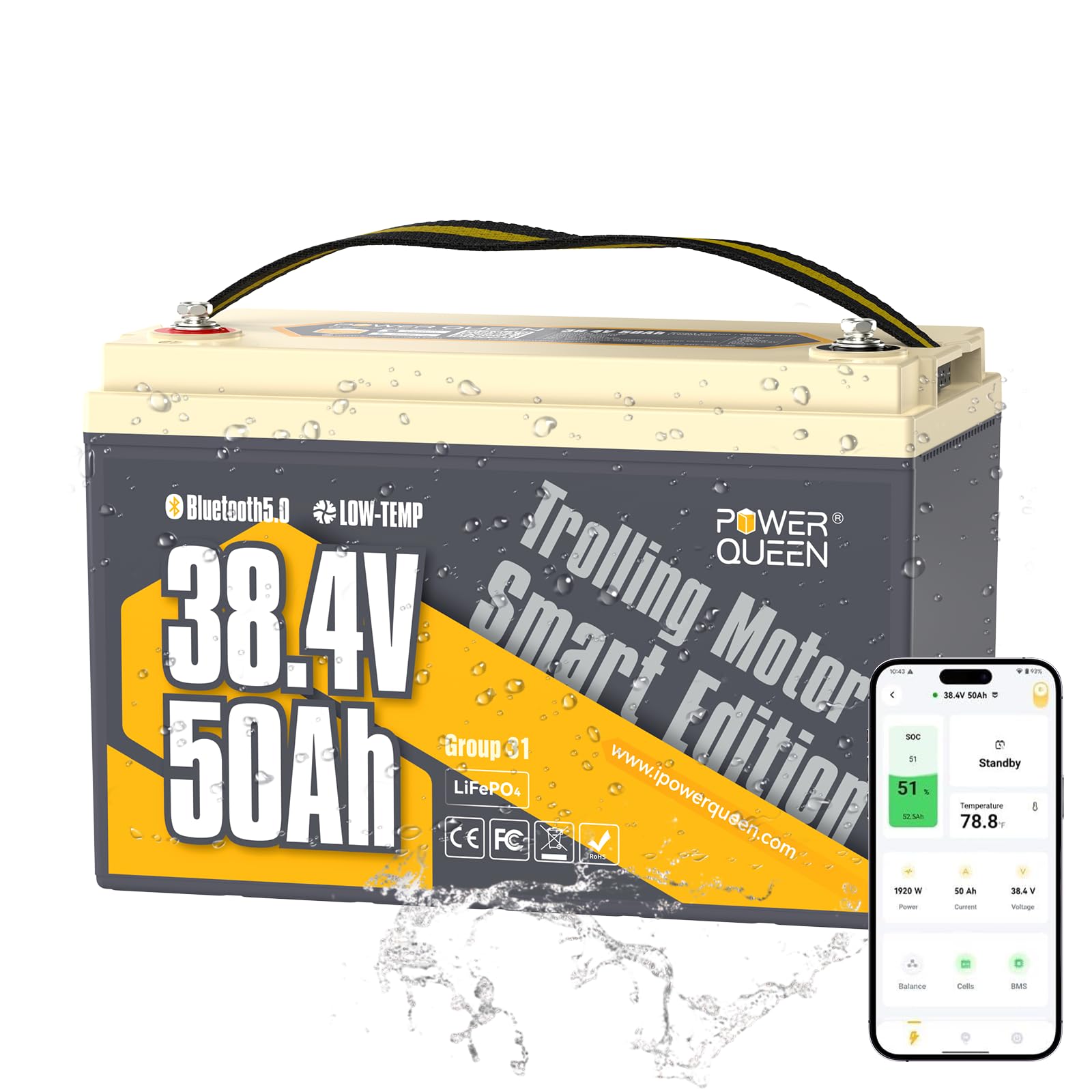
The Power Queen 36V 50Ah delivers the most balanced feature set for marine environments, combining smart Bluetooth monitoring with an IP65 water and dust resistance rating that few competitors match. Its 1920Wh energy capacity feeds a 50A continuous discharge (60A peak for 30 minutes), enough to run trolling motors up to 120 lbs thrust through an entire tournament day — verified by a customer who still had 45% remaining after 8 hours of fishing in 15 mph wind.
Bluetooth 5.0 integration is a genuine diagnostic tool, not a gimmick. The app provides real-time voltage, current, temperature, and state-of-charge data within 10 meters, which proved critical for one reviewer who monitored the battery across multiple trips and observed only 32% depletion after five outings including windy conditions. The BCI Group 31 footprint (13 x 6.77 x 8.5 inches) and 33.1-pound weight make it a direct drop-in replacement for three Group 27 lead-acid batteries, cutting roughly 120 lbs from the stern.
The low-temperature charging protection halts charge below 0°C and resumes above 5°C, a feature that safeguards the pack during winter storage. A small trade-off: the battery accepts a maximum charge rate of 10A, so pairing it with a high-amperage charger provides no speed benefit. Also, the Bluetooth function requires an initial power-on via charging for 3-10 seconds, a detail some users miss on first setup.
Why it’s great
- Reliable Bluetooth BMS with real-time telemetry for voltage, current, and cell balance
- IP65 rated housing resists water spray and dust ingress in marine bilges
- Low-temperature charging protection prevents permanent cold-weather cell damage
Good to know
- Maximum charge rate is 10A — a high-amperage charger will not accelerate recharge
- Bluetooth activation requires an external LiFePO4 charger power cycle on first use
2. LiTime 36V 50Ah TM LiFePO4 Battery

The LiTime 36V 50Ah TM is engineered for the angler who demands maximum runtime from every pound of weight. Its 57.93 Wh/lb energy density is 10.85% higher than the typical 12V 100Ah TM battery, meaning you get more usable watt-hours in a 33.1-pound package. A customer running a 112 lb thrust Minn Kota Ultrex on an 18-foot bass boat reported 11-12 hours of continuous use at speed settings 4-6 in current and wind, with recharge time at roughly 3 hours using the matching LiTime 43.8V 18A charger.
The integrated 50A BMS covers overcharge, over-discharge, short-circuit, and low/high-temperature events, with a 60A peak discharge window lasting 30 minutes for occasional high-draw situations. Users praised the compact BCI Group 31 footprint that fits snugly in marine battery trays designed for three 12V group 27 batteries. The absence of Bluetooth or an SOC display is a deliberate trade-off to keep the cost accessible, though some buyers prefer the simplicity of a cable-top terminal and a printed manual rather than a smartphone app.
LiTime is a member of both ABYC and ASA, adding a layer of third-party standards verification. The 5-year after-sales service includes phone support and a responsive online team, which one reviewer leveraged when troubleshooting their initial setup. Note that this battery is optimized for energy storage, not engine starting, and the maximum continuous discharge rate of 1C (50A) means it is intended for steady-state loads, not high-surge applications.
Why it’s great
- Industry-leading 57.93 Wh/lb energy density packs more runtime per pound than most 36V competitors
- Achieves 11-12 hours on a 112 lb thrust motor with consistent voltage delivery
- ABYC and ASA member — built to recognized marine industry standards
Good to know
- No Bluetooth or state-of-charge display — relies on external monitoring equipment
- BMS limits continuous discharge to 50A (1C) — not intended for high-surge starting applications
3. Stihl 48504006580 AP 300 S Lithium-Ion Battery, 36V 281 Wh

The Stihl AP 300 S is the only non-LiFePO4 36V battery in this lineup, using a traditional lithium-ion chemistry optimized for high-drain handheld power tools within the Stihl Pro battery system. Rated at 281 Wh with a 4,000 mAh capacity, this pack is designed for chainsaws, blowers, and trimmers that require quick bursts of current rather than the sustained deep cycling of marine or golf cart applications. The LED charge status indicator lets users check remaining capacity at a glance without removing the battery from the tool.
Compatibility is strictly tied to Stihl’s PRO ecosystem and the AL 101, AL 300, and AL 500 chargers. Owners report long runtimes across multiple tool swaps — one reviewer noted the AP 300 S performed better than their original Stihl battery after a year of regular use, while another pointed out the convenience of having a second battery to avoid downtime on the job. At 1.8 kg (4 lbs), it is dramatically lighter than any marine 36V pack, though the energy storage is proportionally smaller (281 Wh vs. 1,920 Wh in a 50Ah LiFePO4 unit).
If you are adding a spare or replacing an aging Stihl Pro battery, the AP 300 S is a straightforward OEM-grade choice. It is not suitable as a standalone power station, nor can it be adapted to trolling motors or solar systems without proprietary Stihl hardware. The higher cost per Wh compared to LiFePO4 competition is justified only by guaranteed compatibility and the specific bolt-in form factor of Stihl’s AP mount.
Why it’s great
- Genuine Stihl OEM replacement with guaranteed fit and charger compatibility
- LED charge indicator on the pack provides instant visual state-of-charge feedback
- Lightweight 4-pound design delivers 281 Wh for extended pro tool runtime
Good to know
- Locks into the Stihl Pro battery platform — not compatible with marine, golf cart, or off-grid systems
- Wh-per-dollar ratio is significantly lower than general-purpose LiFePO4 36V packs
4. Dumfume 38.4V (36V) 100Ah LiFePO4 Golf Cart Battery
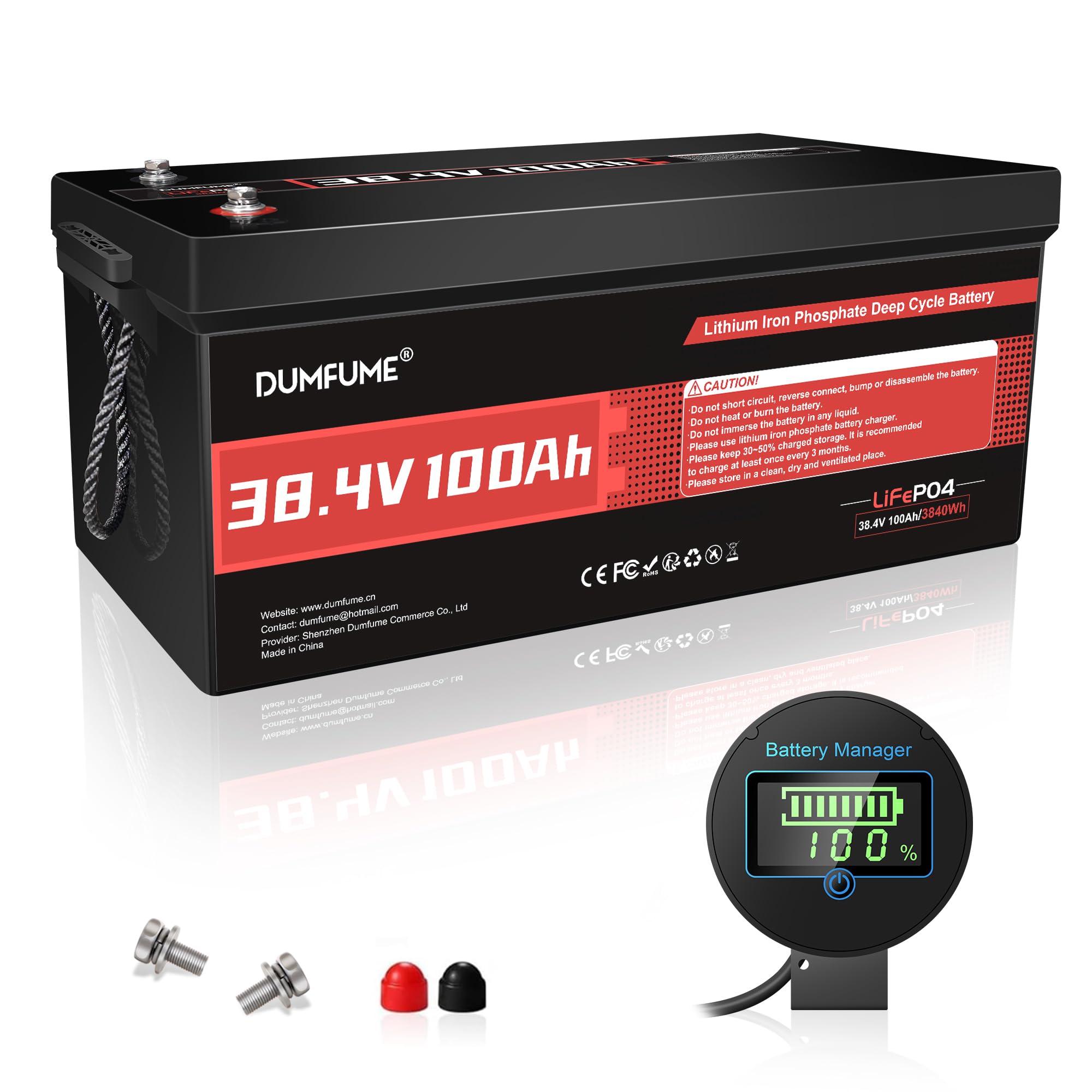
The Dumfume 38.4V 100Ah is built from the ground up for golf cart propulsion, featuring A+ grade cylindrical cells with full-lug technology that reduce internal resistance for better acceleration and hill-climbing performance. The integrated 200A BMS handles the high inrush current typical of controller capacitors and steep-grade starts — a scenario one reviewer encountered on a 36V EZGO, where the BMS initially cut out due to a current spike, then resolved after a brief charging cycle. Rated at 15,000 deep cycles with a 10-year lifespan, this pack dramatically outlasts lead-acid which typically fails within 2-3 years in the same application.
Weighing 68.78 pounds, the Dumfume cuts roughly 63% of the weight from a standard six-battery 36V lead-acid setup. The low internal resistance also enables 50% faster charging compared to lead-acid, and the <3% monthly self-discharge rate means the cart stays ready after prolonged idle periods. One reviewer purchased four units for solar backup and confirmed that each exceeded its rated capacity by roughly 7 Ah after a year of twice-weekly cycling.
A notable caveat: some customers reported that units shipped from Amazon arrived at reduced voltage (12.2-12.4V) and required a parallel jump charge to bring the BMS online, while batteries ordered directly from Dumfume arrived at nominal voltage. The 5-year warranty is explicitly applicable only to direct purchases, not Amazon orders — a distinction that could affect long-term support. Additionally, battery performance requires ambient temperatures of 5°C or higher for charging, and return shipping for cold-related issues is not covered.
Why it’s great
- 200A BMS with full-lug cylindrical cells provides strong hill-climbing torque for 36V golf carts
- 15,000 deep-cycle rating and 10-year lifespan drastically outlast lead-acid alternatives
- 63% weight reduction from six 6V lead-acid batteries improves cart speed and handling
Good to know
- Amazon-purchased units may arrive at low voltage and require a parallel jump charge to activate
- 5-year warranty applies only to direct-from-Dumfume purchases, not Amazon orders
5. OKMO 36V 50Ah LiFePO4 Trolling Motor Battery
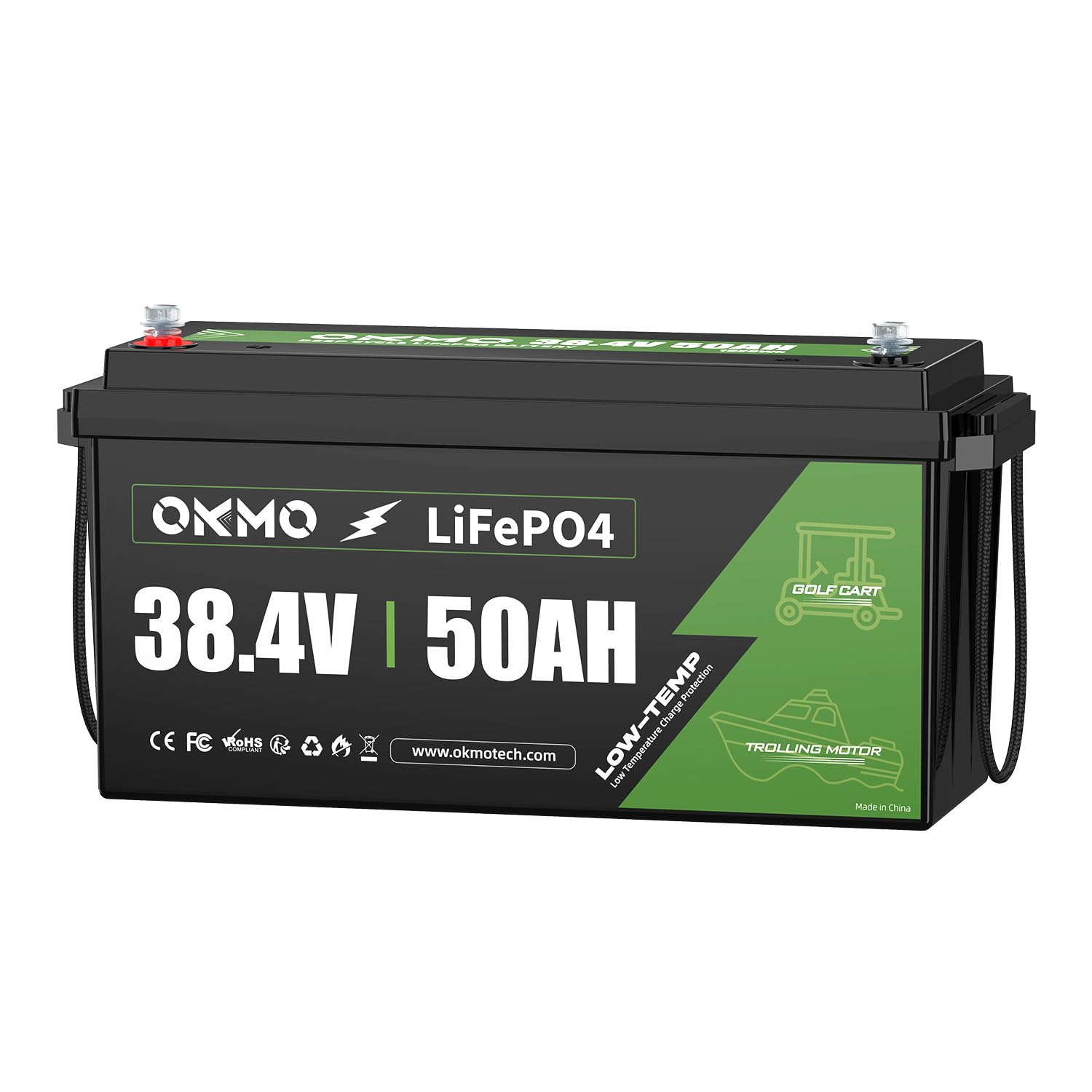
The OKMO 36V 50Ah delivers a compelling entry point into 36V LiFePO4 ownership without sacrificing the critical safety features that protect the investment. It packs 1,920 Wh of energy into a 49.83-pound rectangular case with integrated handles, running a 100A BMS that covers overcharge, deep discharge, overheating, and short-circuit conditions. Low-temperature protection ensures the battery will not attempt to charge below freezing, a feature often missing from budget-tier lithium packs.
Users have deployed this battery in diverse scenarios — one reviewer wired two units in series for a 24V electric outboard and reported strong amp-hour delivery after replacing a defective unit (the company sent a replacement after verification). Another customer integrated it into a homemade portable power station inside a waterproof ammo box, measuring a stable 14 Ah average draw to power 12V test gear, laptops, and LED lighting. The square form factor and top-mounted handles make it easier to mount in tight compartments compared to some rectangular marine batteries.
The biggest reliability concern comes from two reviewers: one reported a single dead-on-arrival unit that was replaced, and another experienced total failure of two out of four batteries within a year — both units stopped accepting a charge entirely. While the 5-year warranty provides a path for resolution, the failure rate reported in reviews is higher than the premium-tier competition. The M8 terminal bolts and included insulating caps are a nice touch, but the lack of any Bluetooth or display panel means you will need a separate voltmeter or coulomb counter to track state of charge accurately.
Why it’s great
- 100A BMS with low-temperature protection and 1,920Wh capacity at a budget-conscious price point
- Square case with built-in handles eases mounting in marine compartments and portable power stations
- 5-year warranty coverage with customer support that replaced a defective unit for one reviewer
Good to know
- A minority of customers report units that fail to charge after a year of use, raising long-term reliability questions
- No Bluetooth or display — requires external monitoring equipment to track state of charge
6. DC HOUSE 36V 50Ah LiFePO4 Golf Cart Battery with Charger
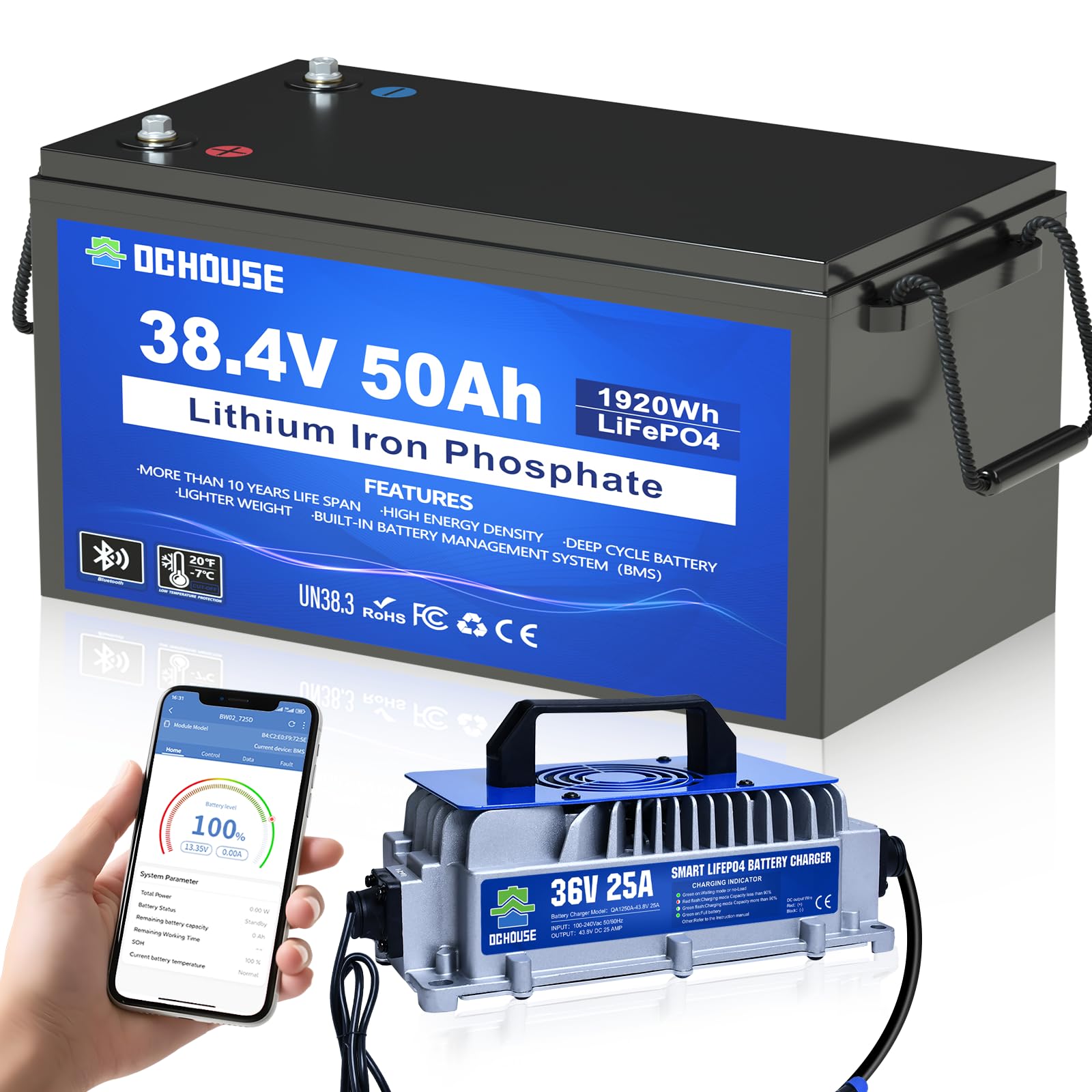
The DC HOUSE 36V 50Ah stands apart with its 2C discharge rate, meaning it can safely deliver 100A continuous (peak 120A for 30 seconds and a staggering 450A for 1 second) — a spec that matters for climbing steep inclines or accelerating through soft turf in a golf cart. The internal battery cells are secured by a 2.2-pound metal fixture that stabilizes the cells against vibration and expands the life by an estimated 30% compared to simpler securing methods. The package comes complete with a 36V 25A LiFePO4 charger that supports 0V activation, enabling a full recharge in about 2 hours.
At 44.1 pounds and 14.4 x 7.4 x 10.7 inches, this unit is notably more compact than five or six series-wired lead-acid batteries, freeing up storage space in the cart. The 100A Bluetooth BMS feeds real-time data to a smartphone app, including voltage, current, and temperature readings. Low-temperature protection cuts off charging below 19.4°F and discharging below 4°F, automatically restoring function once the temperature rises above 32°F — a thermal management scheme designed for four-season outdoor storage.
The battery and the 25A charger ship in separate packages due to the combined weight, so the arrival of only one box initially may cause minor confusion. The M8 terminals are standard, but for installations using OT ring terminals thinner than 2mm, gaskets are required to prevent loosening under vibration. The stackable design supports up to 2 units in parallel (2P1S configuration), expanding available capacity without requiring a complete rewiring.
Why it’s great
- 2C (100A) continuous and 450A peak discharge handles steep hill climbing and high-torque golf cart loads
- 2.2lb internal metal cell fixture improves vibration resistance and extends service life by an estimated 30%
- Complete kit includes a 36V 25A LiFePO4 charger for a reliable 2-hour recharge time
Good to know
- Ships in two separate packages — the battery and the charger may arrive on different days
- Requires gaskets for OT terminals thinner than 2mm to prevent loosening from cart vibration
7. TEMGO 38.4V (36V) 100Ah LiFePO4 Golf Cart Battery Kit
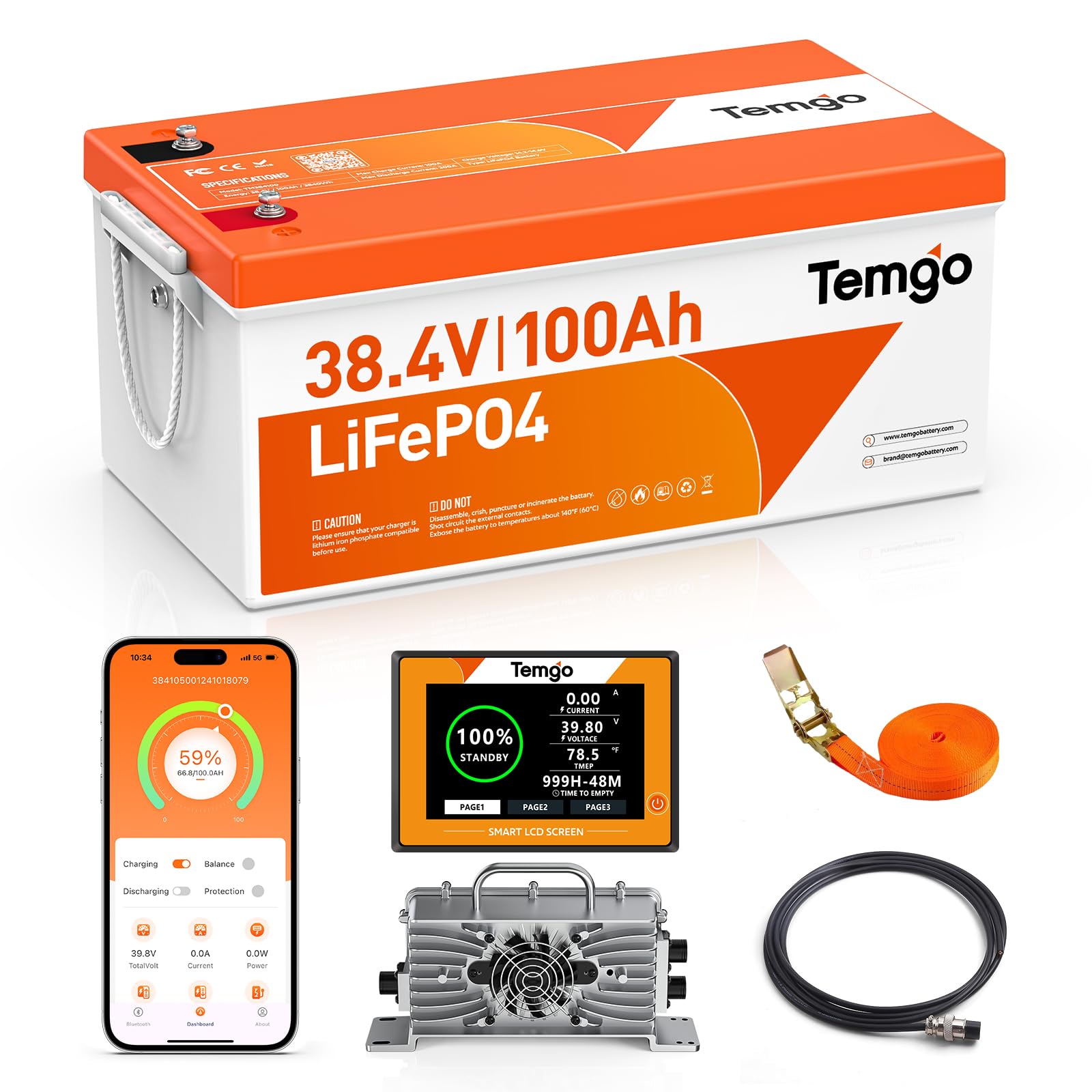
The TEMGO 38.4V 100Ah is the most comprehensive drop-in solution for golf cart owners who want everything in one box: the battery, a 42.6V 20A charger, a 2.8-inch LCD touch display for real-time monitoring, and a retention strap. The 200A BMS handles 200A continuous discharge with a 600A surge for up to 3 seconds — ample power for the controller inrush that can trip less capable systems. The LCD display shows voltage, charge percentage, and a countdown to full charge, while the Bluetooth app provides identical telemetry on a smartphone.
Reviewers highlight the dramatic transformation: dropping 200+ lbs of lead-acid from a 36V cart noticeably improves acceleration and speed. One owner reported that after replacing six 6V batteries, their cart “runs like NEW and is faster,” with the screen readout accurately reflecting range. The kit supports up to 4 units in parallel for a maximum of 15.36 kWh of usable energy, making it scalable for solar backup or off-grid storage. The premium A-grade LiFePO4 cells are rated for 5,000+ deep cycles at 80% depth of discharge, representing over 10 times the cycle life of lead-acid.
Two physical-fit considerations: older golf carts with a center strut in the battery compartment may not accommodate the battery’s 20.67-inch length without custom mounting, as one reviewer discovered. A return for that reason incurs an restocking fee. Also, this battery is not compatible with carts that originally came with lithium packs and require CAN bus communication — it is designed for lead-acid to lithium conversions running standard 36V controllers. Verify the overall cart system voltage and tray dimensions before purchasing.
Why it’s great
- Complete kit includes LCD touch display, 20A charger, and retention strap for a seamless lead-acid conversion
- 200A continuous / 600A peak BMS provides reliable power for controller inrush and hilly terrain
- 5000+ deep cycles at 80% DOD with up to 4 units in parallel for 15.36 kWh scalable storage
Good to know
- Length (20.67 inches) may not fit older golf cart trays with center struts — measure before ordering
- Not compatible with carts using CAN/communication protocols from factory lithium systems
FAQ
Can I replace three 12V lead-acid batteries with a single 36V lithium battery in my trolling motor?
Why does my 36V lithium battery ship with a warning about low-temperature charging?
Should I buy a 36V battery with Bluetooth monitoring for my golf cart?
Can I parallel two 36V LiFePO4 batteries for more capacity?
Final Thoughts: The Verdict
For most users, the best 36v lithium battery winner is the Power Queen 36V 50Ah because it combines smart Bluetooth monitoring, IP65 environmental sealing, and a 50A BMS that handles the full range of 36V trolling motors up to 120 lbs thrust — all in a compact Group 31 footprint that fits existing trays. If you want the highest energy density for extended marine runtime, grab the LiTime 36V 50Ah TM with its 57.93 Wh/lb advantage. And for a golf cart upgrade that includes everything from the charger to a live LCD display, nothing beats the TEMGO 38.4V 100Ah Kit.