
Our readers keep the lights on and my morning glass full of iced black tea. As an Amazon Associate, I earn from qualifying purchases.
Specs are compiled from manufacturer listings and verified buyer reviews and can change over time — please confirm the key details on the product page before buying.
If you heat with wood, you know the real bottleneck isn’t the saw — it’s the hours of swinging a maul. A 37-ton hydraulic splitter changes that math entirely, turning a weekend-long chore into an afternoon of pulling a lever. This guide focuses on machines in the 35 to 40-ton range, the balance for dense hardwood like oak and hickory.
I’m Min — the founder and writer behind Gadgets Feed. This guide is built by comparing the manufacturers’ published specifications and the patterns across verified customer reviews, so you get each pick’s real strengths and trade-offs instead of marketing spin.
To help you skip the research, we’ve ranked the 37 ton wood splitter options that deliver the fastest cycle times and the most reliable engines.
Our Picks at a Glance


How To Choose The Best 37 Ton Wood Splitter
Shopping for a big gas splitter depends on three numbers: tonnage, cycle time, and log length. Tonnage tells you how much force the wedge pushes with — 35 to 40 tons handles the toughest oak and elm. Cycle time is the seconds per full stroke, and it decides how many cords you finish in a day. Longer table capacity means fewer pre-cuts for oversized rounds.
Engine brand is the reliability story
The engine is what you’ll pull-start a thousand times. A Honda GX series or a Briggs & Stratton is the difference between a machine that fires on the first pull for a decade and one that gets temperamental after a couple of seasons. The cubic centimeters (cc) number tells you displacement — bigger usually means more torque for pushing through knotty wood.
Horizontal vs. vertical mode
Horizontal mode is for standard firewood — you roll the log onto the beam and split at waist height. Vertical mode stands the splitter up so you can drop a heavy round on the wedge without lifting it. If you regularly handle 24-inch-plus rounds, a dual-position machine saves your spine. If you only split pre-cut stove lengths, a horizontal-only unit is simpler and often cheaper.
Cycle time and auto-return
Cycle time is the entire stroke — wedge forward, split, and retract. The fastest machines here do it in about 14 to 16 seconds. An auto-return valve pops the wedge back automatically, so you never pull a lever twice per split. These two features are what give you the 200-plus splits per hour that clear a cord fast.
Quick Comparison
| Model | Best For | Splitting Force | Cycle Time | Engine | Amazon |
|---|---|---|---|---|---|
| BILT HARD 35-Ton★ Best Overall | Towable backyard workhorse | 35 tons | 16 seconds | 301cc OHV | Amazon |
| 38 Ton Full BoarFastest Cycle | Raw speed and force | 38 tons | 13.8 seconds | 306cc OHV | Amazon |
| Yardmax 35 Ton CR950Long Log Capacity | Long log capacity | 35 tons | — | Briggs CR950 | Amazon |
| Yardmax 40 Ton XR1450 | Maximum splitting muscle | 40 tons | — | Briggs XR1450 | Amazon |
| Champion 37-Ton | Fastest premium cycles | 37 tons | 16 seconds | 338cc OHV | Amazon |
| NorthStar 37-Ton | Commercial Honda reliability | 37 tons | — | Honda GX270 | Amazon |
| 35 Ton 4-Way/6-Way | Multi-split production | 35 tons | — | 306cc | Amazon |
| YHT 45T Processor | Commercial cord production | 45 tons | — | 20HP GX630 | Amazon |
In-Depth Reviews
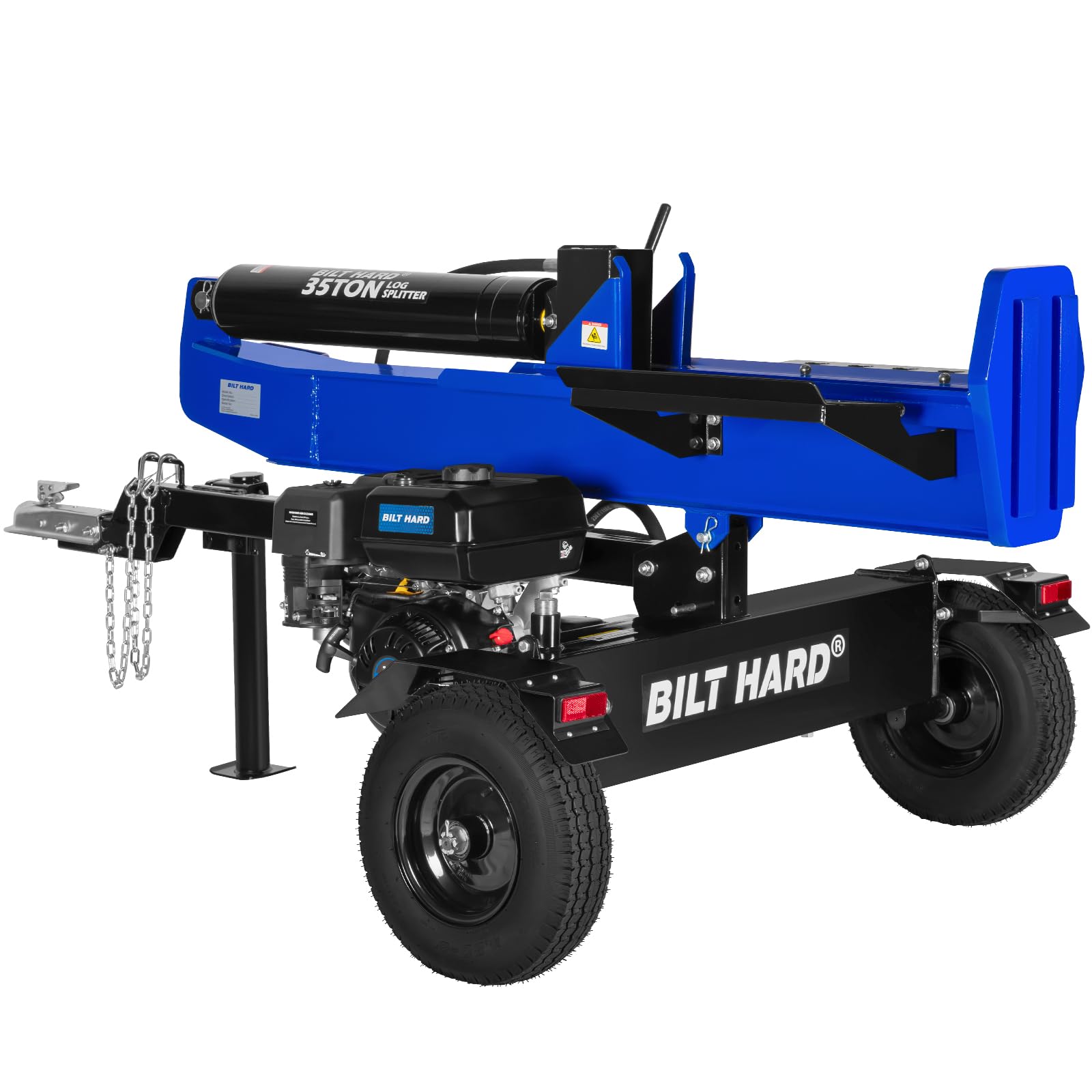
1. BILT HARD 35-Ton Horizontal/Vertical
Our pick — over 4★ from 40+ verified ratings; the strongest balance of quality and price.
The towable workhorse that starts on the first pull and eats a cord fast
This is the machine you hitch to an ATV and drag across the property all season. The 301cc OHV engine delivers 35 tons of force, and the 16-inch DOT tires with a 2-inch ball coupler let you tow it at highway speeds up to 45 MPH — so it travels between woodlots without a trailer.
The 16-second full cycle time on a 24-inch log is quick, but what really wins people over is the dual-position design that flips between horizontal and vertical in seconds, sparing your back on heavy rounds.
Buyers report it splits 3/4 cord of oak per hour and starts on the first pull every time. Unlike some comparable machines this heavy — it weighs 640 pounds — the build quality gets consistent praise, and the hydraulic system holds a 7-gallon reservoir flowing at 14 GPM to keep the ram moving. The main trade-off: a few units arrived with a twisted hydraulic ram, and the 8-inch wedge is rated for 24-inch logs, so oversized rounds need a pre-cut.
Why it earns the top spot
- Starts first pull and splits 3/4 cord of oak per hour
- Tows up to 45 MPH with 16-inch DOT tires and 2-inch coupler
- Easy assembly — the most-cited praise from owners
Who should think twice
- The 640-pound weight needs two people to offload
- An occasional unit arrives with a damaged ram
Reach for this if: You want one splitter that tows to the woodpile, flips vertical for big rounds, and holds up season after season.
Look elsewhere if: You only split pre-cut stove wood in one spot — the extra tow gear adds weight you won’t use.
2. 38 Ton Log Splitter, Full Boar Engine 306cc
Blazing 13.8-second cycles turn big piles into stacked cords
When speed is the whole point, this 38-ton machine beats the BILT HARD above on cycle time — 13.8 seconds versus 16 seconds — and it does it with the same 306cc-class engine feel. That’s roughly 16% faster per split, which adds up to dozens of extra splits in an afternoon. The auto-return control valve with adjustable detent saves you from pulling the lever back every single cycle.
Precision is what owners single out most — the stroke runs straight and true, splitting cleanly on every push. The heavy-duty H-beam structural design keeps the wedge tracking straight, and the hydraulic oil filter sits inside the reservoir, so a falling log can’t crush it or snag your clothing. At 514 pounds, it’s noticeably lighter than the 640-pound BILT HARD, which makes it a touch easier to maneuver around a yard.
Owners mention it works best at “half idle” — it doesn’t need to run wide open to split powerfully, which keeps fuel use down. The durability read is mixed, honestly: one unit had the motor seize after 30 minutes, though support shipped a replacement engine within a week. Others call it “pretty much indestructible.” This is a beast when it runs, and the support team does right by the occasional bad engine.
The speed king: The 13.8-second cycle and 38 tons of force make this the fastest way through a stubborn log pile.
The honest catch: Assembly genuinely needs two people, and the hydraulic hose is a bit short — buy a longer one preemptively if you can.
3. Yardmax 35 Ton 2-Way Full Beam, Briggs & Stratton CR950
The 26.5-inch table that swallows long rounds whole
That means fewer chainsaw cuts on the woodlot and more time at the splitter. The patent-pending U-beam design is engineered to be stronger than a typical I-beam, so the beam resists flexing even on gnarly knotty oak.
The Briggs & Stratton CR950 engine is the durability story here — a name you recognize and a powerplant that fires reliably. Customers note it cuts through oak, maple, and walnut faster than expected, with an auto-return that pushes stuck wood off the wedge by itself. One long-time owner notes: “I have about 10 hours on it so far” and calls it a great machine.
The recurring gripe is the loading racks — they don’t hold the wood well while the machine is running, which is the one thing standing between this and a perfect score. A pair of log cradles adjusts to two positions, and the beam handle makes the horizontal-to-vertical transition easy when you need to stand up a heavy round. It weighs 542 pounds, so plan for two people on setup day.
Built for long wood: The 26.5-inch capacity is the longest in this lineup, saving you cuts on oversized rounds.
What to fix: The loading racks are the weak point — consider a simple aftermarket log table if it bothers you.
4. Yardmax 40 Ton 2-Way Full Beam, Briggs & Stratton XR1450

The 40-ton brute that turns 18-inch pecan into kindling on the first pull
Owners who run it on dense southern pecan report it splits 18-inch rounds with no hesitation and starts on the first pull every time. The oversized hydraulic components are built to deliver the shortest cycle time in its class.
Like its 35-ton sibling, it carries the same patent-pending U-beam design and 26.5-inch log capacity. The dual-end cylinder support spreads the load evenly across the beam, which reduces wear over years of heavy use. At 605 pounds, it’s the heaviest of the Yardmax pair — expect to need two people just to get it positioned on setup day.
The honest read is split. Delivered units are described as “very powerful, easy to assemble,” and the side racks handle wood well. But a couple of units arrived with alignment problems — misaligned pivot cradle holes and one defective tow leg support — which points to occasional quality-control slips on the assembly line. The log lift attachment shown in marketing is sold separately, so budget for that if you want it.
Pick this for: The rawest power in the mid-range tier — nothing in this list out-muscles 40 tons of splitting force.
Pick the 35-ton instead if: You want the same U-beam and log capacity with less weight and fewer QC worries.
5. Champion Power Equipment 37-Ton Horizontal/Vertical

The exact 37-ton spec with a 338cc engine and 220 cycles per hour
This is the machine that matches your search term literally — 37 tons of splitting force powered by a large 338cc Champion single-cylinder OHV engine. The 16-second cycle time pairs with a dependable auto-return valve rated for over 220 cycles per hour, so a full cord is a focused afternoon, not a weekend. Owners describe it as having power to spare, splitting logs bigger than it’s rated for without a single failure.
It tows at up to 45 MPH with an extended tongue, 2-inch ball hitch coupler, and 16-inch tires, mating easily to most ATV/UTV setups. The horizontal-to-vertical conversion takes seconds, letting you stand up those heavy rounds you’d rather not lift. At 542 pounds, it’s comparable to the Yardmax pair, and the Champion support team backs it with a 2-year limited warranty and free lifetime technical support.
The engine cranked on the first pull for owners right after adding fuel. The recurring note is that it doesn’t come with hydraulic fluid — you’ll need to buy that separately before first use. Also, the tongue carries a lot of the weight, so moving it around solo by hand takes some effort even though the tires roll smoothly.
What the 338cc buys you
- 220 cycles per hour with dependable auto-return
- 37 tons that split “logs bigger than it’s supposed to”
- 2-year warranty with free lifetime support
Before you buy
- Hydraulic fluid is not included — factor in that cost
- Heavy tongue weight makes hand-moving a two-person job
The verdict: The best name-brand premium pick that hits the exact 37-ton spec you searched for.
Set aside extra for: Hydraulic fluid and a second pair of hands on delivery day.
6. NorthStar Horizontal/Vertical 37-Ton, Honda GX270
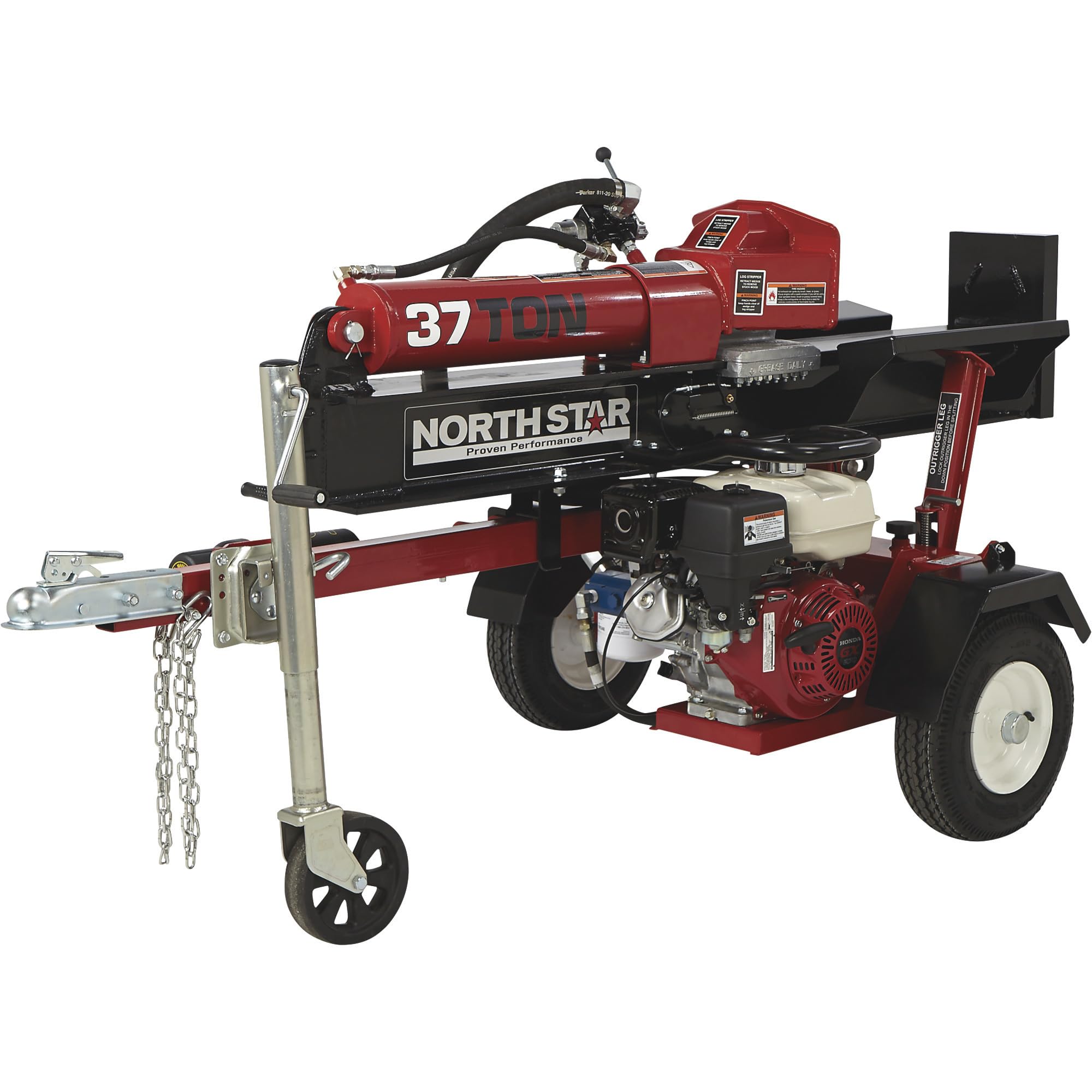
The Honda-powered tank that turns a three-week job into a single day
If the engine is the heart of a splitter, this NorthStar has the strongest heartbeat in the lineup. The commercial-grade Honda GX270 comes with a cast iron cylinder sleeve for longevity, low oil shutdown to protect itself, and a steel fuel tank — the kind of spec sheet you’d expect on a machine that costs twice as much. Owners say it handles the biggest, gnarliest logs in stride, turning a three-week firewood project into one day of work.
Quality and reliability earn equal praise here, with owners running through 9 to 15 cords of oak, pine, cedar, and spruce on a machine that still starts first pull. The American-made Concentric pump and Brand valve keep the hydraulics honest, while the NorthStar cylinder with premium Halite seals handles repeated cycles. Auto throttle control saves fuel and cuts noise, so it’s not screaming at full RPM all day.
The reality check: assembly is the most mixed part of the experience. Some reviewers point out missing parts and wrong hoses, calling it an “assembly nightmare,” while others put it together in under two hours with clear instructions. The 4-year limited warranty is the longest in this guide, which speaks to how confident NorthStar is in the build. This is a 625-pound machine with curbside delivery — have two people and a plan for moving it home.
The Honda advantage: The GX270 with cast iron sleeve is the most durable engine in this guide — it starts first pull even after 15 cords.
The assembly reality: Plan for a half-day of frustration or a careful parts audit before you start building.
7. 35 Ton Log Splitter with 4-Way & 6-Way Wedges
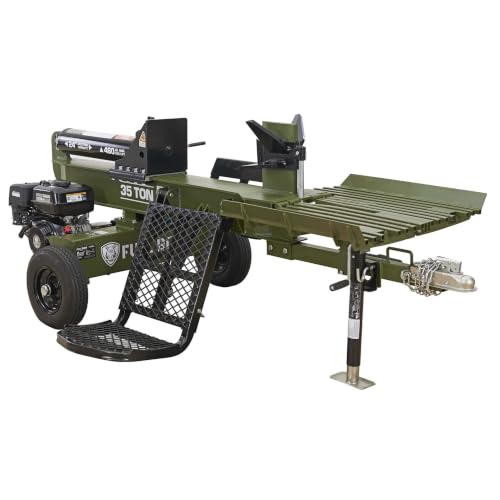
The 6-way wedge splits one log into six pieces with a single pass
This is the production machine for anyone who wants stove-ready splits without re-positioning every log. The standard wedge gives way to interchangeable 2-way, 4-way, and 6-way blades that need no tools to switch — a 6-way pass turns one round into six splits instantly. Owners processing 20-inch stringy live oak report it walks through with the 4-way easily. The 35-ton force is plenty for the multi-blade setup since the blades do the work.
The hydraulic log lift is the back-saver here — it hoists rounds up to 700 pounds onto the beam with a simple lever pull, doubling as a work table when you’re not loading. A hydraulic wedge adjustment gives you 3.55 inches of vertical wedge travel to guarantee uniform center splits regardless of log size. The box-shape beam is engineered to out-perform traditional I-beams for stability.
Quality earns the most praise from owners, and assembly is rated simple with everything included in the package — it even ships with hydraulic fluid already, which the Champion above notably lacks. At 1,045 pounds, this is a permanent installation for a serious woodlot, not something you drag around casually. The only feature owners wish for is a storage spot for the extra wedge.
Why the multi-wedge wins
- 6-way blade makes six splits per pass — no re-positioning
- 700-pound hydraulic log lift saves your back on big rounds
- Ships with hydraulic fluid included
The weight trade-off
- 1,045 pounds needs a truck and a ramp to move
- No built-in storage spot for the spare wedge
Get this if: You process multiple cords a season and want stove-ready splits in a single pass with zero lifting.
skip it if: Your splitter needs to be towed between job sites — this one stays put.
8. YHT 45T Firewood Processor
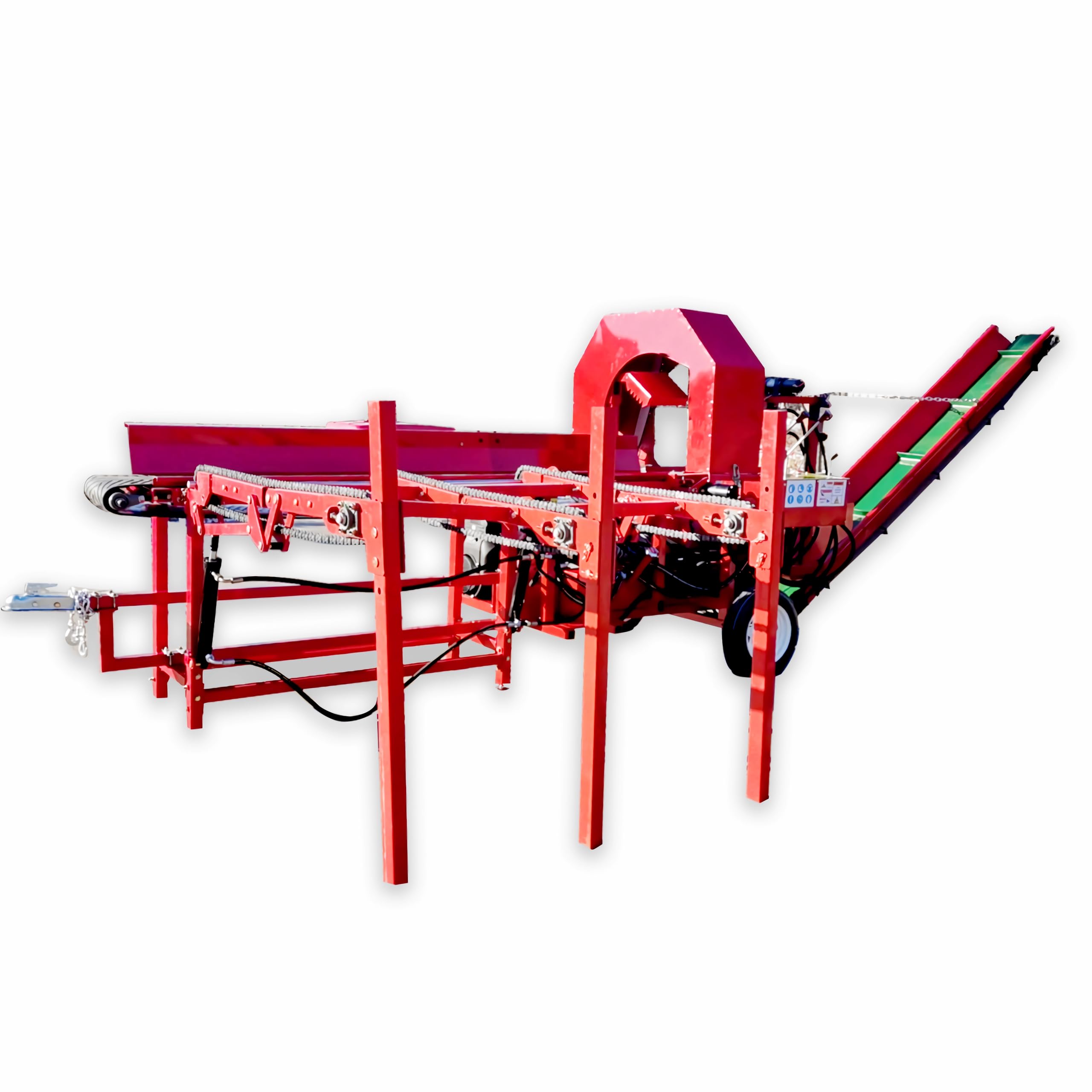
A full firewood factory on wheels with a 25-inch chainsaw and 9.84-foot conveyor
This is not a splitter — it’s a complete processing line. The 20HP GX630 gas engine powers a 25-inch steel chainsaw that cross-cuts logs up to 19.6 inches in diameter, then a 9.84-foot conveyor belt feeds each round into a 45-ton splitter that divides it into 4 or 6 parts. Owners processing on it report clearing 2 cords in about 3 hours — a pace no conventional splitter can match.
The hydraulic manual control panel adjusts cutting speed, depth, and feed rate, with an emergency stop button and a safety net over the chainsaw for protection. It handles logs up to 50 cm (19.6 inches) in diameter and splits lengths up to 580mm (22.83 inches), making it suitable for hardwood, softwood, and even bamboo. The 45 tons of splitting force is the highest in this guide.
The honest reality is that this is a 3,000-pound industrial tool. Shoppers say the assembly manual is poor — plan for 12 to 14 hours of building — and you will need a forklift to get it off the truck; it was dropped at a freight facility for one owner who had to arrange machine unloading. Some logs proved unsplittable even at 45 tons, and the weak point is the ram mount over the hydraulic tank. Still, owners say they’d buy it again and even “would pay k more.”
The throughput king: 2 cords in 3 hours is the fastest production pace in this guide by far.
The commitment required: 3,000 pounds, a forklift, and a 14-hour assembly before you split your first log.
Understanding the Specs
Cycle Time
This is the number that decides your daily output. It’s the seconds a full split takes — wedge forward, split, and retract. The fastest machines here run about 13.8 to 16 seconds per cycle. Multiply that by 60 minutes and you start to see why a 2-second difference becomes dozens of extra splits per hour. An auto-return valve compounds this by pulling the wedge back automatically, so you never touch a lever twice per cycle.
Splitting Force (Tons)
Tonnage is the raw pushing power of the hydraulic ram. 35 tons splits most hardwood like oak and maple cleanly; 40 tons adds margin for knotty elm and ironwood. More force also matters when you use a 4-way or 6-way wedge, which multiplies the contact area. Heavier force usually means a heavier machine and a bigger engine, so match tonnage to the wood you actually cut rather than buying maximum power you’ll never use.
FAQ
What is the difference between horizontal and vertical log splitters?
How long does a full split cycle take on a 37 ton splitter?
Can a 37 ton splitter handle 24-inch logs?
What does the engine cc number mean on a log splitter?
Do log splitters come with hydraulic fluid included?
Can I tow a gas log splitter with an ATV or UTV?
What is an auto-return valve on a log splitter?
Is a 37 ton splitter too much for home use?
How much assembly is required for a large gas splitter?
What makes a 4-way or 6-way wedge worth the extra cost?
Final Thoughts: The Verdict
For the majority of shoppers, the 37 ton wood splitter winner is the BILT HARD 35-Ton because it pairs a 16-second cycle with easy assembly and towing up to 45 MPH — the best all-round value for the money. If you want the rawest force in the mid-range, grab the Yardmax 40 Ton at 40 tons of splitting power. And for the fastest premium cycles on the exact spec you searched, the Champion 37-Ton with its 338cc engine is the one to reach for.
How We Picked
We do not accept paid placement. Every pick is matched to a real buyer and a real use-case; we do not hands-on test units.
Sources & Methodology
Specifications: manufacturer listings and product documentation. Review insights: verified customer reviews, as of August 2026. Pricing: not shown on this page (it changes often); check the current price via the retailer link.
As an Amazon Associate, Gadgets Feed earns from qualifying purchases. This does not affect which products we feature.