
That optical illusion is a side effect of a construction method that also delivers a self-healing surface, exceptional knife-friendliness, and the kind of stability that makes heavy chopping feel solid and controlled.
I’m Min — the co-founder and writer behind Gadgets Feed. I’ve spent countless hours analyzing build quality, grain orientation, dimensional stability, and long-term wear patterns across dozens of end-grain boards to find the ones that genuinely earn their place on a serious home cook’s counter.
Whether you want a statement piece for the island or a workhorse that protects your knife edges, this guide cuts through the noise to deliver the definitive ranking of the best 3d cutting board for every prep style and kitchen setup.
How To Choose The Best 3D Cutting Board
The visual drama of a 3D checkered board comes from end-grain construction — small blocks of hardwood arranged so the end fibers face upward. That layout is what creates the optical depth. It also determines how the board performs under a knife. Before you buy, lock in these three factors.
Grain Construction: End Grain vs. Edge Grain
End-grain boards are built like a butcher block: the wood fibers run perpendicular to the blade. The knife slides between the fibers instead of cutting through them, which keeps edges sharper longer and lets the surface “self-heal” after cuts. Edge-grain boards are cheaper but show every slice. For a true 3D look and genuine knife protection, you need end-grain construction — not a printed or embossed pattern.
Hardwood Species and Moisture Resistance
Acacia is the most common choice: dense, naturally water-resistant, and affordable. Walnut offers a darker, richer aesthetic with excellent stability but demands more frequent oiling. Teak contains natural oils that resist moisture and bacteria, making it the lowest-maintenance option. Rubberwood is often blended with acacia or walnut in checkered patterns — it’s sustainable and stable but slightly softer. Avoid bamboo for end-grain boards; it’s too hard on knife edges.
Thickness, Weight, and Footprint
A board under 1 inch thick is more prone to warping and may slide during heavy chopping. Look for at least 1.2 inches of solid wood. Weight correlates with stability — a 6- to 9-pound board stays put without a damp towel underneath. Dimensions of 16×12 inches or larger give you room to work with a full protein or multiple vegetables. Built-in juice grooves catch runoff, and routed handles make transport easier when the board doubles as a serving platter.
Quick Comparison
On smaller screens, swipe sideways to see the full table.
| Model | Category | Best For | Key Spec | Amazon |
|---|---|---|---|---|
| Cookaholic Acacia 20×15 | Premium | Maximum cutting area | 1.5 in. thick, 9.1 lbs | Amazon |
| Homwoody Walnut End Grain | Premium | Walnut beauty / charcuterie | Walnut end grain, 3D pattern | Amazon |
| Socisen Acacia Workshop | Premium | Extra-large prep / serving | 20×15 in., 8.3 lbs | Amazon |
| Oridom Teak Herringbone | Mid-Range | Low-maintenance teak | Teak wood, 1.2 in. thick | Amazon |
| Nomsters 3-Piece Set | Mid-Range | Multiple prep sizes | 3 boards, acacia/rubberwood | Amazon |
| Artistic Chef’s Kitchen Acacia | Mid-Range | Handcrafted reversible board | 1.1 in. thick, 6.2 lbs | Amazon |
| THETCHRY Checkered Walnut | Mid-Range | Budget-friendly checkered look | 1.2 in. thick, walnut/rubberwood | Amazon |
In‑Depth Reviews
1. Cookaholic Acacia Wood Cutting Board 20×15

At 20 by 15 inches and a dense 9.1 pounds, this acacia end-grain board delivers the largest uninterrupted cutting surface in the roundup. The checkered pattern is genuine end-grain construction, so the visual depth is real — not a surface print — and the wood fibers absorb knife impacts without showing permanent scoring. The 1.5-inch thickness adds enough thermal mass to resist warping even under heavy daily use.
The deep juice groove runs around the entire perimeter and channels liquids effectively during protein prep. Built-in handles on both sides make the board manageable despite its weight, and the coconut-oil cure means it arrives ready to use after a quick hand wash. Customers report minimal visible knife marks after months of regular chopping, confirming the self-healing claim.
The only trade-off is ongoing maintenance: acacia needs periodic mineral oil or board conditioner to prevent the wood from drying out, especially in winter. Some users reported splitting after a year, but those cases appear tied to inconsistent oiling rather than a manufacturing defect. If you want one board that doubles as a large serving platter for gatherings, this is the most versatile pick.
Why it’s great
- Massive 20×15 inch work surface handles full proteins and multiple vegetables
- 1.5-inch thickness provides rock-solid stability and warp resistance
- Genuine end-grain construction self-heals and protects knife edges
Good to know
- Requires regular oiling to maintain wood integrity and prevent cracking
- At 9.1 pounds, it’s heavy to move around the kitchen frequently
2. Homwoody Walnut End Grain Cutting Board

Walnut is the premium choice in the wood-cutting-board world because it naturally resists bacteria without being so hard that it dulls knives — and this Homwoody board uses genuine walnut end-grain blocks arranged in a 3D checkered pattern. The dark brown hue with lighter grain lines creates a dramatic optical depth that stands out on any countertop, and the 1-inch thickness keeps the board substantial enough for daily prep without being cumbersome.
A deep juice groove on one side manages runoff from meats and juicy fruits, while the opposite side is flat — giving you a double-sided board for different tasks. The routed handles are large enough to grip comfortably, making it easy to carry from prep station to table for charcuterie service. Customers consistently note that after months of use, the board shows minimal scratching and maintains its smooth feel.
Walnut requires more frequent oiling than acacia or teak, and some users felt slight unevenness at the finger-joints between blocks that smoothed out after the first few oil applications. The 15×11-inch footprint is generous but noticeably smaller than the 20-inch boards in this roundup. If you prioritize aesthetics and knife protection over raw surface area, this board earns its place on the counter.
Why it’s great
- True walnut end-grain construction with a stunning 3D optical pattern
- Double-sided design with juice groove on one side and flat surface on the other
- Knife-friendly density preserves edge sharpness over time
Good to know
- Walnut needs regular oiling to prevent drying and maintain appearance
- 15×11-inch size is smaller than some competing boards in the premium tier
3. Socisen Acacia Workshop Cutting Board
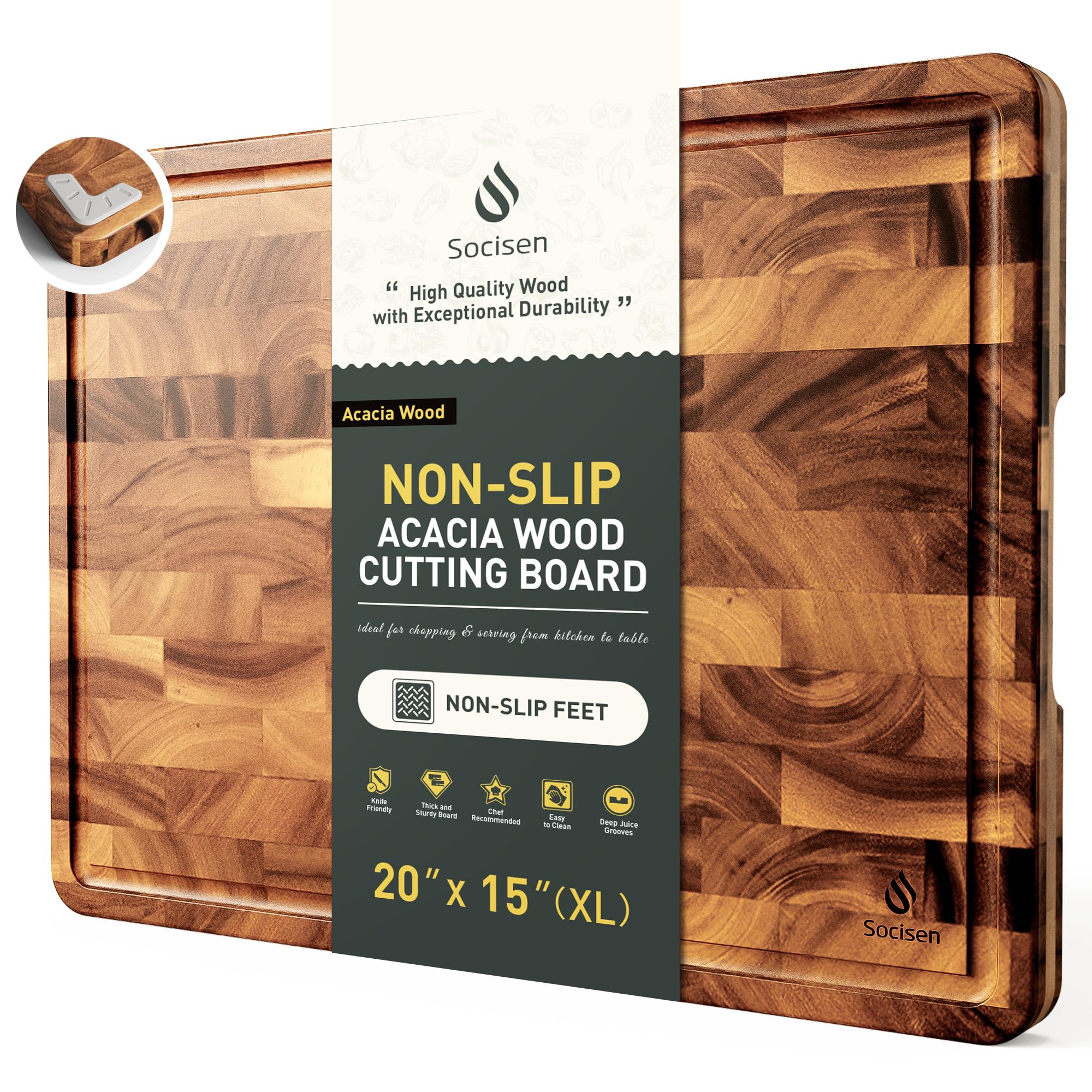
The Socisen Workshop Series board uses genuine end-grain acacia blocks assembled by hand, creating a checkered pattern that appears almost three-dimensional. The non-slip rubber feet are built in with a patented design that keeps the board from shifting on smooth counters.
The deep juice groove is wide enough to handle runoff from a full roast or multiple sliced tomatoes, and the fine-grain finish is noticeably smooth to the touch. Customers consistently report that the board arrives pre-oiled and ready to use, with no rough patches or splinters. The acacia wood’s natural hardness provides excellent moisture resistance, reducing the frequency of oiling compared to walnut.
One user noted a crack developing after three weeks, though this appears to be an outlier case — the vast majority of reviews highlight consistent performance over months of daily use. The board lacks a flat side if you prefer a surface without a juice groove, and the weight, while manageable, still requires two hands to move. For a large, durable board with superior slip resistance, this is a strong contender.
Why it’s great
- Handcrafted end-grain acacia with a striking checkered 3D pattern
- Patented non-slip rubber feet provide exceptional stability
- Deep juice groove effectively contains liquid runoff during prep
Good to know
- Some units have reported minor cracking; consistent oiling is essential
- No flat-side option — both surfaces have a juice groove
4. Oridom Teak Wood Cutting Board

Teak is the secret weapon of low-maintenance cutting boards — its high natural oil content resists moisture, bacteria, and warping without the constant oiling schedule that acacia and walnut demand. This Oridom board uses solid teak in a herringbone end-grain pattern, giving it a distinct visual character that stands apart from the standard checkerboard look. At 17 by 12.5 inches and 6.1 pounds, it offers a generous prep area without feeling excessively heavy.
The 1.2-inch thickness is substantial enough for heavy chopping, and the integrated deep juice groove catches liquids effectively. Non-slip feet keep the board planted on the counter, and the built-in handle makes one-handed transport easy. Customers consistently praise the weight distribution and the way the teak surface self-heals — knife marks become nearly invisible after a short time.
The herringbone grain is visually distinct but some buyers prefer the classic checkerboard of other boards. Teak also has a slightly higher hardness than acacia, meaning it is marginally less gentle on knife edges over very long periods. If you want a beautiful board that requires the least maintenance in the lineup, this is the one.
Why it’s great
- Teak’s natural oils mean less frequent oiling than walnut or acacia
- Herringbone end-grain pattern offers a unique 3D visual
- Built-in handle and non-slip feet make handling and stability easy
Good to know
- Teak is harder than walnut, so knives may dull slightly faster
- Herringbone pattern is visually distinct but not for everyone
5. Nomsters 3-Piece Checkered Cutting Board Set
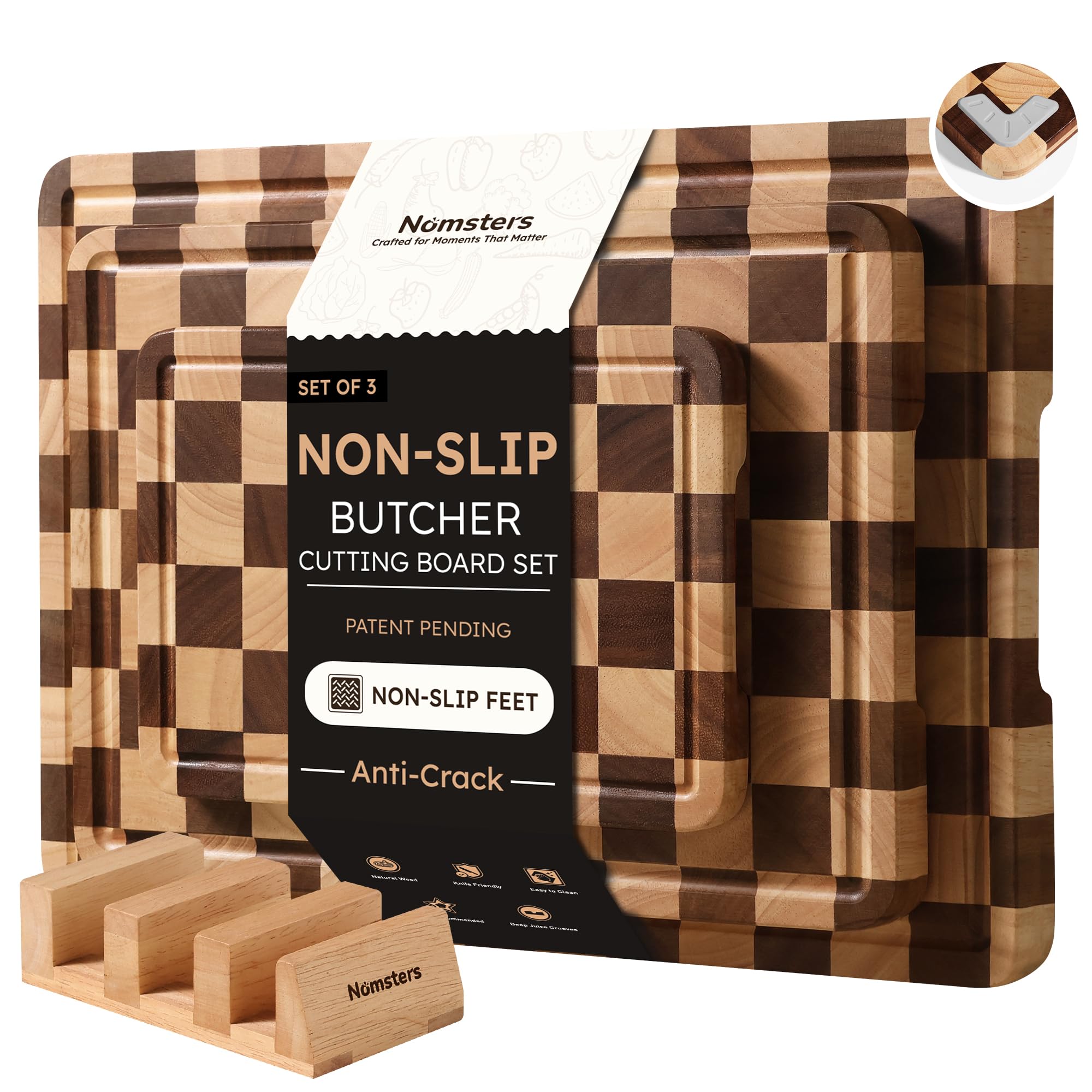
This three-board set from Nomsters gives you end-grain acacia and rubberwood in three practical sizes: roughly 10×17, 14×10, and 17×12 inches. The smaller boards are ideal for quick tasks like slicing fruit or dicing onions, while the largest handles full proteins and serving duty. All three feature the same checkered pattern, so your countertop maintains a cohesive look regardless of which board you grab.
Each board includes a deep juice groove, integrated routed handles, and four non-slip rubber feet that keep the surface stable. The end-grain construction provides the self-healing benefit, and the blend of acacia and rubberwood offers a balanced density that is gentle on knives. Customers specifically note the set’s value — multiple boards for different tasks at a single-unit price point.
The rubberwood in the blend is slightly softer than pure acacia, meaning the boards may show wear sooner under heavy use. They also require standard oiling maintenance. If you frequently prep multiple ingredients at once and want dedicated boards for different tasks, this set eliminates the need to buy boards individually.
Why it’s great
- Three sizes cover small prep, medium chopping, and large serving needs
- End-grain checkered pattern maintains visual consistency across all boards
- Juice grooves, handles, and rubber feet included on every board
Good to know
- Rubberwood blend is softer and may show wear faster than pure acacia
- All boards require regular oiling to prevent drying and cracking
6. Artistic Chef’s Kitchen 3-D Acacia/Rubberwood Board
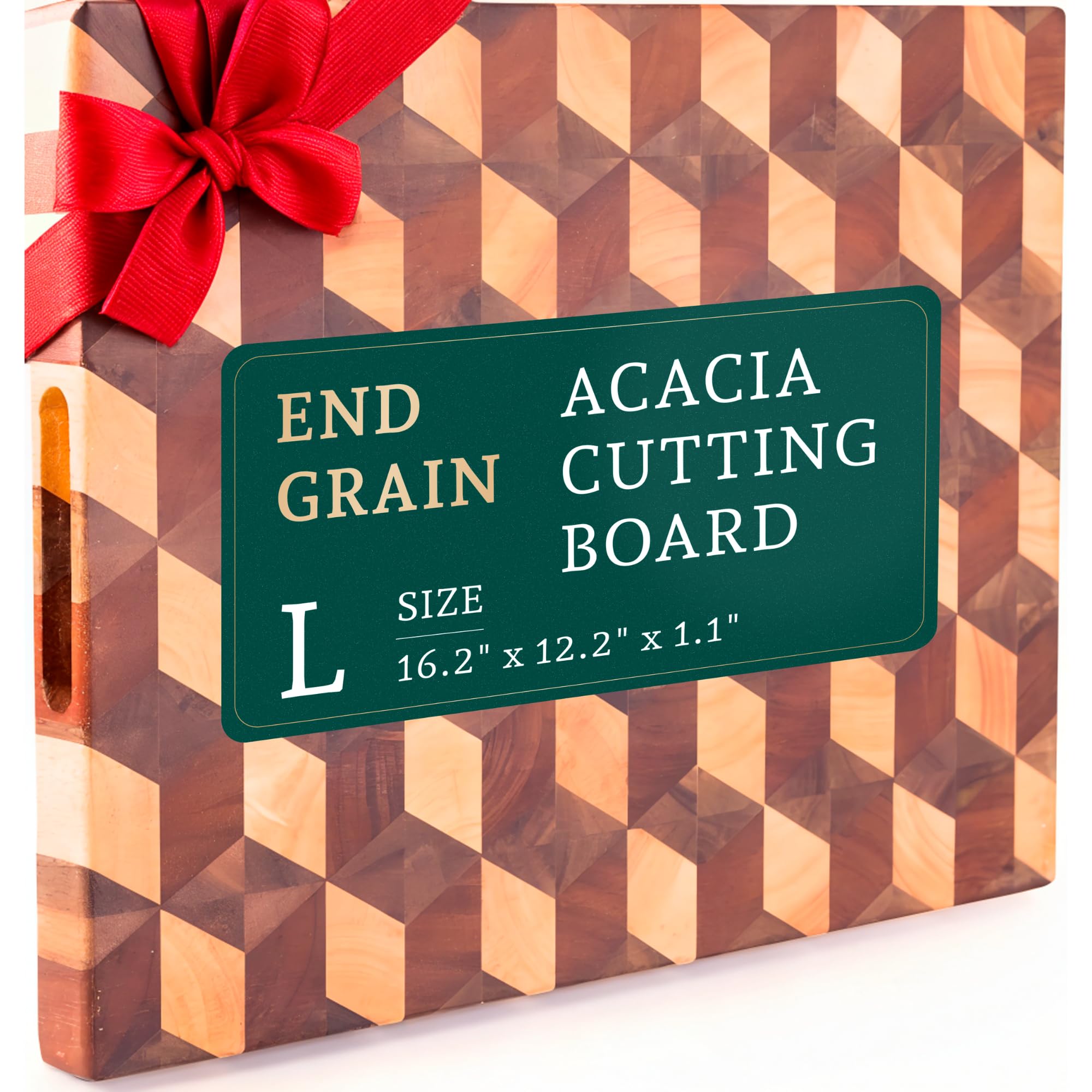
The Artistic Chef’s Kitchen board uses handcrafted end-grain acacia and rubberwood in a pattern that creates a convincing 3-D cube illusion. At 16.2 by 12.2 inches and a 1.1-inch thickness, it sits in the middle of the size range — large enough for substantial prep but compact enough for smaller kitchens. The routed handles on both sides are ergonomically shaped for comfortable carrying, and the reversible design means both surfaces are usable.
The board measures 2.81 kilograms (about 6.2 pounds), giving it a solid, planted feel during chopping. Customers report that the pattern becomes even more striking after an initial coat of mineral oil, with the light catching the cube facets differently depending on the viewing angle. Several reviews note that the board has maintained its shape without warping after six months of regular use.
Some units arrived with rough spots on the juice groove that required light sanding. For the handcrafted look and reversible utility, it remains a strong mid-range option.
Why it’s great
- Handcrafted end-grain construction with a convincing 3-D cube visual
- Reversible design with routed handles for comfortable transport
- Stable weight of 6.2 pounds keeps the board planted during use
Good to know
- 1.1-inch thickness is thinner than recommended for heavy warping resistance
- Some units have rough areas in the juice groove that need sanding
7. THETCHRY Checkered Walnut & Rubberwood Board
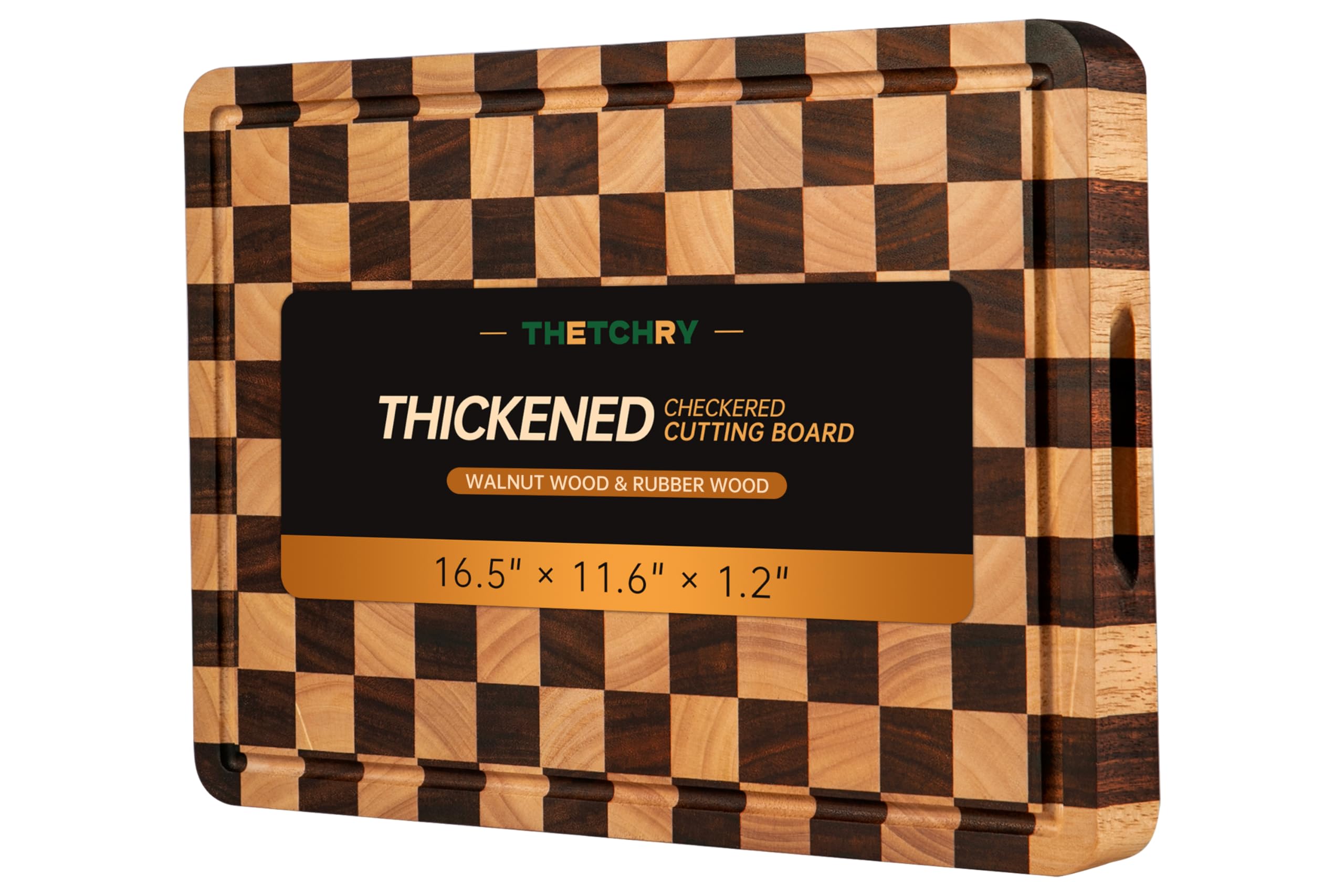
The THETCHRY board brings the checkered 3D look to a more accessible price bracket without cutting corners on construction. Built from walnut and rubberwood in an end-grain pattern, the board measures 16.5 by 11.6 inches with a 1.2-inch thickness that provides solid stability. The checkered visual is genuine end-grain, not a surface pattern, so the knife-friendly self-healing behavior is intact.
A deep dual-sided juice groove captures liquids, and the self-adhesive non-slip feet keep the board stationary during vigorous chopping. Customers consistently praise the visual impact — several note that the board is beautiful enough to leave on the counter as a permanent display piece. The included gift box packaging makes it ready for gifting without extra wrapping.
Some users reported minor imperfections in the wood block joints or a slightly rough juice groove that needed light sanding. The walnut-and-rubberwood blend is softer than pure acacia or teak, so the board may show more surface wear over time. For the price, it delivers genuine end-grain performance and striking 3D aesthetics that outperform most boards at this tier.
Why it’s great
- Genuine end-grain walnut and rubberwood construction at a budget-friendly price
- Deep dual-sided juice groove and non-slip feet for functional prep
- Visually stunning checkered pattern that earns permanent counter display
Good to know
- Minor wood joint imperfections reported in some units
- Softer wood blend may show surface wear faster than acacia or teak
FAQ
How often do I need to oil a 3D end-grain cutting board?
Can I use a 3D cutting board for both raw meat and vegetables?
Are 3D cutting boards dishwasher safe?
Final Thoughts: The Verdict
For most users, the best 3d cutting board winner is the Cookaholic Acacia 20×15 because it combines the largest practical work surface with genuine end-grain self-healing and a striking checkered pattern. If you want a walnut board that doubles as a charcuterie showpiece, grab the Homwoody Walnut End Grain. And for low-maintenance durability that rarely needs oiling, nothing beats the Oridom Teak Herringbone.